



Addicted To Hate
Holy shit. I had to stop the video. Not pause it like some thoughtful critic with a notebook. Stop it the way you stop walking when something in your body clocks danger before your brain can even file the paperwork. Robert Palmer’s Addicted to Love came on, and instead of nostalgia I got hit with this cold little jolt, like my nervous system had already heard the punch line and did not find it funny. Those women in the background looked too perfect, too still, too drilled, like sexy mannequins standing at attention, and the whole thing stopped reading as cool and started reading as control. Then my mind leaped, hard, to that Rolling Stone piece and the Washington Post soft shoe around young Republicans praising Hitler, and I heard myself say out loud, hold the hell up, are we really here now? Are we really at the point where Nazi-curious idiots can drift through Republican politics like cigar smoke at a back-room party, and the prestige press covers it like an awkward seating problem at Thanksgiving? [1][23]
That was the moment this stopped being a clever media gripe for me. It was not some dry politics piece anymore. Not one more little “both sides are uneasy” number in a pressed shirt. It felt like the floor dropped half an inch. Because the Republican Party is not just bumping into this mess by accident. It keeps circling back to it, feeding it, dressing it up, and then pretending to faint when the smell hits the room again. After a while you stop asking who left the door open and start realizing the house has been living with this stank funk for a long time. [1][2]
And if you have been reading some of this coverage and feeling your blood pressure do that little confused two-step, you anin’t imagining it. We are talking about Holocaust “revisionists,” Hitler praise dressed up as trolling, racist group chats, and young activists throwing Nazi language around like it is just boys being boys with Wi-Fi. That is not fringe static. That is rot with a microphone. That is a reward system. The uglier the stunt, the bigger the reaction. The bigger the reaction, the more these young men feel noticed, bonded, and important. It is sick. It is ridiculous. It is like watching somebody spray lighter fluid on the drapes while a major newspaper clears its throat and says some attendees expressed concern. [1][4][5]
That is the energy behind Addicted To Hate. I want to walk you through how this keeps happening, who keeps making room for it, and how soft, respectable language can help a dangerous thing put on a clean shirt and walk right through the front door. Because once hate starts getting covered like a vibe, a phase, a subculture, or a quirky little faction, the country is already deeper in it than it wants to say out loud. [1][19][20]
TLDR
The Republican Party is not just brushing up against Nazi-curious politics. Parts of it keep tolerating it, minimizing it, and finding uses for the energy it brings. [1][2][8]
Young far-right activists in the Nick Fuentes lane are moving from meme culture and “just joking” talk into real Republican spaces, youth groups, and party pipelines. [1][2][13]
The Washington Post put ugly facts on the page, but framed them so softly the danger can feel like “unease” instead of moral rot. [1][23]
Hate grows when social platforms reward it, party spaces make room for it, and respectable coverage cleans it up for public viewing. [1][16][19]
Restack this and share it. Send it to one friend who still thinks this is just fringe noise. Now if this piece is doing what XVOA does best, it is helping cool your head in the middle of a hot, crazy moment. That is not magic. That is time, reporting, reading, and me sitting here working these same fingers that used to type police reports and now type the truth for you. XVOA does not have corporate sponsors standing behind it. It has readers.
So if you want more work like this, support it at
If paid is not in the cards right now, restack this piece, share it, or buy me a coffee at
That helps keep the XVOA air conditioning running.
Robert Palmer and Addicted to Love as cultural template
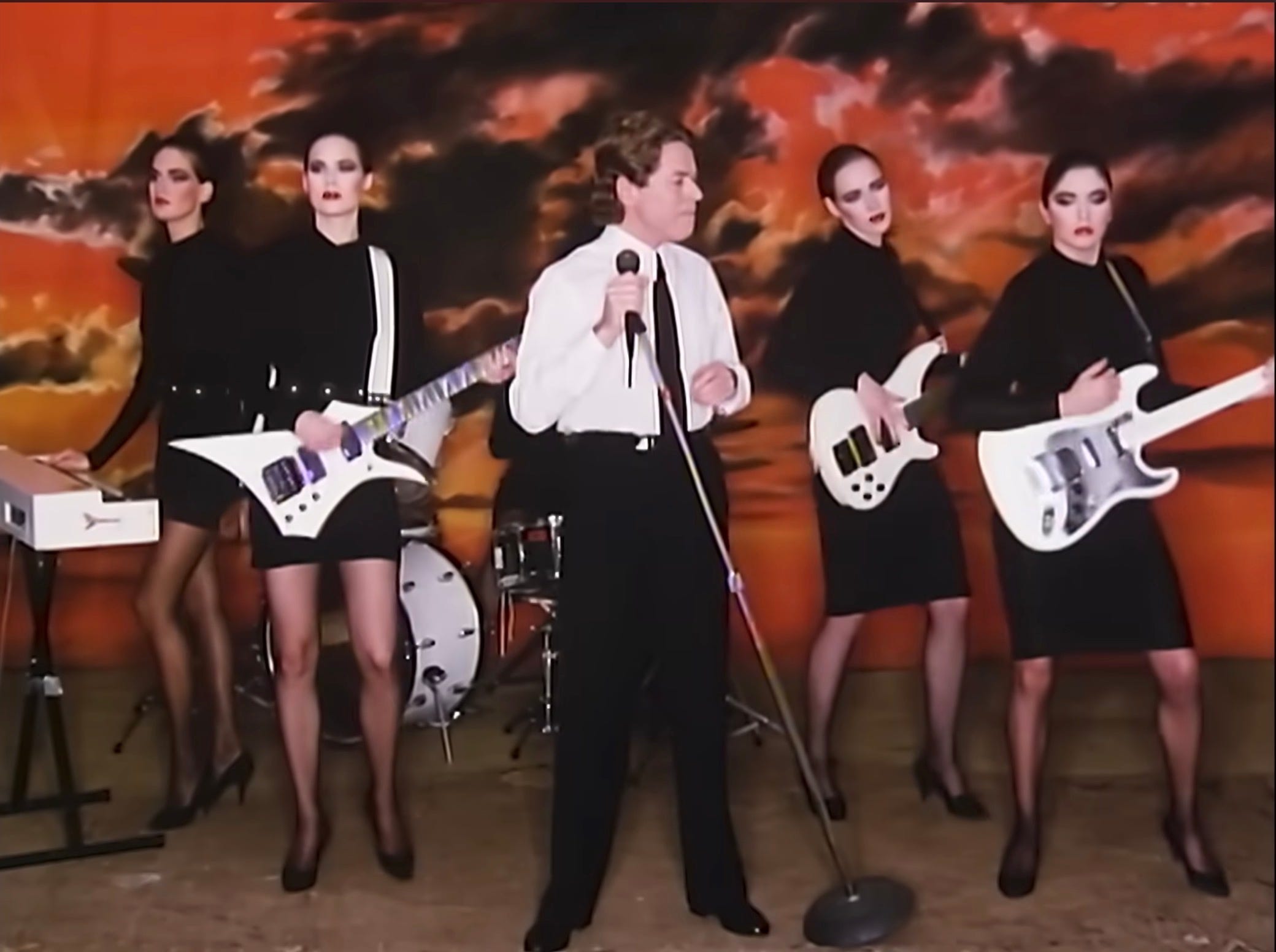
What stayed with me after that first jolt was the staging. Robert Palmer gets to be the star, but the women behind him are arranged like matching furniture: black dresses, red lipstick, blank faces, no real life allowed to leak through. The video became iconic because it looked sleek and controlled. That is exactly why it bothered me. It turns people into atmosphere. It makes obedience look elegant. [21][22]
And that helped me name what felt so wrong about the political coverage I had just read. The problem is not only that some young Republicans are praising Hitler. It is also the way that ugliness gets staged for public consumption. The facts are there, sure. Holocaust “revisionism.” Nazi jokes. Racist group chats. But then the language comes in and tidies the room up. Suddenly it is not moral collapse. It is “unease.” It is “tension.” It is a “fringe debate” inside the party. That is a hell of a makeover. [1][4][5]
What I am looking at now is not random shock-jock behavior. It is performance. These young men learn that cruelty can get laughs, attention, followers, and a place to belong. The party keeps acting like this is an embarrassing side room when the side room keeps getting bigger. And the press, when it gets too polite, can make that growth look almost orderly. Like the problem is not the hate itself, but the awkwardness of having to mention it in mixed company. [1][13][19]
That video gave me a visual language for what I think is happening in the GOP right now: hate is being styled, rehearsed, and normalized until it can stand in plain sight and still pass for politics. I am not saying that was the director’s intent. I am saying that was the click for me. The image helped me see the trick. First make it look smooth. Then act confused when people notice the stink. [21][22]
Chronology and evidence base
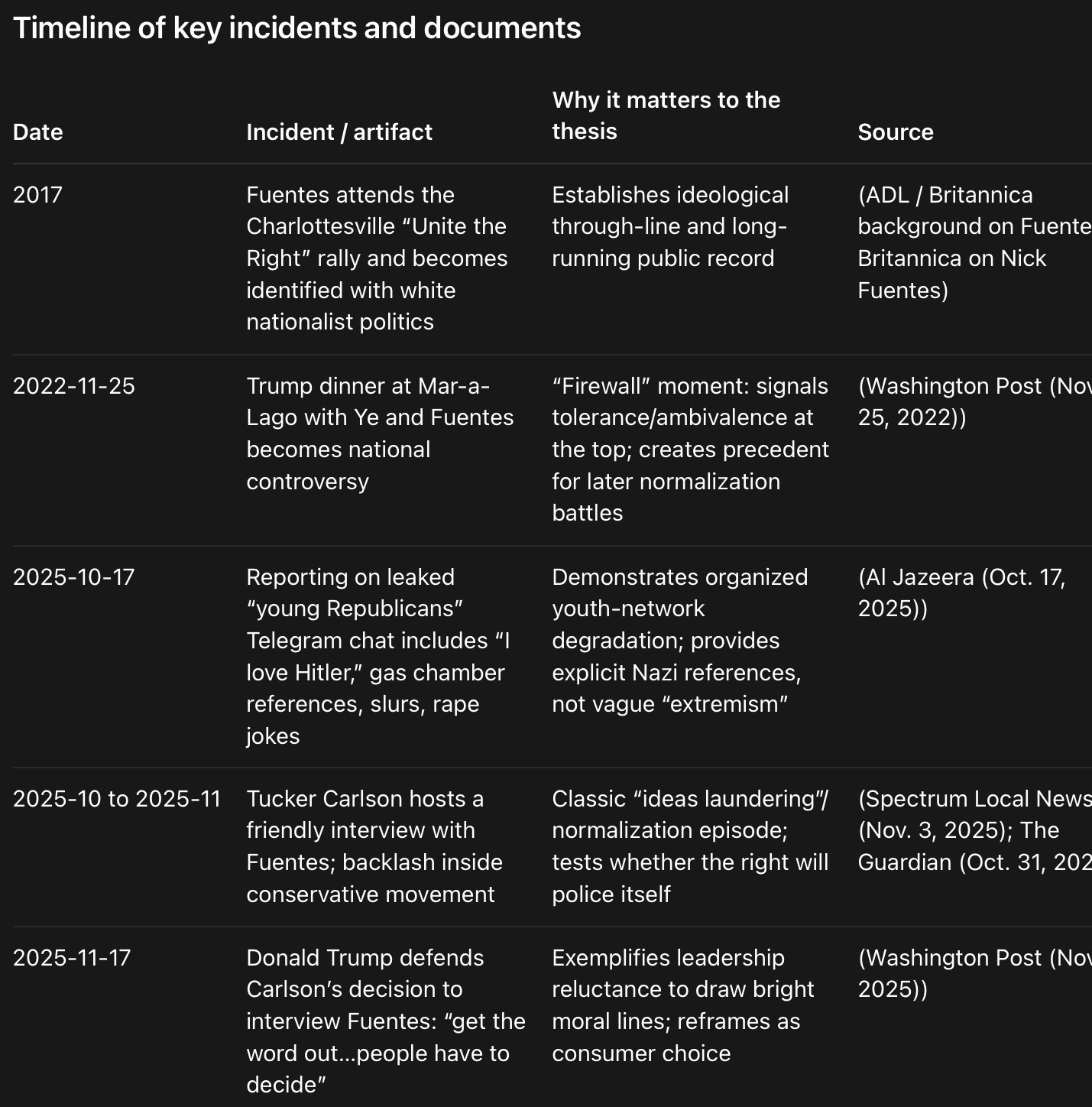
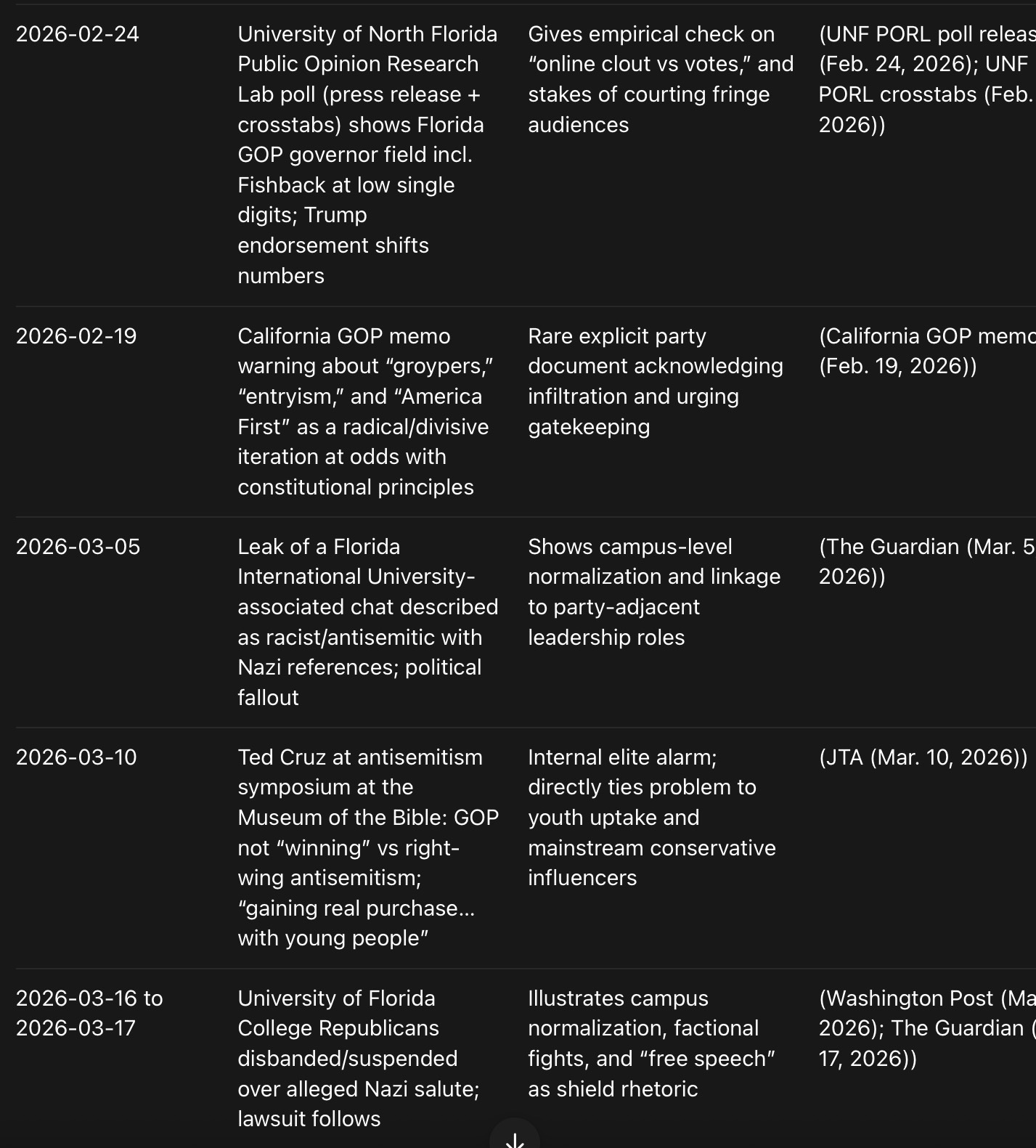
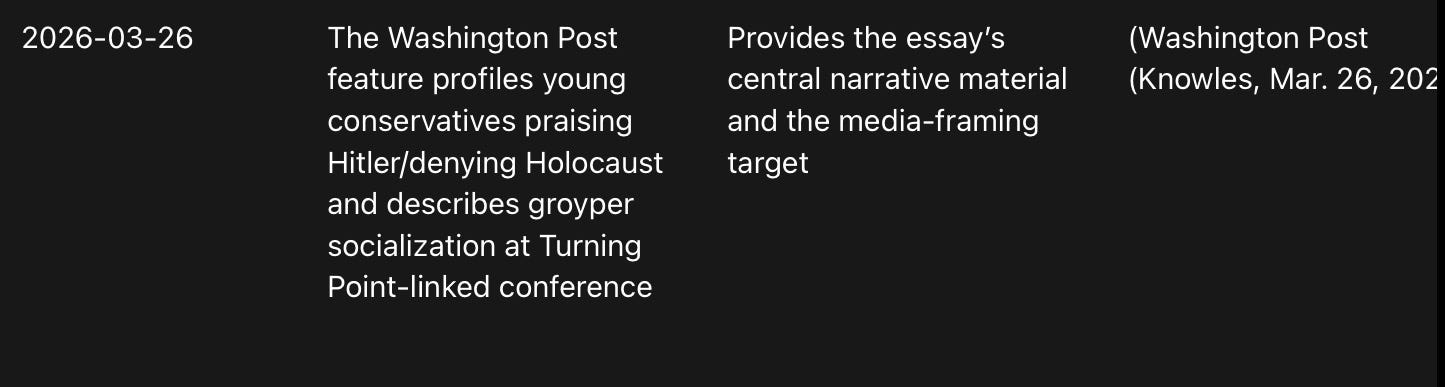
The GOP’s response: denial, deflection, selective gatekeeping
Here is what you need to see in plain English. A lot of Republicans condemn this stuff just enough to look decent, but not enough to actually stop it. They back away with their mouth while leaving the door cracked open with their hand. That is the game. They want the fire for heat, just not the smoke on their suit. [1][2]
The Washington Post story shows this problem clear as day. It talks about Alec Beaton like he is some model young Republican worker, then tells you he calls himself a Holocaust “revisionist” and treats Hitler praise like a prank to mess with people. [1] Come on now. That is not some tiny typo in the party brochure. That is a warning label. And then Republicans in the story do that little soft-shoe move. They say people like him are fringe, but they also admit more of these folks are showing up in the party than they want to admit out loud. [1] So what is really going on? They like the energy. They just do not want the ugly name tag.
And when they get cornered on it, watch how fast they point somewhere else. In the Post story, White House spokesman Davis Ingle says Trump has zero tolerance for antisemitism, then quickly starts talking about Democrats like Ilhan Omar and Rashida Tlaib. [1] You know that move. Somebody catches a rat in your kitchen and you start talking about your neighbor’s messy garage. Sir, we are in your kitchen. That is the problem. Once politics becomes nothing but team loyalty, people start acting like there are no real lines anymore, only sides.
Trump has played that same tune more than once. After that 2022 dinner with Ye and Nick Fuentes blew up, Trump said he pretty much did not know who Fuentes was. [7] Then after Tucker Carlson interviewed Fuentes in 2025, Trump basically shrugged and said let people hear it and decide. [6] That is not how you respond to something morally toxic.That is how you respond when your main concern is the optics. Like, wow, this Nazi situation is really messing up the branding.
Now, to keep this honest, not every Republican is playing dumb. Ted Cruz warned at a major antisemitism event that the right is not really winning this fight and that antisemitism is gaining ground, especially with young people. [8] That matters. It means even people inside the party can see this thing spreading. This is not just critics outside yelling through the window. Some people inside the house smell smoke too.
And California Republicans put that concern in writing. In a memo, they warned that groypers, young far-right activists in the Nick Fuentes lane who wrap white nationalist and antisemitic ideas in memes, irony, and “just joking” talk, were getting into party committees and campaigns, called the movement radical and divisive, and said silence was not acceptable. [2][13] So nobody gets to act brand new here. Parts of the party know exactly what this is. They know this is not just edgy jokes, not just boys being stupid online, not just some weird little side hustle in American politics. They know. The real question is whether they have the nerve to cut it off, or whether they are still too addicted to the juice these people bring.
Media framing critique: how The Washington Post soft-pedals normalization
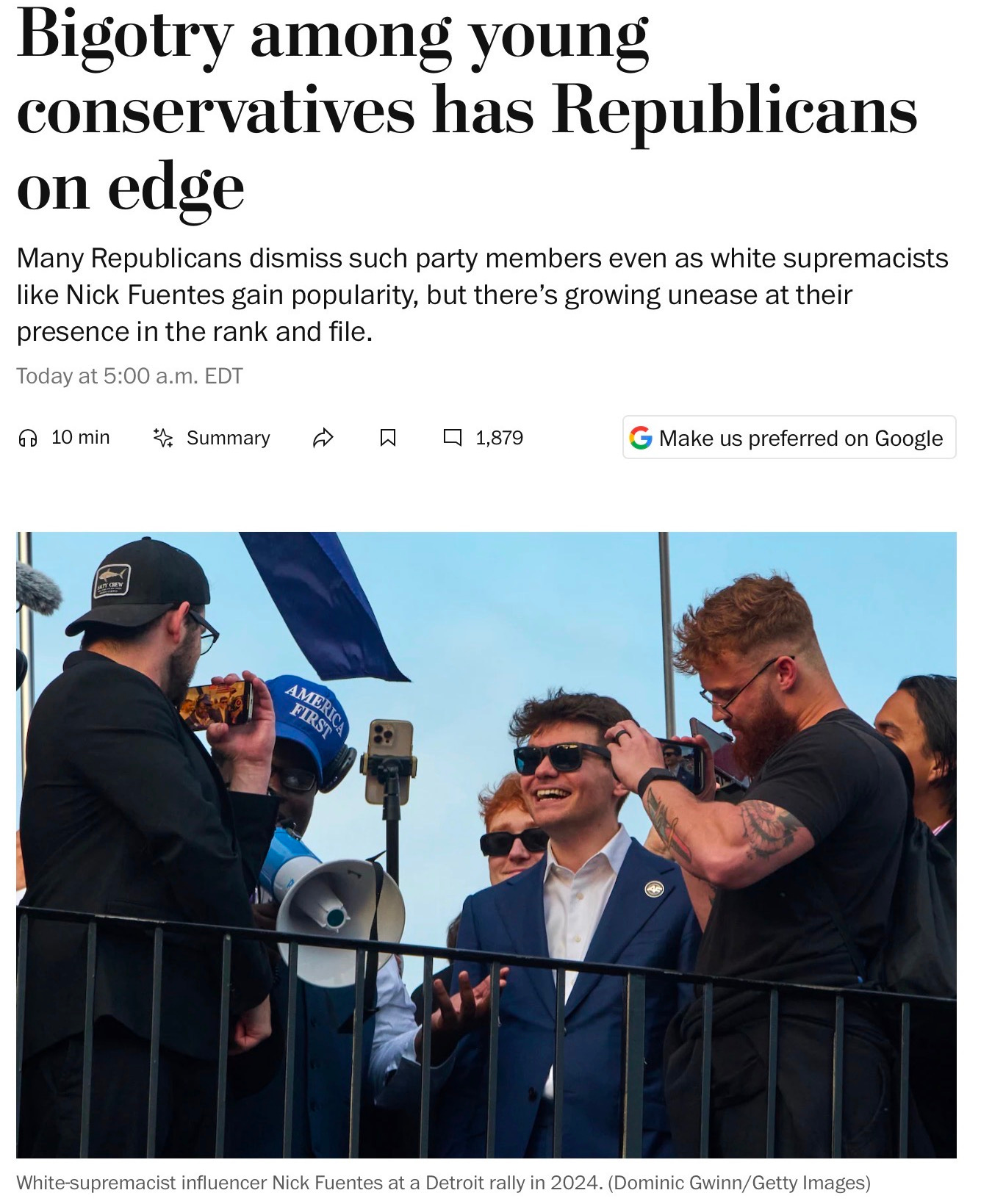
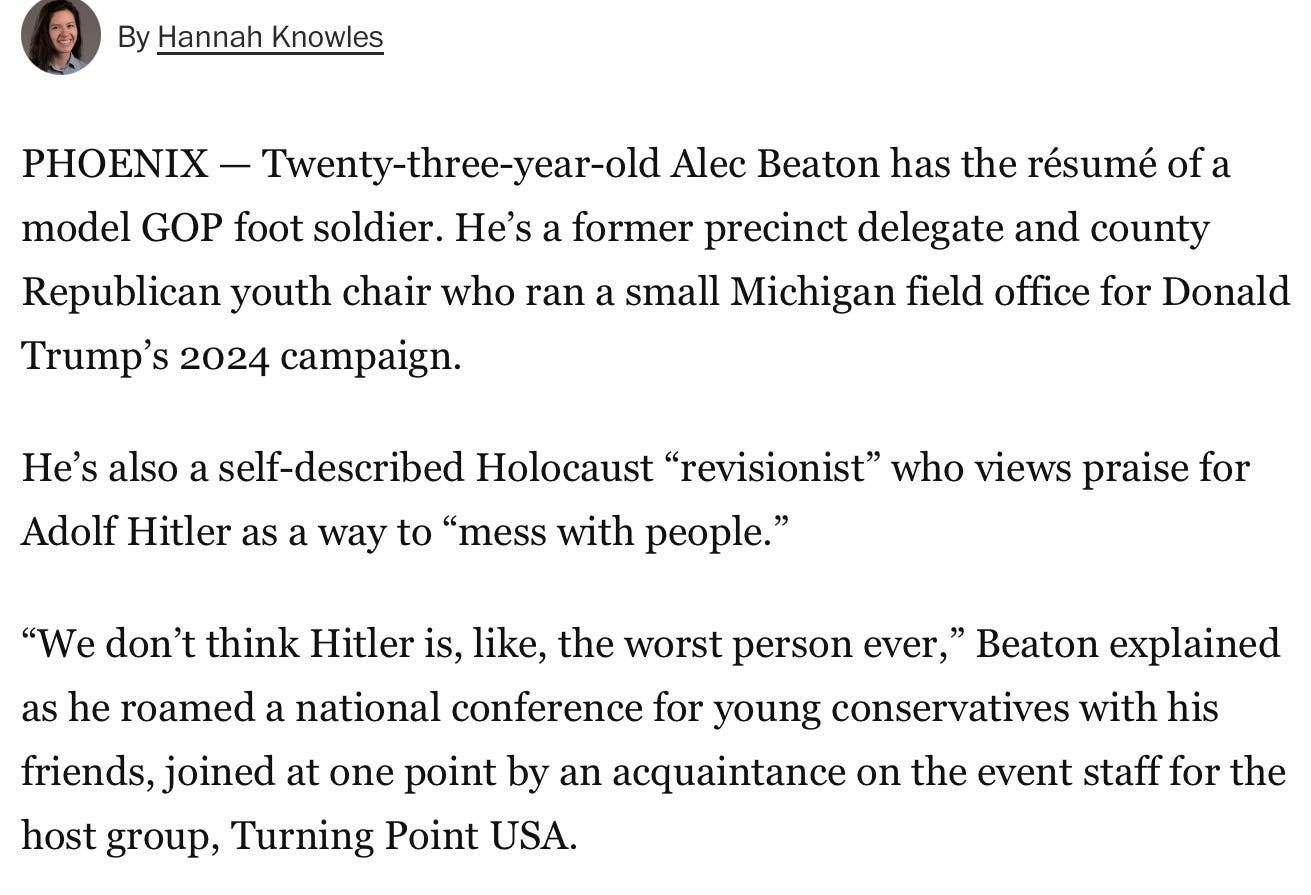
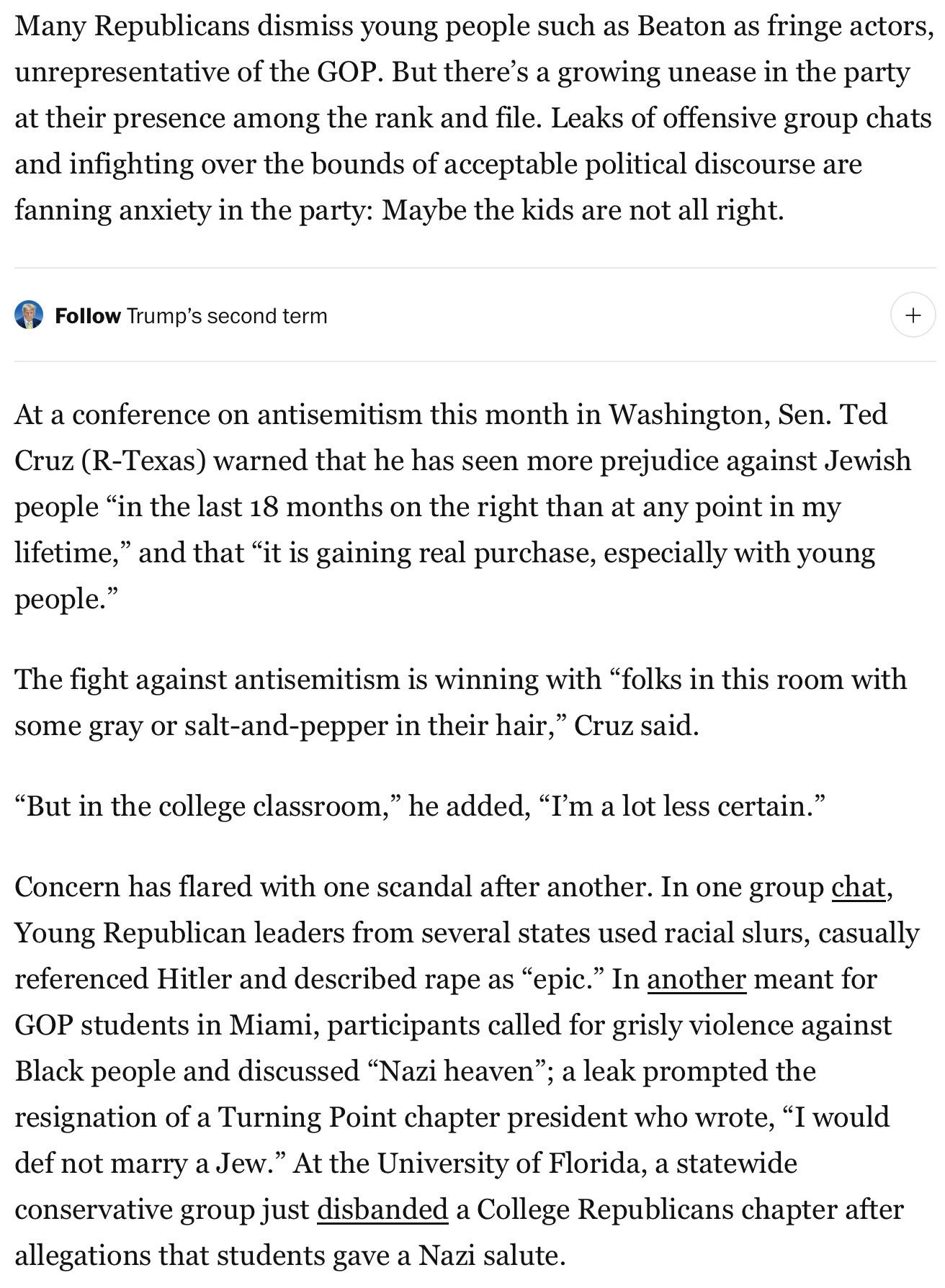
Now let me show you the trick. The problem with the Washington Post piece is not that it hid the facts from you. The facts are right there. White-supremacist influencer. Holocaust “revisionist.” Hitler praise. The problem is that the story keeps putting little cushions under the ugliness. It gives you phrases like “mess with people,” “fringe,” and “infiltrators,” as if we are dealing with some weird youth fashion trend instead of moral sewage leaking into party politics. [1]
And that is how soft coverage works on you. It does not have to lie. It just has to lower your pulse. Give you colorful conference scenes, Airbnb hangouts, bright-blue hats, and all this little subculture wallpaper, and suddenly the story starts to feel less like an alarm and more like a guided tour. Like, come along everybody, and observe the young Republican in his natural habitat. Meanwhile the real point, that these people are praising Hitler and still finding space inside Republican politics, gets turned into background texture. [1]
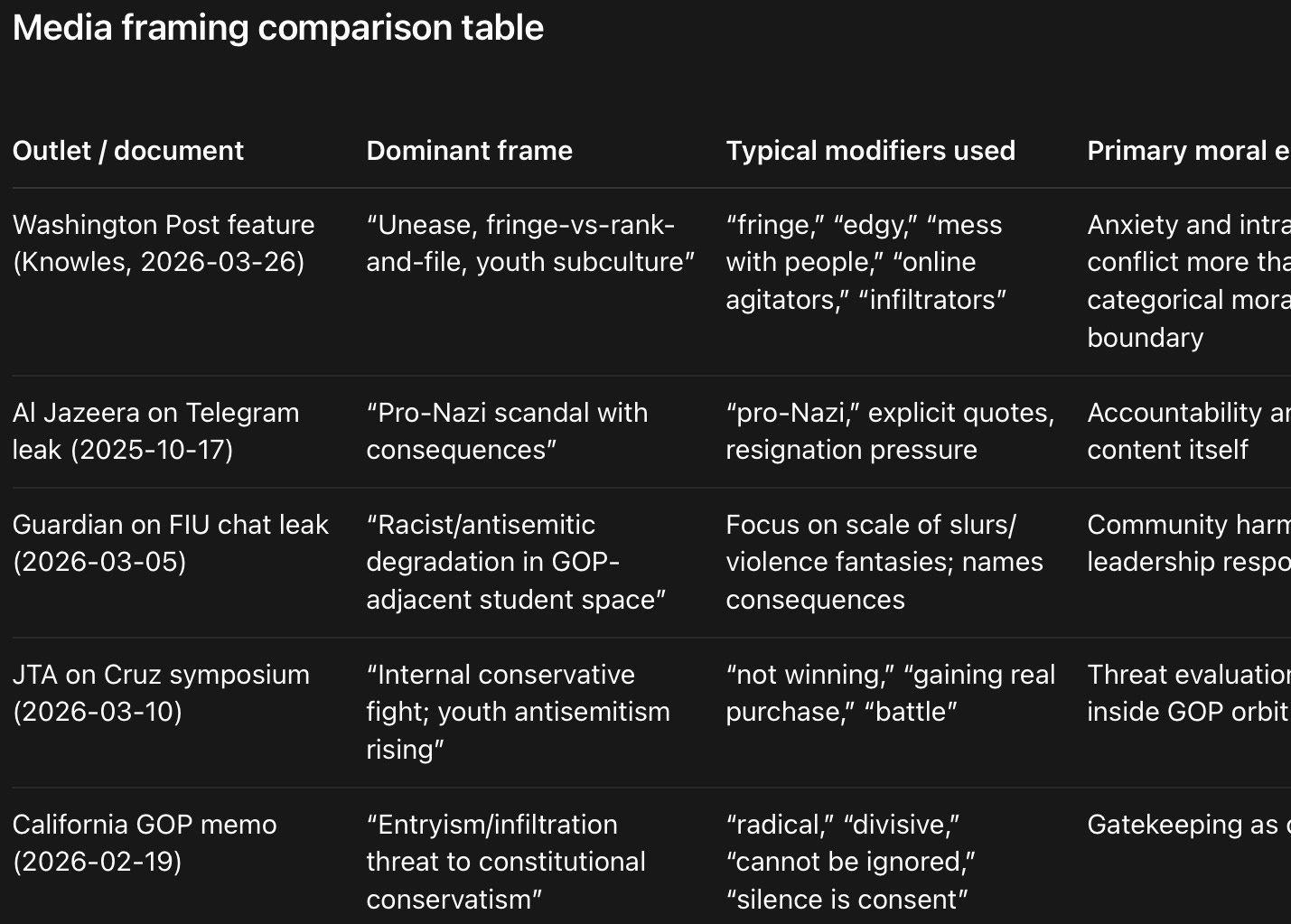
You can really see it when you line that piece up next to other coverage. Al Jazeera did not play cute with it. They led with the Nazi talk, the “I love Hitler” line, the gas chamber jokes, and the consequences that followed. [4] The Guardian did the same with the FIU chat leak. They put the racist language, the violence fantasies, and the “Nazi heaven” stuff right in front of you and showed the fallout. [5] JTA framed it as a real fight the GOP could be losing, especially with young people getting pulled in by online personalities and incentives. [8]
That contrast matters. Some coverage tells you the house is on fire. Some coverage walks you to the window, points at the flames, and says a few residents have expressed concern about the warmth. And that Rolling Stone frame matters too. Admiring Hitler is not just one more spicy opinion in America’s busted little marketplace of ideas. It is not a quirky side plot. It is a pattern. It is a warning. It is a moral emergency, and writing around that fact does not make the danger smaller. It just makes the reader slower to feel it. [23]
Mechanisms of radicalization: online incentives, irony, and event socialization
The essay’s analytic middle should explain how Nazi-curiosity and antisemitism migrate from internet performance into party-adjacent life. The evidence base supports a multi-step mechanism.
First, online incentives reward transgression. The Washington Post quotes Brog describing a “perverse incentive structure” where antisemitic or anti-Israel rhetoric yields instant rewards like clicks, likes, and follows, creating false impressions about what “the base” believes and encouraging ambitious figures to chase those signals. [1] Empirically, research on recommender systems shows how platforms can amplify extreme content after user interaction with far-right material; Whittaker et al. report that YouTube, in particular, can amplify extreme or fringe recommendations in certain conditions. [16] Research on young people’s exposure patterns finds that recommendation systems can normalize harmful ideologies and that misogynistic content can be packaged as entertainment, gaining traction and shaping offline behaviors. [17]
Second, “irony” is not harmless; it is a delivery system. Encyclopaedia Britannica describes the “Groyper Army” as using irony and humor to promote anti-immigration, anti-feminist, and anti-LGBTQ+ stances, providing deniability with the “just joking” shield that lowers social risk for new recruits. [13] That dynamic is echoed in the Post’s reporting: the young activist described Hitler praise as a way to “mess with people,” a textbook example of plausible-deniability transgression. [1]
Third, online identity becomes offline belonging. The Post describes groypers at a Turning Point youth conference late in 2025 who were not treated as pariahs: they greeted friends, received compliments on bright-blue hats, and socialized at an Airbnb hosting dozens of groypers, including a Fuentes cutout and “Splash house” signage. [1] This matters because it turns ideology into lifestyle, where the social cost of leaving can exceed the moral cost of staying.
Fourth, institutional entry follows. The ADL’s congressional testimony argues that the groyper movement’s political activism aims to normalize and mainstream hateful ideology, and it documents organized infrastructure including alternative platforms, monetization, and strategic positioning. [11] The California GOP memo uses the same conceptual frame of entryism and infiltration but from within party leadership concerns. [2]
Policy and political implications
Here is where this story gets bigger than ugly headlines and bad vibes. This is not just moral decline. This is a real power problem. Because once this stuff gets into youth groups, campus organizations, and party pipelines, it does not just stay online making dumb little Nazi jokes for clicks. It starts training future staffers, volunteers, spokespeople, and candidates. That is why this matters.
Take the CRA, the College Republicans of America. Its own website says it has more than 200 chapters nationwide and made 1.1 million voter contacts in the 2024 cycle. [25] That is not some tiny basement club with three folding chairs and a busted ring light. That is scale. That is reach. So when a network like that lifts up people tied to extremist circles, the problem is not just what they believe. The problem is where they can go next. Staff jobs. Campaign work. Endorsements. Access. A whole ladder gets built, and suddenly the weird little internet boy with Hitler jokes is wearing a lanyard and helping shape real politics. [25][26]
There is another problem too. A loud minority can start acting like it speaks for everybody. The Manhattan Institute found a meaningful minority inside the GOP with anti-Jewish views, including some who downplay or deny the Holocaust. Their analysis puts that group at 17 percent. [14] Now, that does not mean most Republicans believe this garbage. It does mean a loud, online, hyperactive slice of the right can make party leaders think the base is angrier, meaner, and more extreme than it really is. And once leaders start chasing that energy, the whole party can drift toward the loudest psychos in the comment section. [1][14]
Then there is the violence problem. Not just violence itself, but the way talk about violence gets turned into bonding. Those leaked chats included explicit threats and gas chamber jokes. [4] That is not edgy. That is not dark humor. That is what happens when cruelty becomes social currency. People say the sickest thing in the room, everybody laughs, and now the poison feels normal. That is how democratic politics starts getting twisted. You are no longer arguing with fellow citizens. You are fantasizing about enemies.
And finally, you have to look at the machine feeding all this. Social platforms and recommendation systems keep pushing people toward more extreme content because outrage travels fast and hate holds attention. Research shows these systems can amplify extremist material under certain conditions, especially when the content sits in that slippery zone of being awful but still technically legal. [16] So no, this is not just a Republican Party problem. It is also an infrastructure problem. The apps keep serving the slop. The algorithm keeps saying, oh, you liked one weird little grievance video? Here, baby, have twelve more. And young people are especially vulnerable to that loop. [16][17]
Conclusion
So listen let me bring this thing home.
I started with a music video because sometimes your body sees the truth before your mind is ready to say it. That Robert Palmer clip looked polished, controlled, and dead behind the eyes. The more I sat with it, the more it felt like a map of what we are watching right now. Dress it up. Smooth it out. Put good lighting on it. Keep the beat clean. Then act confused when people notice the cruelty standing right there in the frame. [21][22]
That is why this cannot end with a shrug and a memo and a few respectable people clearing their throats.Journalists have to stop writing around the smell. Stop calling this “edgy” when the same Hitler praise keeps showing up again and again. Stop handing these boys the camera angle they want, where they get to look dangerous and forbidden and therefore interesting. Call the thing what it is. Tell readers what is happening to them while they read it. Hate gets bigger when you stage it like spectacle and soften it with polite little napkins. [18][19][20]
And Republicans, Lord help me ya’ll, Republicans have got to stop acting like this is some awkward family secret that can be managed with better seating charts. No. If somebody is praising Hitler, denying the Holocaust, or wrapping white nationalist garbage in meme language and “just joking” talk, they do not need a youth chair position. They do not need a chapter. They do not need a microphone and a lanyard and a cute little pathway into power. They need the door shut. Tight. If your party knows these people are working their way into committees and campaigns, then “wait and see” is not caution. It is permission wearing Dockers. [2][4][5][1]
And please do not insult the country by calling that “cancel culture.” This is not cancel culture. This is not a campus food fight. This is basic civic hygiene. You do not negotiate with a roach problem. You do not invite mold to be part of the décor. You do not watch a boy praise genocidal monsters and say, well, let us hear him out, maybe he has an interesting perspective on zoning. No, sir. No, ma’am. Some things are supposed to get shut down fast because history already ran that experiment in blood. [4][11][20]
Even people inside the Republican Party know this. Ted Cruz warned that antisemitism is gaining ground on the right, especially with young people. [8] California Republicans warned that silence is not acceptable. [2] So the facts are not hiding. The issue is not ignorance. The issue is appetite. The issue is whether the party is willing to give up the rush these young men bring: the clicks, the fury, the fake vitality, the thrill of hearing somebody say the unsayable out loud.
That is what addiction does. It tells you the thing killing you is the thing keeping you strong.
So I am back where I started, staring at a video I can no longer watch the same way. The suits are pressed. The faces are fixed. The pose is perfect. But something is dead in it. That is what I see now when I look at this part of Republican politics and the soft-focus coverage that keeps trying to make it sound manageable. Hate has learned how to dress for television. Hate has learned how to smile for the profile piece. Hate has learned how to call itself irony, youth energy, America First, or just asking questions.
But stink is stink. Rot is rot. And a country that cannot say that plainly is already in deeper trouble than it knows.
Support XVOA
If XVOA is doing its job right, it works a little like air conditioning. It cools you down in the middle of the heat so well you almost stop thinking about it. You expect it to come on. You expect the room to make sense again. My job as editor in chief is to remind you that the XVOA AC is not free. It runs on time, reporting, reading, thinking, and these fingers that used to type police reports and now type the truth for you.
And I know this economy is hitting people hard. People need gas. People are watching their 401(k)s get hit. People are stretching every dollar and praying the card balance does not laugh back at them. I get it. I really do. But ask yourself this: is now the time for XVOA to shut down because support dropped? Do we only need independent publications like this when times are good? Do we only need truth-tellers when the air outside feels fine?
Too much of the mainstream press is shrinking, softening, or learning how to tap dance for power. And no, there should be room for more than one giant independent media operation in this country. I do not have corporate sponsors. I do not have some big-money machine behind me. I have you. I have this platform. And I have these fingers that used to type police reports and now type the receipts, the warnings, the history, and the truth for you.
So here is what I need. If you have an extra $80 you can put on a credit card, become an annual subscriber at
Surely most folks can pay off $80 over a year. If $80 is too much right now, go monthly for $8. And if a subscription is still too much, you can still help keep this thing alive by buying me a coffee at
Every bit helps. Every single bit buys me more time to keep doing this work.
And to those of you who are already paid subscribers, thank you. Truly. You are not just supporting a publication. You are keeping the lights on. You are giving this work room to breathe. You are helping me stay in the fight at a time when too much of the press is being cut down, bought off, or trained to look away. You are the reason XVOA is still here, still typing, still digging, still trying to make sense of the heat before it burns the whole house down.
Sources
Washington Post — Hannah Knowles, “Bigotry among young conservatives has Republicans on edge” — Core feature and primary narrative frame.
California Republican Party memo (Feb. 19, 2026) — Primary party document warning about groypers and entryism.
UNF Public Opinion Research Lab statewide poll materials (Feb. 24, 2026) — Polling context on Florida GOP dynamics and Fishback’s limited support.
Al Jazeera — leaked pro-Nazi Young Republicans chat — Chat leak with Hitler praise, gas chamber jokes, and fallout.
The Guardian — FIU racist/antisemitic group chat — Campus-adjacent leak showing racist violence fantasies and Nazi references.
Washington Post — Trump defends Tucker Carlson interview of Fuentes — Leadership reluctance to draw a bright line.
Washington Post — Trump dinner with Fuentes and Ye — Earlier normalization precedent at the top of the party.
JTA — Ted Cruz on rising right-wing antisemitism — Internal conservative warning that the problem is growing with young people.
Washington Post — University of Florida College Republicans episode — Campus normalization and organizational rupture.
The Guardian — UF lawsuit aftermath — Adds free-speech framing and organizational conflict.
ADL congressional testimony on Fuentes and groypers — Movement aims, infrastructure, and mainstreaming strategy.
SPLC extremist profile on Nick Fuentes — Independent documentation of Fuentes’s worldview and role.
Britannica on Nick Fuentes / groyper irony — Reference support for irony, humor, and deniability as political delivery systems.
Manhattan Institute survey analysis of the new GOP — Quantifies anti-Jewish and conspiratorial currents inside the coalition.
CITAP / Marwick literature review — Research support for gradual, community-based radicalization.
Internet Policy Review — recommender systems and extremist amplification — Algorithmic amplification and platform incentive structure.
PMC — youth exposure / recommender normalization study — Youth exposure pathways and normalization of harmful ideologies.
SPJ Code of Ethics — Journalism ethics framework for covering extremists responsibly.
Data & Society — “The Oxygen of Amplification” — Best practices on reducing the mainstreaming effect of coverage.
AP Stylebook guidance — Precision and anti-euphemism framing guidance.
Wikipedia — “Addicted to Love” — Basic factual reference for the Robert Palmer hook.
The Guardian — fashion analysis of the “Addicted to Love” video — Visual and cultural context for the video’s aesthetic.
Political Wire / Rolling Stone contrast frame — Benchmark for a more prosecutorial moral frame.
The Guardian — Tucker Carlson’s interview with far-right antisemite Nick Fuentes divides conservatives — Documents conservative backlash after Carlson platformed Fuentes.
College Republicans of America — Official site describing the group’s chapter count and claimed 2024 voter contacts.
MSNBC / MSNBC Opinion — College Republicans tap MAGA influencer tied to Nick Fuentes for leadership role— Reporting and commentary on the Kai Schwemmer appointment controversy.
Heavy. Dig it. Makes me think of my college-aged, college-attending godson who’s a total Trumper thanks at least to his mom, my sister. Add maybe, his U.S. history teacher father, the irony of which I cannot reconcile. I weep. 😢
I am an army brat. I was in Germany when the Berlin Wall went up, and came back to Ft. Benning not understanding what “whites only” meant…only knowing that kids I had gone to school with were not safe off base. I remember my parents and grandparents disparaging MLK and what he was doing. Why does it feel like we have so much further to go?