

Before we dive in, I want to ask you for something straight up. Right now there are 67 paid readers holding this little light with me, and if we can push that to 100 paid by the end of the year, Substack hands us that “bestseller” checkmark. It’s a keycard that gets XVOA’s work in front of people who will never find a retired cop’s newsletter on their own. If you’re able, upgrading from free to paid today doesn’t just support me, it helps us carry this media autopsy deeper into the heart of the beast; if you can’t, sharing or restacking this piece still moves the needle. Either way, what follows starts where it has to start: with me admitting just how much I’ve been wrestling with what it means to be called a beacon in a country that’s getting dark.
I struggled with this. Not this post itself, but the whiplash of watching XVOA dragged up from anonymity a little less than 6 months ago into something people now call a beacon. The praise has been loud lately and I’m thankful, but I can feel the hurt sitting underneath those compliments. I can feel the fatigue in people who keep doom-scrolling anyway, waiting for one headline that finally tells the truth straight. I can feel the cynicism in folks who quote my work back to me with a little laugh, because they still have to wake up to the same lying chyrons in the morning. I can feel the quiet rage of readers who know they are being played, but do not yet have the language for how deep the game goes. This essay is for that hurt, that fatigue, that cynicism, that rage, and for the part of me that still believes I am not crazy for seeing what I see.
What I am really wrestling with is that truth is heavy. In the police academy it lived in binders and PowerPoints, in policy manuals and multiple-choice tests. You can sit with that kind of truth all day and never feel the weight of it in your chest. The weight showed up the first day I slid into a marked car on FTO training, when the belt dug into my waist different, the radio hissed in my ear, and the city sounded like it was breathing right next to my face. That is the moment when truth stops being theory and becomes a set of keys in your hand. You feel it pressing on you and opening something at the same time. I can feel that same pressure now.
Because if I am honest, XVOA started as a kind of jukebox for me. A playground for R&B metaphors, slow jams, inside jokes about a country that has always danced to the wrong song. It was my way to stay in the classroom, talking about the culture from a safe distance, humming along to the soundtrack while Rome burned in the background. Somewhere between Epstein, Trump, Gaza, SNAP cuts and these court cases, the toy started to feel like a patrol car. The logo, the notes, the bent-lyric essays suddenly carried that same “first day of FTO” feeling. I can feel the platform growing up, whether I am ready to or not, and that is the real struggle sitting under all this talk about beacons and truth.
I’ll be perfectly honest: I am still not ready. I knew it yesterday when Spin Spectrum Daily turned into me staring at a blinking cursor, scrolling headlines and pretending I was hunting for spin when really I was just avoiding the truth. It was embarrassing to admit that the guy who keeps warning you about media hypnosis had quietly slipped back into the trance.
This morning I finally did something different. Instead of doing my usual loop through the Washington Post and a couple of other “respectable” outlets, I sat with the Guardian and actually read. On the Post homepage I saw a sober package on pedestrian deaths, a hed about “quick release of Epstein files in doubt,” a social write-up of who attended the White House dinner for Mohammed bin Salman, a think piece on DeSantis’s makeover of a Florida college, a volcano energy story, and a splashy layout for “the 20 most anticipated movies of the holiday season.” All real, all important in their own way, but the stakes felt filed down to fit politely inside an American living room. Then I flipped to the Guardian and saw: “Trump’s anti-climate agenda could result in 1.3m more deaths globally,” “Senate agrees to pass Epstein files bill after near-unanimous House vote,” “Trump shrugs off Khashoggi murder during Saudi prince’s White House visit,” “Nearly all immigrants detained in Trump Chicago raid had no criminal conviction.” Same planet, same news cycle, but one front page talked like a neighbor and the other talked like a witness.
I am not naïve ya’ll; the Guardian has its own angle and its own blind spots, and this is not some fan letter. What opened my eyes was realizing that my so-called independence was still chained to the same cautious American news rhythm I thought I had escaped. I could not find spin content because I was being spun, politely, professionally, and daily.
The piece that really got under my skin was the Guardian write up on the Saudi prince’s visit to the White House. Buried in all that trillion dollar talk and soft focus Oval Office photography was one small moment where an ABC News reporter asked about Jamal Khashoggi’s murder and Trump snapped, called ABC fake news and scolded her for “embarrassing our guest.” Later I went and found the audio and sat with it on my speakers. Over the clinking of camera shutters you can hear her voice stay steady, refusing to pretend the blood on that checkbook was not there.
Listening to that, something old lit up in me. I remember Pacino in …And Justice for All screaming, “You’re out of order, the whole trial is out of order,” and realizing as a kid that sometimes the only sane person in the room is the one who refuses to play along. I remember Walter Cronkite looking straight into the camera and saying Vietnam was lost, and feeling how one quiet sentence from a trusted voice could rattle an entire war machine, even if my 1972 self was still on backorder when he said it. I remember Dan Rather catching hell for grilling a sitting president like a man applying for a job instead of a king holding court, and knowing in my bones that this was what journalism was supposed to feel like. I remember Edward R. Murrow signing off with “Good night, and good luck” after cutting Joseph McCarthy down to size, and laughing at the fact that a kid born years later could still feel that closing line like a hand on his shoulder.
That ABC reporter’s question dropped right into that lineage. It reminded me that the foot soldiers of journalism are still in the foxholes, still risking their careers and safety to say the part the script leaves out. If they are still fighting that hard on the front lines, then the real surrender must have happened somewhere else. Something went wrong in the editor’s chair, the ownership suites, the boardrooms where truth got downgraded from a calling to a product.
We all know something shifted in the nineties, even if most of us cannot name it cleanly. The news started to feel less like a nightly town hall and more like a game show where the prize was your attention span. The graphics got louder, the anchors smiled wider, and somehow the stories got darker while the tone got lighter, like we were being reassured even as the floor quietly dropped out beneath us. You could see it in the little things, the stock ticker crawling across the bottom of the screen while someone’s tragedy played out above it, the way every local disaster suddenly came with a logo and theme music.
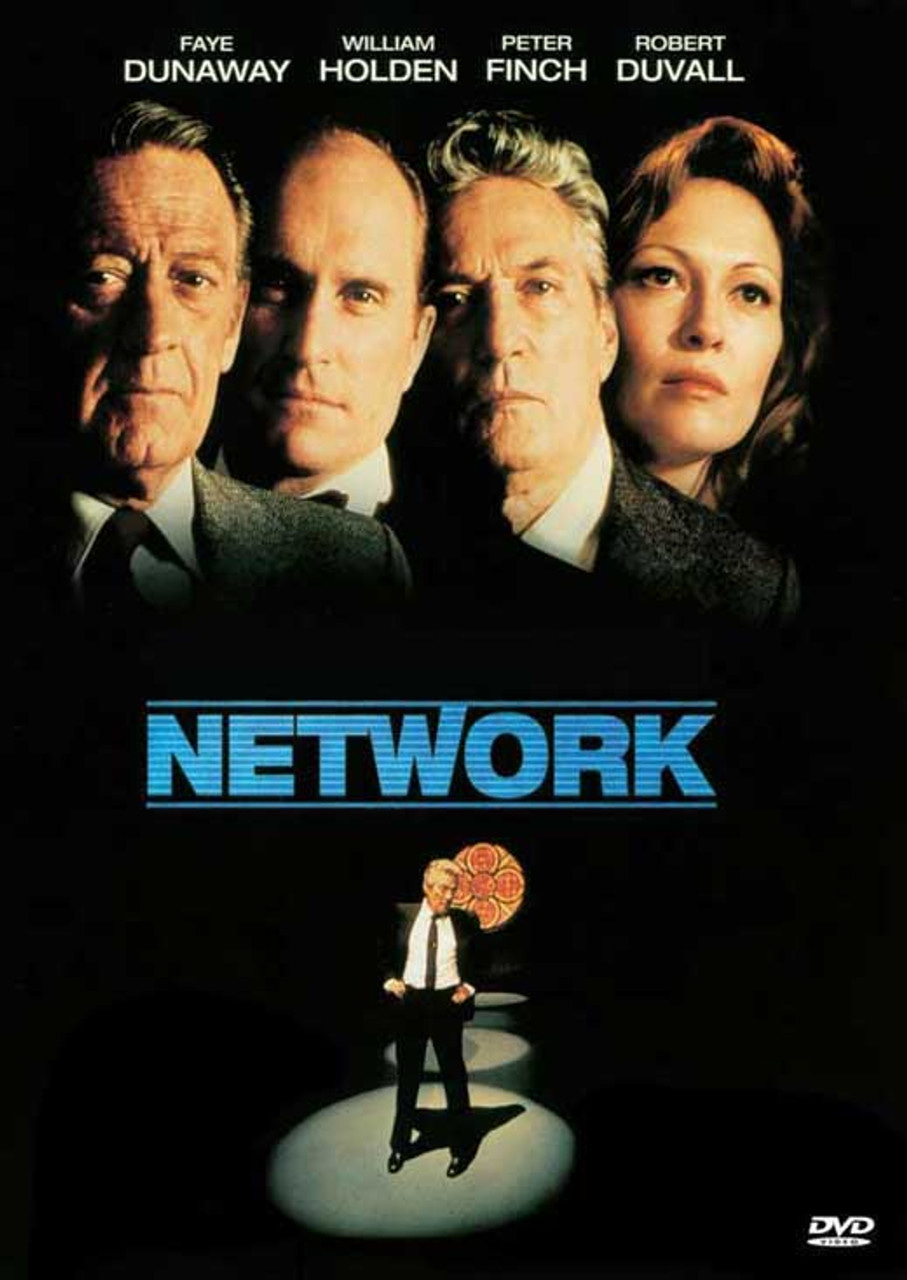
Looking back, I keep thinking about Network, a movie from the seventies that landed like a bootleg prophecy as a kid. Howard Beale was supposed to be a warning, a broken man shouting “I’m mad as hell” into the void, but by the nineties his meltdown had been reverse engineered into a business model. Executives in that film sit around a table and calmly explain that rage and fear are just market segments, and by the time I was a grown man that cold logic had climbed out of the script and into real boardrooms. What used to be a public service license tied to the “public interest” slowly morphed into one simple metric: how many eyeballs can we sell to advertisers and how fast can we grow the quarter.
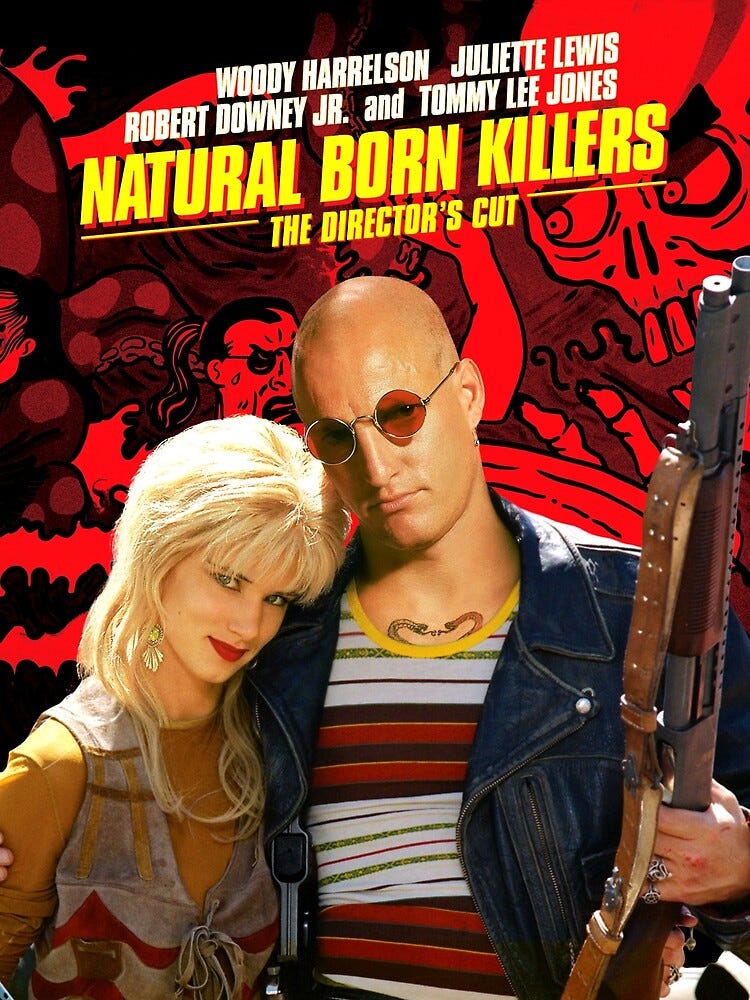
If Network was the sermon, Natural Born Killers was the altar call nobody wanted to admit they answered. That movie took a murderous couple and showed us how TV could turn them into folk heroes, cutting rapid-fire between killings, talk shows, and commercials until the line between news and entertainment disappeared. It was ugly, surreal, and in the middle of the O.J. trial era it did not feel like fiction so much as a funhouse mirror. While anchors clutched their pearls on air, the ad rates climbed, the mergers stacked up, and the message in the spreadsheets was simple: the more we inflame, the more we earn. Somewhere in that decade, truth stopped being the point of the broadcast and became a prop inside a much bigger financial story.
When the United States invaded Iraq, the mask slipped. We were told it was about weapons of mass destruction, mushroom clouds, and a dictator tied in a neat little bow to the terror that had just scarred the country. Night after night, the same retired generals cycled through the same cable sets, pointing to grainy satellite photos like they were holy writ. Instead of interrogating the claims, most of the big outlets packaged them. The questions that did make it on air were framed like polite objections at a sales presentation, not cross-examination in a courtroom that might keep people from dying.

The language gave the game away if you were listening. “Shock and awe.” “Decapitation strike.” “Coalition of the willing.” You could sit on the couch and feel the war being sold like a new car model. Embedded reporters rode with the troops, and on one level their bravery was real, but their vantage point was curated. They showed us the dust, the fear, the camaraderie, yet the larger frame stayed narrow: here are our boys, here is the mission, here are the fireworks over Baghdad. What you almost never saw in prime time was a relentless, daily, front-page reckoning with the shaky intelligence, the dissent inside the agencies, the global screams that this was a mistake we would be paying for in blood and credibility for decades.
By the time the justifications started to crumble, the cameras had already moved on to the next storyline. There were half-apologies, editorials about “lessons learned,” but the damage was done. The press that once liked to imagine itself as a watchdog had, in that moment, behaved more like a partner signing off on the lease. Iraq did not just expose a policy failure. It exposed how quickly the most powerful media in the world could trade transparency for access, truth for spectacle, and their duty to the public for their comfort inside the war room.
So here we are, living in the hangover. The Iraq playbook never got shredded, it just got ported over to a faster internet connection. The same formulas are still on the air: a carousel of “experts,” a narrow list of acceptable questions, a graphics package big enough to distract you from how little real power you have over what is being decided in your name. Only now it comes at you as a constant drip, not a scheduled broadcast, through push alerts and algorithmic feeds that pretend to “inform” you while they mainly measure how long they can keep your thumb from leaving the screen.
The business model finished its evolution. Local newsrooms were gutted, a handful of conglomerates bought the pipes, and the line between news, branding, and politics blurred into one continuous mood. Outlets still print corrections, still run fact-checks, still publish serious work, but look at what gets prime real estate and what gets buried. Stories that flatter power or keep you in a constant state of anxious entertainment rise to the top; anything that might threaten advertisers, donors, or the delicate relationships in the boardroom tends to slip quietly to page A17 or a Sunday afternoon upload. The watchdog costume stayed in the closet while the entertainment division took over the living room.
So if you feel dizzy watching this, you are not imagining it. We are standing inside a media ecosystem that has learned every trick from Network, every dark joke from Natural Born Killers, and every lie of the Iraq era, then optimized them with real-time data. There are still foot soldiers in the foxholes, still Guardians and lone reporters asking the forbidden question in the gilded room, but the command structure above them is wired to treat truth as a line item, not a mission. That is the landscape this essay is written from and written for: a country where you can be flooded with information every second of the day and still be kept in mental chains.
So let me speak directly to the people in the glass offices who might stumble across this. You are not confused; you know exactly what you are doing when you kill a story that makes a donor nervous and greenlight a panel that keeps viewers angry but not organized. You sit in rooms with data dashboards that can tell you how many people clicked on Gaza, on SNAP cuts, on Epstein, and you quietly redirect the spotlight when the numbers threaten the wrong kind of power. You hide behind phrases like “audience appetite” and “brand safety” while the reporters you send into the foxholes still try to practice something that looks like a calling. You are not just reflecting the public; you are shaping what the public is allowed to see and feel, and somewhere along the way you decided that your quarterly report mattered more than our democracy’s vital signs. You are the ones who turned truth into a luxury product and confusion into a subscription plan.
If you are still here, reading this far, I know something about you. You have been carrying questions no anchor ever answered. You have sat in front of a glowing screen and felt your stomach drop because the story you were living did not match the story you were being told. You remember where you were when the towers fell. You remember how it felt when the Iraq lies unraveled. You remember the sick mix of hope and dread on election nights that were sold to you like Super Bowls instead of autopsies on a bleeding democracy. You remember, and you have been told over and over that your memory, your body, your intuition, are “too emotional,” “too biased,” “too online.”
You were right to flinch. You were right to feel the floor move when the chyron did not. You were right to turn the TV off and still feel dirty, to scroll the feeds and still feel alone. If there is a beacon here, it is not me; it is the part of you that refused to fully swallow the script. That is who I am writing to tonight. Before I ask you to help me keep this light on, I have to tell you the truth about how blind I have been, and how unqualified I still feel to be anybody’s journalist.
Here is the part I wish I could skip. I am not a trained journalist. I am a retired cop who spent most of his life responding to calls, not filing FOIAs, a music head who turned a jukebox into a newsletter, a man who can still get spun by the very headlines he mocks. For all my talk about “seeing the system,” I missed the simple fact that I was still letting the same three or four outlets set the boundaries of what I considered “news.” I told myself I was different because I read critically, because I dragged them in these essays, but I was still starting each morning inside their frame.
I have blown deadlines. I have chased clever metaphors when I should have been tracing money flows, and I have let my own exhaustion be the excuse for not digging deeper. The truth is I am learning to do this in front of you in real time, the way a rookie learns a city block by block, call by call. If any of this is a beacon, it is a flickering one, held by somebody who still fumbles the batteries and still has to fight the same fog you do every time he opens a browser.
Here’s where I ask you for something real. If you’ve read this far, you already know I’m not selling vibes, I’m asking you to help build a weapon we actually control. Right now XVOA is a flicker on the edge of a much bigger hurricane of noise. There are 67 paid subscribers standing in this light with me, and the goal is to reach 100 paid by the end of the year. That little “bestseller” checkmark Substack gives at 100 paid isn’t about ego for me; it’s a keycard. It opens doors in this ecosystem, it puts our work in front of people who would never stumble into a retired cop’s newsletter on their own, and it tells the algorithm, “These folks are serious. Push this deeper into the labyrinth.”
So I’m asking you, plainly: if you’re in a position to do it, turn your free subscription into a paid one and help push us over that 100-paid line. Not just so I can have a badge, but so we can walk this reporting, this media autopsy, right into the places that would prefer we stayed small and grateful. Every paid sub is one more brick we pry loose from the wall and one more hour I can spend digging instead of hustling side gigs to supplement my retirement. Let’s make this my one and only side gig, and eventually a full-time gig with other people on the team doing this work alongside us. And if money’s tight, you’re still part of this: share the work, restack it, forward it to the one person you know who is “mad as hell” but doesn’t have the words yet. Nobody is coming to save us from this media hell but us. If you believe that, help me make this beacon impossible to ignore.
Your writing always touches me. It’s so insightful and beautifully written. I have very little extra money right now but I believe your perspective is so valuable that I subscribed. I hope others will too—you deserve the following.
Yeah, this was good- just called into the other room and told my son you did another really good one, and really need more subscribers. He said ok. We both think you couldn’t have a better name 😏