


Verified Explosions in Caracas and Other Cities
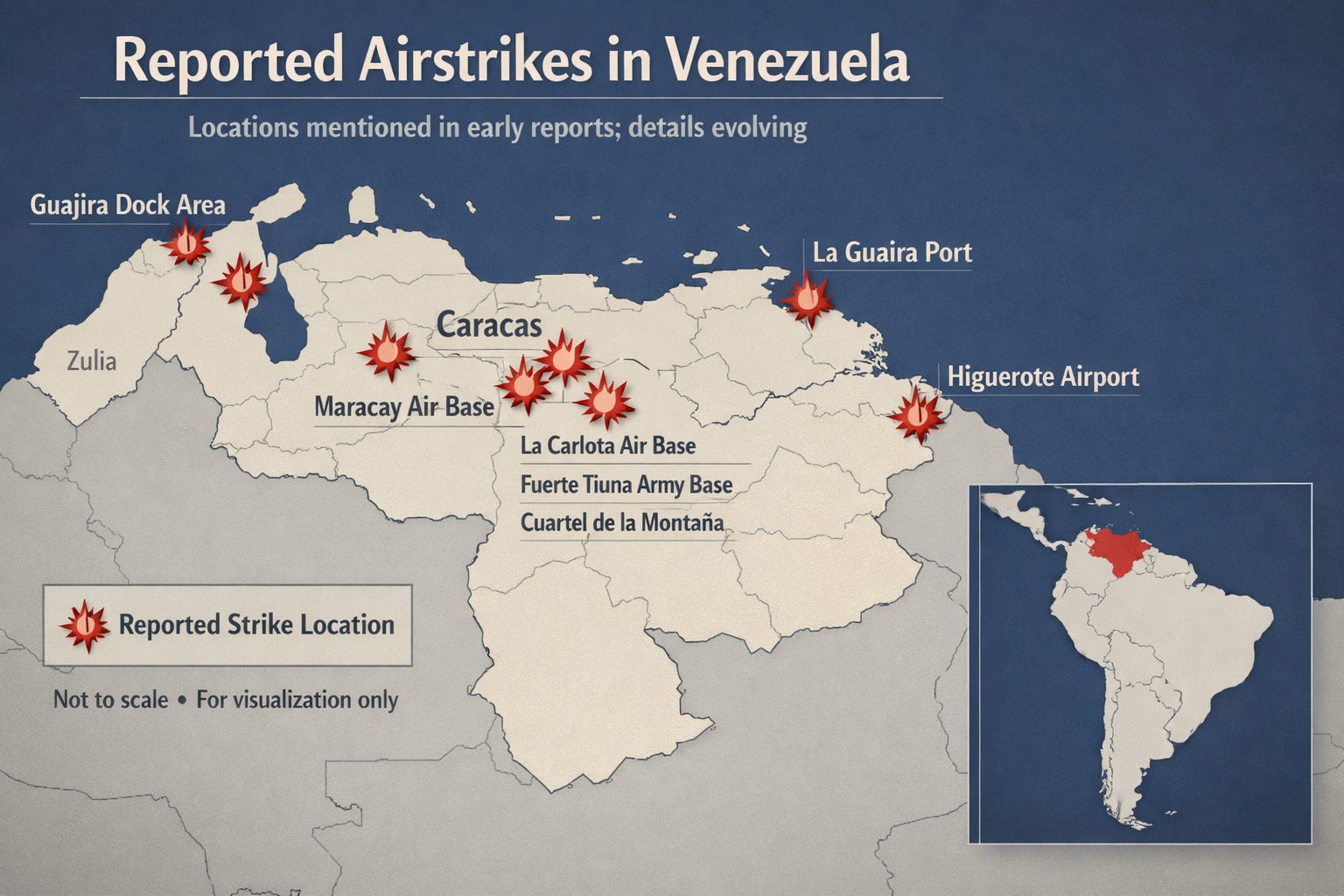
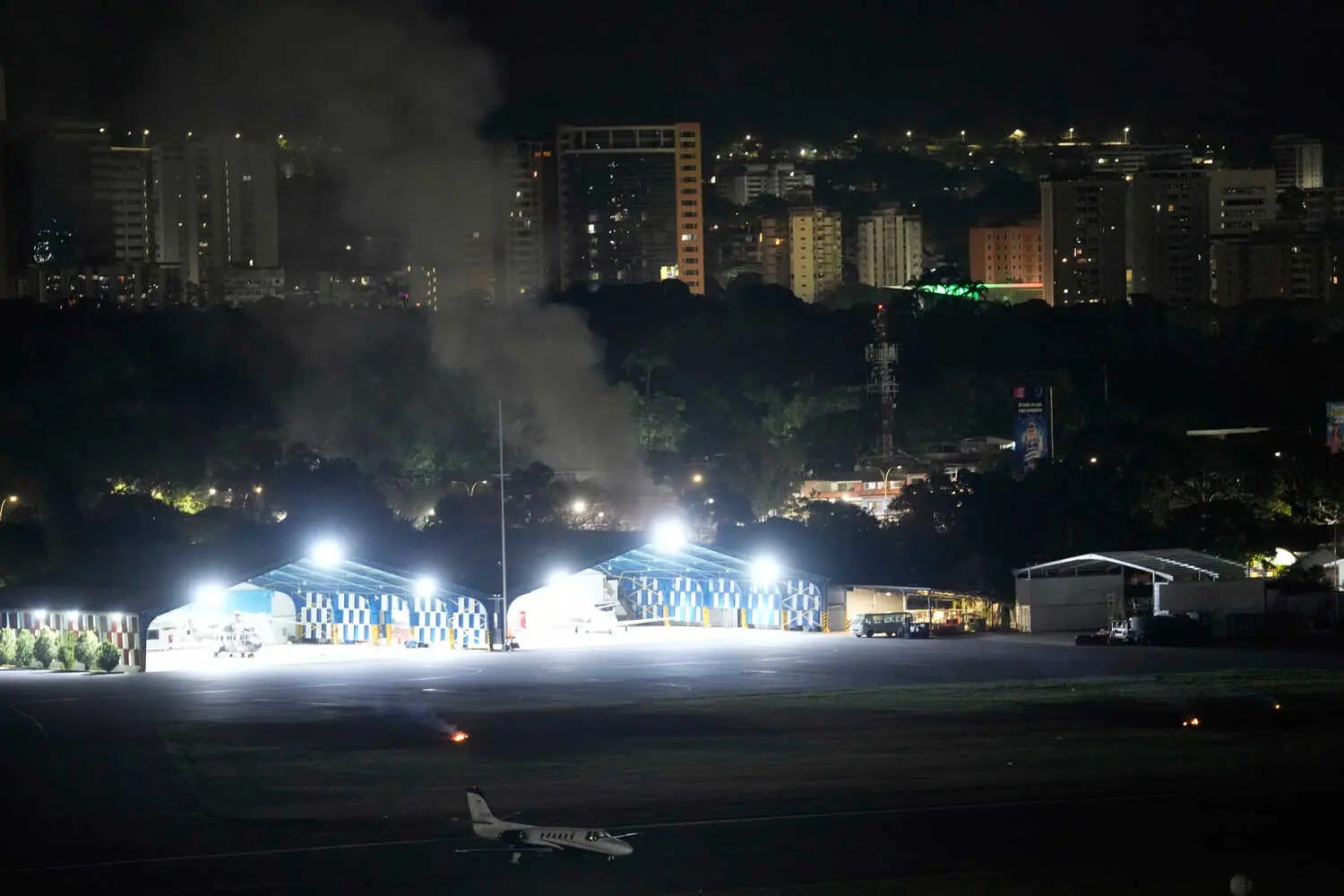
I have just received an alert that withIn the past hour as of 330am January 3rd 2026, multiple explosions have been reported in Venezuela’s capital, Caracas, amid a sudden outbreak of violence. Reuters witnesses and social media footage observed several blasts and aircraft over the city around 2:00 AM local time on January 3 . Residents in various neighborhoods were jolted awake by at least seven loud explosions and the roar of low-flying aircraft . “The whole ground shook… We heard explosions and planes in the distance,” one Caracas resident recounted of the terrifying pre-dawn strikes . Eyewitnesses saw columns of black smoke rising from key sites, including La Carlota military airfield in central Caracas and the sprawling Fuerte Tiuna army base on the city’s southern edge . A power outage plunged southern Caracas into darkness during the attack, likely due to damage near Fuerte Tiuna .
Updates as of 4:40 a.m. ET (Jan 3):
Reuters: A U.S. official confirmed strikes inside Venezuela after explosions and aircraft activity over Caracas; Venezuela says attacks also hit Miranda, Aragua, and La Guaira, and Maduro declared a national emergency and mobilization.
Trump: He claims Maduro (and his wife) were captured and flown out after what he called a “large scale strike”; this is being reported as Trump’s statement and has not been independently confirmed by Caracas in the same reporting. He also said he will host a news conference at Mar-a-Lago at 11:00 a.m. ET.
FAA/U.S. guidance + Colombia: The FAA banned U.S. commercial flights over Venezuelan airspace citing “ongoing military activity,” and U.S.-government messaging urged Americans in Venezuela to shelter in place; Colombia’s President Petro is calling for urgent UN/OAS action.
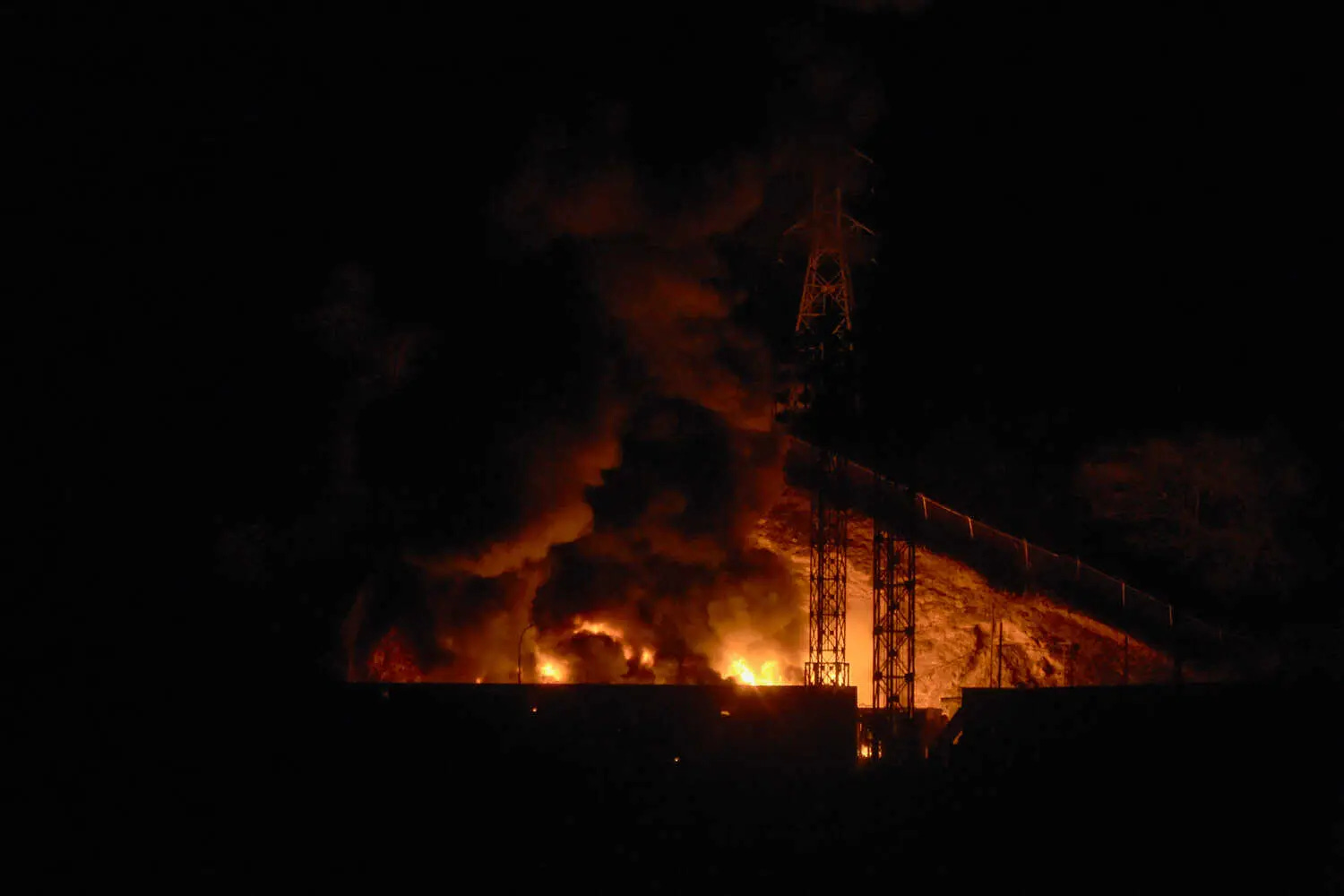
Beyond the capital, additional strikes were reported at other strategic locations. Local and regional outlets confirm that military installations and airports in multiple states were hit. Among the targets were Caracas’s Cuartel de la Montaña (where former President Hugo Chávez is entombed), an airbase in Maracay (west of Caracas), the main port facilities at La Guaira on the central coast, and the Higuerote airport on the coast east of Caracas . Fire and thick gray smoke have been seen billowing from some of these sites in the aftermath . Venezuela’s government has accused an unnamed aggressor of attacking both civilian and military infrastructure in several regions simultaneously . However, no official casualty figures have been released as of yet, and it remains unclear how many military personnel or civilians may have been killed or injured in these overnight bombings. The situation is still developing, and authorities have not immediately provided details on damage or casualties, aside from confirming significant material damage like the large fires and power disruptions .
Official Statements and Regional Responses
Official reactions are beginning to emerge, painting a picture of an international crisis. Notably, Colombia’s President Gustavo Petro issued an alarmed statement on social media, effectively confirming the attacks. “At this moment they are bombing Caracas. Alert everyone — they have attacked Venezuela. They are bombing with missiles,” Petro wrote on X (formerly Twitter) early this morning . He urgently called for the Organization of American States (OAS) and the United Nations to convene emergency sessions in response . Petro did not explicitly state who “they” were, but his comments strongly imply a foreign military attack, given the context of recent U.S.–Venezuela tensions. As of now, Petro’s statement stands as a high-level confirmation from a neighboring country that Caracas is under aerial bombardment.
On the ground in Venezuela, President Nicolás Maduro’s government has characterized the incident as a brazen act of foreign aggression. Several hours after the explosions, Venezuela’s state television broadcast a government communiqué denouncing a “flagrant military aggression” by the United States . The statement declares that the attacks “constitute a flagrant violation of the U.N. Charter” and accuses Washington of targeting Venezuela’s strategic resources – “the objective of this attack is none other than to seize Venezuela’s strategic resources, especially its oil and minerals”, the communiqué said . In response, Maduro has activated a state of emergency (“state of external commotion”) nationwide and called on Venezuelans to mobilize for armed resistance against what he termed an “imperialist aggression” . “The whole country must activate to defeat this imperialist aggression,” the statement read, urging Venezuelan armed forces and civilian militias to defend the nation . Venezuelan officials have thus squarely blamed the United States for the bombing raids and framed them as an illegal attempt to overthrow Venezuela’s government.
Other regional voices are also weighing in. Evo Morales, former president of Bolivia and a vocal supporter of Maduro, condemned what he called “a brutal US bombardment against Venezuela” and likewise decried it as a violation of sovereignty . He expressed solidarity with “the Venezuelan people in resistance” on social media. Thus far, no Latin American government has voiced support for the attack – even governments normally critical of Maduro have been silent or cautious – while allies and regional organizations are being urged to respond. Petro noted that Colombia (which just assumed a seat on the UN Security Councilas of January 1) would push for the Security Council to meet immediately to “establish the international legality of the aggression against Venezuela” . There has been no immediate comment from the OAS or UN leadership, but behind the scenes diplomatic efforts are likely under way in response to Petro’s urgent appeals.
Alleged Perpetrators: Is the US Behind the Bombing?
No government has officially claimed responsibility for the strikes, but all signs point to the United States as the likely actor. The timing and targets align closely with Washington’s recent military pressure campaign against the Maduro government. Over the past five months, U.S. President Donald Trump has repeatedly threatened to carry out “land operations” in Venezuela, ostensibly to combat drug cartels, and has openly pressured Maduro to leave power . Just last week, Trump boastfully revealed that U.S. forces had “hit” a site on Venezuelan soil – a docking area in Venezuela’s Guajira peninsula – marking the first acknowledged U.S. strike inside Venezuela during this campaign . (Trump described a “major explosion in the dock area where they load the boats up with drugs” , though Venezuelan officials never confirmed that incident.) In recent days, Trump had ominously stated it would be “smart” for Maduro to flee the country, hinting at more direct action .
Now, with Caracas and military bases under fire, the Venezuelan government and many observers believe the U.S. has initiated a wider military strike to topple Maduro. The modus operandi of the attack – nighttime air raids on multiple strategic sites – is consistent with U.S. capabilities in the region. In fact, the Pentagon has built up significant forces near Venezuela in the past months, including an aircraft carrier group, navy warships, and squadrons of advanced fighter jets positioned in the Caribbean . This buildup was part of what Washington portrayed as an anti-narcotics and anti-terror operation, but it also placed U.S. firepower in range of Venezuela. Colombian President Petro’s reference to “bombing with missiles” suggests the use of either ship-launched or drone-launched precision munitions. Some reports in Latin American media specifically claim the attacks were carried out by armed drones hitting military targets in Caracas and the coast , though this detail remains unconfirmed. What is clear is that military aircraft were heard and seen above Caracas during the assault , indicating an aerial strike consistent with a technologically advanced military like the United States.
As of now, U.S. officials have not publicly admitted involvement. When asked, the White House and Pentagon declined to comment on the overnight events . However, according to a CBS News reporter, Trump administration officials acknowledged being “aware” of the reports of explosions in Caracas, even if they would not comment further . This suggests Washington is closely monitoring (and very possibly directing) the situation. It’s worth noting that no other country in the region has the capacity or motive to carry out such wide-scale strikes on Venezuelan soil. Colombia itself would almost certainly not attack its neighbor – especially under Petro’s leadership, which is opposed to U.S. military intervention. Thus, all credible analysis points to the United States (or U.S.-led forces) as the actor behind the bombings, even in the absence of an official Pentagon statement. The Venezuelan army’s air defenses are relatively limited, so if the U.S. is indeed responsible, it likely achieved air superiority quickly to carry out these strikes unopposed.
Stated vs. Suspected Motivations
The stated justification for U.S. military actions against Venezuela in recent months has been to combat drug trafficking. Trump and U.S. officials have accused President Maduro’s government of running a “narco-terrorist” network that floods the United States with cocaine and other drugs . Since August, the U.S. has used this rationale to launch more than two dozen airstrikes on Venezuelan vessels at sea, claiming the boats were carrying narcotics . At least 100 Venezuelan and Colombian crew members were killed in those at-sea attacks, according to reports, yet no concrete evidence of large drug shipments was presented . Venezuela is not a major source of the fentanyl or other drugs driving U.S. overdose deaths, experts note, casting doubt on Washington’s narrative . Even so, the Trump administration escalated the campaign – blockading Venezuelan oil tankers and hinting that military strikes on land could occur under the anti-drug mission .
Many international analysts and regional leaders suspect deeper motives behind the U.S. actions. Trump’s own statements have at times betrayed an interest in Venezuela’s immense oil reserves. He has argued that Venezuela’s oil industry rightfully “belongs to Washington” because it was allegedly stolen from U.S. companies through nationalization . The Venezuelan government’s view is unequivocal: they assert that Washington’s real goal is to overthrow Maduro and gain control of Venezuela’s oil and mineral wealth . In today’s official statement, Caracas directly claimed the “objective of this attack” is to seize Venezuela’s resources (especially oil) and to “break the nation’s political independence by force” – something they vow will “not be achieved” . This aligns with Maduro’s long-standing argument that U.S. sanctions and threats have little to do with drugs or democracy and everything to do with oil geopolitics.
Indeed, the timing of these strikes comes after failed diplomatic efforts and increased U.S. sanctions. Late last year, Washington tightened oil sanctions and even seized several Venezuelan oil tankers on the high seas . As economic pressure mounted, Trump publicly mused about “taking the oil” and cited historic U.S. interventions in Latin America. In parallel, he expanded the mission from anti-narcotics to regime change rhetoric – for example, calling Maduro’s 2024 re-election illegitimate and backing Venezuelan opposition figures. In the last week, Maduro actually offered a more conciliatory tone – saying he was open to “serious talks” with the U.S. on issues like drug trafficking and oil, in an interview on December 31 . But he notably refused to confirm or deny the rumored CIA-sponsored U.S. strike on Venezuelan soil in late December . Maduro’s careful public silence on that incident may have been an attempt to de-escalate or buy time. If so, the overnight bombing of Caracas suggests hardliners in Washington opted for force over negotiations. The suspected motivation behind the current bombing campaign, therefore, appears to be forcing regime change – crippling Venezuela’s military assets and pressuring Maduro to surrender or flee – under the dual pretexts of fighting drugs and “restoring democracy,” but with the strategic prize of Venezuela’s oil in mind .
Casualties and Infrastructure Damage
Information on casualties is still very limited and unverified, given that the attacks are recent and communications may be disrupted in some areas. As of this moment, no major news agency or official source has released a death or injury toll. Venezuelan state media has not aired details on fatalities, focusing instead on rallying the population to resistance. However, considering that the strikes hit military bases and possibly other infrastructure in the dead of night, there is fear of significant loss of life. Many Venezuelan soldiers stationed at the targeted bases could have been caught in barracks by surprise. There are unconfirmed social media claims of casualties, but nothing has been corroborated by credible outlets yet. Reuters notes that it “could not immediately verify” the authenticity of videos and reports circulating online about the attack’s aftermath . We may expect casualty figures to emerge once emergency services and officials assess the damage at first light.
On the infrastructure side, the impact is evident in Caracas. Parts of the city experienced power blackouts during the bombing – for example, neighborhoods around Fuerte Tiuna went dark when that base’s power grid was hit . Videos shared by residents (yet to be verified) show large fires raging at what appears to be La Carlota airbase and Fuerte Tiuna, indicating that fuel depots or other flammable installations were struck. Photos obtained by AP and Reuters show thick smoke rising above Caracas’s skyline in the pre-dawn hours . In La Guaira, the country’s main port, at least one drone strike reportedly hit the docks, possibly targeting naval assets or port fuel tanks . If true, such an attack could impact Venezuela’s ability to import goods or export resources in the immediate term. Strikes on the Maracay air base (a hub for Venezuela’s Air Force) and on Higuerote airport suggest an attempt to cripple both military aviation and any escape routes by air .
Beyond military targets, there are concerns about civilian infrastructure suffering collateral damage. Caracas is a densely populated city; Fuerte Tiuna, for instance, is surrounded by residential districts. Residents were seen fleeing into the streets in panic during the explosions . There are anecdotal reports of shattered windows and minor structural damage in nearby civilian areas due to the blast shockwaves. If missiles indeed rained on multiple sites in the capital, the potential for some civilian casualties or damage cannot be ruled out, although again no official report has confirmed this. Hospitals and emergency respondersin Caracas are on high alert. Venezuela’s government has likely put civil defense protocols into effect under the newly declared state of emergency . For now, the lack of confirmed casualty information may simply reflect the fog of the situation – it will take time for first responders to safely assess sites that might still be dangerous or under threat of follow-up strikes.
International Media Coverage and Reactions
Major international news agencies and media outlets have quickly picked up the story, though coverage is cautious and evolving. Reuters, for example, issued breaking news alerts describing “multiple explosions” in Caracas with black smoke and aircraft visible, while noting the cause was not immediately confirmed . Reuters highlighted Petro’s statements and the context of U.S. military threats, providing a straight factual account without officially assigning blame yet . The Associated Press (AP) also reported on the Caracas explosions, which was cited by various outlets. AP’s reporting included vivid on-the-ground details such as the number of blasts and quotes from frightened residents . Both Reuters and AP have underscored that U.S. officials in Washington declined to comment on the incident so far , a notable silence given the gravity of the situation.
Other global media are following suit. BBC News and CNN have not yet issued detailed reports at the time of writing, but The Guardian (UK) has published a piece in coordination with wire services, headlined “Explosions reported in Venezuelan capital Caracas”. The Guardian piece explicitly referenced Petro’s claim that Venezuela was ‘under attack’ and noted analysts’ belief that this comes amid a U.S. campaign aimed at toppling Maduro . It also described the scene in Caracas with eyewitness testimony and made clear that Venezuela’s government had not immediately commented to their requests . Al Jazeeralaunched a live update blog for this crisis, reflecting the seriousness of the development on the international stage. Early updates on Al Jazeera’s feed relay that “Caracas blames the US” for the attacks and confirm that at least 7 explosions were heard, according to AP, with power outages in parts of the city . Such real-time coverage suggests that the world’s media are treating this as a major breaking story with geopolitical implications.
Regional press in Latin America is intensely covering the story, often more bluntly attributing the attacks to the United States. Spain’s leading daily El País has a running live news article titled “Explosions in Venezuela amid tensions with the US”, which reports on the multiple bombings and prominently features Petro’s quote about missiles over Caracas . El País’s Caracas correspondent reports that Venezuelan social media is flooded with videos of planes streaking over the city and massive explosions at military sites . Spanish-language outlets also note that the Venezuelan regime had been warning of a possible U.S. attack for months, given the U.S. troop build-up and rhetoric . In Venezuela’s ally nations like Cuba, Bolivia, and much of the Latin American left, the narrative is one of outrage at U.S. “aggression.” La Jornada in Mexico, for instance, ran the headline “Petro calls urgent UN meeting over bombing of Venezuela”, and included Bolivia’s Evo Morales condemning “the United States’ brutal imperial aggression” .
Even some U.S. outlets (especially those with international focus) have begun to cover the story. Bloomberg and ABC News (Australia) echoed Reuters in reporting “explosions and low-flying aircraft in Caracas” and noting that southern Caracas lost power during the strikes . CBS News in the U.S. cited its sources saying Trump officials were aware of the reports from Caracas but had “no immediate comment”, effectively lending credence to the likelihood of U.S. involvement without an official confirmation . We can expect a wave of official reactions as morning progresses in different capitals: likely emergency meetings at the UN Security Council (given Colombia’s request), statements from countries like Russia or China (which have backed Maduro and will oppose U.S. military intervention), and possibly NATO or other international bodies if the crisis escalates. So far, outside of Latin America, most governments have adopted a wait-and-see approach publicly, no doubt seeking more clarity on the facts and the U.S. endgame.
Misinformation and Unverified Claims
As with any fast-unfolding conflict, misinformation and unverified rumors are circulating alongside verified news. It is crucial to distinguish confirmed facts from speculation in this early stage. One immediate point of confusion has been over who is carrying out the bombings. While all credible indicators suggest a U.S.-led operation, no official acknowledgment exists yet. This vacuum has allowed some rumors and conspiracy theories to spread on social media. For example, isolated posts have claimed “full-scale war” has been declared or even dragged in unrelated events (one dubious account confusingly mentioned an “IRGC headquarters” being bombed, which actually refers to Iran’s Revolutionary Guards and is unrelated to Venezuela). These claims appear to be false or out of context and should be treated with skepticism.
There are also videos and images on Twitter/X, Facebook, and Instagram purporting to show dramatic visuals of the Caracas bombings – such as fighter jets screaming over the city or buildings exploding. Some of these have been reshared thousands of times, but news agencies have not verified many of them . It’s possible some videos are real (a Reuters piece mentioned it obtained a video showing a column of smoke over Caracas ), but others might be old footage or from unrelated incidents. Government propaganda is another factor: Venezuelan state TV will emphasize certain angles (U.S. aggression) while perhaps downplaying any domestic chaos, whereas U.S. officials (once they speak) might overstate the precision of strikes or the “narco-terrorism” angle.
So far, no disinformation has been officially injected by governments, but there are a few inconsistencies in reporting worth noting: for instance, some sources describe the attacks as missile strikes by jets, while others suggest drones were used . This could simply be due to limited visibility at night – observers might not clearly distinguish a jet at high altitude vs. a drone. Another discrepancy is whether only military sites were hit. Venezuela’s government says both military and civilian installations were attacked , but it hasn’t specified which civilian facilities. That claim could be aimed at maximizing outrage. So far, independent reports have only confirmed military targets (bases, ports, airfields). We should be cautious about any claims of high-profile casualties (for example, if rumors emerge that a Venezuelan political leader was killed or captured – none of which is substantiated at this time).
In summary, credible news outlets confirm the explosions and strongly point to a U.S. operation, but key details remain unverified – including the exact attackers, the number of casualties, and the full extent of damage. It’s important to rely on official statements (like President Petro’s and Venezuela’s communiqués) and reputable agencies (Reuters, AP, BBC, etc.) for information . As more facts come to light in the coming hours, some early rumors will likely be dispelled or clarified. Already, Reuters has stressed that it “could not immediately verify” the social media videos of the attacks , a reminder that not everything online is true. Misinformation can thrive in the fog of war, so staying attentive to verified updates is essential. The situation is evolving rapidly, and we will continue to monitor trusted sources for confirmation of any new claims.
Conclusion
At this moment, yes – there are credible reports that Venezuela is under attack, with multiple trusted news agencies confirming explosions in Caracas and beyond in the last hour. All evidence suggests these are airstrikes carried out by the United States, marking a dramatic escalation of the long-brewing confrontation between Washington and Caracas . Official statements from Venezuela and its allies decry the bombing as an illegal U.S. aggression aimed at regime change and resource grab . U.S. officials have so far neither confirmed nor denied involvement, maintaining silence publicly . The motives behind the attack appear entwined with the Trump administration’s campaign against Maduro – initially justified by drug interdiction, now openly intertwined with politics and oil ambitions . The human cost and damage are still being assessed, with power outages and fires indicating significant impact on infrastructure, though no casualty counts are confirmed yet .
This is a fast-moving story with significant international implications. Global and regional media are providing live updates, and more information (and likely global condemnation or support) will emerge as day breaks . In the flurry of social media chatter, caution is advised – stick to what officials and verified journalists report to avoid the trap of disinformation. What’s clear is that Venezuela is experiencing a bombing campaign right now, one that many believe is the fulfillment of U.S. threats against Maduro’s government. The next steps – whether this is a limited strike or the start of a broader conflict – remain uncertain. We will continue watching for verified updates from credible sources to understand how this crisis unfolds .
Excellent breakdown, Xplisset.
I just posted a complementary analysis that adds the behavioral psychology and NSS architecture angles to what you’ve documented here.
The key addition: This isn’t improvisation——it’s the National Security Strategy’s “Trump Corollary” to the Monroe Doctrine being implemented exactly as written.
The November 2025 NSS explicitly calls for “reasserting and enforcing” hemispheric dominance, using military force to deny “non-Hemispheric competitors” (read: China) access to “strategically vital assets” in our sphere of influence.
Maduro’s capture wasn’t the escalation endpoint, it was the template.
The NSS framework identifies “regional champions” who will enforce U.S. interests, and makes clear what happens to governments that refuse: You get labeled narcoterrorist, blockaded, struck, and extracted.
From a behavioral lens, this is commitment escalation.
From a diplomatic perspective, this is the funeral for rules-based order announced on Truth Social at Mar-a-Lago.
Your reporting captured the mechanics. I tried to decode the doctrine behind them.
Appreciate you staying up and documenting this in real-time.
—Johan
Hi explisset. You up and paying attention too. I am beside myself. I am 72, lived through outrage over Cambodia and lord knows Iraq, But even the deepest suckers don't live in fear of Venezuela! No. This was calculated for Friday night. Will our elected representatives golf through the weekend? Stand by.