


Published: March 9, 2026,5:00 p.m. ET
The Seventh Death They Buried in the Scroll
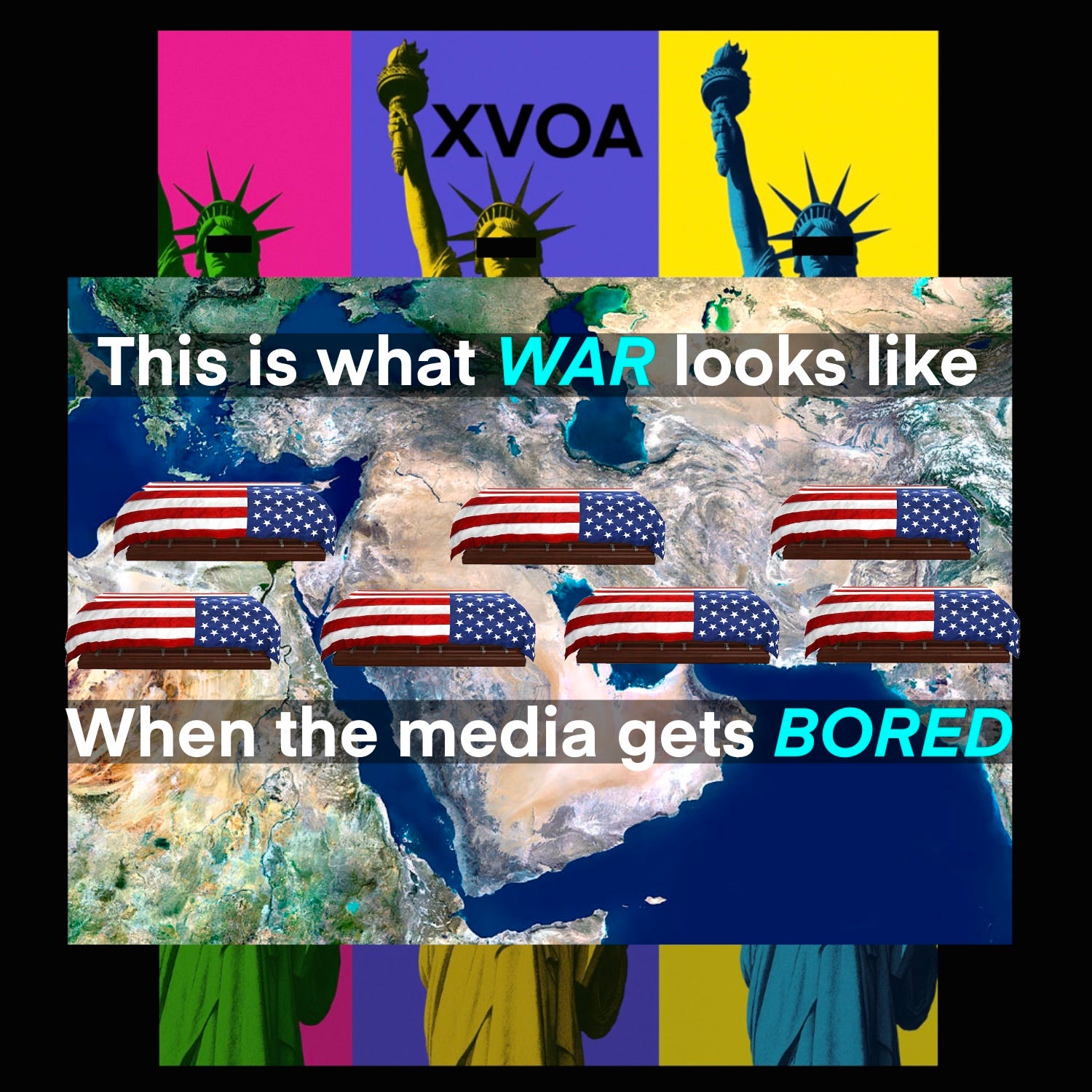
BREAKING: Seven American service members are now officially dead in Operation Epic Fury [3]. The latest was Sgt. Benjamin N. Pennington, 26, of Glendale, Kentucky, who died on March 8 from wounds he suffered in a March 1 enemy attack at Prince Sultan Air Base in Saudi Arabia [4]. The bigger story tonight is not only that the death happened. It is that the seventh American death in a widening war did not hit this country with anything close to front-page national urgency [3][4].
TLDR
The official U.S. combat death count in Operation Epic Fury climbed from 3 on March 1 to 6 on March 2, then to 7 on March 8. Pennington was identified on March 9 [1][2][3][4].
Major outlets did report the seventh death, but many placed it inside live blogs, rolling updates, or bigger stories about oil and Iran’s leadership, not as a main headline [9][10][11][12][13].
The first six deaths already raised major questions about troop protection. AP reported those soldiers were killed at a vulnerable operations center inside a civilian port in Kuwait [5][6][7][8].
The real danger is not only underreporting. It is normalization. Vietnam taught how a war can turn into a running count that people absorb without really feeling [16][17].
If this piece is making you uneasy, good. It should. Restack it, share it, and send it to one person who still thinks troop deaths automatically become front-page news in this country.
And if you want more reporting like this from a newsroom that answers to readers instead of the scroll, become a paid subscriber. Paid subscriptions buy me time to keep digging after the headlines move on.
Why This Felt Buried
I did four years in the military before I ever wore a police uniform, and later as a police officer I stood at funerals for men I served beside on the civilian side. So when I first saw this development through Al Jazeera [12], it did not feel like just another item in the feed. It hit me with the old weight that death notices carry when you know what a folded flag, a stunned family, and a line of uniforms can mean. That matters. Not because American outlets said nothing, but because too many of them treated the death like background material instead of a national alarm [9][10][11][12][13]. Al Jazeera gave it a clear subsection [12]. The Guardian put it in a live blog [11]. Reuters tucked it inside a broader story about Iran’s new supreme leader and oil prices [9]. The Washington Post placed it inside a rolling “latest” roundup [10]. Military Times, to its credit, treated it like what it was: a headline [13].
What We Know Tonight
What we know tonight is clear enough on the basic facts. On March 1, U.S. Central Command said three service members had been killed in action and five were seriously wounded [1]. By 4 p.m. on March 2, the official death toll had risen to six after U.S. forces recovered the remains of two previously unaccounted-for service members from a struck facility [2]. On March 8, CENTCOM announced that another service member, badly wounded in Saudi Arabia on March 1, had died [3]. On March 9, the Department of War identified him as Pennington and said the incident remains under investigation [4].
Seen as a timeline, the climb from three dead to six to seven hits harder than a running paragraph.


The First Six Deaths in Kuwait
The first six deaths came in Kuwait, and those circumstances should have set off louder alarms all by themselves. The Department of War said four Army Reserve soldiers from the 103rd Sustainment Command were killed at Port Shuaiba on March 1 in an unmanned aircraft system attack [5]. The next day, the Pentagon identified Maj. Jeffrey R. O’Brien [6] and said Chief Warrant Officer 3 Robert M. Marzan was believed to have been killed there as well, pending final positive identification [7].
Then the Associated Press added a detail that should still be bothering people in Washington. AP reported that the operations center hit at Port Shuaiba sat inside a civilian seaport, miles from the main Army base [8]. A spouse of one of the dead described it as a container-style building with no real defenses [8]. Satellite imagery reviewed by AP showed the site destroyed [8]. That is not just battlefield tragedy. That is a question about force protection, planning, and whether American troops were placed in a vulnerable position in a war the public was told would be controlled and decisive [8].
The Saudi Arabia Questions
Now look at the Saudi Arabia piece of the story, the one that killed Pennington. The official releases tell us where he was wounded, when he was wounded, and when he died [3][4]. They do not tell us what got through the defenses at Prince Sultan Air Base, what kind of strike this was, whether the fatal injuries came from a direct hit or fragmentation, or how the medical evacuation unfolded over the following week [3][4]. Your research memo is right on this point: the public has location and dates, but not the operational mechanics [3][4].
How the Coverage Got Backgrounded
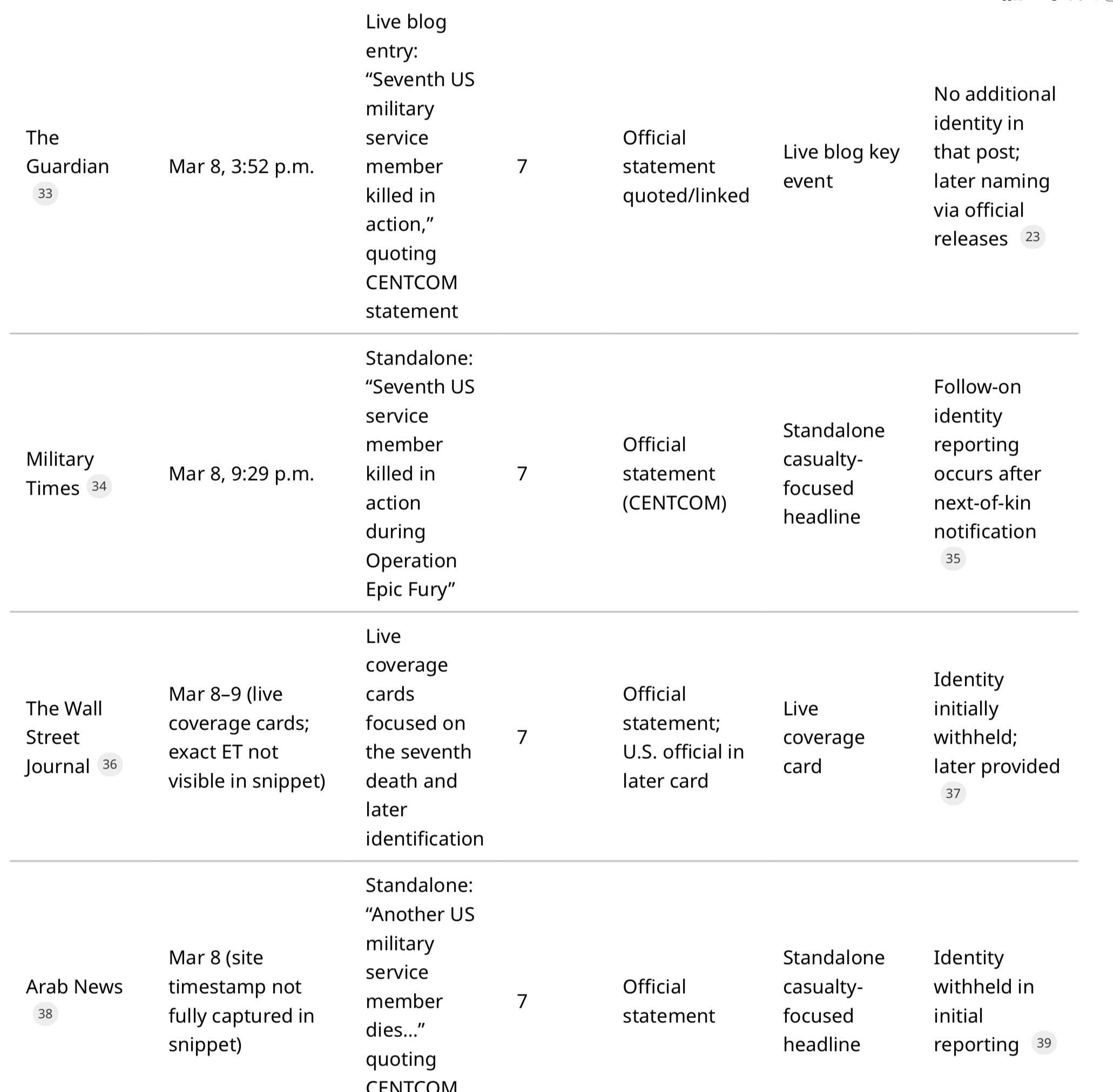
That is where the media question starts. This was not a blackout. It was something quieter and, in some ways, more dangerous. It was backgrounding. Reuters mentioned the death inside a broader story about Iran’s leadership change and surging oil prices [9]. The Post’s roundup placed the seventh death as one item in a larger stream of updates [10]. The Guardian’s live blog made it a key event [11]. Al Jazeera also folded it into a larger politics-and-war story, even while giving the development its own short section [12]. Military Times, a military-focused outlet, treated the death as a standalone headline from the start [13].
Put those outlets side by side and the pattern stops feeling subjective.



Why Placement Matters
That difference in placement matters. Placement is not cosmetic. Placement tells the audience what deserves to stop the scroll. A troop death on a battlefield can appear on a page without ever truly arriving in the public mind. When a seventh American death sits under oil spikes, leadership intrigue, market fear, and diplomatic churn, the reader is being taught, softly but clearly, that this loss is part of the wallpaper [9][10][11][12]. Published is not the same thing as elevated. Seen is not the same thing as felt.
The War Is Already Spreading
And there is another reason this deserves more than a passing mention. The battlefield is already spreading. The Wall Street Journal reported that nine U.S. service members have been seriously wounded across several countries, including Bahrain, Saudi Arabia, Kuwait, Jordan, Qatar, and the United Arab Emirates [14]. That means this is not one bad day at one base. This is a regional war footprint with a widening human cost, and the public is still receiving much of it in fragments [14].
The Vietnam Warning
This is where the Vietnam echo starts to creep in. Vietnam was not only a military wound. It was also a lesson in what happens when war gets translated into numbers, recurring counts, and official metrics that the public can take in without fully taking seriously [16][17]. The old body-count logic helped create a credibility gap [16]. It trained the country to live inside a rolling arithmetic of loss while trust in official narratives kept slipping [16][17]. Historians still point to how casualty reporting and body-count thinking distorted public understanding of that war and deepened distrust when reality broke through [16][17].
The Numbness Problem
That is my concern here. We may be watching the early stages of a new emotional immunity. Not wisdom. Not steadiness. Immunity. Seven killed. Scroll. Oil up. Scroll. New supreme leader in Iran. Scroll. Embassy drawdown. Scroll. Another strike somewhere else. Scroll. A country does not become numb all at once. It becomes numb by repetition, by framing, by editorial triage, and by the quiet conversion of death into update language [9][10][11][12][16].
The Counting Problem
There is also a counting problem starting to show up around the edges, and that should worry people too. Al Jazeera’s AJLabs tracker now lists eight U.S. soldiers dead [15]. But CENTCOM’s official combat death count tied to the March 8 announcement remains seven killed in action [3]. A likely explanation is that some tallies are blending those seven combat deaths with the separate death of Maj. Sorffly Davius, a National Guard officer who died in Kuwait in a non-combat incident while supporting a different operation [15]. That is an inference, not an official reconciliation, but it shows how quickly clarity can slip once a war starts producing overlapping counts, different categories of death, and fast-moving headlines [15].
A clean count table here would help readers see the official sequence before they hit the fight over seven versus eight.


The Real Question
So the question is not only whether mainstream outlets reported the seventh death. Many of them did [9][10][11][12][13]. The question is whether they reported it in a way that told the truth about its weight. Seven Americans are dead in this operation [3][4]. At least nine more have been reported seriously wounded [14]. The first six died in a vulnerable site at a civilian port in Kuwait [5][6][7][8]. The seventh died after a week-long fight to survive wounds suffered in Saudi Arabia [4]. If that can be folded into the background of a news cycle this early, then the warning light is already flashing [9][10][11][12][13].

Before This Becomes Normal
If you do not want this kind of story buried in the scroll, help me keep pulling it back out. Become a paid subscriber if you want this newsroom digging after the headlines move on
And if a full subscription is not your move right now Buy Me a Coffee lets you support the work with a one-time contribution. Either way, you are helping me keep reporting for readers instead of advertisers, and that matters more than ever.
Sources
CENTCOM, March 1 update — official statement saying 3 U.S. service members were killed in action and 5 were seriously wounded. (centcom.mil)
CENTCOM, March 2 update — official statement saying the death toll rose to 6 after two previously unaccounted-for service members were recovered. (centcom.mil)
CENTCOM, March 8 update — official statement announcing a seventh service member died from wounds suffered in the March 1 Saudi attack. (centcom.mil)
Department of War, March 9 release — official identification of Sgt. Benjamin N. Pennington and confirmation that the incident is under investigation. (war.gov)
Department of War, March 3 release — official identification of four soldiers killed at Port Shuaiba, Kuwait, in a drone attack. (war.gov)
Department of War, March 4 release — official identification of Maj. Jeffrey R. O’Brien. (war.gov)
Department of War, March 4 release — official notice that CW3 Robert M. Marzan was believed killed pending positive identification. (war.gov)
Associated Press reporting on Port Shuaiba — report describing the site as a vulnerable operations center inside a civilian port, supported by satellite imagery and family testimony. (washingtonpost.com)
Reuters broader war/oil story — example of the seventh death being included inside a larger story about Iran’s new leader and oil prices. (reuters.com)
Washington Post “latest” roundup — example of the death appearing inside rolling coverage rather than as a standalone main story. (washingtonpost.com)
The Guardian live blog — example of the seventh death treated as a key event inside live coverage. (theguardian.com)
Al Jazeera article — article that gave the development a dedicated subsection while still embedding it inside a broader war story. (aljazeera.com)
Military Times — casualty-focused standalone headline and follow-up identification report. (armytimes.com)
Wall Street Journal live coverage — report that 9 U.S. service members have been seriously wounded across several countries in the region. (wsj.com)
AJLabs and Davius reporting — sources showing the emerging 7-versus-8 discrepancy and a likely non-combat explanation involving Maj. Sorffly Davius. (aljazeera.com) (news.usni.org)
Columbia Journalism Review — background on Vietnam’s body-count logic and the credibility gap it helped create. (cjr.org)
National Geographic History — overview of the Vietnam War’s casualty controversy and long tail of distrust and trauma. (nationalgeographic.com)
I'm finding it very, very difficult to know what to say, what to write. But I wanted you to know I read your story and I appreciate what you do. This is exhausting, life draining, soul draining...deeply frightening with every hour that passes. The delusion of this administration and Republicans in congress is egregious and horrifying.
Kudos to all of the independent journalists here and on podcasts. Thank you all. We need you now more than ever.