

Personal Statement
I’m trying to write this like a journalist and not like a man who’s furious. I’m a retired cop. I’ve stood in front of citizens who had a gun on them, and citizens I only suspected had one, and I never fired a shot. You slow it down. You create distance. You communicate. You choose time over ego.
What I’m seeing in the early reporting and the bystander video does not sit right with me.[3][4] If the facts ultimately match what’s being laid out here, a U.S. citizen, legally armed, tackled into a pile-on, and then shot, then somebody needs to answer for that.[2][3][5] Not a press release. Not a union statement. Accountability, through a real investigation, and consequences if policy or judgment failed.
I’m going to keep this professional, because that’s what you do when a city is on the edge. But understand this. I’m having to actively swallow my rage to do it.
Incident Overview
City officials confirm that federal agents shot and killed a man in south Minneapolis on the morning of Saturday, January 24, 2026[5]. The confrontation took place near the intersection of Nicollet Avenue and West 26th Street around 9:00 a.m., amid frigid subzero temperatures[3]. Minneapolis police responded to find a male victim with multiple gunshot wounds; he was transported to Hennepin County Medical Center, where he was pronounced dead[2]. Authorities described the episode as part of an ongoing immigration enforcement operation by the Department of Homeland Security (DHS) in the city[2].
This fatal shooting is the latest in a string of violent clashes between federal agents and Minneapolis residents in recent weeks. Less than three weeks earlier, on January 7, a U.S. Immigration and Customs Enforcement (ICE) officer fatally shot 37-year-old Renee Good, a Minneapolis woman, during a traffic stop — an incident that sparked citywide protests[3]. Another encounter on January 14 resulted in an individual being wounded by ICE agents after a pursuit[5]. The January 24 shooting marks the third such federal agent-involved shooting in Minneapolis this month[5], contributing to a volatile atmosphere and heightened public scrutiny.
TLDR
Federal agents shot and killed a 37-year-old Minneapolis man during a DHS immigration operation on Saturday, January 24, 2026. Minneapolis police say they believe he was a U.S. citizen and legally permitted to carry.[2][5]
This is being described as the third federal agent involved shooting in Minneapolis this month, after the Jan. 7 killing of Renee Good and a Jan. 14 shooting that wounded another person.[3][5]
DHS says the man approached agents armed, resisted disarmament, and an agent fired in self-defense. Local officials say bystander video raises hard questions about what happened at the exact moment shots were fired.[2][3][4]
The Minnesota BCA is involved, with federal presence at the scene. Expect the investigation to hinge on video, commands given, and whether the weapon was in-hand or controlled when force was used.[3][5]
Walz, Frey, and Klobuchar are demanding the operation end and federal agents leave. Trump is defending the crackdown and accusing Minnesota leadership of incitement.[7][10][11]
The shooting triggered immediate protests, barricades, and crowd-control responses. The short-term risk is escalation while facts are still contested.[1][2][3][4]
If this helped you understand what’s happening, do the obvious: restack, share, and yes, share it on Facebook. If you’re still hovering over the paid button, step off the fence. I work for you. This is indie media. Nuff said:
Victim Identification and Background
Officials have not yet released the name of the victim as of the latest reports[4]. Minneapolis Police Chief Brian O’Hara described the man as a 37-year-old white male and a resident of Minneapolis[2]. Notably, O’Hara stated “we believe he is an American citizen,” emphasizing that the man was reportedly a U.S. citizen with a legal permit to carry a handgun[2]. The victim had no significant criminal history; police said his only prior interactions with law enforcement were minor traffic violations[1][3]. In other words, aside from a traffic ticket or two, he had no record of violent or serious crimes[4]. These details have been highlighted by local leaders given the context that he was killed during a federal operation ostensibly targeting dangerous fugitives.
While the man’s exact activities at the time of the shooting are still under investigation, multiple accounts suggest he was present at the scene of an ongoing ICE enforcement action when the confrontation occurred. Some local media reports have characterized the victim as a possible bystander or protester who became involved in a scuffle with the agents[3]. However, the precise sequence of events and the man’s intentions remain unclear pending further investigation.
Law Enforcement and Official Narratives
DHS Account of the Shooting: According to a statement from the Department of Homeland Security, federal officers were in Minneapolis conducting a “targeted operation” against a suspect described as an “illegal alien wanted for violent assault” on Saturday morning[2]. During this operation, an armed individual allegedly approached the U.S. Border Patrol agents on the scene with a 9mm semi-automatic handgun[2]. DHS officials claim the agents attempted to disarm the man, but he “violently resisted”, leading to a struggle[2]. Fearing for their safety, one agent (a Border Patrol officer with eight years of service) then fired what DHS characterized as “defensive shots,” fatally wounding the armed man[4]. Medics on site attempted life-saving measures, but the individual was pronounced dead shortly after[2]. DHS reported that a loaded firearm and two additional ammunition magazines were recovered from the suspect, suggesting he was capable of inflicting “maximum damage,” according to officials[5][5]. This DHS narrative implies that the agents acted in self-defense in the face of an immediate threat.
At an afternoon press briefing, Border Patrol Commander-at-Large Greg Bovino reiterated the DHS version of events and stressed that the officer who fired the shots was “highly trained”, having served 8 years in the Border Patrol[3]. Bovino stated that federal law enforcement in Minneapolis has been “under attack” amid recent unrest, and he insisted that agents fired only in defense when confronted by an armed suspect[3][3]. He declined to answer questions about video evidence that appeared to conflict with the official account, telling reporters that the situation was still evolving and more information would be forthcoming[3][3]. DHS officials likewise noted that the incident is under active review, acknowledging that details are still being gathered as part of the ongoing investigation[2].
Local Authorities and Conflicting Evidence: Minneapolis Police Chief Brian O’Hara provided a cautious account, indicating that local law enforcement had limited information initially about what led to the shooting[4]. O’Hara confirmed that multiple federal agents discharged their weapons during the altercation (suggesting more than one agent may have fired shots)[2]. He also revealed that he has seen video footage of the incident and is aware of public questions about the agents’ conduct[2]. In fact, several bystander videos circulating on social media appear to show portions of the confrontation. According to reporting by WCCO CBS Minnesota, these videos show the man before the shooting without a gun in his hands, and they capture federal agents tackling him to the ground[3]. Amid a pile-on involving as many as six to seven agents, flashes and struggles can be seen, followed by the sound of gunshots raising serious questions about whether the victim had actually brandished a weapon or posed an imminent lethal threat at the moment he was shot[4][4]. This apparent discrepancy between the DHS narrative and the video evidence is a central focus of public concern.
Chief O’Hara has urged the importance of a thorough, independent investigation. He announced that the Minnesota Bureau of Criminal Apprehension (BCA) which is the state investigative agency typically tasked with officer-involved shootings was on the scene gathering evidence, alongside agents from the FBI[3]. O’Hara made it clear that Minneapolis police would preserve the scene and evidence but would defer primary investigatory authority to the BCA in order to ensure transparency[5][5]. “Our demand today is for those federal agencies operating in our city to do so with the same discipline, humanity and integrity that effective law enforcement in this country demands,” O’Hara said, pointedly calling on the federal officers to uphold professional standards[4]. He also appealed for calm in the community, acknowledging the anger over what happened but warning that violence or destruction would only compound the tragedy[2].
Border Patrol Union Response: In the aftermath, the Border Patrol agents’ union issued a forceful statement defending the actions of the officers and blaming outside rhetoric for the confrontation. Posted on social media, the union’s statement argued that Border Patrol agents are “trained extremely well to protect themselves, their fellow agents, and innocent third parties.” It contended that when a supposedly “peaceful” protester brings a weapon (such as a loaded handgun) and brandishes it, severe consequences are inevitable[9]. The union accused “irresponsible, hate-filled and false rhetoric” from media and politicians of inciting protesters to recklessly confront law enforcement, thereby endangering lives[9]. “They have encouraged these reckless confrontations and attacks on our agents… The fake and dishonest media and the shameless politicians should be held accountable,” the statement reads, asserting that the agents’ use of force will be found justified once all facts are known[9][9]. This unusually blunt statement from the union underscores the deep tensions between federal law enforcement and local leaders/activists, even as formal investigations into the shooting are just beginning.
Reactions from Officials and Leaders
State and City Leaders Condemn the Killing: Minnesota’s top elected officials reacted swiftly with outrage and demands for accountability. Governor Tim Walz called the incident “sickening,” declaring, “Minnesota has had it” with the ongoing federal crackdown[7]. Walz announced that he had been in contact with the White House and emphatically urged President Donald Trump to halt the DHS operation in Minnesota. “The President must end this operation. Pull the thousands of violent, untrained officers out of Minnesota. Now,” Walz said in a social media post[7]. He insisted that the state must be allowed to lead the investigation into the shooting to ensure credibility and justice[5]. The governor had already put the Minnesota National Guard on standby earlier in the month, and on Saturday he reinforced that measure by requesting Guard support to help local law enforcement manage the situation and prevent further unrest[3][3]. “Let state investigators secure justice… The State has the personnel to keep people safe — federal agents must not obstruct our ability to do so,” Walz said, underscoring his view that federal authorities need to step back[5][5].
Minneapolis Mayor Jacob Frey likewise denounced the actions of the federal agents and the continued presence of militarized federal operations in the city. In a press conference, an visibly angered Frey reported that he had seen a video of the incident which showed “more than six masked agents pummeling one of our constituents and shooting him to death.” He posed a furious question: “How many more residents? How many more Americans need to die or get badly hurt for this operation to end?”[2]. Mayor Frey asserted that the Trump administration’s deployment of federal tactical teams was doing far more harm than good in Minneapolis, and he joined the governor in calling for the immediate withdrawal of ICE and Border Patrol units from the city[2][2]. Frey contrasted the federal agents’ violent tactics with the restraint shown by local citizens, noting that just one day earlier an estimated 15,000 people had marched peacefully in frigid weather to protest the immigration raids “without a single broken window, not a single injury” reported[2]. The mayor implored President Trump to “act like a leader” and end the operation, saying, “Put Minneapolis, put America first in this moment… Let’s end this operation, and I’m telling you, our city will come back; safety will be restored.”[3][3]. Both Walz and Frey emphasized that Minneapolis residents are not the enemy and that heavy-handed federal interventions are unwelcome in their community.
Democratic Lawmakers and Officials: Other Democratic leaders in Minnesota and beyond echoed the outrage. U.S. Senator Amy Klobuchar (D-MN) took to social media to condemn the crackdown, imploring “Donald Trump and all your lieutenants who ordered this ICE surge: watch the horrific video of the killing today. The world is watching.” She described the situation on the ground: “Thousands of citizens [are being] stopped and harassed. Local police [are] no longer able to do their work. Kids hiding. Schools closed.” Senator Klobuchar’s message culminated in a demand: “Get ICE out of Minnesota NOW.”[10]. Her remarks underscore the view that the federal operation has created a climate of fear and disruption well beyond its stated targets.
In the Minnesota Legislature, House Democratic-Farmer-Labor Leader Zack Stephenson issued a blistering statement: “Another Minnesotan is dead at the hands of federal agents. And why?” He accused President Trump of pursuing a “drive for ‘retribution’” and asked, “How many people must die before [this is] satisfied?”[3]. Stephenson joined calls to “ICE must leave Minnesota now. Full stop.” and asserted that the state, not federal authorities, should investigate the shooting[3]. He insisted that anyone who broke Minnesota law be held accountable with “No ‘absolute immunity.’ No lies.”, signaling concern that federal agents might otherwise evade consequences[3]. These comments reflect a broad consensus among Minnesota’s Democratic officials that the federal crackdown is unjust, dangerous, and must be curtailed or terminated.
Republican and Federal Responses: Republican leaders, on the other hand, largely defended the federal law enforcement efforts and criticized local officials for fueling tensions. Minnesota House Speaker Lisa Demuth (R–Cold Spring) expressed heartbreak at the loss of life but cautioned that “too many political leaders [are] urging direct confrontation” with law enforcement, which she said was leading to dangerous situations[3]. She praised the thousands of Minnesotans who protested peacefully the day before, but warned that calls to disrupt federal operations and incidents like “throwing dangerous objects” at officers were unacceptable[3]. “We can have protest… But it’s going to take leadership at all levels of government to turn down the temperature,” Demuth said, implicitly rebuking officials like Frey and Walz for their heated rhetoric[3]. House Republican Leader Harry Niska (R–Ramsey) added that “demonization has put the lives of Minnesotans and law enforcement alike in danger”, arguing that efforts should focus on removing violent criminals while ensuring public safety, rather than “knee-jerk reactions” and confrontation[3].
Minnesota Congressman Tom Emmer, the House Majority Whip, released a statement saying he was “grateful no Border Patrol officers were harmed” in the Minneapolis incident[3]. Emmer pointedly did not mention the man who was killed. Instead, he blamed Governor Walz and other local officials for empowering “criminals” through their rhetoric, which he said “has made the situation in Minneapolis much worse.” Emmer chastised Democrats for jumping to conclusions and added, “Unlike my Democrat colleagues, I’m going to let law enforcement conduct their investigation and not jump to asinine conclusions.”[3][3]. This stance aligns with a broader Republican narrative that the federal agents are performing a necessary mission to restore law and order, and that local Democratic leaders are undermining that mission.
President Trump’s Response: As the conflict escalated, President Donald Trump weighed in personally, showcasing the rift between his administration and Minnesota officials. Early Saturday afternoon, Trump posted on his Truth Social platform accusing Governor Walz and Mayor Frey of “inciting insurrection” against federal authority[11]. He shared a photograph of the handgun that was recovered from the scene, writing that it was “ready to go” implying the suspect clearly posed a lethal threat[11]. The President alleged that Minneapolis police were “called off” and not protecting the federal officers, insinuating that local authorities had abdicated their responsibilities[11]. Trump lambasted Walz and Frey’s critiques as “pompous, dangerous, and arrogant rhetoric,” and claimed that their stance was emboldening violent agitators[11]. He also defended the ongoing operation by asserting that if the “12,000 Illegal Alien Criminals” targeted by federal agents were not arrested and removed, Minnesotans would soon witness “something far worse” unfolding in their streets[11]. The President’s combative response indicates that, from the federal perspective, there is no intent to back down; instead, Trump is doubling down on the narrative that the crackdown is necessary to combat lawlessness, and painting local leaders’ opposition as a dangerous revolt against lawful authority.
Community Response and Protests
The shooting immediately spurred a furious community reaction in the surrounding neighborhood. Within hours, a crowd of Minneapolis residents and protesters converged at the taped-off scene on 26th & Nicollet, shouting in anger at the line of federal agents still present[1]. Eyewitnesses describe a tense and emotional atmosphere — people yelled “cowards!” at the agents and demanded they “go home”, expressing outrage that a local man had been gunned down on their street[1]. Some bystanders confronted the agents up close, venting their grief and fury. In one recorded moment, as officers withdrew, a protester berated them only to receive a sarcastic retort from an agent who said “Boo hoo” mockingly while walking away[1]. The crowd’s anger was palpable, and many held up phones to record the encounter, determined to hold authorities accountable.
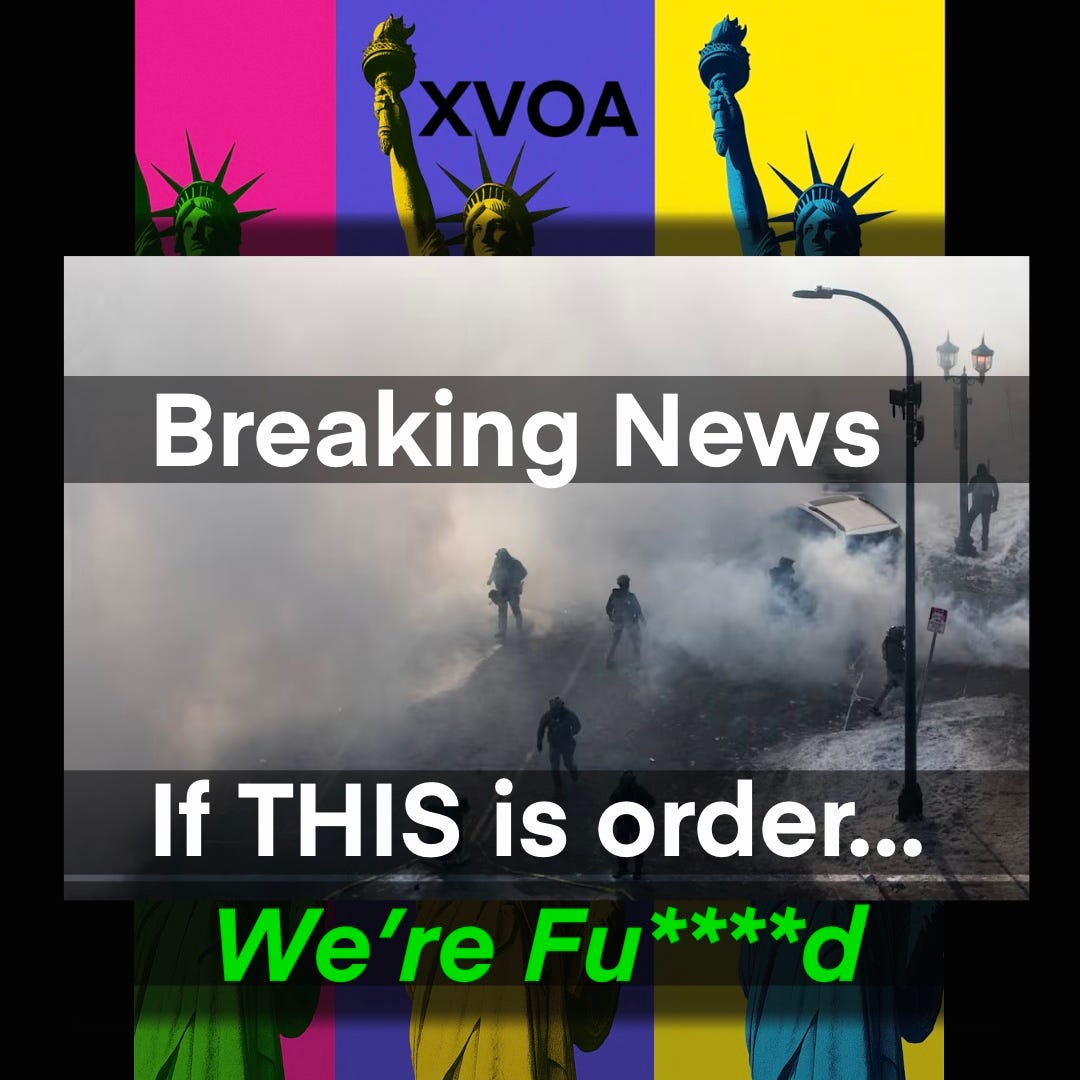
As more people arrived, the situation grew volatile. Protesters began chanting slogans like “ICE out now!”, voicing their demand for federal immigration agents to leave their city[4][4]. Some in the crowd dragged garbage dumpsters and other debris into the street to form makeshift barricades near the site of the shooting[2][4]. A dumpster was set ablaze, sending smoke into the freezing air[2]. Federal enforcement units — many wearing tactical gear and some with their faces masked — responded with crowd-control weapons. They deployed chemical irritants (tear gas) and stun grenades (flash-bangs) in an effort to disperse the crowd and secure the area[2][4]. The confrontation at the scene was chaotic: amid shouting and clouds of tear gas, protesters were seen scrambling and coughing, while lines of agents advanced behind riot shields. Despite the show of force, the crowd at times stood their ground, continuing to yell slogans and hurl insults at the agents. In one scuffle, federal officers tackled a protester to the ground and detained him, an incident captured in bystander video that further inflamed onlookers[2]. Other videos showed agents shoving demonstrators and swinging batons as they moved to clear the area[4]. The immediate outcry over the shooting thus escalated into a physical confrontation between an enraged community and the federal forces operating in the city.
Public Protests and Unrest: By late morning, Minneapolis police and state authorities declared the gathering an “unlawful assembly”, warning that anyone refusing to disperse would be subject to arrest[1]. Officers from the Minnesota State Patrol, who had been called in for support, used loudspeakers to urge the crowd to leave the area for everyone’s safety[1]. Tensions gradually eased after noon as many protesters dispersed to avoid arrest or further injury, but the anger in the community continued to simmer. The events of January 24 occurred against a backdrop of sustained demonstrations in the Twin Cities. Since the killing of Renee Good on Jan. 7, activists and residents had been holding near-daily protests demanding justice and an end to the federal immigration raids “without a single broken window, not a single injury” reported[4][2]. That protest remained entirely peaceful with no violence or vandalism that was reported. City leaders have cited this as evidence that the community can express its grievances responsibly[2]. However, the shock of a second fatal shooting by federal agents drastically heightened emotions. “They’re killing my neighbors!” one Minneapolis resident shouted during Saturday’s chaos, encapsulating the fear and fury many locals feel[4]. In residential neighborhoods, some families reportedly kept children indoors as news of the incident spread, heeding safety advisories as sirens and helicopters roared in the distance[2]. Community organizations and mutual aid groups have been mobilizing to support those traumatized by the violence, and to maintain pressure for accountability.
Local civil rights activists and neighborhood leaders are working to maintain peace amid the protests, but also emphasize that the community’s outrage is justified. They point to the fact that both people killed by the DHS operation so far (Renee Good and the unnamed man on Jan. 24) were U.S. citizens, not the “violent criminals” that the crackdown ostensibly targets[4][4]. This has galvanized a diverse coalition of immigration advocates, faith leaders, and ordinary citizens to protest what they see as an overly aggressive campaign that endangers the public. Some protesters have adopted the slogan “Not One More,” vowing to continue demonstrations every day until the federal agents leave Minneapolis or are held accountable.
Emergency Measures and Calls for Calm: Anticipating that unrest could continue, local authorities have taken steps to bolster security while urging nonviolence. Hennepin County Sheriff Dawanna Witt announced that she has requested assistance from the Minnesota National Guard “due to the potential for continuing and growing conflict” after this latest shooting[3]. National Guard units had already been on standby by order of Governor Walz in the wake of the Jan. 7 incident, and now they may be deployed to support law enforcement at key locations such as the Whipple Federal Building (ICE’s local headquarters) where protesters frequently gather[3][3]. “Their job will be to assist… in protecting life, preserving property, and helping to ensure the safety of all community members,” the Sheriff’s Office said in a statement, emphasizing that the Guard’s presence is “meant to help create a secure environment where all Minnesotans can exercise their rights safely, including the right to peacefully protest.”[3]. City and state officials have repeatedly stressed that they respect the public’s right to protest, and Minneapolis has facilitated numerous large demonstrations in recent years. At the same time, leaders are pleading with protesters to remain peaceful and avoid any actions that could lead to further injuries or a heavy-handed crackdown[3]. “We urge all actions to remain peaceful and lawful,” the Hennepin County Sheriff’s statement read, reflecting a widely shared sentiment among local leaders and community organizers[3]. Minneapolis Police Chief O’Hara added, “Please, do not destroy our own city,” appealing to residents’ sense of community even as he affirmed their anger is understood[2].
So far, there have been only scattered reports of arrests in connection with the Jan. 24 protests, and city officials are hoping to de-escalate the situation through dialogue and patience. Community mediation teams and legal observers have also been present at protest sites to help reduce tensions. Nonetheless, with emotion running high and federal agents still active on the streets, Minneapolis remains in a precarious state, bracing for what the next days might bring.
Wider Implications and Next Steps
Clash Over Immigration Crackdown Policy: This incident has cast a national spotlight on the power struggle between local authorities and federal immigration enforcement. The Department of Homeland Security has touted the Minneapolis operation as part of the “largest-ever immigration enforcement” initiative, reportedly aimed at apprehending thousands of undocumented individuals with criminal warrants[4]. President Trump and his allies frame it as a necessary campaign to remove dangerous individuals and restore order[11]. However, the operation’s execution in Minneapolis is increasingly being seen as a case study in unintended consequences. Local officials argue that the federal agents, many imported from other regions, lack knowledge of the community and have employed militarized tactics that are terrorizing residents[2][2]. The fact that both people killed by federal officers this month were U.S. citizens with little to no criminal history is a stark indictment in the eyes of Minnesota leaders[4][4]. Far from “the worst of the worst” criminals President Trump said his crackdown would target, Renee Good was a U.S. citizen… never charged with anything beyond a traffic ticket, the Associated Press noted pointedly[4]. The same appears true of the latest victim, a legal gun owner with only minor infractions[1][3]. These outcomes are intensifying calls to reassess the scope and methods of the federal operation. Elected officials in Minnesota are openly questioning whether the campaign is actually making the community safer, or if it is instead eroding public trust and inflaming social divisions.
Legal and Accountability Questions
The incident is also raising complex questions about jurisdiction and accountability when federal officers use deadly force. Governor Walz and other state leaders have been adamant that Minnesota’s own law enforcement agencies (such as the BCA) must lead the investigation into the shooting[5]. This suggests a lack of confidence in federal agencies policing themselves, especially after DHS initially characterized the Jan. 7 shooting of Renee Good as justified — a narrative widely disputed by local witnesses and video evidence[4][4]. By inserting the BCA and even the FBI into the inquiry, Minnesota officials are signaling that if the federal agents acted unlawfully, the state is prepared to pursue consequences. State Representative Zack Stephenson’s insistence of “No ‘absolute immunity.’… Justice and peace. Now.” speaks to a growing sentiment that federal agents should not be above the law of the state in which they operate[3]. However, holding federal officers accountable in a state venue could lead to untested legal territory. Typically, federal law enforcement officers enjoy certain immunities under the Supremacy Clause if they were performing their federal duties in good faith. Minnesota’s leaders may seek ways to challenge those protections if egregious misconduct is proven, potentially setting up a legal showdown between state and federal authority. At minimum, public officials are pressing for full transparency to include the release of all body-cam or surveillance footage (if any exists) and independent oversight of the investigation.
Continued Unrest and Political Ramifications: In the coming days, Minneapolis and its surrounding communities are likely to see continued protests and public demonstrations. Community groups have already planned vigils for the deceased man and rallies to demand that “ICE Out of MN”, a slogan that has trended locally, becomes a reality. There is concern that if the federal crackdown isn’t halted, the cycle of confrontation could escalate. Minneapolis is a city still healing from the 2020 killing of George Floyd by a police officer, an event that sparked global protests. While the current situation involves federal agents rather than city police, the public’s trust in law enforcement is fragile and the optics of armed officers clashing with citizens in the streets are drawing uncomfortable parallels[4][4]. “This is not sustainable,” Chief O’Hara warned, reflecting fears that without a change of course, something could spiral out of control[3].
On a national level, the Minneapolis incident is feeding into a broader debate about the balance between immigration enforcement and civil liberties. Supporters of the Trump administration’s operation argue it is addressing lawlessness and making communities safer by removing dangerous individuals. But the deaths of U.S. citizens like Good and the unnamed man have become rallying points for those who argue the strategy is overzealous and inhumane. Legal advocacy groups (such as the ACLU and immigrant rights organizations) are reportedly monitoring the situation and could file lawsuits on behalf of victims’ families or the community, alleging violations of constitutional rights. Minneapolis’s City Council is also under pressure from activists to explore legal avenues to limit the actions of federal agents within city limits, though municipal authority to do so is limited.
In the immediate term, all eyes are on the investigation’s findings. Key questions such as whether the victim actually pointed or fired a gun, whether agents gave adequate warning, and whether use of lethal force was justified will determine the next steps. If evidence shows the agents acted improperly, there will be calls for their prosecution or disciplinary action. If the shooting is ruled justified by authorities, it could further fuel public anger and distrust. Either outcome is likely to have policy implications: for instance, there could be renewed efforts at the state level to curtail cooperation with federal immigration enforcement or to require that federal officers wear body cameras (a measure already proposed by some legislators in response to the earlier shooting)[4][4].
Conclusion
For now, Minneapolis remains in a state of tense uncertainty. The immediate crisis is being managed day by day with a heavy law enforcement presence and passionate street protests. In the background, a larger conversation is unfolding about how to prevent such tragedies in the future. Governor Walz summarized the sentiments of many when he said, “Minnesota has had enough.” The coming days will test whether federal authorities alter their tactics and whether community outrage can be channeled into constructive change. The story is still developing, and more information including the identity and personal story of the man who lost his life is expected to emerge as journalists and investigators continue to dig into what exactly happened and why[1]. For a community already shaken by one controversial killing, this latest tragedy has become a touchstone event, prompting difficult questions about public safety, immigrant rights, and the limits of federal power in American cities.
If you’re reading this, you’ve already seen the difference. I do this work full-time, 24/7, for you and not for a network, not for a billionaire, not for access. This is independent media. Step up and support it with a paid membership:
Sources
ABC News (live updates): Minneapolis ICE shooting — https://abcnews.go.com/US/live-updates/minneapolis-ice-shooting-live-updates-doj-investigating-apparent/?id=129340693
FOX 9 (live updates): Minneapolis shooting — https://www.fox9.com/news/ice-mn-third-federal-agents-shooting-minneapolis
CBS Minnesota / WCCO (live updates): Federal agents fatally shoot another Minneapolis resident — https://www.cbsnews.com/minnesota/live-updates/reported-shooting-south-minneapolis-federal-agents-protesters/
Associated Press: Police chief calls for calm after man shot and killed during Minneapolis immigration crackdown — https://apnews.com/article/4d1499fc5962ab880f3816259e04bdbf
KSTP 5 Eyewitness News: Police: 37-year-old US citizen shot, killed by federal agents in Minneapolis — https://kstp.com/kstp-news/top-news/man-dead-in-minneapolis-after-another-shooting-involving-federal-agents/
Los Angeles Times (AP syndication): Man shot and killed during Minneapolis immigration crackdown — https://www.latimes.com/world-nation/story/2026-01-24/federal-officers-shoot-another-person-in-minneapolis-governor-says
Gov. Tim Walz (X): “Minnesota has had it… Pull the thousands…” —

City of Minneapolis (X): Press conference livestream link —


Border Patrol Union – NBPC (X): Statement defending agents —

Sen. Amy Klobuchar (X): “Get ICE out of Minnesota NOW.” —

President Donald Trump (Truth Social): “inciting insurrection” post — https://truthsocial.com/%40realDonaldTrump/posts/115899252938886431
I'm a retired cop as well and you're doing a better job than I am atm of controlling your rage. Thanks for the thorough and sober coverage of what's happening. Like the Nicole Good shooting, ICE/Border Patrol appear to have instigated this event by pushing a woman to the ground who the victim was subsequently trying to protect. The only terrorists in Minneapolis right now are wearing masks and outfitted like they're invading Venezuela. There's even a video clip of one of the thugs clapping seconds after the last shot was fired. Unfortunately, with the entire federal apparatus standing fully behind their actions and condemning, again, the victim as a terrorist, we won't see justice anytime soon. Thanks for your reporting.
Say his name: Alex Jeffrey Pretti, an intensive-care nurse at the VA hospital.
And don't forget, these fascists are the same people promoting the carrying of firearms and making people feel they have to have one "to be safe."