

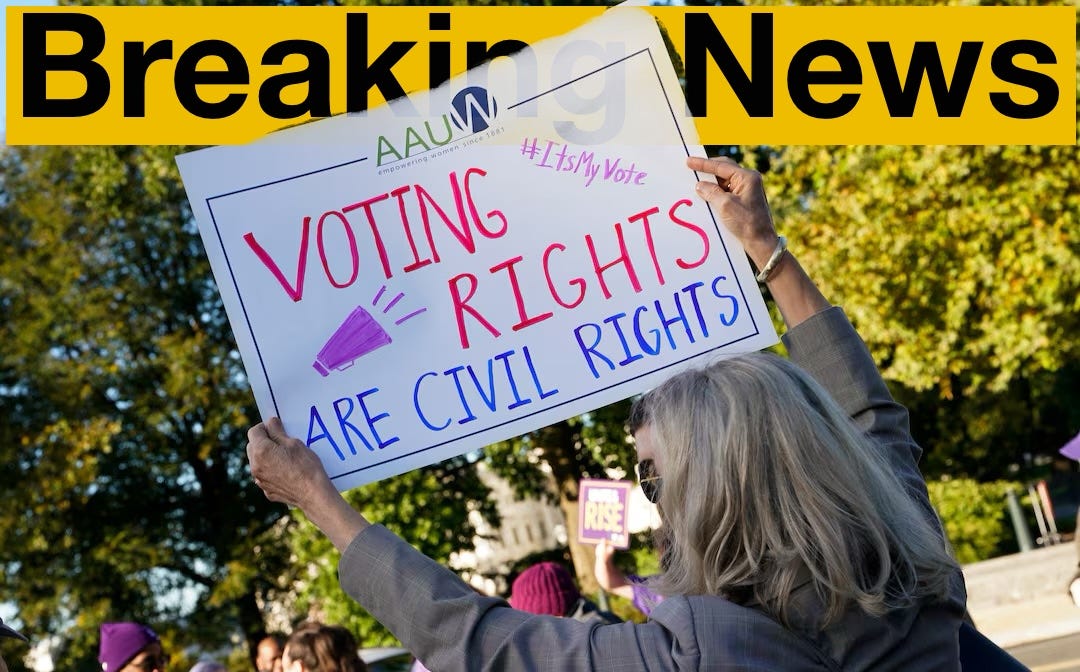
Louisiana officials say the state cannot proceed with congressional primaries under its current map after the Supreme Court struck down the map Wednesday in Louisiana v. Callais. Early voting had been scheduled to begin Saturday.
TLDR
Louisiana’s May congressional primaries have been suspended after the Supreme Court’s April 29 ruling in Louisiana v. Callais. State officials say the ruling prevents Louisiana from using its current congressional map. [1][3][4]
The Court struck down Louisiana’s map with two majority-Black congressional districts, holding that the map was an unconstitutional racial gerrymander. [1][2]
The practical effect was immediate: early voting was scheduled to begin Saturday, but Louisiana officials now say the state cannot run congressional elections under the current district lines. [3][4]
The issue is already national. Florida approved a new congressional map on April 29, and other states are moving or signaling action after the ruling. [5][6]
Sen. Lisa Blunt Rochester and journalist Garrison Hayes both warned that the ruling is part of a broader rollback of Black political power and voting rights. [7][11]
Restack it. Send it to one person. Put this in front of somebody who still thinks voting rights disappear only in history books.
And if you can afford it, become a paid subscriber first:
If a subscription is not possible today, buy me a coffee so this one-person newsroom can keep moving fast when the respectable outlets are still trying to find the softest possible word for the hard thing that just happened.
What Happened
Louisiana has suspended its May congressional primaries after the U.S. Supreme Court struck down the congressional map the state was preparing to use. [1][3]
The ruling came Wednesday, April 29, in Louisiana v. Callais. The Court held that Louisiana’s map, known as SB8, was an unconstitutional racial gerrymander because it created a second majority-Black congressional district. [1][2]
The next day, Louisiana officials said the state could not proceed with congressional elections under the current district lines. Early voting had been scheduled to begin Saturday, and the congressional primary had been scheduled for May 16. [3][4]
Gov. Jeff Landry and Attorney General Liz Murrill said the ruling ended the stay that had allowed Louisiana to use the current map. Once that stay ended, they said, Louisiana was legally prohibited from holding congressional elections under that map. [4]
The sequence is direct: the Supreme Court ruled on Wednesday, Louisiana officials said the current map could not be used, and the congressional primaries were suspended Thursday.
Why The Map Matters
Louisiana has six congressional districts. Black residents make up roughly one-third of the state’s population. After years of litigation under the Voting Rights Act, Louisiana adopted a map with two majority-Black congressional districts. [1][10]
Voting-rights plaintiffs had argued that the prior map diluted Black voting power by packing Black voters into one district while limiting their ability to elect candidates of their choice elsewhere. [10]
The map struck down Wednesday was intended to address that issue. The Supreme Court ruled that the map went too far because race predominated in the drawing of the district and the Voting Rights Act did not require the state to create that second majority-minority district. [1][2]
That ruling does not only affect legal theory. It immediately affected the election calendar. Louisiana now needs a legally usable congressional map before it can conduct congressional primaries. [3][4]
Sen. Lisa Blunt Rochester Linked The Ruling To Voting Rights History
Sen. Lisa Blunt Rochester, a Black senator from Delaware and a member of the Congressional Black Caucus, spoke at a Senate Democrats election-protection event on April 29, the day the ruling was issued. [7][8][9]
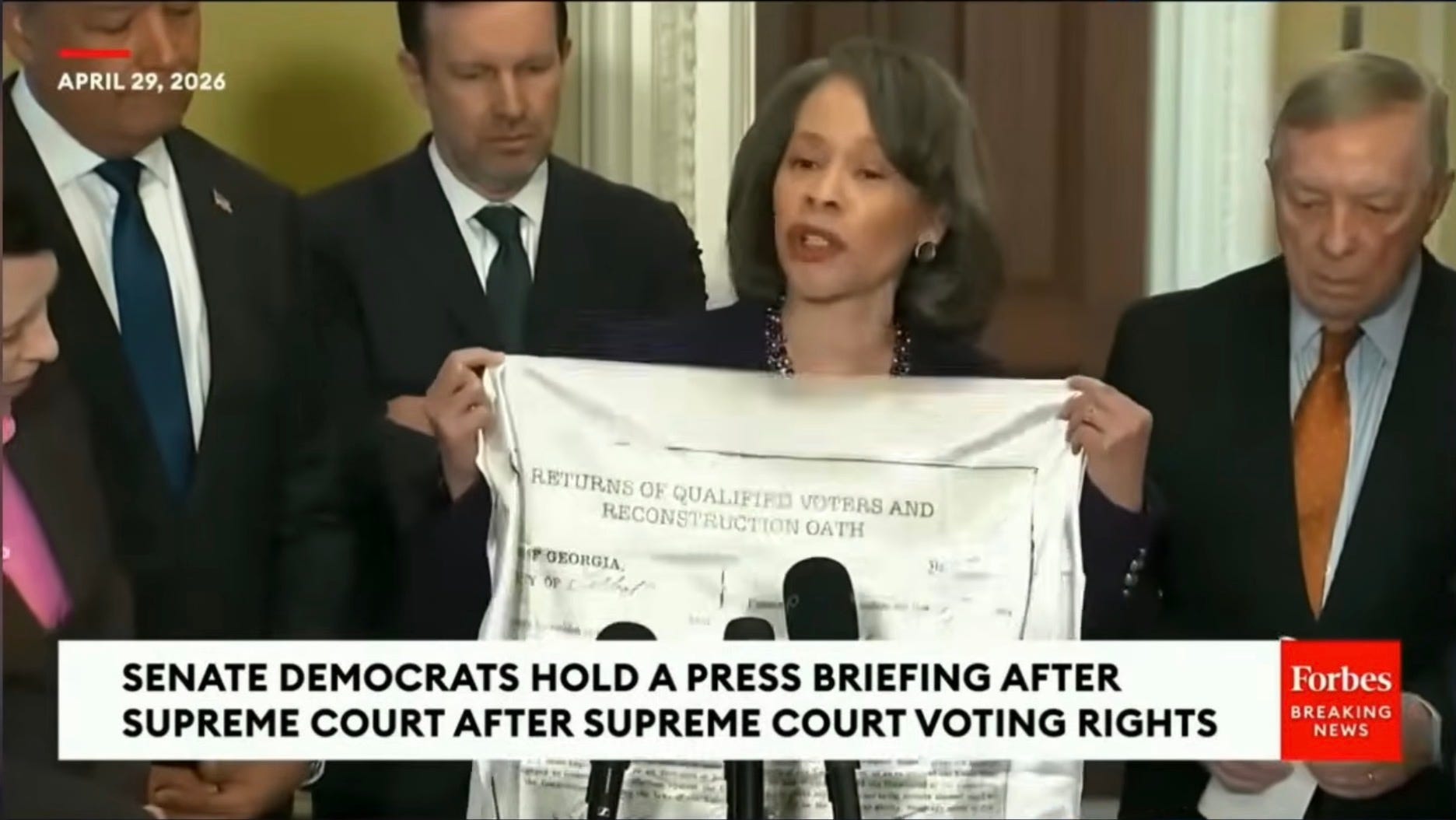
She connected the moment to Reconstruction, the Voting Rights Act, and the current fight over ballot access.
“Thank you, Leader Schumer. I stand before you as a member of the Senate and also a member of the Congressional Black Caucus. This day, when we got the news, I don’t think I knew how the day was going to start. I typically in the past have carried a scarf with me that I carried on the day I was sworn into the House and I carried on the day that I was sworn into the Senate. It allowed our great, great, great grandfather to have the right to vote who had been enslaved in Georgia. And for some reason, I brought it today. He could not read or write. He had to sign an X at the bottom. This is the returns of qualified voters and reconstruction oath from 1867. This document to me is representative of what we are trying to do here today. We are trying to live up to the ideals that were mentioned 250 years ago. That’s what this represents to me. And so today, standing here with my colleagues, our goal is to make sure America knows that we will march, mobilize, organize, pursue, go on the floor, stay up at 2 in the morning, 3 in the morning to stop things like the same back because this is a coordinated effort and we are coordinated as well. I was four years old when the Voting Rights Act was signed into law. I did not think that I would have to be here defending it, but we will. We must. And so thank you, Leader Schumer, for your leadership. Looking forward to working with my colleagues. And we do this for America.” [7]
Her remarks are important because the ruling is not being treated by civil-rights advocates as a narrow Louisiana dispute. It is being treated as part of a larger fight over the future of the Voting Rights Act and the legal tools used to protect minority representation. [10]
Garrison Hayes Called It A Major Blow To Black Political Power
Garrison Hayes, a journalist and video correspondent for Mother Jones, discussed the ruling Thursday morning on Don Lemon’s livestream. [11][12]
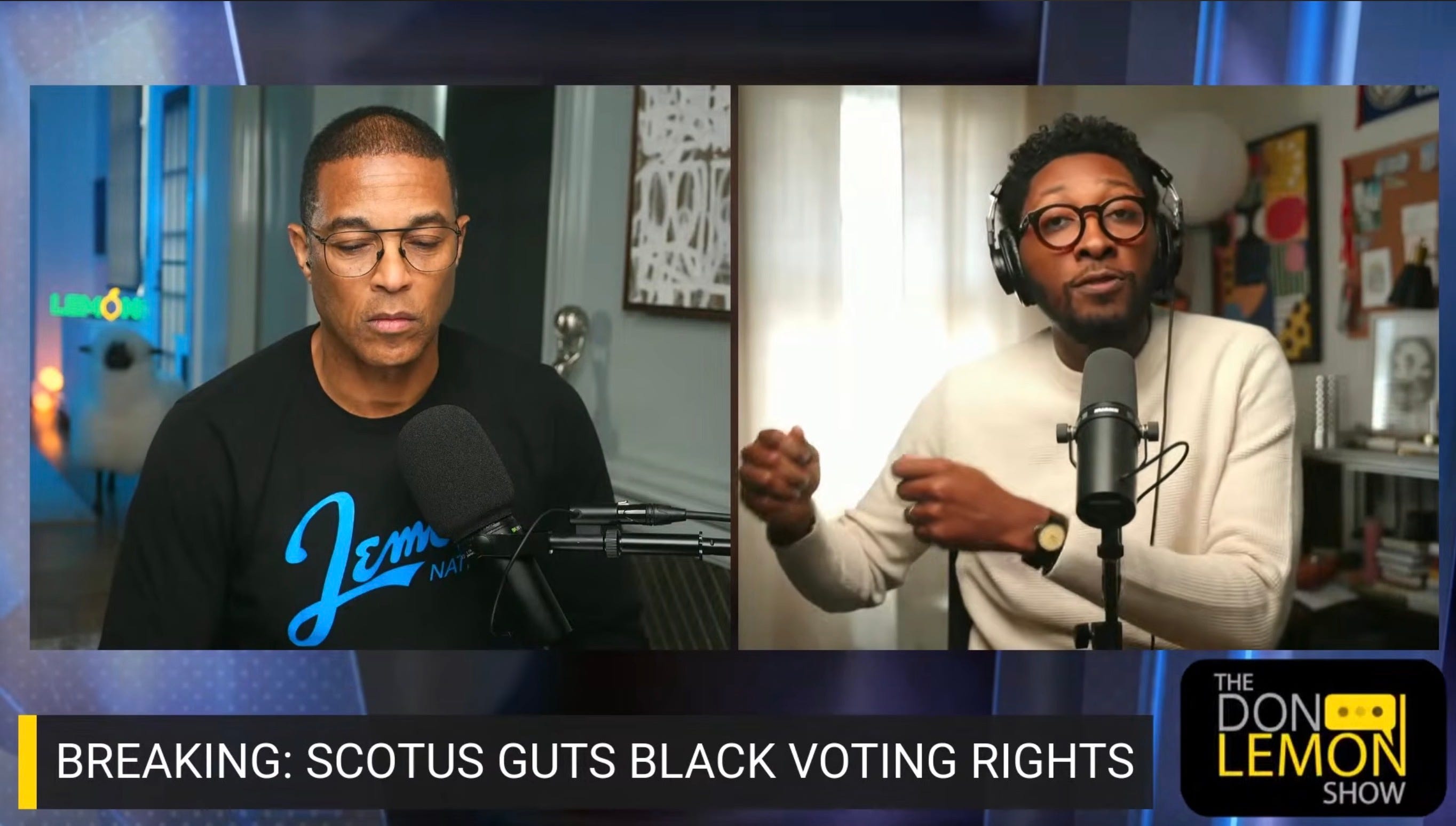
Hayes described the ruling as part of a broader rollback affecting voting rights, higher education, and workplace inclusion.
“No, I agree with you. It is the, I posted this yesterday on threads, that this is the worst day, one of the worst days for Black political power in American history. America was not a democracy until the Voting Rights Act. The Voting Rights Act is the thing that destroyed, that defeated, that tore down Jim Crow. And to erase that sets us back at least 60 years. But I recognize that this isn’t the only, that we were building political power over time. You recognize that, you know, the defeat of segregation was many years before that. And so we’re in a moment where they are rolling back not only our access to the ballot, but they have been systematically chipping away at our access to higher education, to our inclusion in the workforce. And so this moment is, it should infuriate everyone who is interested in a multiracial democracy. But I’ll be honest with you, Don, I am, I am waiting for more people to be upset about this. I’ve seen you talking about it. I’ve seen other Black folks talking about it. Thank goodness The Times talked about it this morning on The Daily. But I’m waiting to hear from a few more people who have been pretty quiet about this particular issue over the last 24 hours. We are living in perilous times, and I hate to be the person that sounds like I’m saying the sky is falling, but the sky is actually falling in America right now, and it needs to be said.” [11]
Hayes’s comments reflect the concern among voting-rights observers that the ruling will have consequences beyond Louisiana. Reuters reported that legal experts see the decision as a major blow to Section 2 of the Voting Rights Act, the provision used to challenge voting practices that dilute minority voting strength. [5]
Florida And Other States Are Moving
Louisiana is not the only state affected by the ruling and the broader redistricting fight.
On April 29, the same day the Supreme Court issued the Callais ruling, Florida Republicans approved a new congressional map aimed at flipping four Democratic-held House seats. Reuters reported that the map, drawn by Gov. Ron DeSantis’s office, would give Republicans an advantage in 24 of Florida’s 28 House seats, compared with the current 20-8 advantage. [5]
The Guardian reported that other states are also moving or preparing to move after the Supreme Court ruling, including Mississippi, Alabama, and Tennessee. [6]
That matters because the ruling gives Republican-led states a new legal opening to revisit maps that created or protected districts where Black and Latino voters have a stronger opportunity to elect candidates of their choice. [5][6][10]
What Happens Next
Louisiana officials must now determine how to proceed with congressional elections. That could require the Legislature to adopt a new map, further court action, or both. [3][4]
The immediate question is how quickly Louisiana can produce a legally usable map and reset its election schedule.
The national question is how many other states will use the ruling to reopen redistricting fights ahead of the next congressional elections.
For voters, the issue is not abstract. District lines determine who has a realistic chance to elect representatives. In Louisiana, the ruling has already moved from Supreme Court opinion to election suspension in less than 24 hours.
Support This Work
This is not a process story. It is a power story.
Louisiana’s congressional primaries were suspended because the Supreme Court struck down the map the state was about to use. Florida moved on a new map the same day. Other states are already in motion.
If this reporting helps clarify what is happening, restack it and send it to one person.
A restack costs nothing. Silence also sends a message.
And if you want fast, sourced, independent coverage before these stories get softened into polite headlines, become a paid subscriber:
Or just buy a coffee
Sources
Supreme Court of the United States, Louisiana v. Callais slip opinion — Official Supreme Court opinion issued April 29, 2026, striking down Louisiana’s SB8 map.
SCOTUSblog, “In major Voting Rights Act case, Supreme Court strikes down redistricting map challenged as racially discriminatory” — Legal analysis of the ruling and the 6-3 split.
Associated Press, “Louisiana congressional primaries suspended as a result of Supreme Court ruling, state officials say” — Breaking report on the suspended primaries and the early-voting timeline.
WBRZ, “AG, Governor: State legally prohibited from using current congressional map after landmark SCOTUS decision” — Local report explaining the terminated stay and Louisiana’s legal rationale for suspending the primaries.
Reuters, “Florida Republicans approve congressional map aimed at flipping four Democratic seats” — Reporting on Florida’s April 29 map approval and its partisan implications.
The Guardian, “Louisiana postpones primaries as states rush to redraw districts after supreme court ruling” — National overview of Louisiana, Florida, Mississippi, Alabama, Tennessee, and the broader redistricting response.
C-SPAN, “Senate Democrats Launch Elections Task Force” — April 29, 2026 Senate Democrats press event featuring Sen. Lisa Blunt Rochester’s remarks.
Britannica, “Lisa Blunt Rochester” — Background on Blunt Rochester, her Senate role, her family’s Reconstruction-era voting document, and her place in Black women’s Senate history.
U.S. House History, “BLUNT ROCHESTER, Lisa” — Official congressional biographical entry for Lisa Blunt Rochester.
NAACP Legal Defense Fund, “Louisiana v. Callais” — Civil rights litigation background on the Louisiana map and Black representation stakes.
The Don Lemon Show on YouTube — April 30, 2026 livestream segment with Garrison Hayes; quote based on user-transcribed live remarks from the broadcast.
Muck Rack, “Garrison Hayes” — Professional profile identifying Hayes as a Mother Jones video correspondent covering race, history, and progress.
We must persist to legally end this wave of extreme right-wing crimes against humanity and democracy.! All we have to fear is fear itself! United we stand! We shall overcome!
The effects of this ruling are serious. First Louisana, and then other predominantly Black states. This article states it clearly. I invite you to Denver Riggleman's Substack. Denver is a former Congressman from Virginia and the author of The Breach, the only book that dives deep into January 6 and the committee's work. A few weeks ago, Denver posted two chapters from that work. He outlines the steps that the administration (including Supreme Court) can take to ensure Republicans win the Primary Election.
This is one of those steps: Find a way to cancel the Primaries. This has now happened in Louisana, and other states plan to follow. I suggest you go to Denver's Substack post where you can download the two chapters from his book: https://denverriggleman.substack.com/p/free-book-chapters-the-breach-chapter