
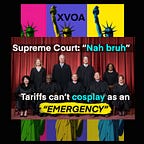

The Supreme Court has ruled 6–3 that the International Emergency Economic Powers Act (IEEPA) does not authorize the President to impose tariffs, striking down the Trump administration’s most sweeping tariff programs that had been justified under a national-emergency theory. [1]
I’m Xplisset, a retired patrol officer, and that background is why I’m good at digging through notes, timelines, and investigations. Below is the readable version of today’s breaking-news briefing for anyone who doesn’t want to play the audio podcast version.
Quick follow
If this helped, follow XVOA Breaking News right here on Spotify or Apple Podcasts. And if you want the transcript, sources, and you want to keep this one-man newsroom running, go to xplisset dot com slash subscribe or search “Xplisset Voice of America” on Substack and go paid. I’m a retired patrol cop with a keyboard doing this full time. Your paid subscription is not buying my wife a bigger walk-in closet for those red-bottom designer shoes, it’s keeping my heat and lights on. I work for you.
What happened
Here’s the bottom line, clean and simple.
The Supreme Court held that IEEPA does not authorize tariffs. [1] IEEPA is a 1977 emergency-powers law presidents usually use for economic sanctions: freezing assets, blocking transactions, and restricting trade with targeted countries or actors. [6,7] The administration argued that the law’s power to “regulate … importation” includes the power to levy import duties. The Court rejected that argument. [1]
And this matters because IEEPA has been the fast lane. It is a switch the President can flip quickly once an “unusual and extraordinary threat” is declared. [7] The Court just said: not for tariffs. [1]
The case pathway, in plain language
Two different groups filed lawsuits in two different courts. [1]
One group went to a special court that is built to handle tariff fights. [4,10]
The other group went to a regular federal court in Washington, D.C. [1]
The Supreme Court said the D.C. court was the wrong place for this kind of case, so that case gets thrown out. [1] If you want to fight a tariff, you have to go through the Court of International Trade. [1,4,10]
Why that matters is simple. It is like the Court putting a big sign on one door that says “tariff cases go here.” [1,10] So the next tariff fight will follow that same path, with that court’s rules and timeline. [10]
Which tariffs the ruling knocks out
This ruling hits the most expansive IEEPA tariff programs. [1]
One: the so-called “drug trafficking” tariffs. This was the administration’s framing: use emergency powers to pressure trading partners over fentanyl and cross-border trafficking. Under that banner, it imposed 25% duties on most goods from Canada and Mexico, plus duties on most goods from China. [1,8]
Two: the “trade deficit” or “reciprocal” tariffs. This was framed as a reset of the whole global price list, the U.S. matching what the administration said other countries effectively charge the U.S. through tariffs and non-tariff barriers. These applied at least a 10% duty to essentially all imports, with higher rates for dozens of countries, even where trade agreements were in place. [1,8]
So this is not a narrow technical cleanup. This is the Court cutting off a broad and flexible tariff lever that had been used at scale. [1]
How the Court lined up
The vote and the structure inside that majority matters. [1]
Chief Justice John Roberts delivered the principal opinion. The judgment is 6–3. [1]
Three justices—Roberts plus Justices Gorsuch and Barrett—also used what you can call a “major questions” warning label. [1]
Major questions, explained so a ten-year-old gets it: if a president is trying to do something huge that affects everybody’s money—something Congress normally decides—the Court wants Congress to have said “YES, you can do that” clearly. Not in vague language buried in an old law. [1]
But three other justices in the majority, including Justice Kagan joined by Justices Sotomayor and Jackson, said you do not even need that doctrine here. Ordinary statutory interpretation gets you to the same place: Congress did not clearly grant tariff authority in this emergency statute. [1]
The dissent was written by Justice Kavanaugh, joined by Justices Thomas and Alito. The dissent’s posture is basically: tariffs can be a traditional tool to regulate importation, and the Court is tying the President’s hands too much in an emergency and foreign commerce setting. [1]
What it means
The legal meaning
This is a separation-of-powers story with a very specific spine. [1]
The Court’s core message is that tariffs are not a casual detail tucked into the word “regulate.” Tariffs look like taxes. And in our system, taxes live with Congress. So if Congress is going to hand a President sweeping tariff power, the Court says Congress needs to say that clearly. [1]
The economic meaning
When tariffs hit broadly, they hit broadly. The exposure here is systemic because these tariffs attached to large import volumes. [1,12] The analysis tied to the case notes that U.S. goods imports in 2025 were about $3.416 trillion on a Census basis, and the categories most implicated include capital goods, consumer goods, and industrial supplies. [11]
Let me make that real with a quick example of the kind of person who just found this podcast.
Call her Tanya. She’s a working mom who’s listening while driving home, and her dryer just died on her at the worst possible time. She goes to a big-box store for the cheapest replacement, or she orders a replacement part online, and the price is higher than she expected. No one says the word “tariff.” The cashier just says, “Prices went up.”
Here’s what that can mean, in plain language. If that dryer, or even just one key part inside it, comes from overseas, the company bringing it into the U.S. may have had to pay an extra charge at the border. The importer raises the price to the wholesaler. The wholesaler raises the price to the store. The store raises the shelf tag. Tanya doesn’t see a policy debate. She sees a quiet markup. [12]
So if you are asking, “Does this matter for real people?” the answer is yes, because tariffs are one of those policies that show up as a quiet markup. Not always instantly. Not always as a single line item you can point to. But through supply chains and prices. [12]
The political meaning
Emergency powers do something to the psyche of government. They create a moral permission slip. The word “emergency” can make almost anything feel justified, even when the mechanism is basically: let’s tax imports by executive order. [7]
And once a political system gets used to that shortcut, it starts to feel normal. Until a court says: no. Not like that. Not under that law. [1]
What happens next
Will the tariffs stop immediately?
First question everyone asks: does this end the tariffs immediately?
Legally, the basis for continuing to collect IEEPA tariffs is removed by the Court’s categorical holding. [1] Operationally, the real-world unwinding runs through Customs and Border Protection, implementing guidance, and likely more litigation over scope and process. [8]
Refunds, in plain language: refunds for who?
Next question: are refunds automatic?
The short answer is: don’t count on it—and here’s who “refunds” even go to. Customs refunds the money to whoever paid the tariff at the border, usually the “importer of record”—the business that brought the goods into the U.S., not the shopper who bought the item. [10]
Think of each shipment like a bill that Customs either hasn’t “closed out” yet, or has already stamped “final.” [10]
If Customs has not finalized that import paperwork yet (“unliquidated”), it’s easier to correct the bill and send the extra money back to that importing business. [10]
If Customs already stamped it “final” (“liquidated”), the importer usually has to file an official challenge on time. Miss the deadline and the money can be gone. [10]
And for regular consumers: you’re probably not getting a check in the mail. The consumer “refund,” if it happens at all, tends to show up later as prices stopping their climb, discounts returning, or a product getting cheaper—only if businesses decide to pass savings through and competition forces it. [12]
So yes, this ruling can mean refunds, but it can also mean forms, filings, deadlines—and uncertainty about how much of it reaches your receipt. [10]
How much money are we talking about?
Reporting tied to this fight cites an estimate exceeding $175 billion in tariff revenues potentially at risk and refundable. [9] Even if the final number changes, the scale is the point. This is big money and that means the post-ruling fights will be intense. [9]
Can the administration re-impose tariffs another way?
Officials have signaled they will explore other legal avenues, including national-security tariff authority and unfair-trade practices authorities. [8] But those routes are typically narrower and come with more procedural steps. [8] The Supreme Court itself avoided speculating on which alternative statutes could or could not support similar actions, but it noted that other tariff statutes often have prerequisites and limits not present in the IEEPA theory. [1]
In plain terms: the shortcut lane just got blocked. If they want to keep tariffs at this scale, they may need Congress or a slower, more constrained statutory pathway. [1]
Quick recap
One: the Supreme Court ruled 6–3 that IEEPA does not authorize the President to impose tariffs. [1]
Two: the ruling invalidates the administration’s most expansive IEEPA tariffs, including the “drug trafficking” tariffs and the broad “reciprocal” tariffs. [1]
Three: the decision reinforces Congress’s central role in tariff power and channels future tariff challenges into the specialized trade court system. [1,4,10]
Where to find me
If this helped, follow XVOA Breaking News right here on Spotify or Apple Podcasts. And if you want the transcript, sources, and you want to keep this one-man newsroom running, go to xplisset dot com slash subscribe or search “Xplisset Voice of America” on Substack and go paid. I’m a retired patrol cop with a keyboard doing this full time. Your subscription is not buying my wife a bigger walk-in closet for those red-bottom designer shoes, it’s keeping my heat and lights on. I work for you.
This is Xplisset from Xplisset Voice of America. XVOA. I’m gonna keep on diggin so you can keep your hands on the wheel.
Sources
U.S. Supreme Court opinion (Feb. 20, 2026) — Holding that IEEPA does not authorize tariffs; vote lineup, reasoning structure, and disposition.
SCOTUS docket No. 24-1287 — Procedural history for the Learning Resources track.
SCOTUS docket No. 25-250 — Procedural history for the trade-court track consolidated with 24-1287.
U.S. Court of International Trade — Slip Op. 25-66 (May 28, 2025) — Trade court decision setting aside the IEEPA tariffs.
U.S. Court of Appeals for the Federal Circuit — en banc opinion (Aug. 29, 2025) — En banc merits ruling; remand on remedy scope.
IEEPA (50 U.S.C. § 1702) — The statutory authority the administration relied on to argue for tariff power.
IEEPA emergency threshold (50 U.S.C. § 1701) — The “unusual and extraordinary threat” emergency declaration language.
Reuters (Feb. 20, 2026) — News coverage of the ruling and immediate reactions.
Reuters (Feb. 20, 2026) — Refund exposure estimate exceeding $175B (Penn Wharton Budget Model).
Congressional Research Service — IF13150 — Refund mechanics, liquidation, and trade-court jurisdiction pathways.
BEA trade tables (Dec/Annual 2025) — Import totals and category breakdown used for exposure context.
Federal Reserve Bank of New York — Liberty Street Economics (Feb. 2026) — Tariff incidence analysis and who bears the costs.


