


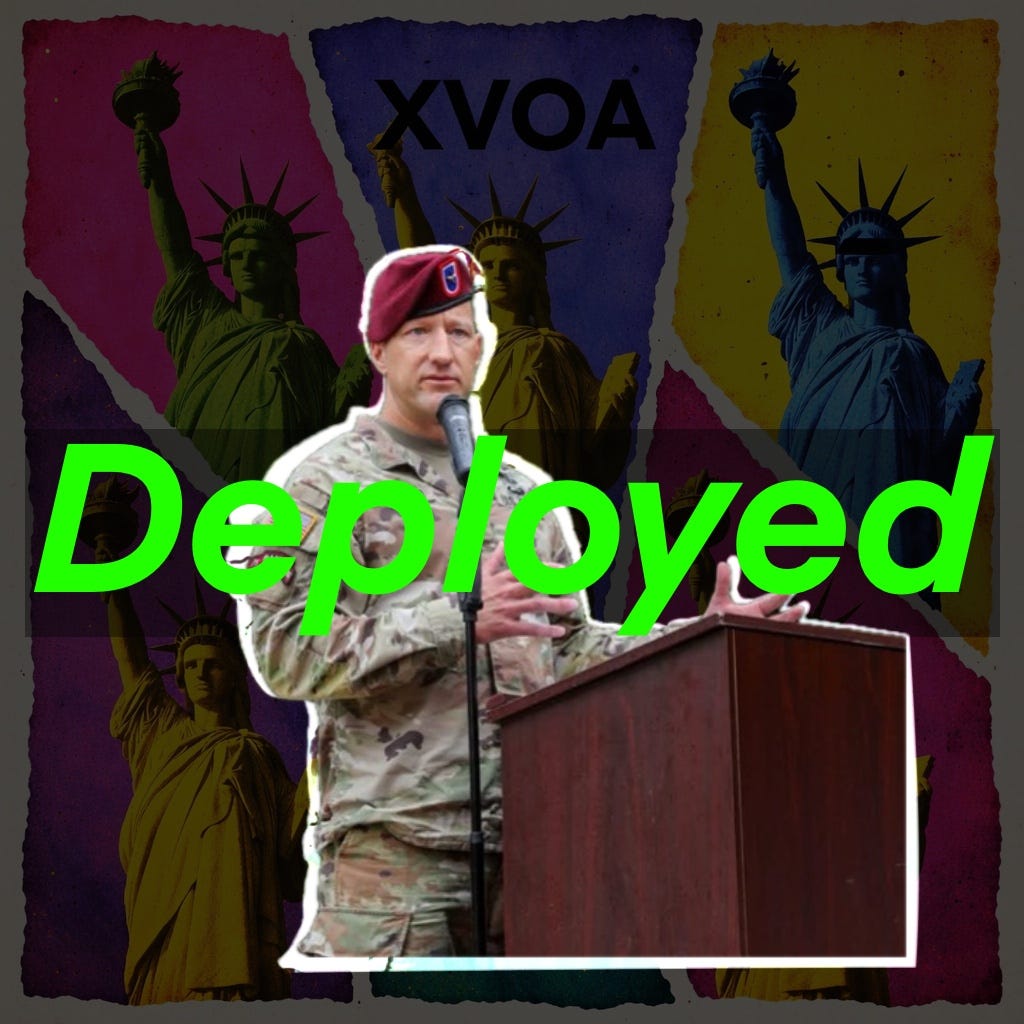
One brigade from the 82nd Airborne is being readied for the Middle East, and the most dangerous part is not the paratroopers. It is the way the escalation is being made to feel optional.
I noticed it the way you notice a leak when the ceiling is still mostly dry.
Not by a siren, not by a banner, not by a neighbor pounding on the door. I caught it while doing the modern American ritual of checking three different screens, half listening to a talking head, half scrolling a feed that keeps insisting the world is either fine or funny. The kind of multi-tasking that feels like power until you realize it is also the perfect container for denial.
Then the line hit.
The U.S. is expected to deploy 3,000 to 4,000 soldiers from the 82nd Airborne to the Middle East. No confirmed destination. No public clarity on mission. No clean democratic moment where the country pauses, looks at itself, and says: yes, we are doing this. [1]
I felt that old embarrassment I recognize from Iraq. Not just the sense that leaders can drift into war. The deeper shame of realizing I can drift with them, if the information comes packaged as background noise.
TLDR
The U.S. is expected to deploy 3,000 to 4,000 soldiers from the 82nd Airborne to the Middle East, a significant reinforcement layered on top of an already large regional posture, with the Pentagon not publicly confirming destination or timeline. [1]
This troop movement is not occurring in isolation. Reuters has documented a broader acceleration: additional Marines and sailors moving early, two Marine Expeditionary Units in the region, and explicit planning options that include operations tied to the Strait of Hormuz and Iran’s Kharg Island. [2]
The President’s own 48-hour War Powers notification says it is not possible “to know the full scope and duration” of military operations, which is the legal seed of an open-ended war even before any ground escalation. [4]
Public support is strikingly thin. A Reuters/Ipsos poll found most Americans believe ground troops will be sent, and almost nobody supports a large-scale ground war. [3]
Oil markets are acting like this is real and ongoing, with Reuters reporting Brent above $100 as disruptions and uncertainty persist around Hormuz, a chokepoint for roughly one-fifth of global oil and LNG shipments.[10]
Restack this. Share it. Send it to one person who is still telling themselves it is probably nothing. Then do the thing your better judgment has already suggested: become a paid subscriber and help keep this operation alive.
If you value this work, support it here: https://www.xplisset.com/subscribe
One-time support:
The thing that would not leave me alone
Here is what set me off: the mismatch between scale and sensation.
On paper, the situation is enormous. The United States and Israel launched military operations against Iran on Feb. 28, according to a Congressional Research Service brief for lawmakers, with ongoing regional ripple effects. [5] That same CRS document underlines war powers and oversight questions, because the constitutional machinery was never designed for a country to slide into hostilities by slow increments. [5]
In the official fact sheets, the campaign is described with numbers and platforms: thousands of targets struck, thousands of combat flights, naval vessels damaged or destroyed. [6] It reads like a scoreboard, and that is part of the problem. Scoreboards create distance.
And now, when the 82nd Airborne enters the conversation, it changes the texture. That unit is built for speed. The Army’s own description emphasizes rapid deployment within 18 hours and forcible entry operations when ordered. [12]
You do not move that kind of capability toward a theater because you are calm.
What I could not shake was the psychological pattern: how easily a population can be put into a trance when the escalation arrives as a “developing story,” a live-blog bullet, a “sources say,” a clip between weather and sports.
We are back in the domain of what psychologist Carl G. Jung would call the shadow, but not in the theatrical sense. The shadow here is the part of national identity that wants the benefits of global power without the felt responsibility of what power costs. When the shadow runs the room, we do not debate. We dissociate.
What everybody thinks this is about
If you ask most people what this is about, you get one of two answers.
Answer one is technical: this is about contingency planning, deterrence, “keeping options on the table,” moving pieces on a board so Iran cannot close the Strait of Hormuz or strike regional bases. That framing is not wholly wrong. Reuters has described the military planning logic in precisely those terms, including options related to Hormuz and Kharg Island. [2]
Answer two is political: this is about a president posturing, threatening, pausing, resuming, leveraging war talk for domestic dominance. That framing is also not wholly wrong. Reuters has shown how often the message shifts while forces keep moving. [1]
But both answers are too shallow, because they treat “troop deployment” as a discrete event rather than an escalation ladder.
The deeper question is not whether the 82nd Airborne is boarding aircraft tonight.
The deeper question is why the United States can be three-plus weeks into a major conflict environment, with casualties, with a widening regional footprint, with oil above $100, and still allow millions of citizens to experience it as optional knowledge. [10]
That is not just a media question. It is a civic architecture question.
Because this is how long wars begin now. Not with a single thunderclap, but with a drip-drip sequence of “limited,” “targeted,” “no ground forces,” “no decision,” “just in case,” and then, quietly, “rapid response forces” repositioned.
The public story says we are avoiding another Iraq.
The paper trail says we are building the scaffolding for one.
The receipts
Let’s name the documented spine of this, because the vibe is not enough.
Reuters reported today that the U.S. is expected to deploy 3,000 to 4,000 soldiers from the 82nd Airborne to the Middle East, in what it framed as a significant reinforcements move on top of more than 50,000 U.S. troops already in the region, with the Pentagon not confirming destination or timeline. [1]
Four days earlier, Reuters reported thousands of additional Marines and sailors deploying early, with the USS Boxer and a Marine Expeditionary Unit headed to the region, explicitly noting these units could be deployed on land. [2]
Now layer the legal record onto the military movement.
A War Powers letter dated March 2 states the President was reporting military action taken on Feb. 28 against Iran, claiming strikes were undertaken to protect U.S. forces and interests, and then includes the most important sentence for readers who lived through Vietnam and Iraq: it is not possible “to know the full scope and duration” of operations that may be necessary. [4]
That sentence is not filler. It is the open door.
It is what turns “limited strikes” into a structure that can absorb anything later.
Then there is the official tempo narrative. A CENTCOM fact sheet dated March 16 describes the operation’s metrics at that point: “Targets Struck: 7,000+,” “Combat Flights: 6,500+,” “Iranian Vessels Damaged or Destroyed: 100+.” [6] You do not generate that level of activity and then pretend the public does not deserve adult-level clarity on end state.
Congress is not silent either, even if it is outgunned. A group of senators wrote to Majority Leader John Thune requesting immediate public hearings with cabinet officials to explain why the administration launched the war.[8] The insistence is not rhetorical. It is an attempt to pull the conflict back into democratic light.
And the public? The public is not buying the inevitability story.
Reuters/Ipsos polling found most Americans believe ground troops will be ordered into Iran, while only a tiny fraction support a large-scale ground war. [3] Another Reuters report on the war powers vote captured how thin approval was even for the strikes themselves. [9]
So if public support is low, why does the escalation continue?
That question brings us to the machine.
The machine under the story
There are three machines operating at once here, and together they create the illusion that this is not happening, even as it is happening.
The “options” machine
The first machine is strategic language.
“Options.” “Planning.” “Prudent.” “No decision.” “Not putting troops anywhere.”
That vocabulary does not merely describe uncertainty. It lowers emotional temperature. It buys time. It keeps the public from having to take a position until facts become “fait accompli.”
Reuters reports this explicitly: no decision made to send troops into Iran itself, but deployments build capacity for future operations. [2] That is the definition of an escalation ramp.
The 82nd Airborne is not just another unit. Its rapid deployment posture is part of its identity. [12] So when “options” start requiring that kind of unit, it is not neutral planning. It is mission shaping.
The attention machine
The second machine is the outrage economy.
Wars that grind do not compete well with scandals that spike. Foreign policy becomes a background tab. People, exhausted, triage their own nervous systems.
Pew’s research on another conflict dynamic showed something that matters here: even when Americans have strong emotional reactions to a war, many still do not follow it closely, and only about half could answer a basic factual question about relative deaths. [11]
That is not an insult to the public. It is a description of what mass psychology looks like under constant stimulus.Information overload does not create informed citizens. It creates citizens who choose one storyline to hold onto so they can get through the day.
That is why “no front page coverage” can be experienced as true even when headlines exist. The story may be published, but it is not metabolized.
The legitimacy machine
The third machine is democratic drift.
The War Powers framework was designed for transparency and accountability. Yet, the operational reality now is often: strike first, notify, then debate.
Reuters summarized this drift in its report on a war powers vote: lawmakers describe the resolution as a bid to reclaim Congress’s constitutional role, while opponents frame limitation efforts as endangering forces. [9]
The result is predictable. Once troops and bombs are active, dissent is framed as betrayal.
A user-provided transcript of a viral commentary segment (the one that set some readers off) makes a raw version of the same argument: that corporate media ecosystems and political power can normalize war by repetition and omission.
You do not have to agree with every inflection in that transcript to recognize the underlying dynamic: when institutions treat a war as a technical operation rather than a moral and civic rupture, the public is trained to look away.
That is the machine. It is not always a conspiracy. Often it is incentives moving through systems.
But it produces the same outcome: a war that can proceed without shared national consent.
The deeper echo
If you lived through Vietnam, Iraq, and Afghanistan, you already know the echo, and it is not just “another Middle East war.”
The echo is the incrementalism.
It starts as air power. It starts as advisors. It starts as “limited mission.” It starts as “we are almost done.” It starts as “this is not endless.”
Then the legal language appears that quietly admits the truth: we do not know how long this will take. [4]
Then the rapid response units reposition, because planners do not like leaving the President without tools. [1]
And then, one day, the public wakes up inside a new normal.
There is a haunting historical footnote here, and it matters for the psychology of “confidence.”
A declassified assessment from the Millennium Challenge 2002 war game includes a detail that sounds almost too on-the-nose for 2026: it criticizes how “world media play” was not structured to represent truly independent reporters, and how reporting was “heavily biased” toward Blue, meaning the U.S. and allied side of the war game, with little questioning of Blue government policies and plans. In that exercise, Red was the opposing force. [13]
That is not a claim about today’s journalists. It is a reminder that powerful institutions have long understood that if the information environment leans toward the home team, the public feels less friction, less doubt, and less urgency.
And once emotional temperature is controlled, escalation becomes administratively easy.
Who gets paid, who gets hurt, who gets erased
Start with who gets hurt.
Military families get the first cut, every time. Not just the deployed, but the spouses, the kids, the parents who become logistics managers of fear. The people who start counting days by news alerts.
Then there is the economic funnel.
Reuters reported oil surging with supply risks, with Brent above $100 per barrel amid ongoing uncertainty and disruptions tied to Hormuz dynamics. [10] That pressure hits working families as higher gas prices, higher transport costs, higher grocery costs. Not metaphorically. Practically.
Now let’s talk about Black impact, because the evidence supports the concern.
The Army’s own demographic snapshot (from an official Army G-1 report) shows Black, non-Hispanic soldiers comprised about 20.3% of the active component at that time. [14] That is a larger share than Black Americans’ share of the overall U.S. population, which means the burden of repeated deployments and repeated wars does not land evenly.
So when a war escalates quietly, the quietness itself becomes a form of inequity.
If your community has fewer direct ties to the military, you can treat this as distant.
If your cousin is in the division, you cannot.
And finally, who gets paid?
I am not going to do the lazy thing where every conflict becomes a single explanation, like “it’s all because of defense contractors.” The world is more complicated than that.
But we can say something simpler and truer: prolonged crisis reliably creates financial winners and political winners, and it reliably produces permission structures for budgets, secrecy, and expanded executive power.
Even the language around supplemental funding shows the scale of appetite. Reuters reported the Pentagon asked the White House to approve a request of more than $200 billion to fund the conflict. [2]
That number is not just accounting. It is destiny-writing.
And if the war continues, the people who pay first are not the people who decide first.
A word for the people in charge
So here is the clean accountability question, the one that should be asked in plain language until it is answered:
What is the end state, and who authorized it?
Not the objective list. Not the “we are winning” cadence. Not the nightly metrics.
The end state.
And if the answer is “we don’t know yet,” then the follow-up question is immediate:
Why are you moving the 82nd Airborne as if you do?
Because the War Powers notification already admitted uncertainty about scope and duration. [4] The deployment reports show capacity building. [1]
That combination is how democratic societies drift into open-ended wars while insisting they are avoiding them.
Congress should hold public hearings, as senators demanded, with testimony under oath and a defined authorization debate. [8]
And yes, the press should cover troop movements with urgency, but the deeper ask is for coverage that helps people feel the causal chain: troop deployments are not “news items.” They are moral commitments made with other people’s bodies.
Support This Work
If you made it this far, felt your stomach tighten, and told yourself this kind of reporting matters, first, thank you.Thank you to the people who read for free, because I know not everybody can afford another subscription right now, and thank you even more to the paid subscribers already carrying part of this load so this work can keep breathing.
But this is also the part where the followers and free subscribers who absolutely can afford to pay start having a little private meeting between conscience, convenience, and delay. Not the people who truly cannot spare it. I mean the ones nodding along, getting value, telling themselves this work matters, and still quietly assigning the bill to some more generous stranger in the audience.
If that is you, do not let that version of yourself make this decision for you.
And if your inner negotiator is already clearing its throat and giving a speech about timing, budgets, and circling back later, fine. Keep the guilt useful and the drama small. Buy me a coffee instead. Smaller gestures still buy time, and time is exactly what independent work burns through trying to keep stories like this from disappearing into the scroll. Buy Me a Coffee.
Sources
Reuters | US expected to send thousands more soldiers to Middle East, sources say (Mar 24, 2026) - Core reporting on the expected 82nd Airborne deployment and the Pentagon’s non-confirmation of destination/timeline.
Reuters | US to deploy thousands of additional troops to the Middle East, officials say (Mar 20, 2026) - Documents the broader force buildup, including Marines/sailors and explicit “options” logic.
Reuters | Americans believe Trump will send troops into Iran, don’t support it, Reuters/Ipsos poll finds (Mar 19, 2026) - Public opinion evidence showing fear of escalation and near-zero support for a large ground war.
War Powers Report letter (Mar 2, 2026) via Just Security PDF - Primary document: the administration’s War Powers notification language on scope/duration and rationale.
Congressional Research Service | U.S. and Israeli Military Operations Against Iran: Issues for Congress (Mar 1, 2026) - Nonpartisan briefing summarizing conflict context and oversight questions for lawmakers.
CENTCOM / media.defense.gov | Operation Epic Fury Fact Sheet (Mar 16, 2026) PDF - Primary document with official operational metrics and asset lists.
U.S. Central Command | Operation Epic Fury page - Official hub for CENTCOM framing and updates, useful for comparing narrative and numbers.
Letter to Senate Majority Leader John Thune requesting public hearings (Mar 11, 2026) PDF - Primary document showing congressional push for public oversight and clarity.
Reuters | US Senate backs Trump on Iran strikes, blocks bid to limit his war powers (Mar 4, 2026) - Reporting on the war-powers vote and the institutional dynamics that make escalation easier.
Reuters | Oil rises as markets assess supply risks after Iran denies U.S. talks (Mar 24, 2026) - Market evidence connecting the war to real household costs via energy disruption and price spikes.
Pew Research Center | Emotions, news and knowledge about the Israel-Hamas war (Mar 21, 2024) - Research on how Americans can feel strongly about war while still not tracking basic facts, a useful model for today’s attention dynamics.
U.S. Army | 82nd Airborne Division overview - Official description of the unit’s rapid deployment role and doctrinal purpose.
National Security Archive | “Opposition Force Senior Mentor’s Observations of Millennium Challenge 2002” PDF- Primary-source critique of war-gaming constraints and narrative control, including “world media play” bias.
U.S. Army G-1 | Active Component Demographics (Data as of Oct 31, 2022) PDF - Official demographics showing racial distribution in the Army, grounding Black-impact stakes in data.
Uploaded transcript: “US journalist exposes media’s support for Iran war” - User-provided commentary artifact illustrating how “media complicity” arguments circulate and why the perception of silence persists.
I don't know if you follow Malcolm Nance Black Man Spy on Substack. He's a retired Naval Intelligence officer with 40 years of experience in the Middle East. He's been right about everything so far. He thinks the Marines may attempt an invasion of Iran and some of the islands as soon as this weekend. He uses publicly available information and knows how to put the puzzle together. God help the Marines. It won't go well. It looks like a poorly conceived operation right into an untenable situation.
Malcolm nance is great. Been watching him since he would come on MSNBC.