


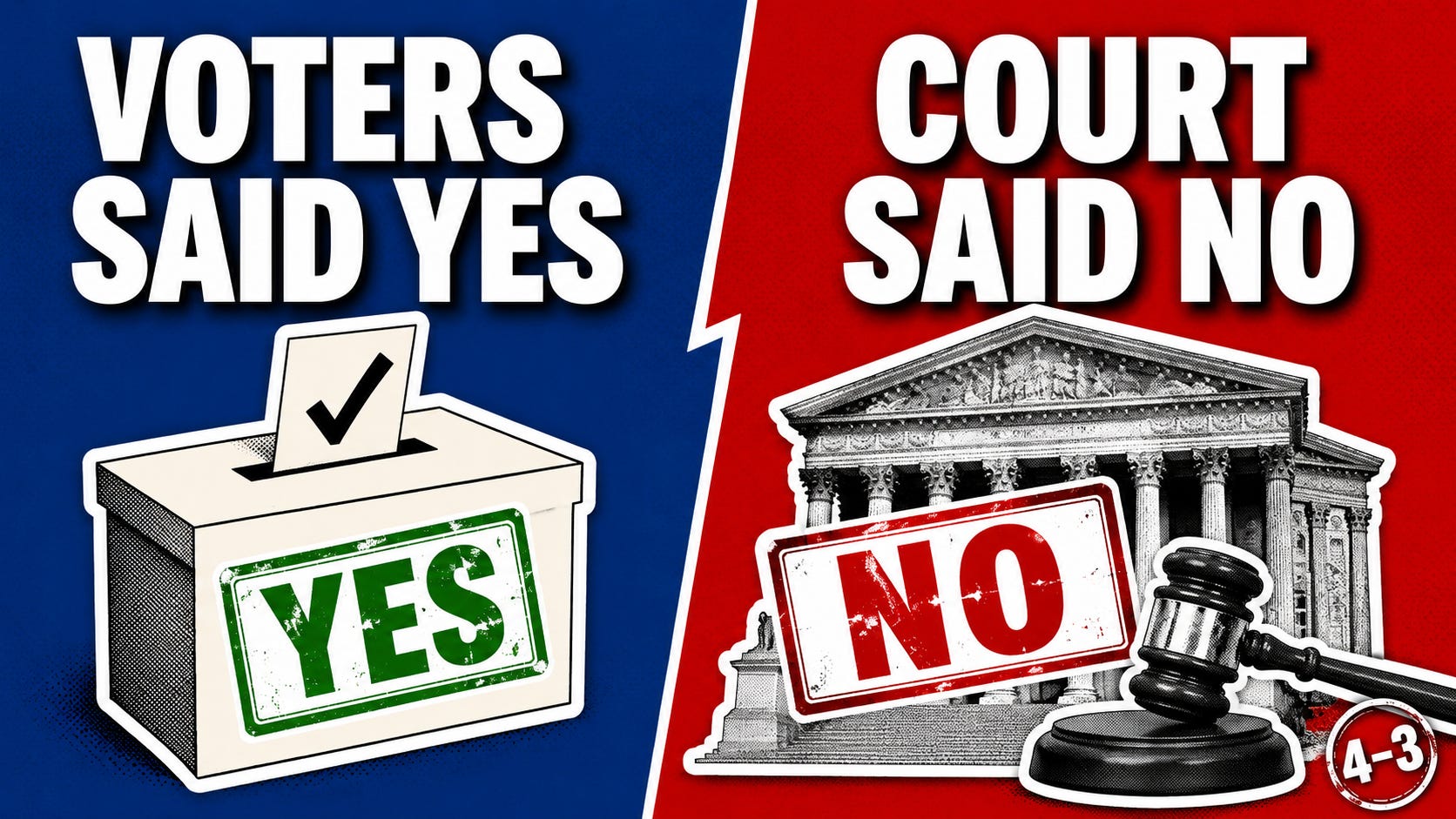
The Supreme Court of Virginia has thrown out Virginia’s voter-approved redistricting referendum, keeping the state’s existing congressional map in place for the 2026 midterms.
The ruling came Friday in Don Scott v. Ryan T. McDougle. In a 4-3 decision, the court held that the General Assembly violated Virginia’s constitutional process when it moved the amendment toward the ballot. The court said the referendum was legally tainted and that the 2021 court-drawn congressional map remains the governing map for the upcoming election. [1][2]
This is not only a Virginia story.
This is the map war.
TLDR
The Supreme Court of Virginia struck down Virginia’s voter-approved redistricting referendum. The court said the General Assembly violated the state constitution’s process for putting the amendment before voters. [1][2]
The referendum had been approved by voters on April 21. The official opinion says 1,604,276 Virginians voted yes, while 1,499,393 voted no. [1]
The practical result is immediate: Virginia’s current 2021 congressional map stays in place for the 2026 congressional elections. That map currently gives Democrats a 6-5 edge in the state’s U.S. House delegation. [1][2]
The Democratic-backed map could have shifted Virginia from 6-5 Democratic to as much as 10-1 Democratic. That is why this was never just about process. It was about power, control of the House, and the national redistricting arms race. [1][2][3]
This is different from Louisiana’s Voting Rights Act fight, but it lands in the same political storm. Virginia’s case turned on state constitutional procedure. Louisiana’s fight centered on race and minority representation. But both stories show how congressional maps are being fought over in real time before the 2026 midterms. [2][4][5]
Restack it. Send it to one person. Put this in front of somebody who still thinks redistricting is a boring civics-class word.
And if you can afford it, you need to become a paid subscriber:
If a subscription is not possible today, buy me a coffee so this one-person newsroom can keep moving fast while the respectable outlets are still looking for a softer word than power.
What Happened
The Supreme Court of Virginia struck down the redistricting referendum that Virginia voters approved last month.
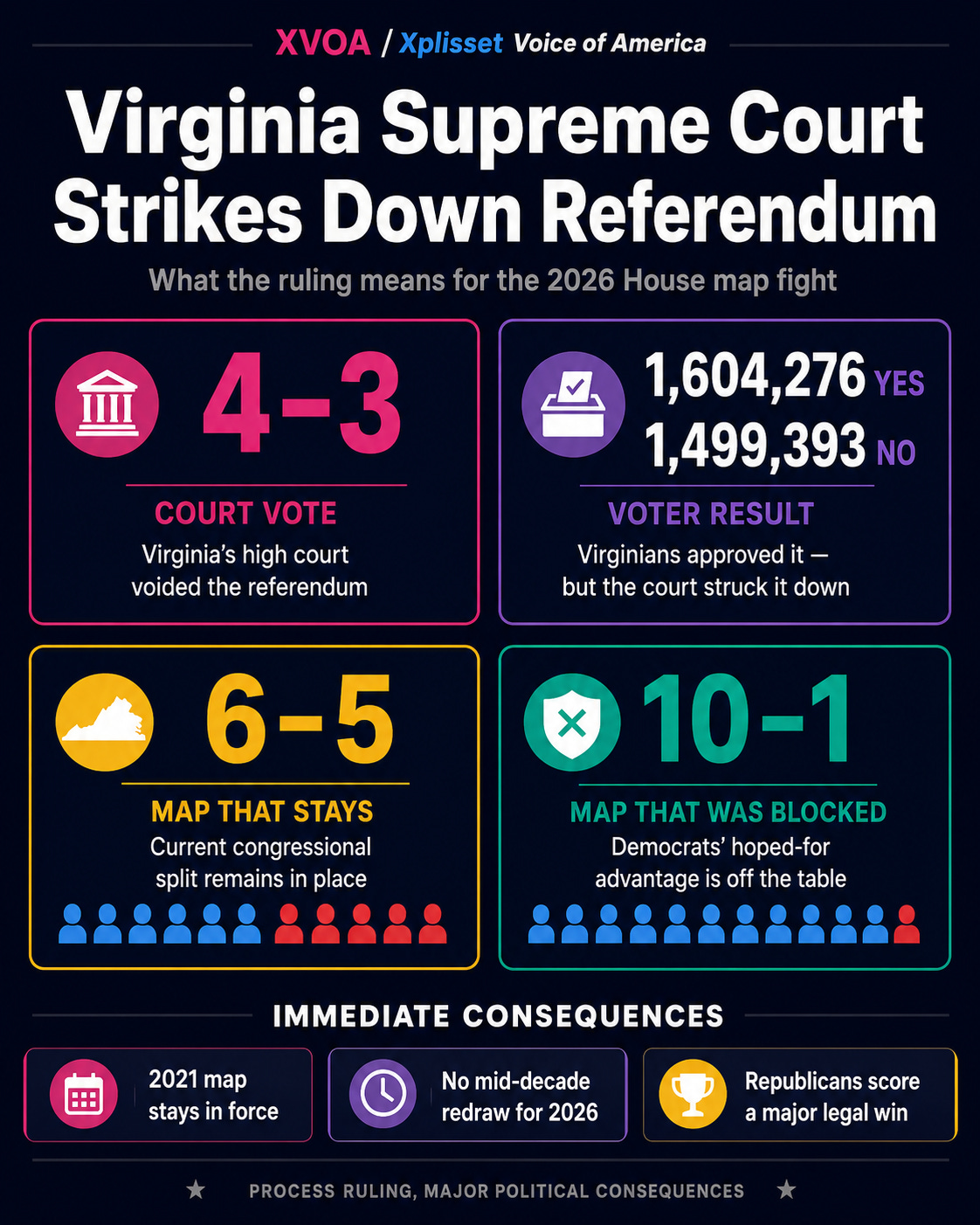
The April 21 referendum asked voters whether Virginia should allow a mid-decade congressional redistricting plan to take effect before the 2026 midterms. Voters narrowly approved it. According to the court’s opinion, the final tally was 1,604,276 yes votes to 1,499,393 no votes. [1]
But on Friday, the court ruled that the process used to get the amendment onto the ballot violated Article XII, Section 1 of the Virginia Constitution. [1]
The court’s key conclusion was simple and brutal: the General Assembly did not properly satisfy the requirement that a proposed constitutional amendment pass through two legislative approvals with a general election in between. [1][2]
That sounds dry until you see the result.
The referendum is gone. The new map is blocked. The 2021 map stays. [1]
The majority held that Virginia’s current congressional districts, drawn by the court in 2021 after the state’s redistricting commission deadlocked, remain the governing maps for the 2026 congressional elections. [1]
The sequence is direct: Virginia voters approved a redistricting referendum in April, Democrats hoped to use it to reshape the congressional map for November, Republicans challenged the process in court, and the state Supreme Court has now wiped out the referendum’s legal effect. [1][2][3]
Why The Referendum Mattered
Virginia has 11 U.S. House seats. Under the existing map, Democrats hold six and Republicans hold five. [1][2]
The Democratic-backed redistricting plan could have changed that balance dramatically. The official opinion describes the proposed map as one that would replace a 6-5 split with an expected 10-1 split. [1]
That is the part nobody should bury under procedural language.
This was about control of congressional power.
Democrats saw Virginia as one of the few places where they could answer Republican-led redistricting efforts in states such as Texas, Florida, Missouri, North Carolina, Ohio, and Tennessee. Republicans saw the Virginia referendum as an illegal Democratic power grab. [2][4][5]
Both things can be true in the narrowest sense: Democrats were trying to gain seats through a mid-decade map change, and Republicans were trying to stop them from doing it.
But the larger truth is harsher.
America is now fighting congressional elections before the elections happen. The fight is not only over candidates. It is over who gets packed where, who gets cracked where, and which voters get turned into background noise before a campaign ad ever runs.
That is why this story matters.
The map is the battlefield.
What The Court Said
The court did not decide the case by saying Democrats drew a bad map and Republicans drew a good one.
The court decided the case by saying the General Assembly used the wrong constitutional process.
Virginia’s constitution requires a proposed constitutional amendment to be approved in two legislative sessions with a general election in between. The dispute turned on what counts as the intervening “general election.” [1][2]
Democratic legislative defenders argued that the election meant Election Day itself. Under that view, the first legislative vote came before Election Day and satisfied the constitution. [2]
The majority rejected that view.
The court held that a general election includes the full process of voters casting ballots and election officers receiving those votes, not merely the final Tuesday. Because early voting had already begun when the General Assembly first passed the proposed amendment, the court said the required intervening election had not occurred in the constitutionally proper sequence. [1][2]
The court wrote that the Commonwealth submitted the proposed amendment to voters in an “unprecedented manner” and that the violation rendered the referendum “null and void.” [1]
That is the hinge of the whole ruling.
The people voted.
The court said the process that got the question to the people was constitutionally broken.
Why The Dissent Matters
The dissent, led by Chief Justice Cleo Powell and joined by Justices Mann and Fulton, rejected the majority’s interpretation. [1]
The dissent argued that the majority wrongly expanded the meaning of “election” to include the early voting period. It warned that this conflicts with how Virginia and federal law define elections. [1]
That is not a small disagreement.
It changes the moral picture of the case.
To the majority, the ruling protects the constitution from a rushed and improper process.
To the dissent, the ruling rewrites the meaning of election after millions of Virginians had already voted.
And that is why Democrats immediately framed the ruling as a discarded-votes story.
Local Virginia reporting collected reactions from both sides. Republican Rep. Ben Cline called it the correct decision and said Virginia’s ban on gerrymandering remains in effect. Democratic leaders, including Lt. Gov. Ghazala Hashmi and Sen. Tim Kaine, argued that voters participated in good faith and that the court waited until after the vote to throw the results away. [6]
That is the public fight now.
Not just who drew the map.
Who gets the final word: voters, legislators, or courts?
This Is Not Louisiana, But It Rhymes
Virginia is not Louisiana.
That distinction matters.
The Louisiana case was about race, representation, the Voting Rights Act, and whether a map with two majority-Black districts could survive the Supreme Court’s racial-gerrymandering analysis. Virginia’s case is about whether the state followed the proper constitutional steps for a referendum. [1][2][4][5]
But politically, the two stories are now breathing the same air.
The U.S. House is narrowly divided. State maps are being redrawn mid-decade. Courts are shaping the battlefield before voters get to choose candidates. Republican-led states are moving aggressively. Democratic-led states are trying to answer. And every ruling becomes part of the national chessboard. [2][4][5]
The polite way to say that is this: redistricting has become a central front in the 2026 midterm fight.
The plain way to say it is this: the election is being fought through maps before it is fought through voters.
Virginia’s ruling gives Republicans a major win because it blocks one of the Democratic Party’s biggest potential counter-moves. [2][3][4]
That is the headline under the headline.
The Majority Report Heard The Same Alarm
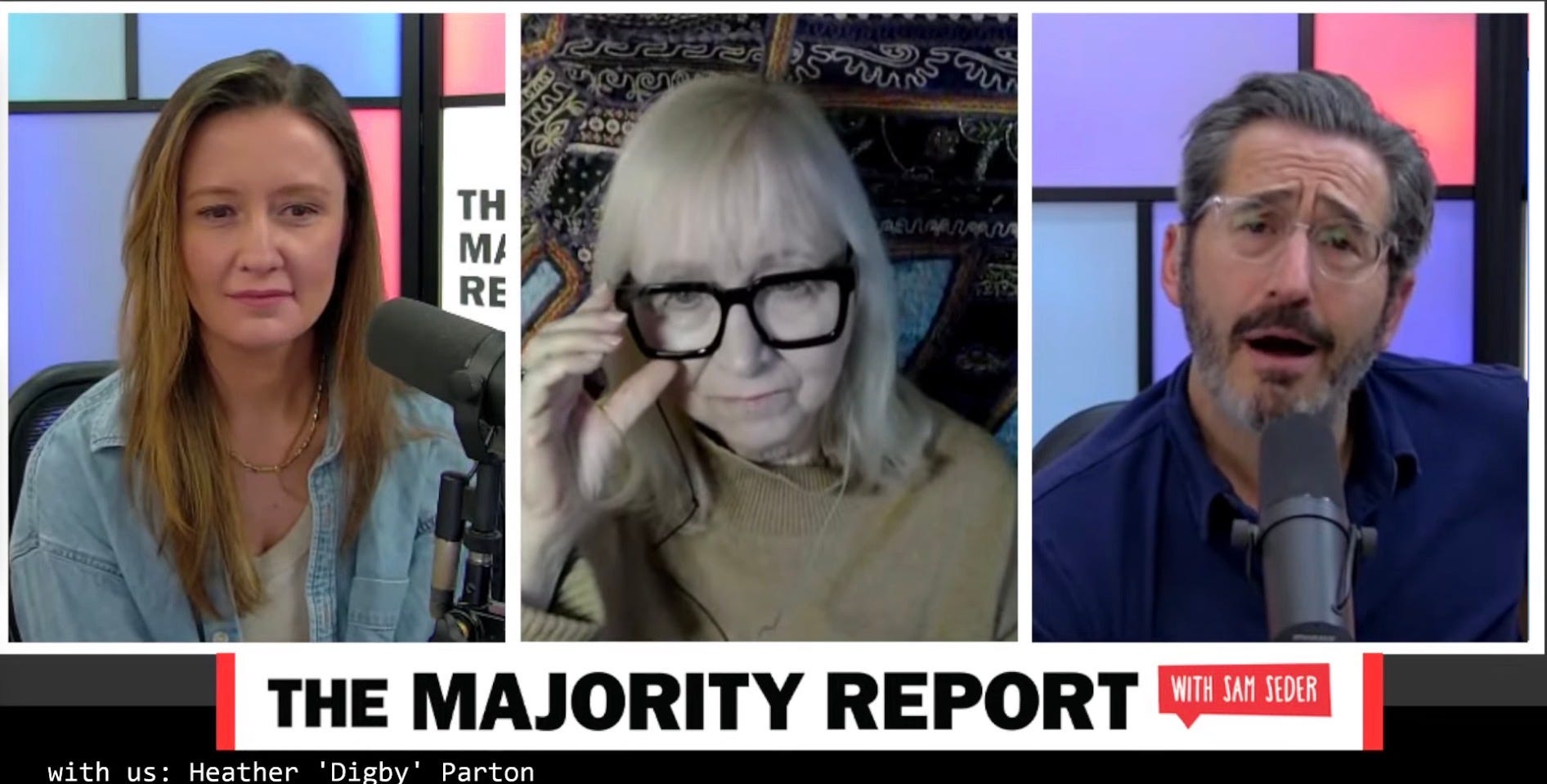
That is why the Friday conversation between Sam Seder and Heather “Digby” Parton on The Majority Report belongs in this piece. For readers who do not live inside the progressive media ecosystem, Sam Seder is the host and founder of The Majority Report, a progressive political talk show built around news commentary, interviews, debate, and live reaction. Heather “Digby” Parton is a longtime progressive political writer, a Salon columnist, and the founder of the political blog Hullabaloo.
Here is the transcript excerpt, with speakers separated. The transcript language is preserved as given. Only speaker labels have been added.
Transcript excerpt begins
Sam Seder: Nice. Yes, ladies and gentlemen, the dulcet tones of... I can’t remember who wrote that song. I don’t think I ever knew. Let’s look that up. But regardless, thank you. And a great way to introduce our next guest, Heather Digby Martin, writer at Salon.com and proprietor of the uberblog Hullabaloo. Hi, Digby.
Heather “Digby” Parton: Hi, guys. Glad to be here.
Sam Seder: Great to see you, Heather. Great at the end of the week.
Heather “Digby” Parton: Yes. Another week.
Sam Seder: Another week, yes. Feels like a year. The week, as the week progressed, it feels like it got worse. And let’s start with the most recent. I’ve barely had a chance to read into this. The Virginia Supreme Court came down with a ruling that found that the Virginia referendum was illegal. And if I understand correctly, I just read quickly, it was because the vote, they’re supposed to take two votes for a referendum on the either side of an election, of a general election.
And supposedly, one of the votes took place in early voting of one of the elections. And therefore, they didn’t really do it on either side of the election because the election was ongoing. Quite the technicality. We should also say, before you go into this, that the way that they pick Supreme Court justices is that the legislature votes on it, but they’ve had a split legislature for some time in Virginia.
So three of the members of the court were picked by Republicans, one by a Democrat, and then the other, I think it was three, were in a sort of bipartisan fashion. So you’ve got to imagine at least one or two of those are Republican essentially leaning. And so there you have it.
This is a crap show because we’re looking at now a lot of states that are Republicans are moving aggressively, particularly in the wake of the Voting Rights Act dissolution, and there’s going to be a net gain much bigger than we had anticipated just even a week ago.
Heather “Digby” Parton: Absolutely. I mean, this is pretty devastating, I have to say. And it’s not just devastating because of the numbers, although that’s part of it. Having the Supreme Court ruling on the Voting Rights Act, which of course these red states just immediately went in and are decimating every black, you know, district. They just did it in Tennessee yesterday.
You know, they’re going to, they split Memphis three ways and now there will be no black representation in Tennessee. So the only black representation in the U.S. Congress will be in blue states and red states won’t have any anymore. It’s just absolutely insane.
But, you know, very depressing and not unexpected. I mean, I have to say I really, I knew it was coming. I’m sure most people did because John Roberts and the, you know, the rest of the conservatives on the court have been angling to do this for, well, for decades since the Voting Rights Act was enacted, essentially. So, you know, basically it’s just, it’s a racist ruling. We had many of them right up there, I think, with Dred Scott, you know, some of these Buzzy vs. Ferguson. The famous ones. This is going to be one too, Chalet, you know, versus Louisiana. It’s going to be one of those. And so we’re dealing with that, which we knew was going to be bad. And then to have, and so what are they doing? They’ve got in Florida now, they have a Supreme Court, they have a Supreme Court decision.
They actually had, I think, a constitutional amendment that said that you can’t, that the legislature is not allowed to do redistricting. They’re doing it. It’s going to go to the Supreme Court and the Supreme Court looks in every way like they’re going to just allow it to happen because it’s Florida, so they do things like that in the red states and they just say, yeah, whatever you need, Don, you know, dear leader, whatever you need and whatever you need the Republican Party.
So they’re going to gain a bunch of seats, as you just said. And then in Virginia, where it went, you know, this was a referendum, people went out and voted in large numbers and they voted to redistrict. And it was, that’s the democratic way, right? I mean, you have the people vote and people came out on both sides. It wasn’t particular, it wasn’t an overwhelming vote, but it was decisive. And the, you know, the democratic side on that prevailed.
And their Supreme Court, which as you’ve just pointed out, is packed with a bunch of Republicans, decided on a very, what appears to be, I mean, I just gave a cursory glance at the opinion too because we just came on. We just came on and it was just released a little bit ago. But it’s what you say, I mean, it was just a very thin technicality that they could have, you know, they could have easily, you know, ignored and ruled the other way. But of course, they took the opportunity to do this, which is how they work and that.
Transcript excerpt ends
That live exchange matters because it catches the political weather around the ruling before everybody has time to launder it into calm institutional language. The legal issue is technical. The consequence is not technical at all.
Seder hears a procedural trapdoor. Parton hears the national redistricting emergency. Put them together and you hear the same alarm this essay is trying to sound.
The election is already being fought before voters ever reach November.
That is the buried sentence under the ruling: democracy does not disappear only when people are blocked from voting. Sometimes it disappears after people vote and are told their vote arrived through the wrong door.
The Bigger Power Story
This is where the easy sermon gets dangerous.
It would be simple to write this as if Democrats were pure defenders of democracy and Republicans were pure villains. But that would be too easy and too fake.
Virginia Democrats were not trying to draw a neutral love letter to democracy. They were trying to draw a map that could help them win more seats.
But Republicans are not innocent referees standing outside the game with whistles and clean hands. The national redistricting fight did not begin with Virginia. It has been fueled by Republican-led efforts to redraw maps in multiple states in order to preserve or expand a House majority. [2][4][5]
So the real question is not whether one side wants power.
Of course they do.
The real question is whether one side gets to fight a national map war while the other side gets trapped in procedural purity.
That is the tension Virginia exposes.
If Republicans redraw aggressively in red states, and Democrats are blocked from answering in blue or purple states, then “process” becomes more than a legal argument. It becomes a weaponized asymmetry.
That does not mean the court’s procedural holding is automatically wrong.
It means the consequences are not neutral.
They never are.
What Happens Next
As of now, Virginia’s 2021 congressional map remains in place for the 2026 elections. [1][2]
That means Democrats do not get the expected 10-1 map they hoped would offset Republican gains elsewhere. It also means Virginia’s delegation remains on the current 6-5 Democratic footing unless voters change individual seats under the existing districts. [1][2]
There may still be more legal and political maneuvering. Virginia Democratic leaders have signaled anger and a desire to keep fighting, while Republicans are treating the ruling as a major validation of their challenge. [6]
But the immediate effect is clear.
The referendum is dead. The new map is blocked. The old map governs.
That is the breaking news.
The deeper story is that the 2026 election is no longer waiting for November.
It is already happening in courthouses, statehouses, map rooms, and emergency rulings most voters will never read.
By the time people show up to vote, part of the election may already be over.
Support This Work
This is not a process story.
It is a power story.
Virginia voters approved a referendum. The state Supreme Court struck it down. The congressional map that could have changed the balance of the House stays off the table. And the national redistricting war keeps moving.
If this reporting helps clarify what is happening, restack it and send it to one person.
A restack costs nothing. Silence also sends a message.
And if you want fast, sourced, independent coverage before these stories get softened into polite headlines, become a paid subscriber:
Or just buy a coffee.
Sources
Supreme Court of Virginia, Don Scott, in his official capacity, et al. v. Ryan T. McDougle, Virginia State Senator, et al.: Official May 8, 2026 opinion striking down the redistricting referendum and keeping the 2021 congressional map in place.
Associated Press, “Virginia Supreme Court strikes down Democrats’ redrawn US House maps, giving Republicans a win”: National breaking-news report on the 4-3 ruling, the referendum, the map consequences, and the broader midterm redistricting fight.
Axios Richmond, “Virginia Supreme Court throws out redistricting referendum results”: Richmond-focused summary of the referendum, campaign spending, special-election cost, and expected 6-5 to 10-1 congressional-seat shift.
The Guardian, “Virginia supreme court strikes down new congressional maps in win for Republicans”: Coverage placing the Virginia ruling in the national context of congressional redistricting battles before the 2026 midterms.
Al Jazeera, “Virginia Supreme Court strikes down Democrats’ redistricting plan in US”: AP/Reuters-based report on the ruling, the April 21 referendum, the national map fight, and the broader congressional stakes.
WDBJ7, “Virginia leaders respond to Supreme Court’s striking down of redistricting referendum”: Virginia political reactions from Republican and Democratic officials after the court struck down the voter-approved plan.
The Majority Report with Sam Seder, “Heather ‘Digby’ Parton | MR Live | Majority Report”: Sam Seder and Heather “Digby” Parton’s May 8, 2026 live discussion of the Virginia Supreme Court ruling and the broader national redistricting fight; transcript excerpt supplied by Xplisset.
Now is when I tell all the screaming mimi's (myself included): We weren't overreacting.
Collusion to invalidate voting. Like the attacks on our quality of life and wanton acts of violence, these multi-directional attacks on due process seek to drive Americans to either violence (so they can send the paramilitaries after us) or disempowered despair. Ghandi, Dr. King and many others (eg. in Minneapolis) can help us find paths to creative, empowering, nonviolent action that goes beyond resistance and builds a better future.