

I started with a question I could not shake.
When the United States Supreme Court handed down Louisiana v. Callais, I wanted to know something very specific. Not how American cable news would spin it. Not how party hacks would explain it. Not how some legal analyst would put on a serious face and turn Black voting power into a crossword puzzle.
I wanted to know this one thing:
Could the rest of the world see what was happening?
When America takes a voting-rights fight rooted in Black political power and dresses it up as maps, process, doctrine, and “neutral” law, can foreign media still see the old racial line underneath it?
The answer is yes.
But not everyone saw it the same way. Some outlets saw a democracy story. Some saw a Republican power grab. Some saw a minority-rights fight. And a few saw the thing America keeps trying to hide in plain sight: Black voters being pushed back toward the margins by legal language clean enough to wear to court.
The clearest coverage came from The Guardian, Caribbean Life, and El País. Those outlets did not just say “maps” or “midterms.” They said Black voters, civil rights, and, in the strongest cases, Jim Crow, slavery, or the long afterlife of racial exclusion. [7][11][12][17]
That matters because the ruling was not just about lines on a map. It was about who gets to turn Black political power into legal paperwork, then tell the rest of us not to notice.
And please, spare me the “this is just redistricting” routine.
That is how America puts a tuxedo on a mugging, then asks you to compliment the tailoring.
TLDR
The strongest “color line” reporting came from Britain, the Caribbean diaspora, Spain, and one sharp comparative piece from South Africa. [7][11][13][17]
France and Germany clearly saw minority-rights damage and partisan gain, but their framing leaned more toward institutions, party power, and “minorities” than deep anti-Black history. [9][10]
The Jamaica island sample was thinner and more syndicated. The main current piece I found from the Jamaica Observer was an AFP dispatch. [16]
The Caribbean diaspora sample was the boldest about anti-Black harm, Jim Crow echoes, and damage to Black political power. [17]
The world can see the crisis. What it cannot always do is name the crisis in Black terms with equal force. [7][9][10][11][16][17]
Paid subscribers keep XVOA alive. If this work helps you see the story behind the story, support it here:
If a paid subscription is not possible today, buy me a coffee.
Five dollars helps. Ten dollars helps. A one-time contribution helps keep the lights on. If money is not possible, restack it, share it, and send it to one friend who still thinks “states’ rights” is just a harmless phrase with a nice little hat on.
What the Case Changed
In plain language, foreign outlets read Louisiana v. Callais as a ruling that made Section 2 of the Voting Rights Act much harder to use.
The Supreme Court did not erase the law in full. But many outlets concluded that the decision pushed voting-rights plaintiffs toward a much harder burden. Instead of showing that a map dilutes minority voting power, they may now have to prove intentional racial discrimination. [1][11][16]
That is why so many reports used words like “gut,” “demolish,” “weaken,” or “neutralize.”
The ruling also came after years of damage to the Voting Rights Act, especially after Shelby County v. Holder in 2013. Several outlets treated Callais not as a one-off map fight in Louisiana, but as another step in the long rollback of federal protection for Black voting power. [8][11][12][13]
The timeline matters.
Louisiana’s post-2020 census map was challenged in Robinson v. Ardoin in 2022. A district court found a likely Section 2 violation on June 6, 2022. A new map was later challenged in Callais. The Supreme Court stayed the lower-court block on May 15, 2024, noted probable jurisdiction on November 4, 2024, heard argument on March 24, 2025, ordered reargument on June 27, 2025, reargued the case on October 15, 2025, decided it on April 29, 2026, and then sped the judgment down on May 4, 2026. [1][2][3][4]
That last part matters too. The court did not just rule. It moved fast enough to help the ruling matter before the midterms. That is not a small procedural footnote. That is the machinery making the sound.
How This Audit Worked
I looked at a focused sample of foreign and diaspora coverage after the ruling.
The question was not “Did every country in the world cover this?” That would be a census. This is an audit.
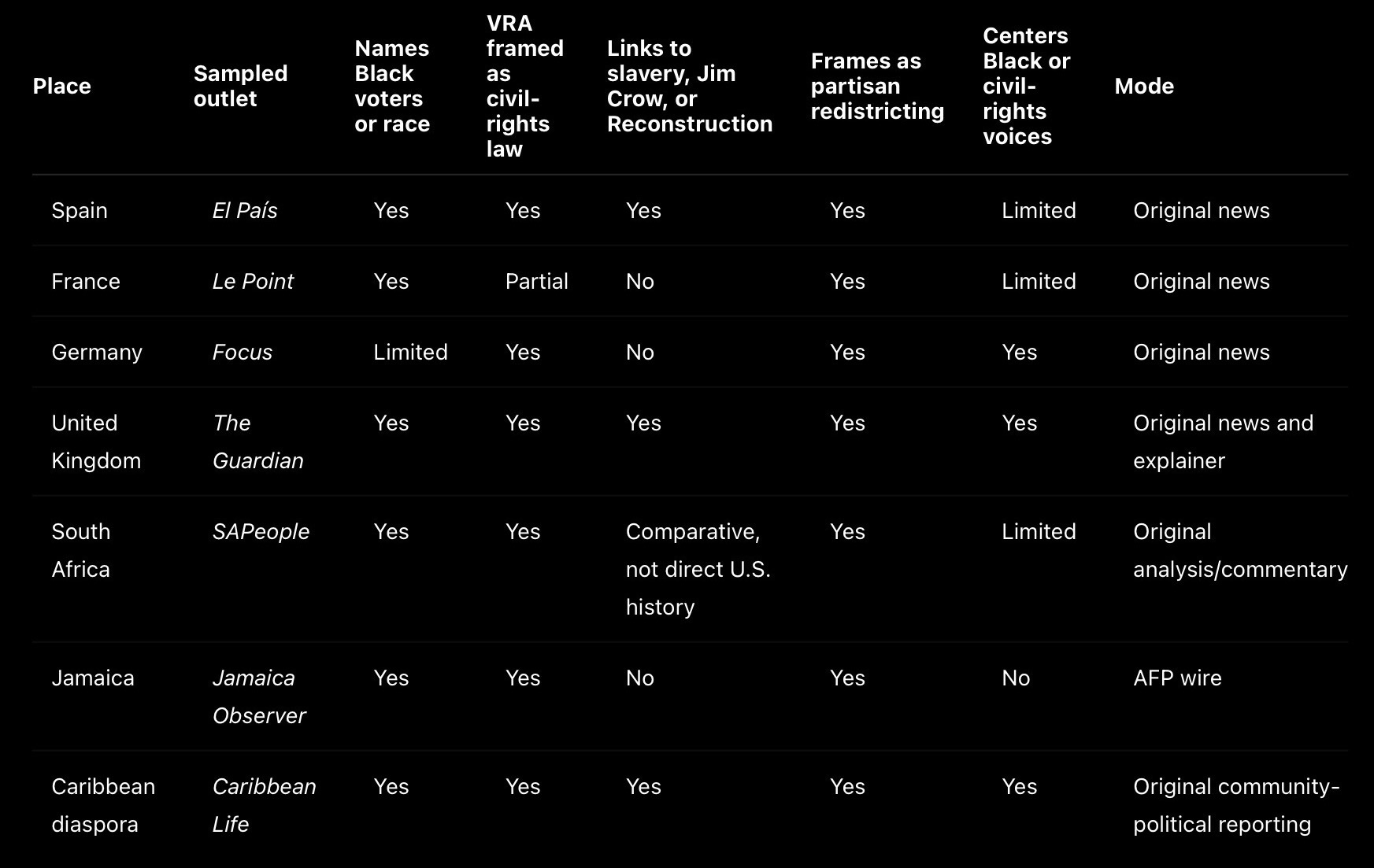
I coded each sample for five things:
Did it name Black voters or race?
Did it frame the Voting Rights Act as a civil-rights law?
Did it link the story to slavery, Jim Crow, Reconstruction, or the long history of racial exclusion?
Did it treat the ruling as partisan redistricting?
Did it center Black or civil-rights voices?
I used “Limited” when a point appeared, but did not drive the story.
That distinction matters. A story can mention Black voters in paragraph eight while still making party strategy the real star of the show. That is like inviting Black people to the cookout and then seating them next to the trash cans.
Audit Results
Listen, the pattern is clean.
The outlets that most clearly saw the color line were the ones that kept race, law, history, and voice in the same frame.
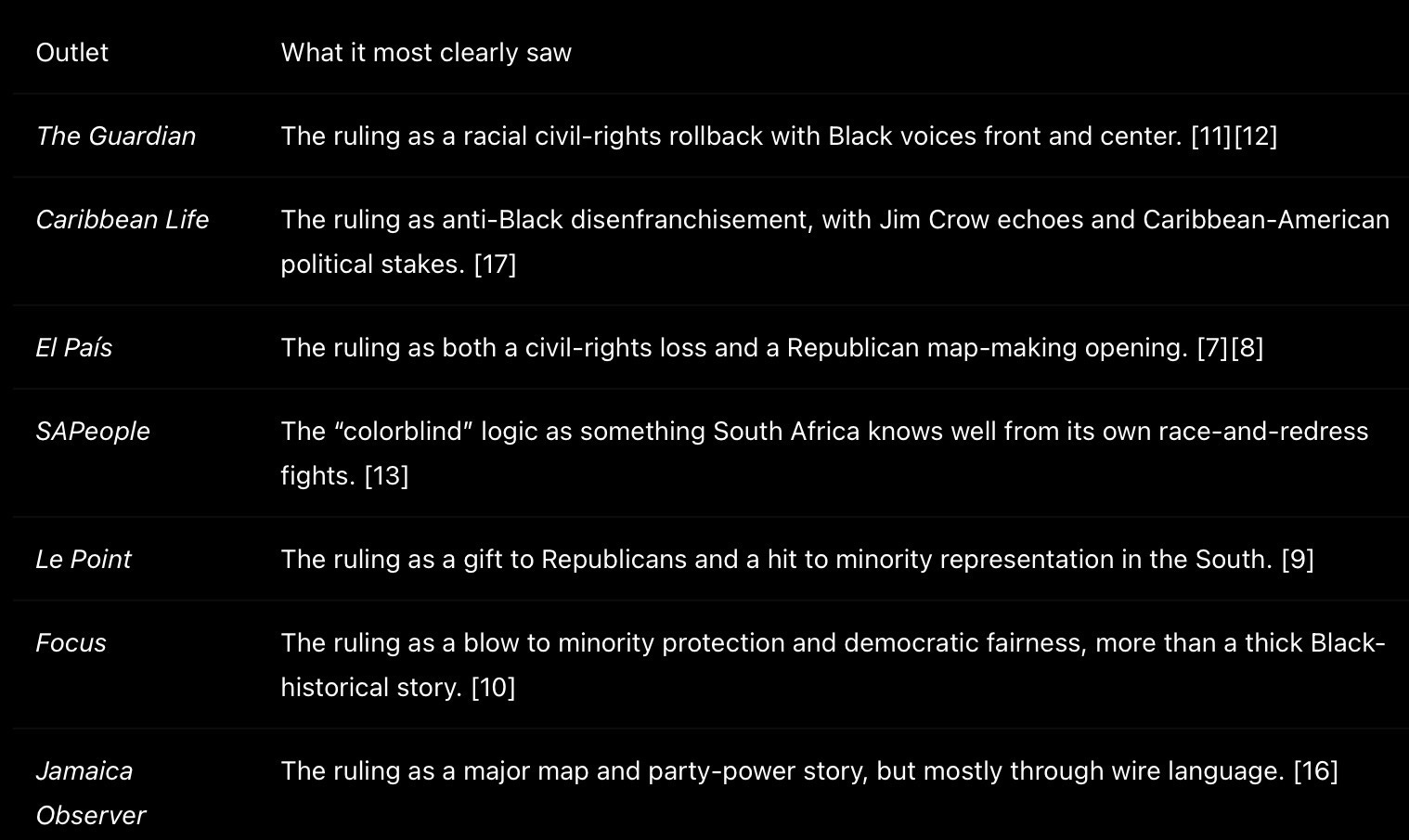
That was strongest at The Guardian and Caribbean Life, with El País close behind. [7][11][12][17]
The weaker pieces were not blind to harm. They simply flattened racial harm into broader terms like “minorities,” “electoral maps,” or “Congressional power.” [9][10][16]
That is not nothing. But it is not the same thing as saying the quiet part out loud.
What Each Outlet Saw Most Clearly
Spain: El País Saw the Ghost Under the Map
Spain’s sample was solid and clear.
El País called the Voting Rights Act a landmark achievement of the civil-rights era. It named the second majority-Black district. It said the ruling opened the door for Republicans to redraw maps. Its follow-up explainer also reminded readers that the law grew out of the civil-rights struggle and that Shelby County had already weakened it. [7][8]
The strongest move came when the outlet tied the law to America’s painful history of slavery and post-Civil War racial discrimination. [7]
That is exactly the bridge many outlets skip.
El País did not just see a map. It saw the ghost under the map.
Its page-level calls to action were simple: newsletter sign-up and social sharing. That is standard, but it also tells us something. The article was packaged as news that could travel.
France: Le Point Saw Power More Than the Full Racial Story
France’s sample was sharper on power than on racial depth.
Le Point called the ruling a gift to Republicans. It said the decision would reshape the political representation of American minorities. It noted the earlier creation of a second Black district. It warned that Southern states could reduce Black representation. [9]
That is real coverage.
But in the visible text, the racial story came through more as minority representation and party balance than as a deeply narrated Black civil-rights struggle.
France saw the chessboard. It saw who gained. It saw who might lose. But it did not give the same thick historical weight to Black political exclusion that The Guardian, El País, or Caribbean Life did.
Its on-page calls to action were classic magazine infrastructure: newsletter sign-up and more reading.
Germany: Focus Saw the Democratic Harm Through an Institutional Lens
Germany’s sample made the democratic harm plain.
Focus said the court had massively weakened the Voting Rights Act. It said minority protection would now be much harder to enforce. It said the ruling could change the balance of power in Congress for years. [10]
The visible wording leaned more on minority protection than on explicit anti-Black naming.
But it did pull in civil-rights advocate Kristen Clarke, who called it a dark day for democracy. [10]
So Germany saw the wound, but through an institutional lens first.
That is a different kind of sight. It is not blind. It is more like wearing democracy glasses when the story also needs Black-history glasses.
United Kingdom: The Guardian Saw the Whole Layer Cake
The British sample was the most complete.
The Guardian called Section 2 the last powerful part of the 1965 civil-rights law. It said the ruling gutted it. It explained how the new test lets states hide racial harm behind partisanship. It gave readers the longer history: slavery, southern segregation, bloody struggle, and the legacy of discrimination. [11][12]
It also did the thing the strongest audit pieces did. It let Black and civil-rights voices speak.
The article quoted NAACP president Derrick Johnson, NAACP Legal Defense Fund president Janai Nelson, and Louisiana voting-rights plaintiff Press Robinson. It also explained how race and party are linked in the South. [11]
That matters.
A lot of journalism treats Black people as the object of harm. Better journalism lets Black people explain the harm.
If you want one example of foreign media seeing the whole layer cake, this was it.
The Guardian’s calls to action were familiar: newsletter sign-up, share prompts, related explainers, and adjacent reading.
South Africa: SAPeople Read America Through the Colorblind Trap
The South African choice paid off.
SAPeople gave this audit something different: not just a foreign report about America, but a comparative racial reading.
The piece said the ruling made Black votes easier to erase. It described the court’s reasoning as a familiar form of “colorblind” logic. It linked that logic to South African fights over racial redress. [13]
That is why South Africa belongs in this piece.
Not because South Africa speaks for all of Africa. It does not. No country does.
South Africa belongs because it has a living public vocabulary around apartheid, nonracialism, redress, and the politics of pretending not to see color while the results remain color-coded.
That is the core issue in the American ruling too.
The law says, “Do not look at race.” The result says, “Black voters lose power.”
Funny how that works. Funny in the way a locked door is funny when you are the one standing outside.
Some mainstream South African pickup was also available, but part of it appeared to track wire-service coverage. SAPeople gave the stronger local interpretive lens, which is why it is the better audit sample here. [13][14][15]
Jamaica: The Island Sample Was Real but Thinner
The Jamaica island sample was the weakest on original voice, but not because Jamaican media missed the stakes.
The Jamaica Observer clearly named a majority-Black district. It said the ruling could boost Republican prospects. It noted that civil-rights activists saw a serious blow to the law. [16]
But the piece was also labeled AFP. That matters.
That means readers got a competent summary, but not a strongly Jamaican frame.
Black voters were named. Black voices were not centered.
That does not mean Jamaican journalism lacks independent judgment. That would be wrong and insulting.
In fact, The Gleaner has treated U.S. voting fights as rights questions before. In a 2018 editorial on Ohio voter purges, it said civil-rights groups saw the Supreme Court as gutting the Voting Rights Act to the detriment of minorities, the poor, and disabled voters. It also warned that some U.S. conservatives treated voting more as a privilege than a right. [18]
So the issue is not capacity. The issue is this specific sample.
For Callais, the immediate island sample was lighter and more syndicated than the diaspora sample.
That is a finding, not an insult.
Caribbean Diaspora: Caribbean Life Put the Spotlight on Anti-Black Harm
This was the loudest and clearest racial reading in the full sample.
Caribbean Life did not hedge.
It said the ruling threatened majority-Black and brown districts. It quoted Representative Yvette Clarke calling it a “death certificate” for the Voting Rights Act. It described racist, anti-Black maps. It invoked Jim Crow. It foregrounded Black and immigrant-rights organizations. [17]
This is why diaspora press matters.
The story is not abstract to its readers. It runs through Brooklyn, New York State voting law, the Congressional Black Caucus, Black immigrant communities, and Caribbean-American political life. [17]
The diaspora did not whisper the racial subtext.
It put a spotlight on it and turned the dimmer up.
That is journalism with its shoes on.
Its calls to action were direct and community-based: stay connected, sign up by email, keep reading.
Why Hungary Was Excluded
Hungary was excluded for an editorial reason, not because Hungarian outlets have nothing to say.
This audit is about whether foreign media can see the racial meaning of the new voting-rights fight in the United States.
Hungary would likely pull the project toward a different question: democratic backsliding, court power, right-wing media capture, and liberal-versus-illiberal politics.
That is a real story. But it is not this story.
For this piece, I wanted countries and outlets that could test whether media would recognize Black disenfranchisement, not just American institutional decay.
Hungary belongs in a follow-up. It is less a neutral observer than a warning mirror.
Why South Africa, Jamaica, and the Caribbean Diaspora Were Included
South Africa was chosen because it gave the strongest current African comparison in the searchable sample.
The point is not “Africa explains America.” That would be lazy.
The point is narrower and stronger: South Africa has a public vocabulary around racial hierarchy, redress, and colorblind language. The SAPeople sample used that vocabulary to read the U.S. ruling. That makes it useful. [13]
Jamaica was chosen because Jamaican journalism has treated U.S. voting fights as rights issues before, not just foreign spectacle. The Gleaner editorial on voter purges makes that plain. [18]
The Caribbean diaspora was included because diaspora media sit inside the social world most affected by these U.S. battles.
In this sample, that mattered a lot.
Caribbean Life produced the boldest anti-Black analysis, while the island sample was more mixed and more dependent on wire copy. [16][17][18]
Put differently, the Jamaica-plus-diaspora pairing gave the audit range: one foot on the island, one foot in the U.S. Black Atlantic.
The Finding
The world can see America’s voting-rights crisis.
But it does not always name it the same way.
Some outlets see a democracy story.
Some see a partisan power story.
Some see a minority-rights story.
The strongest ones see the full thing: a racial democracy story about Black voting power, civil-rights law, partisan control, and historical memory.
That is the frame America keeps trying to break apart.
The legal language says race is too dangerous to use as a remedy. The political result says Black voters can be packed, cracked, erased, or diluted while everyone pretends the problem is neutrality.
That is the trick.
Call the robbery “process.” Call the wound “redistricting.” Call the color line “constitutional doctrine.” Then act shocked when someone notices the blood on the paperwork.
The world noticed.
Not perfectly. Not evenly. But enough.
And sometimes the clearest view came from outside the American prestige press, where nobody had to pretend this country’s racial history was just a background detail.
Keep This Work Alive
This is the kind of work XVOA exists to do.
Not just “what happened.”
Not just “who won.”
But what the language is hiding. What the map is doing. What the court is blessing. What the media is softening. What the public is being trained not to see.
If this work helps you, become a paid subscriber:
If you cannot do that today, buy me a coffee. Five dollars helps. Ten dollars helps. A one-time contribution keeps this one-person newsroom moving.
If money is not possible, restack this, share it, and send it to one person who still thinks voting-rights stories are just for lawyers, activists, and people who own too many tote bags.
This is one retired cop with a keyboard trying to keep the lights on while the country keeps changing the locks.
Don’t Do It.
Unless you know exactly why you should.
Sources
[1] U.S. Supreme Court opinion in Louisiana v. Callais — Official April 29, 2026 Supreme Court ruling.
[2] U.S. Supreme Court order issuing judgment forthwith — Official May 4, 2026 order speeding the judgment.
[3] U.S. Supreme Court docket for 24-109 — Official case docket for Louisiana v. Callais.
[4] NAACP Legal Defense Fund press release on Louisiana map litigation — Background on the lower-court finding involving Louisiana’s congressional map.
[5] NAACP Legal Defense Fund case page on Louisiana v. Callais — Civil-rights background on the case and its stakes for Black voters.
[6] ACLU statement on Supreme Court decision — Civil-rights group response to the ruling.
[7] El País: “The Supreme Court reshapes US electoral rules with a ruling that limits minority rights” — Spain-based English-language report on the ruling.
[8] El País: explainer on the Voting Rights Act and minority voting rights — Spanish-language explainer on the law and its civil-rights history.
[9] Le Point: “Redécoupage électoral américain: le cadeau de la Cour suprême aux républicains” — French coverage framing the ruling as a Republican advantage and minority-representation issue.
[10] Focus: German report on Supreme Court ruling and minority protections — German coverage emphasizing weakened minority protection and democratic harm.
[11] The Guardian: “US supreme court ‘demolishes’ Voting Rights Act” — British coverage foregrounding race, civil-rights law, and Black voices.
[12] The Guardian: explainer on the voting-rights ruling — Follow-up explainer on the ruling’s legal and political stakes.
[13] SAPeople: analysis of Voting Rights Act ruling — South African comparative analysis linking U.S. colorblind logic to race-and-redress debates.
[14] News24: U.S. Supreme Court voids Louisiana voting map — South African pickup of the ruling, useful for comparison with local analysis.
[15] Reuters: redistricting after the Supreme Court decision — Wire-service account of post-ruling redistricting moves.
[16] Jamaica Observer: AFP dispatch on Supreme Court voting-map ruling — Jamaica-based publication carrying an AFP report on the decision.
[17] Caribbean Life: report on Haitian Creole voter law and voting-rights ruling — Caribbean-diaspora coverage connecting the ruling to anti-Black maps, Jim Crow echoes, and Black immigrant communities.
[18] The Gleaner: editorial on U.S. voter purges — Jamaican editorial background showing prior rights-based framing of U.S. voting fights.
Excellent written and referenced. Thank you!
A legal word used to hear on the news when I was growing up , especially connected to racial matters of racial discrimination was "de facto". I have no legal training, but The American Heritage Dictionary says this:
de facto /dĭ făk′tō, dā/
adjective
Existing in actuality, especially when contrary to or not established by law.
"de facto segregation; a de facto government."
In fact or in practice; in actual use or existence, regardless of official or legal status. (Often opposed to de jure.).
Existing in fact whether with lawful authority or not.
"a de facto state of war"
I have always presumed that "de facto" means "What's real".
Reality is where we live, so it counts. The law once claimed that women are inferior and subservient to men. It was a lie. The law, and in fact the Supreme Court of the US declared that black people had no natural rights. They also lied. When the law is at odds with reality, any honest sense of justice demands that the law be changed. When the law is deliberately misapplied, there is no less injustice. The Orwellian pretenses of this regime are blatantly untrue and blatantly evil. Rule of law is necessary, but justice is possible only when provable big lies and corruption are resisted. De facto injustice stinks just as badly no matter how it is labeled.
The weird part is that the MAGA judges expect us ignore epic, deliberate, institutionalized racism as practiced by the current (anti-republic) "Republican Party", so long as the rights of black and other voters are diluted only for "partizan purposes" (of a party which happen to be demonstrably blatantly racist). Like a bribe is not a bribe without the issue of an itemized invoice? "Equal Justice Under Law"? It's what is written on the Supreme Court building. Reality, whether we grasp it or not, is what actually happens.