


I am married to a woman. I have daughters. Feminism has to mean something in my home once I shut this computer. Anyone can claim they believe women. I still have to listen when one of them is telling me something I don’t want to hear.
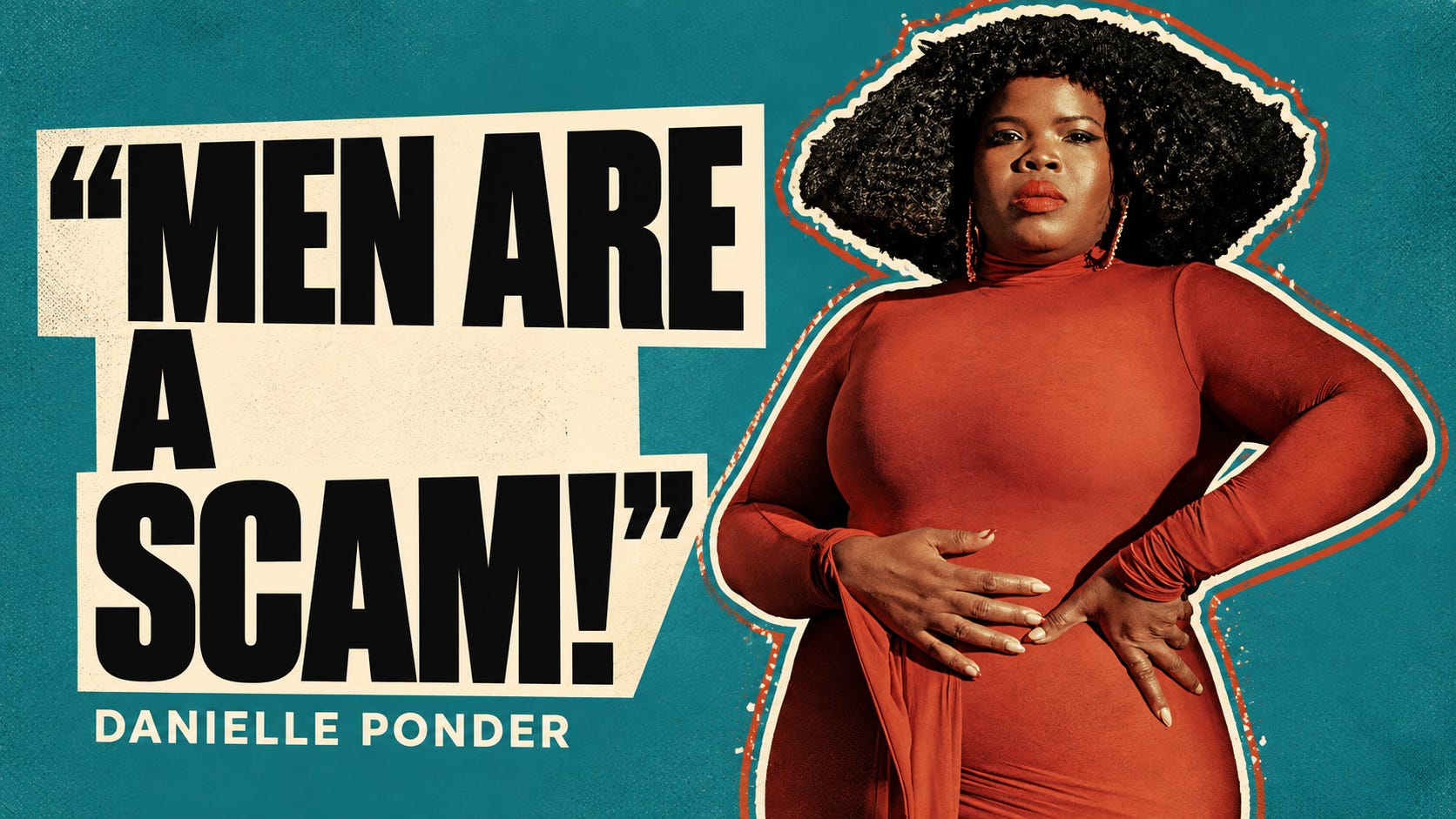
And yes, I realize I just offered my wife and daughters as references. Plenty of men collect those credentials while making women miserable. I have to look at myself in the mirror too ya’ll. Former lawyer turned full time musician Danielle Ponder told Iman Amrani of the Guardian, “Men are a scam!” [1] There’s a rich tradition of Black women articulating that sentiment through music.
In 2021 Ponder, then thirty-nine, left the practice of law to focus full time on music. Her pastor father didn’t support any non-religious music being played in the house but singers such as Big Mama Thornton helped Ponder understand what her own voice could do. [2] Her story is emblematic of an old argument about what women are allowed to want.
Who Gets to Choose
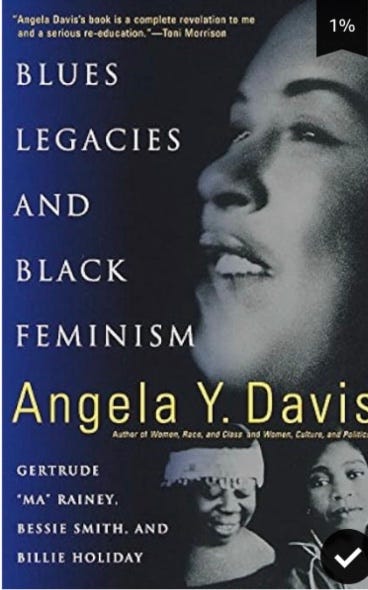
Angela Davis’s Blues Legacies and Black Feminism helps explain why so much of this music concerns somebody’s lover.
Davis connects the emergence of blues after emancipation to greater freedom of movement and choice of sexual partners. Freedom remained severely constrained, but intimate decisions acquired new possibilities slavery had denied. Choosing a lover could carry a significance that gets lost when we hear another song about somebody’s man. [3]
Picture what it would be like to choose who you loved when someone else had previously been able to sell that person away. And then picture that person getting on your last nerve. Both of those things exist in the blues. Part of freedom is being frustrated by choices that you were finally free to make.
Women had something to say about the terms of that freedom. Quite a lot, as it turned out.
The Marriage Had Fine Print
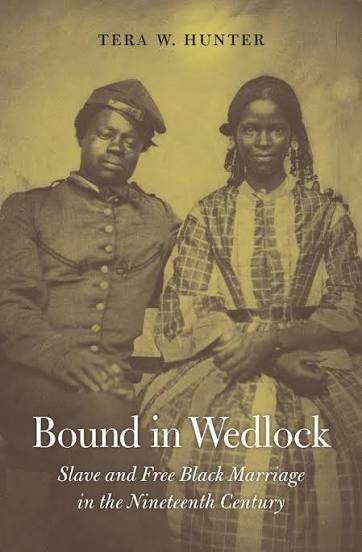
Enslaved people had formed marriages and families long before the law respected them. Legal recognition after emancipation was something Black couples sought for themselves. Tera Hunter’s Bound in Wedlock documents those relationships alongside the coercion built into the new marriage regime. Rights came with terms on how the formerly enslaved were supposed to behave. [4]
Money was part of those terms. In the evolving agricultural system, employers were allowed to strike deals with a male head of household for the labor of a whole family. The Freedmen’s Bureau encouraged these agreements. A husband’s power could be an asset for a landowner. [5]
Consider the woman at the center of this deal. She had gained freedom. Yet someone was bargaining over the terms of her liberty.
Some Black men pursued the authority attached to being a husband. Others used their position to help women challenge abuse. Historian Elizabeth Barnes documents both, along with women refusing men’s claims over them. [6] We have to leave those differences intact. Black women were arguing, choosing and resisting throughout this history.
But just because white men refused to give a Black man power didn’t mean a Black man couldn’t want to wield power over a woman. I don’t know how we get past that.
A man can recognize how it feels to be humiliated by being told to take orders from someone else, and then go home and demand the same from his wife.
The Women Were Playing, Too
Mamie Desdunes belongs in this story. Her singing and piano playing influenced Jelly Roll Morton’s approach to blues. Music historian Sherrie Tucker places her within the exchange between Caribbean and New Orleans musical traditions. [7] Desdunes is a name worth remembering the next time somebody tells this history entirely through men.
Then there’s Ma Rainey, building her own performance company after her marriage ended. Her “Prove It on Me Blues” put the desire for women in her art. [8] She offered audiences a woman whose needs couldn’t be packaged into someone else’s version of womanly respectability.
Women were contributing their own life experiences and needs to the music they were making. This is relevant to the discussion of who ‘owns’ the blues. Davis also recounts pianist Ida Goodson recalling how she played blues at home, but if her religious parents came in, the children changed to hymns. [3]
I love that detail. The music was already in the house. The children just had to keep an eye on the door.
Making a God Out of a Man
That brings me back to Ponder and the preacher’s household.
What strikes me as both interesting and scary is the idea of ceding this much power to somebody, handing them the controls on what’s okay and what your achievements are and what your value is. A completely normal guy, but his approval somehow becomes the thing that settles all of it.
That’s the danger I hear in Ponder’s “God of You.” Ponder co-wrote the song with Mike Elizondo, and the release notes identify Screamin’ Jay Hawkins’s “I Put a Spell on You” as part of its inspiration. [9]
A woman can go on for years trying to satisfy that voice. And eventually even her unhappiness is something that she thinks she should fix for his sake. I hear Ponder examining what she has sacrificed. There is some shame there, and some resentment. But what it means is that it takes a lot of courage to admit how much of yourself you organized around another person’s judgment.
We’ve spent enough time asking Black women to explain their pain. On Everything Has Changed, in a song appropriately called “Power,” Ponder salutes Black power and Black beauty. [2] I hope that Ponder has fun.
Her music moves across blues, soul and other forms. [2] I consider Ponder the embodiment of the blues because she insists on telling her story in her own terms. The desire belongs in it. So does the disappointment.
I hope that my daughters will have the autonomy she sings about: to write their own stories and decide when a man no longer gets to be the main character. I want them to recognize when being loved starts requiring them to disappear.
And if they have something to tell me about that, I need to hear it.
XVOA follows these connections because Black history changes what we can hear in the present. Reading the scholarship and checking the reporting takes time. If you read free, become a paid subscriber to help finance that work:
If another subscription isn’t workable, Buy Me a Coffee is the one-time option where you can contribute as little or as much as you’d like in just one gesture:
To the readers already paying for this desk and those who have contributed before, thank you for giving me the time to keep doing it.
Sources
[1] Iman Amrani, Danielle Ponder interview, The Guardian, October 7, 2026.
https://www.theguardian.com/music/2026/oct/07/danielle-ponder-lawyer-turned-singer-interview
[2] Danielle Ponder, artist biography, Dead Oceans.
https://deadoceans.com/artists/danielle-ponder/
[3] Angela Y. Davis, Blues Legacies and Black Feminism, chapter 1, “I Used to Be Your Sweet Mama: Ideology, Sexuality, and Domesticity.” Authorized ebook preview.
https://www.everand.com/book/769508291/Blues-Legacies-and-Black-Feminism-Gertrude-Ma-Rainey-Bessie-Smith-and-Billie-Holiday
[4] Tera W. Hunter, Bound in Wedlock: Slave and Free Black Marriage in the Nineteenth Century. Princeton University book overview and author interview.
https://history.princeton.edu/about/publications/bound-wedlock-slave-and-free-black-marriage-nineteenth-century
https://aas.princeton.edu/news/aas21-podcast-episode-7-what-was-african-american-marriage
[5] “Tenancy, Marriage, and the Boll Weevil Infestation, 1892–1930,” Demography.
https://pmc.ncbi.nlm.nih.gov/articles/PMC5858199/
[6] Elizabeth M. Barnes, “‘The girl did not recognise him as her husband’: freedmen, sexual violence, and gendered authority after emancipation,” American Nineteenth Century History, 2022.
https://www.tandfonline.com/doi/abs/10.1080/14664658.2021.2022476
[7] Sherrie Tucker, A Feminist Perspective on New Orleans Jazzwomen, National Park Service research study.
https://www.nps.gov/jazz/learn/historyculture/upload/New_Orleans_Jazzwomen_RS-2.pdf
[8] “Ma Rainey,” Smithsonian National Museum of African American History and Culture.
https://nmaahc.si.edu/ma-rainey
[9] “Danielle Ponder Debuts New Song ‘God of You,’” Dead Oceans, September 8, 2026.
https://deadoceans.com/news/danielle-ponder-debuts-new-song-god-of-you/
Wonderful piece recognizing the importance of women in music historically and today.