


A Deal at Day 40: Democrats Break Ranks to Reopen Government
After a grueling 40 days of a federal shutdown – the longest in U.S. history – a late-night Senate vote on Sunday finally set the stage to reopen the government . In a dramatic 60-40 procedural vote, seven Senate Democrats and one independent broke with their party to join Republicans in advancing a stopgap funding bill . The measure would extend government funding through January 30, include three full-year appropriations bills, and guarantee back pay for federal workers . In exchange for these concessions, Republicans agreed only to hold a future vote on extending Affordable Care Act (ACA) subsidies – the very issue at the heart of the standoff. Many progressives think Tim Kaine’s funding vote will generate backlash. Forty days of chaos just to promise a promise sort of like killing the lights for forty days and then selling us a voucher for sunlight.
This high-stakes compromise emerged after weeks of false starts and failed votes. Senate Majority Leader John Thune (R-S.D.) – who had largely refused to negotiate amid Democratic demands – acknowledged Sunday that “a deal is coming together,” even as he cautioned it wasn’t yet guaranteed . Behind the scenes, a small group of moderate Democrats had been quietly negotiating with GOP leaders on a framework to end the shutdown. Their outline: reopen the government into January, fund critical areas like veterans’ programs and food aid, and settle for a “pinky promise” of a later vote on the ACA subsidies, rather than the guarantee Democrats originally sought .
By Sunday evening, the choice for Democrats was stark. Keep fighting for a meaningful deal on health-care aid – prolonging the pain of a shutdown that had delayed food assistance, sidelined federal workers, and snarled air travel – or take the deal on the table and hope Republicans honor their word in a few weeks’ time . In the end, eight members of the Democratic caucus took the leap. “This was the only deal on the table. It was our best chance to reopen the government and immediately begin negotiations to extend the ACA tax credits,” said Senator Jeanne Shaheen (D-N.H.), who helped broker the agreement
Tim Kaine Breaks Ranks – “Controversial, Tough Call” or Pragmatic Move?
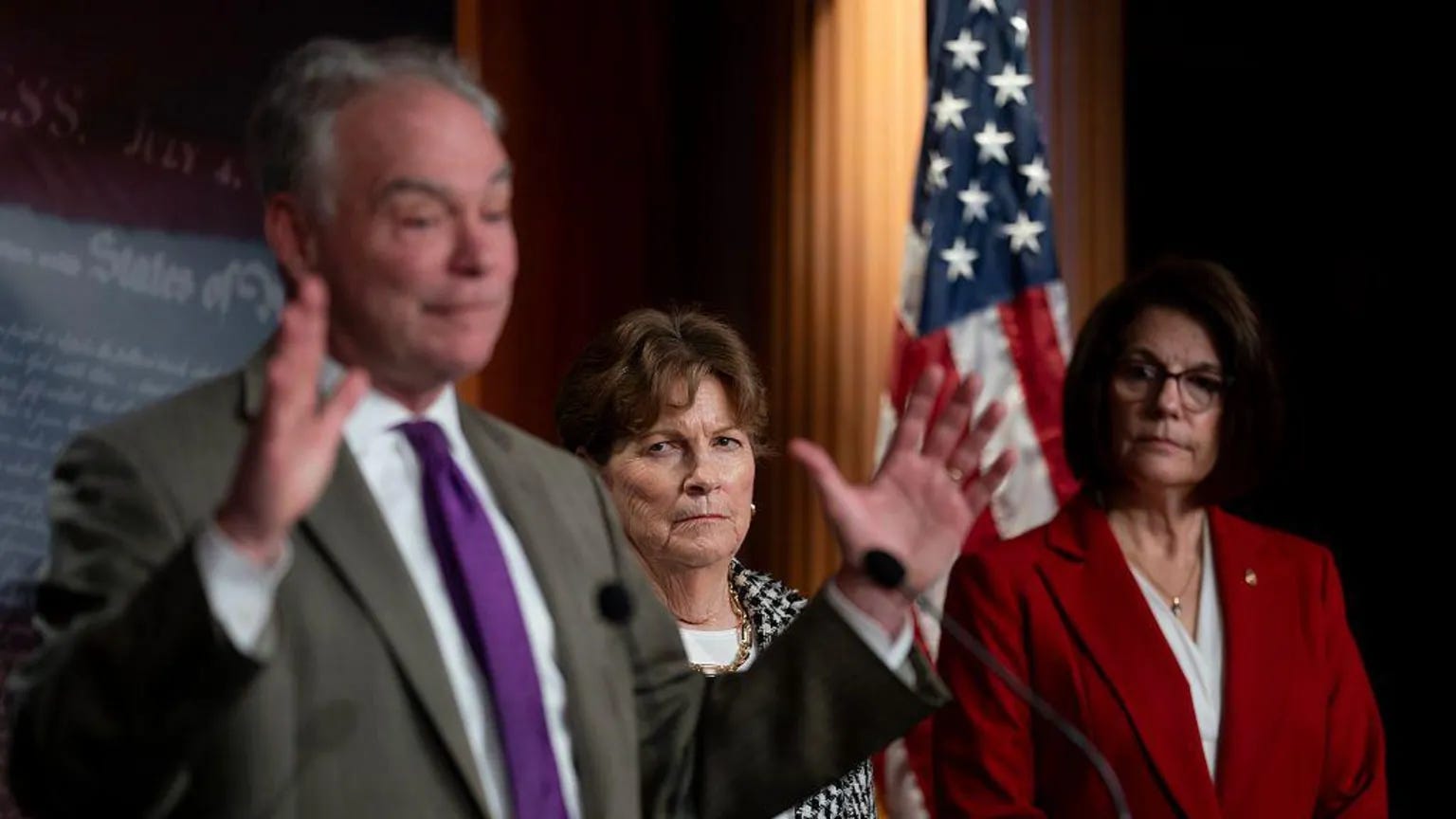
One of the most prominent defectors was Senator Tim Kaine (D-VA), a generally loyal Democrat and former vice-presidential nominee, whose vote to advance the GOP-led funding bill came as a surprise to many. “Controversial, tough call – some of my colleagues don’t like it,” Kaine admitted on Monday, “but my governor-elect is very happy with it, and I’m hearing from Virginians this morning… ‘Thank God you did this.’” Kaine’s home state of Virginia, with its massive federal workforce and 850,000 residents on food assistance, had been hit especially hard by the shutdown’s ripple effects . Federal employees faced “baseless” mass firings under President Trump’s downsizing drive, and SNAP benefits were frozen, prompting even Virginia’s Republican governor to declare a state of emergency to fill the gap .
Kaine portrays his defection as an act of conscience driven by constituent pain. After Virginia’s state elections last week, “I assessed, ‘Where are we?’ on the shutdown… and so I decided to join the discussions to try to find the path out,” he explained . He insisted on specific safeguards in the deal as his price for support: rehiring any federal workers fired during the shutdown, a ban on further layoffs until January 30, and full back pay for all federal employees . Those terms, Kaine said, “met his requirements” for protecting workers in his state . Indeed, the temporary funding bill includes language to reverse thousands of terminations that occurred since the shutdown began on Oct. 1 and to halt additional workforce reductions through January . “This legislation will protect federal workers from baseless firings, reinstate those who have been wrongfully terminated during the shutdown, and ensure federal workers receive back pay,” Kaine noted in a statement .
Yet Kaine also acknowledged the deal’s biggest shortcoming: it does not actually extend the expiring ACA health insurance subsidies – it merely ensures a debate and vote on them next month . A floor debate, however, doesn’t pay anyone’s premium. Democrats had been holding out for those subsidies, which keep insurance premiums affordable for millions, and their omission immediately provoked anger on the left . Kaine, however, sounded blunt in challenging his progressive colleagues’ hard line. “I asked my progressive colleagues… do you think another week of punishing SNAP recipients is going to make the Republicans cave? Will another month make them cave?” he recounted, rejecting the notion that simply waiting out the GOP would yield a better result . In his view, the shutdown had become a dangerous game of chicken with ordinary Americans as collateral: “We don’t have a guarantee [on ACA credits], but we have a guarantee of a very high-stakes debate… in full view of the American public, without the background noise of shutdown consequences,” Kaine argued, implying that lawmakers can hash out health care once workers are back on the job .
Notably, Kaine won’t face voters again until 2030, freeing him from immediate electoral backlash . He wasn’t alone in that luxury. Every Senate Democrat up for reelection next year (2026) voted against the compromise funding bill, while many who crossed the aisle are either retiring or safely distant from the next campaign . In Kaine’s case, he had just secured another term in 2024, as had fellow deal-supporters Jacky Rosen (D-NV) and Angus King (I-ME). Others, like Sen. Dick Durbin (D-IL), are retiring, and two swing-state senators (Jeanne Shaheen and Maggie Hassan of New Hampshire) aren’t on the ballot until 2028 or beyond . That timing wasn’t lost on observers. “The farther an elected official is from their next election, the more likely they are to make the decision based on sound public policy,” noted political scientist Stephen Farnsworth, pointing out that many deal-makers were insulated from near-term political danger . Farnsworth said Kaine and others appeared to be acting on their assessment of “how the government should proceed” rather than election optics .
Kaine himself sounded unsentimental about potential blowback. “I don’t need to court anybody’s approval and I don’t need to fear anybody’s judgment,” he said defiantly of his vote . In Virginia, at least, he found some support. The state’s incoming Democratic governor, Abigail Spanberger, publicly backed Kaine’s move, saying “Virginians need to… see the government reopen” . Even one of Northern Virginia’s Democratic congressmen, Rep. James Walkinshaw, applauded Kaine for protecting federal workers and ending “attack after attack” on them under the Trump administration . In other words, ending the shutdown now was more important to them than winning the ideal policy fight later. As one veteran lawmaker put it, “Only time will tell” whether Kaine’s pivot was bold statesmanship or a miscalculation – “It’s better for the government to be open than not”.
“Caving” or “Saving”? Democratic Base Erupts in Anger
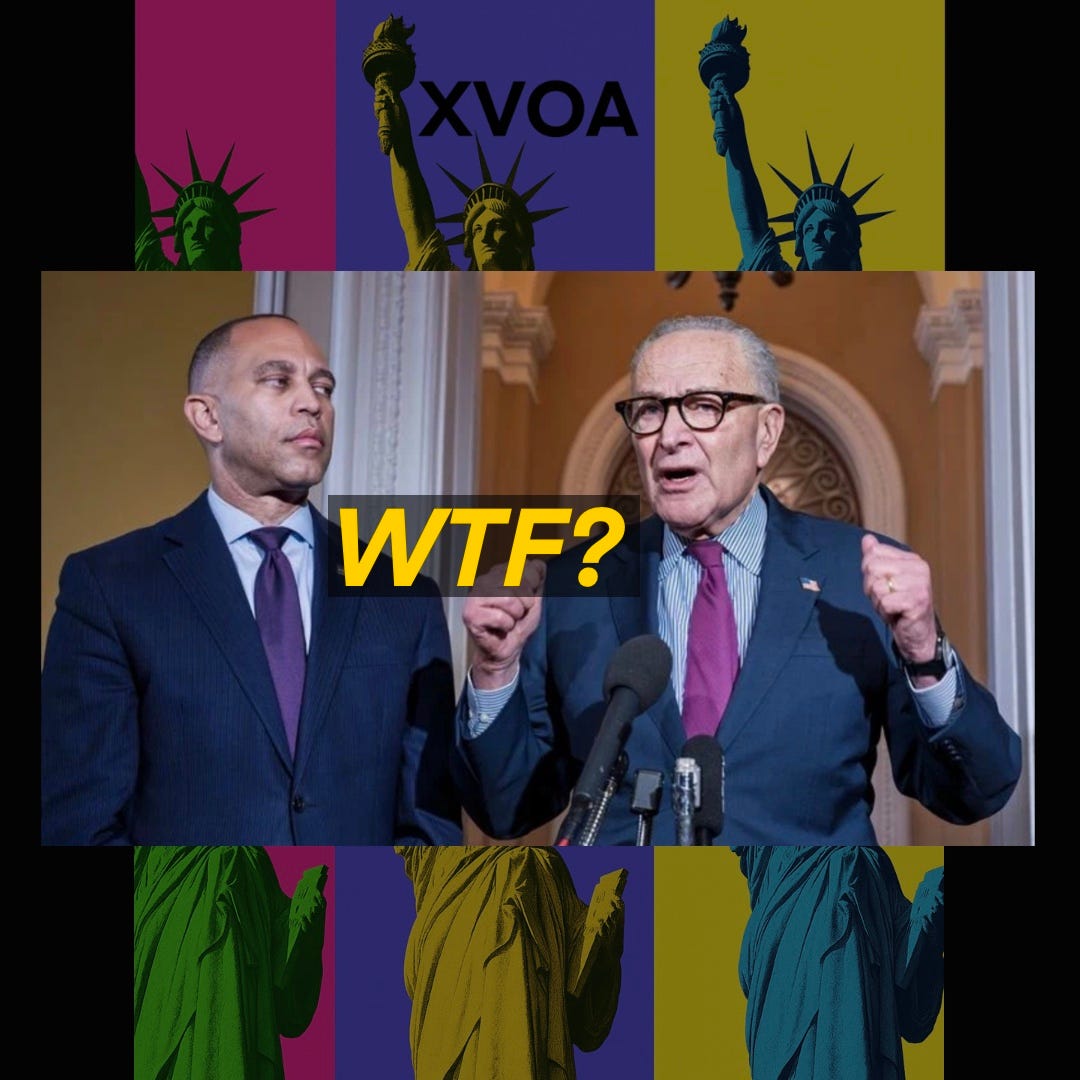
If Tim Kaine hoped his pragmatic stance would be universally praised back home, he was swiftly disabused of that notion. Progressive activists and many Democratic colleagues exploded in anger, seeing the deal as a unilateral surrender. The Democratic caucus aimed its fury at the eight defectors, accusing them of “abandoning the party’s negotiating position” and giving away vital leverage for free . Senate Majority (or Minority) Leader Chuck Schumer – who had led the hold-the-line strategy – bitterly noted that the compromise “surrendered critical leverage” on extending ACA subsidies “without securing firm commitments” from the GOP . House Minority Leader Hakeem Jeffries was even more scathing: before the vote, he dismissed the Senate deal as “a promise, a wing and a prayer, from folks who have been devastating the health care of the American people for years” . In other words, trust the Trump Republicans? No way, Jeffries signaled – House Democrats would not back “accepting nothing but a pinky promise” on health costs .
Liberal commentators also pulled no punches. On ABC’s The View, co-host Sunny Hostin lit into her own party with a tirade that quickly went viral on the right. “I think the Democrats caved. The Democrats let down the American people,” Hostin fumed Monday, arguing that voters had just handed Democrats a “blue wave” mandate in local elections to stand up to Trump, only to watch Senate Dems fold days later . She even called for Schumer’s ouster as Democratic leader: “If he cannot keep his caucus together, he needs to go. He needs to be replaced,” Hostin declared, saying Schumer’s “days are over” after failing to hold the line . (In a stunning TV moment back in March, Hostin had confronted Schumer to his face over an earlier funding skirmish, telling him bluntly, “you caved… you and nine other Democrats caved” . Now, she seemed vindicated – and livid.)
Progressive firebrand Keith Olbermann was even less subtle. “RESIGN NOW. You are no longer a Democrat,” the former MSNBC host thundered at Kaine on X (Twitter), demanding he quit immediately for what he saw as rank betrayal . And he wasn’t alone. The frustration poured out across social media and the liberal commentariat. One popular young Democratic commentator vented, “I am so sick of WEAK Democrats… We need a big tent of fighters, not folders” . Even Representative Alexandria Ocasio-Cortez weighed in to chastise the Senate deal: “People want us to hold the line for a reason… It’s about people’s lives. Working people want leaders whose word means something,” she wrote, warning that caving now – on something as tangible as health insurance costs – would erode public trust .
Within the halls of Congress, members of the Progressive Caucus voiced similar outrage. Rep. Greg Casar (D-Texas), the caucus’s chair, blasted the agreement as “a betrayal of millions of Americans counting on Democrats to fight for them”. “Accepting nothing but a pinky promise from Republicans isn’t a compromise – it’s capitulation,” Casar tweeted, capturing the prevailing mood on the left . Senator Bernie Sanders (I-VT) – who pointedly refused to join the moderates – dismissed the promised ACA vote as a “wasteful gesture” unless Speaker Mike Johnson and President Trump explicitly pledged support (which they pointedly had not) . “Doing nothing is derelict… people will go bankrupt… get sicker” if Congress fails to act on health care, Schumer had warned on the floor Saturday . Now, from the progressives’ perspective, eight members of his own team had done just that: effectively nothing for health care, leaving millions in limbo.
The intra-party rift was especially glaring in places like Virginia. One freshman Democrat, Rep. Suhas Subramanyam of the D.C. suburbs, vowed to vote “no” when the Senate bill reaches the House, saying a “promise not to fire [future] federal workers is no comfort” to those already laid off or contractors already losing pay . By contrast, his neighbor Rep. Walkinshaw (the Fairfax County Democrat who praised Kaine) stood by the deal. Such splits underscore a bitter truth: even people who agree most of the time don’t agree all the time . As Professor Farnsworth noted, it’s unusual to see Virginia’s two Democratic senators (Kaine and Mark Warner) diverge on a major vote, but “reasonable people could disagree” on the best path forward . Warner, who toed the party line and voted against the compromise, said that while he appreciated the protections for workers, he “could not support an agreement that still leaves millions… wondering how they are going to pay for their health care” .
For the Democratic base, the sting is real. If it doesn’t hurt now, it doesn’t matter now – that’s the fear. With the shutdown’s pain about to end, will Washington simply move on and forget those ACA subsidies until they actually expire and people start getting sick or bankrupt? Progressive activists worry that once the immediate crisis fades, so will the urgency to fulfill that “pinky promise.” The mood has a bent note of cynicism: a sense that Democrats flinched when it counted, and if it doesn’t hurt now, nobody in power will care until it’s too late. As one frustrated observer put it, “The working people want the Democratic Party to fight for them… and now, they just caved and surrendered” . It’s an emotional bruise that won’t heal overnight.
Conservative Rejoicing and Republican Reframes
On the other side of the aisle, Republicans greeted the Democrats’ split with barely disguised glee. After all, the GOP had stood firm for 40 days, and in the end Democrats relented on the core issue – extending Obamacare aid – without Republicans having to give it. “After 40 days of unnecessary hardship, Democrats have finally recognized that their government shutdown strategy was a failure,” crowed Rep. Ben Cline (R-VA), blaming Democrats for the weeks of chaos. “Sadly, it came at the expense of our troops, SNAP recipients, and federal employees who bore the brunt of their political brinkmanship,” he added . In the conservative telling, it was the Democrats who “shut down” the government by insisting on an ACA fix, and it was Democrats who hurt working Americans – a narrative sharply at odds with polls showing most Americans blamed Republicans for the impasse .
Right-wing media seized on the Democratic infighting as a vindication for Trump’s hardball tactics. Fox News amplified Sunny Hostin’s anti-Schumer diatribe and even gave airtime to voices like radio host Charlamagne Tha God, who had implored Democrats earlier to “stop playing politics with people’s lives” and end the shutdown . The message to viewers: even liberals think the Democrats got it wrong. Meanwhile, Republican strategists treated the Senate vote as a political win. By drawing a handful of moderates to their side, they not only broke the filibuster; they also fractured the opposition. “If [Schumer] cannot keep his caucus together, he needs to be replaced,” Hostin’s quote blared on Fox’s website, almost with a sense of satisfaction . Conservative commentators argued that President Trump and Speaker Johnson had successfully outmaneuvered Schumer – forcing Democrats to end the shutdown on Trump’s terms (i.e. no immediate health-care extension) or risk being seen as the ones prolonging Americans’ pain .
At the same time, some Republicans quietly acknowledged the complex political calculus ahead. The deal’s lone concession – a Senate vote on ACA subsidies in December – could yet become a liability for the GOP. As Senate Majority Leader Thune has admitted, such a vote is “likely to fail over GOP opposition” and might not even get a vote in the House . But come campaign season, those very Democratic moderates who “caved” now have a potent talking point: we tried to extend your health care, and Republicans blocked us. 74% of U.S. adults favor extending the ACA credits, according to KFF polling . Republicans’ refusal to do so could “hand Democrats a cudgel” in 2026, the New York Times noted . “These Democrats who voted to end the shutdown are going to be able to say, ‘Look at these guys – they’re cutting your health care benefits. They’re making it more expensive,’” observed political scientist Ray La Raja. “The Democrats still win there politically.” In other words, by giving up the immediate policy victory, moderates like Kaine may have set a trap for the GOP: let them be the villains who hike your premiums.
That cynical logic has enraged progressives – “The message is… Democrats will do anything to stay in power, even if it means undermining the needs of their constituents,” one blistering New Republic piece charged . Citing reporting that a dozen Democrats were anxious about winning the shutdown fight too completely (because it would solve Republicans’ problem and deprive Democrats of a campaign issue), the left-wing magazine concluded that Democrats put politics over people’s health . It’s a damning claim: that some in the party preferred to let ACA subsidies lapse – causing premiums to double for 20+ million Americans – just to weaponize the fallout in the next election . Win the headline, lose the household.. True or not, that narrative is now out there, and conservative pundits will surely wield it to accuse Democrats of bad faith. As if on cue, House Speaker Mike Johnson quipped on Monday that the Senate deal was already “backfiring” on Democrats, noting their internal backlash . And President Trump? He took a victory lap of sorts – earlier in the day he had crowed, “It looks like we’re getting very close to the shutdown ending” , while continuing to rail against Obamacare as “THE WORST HEALTHCARE FOR THE HIGHEST PRICE” . In Trump’s world, forcing the government open without funding “Biden-Obamacare” is a win-win.
Fallout and the Road Ahead: A Bent Note of Uncertainty
By Monday at 4:30pm ET , 41 days into this saga the government appeared on track to finally reopen within days. The Senate’s bipartisan deal was expected to receive formal final passage with sufficient votes, and Speaker Johnson urged House members to return to D.C. for a swift vote on the package . Given Republicans’ narrow House majority, they can pass the bill without any Democratic votes if nearly all GOP members toe the line . That’s no guarantee – the hard-right faction could still balk at provisions like reversing Trump’s federal firings – but party leaders and Trump himself are pushing to end the shutdown now. In all likelihood, federal workers will go back to work, missed paychecks will be issued, and national parks will reopen in time for the holidays.
But the political wounds from this fight remain raw. Public opinion was nearly evenly split over the Democrats’ hardball strategy – 48% supported holding out for the ACA credits even if it prolonged the shutdown, while 50% favored ending the shutdown quickly without the extension . Overall, more Americans blamed Republicans for the crisis by double-digit margins . Those numbers suggested Democrats had the upper hand – until they fumbled it. Now, progressive voters feel whiplash and betrayal, while conservatives sense an opportunity to exploit Democratic divisions. The lingering question is whether this half-satisfied resolution will satisfy anyone for long.
For millions of Americans who depend on the ACA subsidies, a clock is now ticking: January 1st their premiums will soar unless Congress acts. The Senate will have its show vote in December, but even if it passes there, the House (and Trump) are poised to block it . Will moderate Democrats like Tim Kaine have the same fire to “fight for them” without the shutdown as leverage? Or will the issue fade from headlines until real people start feeling real pain? As one senator admitted, “We don’t have a guarantee” – just a hope that maybe reason (or public pressure) will prevail . In Washington, though, hope can be a fragile commodity.
There’s a bittersweet truth playing out in this saga, a kind of “bent note” in the melody of governance: If it doesn’t hurt now, it doesn’t count. Politicians respond to immediate crisis; once the urgency passes, the promises often evaporate. “Shame on [us] for even believing that the Republicans will… vote on it,” Sunny Hostin lamented about the pledged health vote, voicing a deep distrust . In the coming weeks, Democrats will try to regroup and mend the rift – Schumer insists “this fight will and must continue” – but the mood is unmistakably somber. One liberal commentator quipped that the Democrats managed to snatch defeat from the jaws of victory – delivering relief to suffering Americans, yes, but at the cost of their own unity and credibility. It was a win that “if it doesn’t hurt now, nobody cares now.” And for all the sharp-edged humor flying around, there’s real hurt behind it.
As the dust settles, Tim Kaine’s vote stands as a Rorschach test for the Democratic Party’s soul. Was he saving his constituents from further pain, or selling out a principle for a quick fix? In Kaine’s mind, the answer is clear: “I feel very, very good about it,” he said of the deal . He might even joke, with a dark style grin, that he’d rather be thanked by relieved Virginians today than cheered by progressive purists on Twitter. But many in his party are not laughing. They are hurting now – and it does matter. The shutdown may be ending, but the showdown over what this party stands for is just getting started.
If this pressed a tender spot, that’s the signal. If you’d rather I not go there again, do nothing. If you want me free to keep pressing where it hurts, make it paid.
👉 Become a paid subscriber at
It’s cheaper than Congress’s appetite for gridlock, and it actually nourishes something real.
Sources:
Reuters – “US Senate advances bill to end federal shutdown” (Nov. 9, 2025)
The Guardian – “Senate Democrats who defected in shutdown vote: ‘This was the only deal’” (Nov. 10, 2025)
Virginia Mercury/News From The States – “Kaine breaks with Democrats to back deal… securing protections for federal workers” (Nov. 10, 2025)
The National News Desk (via Fox4Beaumont) – “Stopgap deal signals end to shutdown but renews divisions among Democrats” (Nov. 10, 2025)
Newsweek – “Full List of Democrats Who Voted to End Government Shutdown” (Nov. 9–10, 2025)
Fox News – “The View co-host rails against Democrats… says Schumer’s ‘days are over’” (Nov. 10, 2025)
Associated Press – “Senate leader says a potential shutdown deal is coming together…” (Nov. 9, 2025)
New Republic – “The Real Reason Democrats Caved on Shutdown” (Nov. 10, 2025)
https://www.reuters.com/world/us/whats-deal-end-longest-us-government-shutdown-2025-11-10/
https://www.reuters.com/business/healthcare-pharmaceuticals/trump-takes-aim-obamacare-historic-federal-shutdown-hits-40th-day-2025-11-09/
https://apnews.com/article/government-shutdown-congress-trump-641e7e2324f261da72395b604d9540e8
https://www.theguardian.com/us-news/2025/nov/10/senate-democrats-government-shutdown-vote
https://www.theguardian.com/us-news/live/2025/nov/10/us-government-shutdown-record-donald-trump-syria-president-ahmed-al-sharaa-rudy-giuliani-pardon-politics-live-news-updates
https://www.virginiamercury.com/2025/11/10/kaine-breaks-with-democrats-to-back-deal-ending-shutdown-securing-protections-for-federal-workers/
https://www.politico.com/news/2025/11/10/schumer-is-no-longer-effective-dems-outraged-over-shutdown-deal-00644253
https://www.washingtonpost.com/business/2025/11/10/government-shutdown-senate-bill/
https://www.kff.org/public-opinion/kff-health-tracking-poll-public-weighs-in-on-health-care-debate-and-government-shutdown/
https://www.reuters.com/business/healthcare-pharmaceuticals/most-americans-back-extending-obamacare-tax-credits-amid-government-shutdown-kff-2025-11-06/
https://www.newsweek.com/full-list-of-democrats-who-voted-to-end-government-shutdown-11019295
https://www.newsweek.com/government-shutdown-2025-updates-end-over-trump-democrats-11019596
https://www.foxnews.com/media/the-view-co-host-rails-against-democrats-after-ending-shutdown-says-chuck-schumers-days-over
https://www.scrippsnews.com/politics/shutdown-bill-clears-senate-hurdle-house-democrats-push-back-over-aca-subsidies
https://thenationaldesk.com/news/connect-to-congress/stopgap-deal-signals-end-to-shutdown-but-renews-divisions-among-democrats-congress-aca-subsidies-health-care-politics-2026-midterms
https://www.theguardian.com/us-news/2025/nov/09/senate-moves-vote-federal-government-shutdown
https://www.opb.org/article/2025/11/09/senate-leader-says-a-potential-shutdown-deal-is-coming-together-but-there-s-no-guarantee-of-success/
https://newrepublic.com/post/202948/real-reason-democrats-caved-shutdown-obamacare-midterms
https://newrepublic.com/post/202945/mike-johnson-democrats-shutdown-deal-backfiring
Johnson already backed away from his promise, the little weasel.
Great stuff. I think with Snap air traffic controllers and the things going on in the country there was pressure to get something done. And I think Democrats were thinking about people who weren’t getting food and eating. Yes they did give a lot back. But there were people who weren’t eating. It is so tough and difficult. I don’t think republicans should take a victory lap or democrats. It should’ve never got to this point.