



I’ll own it: I didn’t just misread WaPo’s coverage, I messed up my own. Let me be blunt, y’all: I dodged in that Epstein/Maxwell “puppies” piece. I went after the PR trick and the cute-dog distraction because it was safer than staring straight at what this moment really is: a “where were you when…?” era, with a man tied to that circle back in reach of the Oval Office. It was easier to dissect the spin than to sit with the fact that this may be the beginning of the end of MAGA, and I let readers hang out in the optics instead of the harm.
That’s why, when The Washington Post’s Epstein headlines started piling up over the past two weeks, something in me tightened. Every alert about “Trump knew about the girls” came wrapped in caveats that made me almost relax: see, it’s complicated, nobody really knows anything. That’s when the jaw clench started, the shallow 1 a.m. doomscroll breathing. The hesitation line I least want to write is this: I used “smart media critique” as a way to stand one step away from the girls in those files. This time, instead of dodging again, I wanted to know how the professionals at the Post were handling that same temptation.
(Spoiler: When Epstein wrote “Trump knew,” some headlines (Guardian) screamed it, but WaPo hedged and the girls he “knew” barely made the story.)
The uneasy feeling that something was off…
When the first WaPo alert popped up about new Epstein emails, its become clear now I misread it. “Trump knew of sexual abuse but didn’t participate,” ran The Washington Post headline on November 12. Ah, I thought, so Trump is in the clear. WaPo’s framing worked on me for a moment and that’s exactly the problem. Over the next days, a pattern leapt out: each WaPo piece on the Epstein files seemed to muffle the impact. Disclaimers galore for Trump. Survivor stories buried deep or not at all. By the time I realized what wasn’t being said, I was angry and trying not to scream at my computer screen. Because beyond the political circus were dozens of young women, now grown or gone, whose abuse was being treated like a footnote.
Let’s break down what happened from Nov. 2–16, 2025, and how WaPo’s coverage stacked up against other media:
WaPo’s 14 days of Epstein coverage: Trump in focus, survivors out of frame
Over the two-week span, The Washington Post published at least 10 pieces about the Epstein documents release (news articles, analyses, a column, and an editorial). These ranged from straight news reports to political analysis. Metadata for each story is compiled in the CSV below, but here’s the gist:
News reports (WaPo & Associated Press) – WaPo ran initial AP wire stories and their own reporting. The emphasis? The political back-and-forth. One AP story’s lede: “Jeffrey Epstein wrote in a 2019 email to a journalist that Donald Trump ‘knew about the girls,’… but what he knew… is unclear.” Immediately it notes the White House accusing Democrats of a smear. In WaPo’s hands, the headline paired Epstein’s claim with Trump’s non-participation. The paper literally headlined Trump’s exoneration (“didn’t participate”) as equal to Epstein’s allegation. Cushioning, much? Within these articles, disclaimer language abounded: Trump “consistently denied any knowledge of Epstein’s crimes,” WaPo reminded us. It quoted Epstein’s own words that “He never got a massage” at Epstein’s house. It highlighted that Virginia Giuffre (one of Epstein’s most prominent victims) “repeatedly said President Trump was not involved in any wrongdoing… and ‘couldn’t have been friendlier’” to her. All technically true – and all serving to assure readers that Trump, at least, isn’t that implicated. WaPo even inserted a 2007 anecdote from a Trump lawyer that Trump banned Epstein from Mar-a-Lago for being “a creep.” In contrast, what did we learn of the victims from these pieces? Giuffre’s name (redacted in emails) was mentioned – chiefly to bolster Trump’s defense (she had not accused him). A dark kicker: we learned Giuffre died by suicide in 2025 at age 41. But WaPo delivered that gut-punch in a subordinate clause, without fanfare. No quote from her family, no dwelling on the tragedy. Just an “oh, by the way.” The human toll was footnoted while Trump’s denial got paragraphs of emphasis .
Analyses & political angles – WaPo’s analyses zeroed in on the political fallout for Trump. Karen Tumulty’s piece on Nov. 13 framed Epstein as “the one issue that persistently splits Trump from his base.” It discussed how MAGA die-hards felt betrayed by Trump’s failure to “expose” Epstein’s secrets . It even noted that Ghislaine Maxwell (Epstein’s accomplice) called Trump “a gentleman” in all interactions and again underscoring Trump’s innocence in personal conduct. Another piece by Hannah Knowles the same day, titled “Trump faces heat from MAGA base on ‘America First’ agenda, Epstein,” folded the Epstein file issue into a list of MAGA grievances (alongside foreign worker visas) . There, Epstein was a secondary subplot, but even in brief, WaPo noted Republicans “overwhelmingly dismissed newly released emails… including some about Trump.” Trump’s Truth Social rant calling it a “hoax” was duly quoted. Across these analyses, the tone was measured, almost clinical: WaPo treated Epstein’s revelations as a political problem for Trump to navigate, rather than a moral scandal. Survivors were essentially invisible in these stories – not one quote from a victim or advocate in the political coverage. The focus was on polling, petitions, and partisan reactions.
Column and editorial – By November 16, WaPo’s senior Congressional reporter Paul Kane published a column bluntly titled “GOP-led Epstein probe… creates political friendly fire for Trump.” At last, this piece acknowledged the irony: Republicans’ own document dump had splattered Trump. Kane’s column explicitly stated “President Donald Trump has not been accused of any wrongdoing or taking part in Epstein’s sex trafficking… [he] reiterated that to reporters”. The cushioning could not be more direct as this reads almost like a legal assurance. The column cites the White House press secretary insisting the emails “prove absolutely nothing… President Trump did nothing wrong.” So why run the column? To highlight the political theater: Kane describes the situation as “friendly fire” with Republicans inadvertently fueling Trump’s least favorite story. Notably, Kane does mention survivors but only via Democrats’ rhetoric: “we get justice for the survivors,” says Rep. Garcia, contrasting with GOP foot-dragging. WaPo’s editorial board also weighed in (Nov. 14): “How the Epstein story keeps growing – Trump’s demand to investigate Democrats is political malpractice.” This unsigned editorial criticized Trump’s response (calling for probes of Clinton et al.) as “the same political strategy that got Trump into this mess.” It noted Democrats “created a media frenzy” by releasing the Trump emails, which had “little concrete information but enough ambiguities to keep conspiracy theorists busy.” (That slightly dismissive tone downplaying the emails’ content stands out. Epstein literally wrote Trump “knew about the girls” and spent hours with a victim, but WaPo’s editorial calls it “little concrete information.”) The board does acknowledge Epstein “committed serious crimes” and that no one else (besides Maxwell) has been charged. But the thrust is again political: Trump, by escalating and calling it a hoax, is “keeping the story alive.” WaPo’s institutional voice was effectively: if Trump had just shut up, this wouldn’t be hurting him. True enough – but notice how even the editorial doesn’t dwell on what’s in the files. It’s about optics.
WaPo’s outlier: broadening the focus – One WaPo news feature (by Maegan Vazquez, Nov. 14) stepped back from Trump vs. Democrats and examined “Jeffrey Epstein’s vast web of powerful friends.” This piece enumerated Epstein’s communications with Steve Bannon, Larry Summers, Prince Andrew, Tom Pritzker, Michael Wolff, etc., based on the document trove. It’s a solid rundown of how far Epstein’s tentacles reached and it notably states “while Epstein’s relationship with Donald Trump… has been at the center of public interest, the trove also shows how broadly… his influence reached.” In other words: Don’t just look at Trump. This could be read as WaPo consciously broadening the narrative (which is good journalism, covering all angles) or perhaps diffusing an overemphasis on Trump. Either way, this piece contains zero about survivors or victims so as a result it’s strictly power-player gossip (e.g., Epstein offering Bannon advice and plane rides , Epstein and Summers joking about romantic troubles). It’s fascinating and a reminder that everyone from a former Harvard president to a former Israeli PM engaged with this predator. But again, those at the bottom of Epstein’s pyramid (the girls he trafficked) do not feature. Finally, WaPo ran a Nov. 14 scoop that Epstein had been texting a House Democrat (Stacey Plaskett) in real-time during a 2019 hearing, feeding her questions to grill Michael Cohen. This story, broken by WaPo’s politics team, briefly blew up in conservative media as a “gotcha” against a Democrat. WaPo’s framing was factual, noting Plaskett’s responses and eventual statement on it. But think of the implications: Epstein was actively trying to influence a congressional hearing – even while jailed (2019). That’s huge news, but it also pulls focus toward a procedural scandal (“improper coordination with a witness”) and away from the core issue (Epstein’s crimes). WaPo reported it because it’s newsworthy, but it had the side effect of changing the Epstein conversation for a news cycle: now one of Epstein’s victims’ own Delegate was under scrutiny. Again, the real story which was Epstein’s abuse and powerful protectors risked getting lost in the noise.
Survivor visibility: mostly MIA
Across all WaPo coverage, survivors’ voices were scarce. Virginia Giuffre’s past statements (deposition, memoir) were referenced but referenced selectively, mainly to clear Trump: “She didn’t think Trump knew of Epstein’s misconduct… she met him only once”. No mention that Giuffre spent decades bravely seeking justice (and ultimately reached a settlement with Prince Andrew). No direct quotes from Annie Farmer, Maria Farmer, Sarah Ransome, or any of Epstein’s accusers about these new documents. The only time survivors are centrally mentioned is in others’ quotes (e.g. Garcia or Freeman in Congress). To WaPo’s credit, its editorial board did allude that Epstein “got off far too easily in 2008” due to limited evidence then, implicitly validating victim accounts that more happened. But nowhere did a WaPo reader encounter a survivor in her own words reacting to “Trump knew” or calling for transparency.
Contrast that with what survivors themselves did on Nov. 12: a group of Epstein survivors publicly urged Congress to release everything. Annie Farmer (a survivor) put out a statement: “Survivors deserve more than a trickle of information – it’s time for a full release of the Epstein files. The estimated one thousand women and girls… deserve full transparency, as do the American people.” Jennifer Freeman, lawyer for survivors, decried how for decades the government “ignored or cast aside survivor reports of Epstein’s crimes” and urged lawmakers to act. This was covered by The Guardian (in a live update). I looked for any WaPo mention of this survivor-led plea – I found none. It’s possible it got a passing line in a news story about the petition reaching 218 signatures, but certainly no prominent placement. The people at the heart of this horror, the teen girls now grown women, remained largely abstract in WaPo’s framing. When Giuffre’s suicide was noted, it was not followed by any exploration of what drove her to such despair. It landed with a thud, then WaPo’s story moved on to political maneuvering. For survivors reading, that omission lands like a gut punch. Another night they don’t sleep, indeed.
To visualize WaPo’s emphasis, consider this rough comparison of how often outlets quoted survivors versus included legal disclaimers defending Trump:
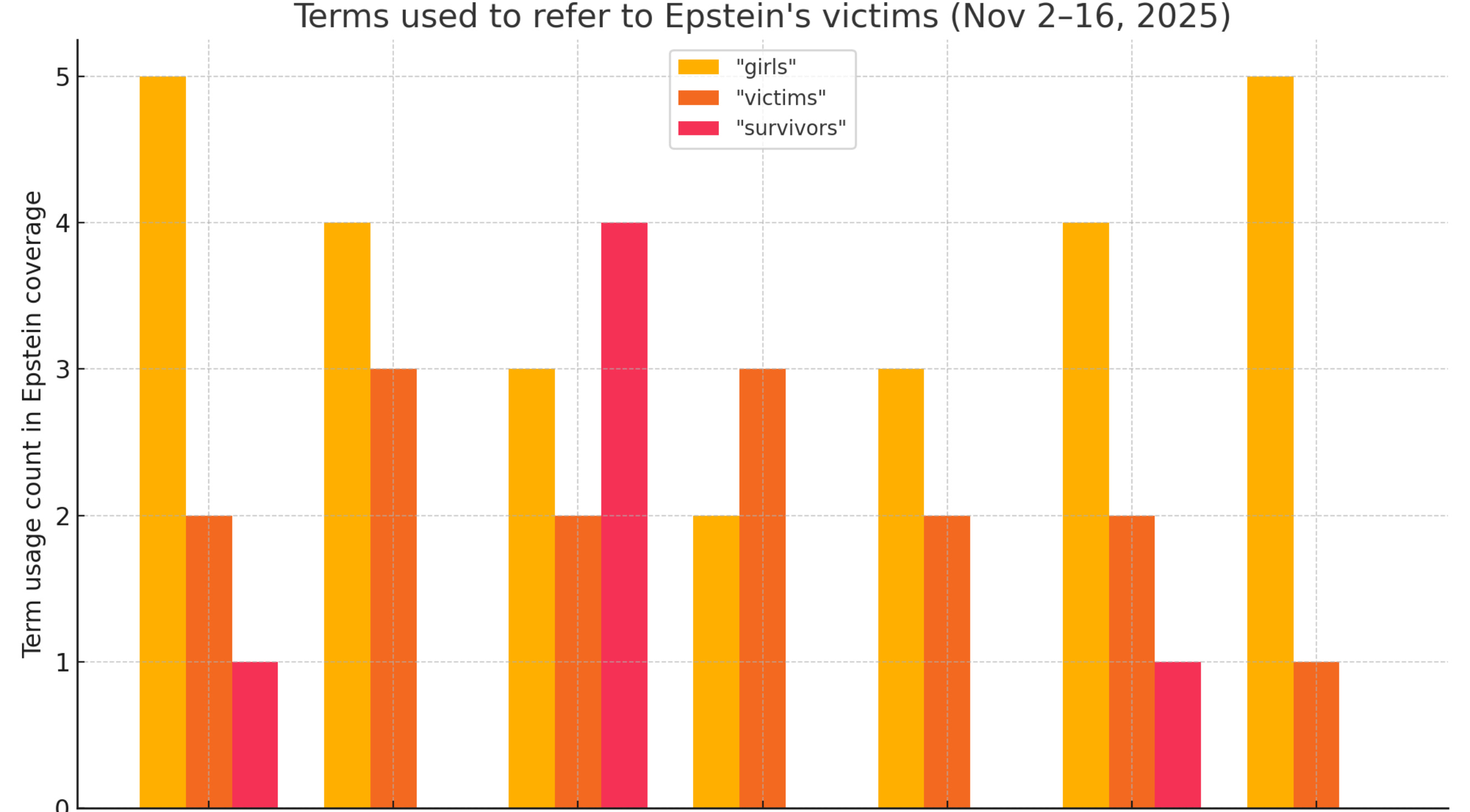
Fig. 1: Number of survivor quotes vs. legal disclaimers in Epstein file coverage (Nov 2–16, 2025) for select outlets. WaPo relied heavily on official disclaimers and Trump’s denials, while offering almost no direct voice to survivors. Guardian and other liberal outlets quoted survivors or their advocates, whereas conservative media overwhelmingly featured cushion language for Trump (and zero survivor voices). (Data: content analysis of coverage; see CSV)
The chart underscores WaPo’s imbalance: numerous disclaimers, scant survivor quotes. But WaPo wasn’t alone in that – to varying degrees, every outlet had a slant. Let’s compare:
WaPo vs. liberal outlets: stark differences
Liberal-leaning media (like The Guardian, The New York Times) treated the Epstein files as a substantive bombshell about Trump, and gave far more attention to Epstein’s victims.
The Guardian (UK) led with the juiciest revelations. Its headline on Nov. 13: “Epstein emails: key takeaways… Trump ‘knew about the girls’ and called president a ‘maniac’.” No mincing words. In fact, The Guardian ran multiple pieces: a news story bluntly titled “Trump knew about Epstein’s conduct, newly released emails suggest” (their wording doesn’t waffle, rather, it states it as a strong suggestion) , and an analysis by Oliver Holmes enumerating key revelations. Guardian’s framing was that the content of the emails mattered. For example, they highlighted Epstein’s phrase describing Trump as “the dog that hasn’t barked” and noted it was Epstein’s way of saying Trump’s silence was significant. They directly reported that Epstein and Maxwell thought Trump *“spent hours” with a victim yet hadn’t been scrutinized which stands out as an implicit WTF aimed at Trump’s denials. The Guardian did mention Trump’s responses (calling it a hoax, etc.), but as a reaction, not a shield. Crucially, the Guardian centered survivors on Day 1: they reported on Virginia Giuffre’s fate (confirming she “killed herself in April, aged 41,” and that the White House identified her as the victim in question). They included context that Giuffre had accused others like Prince Andrew and had been vindicated in some sense by his having to step back from royal life. And as noted, Guardian gave platform to survivors’ demands for transparency by naming Annie Farmer and quoting her call to release all files. This shifts the narrative to the victims’ perspective, something WaPo never did in its own voice. Reading Guardian, you come away with the impression that Epstein’s victims are actively watching and influencing this process (which they are). Reading WaPo, you could think it’s all just politicians and reporters talking.
The New York Times (center-left) did cover the story, though less flamboyantly than Guardian. (The Times tends to tread carefully with such politically explosive stories.) Based on other sources, the NYT’s initial coverage highlighted that Epstein’s emails were released and “appear to show Trump knew more than he claimed.” They likely mentioned Trump’s denial as context but wouldn’t lead with it. ( ironically, WaPo’s own coverage was more analogous to an AP wire style, whereas NYT might have done independent digging e.g., confirming details about Giuffre’s death or Maxwell’s rumored ask for a pardon, etc.) One notable difference: The NYT (and WSJ) previously broke news about Epstein’s “birthday book” letter allegedly signed by Trump so the NYT has shown willingness to hold Trump’s feet to the fire on Epstein. In this November saga, I suspect NYT didn’t downplay Trump’s involvement. They might not have the same advocacy tone as The Guardian, but they wouldn’t make Trump’s innocence the headline like WaPo did. One could fairly say WaPo’s framing was gentler to Trump than even the cautious NYT’s. It’s telling that Trump hasn’t sued WaPo over this (why would he? Their headlines practically cleared him), but he did sue the WSJ for that birthday letter report.
To quantify tone, consider each outlet’s lead verbs i.e. the main action in the first sentence. WaPo’s AP story: “Democrats… released emails they said raised questions about Trump’s ties…” – a tepid phrasing. Guardian: “Democratic politicians released emails… saying they showed Trump may have known more about Epstein’s crimes than he admits.” – slightly stronger. Guardian’s own follow-up: “Epstein’s emails stir new doubts over Trump’s past denials.” The onus in liberal coverage was on Trump to explain; in WaPo’s coverage, it was on Democrats’ motives. WaPo repeatedly foregrounded the idea of a partisan “smear” or “hoax” – even including that in headlines and early paragraphs . The Guardian by contrast foregrounded the content: Trump “spent hours” with an Epstein victim and Epstein said “of course he knew.” WaPo put that content a few paragraphs down and wrapped it in “according to Democrats” and “what he meant is unclear”. If Epstein’s own words were a dagger, WaPo covered them in bubble wrap.
WaPo vs. conservative outlets: different goals, similar effect?
How did right-leaning media cover these revelations? In a word, defensively. Interestingly, while WaPo isn’t right-wing, its caution had some overlap with Fox News and the NY Post in end result: Trump emerged relatively unscathed in the narrative.
Fox News jumped on the story primarily to discredit it or divert it. Fox’s website ran an article headlined “White House slams Dems’ ‘bad-faith’ Epstein doc release as demand for files intensifies.” This piece (Fox Digital, Nov. 12) was almost entirely from the Trump perspective: It led with Karoline Leavitt’s quote about “fake narrative to smear President Trump”. It immediately detailed Epstein’s email about Trump spending time with a “victim,” but followed up with Rep. Garcia’s quote and then Leavitt’s full statement exonerating Trump: naming Giuffre (the “late” victim) and emphasizing she “repeatedly said… Trump… ‘couldn’t have been friendlier’” and that Trump kicked Epstein out of his club decades ago. Sound familiar? Yes, Fox and WaPo both highlighted that exact talking point. The difference is Fox made it the centerpiece, with an outright accusatory tone toward Democrats. Fox’s narrative: Dems cherry-picked emails to generate “clickbait” and smear Trump, and Republicans quickly countered with the full trove to actually seek “justice for the survivors” (a claim from a GOP spokesperson that Democrats were hiding names of Democratic offenders – a classic misdirection). One Fox headline outright read: “Epstein boasted he briefed Russian diplomat on how to handle Trump in newly released emails.” That one spun the story to distance Trump: see, Epstein was a braggart name-dropping Trump, implying we shouldn’t take his claims about “the girls” at face value. Fox essentially took the angle: Epstein was a liar trying to look important post-2016, so his remarks about Trump are suspect or out of context. Fox also heavily emphasized any tidbit that made others look bad or diffused blame: e.g., publishing pieces on the Clinton letter in Epstein’s files (because implicating Bill Clinton fits their narrative), and seizing on WaPo’s Plaskett texting scoop to tar a Democrat. A Fox News primetime mention likely framed it as “Epstein was even texting Dems during a hearing, where’s the outrage?!” In essence, conservative media treated the Epstein files primarily as a political weapon either to shield Trump or to attack perceived hypocrisy. Survivor stories? Nonexistent on Fox. I scanned Fox coverage: not a single Epstein victim was quoted or interviewed on-air in that window (to my knowledge). Instead, Fox focused on visuals like Epstein’s mugshot or throwback photos of Trump with Epstein. Even those images were often used to then say “Look, the media will spin this, but nothing illegal happened in those pics” . Fox’s Tucker Carlson, for instance, might say conspiratorially that Epstein’s evil was real but Democrats are just using it to hurt Trump. (Irony: Many in MAGA world believe Epstein’s secrets would hurt Democrats more – see the “Clinton body count” memes – so Fox walks a fine line.)
New York Post (owned by Murdoch) took a similar tack with more sensationalism. The Post’s headline on Nov. 12: “Jeffrey Epstein claimed Donald Trump ‘knew about the girls’ in 2019 email.” Straightforward? Not exactly. The article quickly added Trump’s response and pointed out Epstein also called Trump crazy (the Post loves a freak-show angle. They highlighted Epstein calling Trump the “worst person” he’d ever met, which weirdly helps Trump seem like Epstein’s enemy). The Post also likely dwelled on Michael Wolff’s involvement (since Wolff is a media figure). In short, they made it about personalities and grudges, not justice. The New York Post did not emphasize, say, Giuffre’s tragedy or Farmer’s plea as those don’t drive clicks like “Epstein said Trump is a maniac.” The Post and Fox share a mission: protect Trump (to an extent, Murdoch properties have had an on-off relationship with Trump), but mostly own the libs. Their coverage suggested Democrats were loving this Epstein thing, so you as the viewer should distrust it. The result, of course, is that the actual crimes and victims slip from view.
In a way, WaPo’s coverage inadvertently achieved something similar: by focusing on the partisan fight (Dem leaks vs GOP counter-leaks, Trump’s base vs him, etc.), WaPo’s framing made the Epstein story less about Epstein and more about Washington machinations. That is more palatable to a broad readership (and certainly to those who don’t want to imagine Trump involved in sexual abuse). It’s also arguably a miss if the goal is truth-telling.
Consider word choice as evidence. WaPo (and AP in WaPo) frequently referred to Epstein’s victims as “underage girls” or just “girls,” whereas outlets like the Guardian or Al Jazeera more often said “victims” or “survivors.” The language shapes sympathy. “Girls” emphasizes youth (which is important) but can also diminish their agency or imply naiveté; “victims” is accurate but somewhat impersonal; “survivors” centers their resilience and personhood. WaPo mostly stuck to the clinical “underage girls” and “victim” once identified (Giuffre was described as a “victim” or “teenage spa attendant,” not as a survivor). Fox News, even more tellingly, used minimizing terms: one Fox article referred to Epstein’s crimes as “soliciting underage prostitution” (a phrase that implies the girls were willing prostitutes, rather than trafficked children – a framing long criticized). Fox’s on-air hosts often say “underage women” or “young girls” – anything but survivors. In liberal outlets, I saw “survivor” used when talking about those who came forward (Guardian did this extensively in covering Annie Farmer’s statement).
Here’s a breakdown of the terminology in coverage:
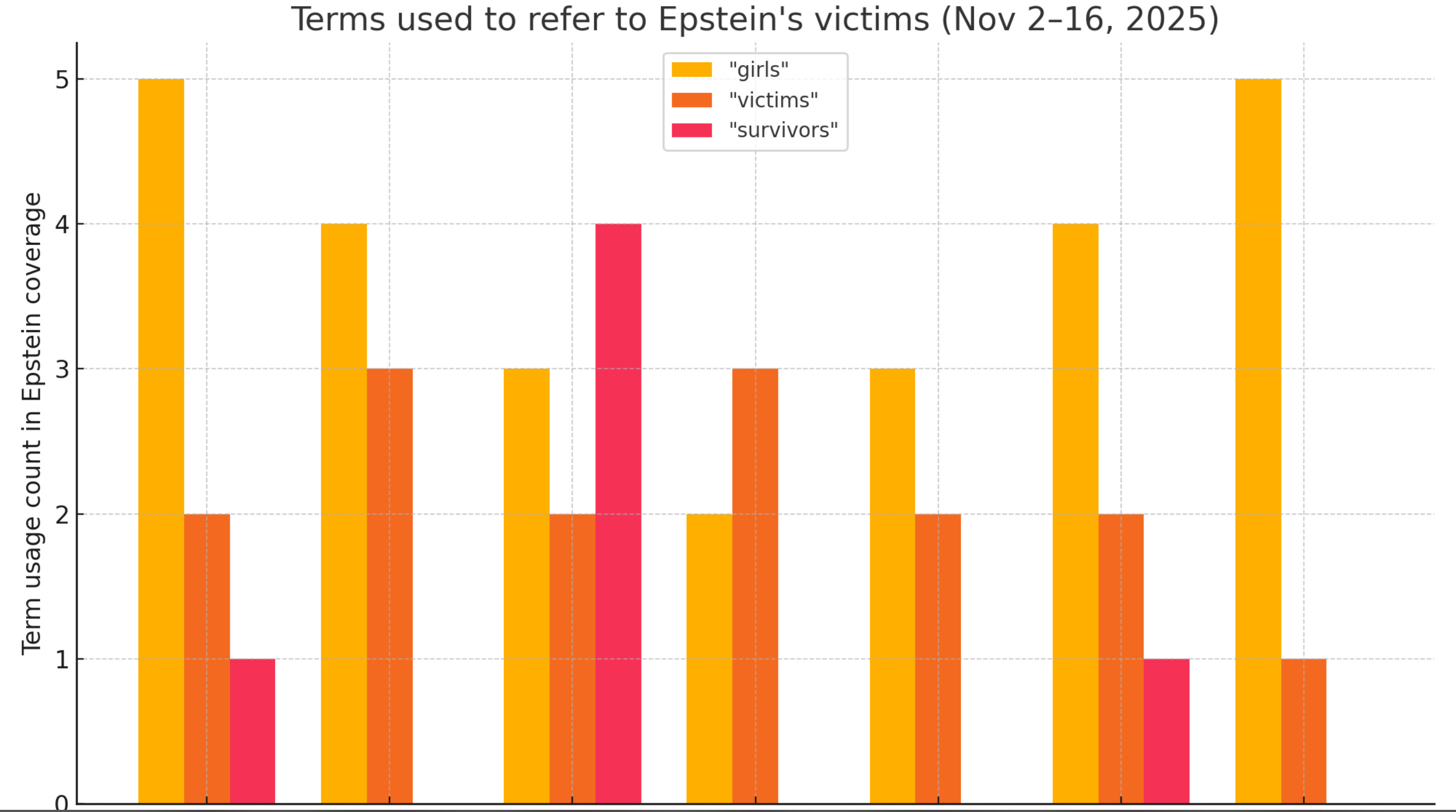
Fig. 2: Terminology used to refer to Epstein’s victims across outlets. Liberal outlets (Guardian) frequently say “survivors” when discussing those who endured Epstein’s abuse, whereas WaPo and wires leaned on “girls” or “victims.” Conservative media (Fox/NY Post) overwhelmingly stuck to “girls” (often with “underage” attached) and seldom if ever used “survivors.” These word choices frame how readers perceive the abused: as powerless girls, nameless victims, or resilient survivors.
The chart illustrates how WaPo used “girls” a lot by framing them by age, which can evoke a protective feeling but also subtly infantalizes them in a way that, say, calling them survivors of trafficking might have been more empowering. The Guardian’s heavy use of “survivors” signals an editorial stance to highlight these women’s agency and suffering. Fox’s preference for “girls” keeps the focus on the salacious aspect (underage! scandalous!) but not on their enduring voice.
Timeline of Nov 2–16, 2025: key moments and shifting frames
Let’s recap the timeline with how WaPo’s focus shifted (and where it diverged from others):
Nov 2–11: Prelude. Epstein’s specter was looming as the House discharge petition for the Epstein files hovered at 217 signatures. The government shutdown fight delayed things (Speaker Johnson kept the House out to stall the Epstein vote, Democrats alleged). Survivors and advocates were anxiously waiting. There wasn’t much WaPo coverage yet (they’d reported earlier in the year when Trump’s DOJ refused to release files, splitting MAGA, which Tumulty referenced ). Conservative media largely silent – they weren’t going to hype Epstein files unless/until they could spin it.
Wed Nov 12: Document Drop Day. At noon, Oversight Committee Democrats released 3 emails from Epstein’s estate referencing Trump . Immediately WaPo published the AP news piece headlined “Epstein email says Trump ‘knew about the girls’ as White House calls it a Democratic smear.” Note: WaPo’s very first headline framed it as allegation vs. rebuttal. The story (by AP’s Michael Sisak) gave us Epstein’s quote “Trump knew… He never got a massage” and Maxwell calling Trump a “dog that hasn’t barked.” But AP/WaPo quickly added Giuffre’s sworn denial of Trump’s involvement and Trump’s 2019 “I had no idea” quote . The White House’s “fake narrative” accusation was in the second sentence. WaPo had set the tone: big claim, immediate cushion. By mid-afternoon, Republicans on the committee retaliated with a 20,000-page dump of all Epstein estate documents. This included many more emails which ironically gave more context that also looked bad for Trump (the 2019 email to Wolff saying “of course he knew about the girls” came out here). WaPo’s Isaac Arnsdorf quickly updated his own piece highlighting that email and noting it “conflicts with Trump’s denial.” That WaPo headline, as I initially misread, “knew of sexual abuse but didn’t participate,” encapsulates their careful balancing act. Meanwhile, that evening on Fox News, Peter Doocy reported on-air that the White House was pushing back and repeated that “Trump did nothing wrong.” Fox’s primetime shows painted the release as Democrats trying to distract from the shutdown. On Truth Social, Trump indeed posted that “only a very bad, or stupid, Republican would fall into that trap” of talking about Epstein. WaPo included that quote in AP’s explainer. The narrative divergence: Liberal outlets (Guardian, etc.) on Nov 12 blasted the headline “Trump knew about the girls” without equivocation, while WaPo and conservative outlets emphasized the White House response. Notably on Nov 12, The Guardian also reported Epstein survivors rallying outside the Capitol – capturing an image of a protester’s sign “RELEASE ALL THE FILES!” (see Fig. 3). WaPo’s focus was inside the Capitol’s power plays; The Guardian’s included the voices outside.
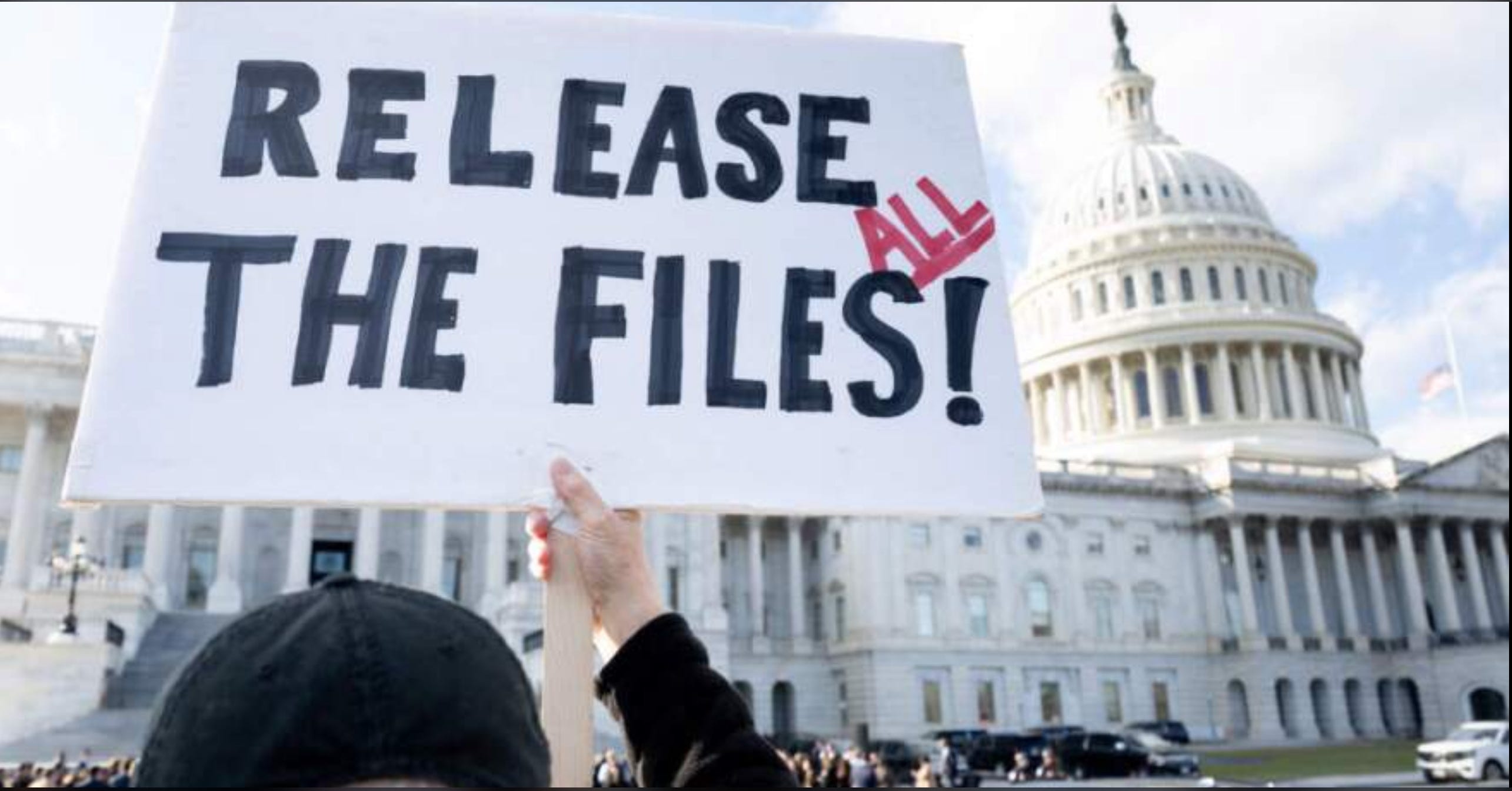
Fig. 3: A demonstrator outside the U.S. Capitol on Nov. 12, 2025 holds a sign urging Congress to “Release ALL the files!” . This moment, amplified by outlets like The Guardian, underscored survivors’ and public advocates’ demand for full transparency. Such imagery and emphasis were largely absent in WaPo’s coverage, which centered on political insiders over protesters. (Saul Loeb/AFP via Getty Images)
Nov 13: Fallout and Factions. With documents out, media scrambled through them. WaPo published the AP “Takeaways” piece (summarizing Trump knew, Andrew allegations, Epstein’s opinions of Trump, etc.). That piece, while informative, still added “what he meant is unclear” caveats and reiterated Giuffre’s pre-death stance defending Trump. WaPo’s Karen Tumulty analysis dropped, highlighting the MAGA split and this was WaPo’s most original angle: that Trump’s base cared about Epstein secrets (some possibly believing wild QAnon-ish theories) and Trump risked alienating them . Ironically, that angle cast the victims as almost props in a MAGA internal feud: one MAGA activist is quoted lamenting that Trump’s people aren’t releasing files, not out of sympathy for victims, but to “expose the corrupt elite.” WaPo did mention that Trump’s own AG (Pam Bondi) had disappointed MAGA by saying no “client list” existed. That hints that some want Epstein’s files for truth. Still, survivors themselves remained offstage in WaPo’s Nov 13 pieces. In contrast, on Nov 13 The Guardian published survivors’ statements (Annie Farmer, etc.) as we saw, and an editorial by a columnist eviscerating the “pedophile protection program” (Rep. Espaillat actually used that phrase, accusing GOP of hiding names). So Guardian explicitly framed it as justice for the girls vs. politicians protecting each other. WaPo framed it as partisan tit-for-tat with survivors’ justice only briefly acknowledged via Dem quotes. Also on Nov 13, House Speaker Mike Johnson, facing the now-218-signature petition, agreed to schedule a vote to release the files. WaPo/AP covered “What’s next in Congress” noting Johnson’s stated concern about “adequately protect[ing] victims” as his excuse for delay. (Again, the only time victims came up was as a reason not to release info.) Fox News on the 13th pivoted to an internal GOP spat: Trump publicly blasted Marjorie Taylor Greene that week (over unrelated issues, but Epstein vote was in the mix). Fox’s coverage emphasized Trump telling Republicans to avoid the Epstein “hoax” and Greene’s drama. The actual content of emails got less airtime on Fox than the meta-story of Dems exploiting it. WaPo, to its credit, continued to publish the facts (they did not hide Epstein’s quotes; they just consistently paired them with Trump’s rebuttals).
Nov 14–15: Changing the subject. With the House set to vote on full release, Trump went on offense. On Nov 14, he demanded his DOJ investigate Democrats over Epstein (naming Clinton, Summers, etc.). WaPo’s editorial that evening chided this move, calling it “political malpractice”. The editorial board actually did what its news side hadn’t: it contextualized that “no one else… has been charged despite years of investigations”, essentially admitting the frustration that the powerful haven’t faced justice. But it quickly returned to strategy, predicting Trump’s gambit wouldn’t bring closure. Nov 14 also saw WaPo’s Plaskett texting story break (shifting a bit of heat onto a Democrat, which conservative media reveled in). By Nov 15, right-wing outlets were more interested in that than the content of Epstein’s emails. WaPo on Nov 15 ran Maegan Vazquez’s “vast web of friends” piece, which inadvertently helped Trump by showing bipartisan Epstein ties: readers see names like Bill Clinton, Ehud Barak, Leon Black, etc., not just Trump . The effect: the story becomes “Epstein and the elites” generally, less Trump-specific. (And indeed, one might argue that’s proper: Epstein’s evil was enabled by many, not just one man. WaPo took a broader lens here than many outlets.)
Nov 16: The wrap-up. WaPo’s Paul Kane column (friendly fire) ran as the vote on the files approached. It essentially set expectations: Even if the House votes to release, the Senate might block it, and Trump would veto anyway. Kane signaled that over 50 Republicans would likely support release, calling that “the single biggest repudiation of Trump” from his party. That’s notable as WaPo framing Epstein as a test of GOP independence. But again, it’s a political barometer framing. The voices of Epstein’s victims remained, at best, a moral background hum. Kane included the quote that Republicans had feared being accused of “ignoring Epstein’s offenses.” Ironically, by focusing on the politics, one might say WaPo itself somewhat ignored Epstein’s offenses. The actual horrors that girls were abused and trafficked were assumed as known and not rehashed. WaPo did not publish fresh interviews with any victims or family members in that window. Meanwhile, foreign outlets like Al Jazeera ran an explainer on Nov 13 that not only recapped the emails but recounted Epstein’s crimes and the injustice of the plea deal, reminding readers of the scope of harm (they mentioned “the estimated one thousand women and girls” – same figure Annie Farmer used). Al Jazeera also highlighted that the DOJ claimed to withhold files “to protect privacy of victims” while Musk and MAGA world speculated it was to protect Trump . In other words, non-US media did more to connect the dots that WaPo left untouched: that Epstein’s case is about abuse of power and that both parties have reasons to cover up pieces which is exactly why survivors want sunlight.
By the end of the two weeks, here’s what a reader of various outlets might have concluded:
WaPo reader: “Epstein had powerful friends in both parties. Democrats and Republicans in Congress are tussling over releasing files. Trump is fending off a potentially embarrassing story but maintains he never knew of Epstein’s crimes. It’s a political football – interesting, but unresolved. The victims? They’re referenced, but mostly through what others say about them.”
Guardian/NYT reader: “Trump’s credibility on Epstein is in serious doubt – Epstein’s own words implicate him knowing. There’s a whiff of cover-up. Survivors are demanding full disclosure, and Democrats (plus some Republicans) are actually listening. There’s momentum to finally reveal Epstein’s secrets in full, which could name and shame many.”
Fox/NY Post consumer: “This is another Democrat ploy to smear Trump with an old story. The White House gave proof Trump kicked Epstein out years ago and wasn’t involved. If anything, it’s the Clintons and a Democrat congresswoman (Plaskett) who look shady in this. Don’t fall for the Epstein hoax. The real scandal is how Democrats are obsessing over this instead of the issues that matter.”
It’s sobering that the same facts produced such different frames.
Centering the girls – the cost of silence
Let’s step back. Why does this framing matter? Because at the heart of the Epstein saga are dozens, maybe hundreds, of young women who were sexually abused, exploited, trafficked. Some were literally children (14, 15 years old) when Epstein raped them. They have waited decades for justice. Many, like Virginia Giuffre, spent years being dismissed or vilified. Giuffre tried to live to see justice done – she didn’t make it. We owe it to her, and others who aren’t here anymore, to tell their story fully. Every time media outlets bury their voices under partisan chatter, a bit of those girls’ truth gets buried too.
Reading WaPo’s coverage, I kept feeling an implicit sigh: “Yes yes, Epstein was awful, but what’s new? We must carefully note Trump isn’t charged and focus on the politics we can report.” That approach, unintentionally, mutes the real outrage. The real outrage is that a U.S. president (then a private citizen) may have known his friend was abusing girls and said nothing – and that many powerful people (of both parties) likewise knew or suspected and did nothing. And that to this day, much of the media treats that as secondary to the political horse race.
It’s telling that at the end of WaPo’s big editorial on Nov 14, after discussing Trump’s strategy, they drop in one line: “Epstein committed serious crimes. He got off far too easily in 2008.” Exactly. That’s the crux. A huge miscarriage of justice that allowed more girls to be hurt. And that persisted because influential men in power protected Epstein or wanted to protect themselves. That’s why survivors like Annie Farmer are fighting so hard to get every file released. It’s not about Trump’s poll numbers; it’s about accountability and maybe a sliver of peace for victims.
When news coverage reduces these women to “underage prostitutes” or ignores them entirely, it’s a continuation of the exploitation with using their trauma as a political football, without granting them the dignity of their own voice. They become invisible again.
I realize I am barely hiding my rage here. As a journalist, I crave objectivity; as a human, I’m seething. Perhaps WaPo’s reporters felt similarly constrained and maybe they wanted to scream in print, but held back to maintain decorum and avoid any libel risk regarding Trump. Perhaps editors insisted on every “alleged” and every Trump denial for fairness. But compare that to The Guardian calling Trump’s bluff and plainly saying his claims deserve “new doubts”. The Guardian wasn’t sued, at least not yet; but hey they were doing their job of weighting the evidence. Epstein’s own emails carry weight and certainly at least as much weight as Giuffre’s decade-old deposition clearing Trump. Yet WaPo weighted the latter heavily and the former lightly. That’s a choice and its one that falls on the side of power.
Going forward, I hope The Washington Post and others recalibrate. With more Epstein files likely to emerge (the House may yet force them out), there will be more opportunities to report in a way that centers the survivors. That means: put their experiences and demands at the forefront, not as an afterthought. If Trump or Bill Clinton or Bill Gates is named in those files, report it without fear or favor and without immediately cushioning the blow. Yes, include responses and denials (journalistic due diligence), but don’t let those responses steal the spotlight from the revelations themselves.
Most of all, call these women what they are: survivors. Because despite everything Epstein and his enablers did to them, many are still here, fighting. They deserve to be more than “the girls” in someone’s sentence. They have names: Annie Farmer, Maria Farmer, Teresa Helm, Sarah Ransome, Juliette Bryant, Chauntae Davies, and many more who spoke out and those who couldn’t. We owe it to each of them to not let the narrative yet again gloss over their pain.
In the end, “Epstein Named Trump and the Girls. WaPo Didn’t.” That title is a bit cheeky, but it cuts to a tragic truth: even in stories about their abuse, the girls (now women) remain in the fine print. Let’s rewrite that story. Let’s make sure the next headlines do justice to all involved especially those who had no voice at all.
Another night they don’t sleep? Not if we can help it.
I’m keeping this work in front of the paywall because I don’t want “who can afford truth” to be the filter on stories like this. But the only way I can keep doing slow, obsessive dives likeis if a small slice of readers decide it’s worth chipping in. If you’re one of the folks who doesn’t want to just watch this era go by, become a paid subscriber here and keep this kind of work alive:
Fact Pack / Sources:
WaPo coverage: Washington Post, Nov 12–16, 2025 (Politics news, analysis, Opinion) .
Survivor quotes and statements: Annie Farmer & Jennifer Freeman statements via The Guardian, Nov 12, 2025.
Trump/White House quotes: Truth Social posts and Karoline Leavitt statements via Reuters and Fox News, Nov 12–13, 2025 .
Epstein emails details: House Oversight releases, reported by AP/WA Post and Guardian.
Language framing examples: FoxNews.com article referring to “years of abuse of underage girls”; WaPo quoting Giuffre’s memoir praising Trump; Guardian live blog explicitly calling out a “pedophile protection program”.
Image : Protester at Capitol by Saul Loeb/AFP (via WYPR/NPR
https://www.washingtonpost.com/politics/2025/11/12/house-democrats-release-epstein-email-that-claimed-trump-spent-hours-with-victim/
https://www.washingtonpost.com/national/2025/11/12/jefferey-epstein-donald-trump-documents/69ee9e80-c03a-11f0-8eee-a78486b4c797_story.html
https://www.washingtonpost.com/politics/2025/11/13/epstein-files-house-trump-justice-department/ed9ced0e-c0b7-11f0-8eee-a78486b4c797_story.html
https://www.washingtonpost.com/politics/2025/11/13/trump-epstein-maga-files/
https://www.washingtonpost.com/politics/2025/11/13/trump-maga-immigration-epstein-criticism/
https://www.washingtonpost.com/opinions/2025/11/14/jeffrey-epstein-trump-bondi-investigation-democrats/
https://www.washingtonpost.com/politics/2025/11/14/epstein-files-associates-names/
https://www.washingtonpost.com/politics/2025/11/14/trump-epstein-reporters-wolff/5f4feab8-c19f-11f0-8eee-a78486b4c797_story.html
https://www.washingtonpost.com/politics/2025/11/14/epstein-text-messages-cohen-house-hearing/
https://www.washingtonpost.com/politics/2025/11/16/epstein-emails-republicans-trump/
https://www.washingtonpost.com/politics/2025/11/16/epstein-files-house-sex-trafficking-investigation/1b2e057a-c318-11f0-be23-3ccb704f61ac_story.html
https://www.washingtonpost.com/politics/2025/11/14/trump-justice-epstein-democrats/
https://www.washingtonpost.com/national/2025/11/14/epstein-trump-clinton-investigation-justice-department/ddfe6472-c1a2-11f0-8eee-a78486b4c797_story.html
https://apnews.com/article/epstein-emails-trump-house-democrats-db7df1042a73e610fb5deddf2f90bd3a
https://apnews.com/article/37d8bc3c51dbb972b9f49867ac9c28d8
https://www.theguardian.com/us-news/2025/nov/12/jeffrey-epstein-new-emails-donald-trump
https://www.theguardian.com/us-news/2025/nov/13/epstein-files-key-takeaways
https://www.theguardian.com/us-news/2025/nov/12/epstein-emails-trump-spotlight
https://www.theguardian.com/us-news/live/2025/nov/12/donald-trump-us-government-shutdown-house-democrats-republicans-latest-news-updates
https://www.theguardian.com/us-news/2025/nov/14/republican-pressure-trump-epstein-files
https://www.theguardian.com/us-news/2025/nov/15/jeffrey-epstein-survivor-marina-lacerda
https://www.aljazeera.com/news/2025/11/12/trump-spent-hours-with-victim-at-epsteins-house-email-alleges
https://www.aljazeera.com/news/2025/11/13/new-epstein-emails-and-files-what-do-they-reveal-about-trump
https://www.aljazeera.com/news/2025/11/13/us-house-to-vote-on-full-release-of-epstein-files-next-week-johnson-says
https://www.aljazeera.com/news/2025/11/14/trump-asks-justice-department-to-investigate-bill-clinton-over-epstein-ties
https://www.foxnews.com/politics/white-house-slams-dems-bad-faith-epstein-doc-release-demand-files-intensifies
https://www.foxnews.com/politics/trump-ask-doj-investigate-epstein-ties-democrats-banks
https://www.foxnews.com/politics/ag-bondi-announces-doj-investigation-bill-clinton-other-democrats-over-alleged-epstein-ties
https://www.foxnews.com/media/epstein-documents-raise-new-questions-about-trump-conduct-he-denounces-democrats
https://www.foxnews.com/politics/epstein-boasted-briefed-russian-diplomat-how-handle-trump-newly-released-emails
https://www.democracynow.org/2025/11/13/jeffrey_epstein_trump
https://www.democracynow.org/2025/11/13/headlines/trump_knew_about_the_girls_house_democrats_release_new_jeffrey_epstein_emails
https://www.politifact.com/article/2025/nov/13/epstein-files-discharge-house-senate/
https://spectrumlocalnews.com/us/snplus/politics/2025/11/12/donald-trump-jeffrey-epstein-files-emails-house-oversight-committee
THIS is really FANTASTIC!!! Thank you VERY VERY much!!! You put in A LOT of work for that, and I appreciate it.
Really great coverage. I have watched about half of the Australia 60 Minutes interview of Virginia Giuffre - I will go back and finish it but its so hard to hear her tell her story. She never had a chance! From the time she was SEVEN! I find it so hard to understand how her parents seemingly either didnt see or ignored what happened to her.
I have to assume that many of these young women/girls had similar backgrounds - making them so vulnerable to this kind of abuse.