

Progress to 100 Paid Subscribers BestSeller Status
First, thank you: in under 24 hours, 11 of you stepped forward, moving XVOA from 67 to 78 paid subscribers. I honestly thought that kind of jump would take two months, not one day. Folks have called these pieces deeply moving beacons of truth and I’m still trying to grow into those words without believing my own hype. Hitting bestseller status isn’t just a vanity badge; on Substack it tells the algorithm, new readers, and the wider network that this is a reliable beacon for truth-telling, which means more reach, more protection, and more time for deep reporting like what you’re reading here. If you’ve felt that “finally, somebody said it” tug with XVOA, I’m asking you to be one of the 22 who push us over the top:
Now, I’m gonna admit something about the way I work: I’ve spent years scrolling past Trump headlines on purpose, like a veteran who’s learned not to stare at a flash-bang. As a young enlisted soldier in the U.S. Army, I was trained to keep my focus on the mission and the chain of command, not the noise around it, and that habit never really left. So when I write about him now, I’m not chasing the spectacle; I’m watching the one institution I once served up close, the military, and asking whether it can stay steady on its oath while a would-be commander in chief daydreams out loud about executions for “traitors.”
A Shocking Threat to “Traitors”
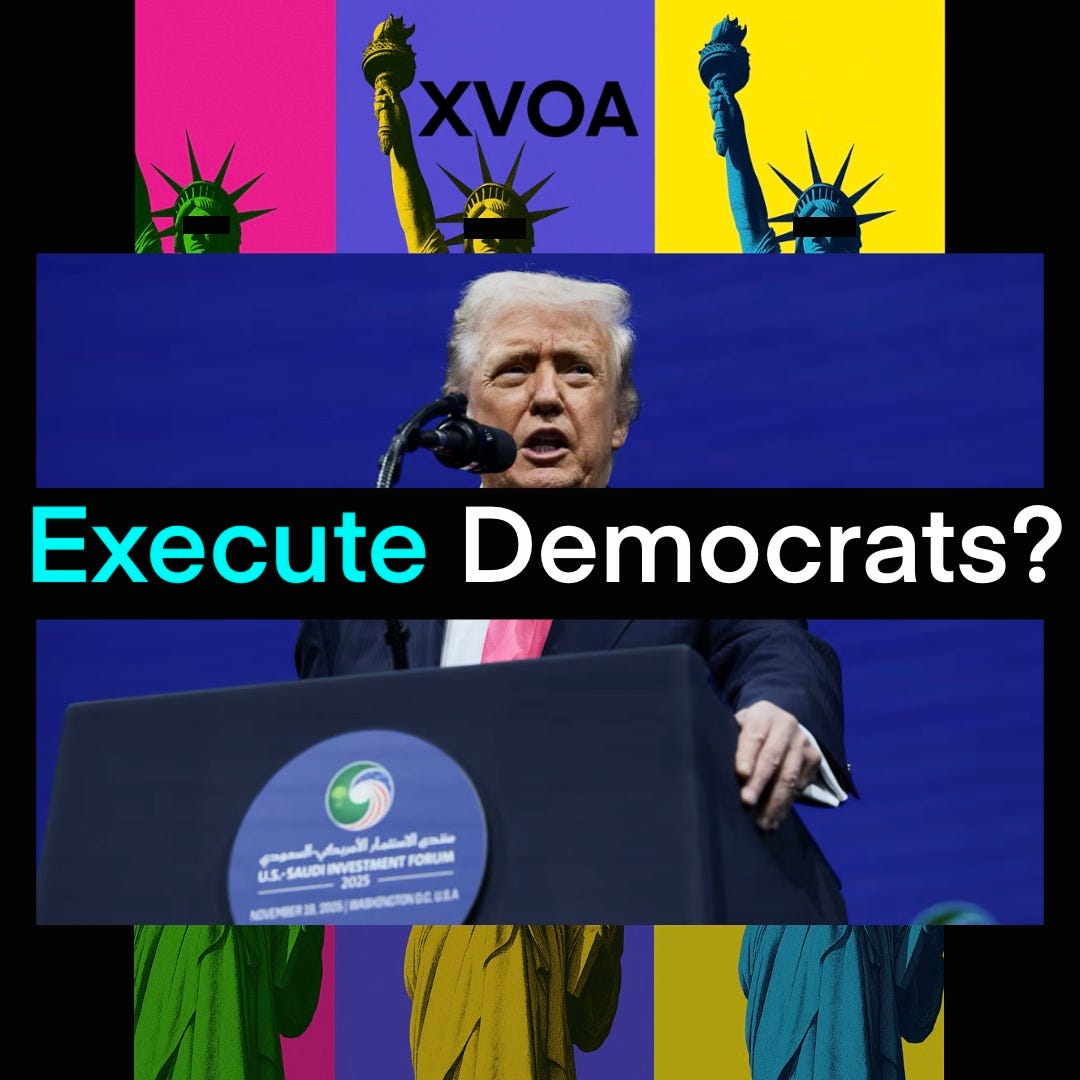
When a group of six Democratic lawmakers, all of whom were military or intelligence veterans , released a video reminding U.S. troops of their duty to the Constitution and their right to refuse illegal orders, they likely anticipated political pushback. What they got was President Donald Trump essentially accusing them of treason and suggesting death as punishment. In a Thursday morning barrage on social media, Trump blasted the lawmakers as “TRAITORS” committing “SEDITIOUS BEHAVIOR, punishable by DEATH!” . He insisted “Their words cannot be allowed to stand”, even retruthing a post that growled “HANG THEM GEORGE WASHINGTON WOULD!!” . By week’s end, Capitol Hill Democrats were scrambling to assure the six officials’ safety and denouncing Trump’s “disgusting and dangerous death threats” .
For America’s military community, this spectacle went beyond the usual partisan food-fight. Here was the commander-in-chief, in public, effectively fantasizing about firing squads for opposition members of Congress all because they reaffirmed that U.S. service members must uphold lawful orders over blind loyalty. Such rhetoric has landed with palpable shock among current and former military leaders. Many see it as an attack not only on individuals but on bedrock principles of American civil-military relations. “This is really bad, and dangerous to our country,” Trump had written – a grimly ironic statement to generals who watched the president himself trample long-held norms. As one of the targeted lawmakers, Rep. Maggie Goodlander, noted, “the president’s reaction to a simple restatement of the law reinforces the core concern here and unfortunately proves our point.”
Veterans and Generals Sound the Alarm
The backlash from prominent retired military figures was swift and scathing. Retired four-star General Barry McCaffrey, a decorated Vietnam veteran and former NATO commander, did not mince words. He warned that Trump’s attacks on military loyalty and threats of execution evoke nothing less than 1930s authoritarianism. “What we are seeing is a parallel to the 1930s in Nazi Germany,” McCaffrey told MSNBC after Trump earlier suggested executing Joint Chiefs Chairman Mark Milley for treason .
The retired general blasted Trump’s movement as “a lawless cult and a major threat to the armed forces of the United States and our security” . He called the former president’s comments “shameful,” vowing that officers like Milley “will not be intimidated” by such rhetoric. McCaffrey’s alarm is widely shared among the military brass, active and retired, who are stunned to hear an American president speak so cavalierly about executing political opponents which is a notion more commonly associated with the very regimes U.S. soldiers have fought against.
Other retired officers have likewise spoken up to defend the military’s professional ethos. Lt. General Mark Hertling, former commander of U.S. Army Europe, reassured the public that today’s military would never carry out illegal orders even under pressure. “I guarantee you that the people in that audience will not execute illegal orders,” Hertling said this week of the nation’s commanders, adding that all military members are taught this fundamental principle from the start. In his view, Trump and his aides grossly underestimate the integrity of the rank-and-file. Far from encouraging insubordination, Hertling argues, the lawmakers’ video simply echoed what responsible officers have always told their troops: you obey the law, not any one leader’s personal whims.
On social media, veterans amplified Hertling’s point by invoking the Nuremberg lesson that “just following orders” is no excuse for unlawful acts. The Uniform Code of Military Justice (UCMJ) not only requires service members to follow lawful commands, but obligates them to refuse blatantly unlawful ones . As Army JAG veteran Victor Hansen notes, troops even receive training to recognize obviously illegal orders, “when you tell me to shoot a prisoner of war who’s unarmed, that’s clearly something… I can’t do” and thus understand that oath of service is to the Constitution and laws, not to an individual leader’s dictates.
Indeed, America’s generals and admirals have been at pains to remind everyone whom they really serve. General Mark Milley, in a fiery farewell speech as Joint Chiefs Chairman last fall, pointedly declared that the U.S. military does “not take an oath to a king or queen, a tyrant or a dictator. We don’t take an oath to a wannabe dictator. …We take an oath to the Constitution” . Those remarks, widely seen as a rebuke of Trump’s behavior, encapsulate the ethos drilled into every officer from West Point on.
The Constitution is the “moral North Star” for the military , Milley said, and service members swear to “protect and defend [it] against all enemies, foreign and domestic,” even at the cost of their lives . When Trump throws around words like “treason” and “sedition” towards officials standing up for the rule of law many in the armed forces see an assault on the very core of military honor.
Civil-Military Norms Under Strain
Trump’s outburst is only the latest, if most extreme, episode in a growing pattern that has deeply unsettled civil-military relations. Since returning to office in 2025, Trump has pushed the boundaries of using the military as a political tool, from deploying National Guard troops to blue-state cities over local objections, to ordering military strikes on suspected drug traffickers without congressional approval . Each move has raised alarms among defense experts about the erosion of the norm that the armed forces remain apolitical and only deploy domestically under strict legal conditions.
This week’s “Don’t Give Up the Ship” video by the six Democratic veterans was itself prompted by these concerns. “This administration is pitting our uniformed military and intelligence community professionals against American citizens,” the lawmakers warned in the clip , citing the oath all troops swear and stressing “our laws are clear: You can refuse illegal orders.” Trump’s furious reaction effectively demanding absolute personal obedience validated their very worry that he views the military as “his personal army” rather than a neutral institution bound by law .
Nonpartisan military professionals describe Trump’s approach as dangerously corrosive to military integrity and cohesion. A group of eleven retired generals and admirals, in an amicus brief this fall, cautioned that using the military as a partisan weapon “is not only contrary to core American values, but can also be harmful to the reputation, integrity, and morale of the military itself.” They emphasized that the U.S. armed forces “must remain a nonpartisan institution” in order to maintain the trust of the American people and even to ensure effective recruitment and retention of troops.
When service members start to feel they could be dragged into domestic political fights or used against fellow citizens, it “exacerbates feelings of isolation and low morale” in the ranks . In short, politicizing the military puts its cohesion at risk, a sentiment echoed by even Trump’s own former Pentagon chiefs. Back in January 2021, all ten living former Secretaries of Defense (Republicans and Democrats alike) signed an unprecedented open letter warning that “Efforts to involve the U.S. armed forces in resolving election disputes would take us into dangerous, unlawful and unconstitutional territory.” Any officials who tried it, they wrote, would be “accountable…for the grave consequences of their actions on our republic.” That letter was a flashing red light at the time, urging Trump to stop contemplating schemes to use the military to cling to power. Now, nearly five years later, retired top brass are again voicing dire warnings as Trump’s rhetoric and actions signal that norms are still in peril.
Many also worry about the climate of intimidation that has settled in. Trump’s Justice Department has shown a willingness to weaponize the law against perceived enemies and recently indicting critics like James Comey and New York’s attorney general Letitia James. Some fear the same could be done to outspoken retired generals. “The administration is using the law as a weapon to go after its enemies, exact revenge and suppress dissent,” said Frank Kendall, a former Air Force secretary, noting there’s “no reason to think they won’t do the same to retired generals in civil or military courts.” In fact, under the UCMJ, retired officers technically remain subject to recall and could face court-martial for “contemptuous” speech against the president. This is a provision rarely used, but ominous in the current environment.
One retired senior officer admitted anonymously that he “has worried about retribution” and even mapped out worst-case scenarios: being involuntarily recalled to active duty to face charges, or prosecuted in civilian court, or targeted with IRS investigations . “It’s not necessarily what you did or didn’t do. It’s the pain they can put you through,” he explained, describing how even baseless charges could bankrupt an accused officer in legal fees .
This chilling effect is real and many ex-leaders are staying silent in public, even as they privately seethe, rather than risk becoming the next target. Such muzzling of professional military voices is itself a stark departure from democratic tradition, experts note. In healthy civil-military relations, retired officers can ordinarily speak their mind on national security issues without fear of vendetta. Today, that freedom is under a cloud.
Oath Above All: The Military’s Steadfastness
Amid these strains, however, America’s military institutions have thus far held their center. Even as political actors try to pull them into partisan conflict, the uniformed services, guided by a deeply ingrained professional ethic , have shown a determination to uphold their Constitutional duty. If there is a silver lining to this week’s drama, it is the open reaffirmation of that duty by those who have worn the uniform. From the halls of the Pentagon to bases across the nation, service members are hearing leaders (past and present) underscore that their loyalty is to the rule of law.
Officers like Gen. Milley and Lt. Gen. Hertling, in defying Trump’s provocations, effectively give cover and clarity to younger officers and enlisted troops: do the right thing, even if a commander or even if the president orders otherwise. There are encouraging precedents. In the chaotic final weeks of Trump’s previous term, military leaders quietly but firmly resisted efforts to involve them in overturning the 2020 election. And President Biden’s Defense Secretary Lloyd Austin has reiterated that “the American people know their military… only as the unwavering defenders of the Constitution” , not as an instrument of any one man’s personal ambitions.
For all his bluster, Trump cannot easily bend the military to his will. Legally, there are formidable hurdles to his talk of charging people with treason or recalling generals for punishment. (Treason has a strict constitutional definition essentially waging war against the U.S. and that plainly doesn’t cover officials posting a video on social media.) Even if Trump tried to court-martial a retired officer like Gen. Milley, he “will be forced to do so in a civilian court… and he would be highly unlikely to win a guilty verdict,” legal scholars note .
In the end, the law and military justice system are on the side of those who refuse unlawful orders, not those who issue them. This reality is one reason retired General McCaffrey dismissed Trump’s floated plans to purge or prosecute military critics as “utter nonsense… a disaster signal to the armed forces” . The U.S. military’s commitment to democratic norms, while tested, has not cracked.
Still, observers warn against complacency. The politicization of the military or even the perception of it can inflict lasting damage. Once troops begin to question whether their leaders’ orders are grounded in law or in politics, unit discipline and morale suffer. Conversely, if troops were ever to follow an unlawful order for fear of presidential wrath, the repercussions for American democracy could be dire. It’s a delicate balance, and it relies on the mutual trust that the military will stay out of domestic politics and that civilian leaders will not abuse the chain of command.
This week’s war of words: A president fantasizing about executing elected opponents, and generals implicitly comparing him to a would-be dictator. This is an alarming sign of how far that trust has frayed. And yet, as unsettling as it is, it has also prompted a clarifying moment. America’s top generals and admirals, active-duty and retired alike, are effectively drawing a line. They are invoking the storied tradition of George Washington’s Continental Army, which remained loyal to the Republic over any one man. “Don’t give up the ship,” implored the six veteran-lawmakers in their video, quoting a Navy hero’s dying words, a call to stand firm on principle. The military’s professional creed echoes the same: hold the line, honor your oath, protect the Constitution.
In the end, that ethos may be the republic’s best safeguard. As General Milley eloquently put it, American service members swear no oath to tyrants or to “wannabe dictator[s]” . They swear it to an idea – the idea of America enshrined in our Constitution – and “we’re willing to die to protect it.” Despite all the noise and provocation, that idea remains the lodestar for the U.S. military. And it is why, even under intense political pressure, America’s generals insist they will stay true to their duty , steadfast in the face of any tempest, and loyal above all to the nation’s democratic ideals.
If you’ve made it this far, you’re already part of the tiny circle I’m writing for. These are the people who actually want the whole story, not the spin. To keep doing pieces like this, I need 22 more folks willing to put a little skin in the game so XVOA can stand as a real beacon of truth in a very noisy storm. If this resonated, don’t just close the tab and nod along. Join the paid side and help carry this work forward:
Sources
Brendan Smialowski/AFP via Getty Images – New Republic: “Trump Suggests Executing Democrats Over Message to Troops”
Steven Porter – Boston Globe: “Maggie Goodlander pushes back on ‘illegal orders’ video criticism”
Doina Chiacu & Nandita Bose – Reuters/FBC News: “Trump says ‘seditious’ Democrats urging US troops to refuse illegal orders should face death”
Mike Bedigan – The Independent: “Retired US general likens Trump’s attacks on military to Nazi Germany”
Dorothy Robyn – Brookings: “Does the president have the power to fire or punish military officers?”
Flynn Nicholls – Newsweek: “Donald Trump’s Reported Military Plan Trashed by Former General”
April Rubin – Axios: “Retired generals warn of dire consequences of Trump politicizing military”
Julian Borger – The Guardian: “Leave military out of it, former defense secretaries tell Trump”
Sig Christenson – San Antonio Express-News: “Why retired generals are staying silent about Trump: They’re scared.”
U.S. Department of War – Official remarks: Gen. Mark Milley at Joint Chiefs change-of-command ceremony (Sept. 29, 2023)
https://newrepublic.com/post/203438/trump-suggests-executing-democrats-told-troops-obey-constitution
https://www.bostonglobe.com/2025/11/20/metro/nh-goodlander-video-military-illegal-orders/
https://www.reuters.com/world/us/trump-says-democrats-who-told-us-military-refuse-illegal-orders-deserve-death-2025-11-20/
https://www.the-independent.com/news/world/americas/us-politics/donald-trump-military-nazi-germany-b2420550.html
https://www.brookings.edu/articles/does-the-president-have-the-power-to-fire-or-punish-military-officers/
https://www.newsweek.com/donald-trump-reported-military-plan-trashed-former-general-1988357
https://www.axios.com/2025/09/09/retired-generals-trump-national-guard-los-angeles
https://www.theguardian.com/us-news/2021/jan/04/leave-military-out-of-it-former-defence-secretaries-tell-trump
https://www.expressnews.com/news/texas/article/trump-hegseth-generals-fear-retaliation-article-88-21118485.php
https://www.war.gov/News/News-Stories/Article/Article/3543934/us-constitution-at-center-of-military-transfer-of-responsibility-ceremony/
Xplisset, I had a comment from you asking why something was not made more prominent, I suppose in the news. When I tried to get to it to answer you, my screen showed a lot of pictures, and I do not know how to use that kind of page. Two other people over several months have asked for a response, and I cannot answer them either because I think it involves an app. However it is, I cannot reach anyone in that way. I’m sorry.
I believe your question might have been in reference to my comment on one of the substacks, possibly Aaron Parnas’s, suggesting that people read the Don Knight substack for particular information. Is that correct? If so, the topic addressed is what I have only seen in two places. The Don Knight substack and one of the Jack Hopkins Newsletters for paid readers are the only indicators of that important information I have seen. I hope that is helpful to you. I do not know how to answer you other than this way as I have looked for one of your articles in emails and found this one as an opportunity to let you know.
Now that I have explained that, referencing the involved facets related to the Epstein files and multiple complications, I want to comment regarding your outstanding article about the service, loyalty to the law of the Constitution, and your outstanding comments and explanations. Thank you immensely for your service, your impressive writings, and your excellent sharing today regarding people in the service now, as well as in the past! I especially appreciate all of your explanations and details. It would be important anytime, but it is of the utmost value and is helpful to me to read it during what I still consider this Thursday night, although I see by the hour that it is now the next day. Your writing, and your wisdom, and experiences reflected in your messages are always impressive and are especially needed. Thank you so much! I
I should have written this part first, but I was concerned because I did not know how else to find a way to answer you. I had saved this article of yours for when I was more alert, but I am comforted to have read it tonight.
Thanks to you and all of the brave and honest people for caring about our country and what is right!
Thanks for this analysis. On the whole, it was more encouraging than I expected, and these days, encouragement is hard to come by.