


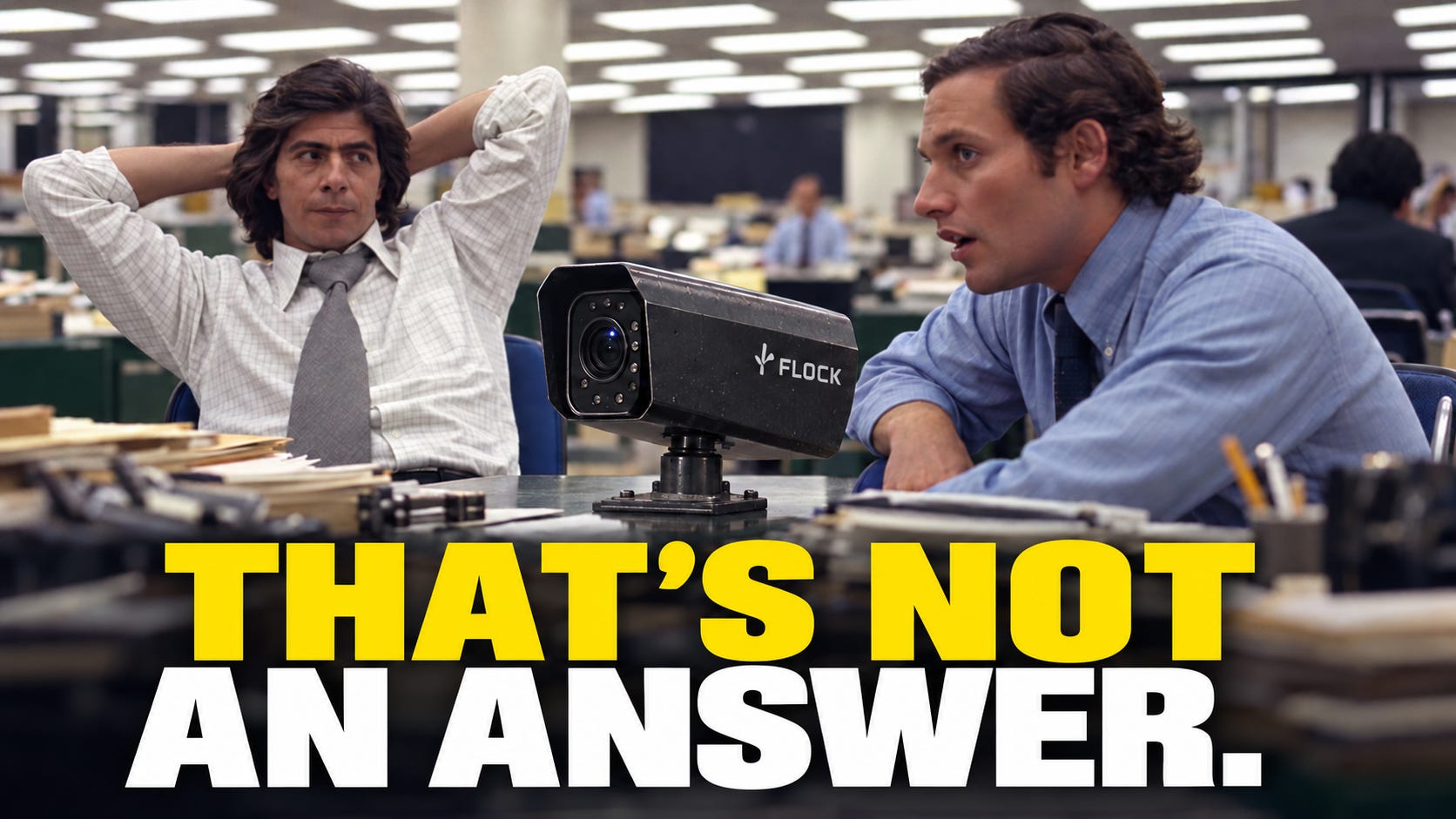
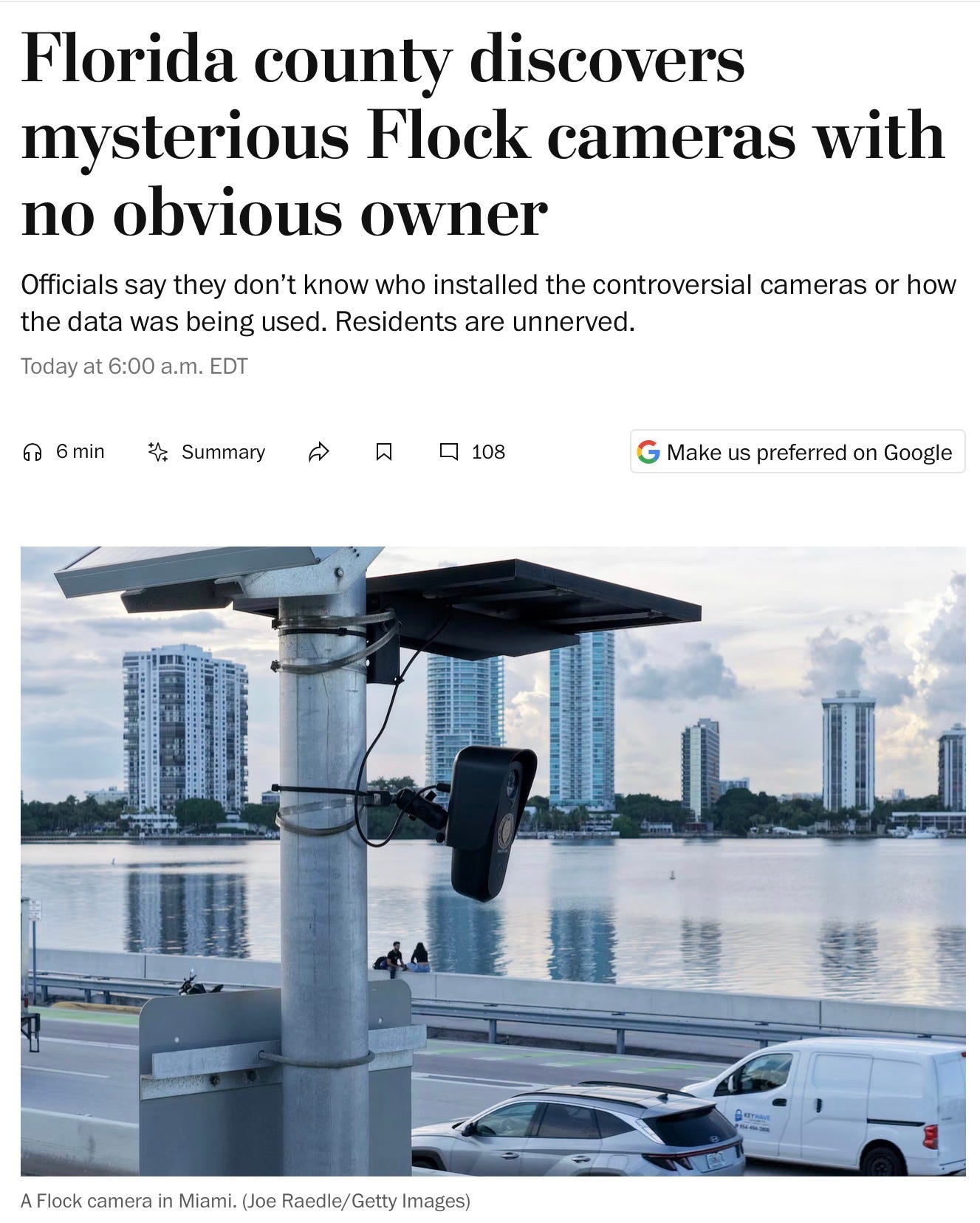
The Washington Post article refers to a “mystery”: who these Flock cameras belong to. I’m a retired police officer. In twenty years on that job, I could never have referred to something as a mystery in a report and then just left it at that.
If I didn’t know who was responsible, I would have been expected to outline everything done to try to find out. If in trying to determine who owned those Flock cameras, all I had obtained was Flock’s non-responsive statement regarding permits, my report would have been tossed back at me with a nasty note or the case would have been assigned to someone else. In the former situation, the note might have read something like: THAT DOESN’T ANSWER THE QUESTION. FOLLOW UP.
It’s hard to believe the editors at the Washington Post, the paper that helped bust Watergate, could publish that deflection without making THAT the story.
Flock Safety makes surveillance cameras that snap pics of cars as they drive by and take note of their license plates. Its accompanying software allows users to look up images of any of those captured cars by plate number, physical description, date, and/or time. Police departments, businesses, even residential associations subscribe to Flock Safety’s tech, potentially turning cars that happen to drive past one of its cameras into database entries. [2]
What Happened in Florida
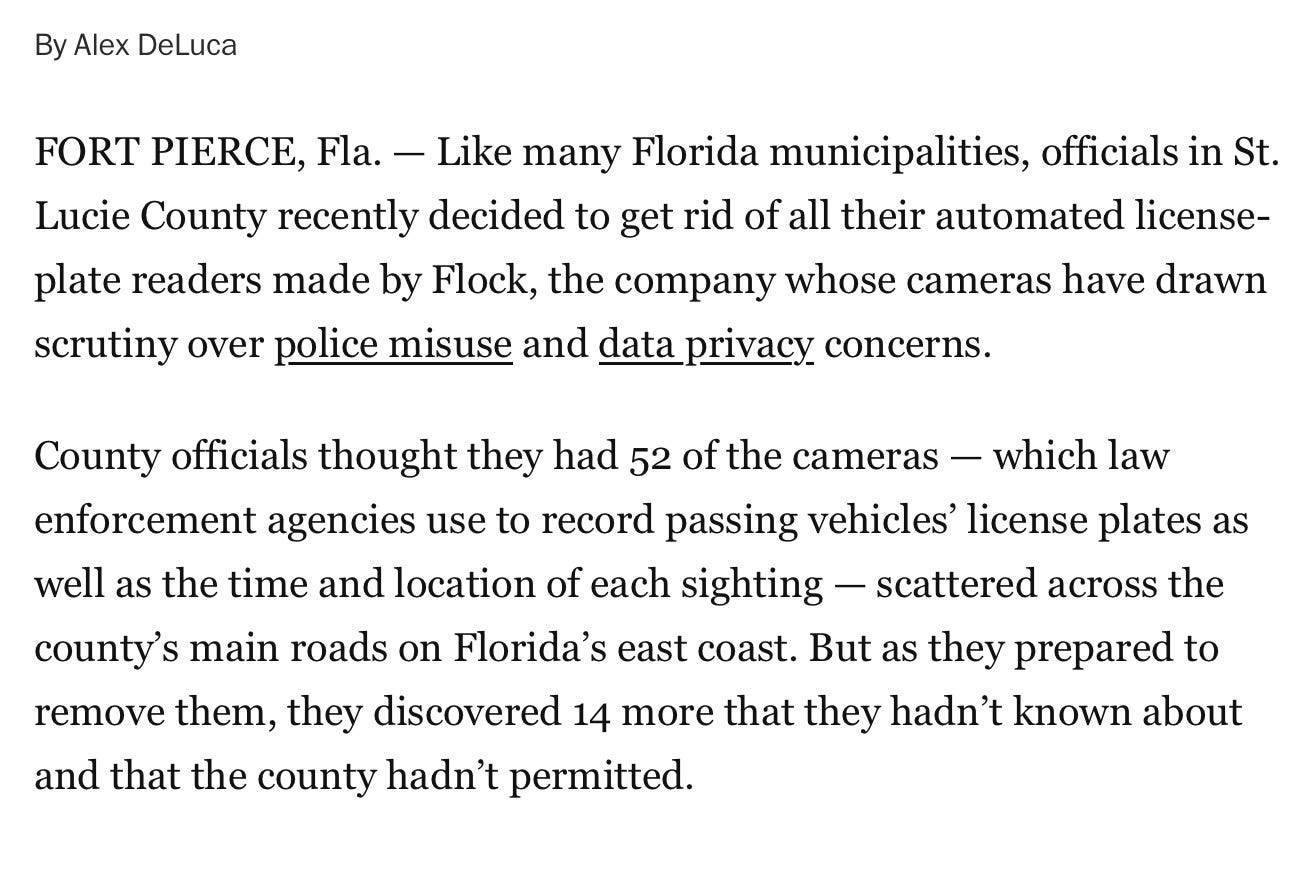
Commissioners in St. Lucie County, Florida, recently approved the removal of Flock Safety cameras on county roads out of privacy and police-misuse concerns. In preparing to pull the tech, workers discovered 14 extra cameras. Three were said to belong to the sheriff’s office, and no one had publicly claimed the remaining 11. It was also unclear whether those 11 cameras were operational. [1]
The county posted notices of removal and planned to cover the cameras in plastic. County officials had not yet contacted Flock to ask who owned them, intending to wait until the removal notices expired. [1]
When asked by the Post who operated the cameras, Flock’s response did not identify an operator. It included an explanation that “permitting requirements vary by jurisdiction.” [1]
Flock’s own website explains what happens when a neighborhood signs up: the company assigns an account representative who helps “set up billing, determine the placement of your cameras,” arrange installation, and make sure everything works. [2]
Start With the Customer Account
There is without a doubt ta paper trail somewhere.The article doesn’t tell readers whether Flock was asked to check for customer accounts, camera-placement records or installation orders relating to those St. Lucie County cameras. This is to me just basic follow-up information and the sort of thing that ought to be pursued by editors and journalists before printing a story that posits a mystery.
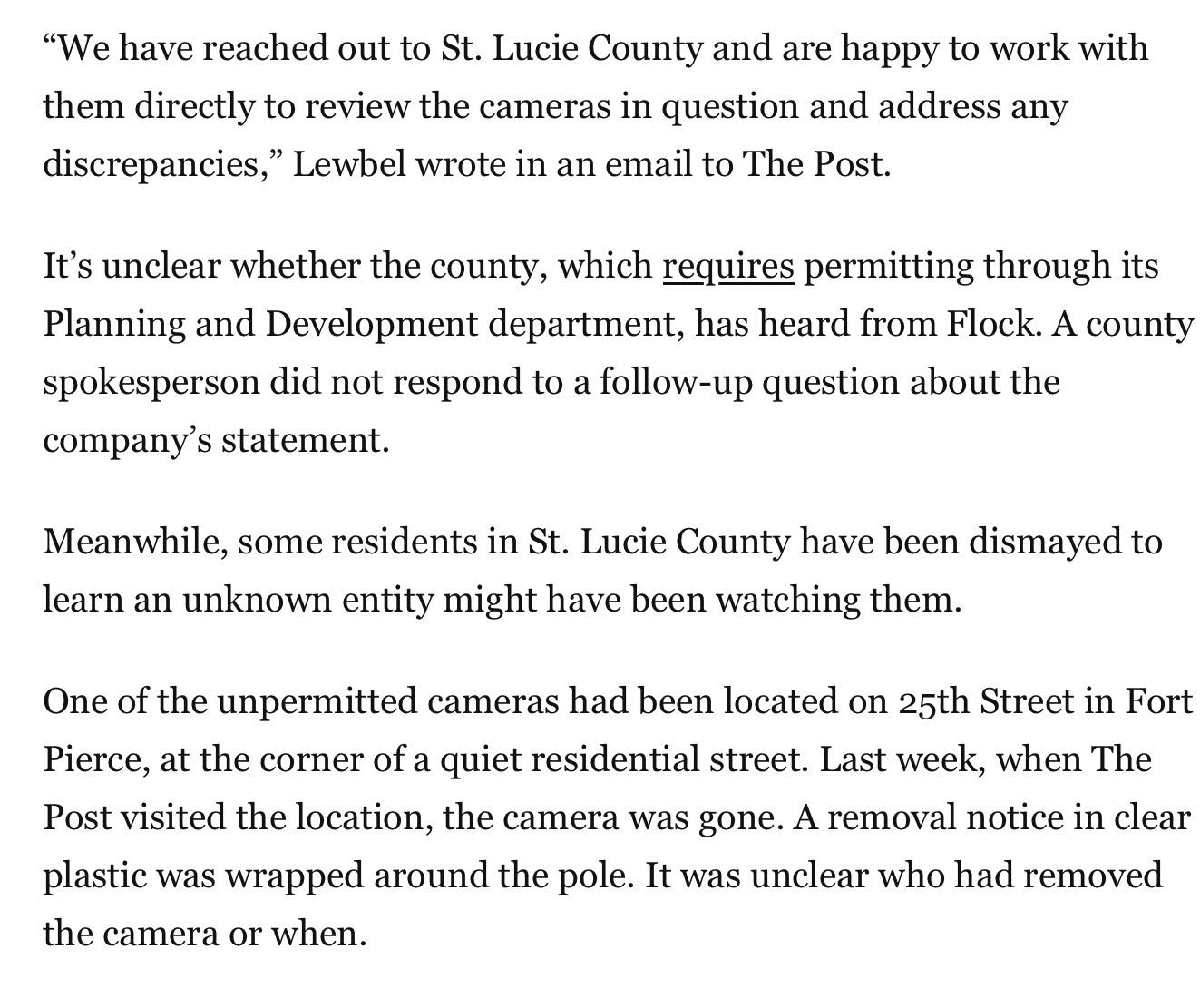
Flock told the Post, “We have reached out to St. Lucie County,” and offered to review the cameras with county officials. According to the story, the county did not answer the Post’s follow-up question about that offer. [1]
What could Flock establish about these particular cameras through its customer and installation process? If it couldn’t connect them to a customer, the company should have been asked to explain why. Readers deserve to know how far those inquiries went.
Who Gets to Remain Unidentified?
A former Fort Pierce police officer used Flock’s database 382 times to track his ex-girlfriend during times when he was off duty. [1]
The Post’s coverage made clear why we need to know who controls surveillance technology and how they use it. Ty Grant, a resident who lived near one of the cameras, had assumed it belonged to local police. When he learned that county officials had no idea who had installed it, his response seemed reasonable: “That makes me feel very unsafe.” [1]
Residents should know who has records of their vehicles, who else might be able to view those records and whether they’ve been misused in the past. The people who set up the Flock cameras should be scrutinized, as Flock’s response didn’t tell readers who’s responsible for the company’s equipment, designed specifically to make cars searchable.
The Post’s own reporting showed why identifying those people matters. Editors had all they needed to put Ty Grant’s concerns front and center, but the headline offered readers a mystery.
The Paper That Helped Bust Watergate
Imagine the Washington Post covering Watergate under this headline: Mysterious Assailants Break Into Watergate Office With No Apparent Motive. Perhaps a helpful spokesperson could have explained that building-access policies vary by jurisdiction.
The June 18, 1972, headline was “5 Held in Plot to Bug Democrats’ Office Here,” and the report acknowledged unanswered questions. [3] Listen, I bring up Watergate because the newspaper’s reputation carries an expectation of persistence. An evasive response ought to attract particular attention at an institution whose name became associated with pursuing people who had reasons to avoid answering questions.
One of the most important questions posed to Flock went unanswered: who runs the cameras? The company did provide a statement about permits. It’s a reporter’s job to report that statement accurately, but the editor should ask whether it answers the question and what still needs following up.
The Post had enough information in the statement itself to print FLOCK DOESN’T SAY WHO RUNS CAMERAS WHEN ASKED. And, honestly, I would have thought that a news organization with Watergate on its résumé might have done just that.
Follow Up
Flock’s published statement doesn’t identify the operator of those cameras. [1] I want to know what information Flock has been able to gather from its records. If there is no identifiable operator, we should know that too. If Flock declines to answer, we deserve to know that, too. THAT DOESN’T ANSWER THE QUESTION. FOLLOW UP. If I were editing this story, I’d send it back and tell the reporter to press for a goddamn answer. If Flock still doesn’t identify an operator, say that in the headline.
I link primary sources in my posts so you can review the evidence and reasoning for yourself. Please look at my work critically.
XVOA depends on reader support. Paid subscriptions and contributions pay for the apps, research tools and the setup I use to write, record and publish. I also depend on that money for my most basic living expenses.
A paid subscription helps me predict how much support I’ll receive each month, plan my time and pay monthly expenses. If you’ve been following XVOA and sitting on the fence, please become a paid subscriber today. Thank you to those who’ve already become paid subscribers.
Contributions through Buy Me a Coffee help cover those same immediate costs. If you can’t commit to a subscription and haven’t bought me a coffee before, please make your first contribution here. Thank you to everyone who’s chipped in over the past few days. You’ve helped me keep going.
Sources
[1] Alex DeLuca, “Florida county discovers mysterious Flock cameras with no obvious owner.” The Washington Post, October 1, 2026.
[2] Flock Safety, “Frequently Asked Questions.” Includes the company’s explanations of customer onboarding, camera installation, account access and vehicle searches.
[3] Alfred E. Lewis, “5 Held in Plot to Bug Democrats’ Office Here.” The Washington Post, originally published June 18, 1972; archival reprint.
Flock seems like surveillance.