

Introduction
Harvard is reportedly running a secret disciplinary investigation into two feminist seniors, Rosie P. Couture and Lola DeAscentiis, after they recorded and posted video from a Harvard class where Larry Summers addressed his ties to Jeffrey Epstein.[1][2] Harvard says the issue is unauthorized recording and rules about attending a class you are not enrolled in.[1] The question that keeps crawling under the skin is why the institution’s sharpest energy moved toward the students who exposed the moment, not the powerful man at the center of it.
Pull up a chair. We need to have a serious talk. I’m going to start with a sentence that makes some people grip their NPR tote bag a little tighter, and I promise nobody is being held hostage by this paragraph. My confession is I’m a misogynist, or more precisely, I’m in recovery. This is not some “please clap for my self awareness” moment. It is a confession with receipts.
Not the cute kind of recovery where you read one book, learn three new words, and start correcting strangers at brunch. The real kind that looks like Alcoholics Anonymous. You show up even when you would rather pretend you are fine. You listen more than you talk. You take inventory, not selfies. You admit the old reflex is still in you, the stuff this country fed us with “boys will be boys,” and you work it one day at a time.
Some days you do great. Some days you catch your hand reaching for the old bottle, you put it back down, and you call somebody who will not let you rename relapse as “just joking.”
Because this society was built with patriarchy baked into the foundation. It trained men early, and it trained us hard. So most men are not innocent. We are either still drinking it, or we are working hard to quit.
And I cannot do the performance of detached neutrality here. I have daughters, and I know exactly how fast your heart starts negotiating with itself when you imagine it is your child on the receiving end of a secret process. I am also a retired cop, which means I have watched institutions use procedure the way a skilled hand uses a blanket: to cover what is ugly, and to smother whoever points at it. I have seen people with no status get crushed for wrongdoing, and I have seen people with titles get handled with soft language, distance, and time.
I fought this piece for more than 48 hours. Not because the facts were complicated, but because my head kept whispering that I was not competent enough to carry a message this heavy without losing my composure. I kept seeing old case files. Defendants caught with underage girls. Co-workers who thought a badge could protect them until it did not. Kinfolk who got thrown under the jail when the law finally decided it was time. All of that came back like a smell you cannot scrub out. Then came the second voice, the one that always tries to save the institution: keep it polite, keep it professional, keep it distant.
That is what the writer’s block was. Not lack of ideas. Fear of saying it plainly.
But I came too far to quit. I started at zero subscribers in June.
Not after the late nights.
Not after the shaky first steps.
Not after you opened your inbox and made room for my voice.
Too many of you have been walking with me too long for me to fold now.
Too many newcomers just signed on with hope in your hands for me to go quiet right when the story gets sharp.
So I’m not building a wall of “objective” points like the human stakes do not count. I’m going to do something more honest and more useful: stick to the record, lay out the timeline, quote the policies Harvard is invoking, and show how words like “privacy,” “civility,” and “process” can become cover when feminist accountability stops being convenient. Because once the sentence forms in your body, it does not leave easily: Harvard investigated the wrong people.
Brief Timeline of Events
Aug 2019: Jeffrey Epstein dies in federal custody while facing sex trafficking charges.
Nov 12, 2025: A House Oversight Committee document dump revives scrutiny of Epstein’s elite network, including Summers-related materials.
Nov 18, 2025: Rosie P. Couture attends a Harvard class she is not enrolled in, records Larry Summers addressing his Epstein ties, and posts video online.
Nov 19, 2025: The clip spreads widely. Summers steps back from teaching and additional public roles.
Nov 21, 2025: A follow-up class session is recorded. Lola DeAscentiis is heard rejecting praise for Summers (“No, we won’t!”), and the moment circulates.
Late Nov 2025: Harvard continues its internal review of Epstein-linked ties while campus pressure grows.
Dec 17, 2025: Reporting reveals Harvard has opened a confidential disciplinary investigation into Couture and DeAscentiis focused on class attendance and recording policies.
History of Elite Institutions Punishing Feminist Activism
Elite universities like Harvard have long struggled with student activists, especially women, who challenge institutional power or powerful men. In some cases, instead of addressing the underlying misconduct, institutions have turned on the messengers. A stark example occurred at the University of North Carolina in 2013, when student Landen Gambill spoke out about being raped by a fellow student and about UNC’s mishandling of sexual assault cases. Gambill was stunned to find herself hit with an Honor Code charge for “disruptive or intimidating behavior,” effectively facing expulsion “for saying [she] was raped,” as one report noted[3]. The charge was only dropped after public outcry, but it sent a clear message to survivors on campus: speaking up could make you the target. This “shoot the messenger” pattern has echoes across higher education. Often, when feminist activists or whistleblowers shine light on harassment and abuse by powerful men, universities respond by scrutinizing the accusers’ behavior or minor rule violations in an attempt to discredit or silence them.
Harvard itself is not immune to this reflex. In recent years, multiple Harvard students and staff who pressed complaints of sexual harassment against prominent faculty felt the institution was quicker to protect its reputation (and the accused) than to protect those vulnerable.
In one high-profile case, three Harvard graduate students alleged that respected anthropology professor John Comaroffhad serially harassed students and even “threatened to sabotage [their] careers if they complained.” They reported Comaroff’s behavior to administrators, yet “Harvard watched as he retaliated” against the whistleblowers, warning other students they’d have “trouble getting jobs” if they sided against him[4].
Harvard’s inaction (and breach of confidentiality) forced those students to file a federal lawsuit in 2022, accusing the university of turning a blind eye for years. The suit claims Harvard’s delayed investigation was neither “prompt” nor “equitable,” and that officials even shared a victim’s private therapy records with the accused professor[4]. (Harvard ultimately settled the case in 2023.) The Comaroff saga exposed a culture in which a powerful male faculty member benefited from colleagues’ and administrators’ deference, while students who spoke up endured retaliation and stonewalling[4]. This dynamic, in which elites close ranks and institutions treat feminist critics as nuisances to be managed, forms the troubling backdrop to Harvard’s response in the Summers affair.
Even historical feminist breakthroughs at Ivy League schools came with institutional backlash. In the 1970s, when Yale students and alumni filed the landmark Alexander v. Yale case (arguing that sexual harassment violated Title IX), they faced intense pushback and dismissal from Yale’s establishment[5][6]. Likewise, at Harvard, women who challenged entrenched male privileges often met resistance. In the 1980s and 1990s, campus activists who demanded tougher action on sexual assault and discrimination encountered what one Harvard Magazine retrospective called “institutional defensiveness and procedural hurdles,” a polite way of saying the university frequently hid behind process to blunt their demands[5][6]. From protests against all-male final clubs to campaigns for a Harvard rape crisis center, feminist organizers historically saw their credibility questioned and their tactics policed by administrators worried about bad publicity. In short, when feminist activism targets powerful men or institutional sexism, elite universities have a habit of deflecting and disciplining, whether through formal sanctions or quieter forms of retaliation.
Retaliation via ‘Process’: Secret Investigations and Code Enforcement
Harvard’s handling of the Summers recording episode fits a broader pattern of institutions weaponizing their disciplinary “process” to retaliate against whistleblowers and activists. Rather than openly confront the uncomfortable truths exposed, the institution initiated a confidential inquiry into the students who exposed them[1]. Harvard officials did not announce this probe publicly; it only came to light because sources leaked it to The New York Times. According to those reports, the investigation is focused on whether Rosie Couture and Lola DeAscentiis violated obscure campus rules by (a) attending a class they weren’t enrolled in and (b) recording and sharing classroom remarks without permission[1]. Both are technically prohibited by Harvard’s policies, which university spokespeople defend as measures to “protect privacy and open discussion” in the classroom[1]. In practice, however, such rules are rarely enforced unless a student’s actions ruffle powerful feathers: a classic example of selective enforcement.
Insiders told the Times that initially Harvard even floated an allegation that the young women’s conduct might constitute “bullying.” That strained accusation (presumably on behalf of Summers’s feelings) has since been dropped[1]. Now the case pivots on those procedural violations: the kind of minor infractions (sitting in on a lecture, hitting “record” on a phone) that would normally merit at most a scolding. Harvard, however, has marshaled the full machinery of its Administrative Board process in this instance, invoking a “confidential” investigation under its internal Honor Code system[1]. The secrecy is by design: Harvard’s rules bar the students from publicly discussing the proceedings (except with their advisor or attorney), and even prohibit lawyers from actively participating in the disciplinary hearing[1]. Such gag rules are ostensibly to protect student privacy, but they conveniently also shield the university from scrutiny about how it handles the case. In effect, Harvard has moved the controversy off the public stage and into a black box of university procedure: a textbook example of “doing things quietly through process.”
This tactic mirrors how numerous institutions quell dissent. As civil liberties advocates note, college discipline systems often operate behind closed doors with vaguely defined offenses like “disruptive conduct” that can be invoked against protesters[6]. In 2024, for instance, dozens of U.S. universities cracked down on student protesters (especially pro-Palestinian activists) by fast-tracking disciplinary cases for trespassing, disruption, and similar rule breaches[6].
Many of those students were hit with interim suspensions: barred from campus or even having their diplomas withheld: before any hearing, a pressure tactic that one paper called “a departure” from the softer stance colleges used to take[6]. At Harvard, officials quietly delayed awarding degrees to several students who joined a divestment sit-in encampment, effectively punishing their protest by postponing graduation[6]. This willingness to use bureaucratic levers as punishment sends a chilling message: activism that embarrasses the institution will be met with formal consequences. It’s a way of outsourcing retaliation to rules and procedures.
In the Summers case, Harvard’s disciplinary machine has been set in motion ostensibly to uphold classroom etiquette rules. Yet the context makes the intent clear. These students “helped thrust Larry Summers’ ties to Epstein back into the spotlight,” and Summers’s consequent retreat from teaching was directly “after the clip spread widely and drew calls for his firing”[2]. In other words, the students’ actions precipitated an outcome (Summers’s stepping aside) that Harvard’s leadership likely found both necessary and frustrating. By investigating the students, Harvard can reclaim a measure of control: shifting the narrative from Summers’s misconduct to the students’ misconduct.
The potential penalties on the table range from a private admonishment to “enforced withdrawal” (a forced leave or expulsion)[1]: a draconian response considering no one was harmed by the videos except perhaps Summers’s reputation. Harvard’s own justification for the policy reveals its priorities: the rule exists to prevent a “chilling effect” on classroom discussion[8]. Ironically, it’s now being wielded to chill student whistleblowing and activism instead. As one Harvard sophomore observed at a recent rally, “They want the people that stand up against them out. They have all these little rules…to follow their guidelines”[7].
This encapsulates how “process” can become a weapon: by selectively enforcing minor rules, an institution can discipline dissenters and insulate the powerful from scrutiny.
Larry Summers, Jeffrey Epstein, and Harvard’s Response

To understand the furor, one must appreciate the depth of Larry Summers’s entanglement with Jeffrey Epstein and Harvard’s past tepid responses. Summers is a Harvard economist who served as U.S. Treasury Secretary and famously led Harvard as its president from 2001 to 2006[9]. During his Harvard presidency, Epstein was a generous donor to the university, funneling millions of dollars into Harvard programs and enjoying access to campus events[9]. Epstein’s money even helped bankroll projects dear to Summers’s family: a 2003 report revealed Epstein “donated millions to Harvard during Summers’ tenure… including funding an online poetry project that [Summers’s] wife was working on.”[9] Summers and Epstein developed a personal acquaintance that went beyond donor check-ins. In 2005, shortly after Summers’s wedding to Harvard professor Elisa New, the newlyweds flew to Epstein’s private Caribbean island: a trip that Summers later admitted took place during their honeymoon[9][10]. (A recently released photo from a Congressional investigation even captured Summers and his wife seated alongside director Woody Allen on Epstein’s plane[1], underscoring how Epstein mingled Summers with other elite figures in his circle.)
Summers maintained contact with Epstein even after Epstein’s misconduct was first exposed. In 2008, Epstein pleaded guilty to soliciting prostitution from a minor. That conviction led Harvard (belatedly) to formally bar further donations from him[9]. But the formal distancing did not end the friendship. Newly disclosed emails indicate that between 2013 and 2019: long after Epstein was a registered sex offender: Summers and Epstein “regularly communicated”, discussing everything from economics to politics to Summers’s personal life[2]. These emails, about 20,000 pages of documents from Epstein’s estate, were released by a House Oversight Committee in November 2025[9]. They paint a disturbing picture of Summers seeking counsel and camaraderie from a known predator. In one exchange, Summers nonchalantly noted to Epstein, “U have returned to the press,” after negative news resurfaced in 2018. Epstein coolly replied, “Short lived, no worry.”[2].
Summers appeared to crave Epstein’s approval and advice despite Epstein’s conviction: “How is life among the lucrative and louche?” he emailed Epstein at one point[2]. Most shockingly, Summers leaned on Epstein as a “wingman” in an attempt to pursue a much younger woman in his professional orbit[11][2]. Summers emailed Epstein about a former Harvard student (now an economics professor overseas) whom he described as his “mentee”, asking Epstein’s guidance on how to get the woman to see a romantic relationship as the price for continued mentorship[2]. The pair even gave the woman a nickname, “Peril,” crudely joking about “the probability of my getting horizontal w[ith] Peril”, a phrase laden with predatory and racist overtones (evoking the old “yellow peril” trope)[2].
When these emails emerged, they caused outrage among Harvard students, faculty, and the public. Summers had already been a controversial figure: his presidency ended after a 2005 no-confidence vote sparked by, among other things, his own remarks speculating that women might have less “intrinsic aptitude” for science[2]. To many, the Epstein correspondence confirmed the worst about Summers’s judgment and attitudes toward women. “Grotesque as recent developments are, they should come as no surprise,” wrote the Harvard Crimson Editorial Board, noting that Summers “has now only doubled down on his misogyny”[2]. Even faculty who had defended Summers in past dust-ups were appalled: “No one I know feels sorry for him,” said one long-time colleague, adding that many previously sympathetic professors were now “sending every new Crimson link to each other” in disgust[2]. The consensus, even among Harvard’s elite, was that Summers’s ongoing ties to Epstein represented a moral failing of the highest order: and a profound embarrassment for Harvard.
Harvard’s official response, however, was cautious and procedural. In 2020, after Epstein’s arrest and death, Harvard had conducted an internal review of its connections to Epstein, issuing a report that acknowledged taking over $9 million of his donations but claimed most were spent by the time of his 2008 conviction and noted no rules were violated by accepting the funds[9]. Harvard did not discipline any faculty for their Epstein links in that 2020 review, treating it as a closed chapter. But the 2025 email trove forced Harvard’s hand to revisit the issue.
On November 14, 2025, Harvard’s president, Alan M. Garber announced a new investigation into all Harvard affiliates implicated in the Epstein documents (which included Summers, his wife Elisa New, prominent law professor Alan Dershowitz, and nearly a dozen others)[12][11]. “The University is conducting a review of information concerning individuals at Harvard… to evaluate what actions may be warranted,” a spokesperson stated[11]. At the same time, external institutions swiftly distanced themselves from Summers. Within a week of the emails’ release, Summers resigned or was pushed out from a half-dozen high-profile roles: the OpenAI board, an advisory board of Spain’s Banco Santander, a Brookings-affiliated “Hamilton Project”, Harvard’s own Mossavar-Rahmani Center directorship, a Yale-affiliated budget lab, and even his contract as a paid contributor to The New York Times[9][12]. As the Boston Globequipped, “if Summers is unfit to work for each of these institutions, he is equally unfit to teach at our school. Harvard should not be the only institution in America where Summers remains above reproach.”[10].
Summers himself issued public statements of contrition. “I am deeply ashamed of my actions and recognize the pain they have caused,” he said in a statement to the Boston Globe, adding that he “take[s] full responsibility for [the] misguided decision to continue communicating with Mr. Epstein.”[9].
Initially, Summers tried to draw a line between his public roles and his teaching at Harvard. On November 13, he declared that while he’d step back from “public commitments” (board seats, talks, etc.), he believed “it’s very important to fulfill my teaching obligations” and intended to continue with his Harvard classes[2].
This stance lasted only a couple of days under the glare of the viral student video and intensifying criticism. By November 19, Summers announced he would go on leave from Harvard and cease teaching mid-semester[9][13]. His co-professors took over his remaining lectures[13].
Summers also gave up his title as director of the Harvard center, though notably he did not resign his tenured faculty position[13]. Harvard confirmed he “will keep his tenure” for now[14].
(Revoking tenure is exceedingly rare: Harvard had done it only once in recent decades, in a 2023 research fraud case[9].)
Some student activists feel this isn’t enough. The Harvard Feminist Coalition, of which Couture and DeAscentiis are members, launched a petition demanding Harvard “shut out Summers” completely by stripping his tenure[9].
“Summers is unfit and unsafe to teach at Harvard,” the petition argues, citing how his own emails showed him advising a friend on “abusing power as a professor in pursuing sex with a mentee.”[9].
Hundreds signed the petition within days[9].
As one organizer put it, “It confirms what survivors and Harvard community members have said for years… any complicit in sexual violence… should not teach at Harvard.”[9].) Some student activists feel this isn’t enough: The Harvard Feminist Coalition, of which Couture and DeAscentiis are members, launched a petition demanding Harvard “shut out Summers” completely by stripping his tenure[2]. “Summers is unfit and unsafe to teach at Harvard,” the petition argues, citing how his own emails showed him advising a friend on “abusing power as a professor in pursuing sex with a mentee.”[2] Hundreds signed the petition within days[9].
Harvard’s leadership has so far stopped short of condemning Summers in harsh moral terms. No public statement from the university administration explicitly rebuked the content of the Epstein emails or apologized to students, a silence Rosie Couture noted bitterly: “For there to be no acknowledgment... it’s ridiculous to me. Summers should resign... Now.”[2]. And that silence is not neutral. When an institution can find paragraphs for procedure but cannot find a sentence for moral clarity, it is making a choice.
Instead, Harvard’s messaging has been couched in the neutral language of investigations and policies. That bureaucratic calm does not read like composure. It reads like insulation. It stands in contrast to the palpable anger among students and many faculty.
It underscores why the actions of two 21-year-old seniors, armed only with smartphones and moral clarity, became the catalyst for accountability that Harvard’s Board of Overseers and presidents past and present had long avoided. By hitting “record” and sharing what they heard, those students forced into the open a reckoning that was years overdue.
The Viral Recording and Harvard’s Backlash: Timeline of Events
To put the disciplinary saga in context, here is a brief timeline of the key events surrounding the Summers recording and its fallout:
July 2019: Jeffrey Epstein is arrested on federal sex-trafficking charges; he dies in jail in August 2019. Harvard, which had accepted over $9M from Epstein pre-2008, conducts an internal review in 2020 but takes no action against faculty beyond halting new donations[9].
2013–2018: Summers and Epstein exchange numerous emails (later made public), showing Summers continuing the relationship after Epstein’s 2008 conviction[2]. In these, Epstein advises Summers on personal matters and the two maintain a friendly correspondence even as Epstein returns to the news in 2018[2].
Oct–Nov 2023: Under public pressure related to other controversies (including criticism of Harvard’s handling of campus sexual misconduct and, later, Israel-Palestine protests), Summers pens an April 2024 NY Times op-ed bemoaning that universities have “failed to impose discipline and maintain order” on campuses[17]. (This comment would boomerang ironically when his own conduct came under fire.)
Nov 12, 2025: The House Oversight Committee (now led by Republicans) releases a trove of 23,000 Epstein documents, including email exchanges implicating Summers[9][12]. These show Summers called Epstein his “wingman” and sought help pursuing a female protégé[11][2].
Nov 13–14, 2025: Multiple organizations begin severing ties with Summers. Summers issues a statement expressing “deep shame” but indicates he will continue teaching while stepping back from public roles[9][2]. Harvard’s President announces a new internal review of all Epstein links, including Summers[13].
Nov 18, 2025 (Tuesday): Rosie Couture (Harvard ’26) attends Larry Summers’s undergraduate economics class “The Political Economy of Globalization” (which she is not enrolled in)[2]. Students in the room are abuzz over the Epstein email revelations[2]. At the start of class, a visibly diminished Summers addresses the issue: he acknowledges his “statement of regret” for what he “did in communication with Mr. Epstein”, admits feeling shame, and says he’ll “step back from public activity for a time.” However, he insists “it’s very important to fulfill my teaching obligations…with your permission, we’re going to go forward” with the class material[2]. Couture surreptitiously records these remarks on video and soon posts the clip on social media[2]. On TikTok, she captions it: “This is how classes start at Harvard: Professors apologizing for their ties to Jeffrey Epstein.”[8] The video quickly goes viral, resonating as a snapshot of elite impropriety.
Nov 19, 2025 (Wednesday): The viral video is picked up by major news outlets and circulates widely, sparking anger and calls for Summers’s ouster[2]. That day, Summers resigns from the OpenAI board and other commitments[11]. By evening, Harvard announces Summers will not finish the semester of teaching; his co-professors will take over his classes immediately[13]. Summers also goes on leave from his Harvard center directorship[13]. Essentially, the viral student video forces Summers into retreat within ~24 hours.
Nov 20–24, 2025: Student activists escalate pressure. The Harvard Feminist Coalition (including Couture and DeAscentiis) plasters the campus with printouts of Epstein emails and photos, including covering the John Harvard statue with evidence of Summers’s Epstein ties[9]. They launch a petition to revoke Summers’s tenure, gathering hundreds of signatures[2]. The petition cites the emails (e.g. Summers asking Epstein’s advice on “abusing power…in pursuing sex with a mentee”) as proof that “Summers is unfit and unsafe to teach”[9]. Harvard students hold rallies decrying institutional complicity and comparing this to a broader “legacy of sexual and gender violence” at Harvard[2]. Faculty and even public figures like Senator Elizabeth Warren add to the pressure: Warren declares Summers “has demonstrated that he cannot be trusted” and should be severed from Harvard[2].
Nov 21, 2025 (Thursday): In the first class after Summers’s exit, co-instructor Prof. Robert Lawrence informs the class that “Larry has decided to step down from his teaching responsibilities…We will miss his insights and his wisdom.”[2] At that moment, Lola DeAscentiis (another unregistered student-activist attending) cannot hold her tongue and shouts, “No, we won’t!”[2]. Another person in the hall retorts, “Yes, we will!”: an exchange that DeAscentiis also records. This second video, showing student pushback to the idea of missing Summers, is shared on Instagram and further amplifies the message that not everyone at Harvard venerates its disgraced ex-president[2].
Late Nov 2025: Summers is effectively removed from campus life (though retaining tenure), and the story shifts to Harvard’s next steps. Harvard’s internal review of Epstein links proceeds quietly. Media coverage outside Harvard intensifies: The NY Times, Boston Globe, New Yorker, Fox News, and others run pieces on Summers’s “fall from grace” and Harvard’s dilemma. Alumni, talk show hosts, and social media commentators debate whether this is cancel culture finally catching up to Summers or simply overdue accountability. Meanwhile, Couture and DeAscentiis give no public comments in the immediate aftermath, apart from their social media posts, though they privately celebrate that “Larry Summers [stepping] down” is a hard-won “win”: if only a first step[2].
Dec 2025: It leaks that Harvard has opened a disciplinary case against the two students. On Dec. 17, The New York Times reports that Harvard College’s Administrative Board is investigating Couture and DeAscentiis for possible Honor Code violations related to the class recordings[2]. Sources reveal the inquiry was triggered by at least one faculty complaint about the videos “breaching decorum,” and that an initial claim accusing the students of “bullying” Summers was dismissed as overreach[2]. The focus narrows to the technical rules the pair broke. Harvard refuses to comment on the confidential proceedings, but a quotation surfaces from an official note: “The College prohibits unauthorized recording of classroom proceedings… to prevent chilling effects that undermine participation and inquiry.”[8] This rationale rings hollow to critics, who note that Harvard shows far more zeal investigating these students than it ever did investigating Summers’s Epstein entanglements. Harvard’s potential punishment for the women could be anything from a formal warning to suspension/expulsion[1]. As of this writing, the matter remains unresolved: leaving the students in limbo as they head into their final semester, muzzled from speaking openly, while Summers remains a tenured professor on leave.
This timeline illustrates the swift journey from exposure to backlash: in just over a month, two student whistleblowers went from holding a powerful figure accountable to facing their own disciplinary reckoning.
Social Media Reactions: TikTok, Twitter, and Competing Narratives
The story of Summers’s Epstein apology broke first on social media, and online framing drove much of the public reaction. On TikTok, where Rosie Couture originally posted the video, the narrative was one of shock and dark irony. Her TikTok caption: “This is how classes start at Harvard: Professors apologizing for their ties to Jeffrey Epstein”: distilled the absurdity in a way that resonated with millions[8]. The clip, shot from the back of a lecture hall, showed an Ivy League icon literally confessing shame about a pedophile associate before resuming class. For a young TikTok audience, this was a viral cocktail of scandal and schadenfreude. Comments poured in expressing outrage (“How does Larry Summers still have a job?” one user wrote) and sardonic humor about elite hypocrisy[11]. Many praised the students for “exposing” the situation. “They are trying to normalize this. Don’t allow it,” one commenter implored, reacting to what they saw as Harvard’s instinct to downplay the issue[11]. The TikTok algorithm quickly boosted the video to prominence, and within hours it had been duetted, remixed, and dissected by countless users. On Instagram, a similar dynamic played out when Lola DeAscentiis posted the second clip of the class rejoinder (“No, we won’t!”). Students and alumni shared the post widely, often with captions applauding the “boldness” of challenging a professor in real-time. The Instagram video even made its way into a New York Magazine piece via an embed, underscoring how social media content set the agenda for traditional media coverage[2].
On Twitter (X), reactions split along predictable lines: though interestingly, there was bipartisan condemnation of Summers. Left-leaning voices on X, including many Harvard alumni, feminist activists, and academics, lauded the two students for demanding accountability. They framed the incident as part of the #MeToo and campus accountability movements. Some pointed out the symbolism: young women at Harvard doing what the institution hadn’t: exposing one of the old boys’ network. There was also significant anger directed at Harvard’s administration: “Harvard investigating STUDENTS who revealed Larry Summers’s Epstein emails: you can’t make this up,” one journalist tweeted incredulously. Many saw it as proof that elite schools care more about their powerful allies than their values.
On the other hand, some centrist and conservative commentators took a different angle. A few accounts (often with Harvard or Ivy League affiliations) fretted that secretly recording a class violated trust and could create a chilling precedent. They argued that regardless of Summers’s misdeeds, students filming teachers is a slippery slope: echoing Harvard’s official line about protecting open discourse[8]. But these voices were somewhat muted by the fact that Summers is not a sympathetic figure to conservatives either; as a Clinton/Obama Democrat and prominent economist, he’s hardly their hero. In fact, right-wing media delighted in the spectacle of a liberal Harvard elitist being taken down by his own students.
Outlets like Fox News and the Daily Caller amplified the story with glee, emphasizing Summers’s “shame” and Harvard’s internal strife[11][8].
It was almost sweet. Suddenly, the moral outrage budget got approved. When the Epstein story drifts toward people they protect, the volume drops and everybody discovers nuance. But give them a Harvard liberal and an Ivy League lecture hall, and look at that. Instant backbone.
Fox News ran a headline about Summers “caught on camera” confessing shame, and highlighted online comments calling the situation “diabolical.”[11] The Daily Caller, in an article unsubtly titled “Harvard Seeking Way To Silence Students Who Recorded Larry Summers’ Epstein Apology,” painted the two young women almost as folk heroes exposing a corrupt establishment[2]. It pointed out the irony of Harvard possibly expelling the students while Summers keeps tenure, concluding that Harvard “doesn’t want students investigating [its] ties” to Epstein[2].
This convergence of outrage: from leftist feminists to MAGA sympathizers: created a rare social media consensus that something was very rotten in the state of Harvard.
One platform where framing diverged more was academic listservs and forums. In those spaces (and perhaps in private social media circles of faculty), there was some unease about the tactic of infiltration and recording. A few academics noted that if every controversial classroom comment were secretly taped, it might stifle professors from discussing sensitive topics. But even among faculty, those hypotheticals got little traction in this case, given Summers’s situation. As one Harvard lecturer, Timothy McCarthy, remarked, the content of Summers’s emails was so egregious that it “stunned even his fiercest critics,” and people were “shell-shocked” that he would scheme to seduce a mentee[2]. That shock translated into remarkably little sympathy for Summers across the board. Instead, most online discourse: whether on TikTok, X, or Reddit: fixated on Harvard’s next moves: Would the university actually punish these students? If so, what precedent would that set?
It’s also worth noting how Harvard’s own narrative was virtually absent on social media. The university made no public posts about the matter. Harvard leadership did not tweet or issue any personal statement addressing student concerns about Summers. This vacuum allowed students and outside voices to drive the narrative. And drive it they did: by the time the New York Times confirmed Harvard’s secret probe into the students, the phrase “Harvard investigated the wrong people” was a common refrain in social media comments. Memes even circulated showing Harvard’s Veritas shield being pointed at students instead of at Epstein or abusers, a satirical indictment of skewed priorities. In the court of public opinion online, Harvard was not faring well.
Legacy Media Coverage and Elite Protectiveness
The legacy media’s response to the Summers affair: and specifically to Harvard’s discipline of the student recorders: has been telling. Initial mainstream coverage focused largely on Summers himself (and the salacious Epstein emails), with relatively little mention of the students who ignited the firestorm. For example, The Washington Post ran a straightforward news piece on November 19, 2025 headlined “Larry Summers steps back from teaching as Harvard looks into Epstein ties.” It summarized the Congressional email revelations and noted Summers’s public shame, but nowhere did it mention that students in a Harvard class had instigated his stepping down by posting a viral video[2].
The Wall Street Journal and wire services like Reuters and the AP took a similar approach in those early days: their stories emphasized that Summers resigned from the OpenAI board and that Harvard launched an Epstein ties review[2], but made no reference to student activism or the classroom incident. In essence, the narrative was framed as Summers’s fall from grace due to Epstein, rather than Summers confronted by outraged students. This framing arguably reflects an institutional alumni protectiveness: many journalists and editors in elite media have ties to places like Harvard and may have instinctively centered the story on the famous figure (Summers) rather than the students, whom they saw as peripheral. It was only after the student videos had been widely circulated online that a few outlets like the New York Magazine (Intelligencer) and the Boston Globe gave the students pride of place in the story[2][10].
Intelligencer’s feature, titled “What Harvard Is Whispering About Larry Summers,” opened with Rosie Couture attending the class and even quoted her perspective extensively[2]. The Boston Globe similarly reported on the petition to revoke Summers’s tenure, quoting Lola DeAscentiis by name as an organizer and highlighting student sentiments (“we’re happy [Summers stepped down]... but it’s certainly not enough”[10]). Notably, these more student-centric pieces were in outlets either local (Globe) or traditionally progressive (NY Mag), whereas some national outlets with closer ties to the establishment (NYT, WaPo) trod more lightly at first on the student angle.
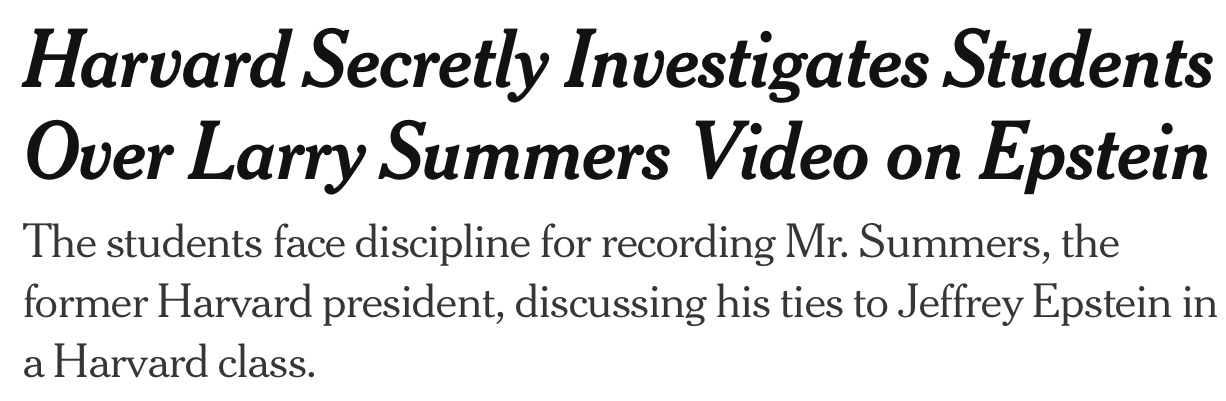
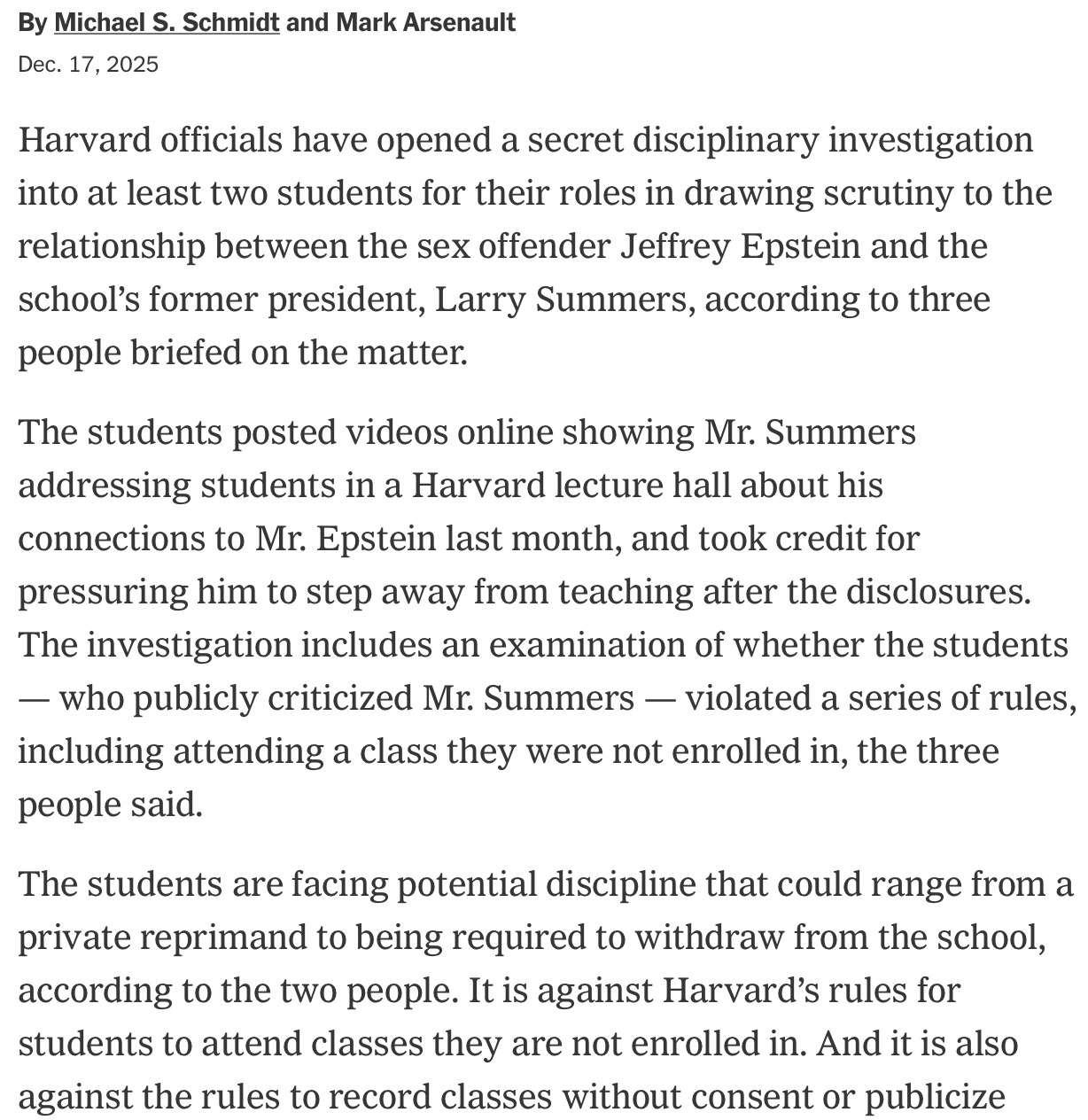
When it comes to the disciplinary investigation into the students, the coverage has been even more limited. The New York Times broke that news on Dec. 17, 2025, in a piece that relied on inside sources rather than official announcement[1]. After the NYT story, smaller pick-ups occurred: Newser (a news aggregator) summarized the situation with the blunt headline “Harvard Probes Students Over Viral Videos of Larry Summers”[1], and conservative outlets like the Daily Caller ran with an outraged tone about Harvard “silencing” the women[8]. But many major media organizations have (as of the research for this report) ignored or barely touched the disciplinary angle. CNN, for instance, covered Summers’s Epstein apology speech on their website and Instagram: even posting a snippet of the video with caption: but did not follow up with any story about Harvard investigating the students (a check of CNN’s site reveals no such article, and CNN’s Instagram framing simply noted Summers’s apology)[15].
The Washington Post, which employs Summers as a contributing columnist (or did, until they quietly indicated they wouldn’t renew his contract)[12], has not run a dedicated piece on the student discipline at the time of writing. This could be an editorial decision to wait until the process concludes, or it could reflect a reluctance to cast Harvard in a negative light over punishing students. It’s worth mentioning that Harvard’s Provost Alan Garber and other top officials are part of the same elite circuit as many media figures: for example, Summers’s 70th birthday in 2024 was attended by luminaries and even toasted by Harvard’s provost (who gently roasted him)[2]. Such coziness can translate into softer media treatment. In general, one observes that outlets with Harvard alumni in key roles often take a measured tone on Harvard scandals. The Times itself, albeit breaking the discipline story, has a deep bench of Harvard grads and was careful to attribute information to “sources” and not sensationalize what Harvard is doing (the Times piece reads as factual and slightly subdued, not an outright condemnation).
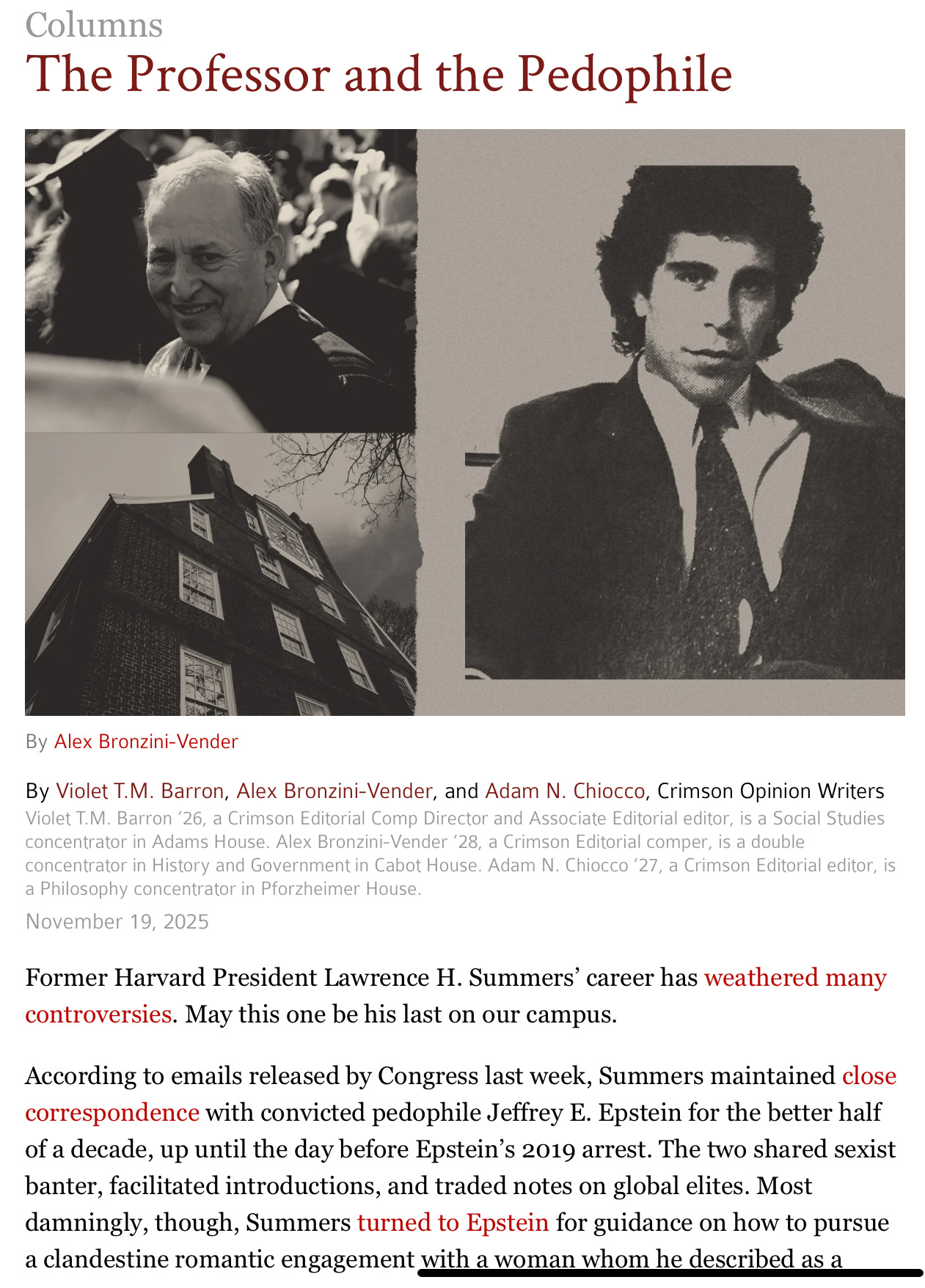
That said, The Harvard Crimson: being the independent student newspaper: has been unsparing. Its editorial “The Professor and the Pedophile” emphatically called for Summers to be cast out and noted with dismay that “Harvard must hold its faculty to basic moral standards, however great their accolades.”[2] The Crimson even threw a jab quoting Summers’s own recent words about discipline back at him: since Summers once criticized Harvard for not imposing discipline, “if Summers won’t step aside voluntarily, Harvard should take his advice: and begin by disciplining him.”[2]. This youthful insistence on principle over pedigree starkly contrasts with the relative silence of many older Harvard affiliates. Few prominent Harvard alumni publicly defended Summers (his position was largely indefensible), but nor did they loudly cheer the students. Instead, one observed a kind of elite omertà: a code of quiet.
Harvard’s alumni network, full of politicians, CEOs, and media personalities, did not circulate open letters supporting Couture and DeAscentiis. No famous Harvard trustee or overseer spoke out to say, “These students did the right thing.” This silence can be interpreted as a subtle form of protecting the institution: rallying behind the students would implicitly shame Harvard for investigating them, so the elite class largely stayed mum and let the process play out internally.
Another aspect of institutional self-protection is how swiftly Harvard’s inquiry was labeled “confidential.” This meant that if the Times hadn’t reported it, the broader community might never have known the students were under investigation until possibly sanctions were delivered. Elite institutions often manage controversy by containing it. We saw this when 40 Harvard faculty members initially signed a private letter supporting the accused harasser Comaroff in early 2022: an attempt to shield a colleague by leveraging insider clout[4]. (They later retracted it under public pressure.) We see echoes of that impulse in one faculty member’s reaction to the Summers videos: instead of thanking the students for revealing something important, this professor lodged a complaint that the students had behaved improperly[8]. It only takes one such complaint to give the university an opening to “handle” the problem. It’s a pattern: protect the powerful, reproach the disruptors. In Harvard’s calculus, Summers was an insider (President Emeritus, University Professor, celebrated economist), whereas Rosie and Lola are temporary residents of Harvard Yard with no institutional power.
Even as Summers’s actions tarnished Harvard’s reputation, cutting him loose entirely would be a grave step (revoking tenure being almost unheard of[10]). By investigating the students, Harvard demonstrates to its community: and its influential alumni: that it still takes decorum and loyalty seriously. It signals that no matter how justified your cause, embarrassing Harvard or its distinguished faculty has consequences. This implicit message “protects” elite norms: it warns future activists that going rogue (even for a good cause) might ruin your prospects more than your target’s.
In terms of which legacy outlets ignored the student angle, it’s worth noting that some may yet cover it if the story escalates (for instance, if Harvard were to actually punish the students severely, it would likely trigger a wave of op-eds). But the initial disparity is striking: the disciplinary investigation was major news in the New York Times and Boston press, while TV networks and many national papers have given it scant attention. An observer might cynically note that Larry Summers has been a fixture in the opinion pages (writing for the Financial Times and Washington Post, and frequently quoted): he’s part of the media-commentary elite. The two undergraduate women are not. There is an asymmetry in voice and influence. Summers’s perspective: that he felt ashamed but thought he should keep teaching: was broadcast in headlines and TV chyrons[2].
The students’ perspective only got out because they spoke for themselves on new media or via student publications. When Harvard then muzzled them with the Ad Board confidentiality rules, it ensured they couldn’t easily go on CNN or write their own op-ed about being investigated. In that vacuum, the duty of coverage fell to journalists. Some did their duty (the Times piece is a solid example of investigative reporting, not shying from calling it a “confidential disciplinary investigation”[1]). Others, perhaps out of an instinct to protect “collegial” relationships or simply because they viewed it as a minor subplot, did not amplify that angle.
Finally, one cannot overlook the broader elite pattern of backlash minimization. Summers, despite all, still has defenders in high places (or at least people willing to quietly support him). New York Magazine noted that over the years Summers “enjoyed quiet support” from a network of centrist academics and power-brokers: people who agreed with some of his stances and “shared at least some of his public opinions,” even if they wouldn’t voice them publicly[2]. These folks aren’t about to hold a rally for Summers, but their instinct is to contain damage. One such unnamed economist told Intelligencer that among Summers’s circle, there was “exhaustion” and a sense of “How many times are you going to put your friends and the university through the wringer because of your stupid decisions?”[2]. That quote is revealing. It is not about sympathy for victims or students. It is about the inconvenience of bad press. Translation: how many times are you going to embarrass us in public, Larry? You can almost hear the institution sighing like a parent in a grocery store, not because the kid hurt somebody, but because the kid yelled at the wrong time.
In that mindset, the fix is not accountability. It is containment. Get Summers out of the spotlight, which has happened, and prevent anyone from dragging the mess back into daylight. That is how you end up clamping down on the people airing the dirty laundry, even when the laundry is real. Summers’s own line about needing to “maintain order” at universities (from his April 2024 essay) lands with dark irony here[17]. If you are Harvard’s old guard, disciplining the two students becomes a way to teach the real lesson: do not make the powerful unsafe in public.
In summary, legacy media’s coverage has helped the institution hide behind a familiar story. One bad man. One ugly scandal. A quiet internal review. Everybody moves on.
But that is not what this is.
This is an institution watching a public record form in real time, and then turning its sharpest tools toward the women who forced that record into daylight. That is why this does not read like “order.” It reads like fear.
And here is the part I need you to sit with.
If Harvard can make feminist seniors the problem, then any institution can.
If Harvard can call it privacy while it disciplines the witness, then any institution can.
If Harvard can wrap retaliation in procedure and expect you to applaud, then any institution can.
Harvard investigated the wrong people.
If your stomach turned reading this, good. That is your alarm system working.
Because look at the country we are living in. A man like Nick Fuentes can go online and sneer, “Your body, my choice. Forever,” and it does not just stay online. It shows up in comment sections, in schools, and in the air women have to breathe.
And he can still build a platform around that kind of threat. Loud, crude, lucrative.
Now watch Harvard do the Ivy League version. Not “your body, my choice,” but “your voice, our process.” Not a threat you can screenshot, but a confidential investigation that can still touch a young woman’s future.
And Harvard is not some fragile little nonprofit trying to make rent. It is sitting on an endowment counted in tens of billions.
Harvard investigated the wrong people.
If your chest tightened when you read “your body, my choice” and then watched Harvard reach for a confidential file, that is the same muscle. Control comes for women first, whether it is shouted online or whispered in policy language.
I told you earlier I’m in recovery. This is what recovery looks like in public. You do not look away. You do not rename it as “just politics” or “just process.” You show up, you tell the truth, and you keep showing up.
If you want me to keep showing up here, through the paperwork, the policies, the resignations, and the next quiet hearing, become a paid subscriber. That is how I buy the hours to keep pressure on the powerful and keep the main reporting free for the people who cannot.
Paid options are here:
Sources are referenced inline using bracketed numbers that match the list below.
Sources:
https://www.newser.com/story/380537/harvard-probes-students-over-viral-videos-of-larry-summers.html
https://www.thenation.com/article/activism/student-protests-devos-fraternities/
https://www.thecrimson.com/article/2025/10/6/students-protest-diversity-changes/
https://www.bostonglobe.com/2025/11/23/business/larry-summers-tenure-petition/
https://abcnews.go.com/US/larry-summers-resigns-open-ai-board/story?id=127664575
https://www.washingtonpost.com/nation/2025/11/19/larry-summers-jeffrey-epstein-harvard-openai/
https://www.thecrimson.com/article/2025/11/19/barron-bronzini-vender-chiocco-summers-resignation/
Correction: Harvard’s president is Alan Garber, not Claudine Gay. Thank you to Cassandra Butler for the catch. Also removed a duplicated paragraph, thanks Jerry McIntire.
Let me tell you... at one time or another, nearly every woman has been harassed by some guy in power. It could be a boss, a father, a colleague, a clergy member, a teaching assistant, a professor, a mentor, etc etc etc. My friends and I can recount harassment even in our later years, when you'd think we wouldn't be so attractive anymore.
At some point, however, it's hard to push back because of the job market or worries that you won't get a decent review or that you can't sustain yourself on unemployment. And then there's the worry that you'll be labeled as "the troublemaker" or that your boss would retaliate because you went to HR. (Hint: Eventually you learn that HR isn't there to protect employees. It's there to protect the company.) For all practical purposes, it's a no-win situation for the women. The bottom line is that we simply want to depend on men to act responsibly. (And just for the record, women can harass men, too. It's just less common because we have fewer opportunities to be in the power position.)