

I Hate The News 5-12-2026
A Daily Brief on Distortion, Erasure, and Survival
I Hate The News: When The Referee Starts Drawing The Map
Today’s buried pattern is simple: the institutions are not just calling the game. They are changing the field, moving the lines, and then asking Black people why we keep noticing the scoreboard.
Introduction
Today’s brief is about institutions turning harm into paperwork.
Redistricting. Accreditation. Charity oversight. Resolution agreements. Judicial efficiency. These are the soft words of the day. They make raw power sound like administration. But underneath them sits the same old question: who gets protected, who gets documented, who gets translated, who gets erased, and who gets told that fighting erasure is the real discrimination.
The weak frame is procedure. The deeper frame is power with a lanyard.
TLDR
Black voting power is being shrunk under the language of neutrality. The Supreme Court let Alabama move toward a congressional map with only one largely Black district, and the Don Lemon segment with Tim Wise and Rep. Jolanda Jones named the old racial logic underneath the new legal packaging. [1][2][3]
Utah Republicans just did the court packing they tell the country to fear. They expanded the state Supreme Court from five to seven seats after legal defeats, then sold the move as efficiency. [7][8][9]
Civil rights infrastructure is being squeezed at multiple pressure points. Alabama is probing the Southern Poverty Law Center, the ABA is under pressure to gut law school diversity standards, and Kansas schools are being pushed to erase trans students through federal compliance threats. [10][11][12]
Culture is showing its own capture map. French cinema figures warned about far-right control of the film pipeline, Josephine Baker’s story is headed back to the screen, and Sony is buying song catalogs like memory is a rent-producing asset. [13][14][15]
The proof of life is still loud. Amy Sherald is bringing contested Black and trans visibility home to Georgia, the Studio Museum is building access into the archive, A’ja Wilson is expanding the labor imagination of women’s sports, and HBCUs are building the future of women’s flag football before the mainstream catches up. [16][18][19][21]
🛑STOP🛑
Today we are watching Black voting power get carved up in court language. We are watching state politicians pack courts while pretending they believe in judicial restraint. We are watching schools get threatened for refusing to erase trans kids. We are watching archives, museums, music catalogs, athletes, artists, and students fight to keep memory alive while power keeps trying to turn the lights out.
So let me say this plainly.
If this work matters to you, this is the moment to stop admiring it for free from the doorway.
I am not asking everybody to drop $80 today. If you can, do it. Annual subscriptions help keep this machine breathing.
But if $80 is too much right now, then do the monthly. It is $8 a month. That is not a grand heroic sacrifice. That is one fast-food combo. That is one streaming service you forgot you still had. That is less than the price of pretending somebody else will keep doing this work after the independent writers burn out.
Become a paid subscriber here:
And yes, I am guilt-tripping you a little.
Because some of you who do have means read every post. Some of you nod along. Some of you send me messages saying this is important, necessary, sharp, needed, different, powerful, and then disappear when the subscription button shows up like it asked for your Social Security number and a blood sample.
I love you. But come on.
The people trying to erase us are funded. The people lying on us are funded. The people laundering this mess through courts, schools, museums, campaigns, and media shops are funded. Truth should not have to pass a collection plate after every fire.
So go paid.
And if you genuinely cannot commit to a subscription right now, fine. I am not unreasonable. Take the side door.
Buy Me A Coffee.
Not as a cute little tip. Not as charity. As proof that you understand labor happened here. As proof that you did not walk out of the room after the sermon and leave the preacher with the light bill.
Buy the coffee if that is what you can do today.
But do something.
Because compliments do not pay for research. Restacks do not pay for exhaustion. And moral agreement does not keep this thing alive unless it becomes material support.
That is the ask.
No more standing at the edge of the work pretending the work runs on vibes.
👇🏻CARRY ON WITH THE READ
Part I: The Five Ways They Tried to Fuck Us Over Today
1. Alabama got permission to make Black votes smaller again
The Supreme Court cleared the way for Alabama to use a congressional map with only one largely Black district after a lower court had required a map with two. AP reported that the move could help Republicans gain a U.S. House seat, and The Guardian noted that the Court’s conservative majority offered no explanation even though a lower court had found intentional discrimination in the map. [1][2]
This is where the Don Lemon segment matters. Tim Wise is an anti-racist essayist, author, and educator whose work focuses on race, racism, and white privilege. Rep. Jolanda “Jo” Jones is a Texas state representative for House District 147, and Houston’s Defender has described her as the first openly LGBTQ Black representative in the Texas Legislature. [3][4][5][6]
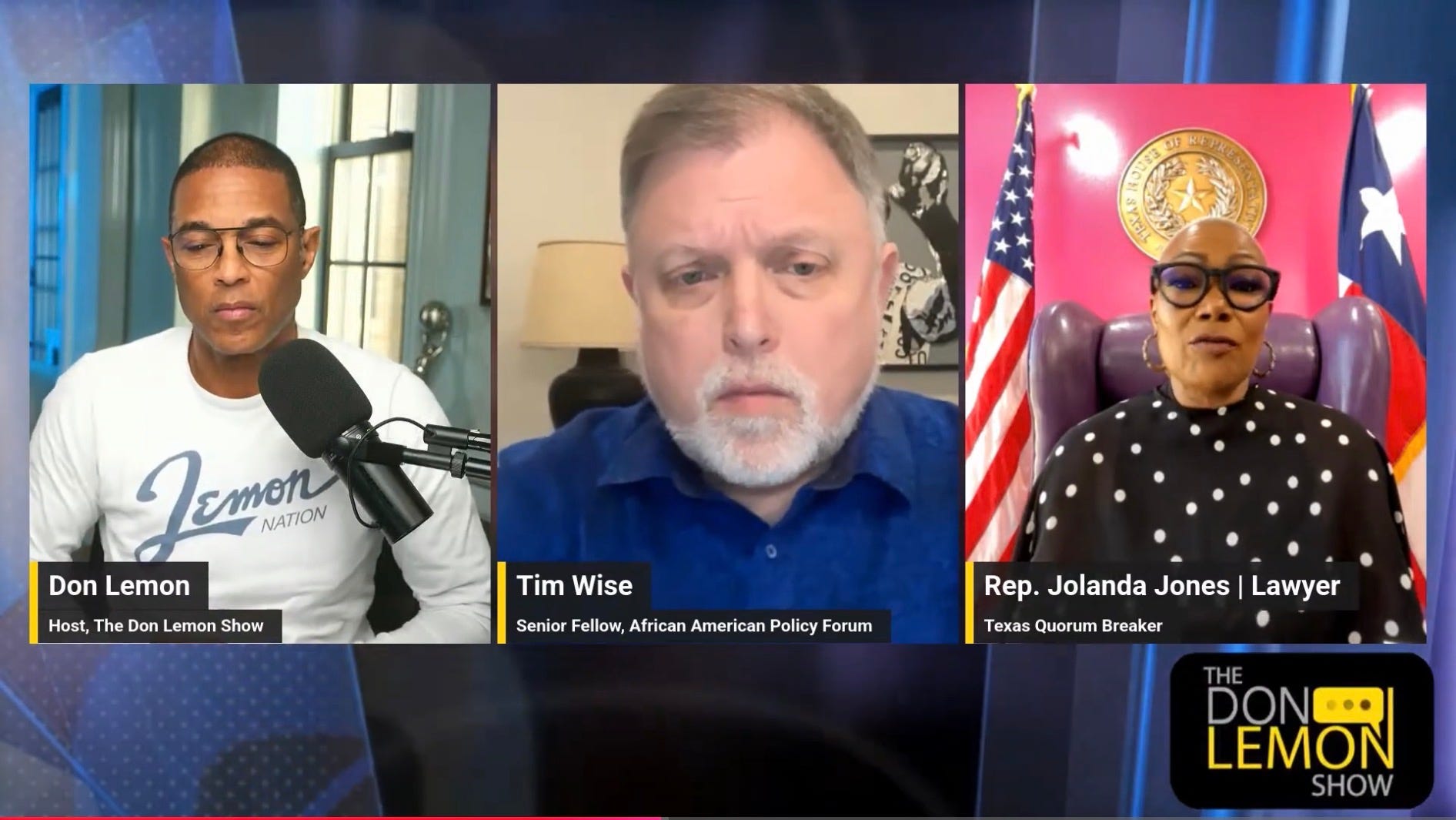
Don Lemon Segment: Tim Wise and Rep. Jolanda Jones Say the Quiet Part Out Loud
Don Lemon: Thanks to our guests for waiting. We’re a little bit behind this morning because I got so worked up on the monologue. And look, I’m happy to have all of you here. Jonathan, I’m especially grateful to you because you offer an alternative view that perhaps this is not good for the Republican Party. Right. We’ll talk about that in a moment. Sure. And Jolanda Jones, and those are my two political folks. Tim Wise, I want to talk to you about this. Am I wrong about the racism in all of this?
Tim Wise: Well, you know I’m not going to contradict your take on that. No, you’re not wrong at all. Look, white supremacy is to America what shingles is to those of us over the age of 50. It is in our bodies, and it is in the body politic of America. It has been in the body politic of this country since the founding of the nation, and it flares up pretty regularly, and this is the latest flare-up of that condition.
Tim Wise: And we are seeing it happen in state after state in the South, where I’m from, and where, of course, you are from as well. And it is, although moving very quickly, it is not a new thing. Let’s be very clear about the groundwork for what we are seeing right now. This is the resurrection of the Confederacy in many, many ways, and the logic that the Roberts Court is using to justify what is being done in my state of Tennessee, being done in your home state of Louisiana, where I also lived for 10 years, is a logic that was laid down beginning in the immediate aftermath of the end of the Civil War.
Tim Wise: It was Andrew Johnson, after all, the president after Abraham Lincoln was assassinated, who vetoed the first civil rights bill in this country, the 1866 Civil Rights Act, and in so doing, the logic he used, luckily his veto was overridden, but the logic that he used was that that law, by protecting black people from discrimination, it was not preferential treatment. It simply prohibited discrimination, that that was, in Johnson’s words, doing more for the colored race than had ever been done for the white race.
Tim Wise: In other words, it was a claim of reverse discrimination. It was a claim that doing something color-conscious, simply preventing discrimination, was itself discriminatory. That’s the same logic that Roberts Court, and under Alito in this decision, under Calle, in the Calle decision is using, essentially saying that if you don’t dilute black votes, you are in effect diluting white votes. If you don’t screw black people, you are somehow hurting white people. It is to say that civil rights and anti-discrimination is what is racist, that color-conscious policy is what is discriminatory, that anti-racism is racism.
Tim Wise: That logic goes back 160 years. These people are not original. They have not had an original thought in their lives. They are neo-Confederates, and what we should have done 160 some odd years ago is crush these people when we have the chance. We should have taken their land. We should have lined them up against the wall rather than integrating them back into the body politic and acted like they were just wayward cousins who we wanted to bring back into the family. No, we should have taken their stuff and spoiled the earth and salted it because then we wouldn’t be in this particular condition. But sadly, we are because we decided we believe more in reconciliation than justice. And so now we deal with the constant regeneration of this disease known as white supremacy because we didn’t crush it when we had the chance.
Don Lemon: Um, Jolan, you’re in Texas. That’s Southern, right next to my state. What is, what’s your take on what’s happening now? They moved with a quickness on this.
Rep. Jolanda Jones: So I need to remind you that John Roberts is from Texas. So, newsflash, go figure that out. My take on this is that this is a direct attack on black people. It is anti-blackism to the extent I just made that word up, and people don’t want to say it. And we even have that problem with white progressives and white Democrats. Nobody wants to call a thing a thing.
Rep. Jolanda Jones: And it is terrifying to me because I know when we get back in the legislature, they’re going to redraw the state red lines. They are literally going to pack us and they’re gonna split us up in order to get the desired result, which is to disempower black people. And I don’t think people understand it. I don’t even think people who weren’t alive to understand what actually happened in Jim Crow. And this goes farther back than Jim Crow. This is worse than Jim Crow. I mean, in Jim Crow in the police ride horses with masks over their head and whinters, they basically can do the same thing now.
Rep. Jolanda Jones: They can kill us. I mean, look at Trayvon Martin, and people don’t pay attention. The police can murder us in public and nobody pays attention. They’ve even gotten to where they can kill white people like they did with the Jewish people during the civil rights movement, who are helping black people. So look at Freddie, look at Renee Good. They are taking us back.
Rep. Jolanda Jones: And my fear is that they will successfully disempower black people in Congress so that at the federal level, they can pass all these bills that literally invisible black people. And to people who say they are doing this to people of color, that’s the bullshit. They’re doing this to black people. It’s a concerted effort because it is because of black people and our refusal to stay oppressed that we started this civil rights movement and we were willing to put our bodies on the line in order to save ourselves, which necessarily saved humanity.
Rep. Jolanda Jones: And right now white people are not making babies like they want for them to do. And so the only way for them to retain their power, even though they’re not procreating, is to pass these anti-black laws to shut us up because we are always the igniters of the flame to fight for freedom.
That transcript is doing work a clean summary cannot do. Wise reaches back to Andrew Johnson’s veto logic and shows how the old reverse-discrimination claim keeps reappearing in new legal clothes. Jones refuses the soft phrase “people of color” when the target, in her reading, is Black political power. That is why this belongs in the brief.
The weak frame is redistricting. The deeper frame is that protecting Black voters is being recoded as unfairness to white voters. Once that trick works, vote dilution becomes neutral, and anti-discrimination becomes the thing accused of being discriminatory.
Why this matters.
This is not just a map story. This is a memory story. The old regime used racial terror to keep Black people from voting. The modern regime uses legal abstraction, procedural delay, and map math. Different costume. Same ghost.
When civil rights becomes the accused party, white power gets to walk into court dressed as innocence.
2. Utah Republicans did the court packing they pretend to fear
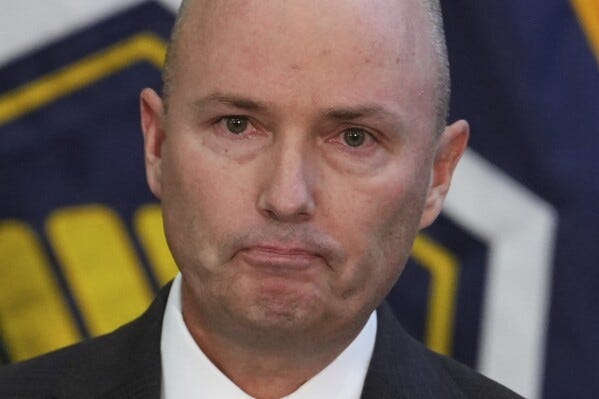
Utah Gov. Spencer Cox signed a bill earlier this year expanding the Utah Supreme Court from five justices to seven. AP reported that the move came as Republican lawmakers were frustrated by a string of losses before the court, including fights around redistricting. Supporters called it efficiency. Legal experts warned about precedent. The state judiciary had not asked for more justices on the high court. [7]
The timing is the tell. State Court Report called the Utah move part of a larger wave of legislative assaults on state courts, and the Utah State Bar warned that a fast-moving package of bills would fundamentally remake the state’s judicial system. [8][9]
The hypocrisy is thick enough to spread on toast. When Democrats talk about expanding the U.S. Supreme Court, conservatives call it court packing, norm breaking, institutional arson, and the end of the republic. When Utah Republicans actually expand their state Supreme Court after the court gets in the way, suddenly it becomes caseload management.
Why this matters.
State supreme courts are not side characters anymore. They are where abortion rights, voting rights, education fights, public records, ballot initiatives, and state constitutional limits get decided. If legislatures can change the referee after losing too many calls, then the public is no longer watching law. It is watching power design its own appeal process.
The buried frame is not court efficiency. The buried frame is revenge against judicial independence.
3. Alabama turned a hate-watchdog case into a warning shot
Alabama Attorney General Steve Marshall announced a civil investigation into the Southern Poverty Law Center’s fundraising practices after a federal indictment accused the organization of fraud tied to payments to informants inside extremist groups. The SPLC denies wrongdoing and says its informant work helped prevent violence and supported law enforcement. The allegations have not been proven in court. [10]
The weak frame is charity oversight. The deeper frame is state power testing how far it can go in making anti-extremism work legally expensive, reputationally toxic, and institutionally dangerous.
That does not mean a nonprofit is above scrutiny. Nobody gets a magic halo because they do civil rights work. But the political context matters. The SPLC is not just any nonprofit. It is one of the most visible institutions tracking hate groups. When the machinery of prosecution and state investigation points at that work, the question is not only whether a rule was broken. The question is who benefits from making the watcher look like the scam.
Why this matters.
Authoritarian politics does not only attack people. It attacks the institutions that document the attack. That is how public memory gets pre-compromised.
If the archive can be discredited before the next wave of extremism arrives, the extremists get to enter the room already wearing somebody else’s doubt.
4. They tried to make law schools forget why bias training exists
Reuters reported that a committee inside the American Bar Association recommended eliminating or sharply reducing three diversity and non-discrimination requirements from law school accreditation standards. The proposed rollback comes under pressure from the Trump administration and state supreme courts that object to the ABA’s diversity, equity, and inclusion rules. The ABA’s legal education council is scheduled to vote on the changes this week. [11]
The weak frame is accreditation neutrality. The deeper frame is pipeline control. Law schools do not only teach statutes and cases. They teach future prosecutors, judges, clerks, agency lawyers, civil rights attorneys, corporate counsel, and public defenders what harm looks like when it enters the record wearing a suit.
When bias training gets framed as ideology, the legal profession is being taught to forget the very habits of perception that make justice possible.
Why this matters.
The law does not interpret itself. People do. And those people bring training, blind spots, class loyalties, racial assumptions, and institutional incentives into every courtroom.
A legal system that refuses to study bias does not become neutral. It becomes fluent in its own denial.
5. A Kansas district called the federal bluff on trans kids
Education Week reported that the Shawnee Mission School District in Kansas refused to sign a federal resolution agreement after the Education Department accused several districts of violating Title IX and the Family Educational Rights and Privacy Act through gender identity policies. The department threatened federal funding and pushed terms that would tie sports and restroom access to sex assigned at birth and make gender support plans available for parental review. [12]
Olathe Public Schools signed an agreement while denying wrongdoing. Shawnee Mission refused, saying the findings contained inaccurate law, false factual claims, and unreasonable conditions. The district also rejected language that would, in effect, deny the existence of transgender people. [12]
The weak frame is compliance. The deeper frame is coerced erasure. This is not merely a school policy fight. This is a records fight. A privacy fight. A name fight. A bathroom fight. A body fight. A belonging fight.
Why this matters.
Anti-trans politics loves to pretend it is protecting children while using children as the instrument. The state does not need to drag a child out of class to humiliate them. Sometimes it just threatens the district, rewrites the record, and calls the violence paperwork.
Bad translation becomes extraction. Bad policy becomes a mirror that tells a child they are not real.
Part II: Entertainment
1. French cinema saw the censor in the finance chain

More than 600 figures in French cinema, including Juliette Binoche, warned that far-right influence over French film production and distribution could threaten artistic independence. The Guardian reported that the warning focused on billionaire Vincent Bolloré’s growing media empire, including Canal+, StudioCanal, and a stake in UGC cinemas. [13]
The lazy frame is industry drama at Cannes. The deeper frame is cultural infrastructure. If one ideological owner can shape financing, production, distribution, and theatrical access, then the question is not only what films get made. It is what kinds of human beings get imagined on screen.
Why this matters.
Authoritarian culture does not always begin by banning art. Sometimes it buys the road that art has to travel.
The archive is the battlefield. So is the distribution chain.
2. Josephine Baker gets another life, and another argument over who gets to hold her complexity
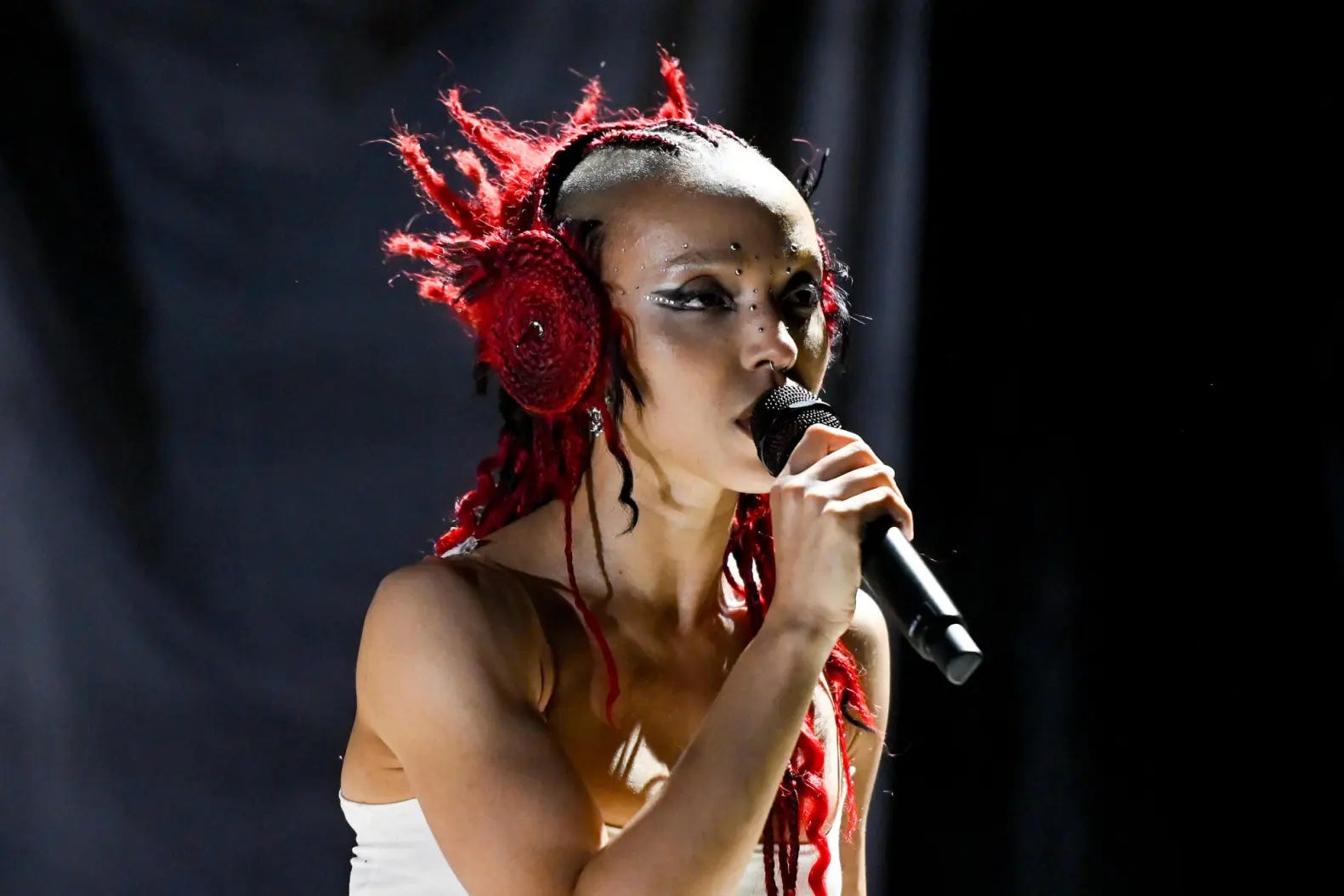
Entertainment Weekly reported that FKA Twigs will portray Josephine Baker in an upcoming biopic written and directed by Maïmouna Doucouré. The project is being produced by StudioCanal and Bien ou Bien Productions with support from two of Baker’s sons, and filming is scheduled for fall 2026. [14]
Baker was not just a glamorous Jazz Age icon. She was a Black American artist who became a global star, a French Resistance figure, and a civil rights activist. That makes this more than casting news. It is a question of whether a film can resist turning a dangerous life into beautiful wallpaper.
Why this matters.
Biopics can restore complexity, or they can launder it. Baker’s story is too large to become only feathers, Paris, and sepia lighting.
Visibility without understanding is extraction in HD.
3. Sony bought songs like everybody finally admitted catalogs are infrastructure
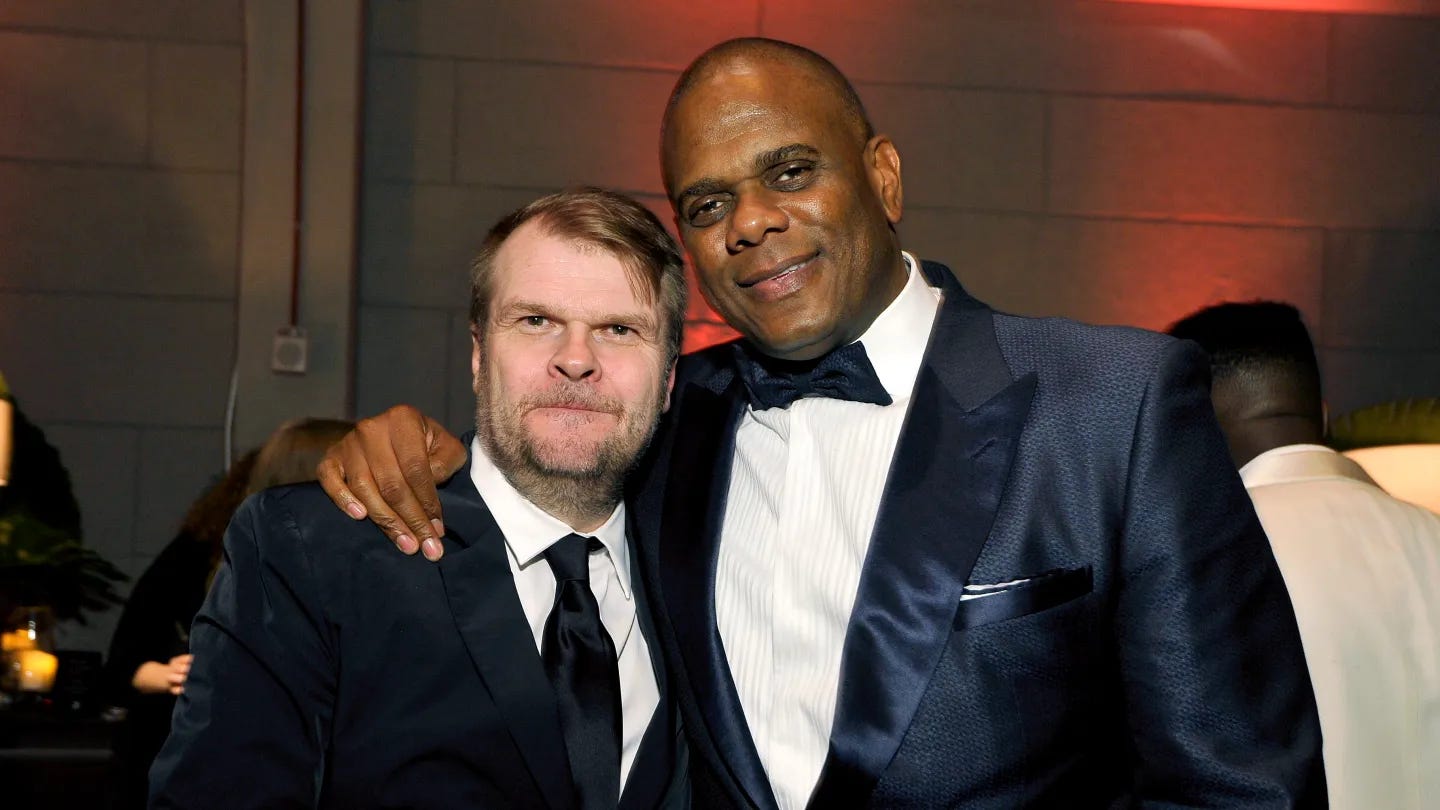
Reuters reported that Sony Music Publishing will acquire Recognition Music Group’s full catalog from funds managed by Blackstone, gaining access to more than 45,000 songs associated with artists including Beyoncé, Fleetwood Mac, and Rihanna. A source told Reuters the deal was worth about $4 billion. [15]
The weak frame is another music business deal. The deeper frame is that song memory has become an asset class. Streaming made catalogs predictable revenue machines. Film, television, documentaries, games, ads, and platforms all need music that already carries feeling.
Why this matters.
Black music has always built emotional infrastructure for America. The question is who owns that infrastructure when the check clears.
They do not just buy songs. They buy the right to collect rent on memory.
Part III: Arts
1. Amy Sherald came home with a painting the museum world could not politely contain

Rough Draft Atlanta reported that Amy Sherald’s “American Sublime” will open at the High Museum of Art in Atlanta on May 15 after a national tour marked by controversy over Sherald’s withdrawal from the Smithsonian National Portrait Gallery. The show includes more than 35 paintings from 2007 to 2024, including portraits of Michelle Obama and Breonna Taylor. [16]
Sherald accused the Smithsonian of censorship concerns involving “Trans Forming Liberty,” a painting depicting a Black transgender woman as the Statue of Liberty. Smithsonian officials disputed that characterization and said they sought additional context rather than removal. That distinction matters factually. It also does not erase the larger institutional fear around Black trans visibility inside national memory. [16]
Why this matters.
Museums love the language of context when the work makes power sweat. But some images do not need softening. They need a room brave enough to hold them.
This is counter-memory in oil paint.
2. Black by Design treated graphic memory like an archive, not decoration

Visit Winston-Salem lists “Black by Design” at the Delta Arts Center from May 12 to May 22. The exhibition is described as a living archive honoring freedom, identity, design, memory, text, and lived experience. [17]
That language matters because design is often treated as background. The logo. The flyer. The poster. The church bulletin. The album cover. The protest sign. But Black design has always been a way of organizing memory before institutions agreed to preserve it.
Why this matters.
The canon loves painters and sculptors because museums know how to frame them. Design is more slippery. It moves through neighborhoods, movements, businesses, dances, funerals, barber shops, record stores, and bedrooms.
Black design is not decoration. It is how survival learns typography.
3. The Studio Museum made access part of the art
The Studio Museum in Harlem hosted a verbal description tour of “From Now: A Collection in Context” on May 12 for Blind and Low Vision community members. The museum says the exhibition highlights more than two hundred years of artistic achievement by artists of African descent, and the tour included sensory exploration, art making, assistive listening devices, tactile reproductions, and sighted guides. [18]
The weak frame is accessibility programming. The deeper frame is that access is not an accessory to the archive. It is part of whether the archive is honest.
Why this matters.
A museum that preserves Black art while excluding disabled Black viewers has not completed the work. It has curated a contradiction.
The room is part of the work. The doorway is part of the work too.
Part IV: Sports
1. A’ja Wilson turned the GOAT conversation into a labor demand in heels
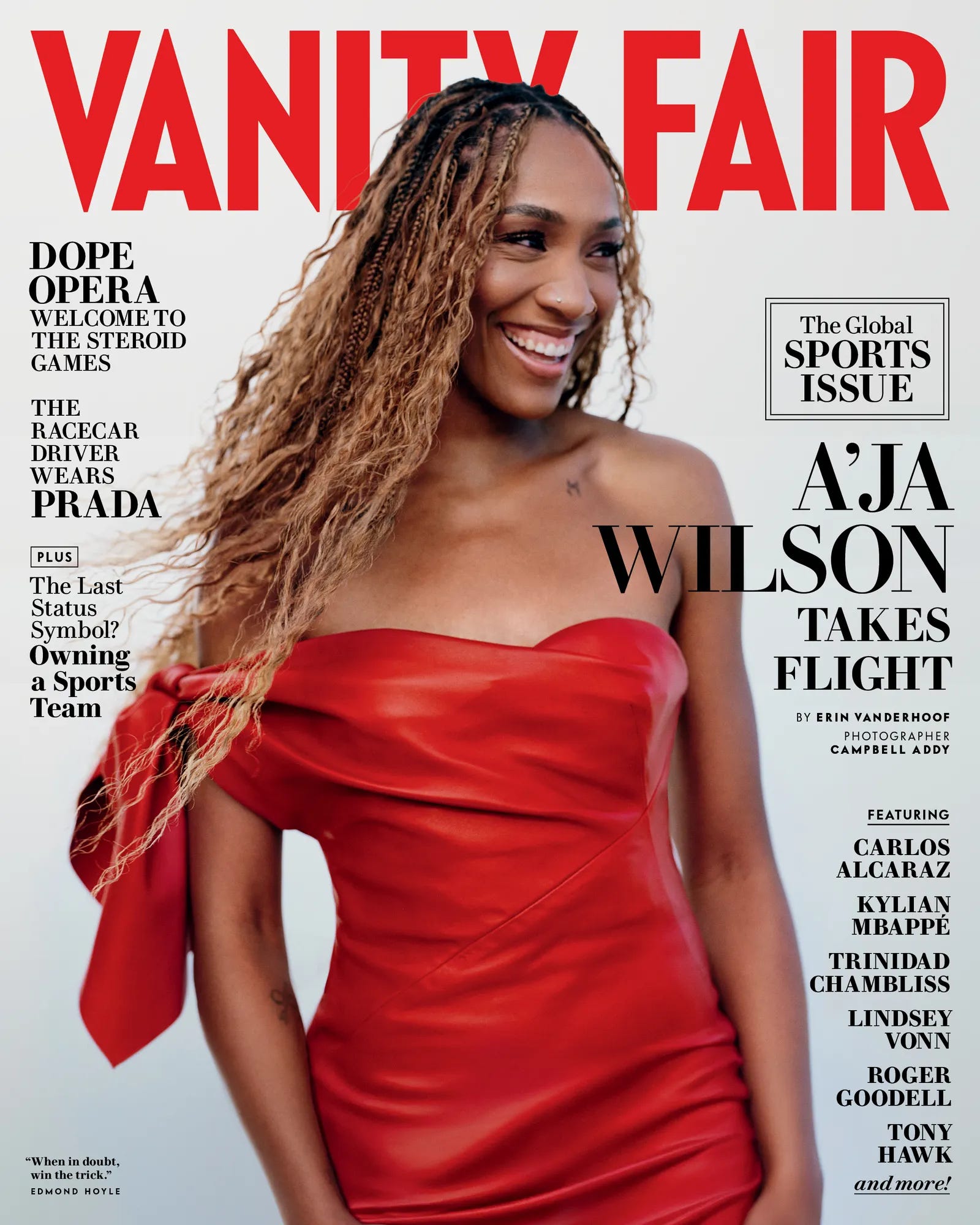
Vanity Fair profiled A’ja Wilson as a four-time WNBA MVP, a three-time champion with the Las Vegas Aces, and the first WNBA player to score more than 1,000 points in a single season. The magazine also reported that she signed a deal that made her the highest-paid player in WNBA history, starting at $1.4 million and potentially reaching $5 million. [19]
The lazy frame is stardom. The deeper frame is valuation. Wilson is not only making a case for basketball greatness. She is making a case that Black women’s excellence should change contracts, fashion deals, shoe economics, media coverage, and the imagination of what professional care looks like.
Why this matters.
Women’s sports coverage often wants the glow without the labor argument. A’ja brings both.
She is not asking the market to clap. She is forcing it to count.
2. A Norfolk State student reminded sports media that the pipeline is culture too

Andscape published Alauna Marable’s reflection on how the Rhoden Fellowship moved her closer to a career in sports media. Marable, a Norfolk State student, wrote about producing articles, podcasts, social content, and live-event coverage through the fellowship. [20]
The easy frame is a nice student opportunity. The deeper frame is authorship. Who gets trained to cover the game shapes what the public learns to notice about the game.
Why this matters.
Sports media is not just box scores and press conferences. It is narrative power. It decides whether Black athletes are covered as workers, brands, trouble, miracles, commodities, leaders, or whole human beings.
The pipeline is not separate from representation. The pipeline is representation before it gets a byline.
3. HBCUs are building the women’s football future before everybody else calls it innovation
Andscape reported that HBCUs are at the forefront of women’s flag football’s growth. Alabama State became the first NCAA Division I school to offer a women’s flag football program in 2024, the CIAA will become the first HBCU athletic conference to offer it as a varsity sport starting in 2026-27, and Wilberforce and Edward Waters are launching programs for 2026-27. [21]
The lazy frame is a cute new sport. The deeper frame is opportunity architecture. Before the mainstream finishes naming the trend, Black institutions are already building teams, conferences, recruiting paths, and Olympic-adjacent dreams.
Why this matters.
This is what HBCUs have always done at their best. They create institutional shelter for talent America notices late, underfunds early, and celebrates only after somebody else figures out how to monetize it.
By the time the cameras arrive, the field is already Black-built.
Closing
Today they tried to make vote dilution sound like legal clarity. They tried to make court packing sound like efficiency. They tried to make an investigation of a hate-watchdog organization sound like charity oversight. They tried to make the gutting of law school diversity standards sound like accreditation survival. They tried to make forced erasure of trans students sound like federal compliance.
But then life broke through.
Tim Wise and Jolanda Jones named the old poison under the new label. Amy Sherald brought a censored argument home in paint. The Studio Museum treated access like a moral structure, not a side door. FKA Twigs stepped toward Josephine Baker’s dangerous complexity. A’ja Wilson made greatness sound like a labor negotiation. HBCUs started building a women’s football future before the mainstream could pretend it discovered the idea.
That is the brief.
The manipulation is real. So is the proof of life.
Keep This Thing Alive
You know what to do.
Restack this before somebody with a better suit and worse instincts turns the same idea into a panel discussion called “America at a Crossroads.” Send it to the friend who keeps saying they hate the news but somehow still wants to know who is lying, who is laundering, and who is walking away with the furniture.
And if this brief did what it was supposed to do, become a paid subscriber here:
That is the grown-up move. That is how this keeps going. That is how one person with a keyboard, a bad attitude, and a suspicious relationship with sleep keeps showing up with receipts.
Then, if a paid subscription is not in the cards today, buy the coffee. Because after all this labor, walking out without leaving at least $5 is between you, your conscience, and whatever little committee in your spirit convinced you this much work runs on compliments.
Sources
AP: Supreme Court halts order for Alabama to use US House map with 2 largely Black districts: Reporting on the Court’s order, Alabama’s map fight, and the stakes for Black congressional representation.
The Guardian: Alabama can use electoral map that favors Republicans, supreme court rules: Context on the lower court discrimination finding, the dissent, and the national redistricting cascade.
The Don Lemon Show: Lemon LIVE at 5 | Is the Alleged Charlie Kirk Shooter MAGA ...: Video source for the panel segment referenced alongside the user-supplied transcript.
Arizona State University Center for the Study of Race and Democracy: Tim Wise: Biographical background on Wise as an anti-racist essayist, author, and educator.
Texas House of Representatives: Rep. Jones, Jolanda “Jo”: Official biography for Jones and her role representing Texas House District 147.
Houston Defender: Rep. Jolanda Jones shares journey as lesbian in politics: Background on Jones as an openly LGBTQ Black legislator and advocate.
AP: Utah governor signs bill adding justices to state Supreme Court as redistricting appeal looms: Reporting on Utah expanding its state Supreme Court from five to seven seats.
State Court Report: The Next Wave of Legislative Assaults on State Courts: Analysis of Utah’s court expansion as part of escalating legislative pressure on state judiciaries.
Utah State Bar: Package of Bills Would Remake Utah’s Judicial System: Utah State Bar warning about fast-moving bills remaking the judicial system.
AP: Alabama attorney general announces civil probe of Southern Poverty Law Center: Reporting on Alabama’s SPLC subpoena and the organization’s response to allegations.
Reuters: ABA must axe law school diversity rules to retain accreditor status, committee says: Reporting on proposed rollbacks to ABA diversity, bias, and non-discrimination accreditation standards.
Education Week: School District Refuses to Sign Federal Agreement, Change Trans Student Rules: Reporting on Shawnee Mission’s refusal to accept federal terms aimed at trans student policies.
The Guardian: French film industry at risk from the far right, say actors and directors: Reporting on French cinema figures warning about far-right influence over film production and distribution.
Entertainment Weekly: FKA Twigs to star in biopic of Jazz Age icon Josephine Baker from director of controversial Cuties: Reporting on the Baker biopic, casting, production team, and planned filming schedule.
Reuters: Sony Music Publishing to buy Recognition Music catalog; source says deal for $4 billion: Reporting on Sony’s acquisition of a 45,000-song catalog from Blackstone-managed funds.
Rough Draft Atlanta: “American Sublime” brings Amy Sherald home to Georgia amid exhibition controversy: Reporting on Sherald’s High Museum exhibition and the censorship dispute around the Smithsonian withdrawal.
Visit Winston-Salem: “Black by Design” Exhibit: Event listing for the Delta Arts Center exhibition centering Black design, memory, freedom, and identity.
Studio Museum in Harlem: Verbal Description Tour: From Now: A Collection in Context: Institutional source for the access tour and exhibition context.
Vanity Fair: A’ja Wilson Is Going for GOAT Status: “I Want to Prove That I’m the Best”: Profile documenting Wilson’s on-court dominance, contract report, and cultural influence.
Andscape: Rhoden Fellowship moves Norfolk State student a step closer to her dream career: First-person account of Alauna Marable’s HBCU sports media fellowship path.
Andscape: Historically Black colleges take the lead in driving the growth of women’s flag football: Reporting on HBCU programs shaping the future of women’s flag football.