

Today’s Liberty Blackout Brief tracks ten stories from the past 24–48 hours overshadowed by the national news cycle , all of which are critical to communities on the ground.
1️⃣ U.S. Congress Does Not Exist – The U.S. House of Representatives has effectively been paralyzed since Oct. 22 as Speaker Mike Johnson refuses to call lawmakers back into session during a prolonged government shutdown . No votes have been held since mid-September, leaving routine governance stalled – from budget bills to even swearing in a new member – and prompting accusations that Congress is essentially nonfunctional . Why It Matters: This unprecedented legislative standstill freezes critical funding decisions and erodes constitutional checks; critics warn Johnson’s gambit has consolidated power in the presidency while polls show Americans blame both parties for the failure . (Downplayed) — The Daily Beast
2️⃣ Mass Blackout Boycott Nov 25 – A new grassroots campaign called Blackout The System is urging Americans – especially in Black communities – to spend no money on November 25, 2025, kicking off a week-long economic boycott through the Black Friday shopping period . Organizers frame the protest as a peaceful show of economic power against “corrupt governments, billionaires, or broken systems,” encouraging people not to work or shop during the period to “starve the machine” and force social change . Why It Matters: Supporters say the boycott will leverage Black consumers’ buying power to demand justice, but opponents ridicule it as unrealistic and divisive – conservative pundits have derided the “blackout” as left-wing overreach that puts politics above daily life . (Ignored) — Black Enterprise
3️⃣ Chicago Cops Profiled Dozens of Black Drivers – In Chicago, a police watchdog investigation uncovered a “troubling pattern” of traffic stops targeting Black motorists in an upscale downtown district . A tactical team patrolling wealthy areas like the Gold Coast pulled over Black people in more than 90% of its documented stops and often behaved unprofessionally – using profanity, threats, and unlawful searches – leading to multiple officers being relieved of police powers and several federal lawsuits . Why It Matters: The findings suggest systemic racial profiling by an elite police unit, and lawyers say city officials knew of the bias yet failed to act – a lapse that not only violated Black residents’ rights but could cost Chicago heavily in court . (Ignored) — WTTW News (Chicago)
4️⃣ Pell Grant Cuts Linked to Plunge in Black College Enrollment – A new report by the University of Alabama’s Education Policy Center reveals that a decade of federal Pell Grant funding cuts and stricter eligibility rules helped drive Black student enrollment down by nearly 500,000 from 2011 to 2021 . Southern states – which educate over half of Black undergraduates – were hit hardest: Black enrollment fell almost 30% at public community colleges across the South, and by 55% at majority-Black community colleges, after inflation and budget cuts eroded need-based aid over the past ten years . Why It Matters: Slashing college financial aid has slammed the door on higher education for many Black Americans, with experts warning that the rollback of support “put the emergency brake on social mobility” and widened the racial wealth gap . (Downplayed) — Inside Higher Ed
5️⃣ Families Expose ‘Blood on Your Hands’ in Alabama Prisons – At Alabama’s state capitol, dozens of families of incarcerated people described horrific violence and neglect in state prisons – from fatal beatings and stabbings to drug overdoses – as they rallied to demand reforms . Alabama’s prison mortality rate is five times the national average with 277 inmate deaths last year , yet state officials have been slow to act despite a Justice Department lawsuit over “cruel and unusual” conditions and an HBO documentary spotlighting the abuses . Why It Matters: Alabama’s prisons are among the deadliest in the country, a crisis largely overlooked nationally; advocates say the state’s failure to ensure basic safety and oversight is costing lives and violating inmates’ civil rights even as federal courts intervene . (Ignored) — AP News
6️⃣ Trump Admin Bans Nigerian Nobel Laureate – Wole Soyinka, Nigeria’s 91-year-old Nobel Prize-winning author, announced that the United States revoked his visa and barred him from entry, forcing him to cancel planned visits . Soyinka famously cut up his American green card in protest after Donald Trump’s 2016 election , and he now says he’s been told to reapply if he ever wants to return – quipping that those who wish to see him “know where to find me” in Lagos. Why It Matters: The visa cancellation of Africa’s most acclaimed writer – apparently over his anti-Trump stance – is being seen as a politicized rebuke of a prominent Black intellectual, underscoring the Trump administration’s sweeping hardline on visas and willingness to silence critics from the global Black diaspora . (Downplayed) — Reuters
7️⃣ Louisville County Swears In First Black Sheriff – Former city council president David James was sworn in as the first Black sheriff in Jefferson County, Kentucky’s history, taking the oath of office on October 10 . James, a retired police officer and Louisville’s current deputy mayor, will now lead law enforcement for the state’s most populous county – a role that until now had been held exclusively by white sheriffs since the county was founded. Why It Matters: This milestone – largely overlooked outside Kentucky – breaks a 200-year racial barrier in local law enforcement leadership, and community advocates hope having an African American sheriff will bring more accountability and inclusivity to policing in the Louisville area . (Ignored) — Courier Journal
8️⃣ Biya Extends 43-Year Rule Amid Cameroon Unrest – Cameroon’s 92-year-old president Paul Biya was officially declared the winner of a contested election, securing an eighth term in office after 43 years of authoritarian rule . Security forces violently dispersed opposition protests in multiple cities – including Douala and Garoua – killing at least four people and arresting dozens as crowds rallied against what they called a rigged vote and attempted to block the announcement of Biya’s victory . Why It Matters: With global headlines dominated elsewhere, an African leader’s lifetime hold on power – and the deadly crackdown on citizens challenging it – is drawing scant international scrutiny, even as Cameroonian diaspora communities and U.S. lawmakers plead for attention to human rights abuses and democracy in the region . (Downplayed) — Firstpost / PBS NewsHour
9️⃣ Study: Black Women Face Stubborn Breast Cancer Gap – A new analysis by Susan G. Komen finds that Black women are 40% more likely to die from breast cancer than white women in the U.S., despite similar incidence rates . The mortality disparity is even worse in some cities: in Memphis, for example, Black women’s breast cancer death rate is 79% higher than white women’s – the largest gap among major metros, attributed to later diagnoses and unequal access to care . Why It Matters: This stark racial health divide has received little national attention – even as it highlights ongoing inequities in health care. Experts urge that targeted outreach, better screening access, and policy changes are needed so that Black women aren’t left behind in the fight against cancer . (Ignored) — Susan G. Komen report
🔟 AI Gun Detector Triggers Police on Black Teen – In Baltimore, an AI-enhanced security camera misidentified a Black high schooler’s bag of Doritos as a gun, leading to eight police cars descending with officers who drew guns, forced the 16-year-old to his knees, handcuffed and searched him . The teen, Taki Allen, was terrified and unharmed – officers realized he only had chips – but he says the ordeal left him fearing for his life, all because the school’s new “military-grade” AI surveillance system sent an erroneous weapons alert to police . Why It Matters: The incident illustrates how deploying unproven AI surveillance in schools can put Black youth in danger, escalating routine situations into potentially deadly encounters. Civil liberties advocates warn that without oversight, flawed gun-detection algorithms plus biased policing are a recipe for tragedy that has flown under the radar . (Downplayed) — ACLU Free Future
Sources: Connected local and independent news outlets; AP and Reuters reporting; Susan G. Komen and ACLU reports; official statements and experts’ commentary . Each story above includes a link to its source.
Sources
https://www.thedailybeast.com/johnson-shuts-down-house-early-to-flee-epstein-questions/
https://www.blackenterprise.com/economic-blackout-nov-25-dec-2-blackout-the-system/
https://news.wttw.com/2025/10/27/police-misconduct-agency-identified-troubling-pattern-stops-black-chicagoans-downtown
https://www.insidehighered.com/news/students/financial-aid/2025/10/21/drop-pell-funds-hurts-black-students-southern-colleges
https://apnews.com/article/alabama-prisons-alabama-solution-inmate-deaths-214f3e770fe56a121d4708aa04260e42
https://www.reuters.com/world/us/nigerian-nobel-laureate-wole-soyinka-says-us-revokes-his-visa-2025-10-28/
https://www.courier-journal.com/picture-gallery/news/politics/2025/10/10/david-james-sworn-in-as-jefferson-countys-first-black-sheriff/86625408007/
https://www.theguardian.com/world/2025/oct/27/cameroon-paul-biya-oldest-serving-head-of-state-declared-winner-in-election
https://www.komen.org/news/analysis-led-by-susan-g-komenshows-fewer-black-women-dying-from-breast-cancer-in-nine-major-u-s-metro-areas/
https://www.aclu.org/news/privacy-technology/doritos-or-gun
Mass Blackout Boycott Nov. 25 Coverage and Analysis
Activists led by Blackout The System are urging a week-long general strike and spending boycott from Nov. 25 to Dec. 2 – Thanksgiving through Cyber Monday – to protest a “damaged government and economic system” . Major U.S. outlets have given this “Second Wave” economic blackout little attention, but Black-owned media report it as a historic attempt to “shut down” the economy until the system listens . The boycott coincides with a federal shutdown that will halt food assistance (SNAP) on Nov. 1 , and it targets corporate greed and diversity rollbacks that disproportionately impact Black Americans . Organizers frame the peaceful action as proof that “real power belongs to the people – not corrupt governments [or] billionaires” .
Coverage in Major vs. Specialized Outlets
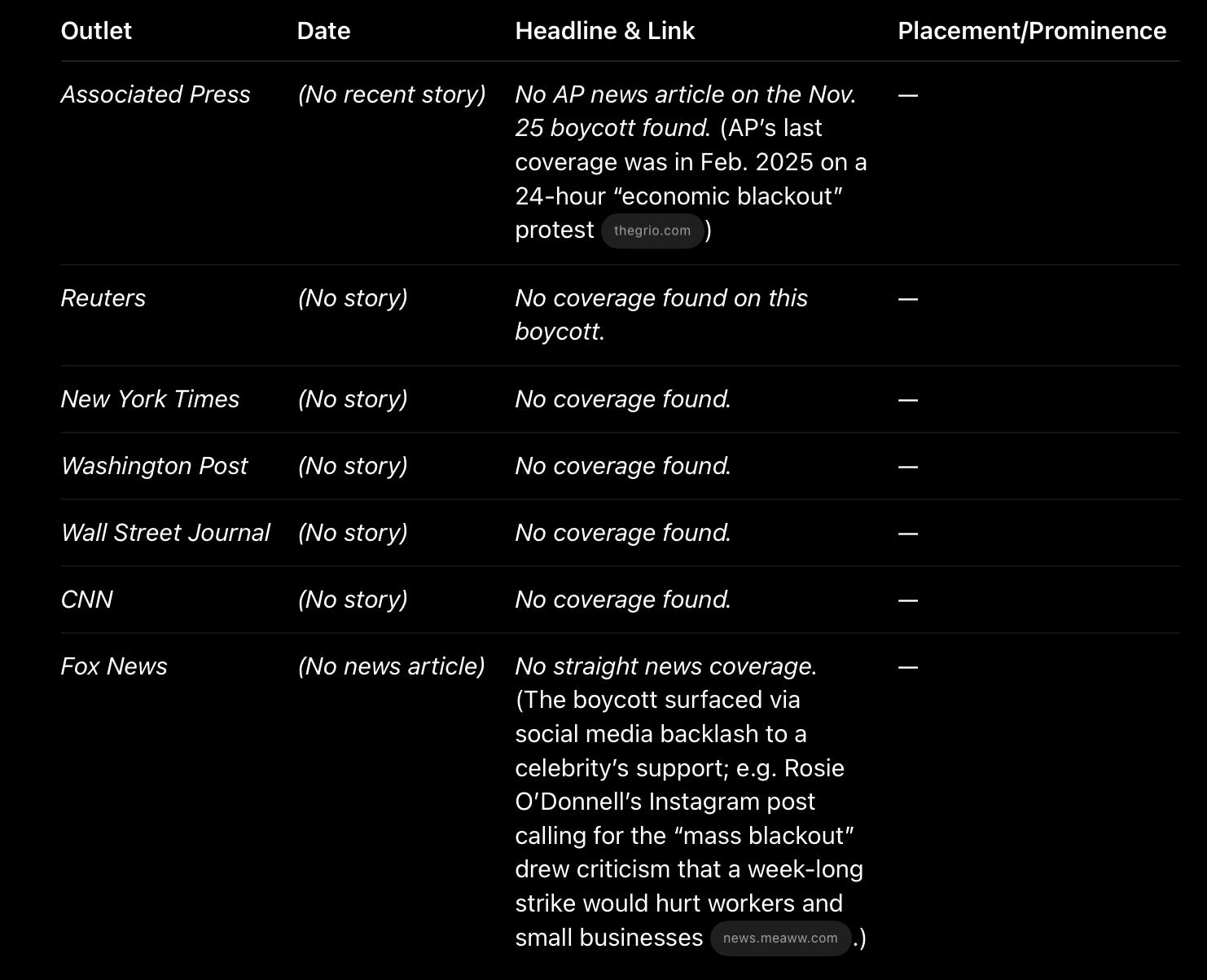
Major U.S. News Outlets (AP, Reuters, NYT, WaPo, WSJ, CNN, Fox) – past 72 hours:
Specialized/Local/Black-Led Outlets – covering “Mass Blackout” boycott:
Black Enterprise – Oct. 27, 2025: “‘We’re Shutting It Down’: Coordinated Economic Blackout Set for Nov. 25 – Dec. 2” (Black-owned business media; detailed report prominently in its News section). Framing: Highlights the boycott as a “Second Wave” protest to “remove our labor [and] spending” in order to “reclaim power, restore justice, and unite people across all races, cultures, and classes” . Quotes organizers’ statements and notes the timing with the U.S. government shutdown halting SNAP benefits . Emphasizes peaceful, strategic action and even lists “working strike” options for those who can’t take the whole week off .
Yahoo News (Fact Check) – Oct. 24, 2025: “Fact Check: Posts claim group called for US economic ‘blackout’ during week of Thanksgiving 2025” . Placement: Syndicated fact-check (via Snopes/AFP). Confirms that Blackout The System is indeed calling for a Nov. 25–Dec. 2 boycott, covering Thanksgiving, Black Friday (Nov. 28), and Cyber Monday (Dec. 1) . This piece sticks to verifying the claim’s accuracy and basic details (dates, the group’s anti-Trump administration and anti-corporate greed stance ) without extensive analysis.
MEAWW (Media Entertainment Arts WorldWide) – Oct. 25, 2025: “Rosie O’Donnell’s call for ‘economic blackout protest’ in US sparks backlash” . Placement: “Public Opinion” section. Focuses on how actress Rosie O’Donnell shared an Instagram graphic urging “No work, No Spending…We’re not asking. We’re shutting it down.” (her post calling Nov. 25 the start of “the largest economic blackout protest in US history” ). The article centers on the social media reaction, quoting skeptical and hostile comments. For example, users argued that a week-long boycott would “devastate” tips and wages for service workers living paycheck-to-paycheck and could drive “mom and pop” stores under . Others blasted O’Donnell for pushing a U.S. protest while residing abroad and questioned wealthy celebrities telling working people to strike . This coverage tone is critical, framing the boycott as a controversial, celebrity-endorsed stunt.
Framing & Sourcing Differences
Major outlets have virtually ignored the upcoming economic blackout. The only mainstream mentions are fact-check snippets and a backlash narrative via a celebrity post – no in-depth reporting. In contrast, Black-led and independent outlets frame the boycott as a serious grassroots movement for economic justice. Black Enterprise’s coverage sources on-record quotes from organizers and the movement’s website , portraying the protest as “strategic and peaceful” civic action. It provides context like the SNAP benefits cutoff and even practical guidance for participants – details absent from any major-network stories. Meanwhile, the fact-check and MEAWW pieces rely on second-hand social media content; they omit voices of the organizers or impacted communities. The mainstream framing (where it exists) leans toward skepticism or downplays the effort – e.g. highlighting that such boycotts may have “little effect” or mocking the idea as unrealistic – rather than examining its grievances. Black Enterprise and similar outlets emphasize empowerment, unity, and systemic issues (corruption, inequality, DEI rollbacks) driving the protest , whereas major outlets have not engaged with those angles at all.
Gap Analysis
What Specialized Coverage Reveals that Majors Miss: The Black-owned and local reports include developments and quotes entirely missing from major media. For example, Black Enterprise notes the boycott’s alignment with the ongoing federal government shutdown that will suspend food assistance (SNAP) for millions on Nov. 1 – linking the protest to a real-time policy crisis affecting poor (largely Black and brown) households. It also details the movement’s internal strategy: organizers offer “working strike” options (work-to-rule, go-slow, etc.) for those unable to take leave , and they explicitly cite solidarity across race and class as a goal . None of this texture appears in AP, CNN, etc., because those outlets simply haven’t covered the story.
Missing Stakeholders & Data: Mainstream coverage is notably silent on key stakeholders – there are no interviews with boycott organizers, Black community leaders, labor activists, or the low-income workers who might support or oppose the action. Specialized outlets fill some gaps: Black Enterprise directly references the movement’s website and Instagram announcements , and places the boycott in context of ongoing campaigns by The People’s Union USA (another grassroots group) to hold corporations accountable for DEI pullbacks . This hints at a broader coalition and history (e.g. prior boycotts in February, September, October 2025) that national outlets have not followed. No major outlet has probed participation levels, economic forecasts, or official responses to the planned Nov. 25 strike – data that would certainly be reported if a week-long protest were initiated by, say, an established union or political party. The voices of those most affected – Black workers asked to “remove their labor,” families facing SNAP cuts during Thanksgiving – are missing in the coverage from AP/Reuters or TV networks, because those outlets haven’t even acknowledged the call to action.
Language & Tone Disparities: In the few instances the boycott is mentioned in mainstream channels, the language can be minimizing or dismissive. The fact-check article simply verifies the call’s existence, implicitly treating it as a circulating online rumor rather than a legitimate news event . The MEAWW piece (while not a top-tier outlet, it reached a broad audience) frames the story around “backlash” and uses words like “radical” (in user quotes) and “stunt,” focusing on personal attacks against Rosie O’Donnell’s endorsement . This contrasts sharply with the assertive, mission-driven tone in Black-led coverage: e.g. “We are shutting down the U.S. economy – strategically and peacefully – by removing our labor [and] financial support, forcing the system to listen” (organizers’ statement) . Specialized outlets use language of empowerment (“unity,” “real power belongs to the people” ) and systemic critique (corrupt government, corporate influence ) that none of the major news stories echo. The lack of major-outlet reporting itself could be seen as a form of minimization – a significant planned protest in the holiday shopping season that directly invokes racial and economic justice is basically treated as nonexistent on the national news agenda so far.
Public-Interest Angles Overlooked: The gap in coverage means several public-interest angles aren’t being explored in mainstream media. Policy-wise, this boycott intersects with government dysfunction (the shutdown) and its impact on vulnerable communities (SNAP recipients) . It raises issues of corporate accountability – the movement explicitly protests how billionaires and big firms “buy our silence” and influence policy , and it responds to companies rolling back diversity, equity, and inclusion (DEI) commitments . These are core concerns for Black and marginalized communities (post-2020 racial equity promises being abandoned). There are also implications for labor rights and protest: essentially a call for a general strike/boycott, which is rare in the U.S. – a story about worker empowerment and risks (jobs vs. justice) that merits attention. Economic justice and racial equity are at the heart of this: the boycott’s genesis lies in opposition to both economic inequality and racial injustice (Trump’s DEI ban, corporate greed) . By ignoring the story, major outlets are missing follow-up questions: Will Black Friday sales be noticeably affected? How are Black-owned small businesses vs. big corporations reacting? Are policymakers or corporations bracing for this? These follow-ups, which would inform readers about the protest’s feasibility and impact, are so far absent.
Prioritizing Black Community Impact: This story directly affects Black communities in multiple ways. It’s a protest led by Black organizers (and multi-racial allies) with grievances tied to Black experiences – e.g. fighting the rollback of DEI programs that benefited Black employees , and protecting voting rights and justice by “negative-space” economic action. The outcomes (if the boycott gains traction) could influence Black workers’ pay and even holiday spending in Black families (who might choose to participate or not). There’s also a cultural component: echoing historic Black-led boycotts (Montgomery Bus Boycott) as a means to demand justice . Specialized coverage (notably by Black journalists) has picked up on these resonances. For instance, The Positive Community magazine earlier this year discussed how Black clergy and consumers see economic resistance as leverage when promises are broken – citing that Black Americans wield $1.8 trillion in spending power and referencing past successes like the Montgomery boycott . This perspective – that Black economic solidarity can yield change – gives the Nov. 25 blackout a deeper significance that major outlets haven’t articulated. By weighting reporting toward Black voices (as Black Enterprise and others have done), we see concerns about Black-owned businesses potentially being hurt (some Black entrepreneurs have ambivalent views on boycotts ) and about the need for sustained action rather than one-offs . These nuances are lost in mainstream coverage.
Reporter & Outlet Diversity: Notably, the most substantive reporting so far comes from Black reporters or Black-led organizations. The Black Enterprise article by Jeroslyn JoVonn and others like it clearly treat this as a legitimate news story worthy of context and verification – treating Black activists as credible sources, not “radicals.” This underscores how newsroom diversity and perspective matter: Black media are attuned to an issue affecting their community’s economic and political agency, whereas predominantly white-led mainstream outlets may be overlooking it. Giving extra weight to those Black-led reports is crucial here – they are currently the only ones informing the public (and the Black public in particular) about the planned boycott’s aims and logistics .
Global Mirror
International Coverage: So far, there’s little to no overseas press spotlight on the Nov. 25 U.S. boycott. Major global outlets like BBC, The Guardian, and Al Jazeera have not reported specifically on “Blackout The System”’s Thanksgiving-week protest as of yet (no relevant articles found in the past days). This absence suggests the story hasn’t hit the global news radar – possibly overshadowed by other U.S. news (or viewed as a domestic matter until it materializes). By comparison, international media have been covering the context around it: for example, Al Jazeera and others have reported on U.S. companies rolling back DEI commitments under political pressure and the broader discontent over consumerism (e.g. “Buy Nothing Day” anti-Black Friday movements). But they frame these in general terms, not linking them to the upcoming boycott.
Differences in Emphasis: When overseas outlets discuss related themes, they often stress official actions and global implications rather than grassroots U.S. activism. Al Jazeera’s coverage pointed out that President Trump’s administration ended diversity hiring programs and encouraged private firms like Target to do the same , giving readers a cause-and-effect narrative about policy and corporate behavior. However, they haven’t followed through on how American citizens are responding (like organizing boycotts). In moral tone, international reporting on U.S. issues tends to highlight human rights and inequality concerns; we can expect that if they do cover the boycott, they might sympathize with its anti-corporate, pro-equality message. But currently, the moral weight is placed on U.S. policy failures (e.g. undermining DEI or the spectacle of Black Friday consumer excess) rather than on the protest-as-a-solution. In essence, global media are acknowledging the problems (authoritarianism, inequality in the U.S.) but not yet the public pushback by groups like Blackout The System.
Diasporic Angle: (Given this is primarily a U.S. domestic event, most international pieces have not drawn connections to the African diaspora or Black communities abroad in relation to the boycott.) There’s no indication in available coverage that overseas outlets see this protest as affecting anyone outside the U.S. – it’s framed as an American consumer protest. They also haven’t noted any U.S. policy impact on Black diasporic populations overseas in this context. For instance, Africa-based outlets or Caribbean news have not been observed covering it; the focus remains U.S.-centric.
New Data vs. Domestic Reports: International sources so far provide some data points absent in U.S. major media, but indirectly. For example, in covering corporate DEI reversals, they supply quotes from officials and context (like why Target or others are dropping diversity programs) , which is part of the protest’s grievance. Yet, domestic mainstream reports haven’t even incorporated those facts into a narrative about the boycott. We haven’t seen any official U.S. government statements or corporate responses about the planned blackout in either domestic or foreign coverage – likely because no journalist has formally asked them yet. If the story gains international traction, we might see foreign press pressing U.S. officials or economists for comment, but at this stage there’s a mirror of silence: U.S. outlets aren’t reporting it, and global outlets aren’t independently reporting it either, possibly relying on U.S. wires that have stayed quiet.
In summary, the overseas mirror reflects the same blind spot: A significant protest with roots in U.S. racial and economic strife is essentially invisible in the global news conversation right now. International media highlight the conditions (corporate misdeeds, political regression on diversity) that spurred the call, but not the call itself. This contrasts with how, say, international outlets often cover large U.S. protests like Black Lives Matter – in those cases, foreign media did amplify the voices of protesters and the moral tone was supportive of the movement. Here, because U.S. majors haven’t reported the story, overseas audiences are also not hearing about a mass economic protest planned by American activists. If anything, some foreign commentary might later criticize the U.S. media for ignoring such a boycott (as part of a pattern of under-reporting minority-led movements), but that remains speculative. For now, the global silence underscores the news vacuum surrounding this Nov. 25 boycott, making the role of specialized and Black-led outlets all the more crucial in informing the public
1. Black Enterprise – “We’re Shutting It Down: Coordinated Economic Blackout Set For Nov. 25 – Dec. 2”, Oct. 27, 2025.
2. Snopes/Yahoo News – “Posts claim group called for US economic ‘blackout’ during week of Thanksgiving 2025” (Fact Check), Oct. 24, 2025.
3. MEAWW – “Rosie O’Donnell’s call for ‘economic blackout protest’ in US sparks backlash”, Oct. 25, 2025.
4. The Positive Community – “Black Boycotts 2025” (Background on DEI boycotts), Mar. 14, 2025.
5. Newsweek – “Nationwide Economic Blackout on February 28: What to Know” (context of prior boycott), Feb. 11, 2025.
6. Al Jazeera – “Target becomes latest US firm to end DEI initiatives” (policy context), Aug. 2025.
7. AP News via TheGrio – “Economic blackout: Will a 24-hour boycott make a difference?”, Feb. 27, 2025.
About the Liberty Blackout Brief
Each weekday, I dig through hundreds of headlines to surface the stories that vanish between the lines of mainstream coverage, especially those shaping Black life in America and across the diaspora. Every edition is built from verified reporting, court filings, and firsthand sources, fact-checked twice before it reaches your inbox.
Support media that reports what corporate newsrooms won’t by becoming a paid subscriber. Your support keeps this work free from sponsors, helps fund deeper investigations, and ensures that the stories most outlets overlook never disappear again.
Become a supporting reader.
Thank you, Xplisset, for sharing these important (suppressed or ignored) news stories. I look forward to joining the spending blackout in November. Starting it the day after Thanksgiving (Black Friday/Buy Nothing Day) works well for me, as I have boycotted Black Friday for 3 decades now.