

One more “just in case” deployment, one more “no boots” promise, and a familiar old mechanism starts humming beneath the headlines.
I have a petty little ritual when the news cycle gets loud. I open my laptop, pull up three tabs, and tell myself I’m going to read like an adult instead of scrolling like a lab rat. I’ve of those tabs was a working folder with title ideas for this post.
My original title was going to be:
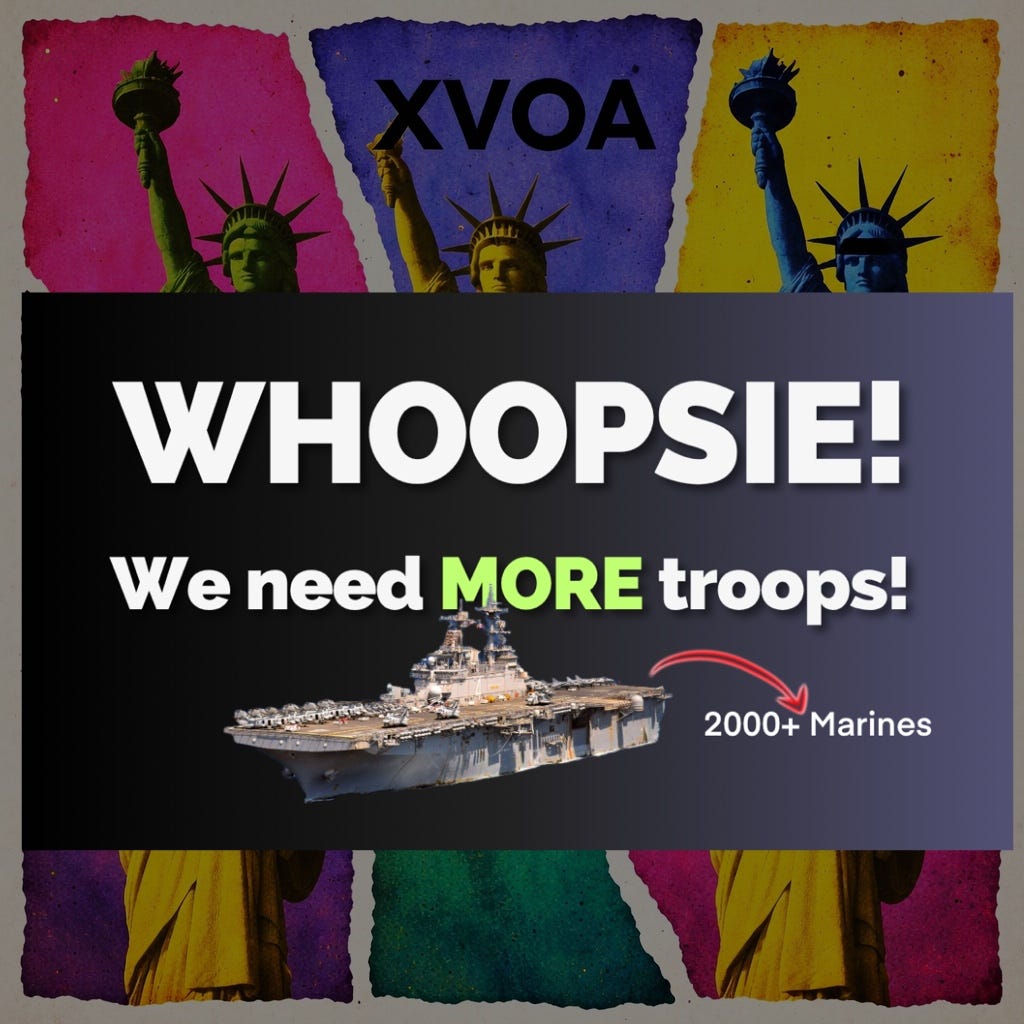
“Breaking: Whoopsie! Turns Out We Do Need Troops!: Gotta Run It’s Friday! News briefing Later!”
I laughed once. Then I didn’t.
Because underneath my gallows humor was a clean, documented statement of reality. The U.S. is moving more forces toward the region, and the number only makes sense if you stop flattening the package. The specifically identified additional piece is the 11th Marine Expeditionary Unit, roughly 2,200 to 2,500 Marines. But once you count the sailors and support personnel moving with the Boxer Amphibious Ready Group that carries them, the full package lands around 4,500 service members. Not in the abstract. Not “some day.” In motion, ahead of schedule, with the kind of capabilities you do not rush into place unless you want options you can actually use. [2][15]
Here is the embarrassing part. For a moment, I wanted to bargain with it. I wanted to call it logistics. I wanted to say it is “just positioning.” I wanted to believe that “no boots on the ground” still means something firm, something like a moral fence.
But this story is not about whether someone used the magic phrase.
It is about how wars change shape. How a military campaign that begins in the air and at sea drags the human body back into the story anyway, not because leaders are cartoon villains, but because they build a ladder and then pretend they didn’t. [3][4]
And if you lived through Vietnam, or lived next door to someone who did, you know what the trap smells like before you can name it.
The smell is official language of restraint wrapped around the logistics of expansion. It is one more “temporary” move, one more “limited” step, until the staircase is already under your feet.
TLDR
The number that keeps getting quoted most specifically is the Marine slice: about 2,200 to 2,500 Marines with the 11th MEU. But that is only the additional expeditionary piece. Once you count the sailors and support personnel moving with the Boxer Amphibious Ready Group, the broader package lands around 4,500 service members. That is not a symbolic move. That is a crisis-response, first-on-the-ground tool being positioned. [3][15]
The administration’s message is “no ground troops planned,” while its actions are “maximum optionality”: planning, preparations, and force packages designed to support raids, evacuations, embassy protection, and potentially larger moves if ordered. [4]
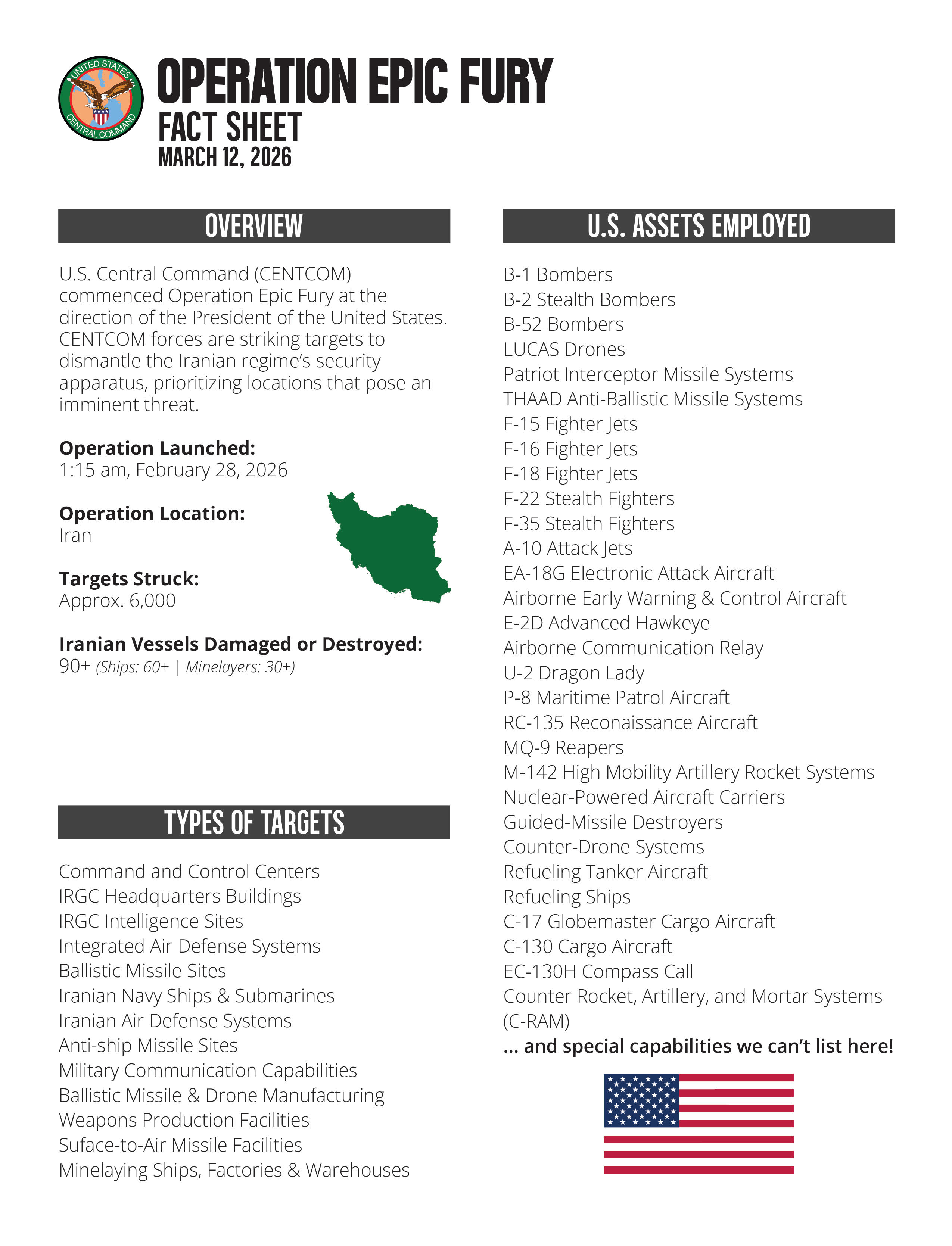
Operation Epic Fury began Feb. 28. A CENTCOM fact sheet and White House messaging describe a campaign aimed at Iran’s military infrastructure, missile forces, and naval capabilities, meaning this is already a large-scale war in air and maritime terms even before any new ground component. [6][7]
The American public can feel the slope. A Reuters/Ipsos poll finds 65% think a large-scale ground operation is likely, but only 7% support sending a large number of ground troops, and 55% oppose sending any troops into Iran at all. [5]
The deeper driver is the chokepoint itself: the Strait of Hormuz. Analysts warn it is effectively closed, carries about 20% of global oil and LNG flows, and can’t simply be “declared open” by speeches. Reopening it at scale pressures leaders toward riskier escalations. [9]
Restack it and share it.
Send it to one friend who still thinks this is just noise.
If you value this work, support it here:
One-time support:
The thing that would not leave me alone
The trending hook is easy to describe and hard to sit with: the specifically identified additional contingent is up to 2,500 Marines with the 11th MEU, but once you add the sailors and support personnel moving with the Boxer Amphibious Ready Group, the total package being pushed toward the region lands around 4,500 service members. [3][15]
But the story that would not leave me alone is not the headline. It is the tone beneath it.
A Navy spokesperson told a local outlet the deployment is “routine operations” in the Indo-Pacific, framed as routine training and readiness. [3]
That sentence is doing a lot of work.
It is paperwork language in the middle of an emergency. It is the bureaucratic equivalent of saying, “Don’t look at the smoke. The wiring is fine.”
And maybe the spokesperson is not lying. Maybe those ships do train. Maybe schedules shift. Maybe “routine” is technically true in the way a hurricane is technically weather.
But here is what routine does psychologically. Routine lowers the heart rate. Routine tells the public to keep sleeping.
Meanwhile, the same reporting that calls it routine also describes why a Marine Expeditionary Unit matters: crisis response, evacuations, embassy protection, and the ability to be first in, building conditions for other forces to follow. [3]
That is not nothing. That is the front end of an escalatory capability.
This is where the Vietnam memory flickers for older readers, not as a perfect analogy, but as a familiar choreography: the language of limitation often arrives at the same time as the logistics of expansion.
Not because leaders wake up wanting catastrophe. Because expansion is how they buy themselves room to move later.
They call it flexibility. They call it deterrence. They call it options.
The human nervous system calls it danger.
What the trend is really about
On the surface, the trending story sounds like a single question: Are we putting troops on the ground in Iran?
But the deeper question is more revealing: What happens when a war collides with a global chokepoint and the economy starts screaming?
That is why this story is catching fire now.
The deployment is not happening in a vacuum. It is happening inside a war that both the U.S. Central Command and Donald Trump’s White House describe as a campaign against Iran’s military infrastructure, missile forces, and naval capabilities. [6][7]
And it is happening as analysts describe the Strait of Hormuz as “effectively closed,” with enormous implications for energy and food prices that no domestic messaging can wish away. [9]
This is the part most people miss: you can talk about “no boots” all day, but if the war’s center of gravity is a maritime artery that carries about 20% of the world’s oil and roughly 20% of global LNG supply, your war is already inside the global economy’s bloodstream. [9]
And once a war has its hands around the gas pump, politics turns feral.
The same Reuters/Ipsos poll that shows low support for troop deployments also shows Americans expecting gas prices to rise and reporting that rising gas prices are affecting their household finances. [5]
So now the escalation trap takes on a modern shape.
Leaders want to keep the war “limited.” Markets want the chokepoint “open.” The public wants the pain “over.”
Those desires do not line up neatly.
That misalignment is what we are watching.
The receipts
Let’s get concrete, because “troops” becomes a political fog word fast.
One credible report describes the latest movement as deploying up to 2,500 Marines with at least three more ships, tied to the USS Boxer Amphibious Ready Group and the 11th Marine Expeditionary Unit. That 2,500 figure is the Marine slice of the buildup, not the whole sailors-and-Marines package. [2]
Another report specifies the 11th MEU itself as at least 2,200 Marines based at Camp Pendleton, deploying ahead of schedule aboard USS Boxer, with the broader context that another amphibious group carrying Marines and sailors had already been ordered toward the region days earlier. [3]
This is the number problem that needed to be said plainly. The 2,200 to 2,500 figure is the specifically identified additional Marine contingent. The 4,500 figure is the broader sailors-and-Marines package once you count the Boxer Amphibious Ready Group that carries and supports the MEU. Official Navy reporting on the Boxer ARG and embarked 11th MEU has previously described that combined team as more than 4,500 Sailors and Marines, which is why the larger number works only if you explain that it is a total, not just the extra Marine slice. [3][15]
Taken together, this is not “one unit.” It is the movement of multiple amphibious packages. It is the stacking of a very specific kind of capability: self-contained, air-and-ground integrated forces designed for crisis response and, if ordered, entry operations.
If you want to know why that matters, look at the official operational framing.
A Department of Defense memorandum from 2025 opens with a promise to the public: “sons and daughters serve under the best leadership,” “merit-based, color-blind policies,” and a focus on lethality and readiness. [12]
In March 2026, the White House goes beyond readiness language and describes Operation Epic Fury as “precise” and “overwhelming,” aimed at an “imminent nuclear threat,” missile arsenals, proxy networks, and naval forces, executed with regional allies. [7]
CENTCOM’s own fact sheet, dated March 12, pins the operation’s launch at 1:15 a.m. on Feb. 28 and lists a broad set of U.S. assets employed, along with an estimate of approximately 6,000 targets struck at that point. [6]
Even if you do not trust the rhetoric, the published shape of the operation is large.
Now add the human body count, because “no boots” gets used to tranquilize public conscience.
The Washington Post reports that the number of U.S. troops wounded in the war has surpassed 200 across multiple countries, and it describes both the geographic spread and the nature of injuries tied to missile and drone attacks and other incidents. [8]
So when someone says “no boots on the ground,” ask what they mean.
Do they mean no soldiers will die? That is already untrue. [8]
Do they mean no ground troops inside Iran? That is the contested question. But the force movements and preparations are designed to keep that option alive.
CBS News reports the White House press secretary saying that Pentagon preparations are about giving the commander in chief “maximum optionality,” and that preparation does not equal decision. It also reports planning features that sound like a bureaucracy rehearsing escalation, including how detention of Iranian soldiers or paramilitary operatives might be handled if boots are ordered into place. [4]
This is the honest part of the story.
They are getting ready for the thing they say is not happening.
That is exactly how escalation traps are built.
The escalation trap underneath the troop number
Now we can name the machine.
The machine is not simply “warmongers want war.”
The machine is “optionality becomes obligation.”
Here is how it works.
First, leaders frame the war as limited, decisive, and controllable. That is what the White House messaging does when it promises “overwhelming” action to eliminate threats. [7]
Second, the war hits a structure that is bigger than the war, like a chokepoint. Brookings experts describe the Strait of Hormuz as “the big one” and note that about 20% of global oil and LNG supply flows through it, and that fear, insurance, mines, missiles, and human risk can shut it down even without a perfect blockade. [9]
Third, the public feels the economic shock, and leaders feel the political clock.
The Reuters/Ipsos poll release notes that 87% expect gas prices to rise and that 55% report their household finances have been affected. It also frames cost of living as a leading issue heading into midterm politics. [5]
At that point, the war stops being a foreign policy event and becomes an internal political crisis.
So the leader faces a choice: accept the pain and negotiate, or try to “solve” the chokepoint.
But Brookings experts make a point that should sober anyone who remembers easy war promises. Escorts are not a simple solution, because they put expensive platforms close to the Iranian shore, they require lots of assets to move normal volumes of traffic, and mines make the problem worse. [9]
In plain language: you can’t reopen the Strait with a press conference.
You reopen it with sustained, risky, resource-heavy military action.
That is where the trap tightens.
Once the public is told the war is necessary, and the economy is harmed, leaders become tempted to escalate in order to justify the pain.
That is not ideology. That is a psychological drive to make suffering “mean something.”
It is the same mechanics you see in a family argument: once someone breaks something in anger, they feel compelled to keep yelling so the broken object does not stand as proof of their loss of control.
A nation can do the same thing.
This is where Vietnam comes in, not as a cheap comparison, but as a warning about how authorization and language slip.
The State Department’s historical framing of the Gulf of Tonkin describes how a congressional resolution became the legal basis for expanded U.S. involvement in Vietnam. [11]
You do not need a carbon copy of 1964 to recognize the pattern: a broad authorization, a shifting rationale, and incremental escalations described as necessary responses to circumstances.
If you want the modern legal guardrails, the War Powers Resolution exists precisely because Vietnam taught Congress and the public what happens when unilateral executive war-making expands. Cornell’s plain-language presentation of the statute’s purpose is direct: introducing U.S. armed forces into hostilities is meant to occur only with a declaration of war, specific statutory authorization, or a national emergency created by attack on the United States or its armed forces. [10]
Here is the civic danger in 2026. The nation is arguing about “boots” as if boots are a binary.
But escalation is not binary. It is a staircase.
And moving an MEU is a step.
Maybe it is a defensive step. Maybe it is contingency planning. Sometimes prudence requires preparation.
But preparation changes the political landscape anyway, because an option that is resourced, staffed, and positioned becomes easier to choose than an option that requires starting from scratch.
This is what older readers recognize in their bones.
Escalation becomes the path of least resistance.
Who pays and who gets protected.
The cleanest way to see who pays is to stop arguing about ideology and look at bodies and households.
The poll data shows the public expects escalation and does not want it. Two-thirds say a large-scale ground operation is likely, but only 7% support sending a large number of troops, and a majority oppose sending any troops into Iran. [5]
The casualty reporting shows Americans are already bleeding, even in a war described as “precision” and “overwhelming.” [8]
And the economic reality shows households are already being taxed by the conflict through prices and uncertainty. [5]
Now we have to talk about the people who do not get to decide.
Military OneSource’s demographic profile shows that active duty is overwhelmingly enlisted, and that a significant share of active-duty members identify with racial minority groups. [13]
This matters because enlisted life is where policy becomes consequence.
Officers debate. Enlisted families reorganize their kitchen table.
And there is a documented structural tension in who gets to lead and who gets sent. A U.S. Naval Institute Proceedings essay argues that wardrooms are less diverse than enlisted ranks and that this discrepancy has implications for culture, trust, and leadership. [14]
You do not need to invent a conspiracy to make that point. You can name a structural fact which is that leadership pipelines are not evenly representative, while the burdens of enlisted life are widely distributed, including across Black and other minority communities who have long served at high rates.
Now fold in the current political climate around “anti-DEI” policy.
The Department of Defense memorandum “Restoring America’s Fighting Force” explicitly describes DEI policies as incompatible with DoD values, directs elimination of DEI offices, and states the DoD will not consider sex, race, or ethnicity for promotion, command, or special duty, with limited exceptions. [12]
You can support or oppose that agenda. But you cannot deny what it does psychologically in the force.
It tells minority service members that your presence will be described as either “merit” or “preference,” but the institution will not speak the language of equity.
Then the institution asks those same members to trust the mission, absorb casualties, and accept “optional” escalations as routine.
That is how moral injury grows.
Not simply from danger, but from the feeling that the story being told about the danger is dishonest.
This is where my indignation lands, controlled but real.
Do not tell the public “no boots” while building the boots’ entire support system.
Do not treat the word “troop” like it is a PR variable instead of a human being with a mother, a spouse, a kid, and a mortgage.
Do not sell war like a product launch.
If this is truly necessary, then speak like it is necessary. Tell the truth about tradeoffs. Tell the truth about time. Tell the truth about what happens if the Strait stays closed for weeks or months, which experts warn is a real possibility. [9]
And if it is not necessary, then stop feeding the machinery that makes it inevitable.
Here is what I’d ask Congress and the executive branch, plain and unromantic:
What is the limiting principle?
Not the slogan. The mechanism.
What specific condition would justify putting ground troops into Iran, and what condition would stop it?
What legal authority is being relied on for continued hostilities and expansions of force posture, and when will Congress vote on it instead of funding it by inertia? [10]
What is the exit, not in vibes, but in verifiable terms?
And who will tell military families the truth first, before the next dignified transfer forces honesty on the country?
Once you build that ladder, you climb it more easily than you climb down.
The trap is not that leaders lie once.
The trap is that the public gets trained to accept the lie as weather.
If you are old enough to remember Vietnam as something more than a documentary, you know what I’m asking you to do.
Do not accept the tranquilizing language.
Do not let “optional” become destiny.
Say, out loud, that you see the wiring behind the wall.
CTA
If this helped you see the mechanism more clearly, restack it and share it.
Send it to one friend who still thinks “no boots on the ground” is a policy instead of a slogan.
And let me say thank you first to the free subscribers, the paid subscribers, and the people who have kicked in coffee money. The output of this publication the past couple of weeks has been strong, consistent, and unapologetically serious. That did not happen by magic. It happened because readers bought me time to read deeper, think longer, and publish harder.
Now for the fence-stragglers. If you have the means and you keep getting value from this work, stop making this a morality play where somebody else is supposed to carry the load for you. A lot of readers do not have the extra money right now. If you do, help cover the ones who do not. Paid support keeps this publication alive:
And yes, this publication lives off coffee. That is not a cute line. It is the truth. If you already chipped in once, chip in again. If you have been meaning to, consider this your nudge. One-time support:
Sources
US to deploy thousands of additional troops to the Middle East, officials say - Core reporting on the accelerated deployments, troop levels, and the political context around potential next steps.
US sending 2,500 Marines, at least 3 ships to the Middle East - Detailed military reporting on the Marine and ship package and the broader force posture.
Thousands of San Diego troops deploy to the Middle East on USS Boxer - Local reporting with key details about the 11th MEU, timing, and “routine operations” framing.
Trump administration making heavy preparations for possible ground troop moves - Reporting on White House messaging about “optionality” and indications of planning for escalation contingencies.
Americans think it’s likely the U.S. will send troops into Iran - The primary public release of the Reuters/Ipsos polling data on troop support, expectations of escalation, and gas-price anxiety.
Operation Epic Fury Fact Sheet (CENTCOM, March 12, 2026) - Official fact sheet documenting operation start time, target estimates, and major U.S. assets employed.
Peace Through Strength: President Trump Launches Operation Epic Fury to Crush Iranian Regime, End Nuclear Threat - Primary White House framing of objectives and justification for the campaign.
Number of U.S. troops wounded in Iran war surpasses 200 across 7 countries - Reporting grounding the essay’s point that “no boots” rhetoric does not stop casualties and widespread risk.
Why Iran’s disruption of the Strait of Hormuz matters - Expert analysis on why the chokepoint is so consequential and why “reopening” it is not a simple military or political promise.
50 U.S. Code § 1541: Purpose and policy (War Powers Resolution) - The clearest legal baseline for Congress versus executive war-making authority the public tends to forget until too late.
US Involvement in the Vietnam War: the Gulf of Tonkin - Historical reference point for how limited framing and broad authorizations can feed escalation.
Restoring America’s Fighting Force (DoD Memorandum, Jan. 29, 2025) - Primary policy document showing how “anti-DEI” and “color-blind” frameworks are being operationalized.
2024 Demographics Profile: Active-Duty Members (Military OneSource) - Baseline demographic context for who serves, who is enlisted, and who bears deployment risk.
There’s a Diversity Gap in the Wardroom (Proceedings) - A specialist discussion of how diversity differs between enlisted ranks and officer leadership, shaping trust and representation.
Boxer Amphibious Ready Group returns home from deployment - Official Navy reporting on the Boxer ARG and embarked 11th MEU describing the combined sailors-and-Marines team as more than 4,500, which helps clarify what the larger total figure represents.
I'm tired of all the lies and the journalists who never push back or ask follow-up questions. Thank you for giving your readers the truth. The mainstream corporate media needs to up their game. Yesterday.