


Seven Pages a Day: Day One
The title I chose is actually the title of another book that I’m working on. And I don’t know, I kind of had hesitation about doing it this way, but this is what I came up with, right?
And as I said before, I know it’s kind of messy. This whole series about one book, expounding on a philosophy I pulled from another book. Like, who the hell does that? I don’t know. But it really stimulated my thinking, and this is what got me through these first seven pages.
Now, don’t get me wrong, don’t take it the wrong way. I don’t mean that nobody will ever care about it. What I’m trying to say is that nobody cares enough right now to get me through all those years of sitting alone in a patrol car, reading research papers, notes, and books by that Civil War researcher whose name escapes me right now (Eric Fonner). But I didn’t spend all that time alone reading this stuff. I mean, it carried me through years of enduring all of that reading, false starts, and abandoned openings.
Now, once I came to terms with that, it really kind of cleared up something that had been messing with all my writing. If I wasn’t doing it just for some kind of insta-fame as validation, and really nobody GAF, then why was I putting in all these years of research and false starts for? What was I doing it for? Here’s who I was doing it for: I was doing it for me.
Listen, art is the end result of an artist trying to reconcile his own struggle for the truth.
Let me…did y’all hear me? Did y’all hear what I just said? Let me say it again for you.
Art is the end result of an artist trying to reconcile his own struggle for the truth.
And I know that is definitely what… No, let me say it this way. This is probably why I keep returning and seeing images in my head as I’m wandering around my place at 3 a.m. in the morning when there’s a full moon. I think of those cave paintings, prehistoric cave art that sits deep inside those dark chambers that were so isolated, and where getting pigment to the wall was an ordeal in and of itself.
Now to me, those paintings, that’s mankind right there trying to make terms with this new power of consciousness and self-awareness. Okay, so now, I want you to imagine having to live with the knowledge that you and those animals that you’re gonna hunt down across the African Sahara will die. Simultaneously knowing something happened yesterday and feeling some kind of way about having to make it exist tomorrow.
Now, there isn’t an audience assembled together, you know, sitting in fold-up chairs, waiting in those caves. Maybe a small group saw the paintings, and maybe they understood them as ritual, storytelling, or something we no longer quite know how to name.
Listen. You don’t need me to tell you that most of that meaning disappeared over time and, you know, just left us with the fact that somebody cared enough to put that ink on their fingers, and then put those fingers onto the wall in the dark, and put what was happening inside their minds onto a wall.
They weren’t thinking that millions and millions of people would be seeing their paintings tens of thousands of years into the future.
But that is the bargain I finally had to come to with my own work. I have to give a damn about it more than anybody else. And once that happens, it becomes infectious: I’ve seen it happen time and time again.
George Lucas, prime example, spent years alone, you know, in solitary confinement, reading The Hero with a Thousand Faces, that book by Joseph Campbell, and, you know, trying to reconcile his feelings about the Vietnam War, trying to reconcile his own limitations as far as his own art. Okay?
So, which brings me somehow, you know, to ants: how in the world did we get to ants?
Yeah, that’s right, that’s right, that’s what I’m talking about, ants here.
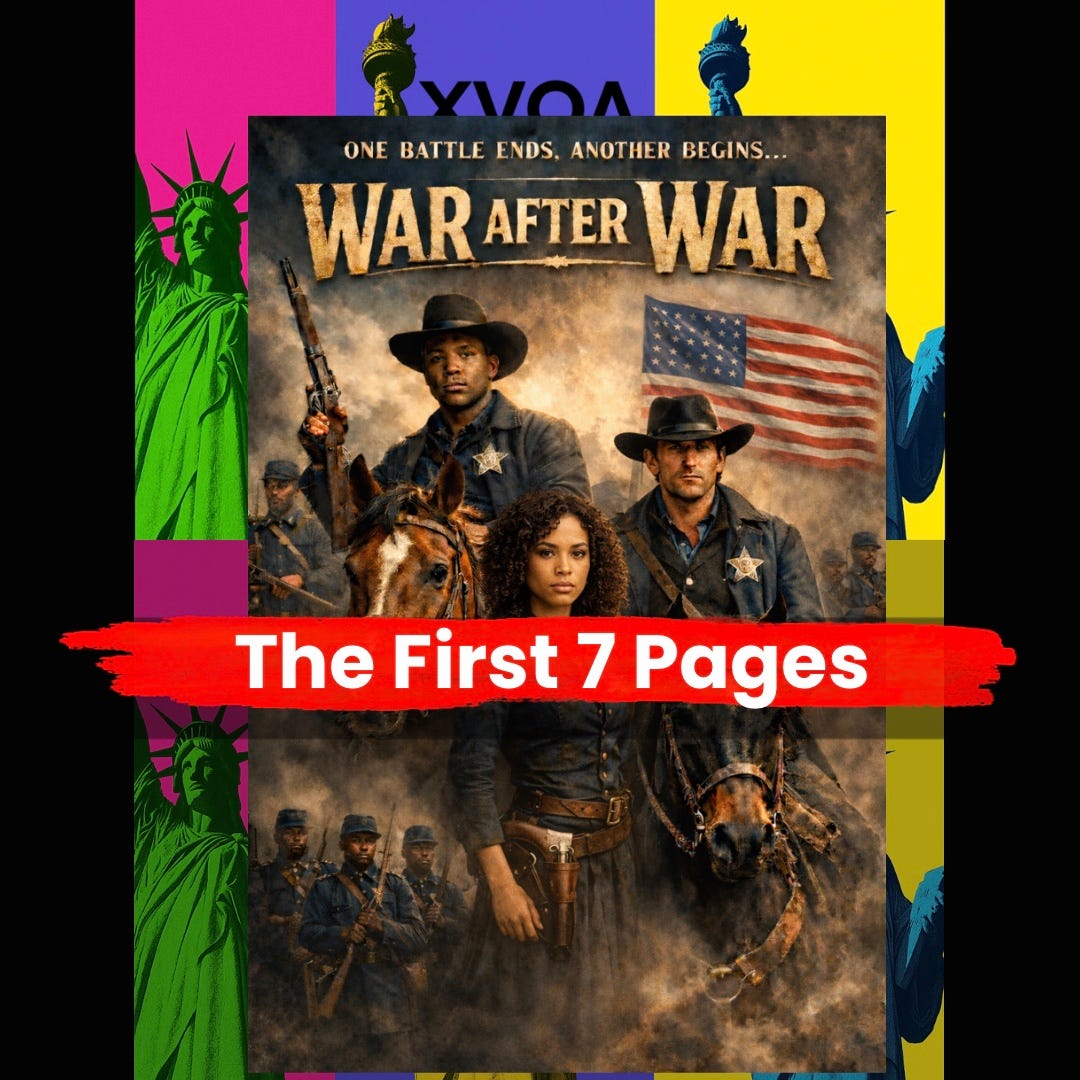
So, listen, I told you I was opening War After War at Ebenezer Creek, then I kind of, kind of flipped the tables on y’all again. Or maybe I finally found the door into Ebenezer Creek instead of dropping the whole reader into a history lesson and expecting the horror of the event to do all the work here.
So, the first consciousness in the novel now belongs to black ants. As silly as that sounds. And you’re watching me trying to reconcile my own art in real time here.
And I’m taking the point of view all the way down inside of the ants’ world. At that scale, the plantation above them is almost incomprehensible, and a child’s hand becomes weather, while a shoe can wipe out everything they know.
Now, Logan Dixon is just a boy playing in the dirt to them. Well, not to them, but to us. Logan Dixon is just a little white boy playing in the dirt. But from where the ants live, he not only has appointed himself God, he is God.
Then the point of view moves into Logan, and to him, killing them is a game.
Then Alex enters.
And that same patch of dirt becomes something else to him. I’m not going to tell you exactly what that is just yet.
Now, the more I read about ants, the less I could use them as dumb little symbols marching across the landscape. So, I’m not going to get into species and all that. But listen, ants can teach routes, divide labor, care for their young, rescue injured nestmates, share information, solve problems together, pass down knowledge. They farm. Yes, there are species of ants who even do farming. Think about that.
One individual ant carries private memory while the colony builds communal pathways. One ant never holds the whole plan, yet the colony still knows how to survive.
Now, I could stop the post right there and explain the parallel until I killed it, but I ain’t going to stand over it, you know, with a highlighter. It can live in the story.
So, listen, the boy standing over that colony, he becomes Lieutenant Logan Dixon at Ebenezer Creek. We have newly freed Black people. They have followed the Union Army to the river. General Jefferson C. Davis orders them held back while his soldiers cross, then orders the pontoon bridge dismantled with the Confederate cavalry closing in.
You’ve got families, this is tragic, y’all, okay? Families are trapped between the river and men willing to kill them or drag them back into slavery.
Now, in this scene here I’ve created, Davis gives Logan the meaning of that order plain:
“Pull the bridge. Finally finish those niggers off.”
Now, I’m not going to tell you what Logan does next because we’re going to keep some things in the novel, all right?
But that’s what I found in those first seven pages. I know it sounds kind of crazy, but I, I’m starting to find me. I’m starting the process of reconciliation with a truth I’ve been struggling with.
The patch of dirt and the river started talking to each other, and it started talking to me.
A child playing God over a small living world grows into a man standing inside an army where somebody with more power can make the exact same decision about Black families and call it military necessity.
And I’ve been in the Army. I’ve seen decisions, the decision-making process, even maybe over small, trivial things, but the process nevertheless is the same.
So that ant scene was not a detour from Ebenezer Creek. It was the way in: it was the way into my soul.
Seven pages down.
I’m still thinking about those damn ants.
*Scroll over to the right after pushing the button above.
Kudos to you for taking on the enormous task of writing a book. I have never written in that long of a form. The closest I get to long form writing is screenwriting--scripts are an average of 90 pages which is nothing compared to a novel.
I like the backstory/backward glimpse/metaphor of Logan as a child looming over the ants. I'm biased in my POV because I write scripts, but the imagery is very cinematic and powerful. It would be a great Act I for a film. As I was taught, if you don't engage your audience in Act I, it's likely that the rest of the film will sag under that weight unless there's an incredibly powerful Act II.
I wish all the best with your book. There's also the possibility that someone will want to adapt it to film and make you a chunky option offer. :-)
This sounds like a really good start to a good book. I admire your self reflection and your writing. Heavy lift on both counts for all of us. I can only imagine the time and effort to produce this book.