

Updates:
Judge Indira Talwani signaled she will likely order partial SNAP benefits using emergency funds; a formal written ruling is pending as of this evening.
A Boston federal judge strongly indicated she will compel the USDA to tap emergency funds so that partial SNAP benefits go out in November despite the ongoing shutdown. The move – expected to be formalized soon – aims to avert a first-ever full halt of food aid for roughly 42 million Americans.
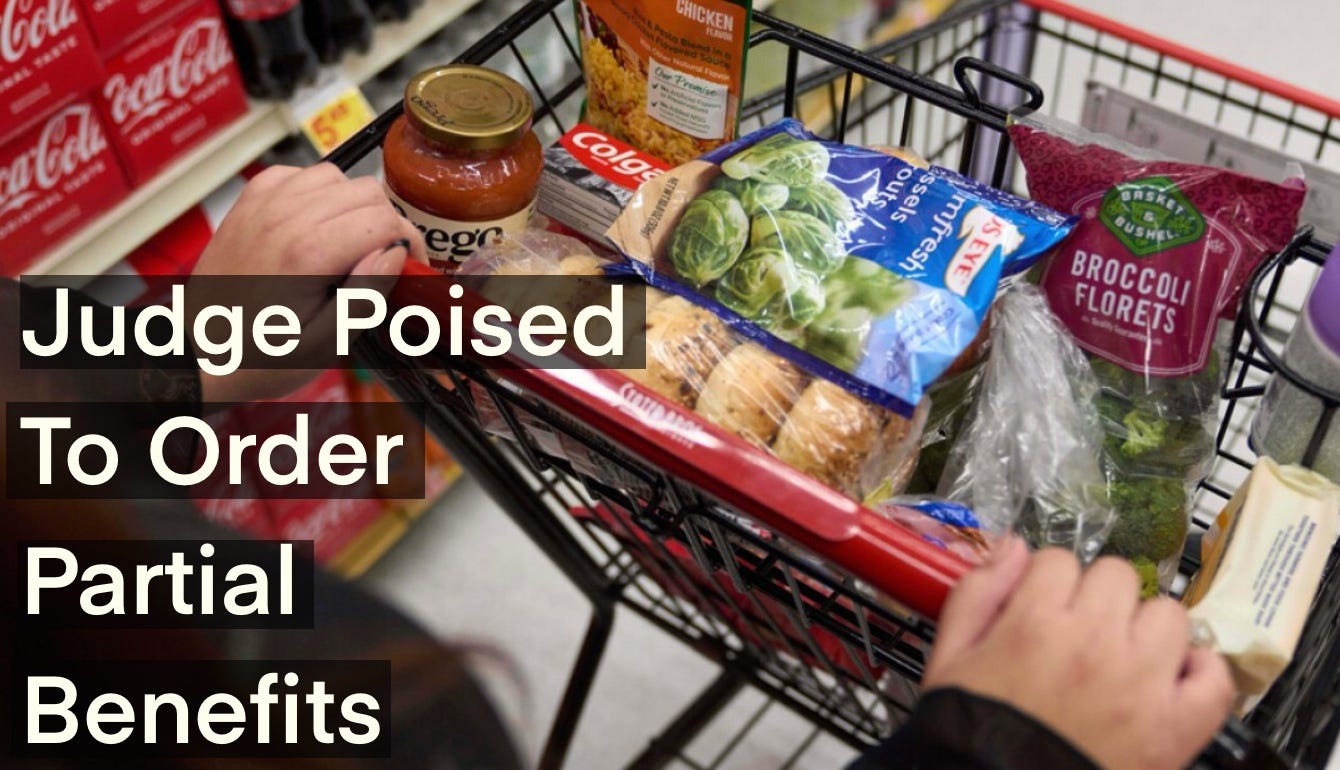
BOSTON — In an extraordinary hearing Thursday, a federal judge said she is likely to order the Trump administration to use its contingency reserves to partially fund November food stamp benefits, ensuring assistance continues despite the federal shutdown . U.S. District Judge Indira Talwani made clear from the bench that she views the SNAP funding lapse as a true emergency and signaled she will not wait for Congress to act. “Congress has put money in an emergency fund, and it is hard for me to understand how this is not an emergency,” Talwani told government attorneys, emphasizing that existing law obligates the agency to use those funds now . While no written order has been issued yet, Talwani said she would decide by the end of the day whether to force the Agriculture Department to deploy about $5.2 billion in SNAP contingency funds – a step she strongly indicated is imminent.
The judge’s pointed remarks came during a lawsuit brought by a coalition of states seeking to prevent a devastating cutoff of food assistance. More than 20 state attorneys general and several governors – led by Massachusetts, California, Arizona and Minnesota – sued the USDA this week after it refused to tap its emergency SNAP fund for November benefits . USDA officials had insisted that the $5+ billion contingency pool is reserved for natural disasters and not to cover a funding lapse, and they argued the agency lacks authority to pay any benefits until Congress restores funding . In response, the states argue that failing to use available funds violates federal law, noting that Congress specifically created the contingency account “to carry out program operations” in a crisis . Talwani appeared deeply skeptical of the administration’s stance. She noted that SNAP has never been interrupted by a budget impasse in the program’s 60-year history, and she admonished USDA for effectively choosing to let Americans go hungry in a political standoff . “If you don’t have money, you tighten your belt,” the judge said, adding that “[You’re] not going to make everyone drop dead because it’s a political game” – a sharp rebuke to the idea of allowing a total shutdown of food aid .
Talwani’s expected order would unlock roughly $5.5 billion in emergency SNAP funds, which officials say is not enough for a full month of benefits. (SNAP normally costs about $9 billion per month.) However, those reserves could cover partial payments to give recipients at least some benefit in November . Under SNAP’s staggered distribution schedule, not all benefits are paid on the first of the month, so states could stretch the limited dollars to deliver pro-rated November allotments if the judge compels the USDA to act . The contingency funding is essentially a stopgap; even in a best-case scenario it would fund only a few weeks of aid, not a full month’s supply of nutrition assistance . Still, officials say partial SNAP payments are far preferable to none, buying time for families as the budget standoff continues .
Who is the judge?
U.S. District Judge Indira Talwani has served on the District of Massachusetts since 2014, appointed by Barack Obama and confirmed 94–0 by the Senate. Before the bench, she practiced civil litigation with a labor/worker focus at Segal Roitman LLP in Boston (and earlier at Altshuler Berzon in San Francisco). She has handled high-profile matters on the court, including sentences in the “Varsity Blues” admissions cases.
Timing is critical. Without court intervention, SNAP benefits would be cut off starting Saturday, November 1, as states run out of federally provided funds . State social service agencies and the private contractors that load SNAP funds onto EBT cards have warned they need lead time to implement any late-breaking fix . Even with an emergency order, benefits are likely to be delayed by a few days because state systems cannot immediately disburse money without advance notice . That urgency is why the plaintiff states sought a ruling by Thursday. Indeed, USDA set off alarms last weekend by updating its website with an unapologetic notice that “the well has run dry” and no November food stamps would be issued . (The agency’s public message controversially blamed Senate Democrats for the situation, a politicized stance that experts said may violate federal rules .) Judge Talwani acknowledged Thursday that time is short, but stressed that existing law mandates “agency action, not lawyering,” in a crisis . She indicated USDA must find a way to use whatever funds remain to keep Americans fed, rather than stand by until Congress resolves its funding fight .
Meanwhile, state governments are scrambling to shield vulnerable residents as the SNAP lapse looms. For example, Maryland Gov. Wes Moore on Thursday declared a state of emergency and directed $10 million in state funds to food banks and community organizations to help families brace for a potential halt in benefits . Moore, a Democrat, had faced bipartisan calls to use Maryland’s reserve funds to plug the SNAP gap directly. He opted instead to bolster food charities, arguing that the “human-made disaster” was caused by federal inaction and that Maryland cannot reliably backfill federal benefits without a guarantee of reimbursement . Other states have gone further: Virginia’s governor declared a “hunger emergency” last week and set up a temporary program to issue weekly SNAP-like benefits using state dollars, in hopes of covering needs until Washington reopens . More than two dozen states (as well as D.C.) are part of the lawsuit pressing USDA to use the contingency fund , underscoring a widespread, bipartisan demand for urgent relief.
The judge’s impending decision could provide that relief in the nick of time. If Judge Talwani formally orders the USDA to unlock the emergency SNAP reserve, state agencies are expected to move quickly to load partial November benefits onto recipients’ EBT cards early next week . It would be an unprecedented court-mandated workaround to keep food assistance flowing during a funding lapse. Federal officials have quietly acknowledged that the contingency fund exists for exactly this type of emergency – a fact highlighted by advocates who note the shutdown crisis is entirely avoidable . For now, millions of Americans are anxiously watching for the judge’s ruling and bracing for disruptions at the grocery store. This is a developing story, and XVOA will continue to provide exclusive, in-depth coverage. Readers are encouraged to subscribe to support truly independent media such as this:
Thank you for sharing possible good news. I work with the low income population. I cannot fathom why anyone would cut off food for its citizens. Shame, shame, shame on them.
Thank you for this update! Great job reporting!