


Welcome to the Spin Spectrum. This series is a simple tool for people who want the news without being quietly steered by it. Each time, I take one headline and line up how different outlets cover the same event from left, center, right, domestic, and foreign so you can see what gets emphasized, what gets softened, and what gets left out.
What makes the Spin Spectrum different is restraint. I’m not here to “win” the story, punish villains, or crown heroes. Even when a headline hits a nerve, I deliberately hold back my own hot takes and moral outrage not because I don’t have them, but because outrage can become a fog machine that hides the real shape of things. The goal is to let the facts breathe, then let the patterns in coverage show themselves.
Think of it like a media x‑ray. When you can see the framing choices side by side, the story stops owning you. You start owning your attention.
What Happened
In the early hours of January 3, 2026, United States special forces conducted a surprise raid in Venezuela’s capital, Caracas. Their target was Venezuela’s long-time president, Nicolás Maduro. In a brief but intense operation, U.S. troops captured Maduro and his wife, Cilia Flores, and whisked them out of the country . The raid was accompanied by air strikes that knocked out parts of Caracas’s power and defenses . By morning, President Donald Trump announced that Maduro was “enroute to New York” to face criminal charges related to narcotics trafficking . This marked the most direct U.S. military intervention in Latin America since the 1989 capture of Panama’s Manuel Noriega .
Trump praised the mission’s success. He confirmed that no American casualties occurred and compared the raid’s precision to “watching a television show” in its flawless execution . The U.S. President even posted a photo of a blindfolded, handcuffed Maduro aboard a U.S. Navy ship, underscoring the operation’s outcome. In a press conference from Florida, President Trump declared, “We’re going to run the country until such time as we can do a safe, proper and judicious transition” in Venezuela . He suggested that U.S. forces would oversee Venezuela temporarily to prevent any hostile regime from taking power. Maduro’s supporters at home, meanwhile, were shocked and angered – Venezuelan officials decried the raid as a “large-scale strike” amounting to an illegal attack on their sovereignty .
With Maduro detained, U.S. authorities indicated he would be brought before a federal court in New York to answer to a 2020 indictment on charges including narcoterrorism and cocaine trafficking . The dramatic capture of a sitting foreign president by U.S. forces raised immediate questions and strong reactions across the political spectrum and around the world.
How Liberal Media Covered It
Liberal and left-leaning outlets focused on the legality, implications, and ethical concerns of the U.S. operation. Rather than celebrating Maduro’s capture, these sources scrutinized the raid’s justification and potential consequences. They often described the event with words like “assault,” “attack,” or even “invasion,” emphasizing the aggressive nature of the U.S. action. For example, the UK’s Guardian newspaper, known for its left-of-center stance, called it a “pre-dawn assault” and highlighted the Venezuelan government’s outrage at what it labeled an “imperialist aggression” by Washington . The Guardian’s coverage featured Venezuela’s defense minister condemning the U.S. for launching a “deplorable” “barbaric” invasion that “desecrated our sacred land,” urging citizens to resist the foreign attack . By prominently quoting such language, liberal outlets framed the U.S. intervention as highly controversial.
In the U.S., MS NOW formerly known as MSNBC, a television network with a liberal tilt, zeroed in on the constitutional and legal issues raised by the raid. An MS NOW report noted that this was “the most aggressive use of military force against a foreign head of state in a generation”, and it stressed that President Trump had not sought Congressional authorization for the operation . The tone on MS NOW was one of alarm at an “extraordinary escalation” of executive power. They pointed out that the Trump administration was citing a secret Justice Department memo as legal justification, a move which “fuels a new war powers showdown” between the President and Congress . In plain terms, MS NOW commentators questioned whether Trump had the right to order an attack on a foreign country without lawmakers’ approval, and what precedent that set. This focus on process and legality is a hallmark of liberal coverage, which tends to be skeptical of military interventions initiated by Republican presidents.
Some progressive outlets and commentators also highlighted statements and outcomes that they found troubling. For instance, when President Trump said the U.S. will “run” Venezuela in the interim, it set off alarm bells in left-leaning media. Progressive magazine Mother Jones and others argued that this wording suggested an American occupation of a sovereign nation, echoing a long history of U.S. interference in Latin America.
Liberal outlets underscored how unusual and provocative it was for a U.S. leader to openly say Washington would administer another country’s affairs. They often noted that “no one is bemoaning the end of Nicolás Maduro’s rule”, since Maduro was widely seen as an authoritarian, but they warned that the manner of his removal by force could be deeply destabilizing .
The Guardian, for example, cited experts who said removing a dictator this way “carries serious costs for US legitimacy” and could do long-term damage to international law . In summary, liberal coverage acknowledged Maduro’s dictatorial grip on Venezuela, yet primarily focused on criticizing the U.S. action’s legality, its moral implications, and the risk of sliding into war. Headlines in left-leaning media often reflected this concern, with phrases like “US Attack on Venezuela” and “Trump Crosses Line” conveying disapproval or worry.
To illustrate, The Guardian ran updates like “France says [the] military operation behind Maduro’s capture goes against international law” , signaling broad skepticism among allies. U.S. liberal commentators similarly expressed fear that the raid set a dangerous precedent. Democratic lawmakers’ reactions featured prominently: “It risks pulling our nation into another war,” warned one congresswoman, and Senator Mark Warner cautioned that unilateral regime change by force “demands the closest scrutiny”. By highlighting such quotes, liberal media framed the capture of Maduro not as a triumphant victory, but as a harbinger of potential fallout – from quagmires abroad to the erosion of norms at home. Their reporting tended to be somber and critical in tone, stressing questions like “Was this operation legal or wise?” rather than celebrating the event.
Quick pause. If you’ve been looking for a place where the facts get room to breathe and where sources get compared without turning everything into a morality play then this is it. The internet pays the loudest voices. It rarely pays the clearest ones.
If Spin Spectrum helps you think instead of just react, consider becoming a paid subscriber. Not because outrage is “bad” (it has its uses and I’ve done my share), but because a timeline powered by rage needs a counterweight using a steady, sober comparison that doesn’t flinch and doesn’t spin.
Support the work that keeps your mind free.
How Centrist / Mainstream Media Covered It
Centrist and mainstream outlets which includes those with a reputation for straight news reporting without an overt partisan slant took a more neutral, factual approach. Their coverage aimed to tell what happened in a straightforward way, with context but minimal loaded language. For example, Reuters, a global news agency known for neutrality, reported the story with a dry, factual headline: “Trump says Venezuela’s Maduro captured after strikes.” The lead sentence delivered the core facts without adjectives: the U.S. “attacked Venezuela and captured its long-serving President Nicolás Maduro in an overnight operation,” according to President Trump . This matter-of-fact description (“attacked” and “captured”) gave readers the basic news. Reuters noted Trump’s promise to “put the country under American control for now” to manage a transition, including his direct quote about running the country until a proper transition can occur . Such outlets reported Trump’s words and the Venezuelan response, but without explicitly approving or condemning.
Mainstream coverage typically provided context and background to help audiences understand the significance. They reminded readers that Maduro had been under U.S. indictment since 2020 on drug trafficking and weapons charges , which is one reason the U.S. gave for seeking his arrest. The Associated Press (AP), another centrist source, described the event as a “large-scale strike” carried out after months of increasing pressure on Maduro . AP and others noted that this was Washington’s most direct military action in the Western Hemisphere in decades, drawing parallels to past interventions (for instance, comparing it to the 1989 U.S. invasion of Panama to capture Manuel Noriega ). Such historical context was offered without heavy judgment, to situate the reader.
In terms of tone, centrist outlets used neutral or official language. They often referred to Maduro with titles like “Venezuelan President” or noted his reputation as an “autocratic ruler” in passing , but did not employ hyperbolic labels. If they used the term “dictator,” it was usually attributed to someone (e.g. “Trump called Maduro a dictator”) rather than stated outright by the reporter. Their focus was on verified details: how the operation unfolded, what U.S. officials said, and what might happen next (such as Maduro’s upcoming trial in the U.S.).
For example, an AP report calmly stated that Maduro and his wife were “captured and flown out of the country” in a U.S. military operation and that the U.S. government insisted it would run Venezuela temporarily to stabilize it . Reuters similarly noted Trump’s comments about a possible U.S. troop presence in Venezuela and even pointed out the practical challenge: despite the dramatic raid, “U.S. forces have no control over the country itself” beyond having Maduro in custody . This kind of analysis was presented in a factual, even-handed way, often in the latter part of articles to cover potential complications without straying into opinion.
Mainstream outlets also made sure to report reactions from multiple sides. A typical Reuters or BBC piece would include U.S. officials’ statements (e.g. U.S. Attorney General announcing Maduro will face justice in New York) alongside responses from Venezuela’s allies or other countries. For instance, BBC News and Reuters Live updates mentioned that Russia and China criticized the U.S. action, while U.S. allies were more muted. But these reactions were usually summarized in diplomatic terms.
An AP story might note that China “strongly condemned” the U.S. strikes as a violation of international law , conveying the information without additional commentary. In general, centrist media coverage was neutral in language, balanced in presenting viewpoints, and focused on concrete facts (like number of aircraft used in the raid, or the legal charges pending against Maduro) rather than emotional or moral arguments. The idea was to inform readers of who, what, when, where, and why, allowing them to draw their own conclusions about the rightness or wrongness of the operation.
How Conservative Media Covered It
On the conservative and right-leaning side, the coverage struck a triumphant and approving tone. These outlets emphasized the success, strength, and righteousness of the U.S. action, often framing it as a victory of good over evil. Maduro was invariably described in harsh terms – “dictator”, “strongman”, even a “narcoterrorist” – underscoring that he was a villain who had it coming. For example, Fox News, a major U.S. conservative network, headlined the story as a daring feat: it highlighted that an “Elite Army unit (Delta Force) captured Venezuelan President Maduro in a daring raid”, explicitly labeling Maduro a “dictator” in its report . Fox News coverage celebrated the U.S. special forces’ prowess, going into detail about Delta Force’s elite capabilities and past missions. This focus on military heroism sent the message that America had achieved something great.
Conservative outlets lauded President Trump’s leadership in the operation. They quoted his praise for the troops extensively. Fox News, for instance, broadcast Trump’s interviews where he said the military “did an incredible job” and that “no other country on earth could do such a maneuver” . Such quotes were featured prominently, reinforcing the idea that the raid was a justified and brilliantly executed mission. There was an air of patriotic pride in the reporting. Any criticism or concerns raised by others were largely absent or downplayed in these reports. Instead of discussing legal debates,
Fox News focused on operational details like how helicopters skimmed low over the water, how many aircraft were involved, and how U.S. forces surprised Maduro. They noted, for example, that Maduro was caught in a “fortified residence” but captured before he could reach a secure safe room, according to Trump’s recounting of the events . The use of words like “fortress” and descriptions of U.S. commandos breaching steel doors portrayed the American forces as almost super-heroic.
The framing in right-leaning media was very much “U.S. vs. a dictator.” The Daily Telegraph in the UK (a conservative-leaning paper) ran headlines emphasizing the bold action: “US bombs Venezuela and captures Nicolás Maduro.” Its narrative described how special forces stormed Maduro’s heavily-guarded compound in the dead of night, catching him as he tried to flee . By using vivid verbs like “stormed” and highlighting the enemy’s humiliation (Maduro fleeing and being caught), the Telegraph and similar outlets framed the story as a military triumph. They also stressed the justice being served: many noted that Maduro was wanted for drug crimes and that finally he would “face American justice.”
The Wall Street Journal’s editorial page (right-leaning in its opinions) reportedly applauded the operation as well. While we do not have a direct quote, it’s likely the WSJ editorial cast the capture as a welcome step toward ending Maduro’s “socialist dictatorship” and restoring democracy in Venezuela, even if it acknowledged the boldness of Trump’s move. Conservative commentators in the U.S. often echoed this sentiment, framing the issue as freeing the Venezuelan people from a tyrant. Some even linked it to broader ideological battles; for example, one might hear on Fox News that “Maduro found out the hard way that if you push drugs and oppress your people, the U.S. will hold you accountable” (paraphrasing a common theme).
Notably, conservative coverage showed little concern for international law criticism or war powers debates. Those aspects were largely absent. Instead, there was focus on American strength and moral clarity. For instance, Fox News underscored that no U.S. lives were lost, but many of Maduro’s forces were neutralized . The implication was that it was a clean, successful operation on the “good guys’” side. When President Trump talked about Venezuela’s oil riches, conservative outlets framed it as protecting resources from a corrupt regime rather than imperialism and some even spun it as helping rebuild Venezuela’s economy with American know-how.
This stands in contrast to liberal media’s view of those comments. Overall, right-leaning media portrayed the capture of Maduro as a justified, courageous act that eliminated a dangerous dictator. The language was often celebratory. Words like “spectacular assault” or “impressive operation” were used by officials (and repeated by these outlets) to describe the raid . By focusing on the bravery of U.S. forces and the crimes of Maduro, conservative outlets’ framing suggested that any right-thinking person would applaud this outcome. In summary, their tone was confident and victorious, with much less attention paid to potential downsides or moral ambiguities.
Domestic vs Foreign Coverage
When comparing domestic U.S. coverage to foreign international coverage, some differences emerge beyond just liberal vs conservative slants. Domestic outlets (those based in the U.S.) often centered the American perspective: U.S. political reactions, implications for U.S. policy, and American strategic interests. Foreign outlets (outside the U.S.) tended to give more weight to international reaction and the sovereignty issue.
For example, in American media whether liberal or conservative there was substantial focus on U.S. internal politics. U.S. networks and papers discussed how Republicans and Democrats reacted very differently to the news. A Guardian article covering U.S. reactions noted the split: Republicans cheered the enforcement of the indictment against Maduro, while Democrats decried a violation of Venezuela’s self-determination .
This kind of partisan breakdown was a big part of domestic coverage. U.S. outlets also dwelled on what this means for President Trump politically. Was it a bold foreign policy win? Or an example of overreach? Those questions mattered a lot in U.S. discourse. Even a centrist U.S. source like AP had a live update about New York leaders reacting (since Maduro was being brought to New York for trial), which is a very local U.S. angle . In contrast, foreign outlets were more likely to lead with how the world and the region reacted.
International media often explicitly mentioned violations of international law and global condemnation. For instance, coverage in Europe and elsewhere reported on statements from the United Nations and foreign governments. The Guardian (UK) and BBC both noted that the UN Secretary-General condemned the U.S. action as soon as details emerged . Many foreign outlets highlighted outrage from America’s rivals and even some allies: China’s government “strongly condemned” the U.S. raid as a blatant breach of sovereignty , and Russia demanded an emergency UN Security Council meeting. These details appeared prominently in foreign reporting. Domestic U.S. outlets mentioned them too, but often further down in the story. By contrast, a channel like BBC World News might start by saying, “International shockwaves today as the U.S. forcibly removed Venezuela’s president…”, immediately placing the event in a global context.
Another difference was in the terminology and framing of the action itself. U.S. media, especially mainstream, often used fairly neutral or U.S.-centric terms calling it a “military operation,” “mission,” or “raid.” In fact, American officials’ phrasing like “successful operation” or “strike against Venezuela” were commonly echoed . However, foreign outlets (and foreign officials they quoted) sometimes called it an “invasion” or “bombardment.” For example, France’s president and Brazil’s president (Lula) were quoted abroad condemning the “bombing of Venezuela” and saying it “crossed an unacceptable line” .
That choice of words, “bombing”, paints a starker picture of U.S. aggression than a term like “operation” does. Similarly, Venezuelan voices calling it “an extremely serious act of military aggression” got more emphasis outside the U.S. . This isn’t to say U.S. media ignored those quotes, but foreign media outlets tended to foreground them. They also explored the question of international norms more openly: for instance, British and European reports debated if this sets a precedent for other countries to do the same. In one striking analysis abroad, a commentator asked: if the U.S. can kidnap a foreign leader under the banner of justice, “what prevents China from claiming the same authority” against, say, Taiwan’s leaders, or Russia doing so in its region? . That kind of global-norm discussion was prominent in foreign coverage, whereas U.S. domestic coverage was more inward-looking (focused on U.S. policy and partisan views).
Domestic vs foreign differences also showed up in whose perspective was highlighted. Domestic outlets, even when critical, often still framed Maduro as the antagonist – an American perspective that “Maduro is a bad guy, but are we doing the right thing?” Foreign outlets, especially in the Global South, sometimes showed a perspective more sympathetic to Venezuela’s national sovereignty. They reported on ordinary Venezuelans’ reactions, the fear and uncertainty in Caracas after the raid, and how Latin American neighbors viewed the U.S. move. For example, some Latin American media and international agencies noted that even U.S.-opposed Venezuelan opposition leaders were taken aback by the sudden foreign capture of Maduro, because it sidelined Venezuela’s own political processes . In sum, U.S. domestic media framed it largely as a U.S. story with international fallout, while foreign media framed it as an international incident caused by the U.S. One clear indicator is how oil was discussed: U.S. outlets (particularly conservative ones) talked about American companies possibly helping rebuild Venezuela’s oil industry (a positive spin) , whereas foreign coverage often portrayed that as the U.S. eyeing Venezuela’s resources, almost as spoils.
In conclusion, domestic coverage was colored by U.S. politics and typically treated the event within the narrative of American interests and values. Foreign coverage, on the other hand, frequently placed the event in a broader international and historical context, invoking principles of sovereignty and the reactions of the global community. This does not mean all foreign press was against the raid. For instance, some outlets in countries with ideologically opposed regimes (like the new right-wing government in Argentina) welcomed Maduro’s downfall, calling it “Liberty advances” in Venezuela . But overall, reading domestic vs foreign reports side by side, one notices the foreign press was more openly critical of the U.S. and more focused on the raid’s legitimacy under international law. The domestic press, whether critical or celebratory, kept the spotlight on what it means for the U.S. and for Venezuelans, whereas foreign press dwelled on what it means for the world order. Both angles together provide a fuller picture of the event.
Big Picture: What This Tells Us About Media Bias
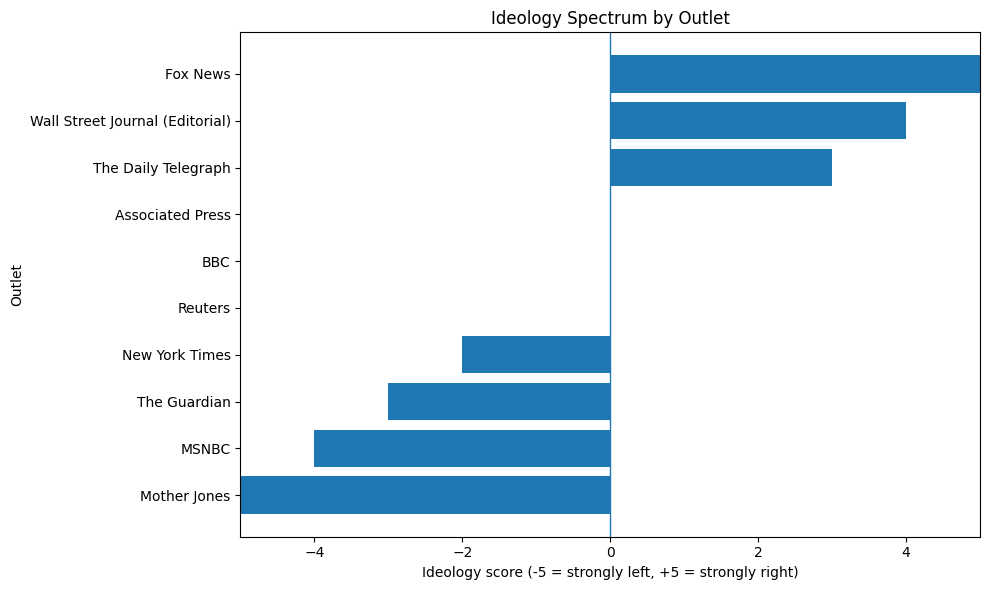
This comparison of coverage across the spectrum reveals a lot about media bias and framing. (Framing means the angle or perspective from which a story is told – essentially, what aspects are emphasized and how the story is presented to the audience.) Different outlets reported the same facts, a U.S. raid captured Maduro, but they framed those facts in noticeably different ways to align with their audiences’ expectations and their own editorial stances.
From the liberal side, we see a bias toward skepticism of military action and authority. These outlets framed the story around questions of legality, morality, and potential negative outcomes. They did report that Maduro was captured, but the tone suggested “this is a problem or at least very concerning.” The language they chose (like “assault” and “aggression”) and the prominence they gave to critics (international law experts, Democratic politicians, etc.) reflect a left-leaning distrust of unilateral military force, especially when ordered by a right-wing leader like Trump. The liberal bias doesn’t mean they liked Maduro – rather, it means they are inclined to challenge the actions of the powerful (in this case, the U.S. government’s action) and to empathize with issues of sovereignty and law. They framed Maduro’s capture as something that might set a dangerous precedent or escalate conflict, thus nudging readers to consider the potential downsides and ethical dilemmas.
The conservative media exhibited the opposite bias: a strong patriotic and law-and-order angle. Their framing made the U.S. action look bold and justified. By calling Maduro a “dictator” in virtually every reference, they ensured the audience views him as a villain from the start. Describing the U.S. troops as heroic and the mission as “daring” imparts a sense of pride and approval. This bias lines up with a right-leaning worldview that America should be tough on hostile regimes and that using force can be necessary to stop bad actors. There was little to no mention of international law which indicates a bias of omission: if something doesn’t fit the narrative (in this case, criticisms of the raid), it gets left out or minimized. Instead, conservative outlets focused on the positive outcomes (no American casualties, a criminal brought to justice) and framed the story as a clear win for the good guys. This shows how bias isn’t always about what is said, but also about what is not said. By not acknowledging any controversy, the right-leaning media presented the raid as straightforwardly good.
Centrist outlets tried to minimize bias and stick to facts, but it’s worth noting that absolute neutrality is hard. Even choices like which quotes to include or which words to use can subtly influence perception. For instance, Reuters saying “attacked Venezuela” is a strong phrase that might raise eyebrows, whereas saying “carried out an operation in Venezuela” sounds more neutral. Reuters chose “attacked,” which is factual but also acknowledges force was used. That could be seen as a slight bias toward clarity over euphemism. However, overall the centrist media aimed to give a balanced account, and they usually succeed in being trusted by both sides. They showed that Maduro was both an accused criminal (hence, the U.S. had charges on him) and a sitting president of a country (hence, raising issues by removing him). By presenting multiple facets, they allow readers to form their own opinion.
The domestic vs foreign contrast reveals how national perspective can be a form of bias as well. U.S. outlets, whether left or right, share an American-centric lens: the story was partly about Trump, U.S. policy, and how Americans feel about it. Foreign outlets don’t cater to a U.S. audience, so their angles differed . For example, focusing on global norms or regional stability. Neither is “wrong,” but each is incomplete on its own. This suggests that media bias isn’t just left vs right; it can also be country-specific. Media in different countries might report the same event in ways that resonate with their local concerns or political climate. In this case, U.S. media (even liberal ones) largely agreed on Maduro’s poor leadership record, whereas some foreign media (especially in countries friendly to Maduro’s regime) might cast the U.S. as the clear bad guy.
In summary, the coverage of Maduro’s capture varied widely:
Liberal outlets framed it as a troubling use of U.S. power, using critical language and highlighting voices that questioned the action .
Centrist outlets delivered a mostly neutral narrative, reporting facts with context but little judgment .
Conservative outlets framed it as a justified triumph, using dramatic and approving language to describe the raid and its outcome .
Domestic U.S. media focused on U.S. political and legal implications,
Foreign media emphasized international law and the reactions of the global community .
Understanding these differences is important for news consumers. It shows that media bias influences which facts or viewpoints get emphasis. No single outlet provided a 360-degree view of the story. To really grasp what happened and why it matters, one would benefit from reading multiple sources. Perhaps start with the factual detail of Reuters or AP, the critical analysis from a liberal source, and the perspective from a conservative source, and even non-U.S. sources for the international angle. By doing so, we can piece together the full story. This comparison teaches us that media bias doesn’t necessarily mean reporting false facts; more often, it means coloring the facts with a certain tone and context. Each version of the Maduro capture story contained truth, but a reader of only one outlet would come away with a very different impression of the event than a reader of another.
In the big picture, this case underscores why media literacy is vital. Recognizing the framing helps readers understand not just what happened, but why the story is being told that way. It encourages us to ask: What angle is this outlet taking? What are they emphasizing or ignoring? By asking these questions, news consumers can better discern bias and seek out complementary sources. Ultimately, the varied coverage of Maduro’s capture is a textbook example of how media bias works in practice, shaping public perception of a major world event through differences in tone, focus, and framing.
Listen, if you actually made it to the end, you just did something rare online which is that you stayed with the facts long enough for the pattern to show itself.
That kind of attention doesn’t happen by accident. The feed isn’t built for it. It’s built to keep you keyed up, certain, and furious. Spin Spectrum is my attempt to build a small, level-headed room inside that noise where we can compare coverage without being recruited into somebody’s emotional army.
If this helped you see clearer, consider becoming a paid subscriber.
You’re not just supporting me. You’re funding a style of reading that the algorithm will never reward, but democracy can’t live without.
Sources:
Reuters (Jan 3):
https://www.reuters.com/world/americas/trump-says-us-has-captured-venezuela-president-maduro-2026-01-03/
Reuters (Jan 3, broader write-up):
https://www.reuters.com/world/americas/loud-noises-heard-venezuela-capital-southern-area-without-electricity-2026-01-03/
Reuters (Jan 4, interim govt):
https://www.reuters.com/world/us/venezuelas-maduro-custody-trump-says-us-will-run-country-2026-01-04/
Reuters (world reactions):
https://www.reuters.com/world/americas/world-reacts-us-strikes-venezuela-2026-01-03/
The Guardian (Jan 3):
https://www.theguardian.com/world/2026/jan/03/explosions-reported-venezuela-caracas
The Guardian (Jan 3, “run Venezuela”):
https://www.theguardian.com/us-news/2026/jan/03/trump-venezuela-oil-industry
The Guardian (Jan 4, Congress/war powers angle):
https://www.theguardian.com/us-news/2026/jan/04/trump-congress-venezuela-attack
The Guardian (Jan 4 live blog):
https://www.theguardian.com/world/live/2026/jan/04/nicolas-maduro-jailed-us-attack-venezuela-donald-trump-reaction-latest-news-updates-live
Fox News (Delta Force explainer):
https://www.foxnews.com/world/what-is-delta-force-what-do-they-do-inside-elite-us-army-unit-captured-maduro
Fox News (military timeline story):
https://www.foxnews.com/us/us-military-details-timeline-operation-capture-maduro-revealing-more-than-150-aircraft-involved
Al Jazeera (how it unfolded):
https://www.aljazeera.com/news/2026/1/4/how-the-us-attack-on-venezuela-abduction-of-maduro-unfolded
Al Jazeera (Jan 3 live blog):
https://www.aljazeera.com/news/liveblog/2026/1/3/live-loud-noises-heard-in-venezuelas-capital-amid-us-tensions
PBS NewsHour (Jan 3):
https://www.pbs.org/newshour/world/us-strikes-venezuela-and-says-its-leader-maduro-has-been-captured-and-flown-out-of-the-country
PBS NewsHour (how the capture happened):
https://www.pbs.org/newshour/world/how-u-s-forces-captured-venezuelan-leader-nicolas-maduro-in-caracas
AP (live updates / “Latest”):
https://apnews.com/article/d337c7b96fc4a0b47eba6b33adc515e6
DW (Congress authorization angle):
https://amp.dw.com/en/venezuela-operation-not-authorized-by-us-congress/video-75382652
ABC News (live updates):
https://abcnews.go.com/International/live-updates/venezuela-live-updates-trump-give-details-after-us/?id=127792811
PolitiFact (fact-check):
https://www.politifact.com/article/2026/jan/03/trump-maduro-venezuela-capture-attack-oil/
MS NOW / MSNBC (war powers piece):
https://www.ms.now/news/venezuela-strikes-legal-justification-trump
Remarkable Xavier, you’ve taken bothsideism and transformed it into a useful tool for intellectual rigor and clarity. Regarding the attack on Venezuela, this essay along with Timothy Snyder’s and Robert Arnold’s essays on Substack today, have given me more insight than everything else I’ve read on mainstream news sources. Thank you.
Excellent work (and a lot of it; well done).
When I first heard the news of whatever you want to call what was done, it was from American sources and left me with the initial impression that no weaponry had been brought into play and no one had been hurt. Of course I soon learned otherwise, but, speaking cynically as a non-American, yeah, lives were lost, but not AMERICAN lives (as people in the U.S. define "American", but that's another issue) so it didn't make the first news. Or maybe in the fog of...again whatever you want to call it...the concern about getting the story out fast precluded knowledge of the violence that had, in fact, occurred.
When I read news stories I do as you advise, and seek many viewpoints, but what really interests me is informed commentary...the subjective views of various experts in relevant fields.
The trouble here is that commentary cannot be very "informed" for two reasons -- the opacity of the current regime, or, if you prefer, administration, precludes the information required. But I think of even greater importance is the fact that we can only speculate on, but not predict, the future.
Past adventures of this nature -- each being individualistic, thus different from each other, suggests that for Venezuelan citizens there will likely be no good come of it -- a frying pan to fire situation -- and for most American citizens, ditto. There is a good chance, I think, that absurdly wealthy Americans will become much more wealthy, a function of war, but they are not my concern.
As a Canadian of course I worry about the fact that a system that has protected us since WWII is now being broken by the country most in a position to break it. It is a sad truth that we are in what in a secular sense (or so I believe) is a war between -- again anything I say will reflect my own bias -- the rule of law on one hand, and the might-makes-right paradigm favored by those who have, or think they have, the might on their side. It has been thus since history was first recorded. Trump is, I think, trying to turn the U.S. into what Britain, or Rome for that matter, more recently, Germany either were, or tried to be. It does not bode well.