

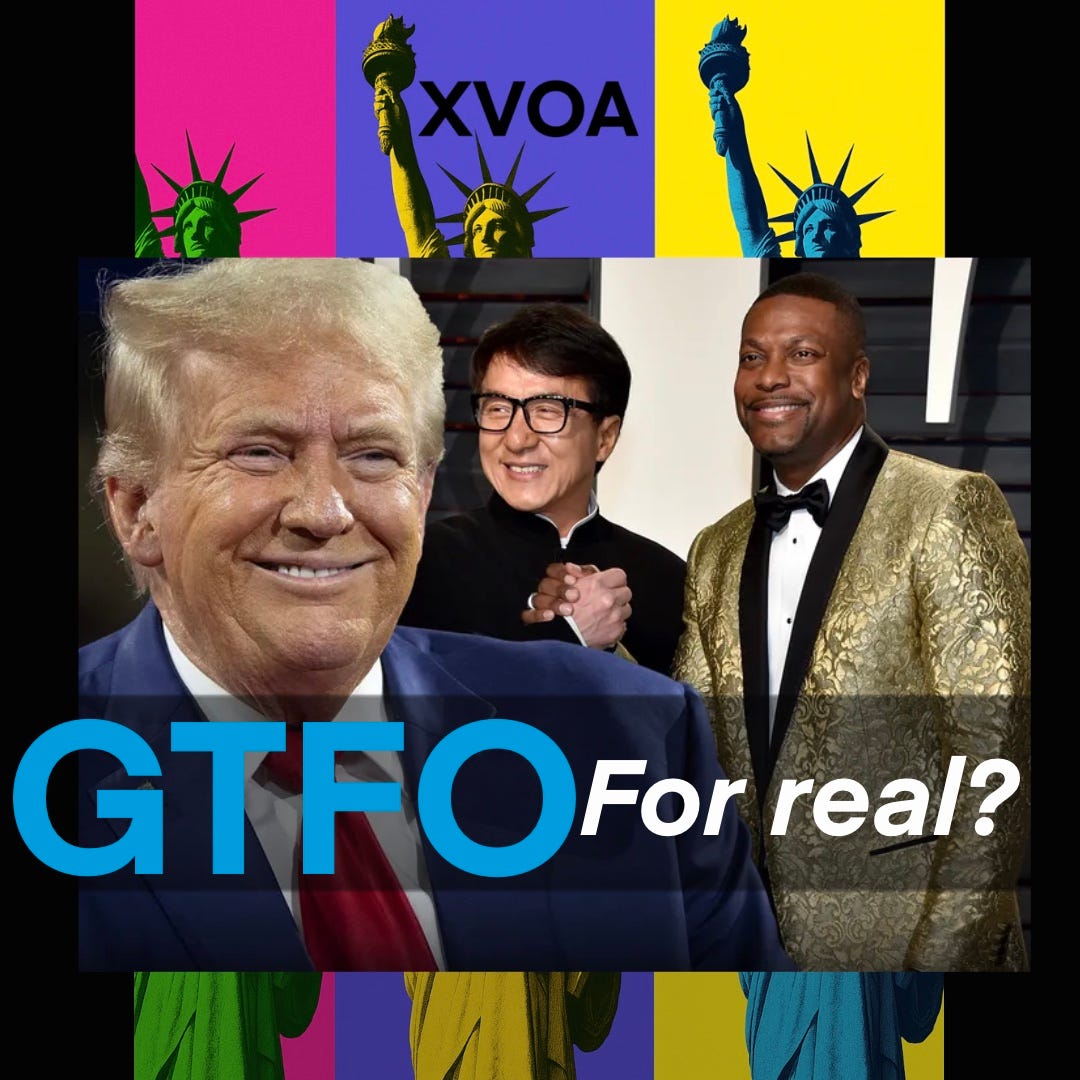
Paramount Pictures is revving up Rush Hour 4 and the surprising catalyst is President Donald Trump. In the past 48 hours, a flurry of reports revealed that Trump personally pressed his billionaire friend Larry Ellison (whose son now runs Paramount) to revive the long-dormant action-comedy franchise .
Trump’s behind-the-scenes lobbying appears to have paid off: Paramount is now in talks to distribute a fourth Rush Hour film starring Jackie Chan and Chris Tucker, with original director Brett Ratner returning . The story matters because it shows a U.S. president directly influencing Hollywood decisions and blurring the lines between politics and pop culture at a time when cultural battles already run hot.
What Liberal, Center and Right Outlets Emphasized
Liberal outlets zoomed in on the political overtones and cronyism behind the deal. The New Republic framed Trump as “waging his own cultural crusade” – intent on reviving “anti-woke, machismo-filled” 1980s/90s action comedies like Rush Hour as a new front in the culture wars . Similarly, The Guardian noted the move fits President Trump’s second-term agenda to reinject “old-fashioned masculinity” into Hollywood , pointing out that Trump recently even named action stars (like Stallone and Mel Gibson) as unofficial “special ambassadors” to promote that agenda.
Trump recently even named action stars (like Stallone and Mel Gibson) as unofficial “special ambassadors” to promote that agenda . Many left-leaning reports highlighted how Ratner who’d been exiled after #MeToo allegations is getting a comeback only because of Trump’s intervention . Some liberal commentators even quoted insider Matthew Belloni’s quip to “Get ready for the dumbest possible state-controlled media” , implying the film might serve as Trumpist propaganda.
The Daily Beast, with trademark snark, trumpeted that Trump “leaned on his billionaire buddy” Ellison to reboot the franchise, granting Ratner “his legacy movie franchise reboot” after every other studio passed . In short, left-of-center coverage cast the sequel as a reward to Trump’s friends and a broader push in his culture war.
Center-aligned outlets stuck to the facts and industry context. People Magazine and Newsweek reported that Rush Hour 4 was greenlit after the President personally lobbied Ellison – noting Paramount will distribute the sequel while Warner Bros. (the original studio) stays hands-off . These outlets emphasized what happened more than why: Chan and Tucker are set to reunite, Ratner will direct despite past misconduct claims, and Paramount won’t shoulder financing risk (it’s taking a flat distribution fee) .
Newsweek did add gentle analysis, observing that the revival “underscores how entertainment content may be shaped by external forces,” i.e. political influence . But down-the-middle reports largely avoided loaded language. They gave equal weight to Trump’s enthusiasm and even quoting his Truth Social post calling Rush Hour “funny [and] action-packed” and saying “We need more movies like this!” – and to industry reactions, like the years of stalled development and other studios’ reluctance to work with Ratner. Overall, centrist coverage treated it as a quirky Hollywood news story with an unusual political twist, but not a partisan fight.
Right-leaning outlets portrayed the President’s role in a positive or neutral light, often as a savvy move. Fox News ran a straightforward news piece announcing the sequel deal “after Trump’s request” , while underscoring that Jackie Chan and Chris Tucker have been “comparatively supportive” of Trump in the past . (Indeed, Fox cited Chan’s 2016 comment urging people to “give [Trump] a chance to change the world,” presenting it as proof that even Hollywood figures back him .)
The Washington Examiner highlighted a Fox Business segment where commentator Joe Concha celebrated the news and calling it “awesome” and predicting Rush Hour 4 “will be quite profitable” thanks to MAGA fans flocking to theaters . This explicitly pro-Trump spin suggested that by championing a popular buddy-cop comedy, Trump is “making Hollywood great again” and delivering a hit that studios had foolishly shelved. Breitbart went even further, with columnist John Nolte applauding the revival as a blow against “the left’s ongoing blacklists.” Nolte argued Rush Hour’s culture-clash humor is “healthy and unifying”, in contrast to a “Woke Gestapo” in Hollywood that he claims uses identity politics to “alienate and divide.”
In Breitbart’s telling, Trump is the loyal friend rewarding Ratner and restoring a beloved, politically incorrect franchise that liberal Hollywood wouldn’t touch. Even the British tabloid Daily Mail cast Trump as the hero of the story. It’s headline gushed that Rush Hour 4 was happening after “superfan President Trump ‘pressured’ [a] billionaire,” cheerily adding: “Trump saves Rush Hour 4!”
Shared Facts Across the Spectrum
Despite differing tones, outlets of all stripes agreed on core facts. All noted that: Jackie Chan and Chris Tucker are expected to reprise their roles, reuniting as the East-West cop duo after 16+ years . Brett Ratner will direct, marking his first feature film since multiple women accused him of sexual harassment and assault in 2017 . It’s widely reported that Paramount Pictures has secured funding and a distribution deal for Rush Hour 4, but is not financing production which is a sign the studio is cautiously just acting as distributor .
Crucially, every outlet acknowledged that Donald Trump actively lobbied Larry Ellison (the Oracle co-founder whose family now controls Paramount) to get this sequel off the ground . The timing was consistently described: multiple reports surfaced over the weekend and by Tuesday that Trump’s private push had “confirmed” Paramount’s involvement . There’s also agreement that Warner Bros. and other studios had passed on Rush Hour 4 for years, meaning without Trump’s nudge to Ellison, the project was going nowhere . Finally, many outlets mentioned that Ratner has been working on a $40 million Melania Trump documentary, implying Trump and Ratner have a friendly connection as well . These shared facts formed the backbone of coverage, even if interpretations diverged.
Domestic vs. Foreign Framing
Domestic U.S. outlets and foreign publications both covered Trump’s Hollywood intervention, but their framing differed in emphasis. U.S. media, especially entertainment trades and mainstream news, framed it as an unexpected Hollywood business story with a political twist.
There was some astonishment that a sitting president would involve himself in something as trivial as a movie sequel. Still, U.S. coverage tended toward straightforward news (“Trump asked, Paramount delivers”). For example, Newsweek and the AP-fed National Desk focused on how Trump’s push overcame industry hurdles, noting that Ellison’s takeover of Paramount gave Trump an opening to finally see his favorite 90s-style comedy revived .
Foreign outlets were more openly bemused or critical about the cultural implications. The UK’s Guardian not only relayed the news but also connected it to Trump’s broader pattern of elevating macho pop culture and mentioning his invites of Stallone and Tyson to political events and his appointment of action stars as symbolic Hollywood envoys . Euronews (Europe) took a sardonic tone: “We did not have this on our 2025 Bingo card,” it quipped, before depicting Trump as turning his attention from geopolitics to “what matters” to resurrecting his “favourite buddy cop action-comedy franchise.” The piece wryly noted that Trump’s beloved Rush Hour films are full of “outdated jokes” and stereotypes, suggesting such content “might have been unwelcome a few years ago” until Trump’s influence changed the equation .
In Pakistan’s Express Tribune, the story ran without partisan commentary but still highlighted that this development was “at President Trump’s request,” giving Trump full credit for reviving a franchise “stuck in limbo for years” . Overall, foreign coverage more freely connected the dots between Trump’s cultural politics and the movie’s resurrection, whereas U.S. coverage (outside opinion columns) was a bit more restrained in drawing those conclusions.
Underplayed or Missing Angles
Paramount’s Calculus: Few outlets probed Paramount’s internal rationale. Is the studio merely currying favor with Ellison’s friend Trump, or does it genuinely see box-office gold in Rush Hour 4? The financial reasoning beyond Trump’s ask wasn’t deeply explored.
Public Opinion: There was scant polling of audience sentiment. Do moviegoers actually want another Rush Hour in 2025? Coverage didn’t say whether Trump’s fan enthusiasm is shared by the broader public, or if his backing could provoke backlash in liberal audiences.
Ellison’s Broader Plans: Only passing mention was made of Larry Ellison’s larger Hollywood ambitions (like a mooted bid for Warner Bros. Discovery) . How Rush Hour 4 might fit into Ellison and Skydance’s strategy or regulatory scrutiny of their expansion got little attention.
Alternative Perspectives: Aside from one Guardian quote by its film critic doubting the need for Rush Hour 4 , we didn’t hear from many independent voices in Hollywood. Studio insiders, competitors, or even Chan and Tucker themselves have so far been quiet or not widely quoted.
Trump’s Use of Power: While liberal outlets noted the propaganda-ish aspect, none explicitly questioned the ethics of a president using his influence to shape studio decisions. It’s an unusual blur of politics and entertainment, but commentary on whether this is an appropriate use of presidential clout was largely absent.
Historical Echoes
Trump’s behind-the-scenes maneuver to get a movie made recalls past instances of U.S. politicians tangling with Hollywood, albeit, in usually in less direct ways. In the 1980s, President Reagan (a former actor) famously joked about wanting sequels to patriotic films, and more recently politicians often pressure media companies over news coverage. But a president acting as a de-facto movie producer is new terrain.
The closest parallels might be authoritarian leaders in other countries who dictate film projects, which makes the “state-controlled media” jab from insiders pointed. It also echoes Trump’s own history in entertainment: as a TV producer of The Apprentice, he has long seen himself as a showbiz impresario.
This Rush Hour 4 episode fits a pattern of Trump blurring roles and using political leverage to pursue personal pop culture preferences, something perhaps not seen at this level since the days of movie-loving world leaders in less democratic regimes. It’s a story where Washington meets Hollywood in a way that feels uniquely Trumpian but also reminiscent of the old studio system’s coziness with power.
3 Things to Watch Next
Hollywood’s Reaction: Will there be backlash within Hollywood about Ratner’s return (given #MeToo) or Trump’s meddling? If prominent filmmakers or actors speak out, that could inflame the culture-war narrative and even affect the project’s progress.
Paramount’s Next Moves: As Larry Ellison’s influence grows (he’s also poised to acquire Warner Bros.), keep an eye on whether more “Trump-approved” projects emerge. For instance, does Bloodsport (another Trump favorite) get fast-tracked next ? Any pattern of greenlights aligning with Trump’s tastes would be telling.
Trump on the Campaign Trail: On the political front, see if Trump himself touts his Rush Hour 4 intervention as a talking point. A claim of “bringing back American (film) greatness” could surface in rallies. Conversely, opponents might use it to question his priorities. How this plays with voters as trivial or triumphant will be something campaigns quietly gauge.
Methods and Caveats
This comparison relied on articles published within 48 hours of the story breaking, spanning U.S. and foreign outlets across the ideological spectrum. We categorized each source’s bias using ratings from AllSides/Ad Fontes and contextual judgment, and adjusted scores for tone and language. “Loaded language” and overt opinion signals were estimated by close reading, not via exact computation. The Bias Index is a rough composite of emotional language, subjectivity, and sourcing density (higher = more biased), not a precise measure. All source links and quotes were taken directly from the reporting cited, and reflect coverage as of this writing (late Nov. 2025). Future developments or retrospective reporting could shift these narratives as more facts (or spin) emerge.
If you made it this far, you’re officially part of the tiny, stubborn minority that actually reads and you’re the reason this little outfit just earned that Substack Bestseller badge. Paid subscriptions are how this goes from “side-hustle screaming into the void” to a full-time job telling the truth about the circus we’re living in. Consider upgrading to paid here and helping me keep the lights (and the jokes) on:
Sources:
The Daily Beast, The New Republic, The Guardian, Euronews, People, Semafor, Express Tribune (PK), Newsweek, Fox News, Washington Examiner, Breitbart, Daily Mail
https://www.thedailybeast.com/obsessed/home-alone-star-trump-79-gets-his-legacy-movie-franchise-reboot
https://newrepublic.com/post/203587/trump-begs-bring-back-movie-rush-hour
https://www.theguardian.com/film/2025/nov/25/rush-hour-4-paramount-trump
https://www.euronews.com/culture/2025/11/25/donald-trump-reportedly-pressuring-studio-to-revive-rush-hour-his-favourite-action-comedy-
https://people.com/rush-hour-4-in-the-works-president-trump-intervened-report-11857236
https://www.semafor.com/article/11/23/2025/how-trump-is-trying-to-remake-american-culture-starting-with-rush-hour
https://tribune.com.pk/story/2579094/rush-hour-4-in-development-with-chan-and-tucker-at-trumps-request
https://www.newsweek.com/donald-trump-rush-hour-4-movie-jackie-chan-11107887
https://www.foxnews.com/media/paramount-revives-rush-hour-franchise-reportedly-after-trumps-request
https://www.washingtonexaminer.com/news/entertainment/3899730/concha-rush-hour-4-profitable-maga-viewers
https://www.breitbart.com/entertainment/2025/11/24/nolte-trump-wants-paramount-make-rush-hour-4/
https://www.dailymail.co.uk/tvshowbiz/article-12666393
Huge omission in 3rd paragraph duly noted. After “pointing out that” the rest should read: Trump recently even named action stars (like Stallone and Mel Gibson) as unofficial “special ambassadors” to promote that agenda.
The only thing that Trump has ever been successful at is entertainment. Everything else he has ever done has failed. So it's no mystery why he'd mess with Paramount. But since our country is now all about entertainment, a sufficient number of our deluded voters put him in charge, perhaps hoping for a Hollywood ending to the story. But everything Trump touches dies. Now he's touched "Rush Hour 4." It will be interesting to see if this movie is any good and how it fits into the culture wars. Will it become a MAGA rite of passage? Will we lefties shun it just because? Or will it just die a quiet death in the back rooms, as Trump becomes more and more of a lame duck and a liability.