

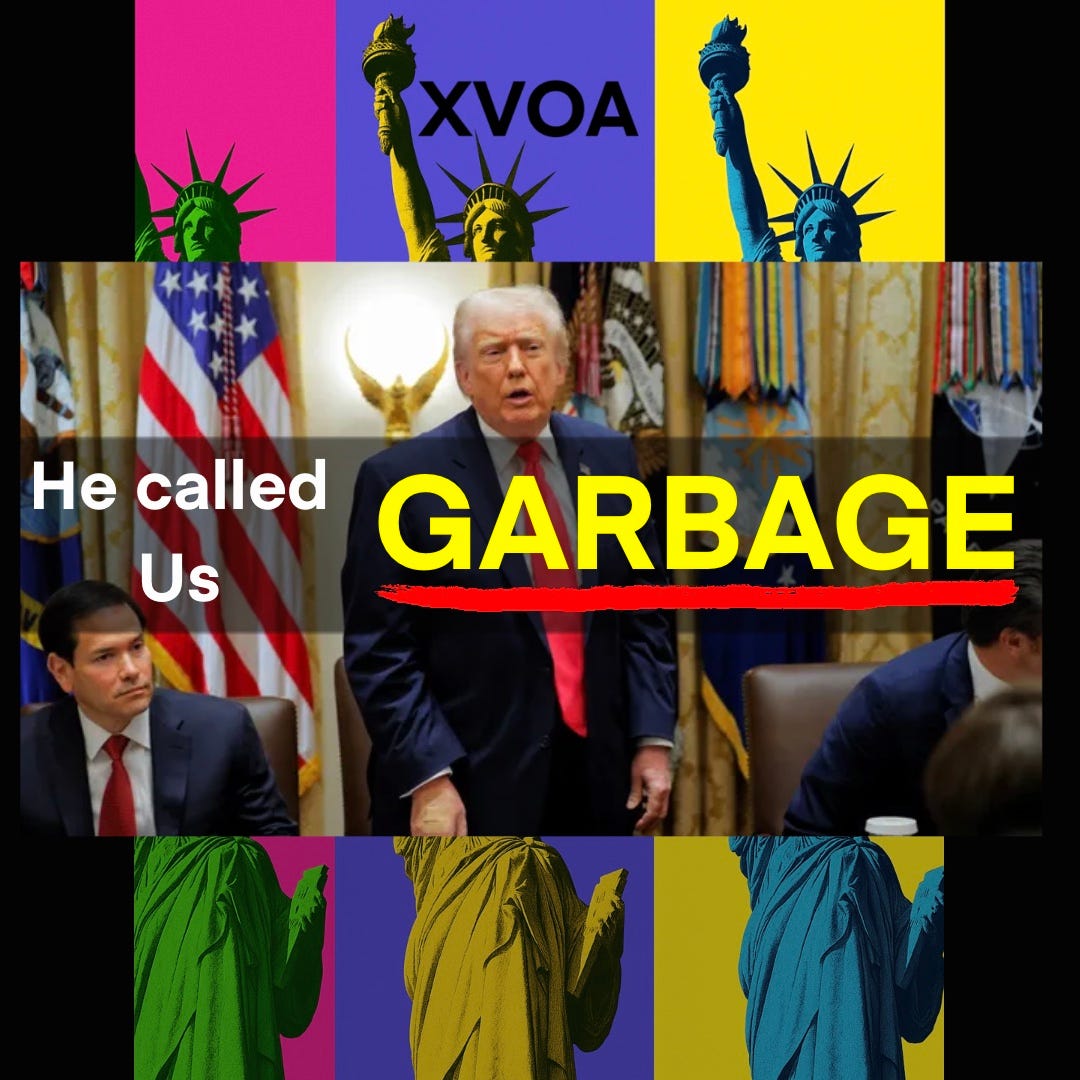
On Tuesday, during a televised Cabinet meeting, President Donald Trump referred to Somali immigrants in the United States as “garbage” and said he doesn’t want them in the country . He singled out the large Somali community in Minnesota, claiming the U.S. is “going to go the wrong way if we keep taking in garbage into our country” . Trump also targeted Democratic Congresswoman Ilhan Omar who is a Somali-born U.S. citizen by calling her “garbage” along with her friends . These remarks came amid discussion of alleged welfare fraud involving some Somali-American individuals in Minnesota and reports (later disputed by officials) of upcoming immigration enforcement raids in Somali communities .
Trump’s comments quickly drew reactions. His Vice President reportedly “banged the table in agreement,” and the White House press secretary praised the remarks as an “epic moment” . Meanwhile, Somali-American community leaders and Democratic officials condemned Trump’s language as offensive and “xenophobic”, warning it could fuel hatred . The incident has since been covered extensively by media outlets across the political spectrum, with notable differences in tone and focus.
Let me just say this. Writing this, I’ll be honest, it was hard as hell to keep a neutral tone when every sentence I read felt like a slap at basic human dignity but duty to the truth means I have to show you the receipts first, then let the anger land. Paid subscriptions are what buy me the hours to sift through the spin, line up the facts, and call out the places where mainstream media quietly looks away. That little checkmark by my name just means a growing number of people decided this work is worth backing, and I don’t take that trust lightly. If you’re able, becoming a paid subscriber not only keeps me doing this full-time, it keeps the work free for the folks who are already stretched to the limit
How Liberal Media Covered It
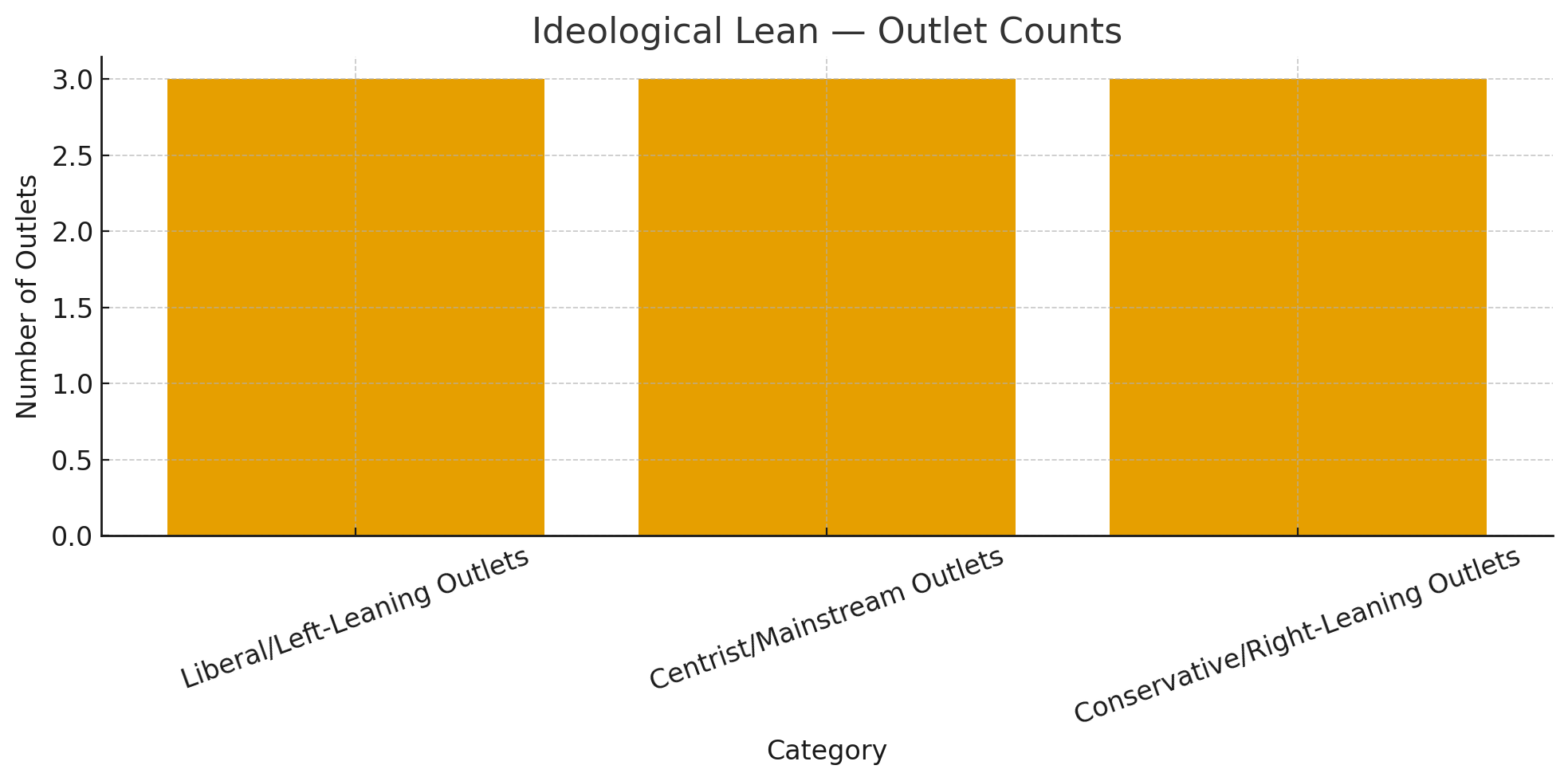
This bar chart shows how many outlets I sampled from each ideological lane: left, center, and right. It’s not a map of all media, just the mix used in this analysis. The goal is to make clear that the story you just read isn’t “one side vs the other,” but a comparison across three distinct information bubbles.
Left-leaning outlets and commentators framed Trump’s words as openly racist and dangerous. The Guardian, for example, described Trump’s dismissal of Somali Americans as “a racist rant” . Their coverage highlighted Congresswoman Omar’s response that Trump was stoking bigotry because he “knows he is failing”, and noted her observation that his attacks on immigrants are part of a longstanding pattern . MSNBC similarly emphasized the dehumanizing nature of Trump’s statement with one opinion piece opened by flatly stating, “President Donald Trump [is] dehumanizing Somali migrants by describing them as ‘garbage’,” which it called a rejection of basic American values . Liberal outlets often reminded readers of Trump’s history of derogatory remarks about immigrants of color (such as previously calling certain nations “shithole countries”) to place the Somali comments in context .
In liberal media coverage, the focus was on condemning the remarks and sympathizing with the targeted community. Many highlighted reactions from Somali-Americans and progressive voices. For instance, Mother Jones and other progressive commentators characterized Trump’s words as openly racist rhetoric and amplified Somali community members calling the comments hurtful and unacceptable. Coverage in these outlets frequently included quotes from officials like Minnesota’s mayor and governor pushing back. Minneapolis Mayor Jacob Frey’s statement – “They are our neighbors… and they are welcome in our city. Nothing Donald Trump does will ever change that” was widely circulated to counter the President’s insult (as he wrote on social media) . Overall, the liberal media tone was one of outrage and alarm, stressing that Trump’s “dehumanizing and dangerous attacks on minority immigrant communities are nothing new” and urging readers to see the comments as part of a broader pattern of bigotry.
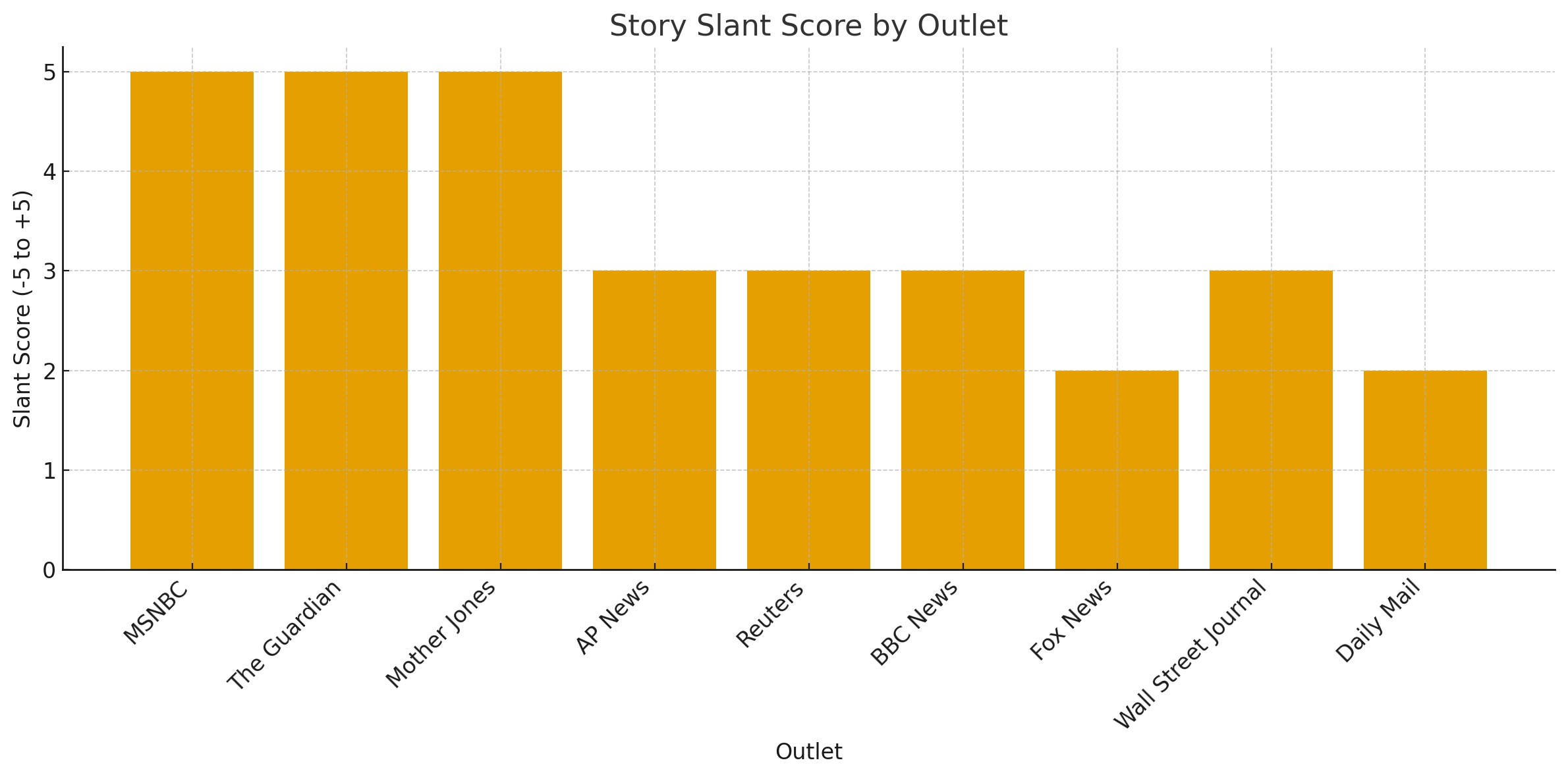
This graphic shows how each outlet leaned in its coverage of Trump’s “garbage” comment, from strongly critical (closer to –5) to more supportive or minimizing (closer to +5). It doesn’t measure “truth,” it measures tone: how the story felt if you only lived in that outlet’s world. Seeing the scores side by side makes it easier to spot which coverage was sounding the alarm and which was riding the brakes.
How Centrist / Mainstream Media Covered It
Centrist and mainstream outlets (such as the Associated Press, Reuters, and BBC) took a more neutral, just-the-facts approach. They reported what Trump said and the ensuing reactions without explicit editorializing. For example, an AP report (carried by many mainstream U.S. papers) simply recounted Trump’s quote that “we’re going to go the wrong way if we keep taking in garbage into our country” and noted that he said of Somalis, “I don’t want them in the United States” . Reuters’ coverage described the incident in a factual tone: Trump called Somali immigrants “garbage” and said he wanted them sent “back to where they came from” . These outlets made sure to include both sides of the response: for instance, Reuters noted that while Trump’s allies cheered – the Vice President and others praised the remarks – Democrats criticized the language as “xenophobic and unacceptable” .
Mainstream reports also provided context without heavy judgment. They mentioned the alleged $1 billion welfare fraud in Minnesota that Trump was reacting to , and included the fact that Minnesota officials (like Governor Tim Walz) denounced Trump’s broadside against Somalis as “racist” and defended their immigrant community . Outlets like BBC News and Reuters pointed out Trump’s history on immigration and race – noting, for example, his past “shithole countries” remark and hardline policies – but did so in a straightforward way. Any strong language (such as calling the comments racist) was usually attributed to sources or critics rather than coming from the reporter. The overall slant in centrist coverage was neutral: conveying the substance of Trump’s statements and the fact that they caused a backlash, without overtly taking a side on the morality of the remarks.
How Conservative Media Covered It
Conservative and right-leaning outlets generally presented the story with a different emphasis, often downplaying the racial controversy and focusing on supporting details or Trump’s rationale. Fox News, for instance, headlined the story as “Trump rips Somali community as federal agents eye Minnesota sweep”, framing it around law enforcement plans rather than the insult itself . Fox’s article reiterated Trump’s point that some Somali immigrants “rely too heavily on the U.S. welfare state” , implicitly justifying his frustration. It prominently discussed the Minnesota welfare fraud investigation – even noting a “$1B … case” that might be the “tip of the iceberg” – which served to contextualize Trump’s anger.
When quoting Trump’s harsh lines about Ilhan Omar and Somali migrants (including “Ilhan Omar is garbage – her friends are garbage… We don’t want them in our country”), Fox did so matter-of-factly , with no added commentary condemning the language. Instead, the piece went on to remind readers of unproven allegations against Rep. Omar (repeating an old claim that she “married her brother” to gain U.S. entry) , a tangential detail that aligns with a frequent trope in right-wing media casting Omar as suspect. Fox News also included a quote from a DHS official insisting that immigration enforcement targets illegality, “not their race or ethnicity,” seemingly to refute the idea that Somalis were being singled out unfairly .
Other conservative outlets followed a similar pattern. The New York Post focused on the fraud angle and on Trump’s criticisms of Minnesota’s Democratic leaders, rather than on moral outrage about the “garbage” comment. The Wall Street Journal – whose news coverage is generally moderate – framed the story in terms of policy and security: one report placed Trump’s expanded immigration crackdown in context of a recent violent incident involving an Afghan immigrant, subtly suggesting a justification for tougher immigration measures .
Notably, these right-leaning reports largely avoided labeling Trump’s remarks as racist or inflammatory in the reporter’s voice. Any criticism was downplayed or briefly mentioned. Instead, the tone often suggested that Trump was addressing a real problem (fraud or crime) albeit in a blunt way. This more defensive or minimizing slant meant readers of conservative outlets would see the “garbage” comment as part of a story about cracking down on wrongdoing and political opponents, rather than a story primarily about bigotry.
Domestic vs Foreign Coverage
Comparing U.S. domestic coverage to foreign international coverage reveals some differences in focus. U.S.-based outlets across the spectrum tended to view the incident through the lens of American politics and its impact on American communities (especially Minnesota). Foreign outlets, on the other hand, often put Trump’s remark in a broader global or moral context. For example, the UK’s Guardian and BBC covered the story not just as a political spat, but as an alarming instance of racial rhetoric from a U.S. leader, likely because such comments draw international concern about American society. The Guardian’s report stressed the bigotry of the tirade and how it “sparked alarm” even beyond U.S. borders .
Some international media zeroed in on the reaction of Somali communities worldwide. Al Jazeera, based in Qatar, ran a story headlined “Somalis reject Trump’s bigoted remarks”, explicitly calling his words bigoted . It highlighted how Somalis “from Mogadishu to Minneapolis” reacted with outrage and even humor – for instance, social media users parodying Trump’s attack to show resilience . Al Jazeera’s piece included voices of Somali-Americans describing fear on the ground in Minnesota and condemning Trump for betraying American ideals . This global coverage angle underscored the damage to the U.S.’s image abroad and the distress caused among diaspora populations.
Foreign outlets also tended to be more blunt in their characterizations. While U.S. network news might say “Trump made controversial remarks about Somali immigrants,” international outlets like BBC News Africa plainly referred to “Trump’s ‘garbage’ remarks” and explained why they were widely seen as racist (often assuming the audience is less entrenched in U.S. partisan loyalties) . Canadian media (e.g. The Globe and Mail) and others picked up wire stories about the incident, generally reporting the facts similarly to AP/Reuters but often with added context about multicultural values or global reaction. In summary, domestic coverage (especially on cable news and U.S. political sites) focused on the immediate U.S. political fight. Trump vs. his critics and implications for elections, etc. whereas foreign coverage zoomed out slightly to view the episode as part of the broader narrative of Trump’s populist nationalism and its repercussions on America’s reputation and minority communities around the world .
Big Picture: What This Tells Us About Media Bias
This case study of Trump’s “garbage” comment vividly illustrates how media bias and perspective shape news coverage. Depending on where one looked, the same event was portrayed with different emphasis and language. Left-leaning media painted Trump’s remarks as racist abuse, using charged descriptors like “racist rant” and “dehumanizing” to signal moral outrage . They foregrounded voices of those offended and harmed, aligning the narrative with a defense of immigrant communities. Centrist outlets stuck to dry facts and a “he said, critics said” balance, giving readers the information without strong guiding language on how to feel about it . Right-leaning outlets, meanwhile, downplayed the racial aspect and framed the story around Trump’s concerns about fraud and security, implicitly validating his point of view . In some cases, conservative coverage even redirected the focus onto alleged wrongdoings by Trump’s targets (mentioning Ilhan Omar’s controversies or Minnesota’s welfare issues) rather than dwelling on the offense of the “garbage” slur.
The divergent coverage shows that media bias isn’t just about political alignment; it influences which facts are highlighted and the tone of an article. A reader of a liberal outlet might come away seeing Trump’s comments as a shocking example of racism that threatens American values. A reader of a conservative outlet could come away thinking the President was blunt but addressing a real problem with immigration or fraud, and that the media or liberals are overreacting. A reader of a centrist newswire story would know what was said and that it upset people, but not be explicitly told how egregious or justified it was – that would be left to the reader’s interpretation of the quotes and context.
Additionally, domestic vs. international angles show how cultural context matters. U.S. outlets assume their audience’s familiarity with domestic politics (e.g. mentioning “the Squad” or Minnesota elections), whereas international outlets often contextualize Trump’s behavior against global norms (e.g. comparing it to authoritarian rhetoric or noting the response of human rights groups).
In the end, this episode tells us that media coverage can be as polarized as the politics it reports on. The facts were the same. The President used the word “garbage” about a group of immigrants but the storytelling ranged from outraged to neutral to defensive. It underscores the importance of consuming news from multiple sources. By comparing coverage side by side, as we’ve done here, one can better discern the underlying bias and get a fuller picture of both the event itself and how different groups want it to be perceived. Readers are reminded that headlines and framing can significantly tilt one’s perception of an event, and seeking out a variety of perspectives is key to understanding the big picture behind the headlines.
If you made it this far, you’re officially part of the tiny, stubborn minority that actually reads and you’re the reason this little outfit just earned that Substack Bestseller badge a little over a week ago. Paid subscriptions are how this goes from “side-hustle screaming into the void” to a full-time job telling the truth about the circus we’re living in. Consider upgrading to paid here and helping me keep the lights (and the jokes) on:
Sources:
1. Reuters – Trump calls Somali immigrants “garbage”
https://www.reuters.com/world/us/trump-calls-somali-immigrants-garbage-promises-send-them-back-2025-01-28/
2. Fox News – Trump criticizes Somali community amid reported DHS sweep
https://www.foxnews.com/politics/trump-rips-somali-community-federal-agents-eye-minnesota-sweep
3. The Guardian – Trump launches racist tirade against Somali Americans
https://www.theguardian.com/us-news/2025/jan/28/donald-trump-somali-americans-racist-comments
4. MSNBC Opinion – Trump dehumanizing Somali migrants
https://www.msnbc.com/opinion/msnbc-opinion/trump-somali-migrants-garbage-comment-rcna168563
5. Associated Press (AP News) – Trump says Somali immigrants are “garbage”
https://apnews.com/article/trump-somali-immigrants-garbage-minnesota-omar-2f9aeb50bf0a4a0a8f0368be35b8e5c9
6. BBC News – Coverage of Trump comments about Somali immigrants
https://www.bbc.com/news/articles/c72ryp9y8j6o
7. Al Jazeera – Somalis worldwide reject Trump’s bigoted remarks
https://www.aljazeera.com/news/2025/1/29/somalis-worldwide-reject-trumps-bigoted-remarks
8. New York Post – Minnesota welfare fraud context & Trump comments
https://nypost.com/2025/01/28/us-news/minnesota-fraud-case-trump-somali-comments/
9. Wall Street Journal – Immigration crackdown context
https://www.wsj.com/articles/trump-expands-immigration-enforcement-minnesota-somali-immigrants-2025-1-28
10. Minneapolis Mayor Jacob Frey statement (via social link)
https://x.com/MayorFrey/status/1884300517148600416
11. Minnesota Governor Tim Walz response
https://x.com/GovTimWalz/status/1884303370382547081
12. Additional Al Jazeera diaspora reactions
https://www.aljazeera.com/features/2025/1/29/somali-americans-react-trump-garbage-comment
Right on! I recognize these biases in myself - I can't stomach reading right-wing "journalism," so my diet is rich in Guardian, MSNow, etc. The process, by the way, is called "epistemic freezing:" the tendency for people, as their viewpoints begin to consolidate, to focus more and more on stimuli that confirms their viewpoints. It's another one of those human cognitive traits that we need to learn to cope with. It creates an existential risk.
Clearly, the phenomenon of epistemic freezing is being exploited by the powerful and the authoritarian to divide and conquer. A big scary issue right now is the flood of social media, the hidden manipulation of content streams, and the biasing of so-called "mainstream media." The techniques I learned as a young professional to resolve conflict - most notably active listening - often fail when fundamental reality is not shared. For example, some years ago I actively listened to a bunch of (liberal) people on the topic of anti-racism. There were those who simply did not believe in the fact of microaggression, even when confronted with a victim's explanation.
Currently, people actually believe in fantasies such as Michelle Obama being a guy, or Haitian immigrants devouring pets. How do you discuss public health with someone who doesn't believe in vaccination? How do you discuss public policy with someone who thinks that human-caused climate change is a hoax? Etc.
I came of age, here in Canada, at about the onset of the Vietnam "war", with American involvement predicated on a fabricated incident (the Gulf of Tonkin episode...look it up), and on the "domino theory" whereby communist take over of South Vietnam by North Vietnam would open a floodgate of communism establishing itself first in Australia and then across the world, thus the need to stop it there before it reached us here. The Americans essentially thought that there was no difference between the ka-zillions of Chinese and the North Vietnamese -- all of them evil commies coming to destroy us all. Actually they had a history of mutual dislike that was a matter of record, had Americans bothered to look.
To this day I think the real reason for that folly, which needlessly cost so many lives before resulting in pretty much what we would have had, had America not interfered with what was otherwise a civil war, was to goose the military economy in the U.S.
But related to your essay is the point I want to make, and that is that living near the border I could, in black and white, watch both Canadian and American news channels, as few as they were, and it was like they were reporting on two different wars. The inglorious defeat of the Americans, not unlike the one suffered in Afghanistan a generation or so later, came, I suspect, as much less of a surprise to Canadians and news consumers in other countries than it did to Americans.
I still say that the most important thing to teach kids, all kids, from kindergarten onward, is critical thinking and the ability to discern demonstrable fact from opinion. Both can serve valid functions, but they should be distinguished from each other...um...and the fact is: that is my opinion.