


How Different Media Covered Trump’s National Security Strategy Announcement
On December 4, 2025, President Donald Trump’s administration released a new National Security Strategy (NSS) outlining its foreign policy vision. This official document which is required by U.S. law for each administration marked the first NSS of Trump’s return to office. It arrived nearly a year into his term and presented a sharp break from the previous administration’s approach. The strategy emphasized Trump’s “America First” philosophy, prioritizing U.S. interests and skepticism of international entanglements .
In the NSS, the Trump White House delivered unusually harsh language toward America’s traditional allies in Europe. It warned that Europe faces the “prospect of civilizational erasure” – essentially saying European nations could lose their identities due to issues like immigration and EU integration . The document suggested some NATO allies might become unreliable partners in the future if current trends continue . It even stated the U.S. should “cultivate resistance” within Europe to its current path, indicating support for nationalist movements opposed to the European Union . This was a striking departure from past U.S. policy, which usually bolstered the EU and transatlantic unity.
The strategy also called for reasserting U.S. influence in the Americas. It proposed a “Trump Corollary” to the Monroe Doctrine – a 19th-century policy opposed to European interference in the Western Hemisphere – as a way to restore American dominance in Latin America and the Caribbean . This included tough measures like using the U.S. military and other tools to combat drug cartels and curb mass migration from the region . In the Middle East, the NSS signaled a step back from trying to reshape other countries’ governments. It argued the U.S. would stop “hectoring” (lecturing) friendly regimes about democracy and human rights, focusing instead on pragmatic partnerships and economic opportunities .
Trump introduced the document as “a roadmap to ensure that America remains the greatest and most successful nation in human history”, underscoring its America-first theme . The timing was also notable – coming late on a Thursday night – and it immediately sparked reactions at home and abroad. European officials, upon reading the NSS, were alarmed by passages questioning their stability. For example, Germany’s foreign minister responded that issues like freedom of expression in Europe “do not need outside advice” from the U.S. . In short, Trump’s new strategy set a controversial tone, and different media outlets reported on it in very different ways.
How Liberal Media Covered It
Liberal and left-leaning media outlets reacted with strong criticism of Trump’s NSS, often using vivid language to condemn its themes. Many of these outlets highlighted what they saw as extremist or even racist overtones in the document. For example, The Guardian (a British liberal newspaper) ran a headline characterizing the policy paper as “laying bare Trump’s support for Europe’s far right” . Its coverage pointed out that the text explicitly endorses nationalist, anti-immigrant European political parties – something unprecedented in a U.S. strategy. The Guardian noted the NSS’s wording appears to embrace the “great replacement” conspiracy theory, a racist notion that white Europeans are being “replaced” by non-European immigrants . The paper quoted the strategy’s warning that Europe could be “unrecognisable in 20 years or less” if trends continue, calling this language extraordinary and echoing far-right rhetoric . In summary, The Guardian painted the NSS as “explosive” and alarming, saying it “makes explicit Washington’s support for Europe’s nationalist far-right parties” .
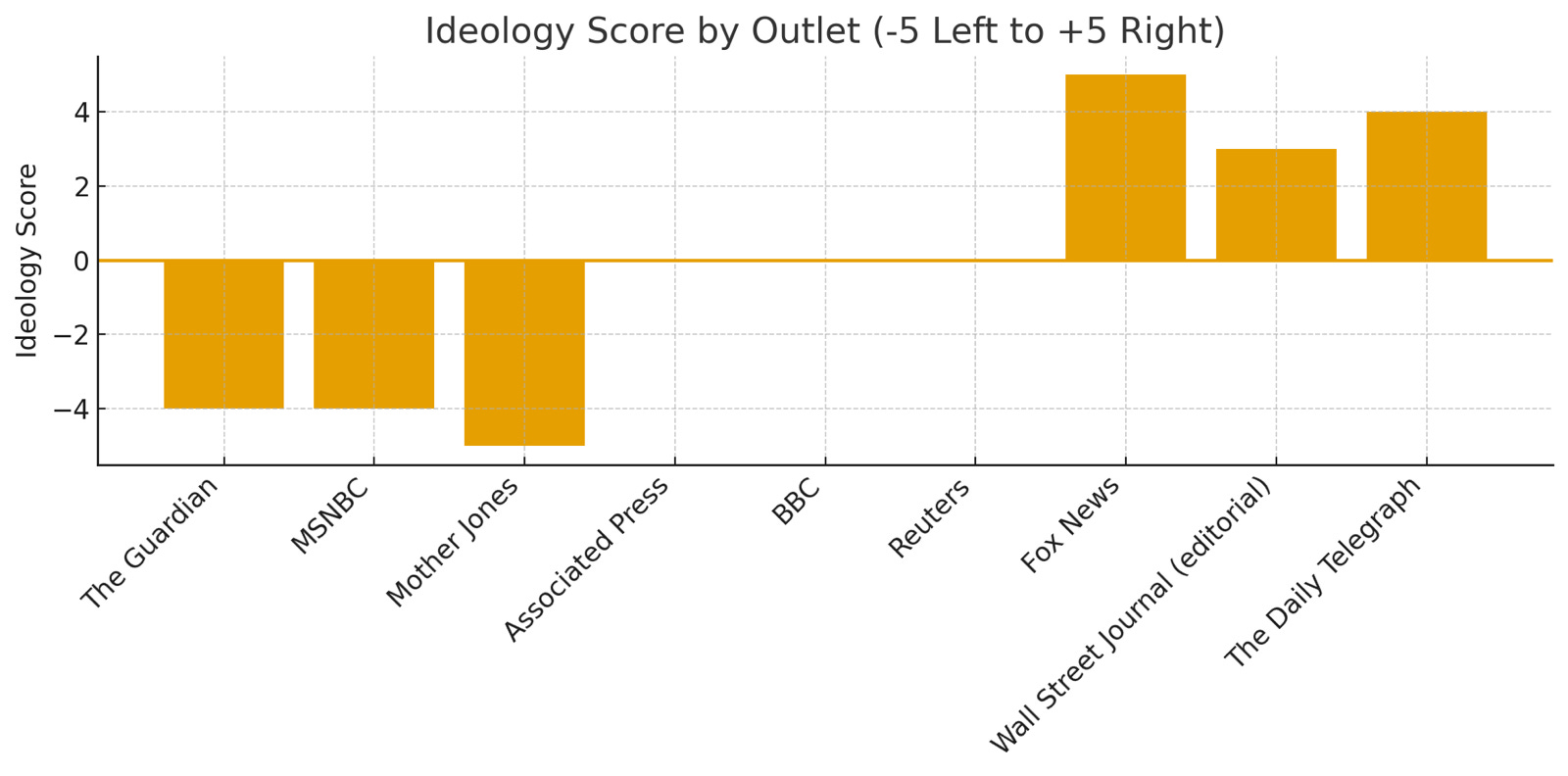
This chart maps each outlet on a simple left–right line, from −5 (strongly left) to +5 (strongly right). You can see The Guardian, MSNBC, and Mother Jones clustered on the left, Fox News and the Telegraph on the right, and AP, BBC, and Reuters near the middle. It’s not a morality score, just a visual snapshot of typical editorial lean.
Left-leaning American outlets took a similar tone. Commentators on MSNBC (a liberal U.S. cable news network) and writers in publications like HuffPost and Mother Jones zeroed in on the idea that Trump’s strategy was pandering to white nationalist themes. For instance, a HuffPost report (syndicated on other platforms) said the document read like a “dog whistle” to white nationalists . (A “dog whistle” means a coded message aimed at a particular audience, in this case far-right extremists.) That report noted the NSS was released in the “wee hours” of the morning and bemoaned what it called “civilizational erasure” in Europe – language HuffPost described as “much of it could be read as a dog whistle to white nationalists.” The outlet emphasized how the strategy blamed a “diversifying Europe” for weakening NATO, implicitly critiquing multiculturalism .
On MSNBC, hosts and analysts discussed how shocking it was for a U.S. policy to suggest some NATO countries might become majority non-European. They connected this to far-right ideology. Some commentators pointed out that the NSS’s hardline stance mirrored proposals from conservative think-tanks (like the Heritage Foundation’s “Project 2025”), warning that Trump was enacting an extreme agenda. Progressive magazine Mother Jones likewise lambasted the strategy. Although Mother Jones is known more for investigative journalism and did not have a major news article on the NSS, its editors and writers echoed the sentiment that Trump’s foreign policy had taken a dystopian turn, effectively promoting xenophobia. They highlighted lines in the strategy that they interpreted as saying the U.S. must help keep Europe “white” and free of immigrant influence. This is a viewpoint Mother Jones condemned as openly embracing far-right European nationalism.
In summary, liberal coverage was highly critical. These outlets used emotional and moral language, warning that Trump’s plan was propaganda for ultra-conservative and racist elements. They frequently cited the most extreme-sounding phrases (like “civilisational erasure”) to argue that the NSS was dangerous. Quotes from the document such as the call to “cultivate resistance” inside Europe were presented as proof that the Trump administration was encouraging anti-democratic movements abroad . Overall, the left-leaning media portrayed Trump’s strategy as a radical departure that undermines democratic values and caters to the far-right.
How Centrist / Mainstream Media Covered It
Centrist and mainstream news outlets, those aiming for a neutral tone, delivered more measured coverage of the NSS announcement. Organizations like the Associated Press (AP), Reuters, and the BBC reported the facts of the policy document and noted the reactions without overt emotional language. Their goal was to explain what the strategy says and why it matters, sticking to a straightforward tone.
For example, an AP news story led with the key point that Trump’s strategy “paints European allies as weak” and seeks to reassert U.S. dominance in the Western Hemisphere . This neutral summary captured the essence of the NSS: it criticized Europe and emphasized American power in the Americas. The AP piece explained the context – that this was Trump’s first strategy since returning to office and a clear break from President Biden’s approach of rebuilding alliances . AP journalists highlighted the America First philosophy running through the document, quoting the line that the U.S. strategy “is motivated above all by what works for America — or, in two words, ‘America First,’” directly from the text . They also included reactions from U.S. lawmakers for balance. For instance, AP noted that a Democratic congressman, Jason Crow, called the strategy “catastrophic to America’s standing in the world,” though they presented this alongside the factual description rather than as their own conclusion .
Reuters, an international news agency rated as center, took a similar approach. A Reuters report out of Berlin matter-of-factly reported that “Europe faces ‘civilisational erasure’ and may one day lose its status as a reliable U.S. ally, the Trump administration said in a major strategy document,” and that this language was “drawing an outcry from Europeans.” This framing shows no obvious slant – it states what the U.S. document claims and notes the reaction it provoked. Reuters then gave specifics: it mentioned the NSS accuses European governments of undermining democracy and even “notably does not list Russia as a threat.” In fact, Reuters highlighted that the strategy seemed to flip the usual script by casting Europe, not Russia, as the main problem – a significant newsworthy detail.
Their piece included quotes from European figures to illustrate the backlash. For example, former Swedish Prime Minister Carl Bildt said the language is something you’d expect from “the Kremlin” (Russia’s government), not the U.S., and described the document as “to the right of the extreme right in Europe.” By providing such quotes, mainstream coverage showed the reader how unusually harsh the U.S. words were, without the reporters themselves using loaded adjectives.
The BBC (Britain’s national broadcaster, known for a centrist stance) also covered the story as a significant international development. A typical BBC-style report would recount the key points: Trump’s NSS criticizing Europe’s economy and migration policies, the call to enforce the Monroe Doctrine in Latin America, and the shift away from promoting democracy abroad.
The BBC would likely note that European Union officials declined to comment or were unsettled, and mention any official responses from allied governments in a factual way. If Russian leaders reacted (as they did), the BBC would report that too. The emphasis would be on what was said in the strategy and what various officials said in response, without obvious approval or disapproval from the BBC reporter.
In summary, centrist mainstream outlets provided a neutral, factual summary of Trump’s national security strategy. They highlighted the most newsworthy aspects – the tough talk on Europe, the America-first tone, the Monroe Doctrine revival – but avoided dramatic or judgmental descriptors. Instead of calling the strategy “frightening” or “heroic,” they let the content and quotes from others speak. For readers, this coverage delivered the basics: Trump’s NSS was a sweeping policy shift, it criticized European allies as falling weak, and it set a new tone in U.S. foreign policy. Any interpretation (good or bad) was mostly left to quoted sources or to the readers themselves.
How Conservative Media Covered It
Conservative and right-leaning media outlets generally praised or defended Trump’s National Security Strategy, often framing it as a bold and positive plan. Instead of focusing on the controversies, these outlets highlighted aspects that aligned with conservative values: national strength, sovereignty, and tough stances on issues like immigration. They tended to present the NSS as Trump delivering on his promises to put America first and stand up to global challenges.
In the United States, Fox News gave the story an approving spin. Fox’s coverage emphasized the restoration of American power and leadership. One Fox News headline declared: “Trump pledges to reassert Monroe Doctrine to restore American power.” The subheading noted that the strategy “aims to enlist established friends and expand relationships while countering adversaries” – a very upbeat summary of the NSS goals. In its article, Fox News highlighted Trump’s commitment to the Monroe Doctrine, explaining the historical reference (President James Monroe’s warning for Europe to stay out of the Americas) and stressing that Trump’s new “corollary” is just “common-sense and a potent restoration of American power” . That phrase actually comes from the strategy document itself, but Fox quoted it to reinforce the idea that this approach is reasonable and smart.
The network focused on how Trump would protect the Western Hemisphere and secure the U.S. border, describing these plans in a positive light. Any mention of the more controversial lines about Europe was downplayed. For example, Fox noted the section about immigration by simply stating “the era of mass migration is over” and that border control is essential , which aligns with conservative viewpoints on immigration. Overall, Fox News presented the NSS as a strong, proactive blueprint for U.S. foreign policy, and as a continuation of Trump’s campaign themes about strength and sovereignty.
The Wall Street Journal’s editorial page (a traditionally conservative-leaning opinion page) also viewed the strategy through a strategic lens, albeit with a bit more nuance. While the Journal’s news reporters wrote about European allies’ shock, the editorial commentators tended to analyze whether Trump’s approach would benefit U.S. interests. The WSJ didn’t resort to alarm; instead, it acknowledged that the NSS “sharply recasts the U.S. view of Europe” as declining and overregulated . An editorial or op-ed might have argued that Europe does indeed need to contribute more to its own defense – a point many conservatives agree on – even if Trump’s wording was provocative.
The Wall Street Journal opinion writers often favor a hard line on China and a strong military posture, but they also usually support NATO and U.S.-European ties. So their take may have been cautiously supportive of Trump’s emphasis on strength, while questioning the wisdom of alienating allies. For instance, they might praise the Monroe Doctrine revival as a long-overdue focus on the U.S.’s backyard and a check on China/Russia influence in Latin America.
At the same time, they could subtly criticize the strategy for casting Europe as a “villain” rather than Russia, noting that Russia was not even labeled a threat in the document . In general though, the WSJ’s conservative editorial stance meant their coverage was far less outraged than liberal media – it was more about debating the policy’s effectiveness than its morality.
In the UK, The Daily Telegraph – a right-leaning British newspaper – covered Trump’s NSS from the perspective of a foreign ally that has often been sympathetic to some of Trump’s views. The Telegraph’s coverage likely did not condemn Trump; instead, it may have echoed some points about Europe’s problems. For example, the Telegraph might focus on the U.S. urging Europe to “stand on its own feet” for defense and the critique of EU bureaucracy. Given the Telegraph’s Euroskeptic (anti-EU) leanings, it might even agree that EU policies and migration have created serious issues in Europe, essentially validating the NSS’s concerns (though perhaps not its drastic wording).
Any positive reactions, say, supporters of Brexit or European conservatives who welcomed Trump’s stance, would find a place in Telegraph reporting. This contrasts with a paper like The Guardian (left-leaning), which only highlighted negative reactions. The Telegraph likely presented Trump’s strategy as a challenge to Europe rather than an outright betrayal. Its tone toward Trump’s policy would be respectful, if not outright approving, describing it as a wake-up call for Western allies to address security and cultural issues.
Across conservative media, there was an evident bias toward highlighting the NSS’s strong points (from their perspective). They framed Trump as tough and proactive. Any notion that the strategy was “racist” or beyond the pale was generally absent in their coverage. Instead, terms like “common-sense”, “restoring power”, and “American strength” were prevalent . In essence, right-leaning outlets portrayed the strategy as a positive affirmation of U.S. leadership and a plan that puts adversaries (like drug cartels or hostile regimes) on notice.
Criticisms from European officials were mentioned briefly, if at all, and often with a hint that those officials might be overreacting or that Trump is simply telling hard truths. This supportive framing is the mirror image of what liberal outlets did, demonstrating how two sides of the media spectrum can spin the same policy in opposite ways.
Domestic vs. Foreign Coverage
Another interesting aspect of the coverage was the difference between domestic U.S. media and foreign media (especially European). American outlets, whether left, center, or right, often filtered the story through a U.S.-centric lens, focusing on what the NSS meant for American politics and policy. Foreign outlets tended to focus on how it affected them and global alliances.
In the U.S., coverage immediately broke down along partisan lines (as described above). The debate was largely about Trump’s intentions, his base, and whether this strategy was good or bad for America’s role in the world. Liberal U.S. media worried about abandoning allies and democratic ideals, while conservative U.S. media cheered the assertiveness and focus on American interests.
This domestic debate sometimes treated Europe’s reaction as a side note. For example, a liberal U.S. piece might use European anger to bolster their argument that Trump was reckless, and a conservative piece might suggest European criticism was to be expected or even justified. But in both cases, the primary audience was Americans, and the tone was influenced by U.S. political bias.
Foreign coverage, on the other hand, often expressed shock and concern from the perspective of allies. In Europe, even center-right politicians were taken aback by the U.S. stance. Many European news outlets, whether liberal or conservative by local standards, highlighted the unprecedented nature of Washington seemingly turning against Europe. A French or German newspaper might lead with the alarm of officials reading that the U.S. thinks Europe is on the brink of collapse. For instance, Reuters reported how European leaders privately described Trump’s document as “shocking” and akin to something from Moscow.
One former European prime minister said “the happiest country reading this is Russia” , implying that the Kremlin wins when the U.S. and Europe are divided. This kind of quote was more prominently featured in foreign coverage, because it directly addresses what the NSS means for Europe’s security.
We saw foreign media underline that Russia openly praised Trump’s strategy – a striking detail. Russian President Vladimir Putin’s spokesman said the adjustments in U.S. policy “correspond in many ways to our vision,” and welcomed the U.S. call for cooperation with Moscow . This is a remarkable role reversal: typically U.S. strategies offend Moscow, but here Moscow was pleased. Australian broadcaster ABC News highlighted this angle with the headline “Kremlin praises Donald Trump’s national security strategy,” noting that the plan was “largely consistent with Moscow’s vision.” Such coverage shows that outside the U.S., people are gauging how Trump’s policies line up with other world powers’ interests.
European outlets also discussed how they might need to respond, for example, by boosting their own defense spending and unity if America might not have their back. British media of all stripes had to consider what Trump’s stance meant for the UK and NATO. The Guardian stressed how this put Europe on its own, quoting analysts who said Europe basically can’t rely on the U.S. now . Meanwhile, even a conservative-leaning UK outlet like The Daily Telegraph would share the concern that Europe must take this seriously, though they may frame it as a necessary reckoning rather than a betrayal.
In summary, U.S. domestic coverage was polarized around Trump, whereas foreign coverage was centered on “What does this mean for us?”. U.S. outlets discussed Trump’s NSS in the context of American politics and ideology. Foreign outlets – whether in Europe, Asia, or elsewhere often viewed it through the lens of international relations and their own national interest. They tended to be more straightforward in expressing dismay or surprise, since for them Trump’s policy was not an internal political issue but an external shock. This split shows how media bias isn’t just about left vs. right, but also home vs. abroad perspectives. Domestic media sometimes missed or downplayed the global implications (for instance, not all U.S. reports highlighted Russia’s approval of the strategy), while international media zeroed in on those aspects.
Big Picture: What This Tells Us About Media Bias
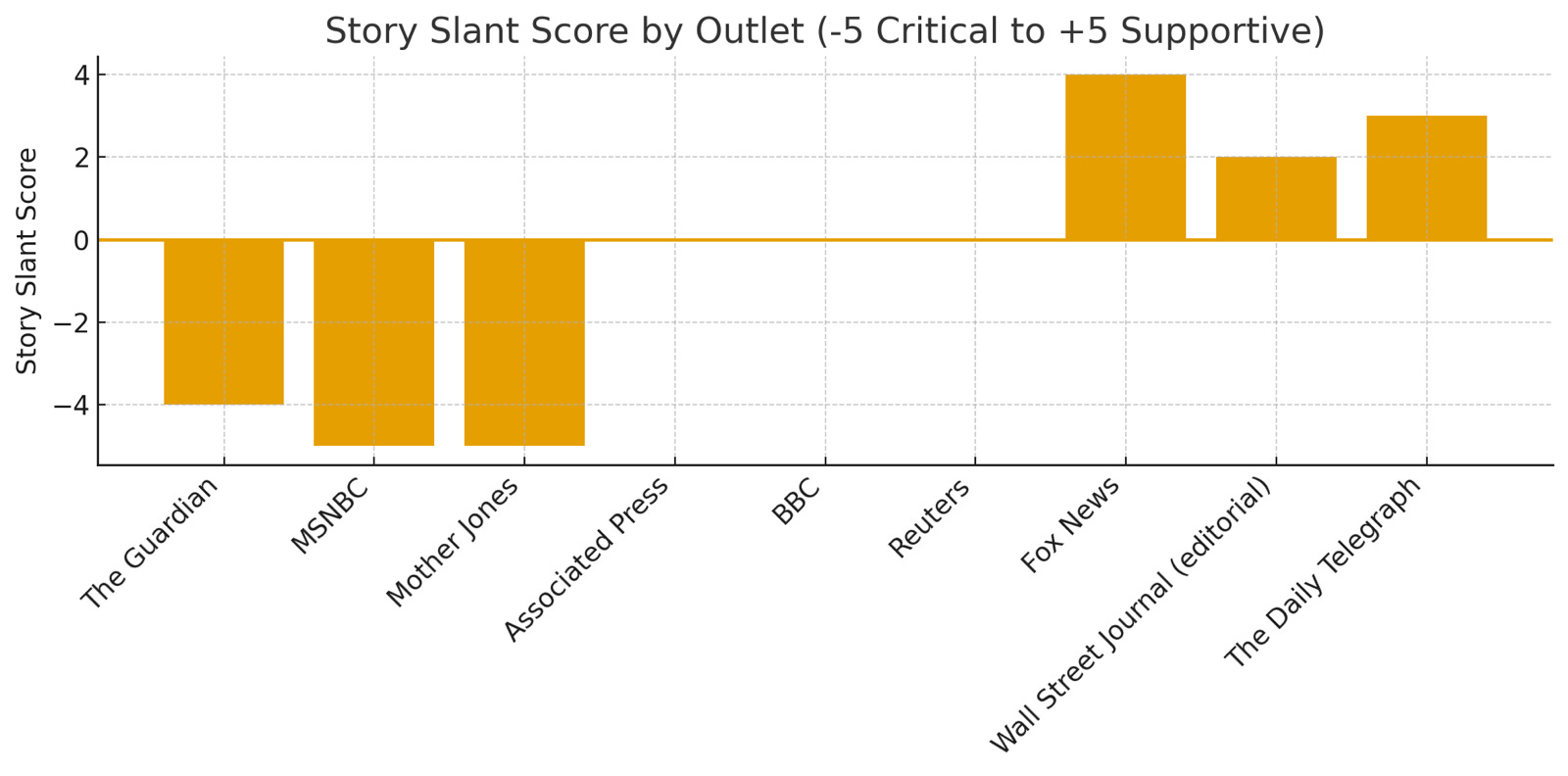
This chart shows how each outlet’s coverage leaned on this specific story, from −5 (sharply critical of Trump’s strategy) to +5 (strongly supportive). Left-leaning outlets hammer the plan, Fox News and the Telegraph cheer it on, and AP, BBC, and Reuters sit near zero with mostly straight-wire reporting.
The varied coverage of Donald Trump’s National Security Strategy provides a clear example of media bias in action. The facts were the same, a 33-page policy document was released, containing certain quotes and proposals but different outlets told very different stories about it.
Liberal vs. Conservative Slant: Left-leaning outlets cast the NSS in a very negative light, using words like “racist,” “far-right,” and “dog whistle”. They emphasized aspects that would alarm their audience (support for nationalist parties, harsh anti-immigration rhetoric, alleged alignment with white nationalist ideas) . By contrast, right-leaning outlets highlighted positive or agreeable aspects, using upbeat descriptors. They focused on strength, sovereignty, and patriotism – for example, calling the strategy “common-sense” and a return to American greatness . They either downplayed or ignored elements that didn’t fit that narrative (like the snub to European allies). This shows how confirmation bias plays out in media: each side cherry-picked elements of the story that confirmed their pre-existing viewpoint on Trump. A reader of only liberal media would come away thinking this NSS was a terrifying step toward authoritarianism. A reader of only conservative media might believe it was a triumphant reinforcement of national security.
Centrist Reporting and Balance: Outlets aiming for the center tried to avoid loaded language and let the facts speak. However, even neutral wording can highlight different things. For instance, AP and Reuters both reported the facts, but Reuters chose to foreground the conflict with Europe and absence of Russia as a foe , which implicitly raises questions, whereas AP’s focus on “weak European allies” echoed the NSS’s own framing more. Both are true, but selection is part of bias. Still, the mainstream coverage provided important context and didn’t overtly take sides, which is crucial for readers seeking straight news. It’s a reminder that not all media coverage is partisan – but what gets emphasized or omitted can subtly influence perception.
Domestic vs. Foreign Focus: The divergence between U.S. and foreign media shows another kind of bias – cultural or national bias. U.S. outlets, even when factual, view the world through an American lens. Foreign outlets have a different lens. Neither is “wrong,” but each is incomplete alone. Understanding Trump’s strategy fully would require seeing both how it plays in Peoria and how it plays in Paris. Media bias often means we get a narrow view. Domestic audiences might not realize just how stunned allies are, and foreign audiences might not grasp the U.S. internal debate behind such a policy.
Use of Jargon and Assumptions: This story also illustrated how media on each side use jargon or references their audience understands. Liberal media talked about the “great replacement theory” and “dog whistles” , assuming readers know these are bad, racist concepts. Conservative media referenced the Monroe Doctrine and “America First” positively, assuming readers see those as good, patriotic ideas . Each side glossed over explanations that might undermine their stance – for example, the left didn’t dwell on why some might find merit in pressuring Europe, and the right didn’t explain why Europeans felt insulted. In doing so, they reinforced their audiences’ worldviews rather than challenging them.
Overall, the coverage of Trump’s NSS announcement is a case study in how media bias works. Same event, different stories. One policy document became, in liberal media, evidence of creeping authoritarianism and racism, and in conservative media, evidence of strong leadership and realism. Centrist outlets tried to stay neutral but still had to choose what leads and what quotes to include. Domestic media often turned it into a partisan fight, while foreign media viewed it as a geopolitical earthquake. For a savvy news consumer, the lesson is to compare sources. By reading across the spectrum – say, a Mother Jones piece, an AP report, and a Fox News story – one can piece together a more complete picture. Each outlet on its own will have blind spots or biases, but recognizing those biases is the first step. In this story, seeing how differently it was covered reminds us that media outlets often reflect their audience’s expectations and prejudices. To get the “big picture,” it helps to look at multiple perspectives. The truth is usually somewhere in between.
In summary, the media reactions to Trump’s December 4, 2025 National Security Strategy show clear divisions: liberal vs. conservative, American vs. international. This tells us that media bias is real and influential. Consumers of news should be aware that any single article might be telling only part of the story. Understanding media bias – and checking multiple sources – is key to being well informed, especially on polarizing topics like this one.
If you want at least one place that does that work on purpose, with receipts instead of vibes, that’s what I’m trying to build here. When you decide to become a paid subscriber, you’re not tipping a creator, you’re underwriting a newsroom that refuses to kneel. Your subscription buys time, spine, and oxygen: hours to dig, courage to publish, and the breathing room to say the quiet parts out loud without asking anyone’s permission.
Xpose the lies,
Xplore the truth,
Xplain the real
That’s the door I’m holding open. If you’re ready to step through whether you carry a press badge, an overdrawn card, or just the ache that says “this can’t be all there is” I’ll be on the other side doing the work you came here for.
Sources:
Here’s a clean numbered list of plain-text links you can use for sources (no titles, just URLs):
https://www.whitehouse.gov/wp-content/uploads/2025/12/2025-National-Security-Strategy.pdf
https://www.reuters.com/business/finance/us-strategy-document-says-europe-risks-civilisational-erasure-2025-12-05/
https://www.reuters.com/business/finance/trump-strategy-document-revives-monroe-doctrine-slams-europe-2025-12-05/
https://apnews.com/article/dd672c0d0b3f31378c39381ef8ea8dea
https://www.theguardian.com/us-news/2025/dec/05/trump-administration-news-update-today
https://www.theguardian.com/world/2025/dec/08/europe-leaders-no-longer-deny-relationship-with-us-changed
https://www.foxnews.com/politics/trump-rewrites-national-security-playbook-mass-migration-overtakes-terrorism-top-us-threat
https://www.foxnews.com/politics/trump-pledges-reassert-monroe-doctrine-restore-american-power
https://www.foxnews.com/world/white-house-roadmap-europe-unrecognizable-20-years-migration-raises-doubts-us-allies
https://www.abc.net.au/news/2025-12-06/trump-warns-europe-faces-civilisational-erasure/106109888
https://www.abc.net.au/news/2025-12-08/russia-welcomes-donald-trumps-national-security-strategy/106113490
https://www.aljazeera.com/news/2025/12/8/will-trumps-new-security-doctrine-boost-the-rise-of-far-right-in-europe
https://www.newsweek.com/russia-welcomes-donald-trumps-national-security-strategy-11170196
Thank you for your work and the various perspectives of media article. Don’t know if you read Robert Hubbell take on the NSS. Thought a good perspective.
https://substack.com/@roberthubbell/note/p-181020233?r=viplr&utm_medium=ios&utm_source=notes-share-action
Said in the notes forum that am saving Robert’s article as time will move forward. Have some friends in Europe that reached out over the weekend that are very concerned in reference to the “new strategy”. They stated they were already in preparation of this since his views on NATO from years past have been clear. However, this “new view” has been “tweaked” as my friend choice of words used was very much more fascist than expected. It appears many more are very concerned in European countries that see the USA even much more differently than they were ready to admit. As said, time will tell. It’s a sad state of affairs, that some Americans are blinded. History does repeat itself, maybe not the exact events but ideologies that should be buried for good have reemerged, unfortunately. Never forget, seems to be forgetful.
The United Kingdom significantly has curtailed intelligence sharing with the U.S. due to concerns over the legality and ethics of U.S. military strikes in the Caribbean. Other allies, including Canada and the Netherlands, have reduced greatly intelligence reporting and are restricting sharing information that has to do even with National Intelligence. Believe France and Germany will be doing the same in the very near future.
Stay safe and healthy. Thank you again for all your work.
I cannot believe how much work you do to show us the spin! Here's where I had to return, though:
"Trump introduced the document as 'a roadmap to ensure that America remains the greatest and most successful nation in human history,'" as he systematically destroys everything in his path from boats in the Caribbean and anyone who isn't white, to the economy in the US, relationships with Canada and Mexico (not to mention the EU); to the release of numerous drug dealers and sex abusers sentenced to life in prison (along with all the J6 insurrectionists, many of whom have already been arrested for sex offenses and other crimes); as he and his anchor babies grift billions from the idiots who pull out their plastic to worship at the Trump altar. I need to stop for a while, but I'm too nervous he'll bomb someone else or kill more in ICE custody or sign a new executive order banning Americans from breathing.