

Before we dive in: I need to start with a thank you. In the last few days a wave of you pushed this outlet into the low 80s in paid subscribers, and that still humbles me every time I open the dashboard. We’re now close enough to that 100-subscriber “Bestseller” checkmark that the algorithm would be forced to push this message to more readers on this platform at the same time that those in power are getting bolder about deciding which speech is “acceptable.” If you’ve been reading along for free and you want this kind of critique to have a fighting chance in this environment, becoming a paid subscriber now doesn’t just help me; it will help push XVOA into bestseller status and the system will be more prone to algorithmically carry this voice to people who may never hear it otherwise.
When a newspaper owned by one of the world’s richest men exposes how the ultra-rich shape our politics, the mirror reflects and conceals at once. The Washington Post’s big exposé on billionaire donors illuminates the halls of power – but stops shy of its own gilded doorstep. In an age of oligarchs, we need independent voices to finish the story legacy media leaves untold.
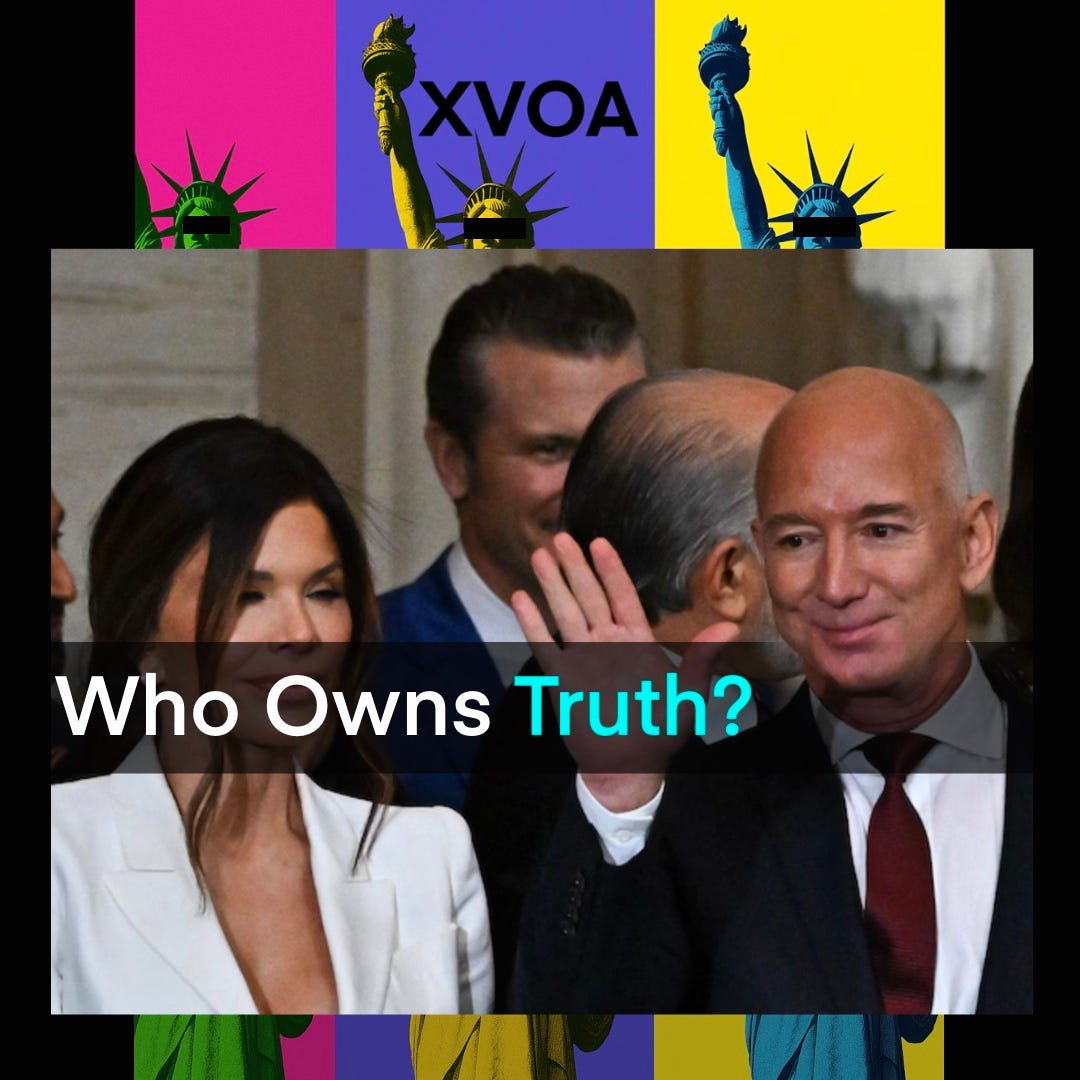
Picture the scene: a frigid January inauguration in Washington, D.C., moved indoors by bitter cold. In the Capitol Rotunda sit 17 billionaires, collectively worth over $1 trillion , enjoying places of honor at Donald Trump’s swearing-in. The three richest men on Earth…Elon Musk, Meta’s Mark Zuckerberg, and Amazon’s Jeff Bezos (who owns The Washington Post) occupy seats beside the new president’s family . It’s a tableau of American oligarchy made flesh, “so striking and so out in the open that the rich people are running the country,” as one stunned onlooker observed . And it is The Washington Post that duly reports this historic concentration of wealth and power, noting its own proprietor among the VIPs. The irony is almost operatic: a billionaire-owned paper bearing witness to the dawn of an American oligarchy in which its owner has a literal front-row seat.
The Washington Post’s recent investigative feature on billionaire political spending delivers a trove of data and a jolt of clarity to a topic often kept in the shadows of public debate. It chronicles how, over recent decades, U.S. democracy has increasingly come to rely on the largesse of the ultra-rich and what that means for power in America.
Billionaire Influence, By the Numbers
The Post’s investigation, titled “How billionaires took over American politics,” does plenty right. It is a sweeping, data-driven account of “unprecedented” billionaire influence, grounded in hard numbers and concrete examples. Since 2000, political donations by the 100 wealthiest Americans have exploded nearly 140-fold, surging from roughly $46 million to $1.1 billion by 2024 . In 2000, those richest 100 donors made up only about a quarter of one percent of all federal election spending; by 2024 they accounted for about 7.5 percent – “roughly 1 in every 13 dollars” spent in national elections came from this tiny club of super-wealthy citizens . Such concentration of election funding is unlike anything in modern U.S. history, a point the Post underscores by noting that wealth at the top is now more concentrated than at any time since the Gilded Age . In other words, a mere one-four-hundredth of 1% of Americans now wield extraordinary sway over who gets elected and which policies prevail .
The article excels in its clarity about how this happened. It walks readers through the tectonic shifts that enabled today’s plutocratic sway: the tech booms and stock market windfalls that swelled billionaire fortunes, bipartisan tax cuts and policy choices that insulated the rich, and court decisions like Citizens United (2010) that gutted campaign finance limits . The result is an era when U.S. politicians are more dependent on billionaires’ money than ever before, effectively giving this wealthy fraction outsized influence over public life . One veteran Democratic lawmaker admits on the record that, when recruiting candidates, party officials now openly consider “the ability to raise money” and connections to big donors as key qualifications . The Post lays out a portrait of a democracy distorted by money, with striking examples that read like case studies: tech mogul Peter Thiel bankrolling a protégé’s Senate race with $15 million ; a billionaire-packed Trump Cabinet, the richest in U.S. history ; and billionaires funding everything from a White House ballroom to stopgap funding for troops during a government shutdown . In one vivid quote, billionaire donor John Catsimatidis cuts to the chase: “If you’re a billionaire, you want to stay a billionaire” – a blunt confession that preserving great wealth is a key motive for these massive political investments.
Politically, the Post’s framing is incisive. It shows that billionaire influence is not a partisan fable but a structural reality affecting both parties. Overall, the wealthiest Americans are tilting their spending heavily to the right: more than 80% of the money from the top 100 in 2024 went to Republicans , and Donald Trump raised 15 times more from this richest cohort in 2024 than he did in 2016 . Tech and finance tycoons once courted by Democrats have swung toward the GOP, drawn by promises of deregulation, crypto boosterism, and resistance to tech oversight . Elon Musk alone poured an astonishing $294 million to help elect Trump and other Republicans in 2024 is the starkest example of this shift. Yet the Post also notes that Democratic candidates partake in the billionaire boom too: Kamala Harris raised three times as much from the ultra-rich in 2024 as Hillary Clinton did in 2016 . Even those who thunder against oligarchy often find themselves entangled in the system’s money web. The piece tellingly highlights a progressive Texas lawmaker, James Talarico, who launched a Senate run railing against “extreme wealth” in biblical terms and then quietly accepted tens of thousands from a PAC bankrolled by a billionaire casino magnate, rationalizing it as support for his policy goals . As the Post dryly observes, “given billionaires’ growing reach in American politics, it is far easier for politicians to denounce them than to escape their influence” .
Throughout, the article’s language is precise and restrained, even as it conveys a situation many would call oligarchic. Indeed, the Post reports that figures across the spectrum from President Joe Biden, who warned in his farewell address that “an oligarchy is taking shape in America of extreme wealth, power and influence” , to Sen. Bernie Sanders, who drew hundreds of thousands to “Fighting Oligarchy” rallies are openly using that once-taboo word . By including such voices, the piece captures a broader public anxiety: a recent Washington Post-Ipsos poll found a majority of Americans view billionaires’ election spending negatively, with about one in three calling it “very bad”. The reporting doesn’t preach; it simply lays these facts on the table with the authority of deep research. In doing so, The Washington Post fulfills, at least in part, its own credo: “Democracy Dies in Darkness.” Here it is shining a light on a fundamental imbalance of our democracy with the wealth bending policy, money talking louder than millions of votes.
What The Post Left Unsaid
And yet, there is a quiet part of this story that The Washington Post, perhaps unsurprisingly, does not say out loud. The exposé painstakingly documents how billionaire money influences candidates and officeholders, but it stays conspicuously silent about another sphere of influence: the media itself, including the paper delivering the exposé. Nowhere does the article ask how a billionaire owning a major newspaper might shape which stories get told and which go untold. It’s here that the limits of legacy media’s self-critique come into view.
To its credit, the Post at least discloses the basics. Jeff Bezos’s name appears in parentheses “(who owns The Washington Post)” when recounting how he sat beside other tycoons at Trump’s inauguration . But that parenthetical aside is as far as the acknowledgment goes. What’s missing is any reflection on what such ownership means. A single sentence in the piece lands with paradox if read closely: “The concentration of wealth among the richest Americans is unlike anything in history and so is billionaires’ influence in politics” . The Washington Post’s reporters deftly illustrate that influence in campaign finance and governance, but they don’t extend the analysis to the influence billionaires wield by owning the platforms of public discourse. The story, in other words, stops at the newsroom door.
This omission is not unique to the Post’s coverage; it’s a systemic blind spot in corporate media. It is understandably difficult for any news organization to turn the spotlight on its owner or scrutinize how wealth might shape its own narrative. As media critic Dan Froomkin has noted, “for a news organization, being owned by an oligarch can be complicated” . Jeff Bezos’s purchase of The Washington Post in 2013 rescued the paper financially and turbocharged its growth, but it also created self-evident conflicts of interest “pretty much every public-policy issue the Post covers affects Bezos’s sprawling personal and business interests in material ways” . How often do those conflicts get aired in the Post’s own pages? Seldom, if ever.
The newsroom insists Bezos stays hands-off, and there’s no indication of direct meddling in daily coverage. But as one Post reporter admitted anonymously, the mere presence of a multibillionaire owner can induce a subtle self-censorship: “What I feel most is a little bit of reluctance to take him on… It certainly can complicate things”. In other words, the very power structure that the Post is examining in politics also hovers over journalism, quietly shaping the contours of discourse. The Post’s series confronts the billionaires’ sway over Washington, yet it falls quiet about their sway over the news, its own institution included.
This pattern of omission and this quiet deference to power runs through much of our media ecosystem. Legacy outlets will bravely investigate political corruption or campaign finance violations, but rarely do they question the broader system of concentrated wealth that undergirds the status quo, perhaps because they are part of that system. Owners of media empires, from tech CEOs to old-fashioned press barons, exert influence simply by sitting atop the organizational chart. They don’t need to issue explicit orders for their presence to be felt; editors may preemptively avoid lines of inquiry that could hit too close to the owner’s interests, or they might frame stories in ways palatable to the sensibilities of their publishers and big advertisers. It’s an insidious form of soft power.
Think of the many billionaire media moguls beyond Bezos: Rupert Murdoch, who has long used his outlets to advance his political and business agenda; Mike Bloomberg, who famously restricted his news service from deeply investigating certain fellow billionaires; or the late Sheldon Adelson, who bought an entire newspaper in Nevada to ensure friendlier coverage. These aren’t conspiracy theories but well-documented tendencies of oligarch-owned media. The Post’s omission of the media angle in its billionaire investigation is thus a case study in the broader phenomenon: even as they cast light on the influence of wealth in one arena, legacy media often leave another arena in semi-darkness and namely, their own house.
Finishing the Story: The Role of Independent Voices
This is why independent outlets to include newsletters, non-corporate media, truly free presses are so vital in the current landscape. They exist to finish the sentence that legacy media leaves trailing off. Where a great metropolitan newspaper stops short, an independent voice can speak the full truth plainly. The Washington Post told us how billionaires buy influence in Washington; an independent critic can add that billionaires also influence what Washington talks about (and what it doesn’t) by owning the very forums of debate. The Post’s analysis implicitly asks: Can democracy survive this flood of billionaire money? Here, we dare to ask a further question: Can we trust billionaire-owned media to fully hold billionaires accountable?
Independent media, not beholden to corporate owners or advertisers, can call out power structures without fear of ruffling a patron’s feathers. This essay you’re reading is an example of that freedom. There is no oligarch signing our paychecks or spiking our inconvenient story ideas. We can applaud the Post’s reporters for their excellent data and reporting when they genuinely shed light on a critical threat to democratic equality and in the next breath, we can point out that their publisher’s wealth is part of the story of power in America. Here, the whole picture can come into view: not only the billionaires courting senators and presidents, but also the billionaires who sit atop media institutions, quietly setting limits on the narratives those institutions produce. It’s a completion of the picture that you won’t often find in the pages of the newspapers owned by the very subjects in question.
The need for such independent scrutiny has never been greater. The Post’s exposé makes clear that we are living in a new Gilded Age, where a tiny elite’s riches translate into outsized political muscle. But recognizing that fact is only the first step. The next step is asking what we’re going to do about it and that discussion inevitably leads to uncomfortable places for the powers that be. It touches on ideas like wealth taxes, campaign finance overhaul, antitrust crackdowns, union empowerment, even the breakup of giant fortunes.
Mainstream media may report on those ideas, but rarely will they crusade for them; these remedies cut against the interests of the owners and advertisers who underwrite mainstream outlets. Independent media has the latitude to keep pressing where others relent. We can insist that “democracy dies in darkness” applies not just to government secrets but also to media blind spots. We can ensure that the story doesn’t end before the most powerful actors are held to account.
In the end, The Washington Post has performed a public service by illuminating how billionaires took over American politics. But it falls to voices outside the billionaires’ empire to connect the final dots and to name the structural truth that even the best corporate journalism will leave implied between the lines. That truth is that concentrated wealth and genuine democracy are fundamentally at odds, in our campaign finance, in our governance, and yes, in our media. Telling that whole truth is a task for independent writers and readers united by a commitment to follow facts wherever they lead, unafraid of whose toes get stepped on.
We owe gratitude to the journalists who dug up the facts and figures of billionaire political influence . Now, using that foundation, we carry the analysis to its conclusion without flinching at the implications. If democracy is indeed dying in darkness, then every light must be switched on including the ones that shine uncomfortably close to home for the media itself. That is the work this outlet strives to do: to speak truth fully, with “controlled moral fire” and intellectual clarity, unbeholden to any fortune. And it’s why support from readers, rather than billionaires, is what keeps this flame lit.
If you found value in this analysis, help us reach our goal of 100 paid subscribers and secure that Substack “Bestseller” badge. Every new paid subscription brings us closer to that milestone so thank you for reading and for your support.
Written with your customary excellence. And with the key point at the end, "concentrated wealth and genuine democracy are fundamentally at odds, in our campaign finance, in our governance, and yes, in our media."
It might be interesting to note what the cost/benefit relationship, in dollar terms, is between these huge campaign finance donations and the return they provide. In relative terms, to the billionaire class, they're practically nothing. But our politicians, whatever their ideological inclinations, have to function in the real world, to pay expenses in absolute dollars. So until or unless we can get rid of Citizens United, this situation is going to persist, to the detriment of the vast majority of our population.
. . ." concentrated wealth and genuine democracy are fundamentally at odds." I watched the big corporate media fawn over Trump in '16 giving him millions in free advertising, (I wanna think) believing it was reporting on a clown show. All that news kept the NBC fiction of The Apprentice (as fake as Trump himself) alive and propelled him to the WH. Why they continue to sane wash his gibberish and gloss over his attempted fascist takeover with an SS that is traumatizing innocent people in this country can only be attributed to $$$$$$ protecting $$$$$$ (a different version of Epstein). When the average person stops aspiring to be part of that billionaire circle, and chooses to merely fight for things like healthcare a living wage and owning a home, and votes for ah honest person who promises to deliver on those basics, things might change.
P.S. You point out " . . .it is The Washington Post that duly reports this historic concentration of wealth and power, noting its own proprietor among the VIPs. The irony is almost operatic: a billionaire-owned paper bearing witness to the dawn of an American oligarchy in which its owner has a literal front-row seat." Your writing is operatic, and I'm glad I have season ticket to your shows!