


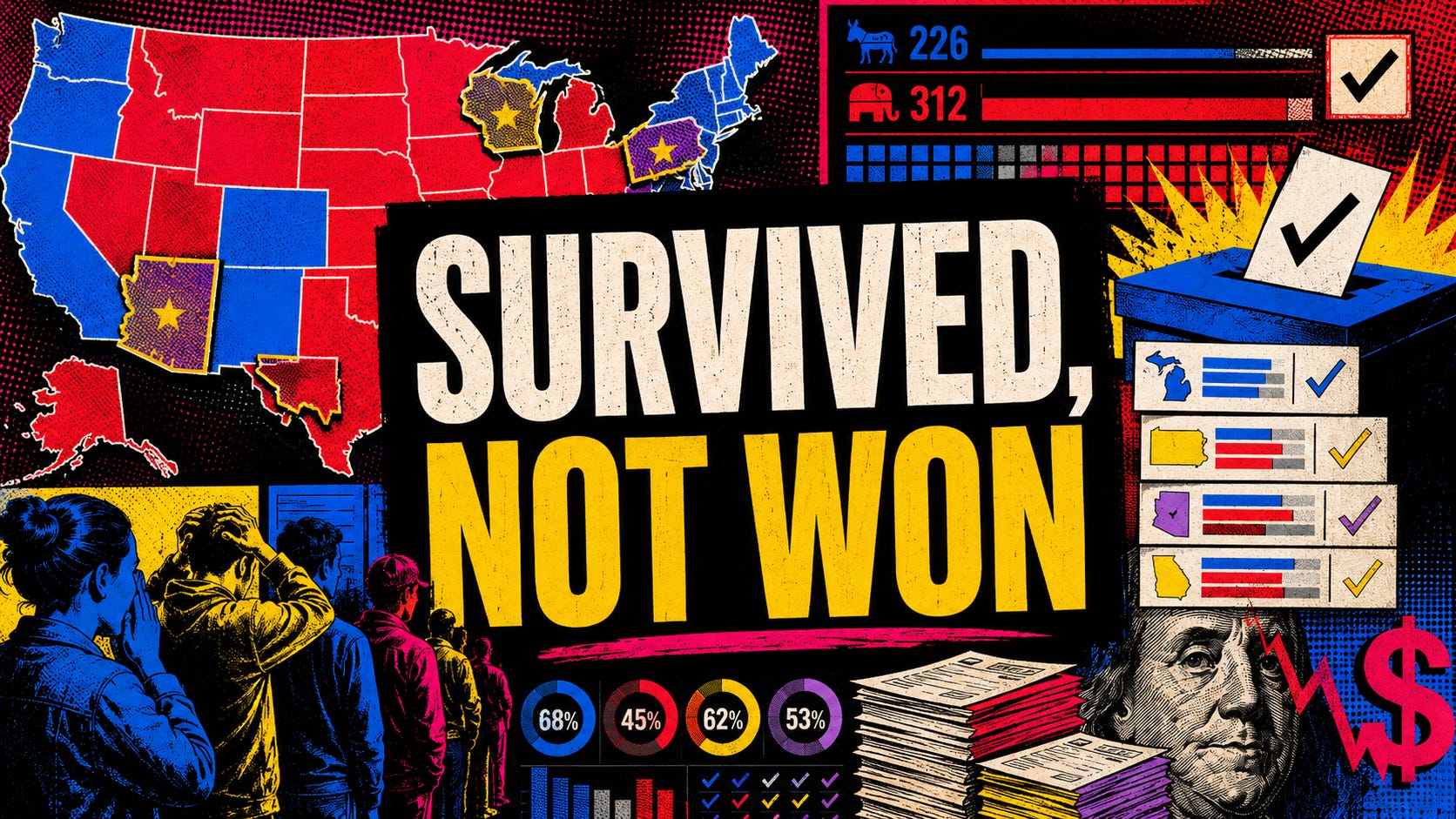
A post-primary XVOA report on progressive power, establishment containment, voter strategy, and the machinery still deciding whose politics get to survive November.
I Got Lost in the Noise
I need to start with the confession before I start with the scoreboard.
I got lost in it.
The primaries. The vote counts. The “breaking” updates that were already half wrong by the time they reached the feed. The California math. The New Jersey signals. Iowa trying to tell one story, cable news trying to tell another. Every race seemed to be carrying three different meanings at once. Was this a progressive surge? Was it an establishment correction? Was it just another night where everybody found the lesson they already wanted to believe?
For a minute, I was blind inside the news.
Why? Because there was too much of it. That is part of the design now. The modern news environment does not only inform. It floods. It overwhelms. It forces the reader to mistake motion for meaning.
Then I remembered the obligation of this desk: XVOA is not here to chase every headline. XVOA is here to read the machinery beneath the headline.
Readers do not need one more person yelling that something happened. You can get that anywhere. The harder work is asking what the thing means, who benefited, who got contained, who got erased, who was protected, and who had to fight the system twice just to be seen once.
That is the work this piece is trying to do.
Where the Desk Stands
Before we get into the returns, I need to tell you where this desk stands.
The fundraiser is now at $440 raised toward the $1,200 goal. That leaves $760 still to go.
I want to thank the reader who came through with the recent $250 donation. I am not naming them here unless they want to be named, but I need to say this clearly: that kind of support does more than move the number. It tells me this work is landing somewhere. It says, keep going.
I also want to thank the people who gave $20, $10 and $5. I mean that just as seriously. Those donations are not small when they come from people carrying their own bills, their own worries, their own private storms. That support matters because it is not abstract. It is someone stopping in the middle of their day and saying this work deserves to continue.
This is not about buying me vague “time.” This is about keeping XVOA from starving itself.
I ran up real costs building this desk: streaming tools, editing apps, subscriptions, software, and the machinery it takes to turn research into livestreams, clips, essays, and reports. That infrastructure is what lets XVOA function like a real publication instead of a man yelling into the void with a half-charged iPad.
But when those costs come due, the choice gets ugly fast.
Either I stay on this story and publish the work subscribers came here for, or I have to go hustle gig work to pay down the bill I ran up trying to build this thing.
And when I have to leave the publication to chase the bill, the cost is not abstract.
The article does not get written. The livestream gets delayed. The clip does not get edited. The next report does not post. The rhythm breaks. And when the rhythm breaks, subscribers start asking why they are still paying for a publication that has gone quiet.
That is how a publication starts a slow death. Not dramatically. Not all at once. Missed post by missed post, delayed report by delayed report, until the thing people believed in starts disappearing from their inbox.
So yes, the fundraiser belongs up top. Not as pity. Not as panic. Not as theater. As the operating reality behind the work.
The paid subscription is the main ask:
Buy Me a Coffee is the one-time contribution lane:
A one-time contribution helps close the gap too. But the real goal is building a reader-supported XVOA strong enough to keep publishing when the news gets deliberately blinding.
I got lost in the fog for a minute. Your support helps keep this desk from going dark.
TLDR
• Progressives did not clearly win power. They survived with force, and that matters.
• California is the center of the story because its top-two primary turns politics into survival math. Voters were not just picking favorites. They were trying to consolidate, block bad runoffs, resist party interference, and wait out late-count ballots before the first narrative became the official myth. [1]
• CA-22 is the clearest machinery test. If Randy Villegas survives the count against the DCCC-backed Jasmeet Bains, that is not just one progressive beating one moderate. It is a local electorate answering back to national party management. [4]
• Los Angeles shows the danger. Progressive diagnosis does not automatically become progressive power. Nithya Raman’s race is a test of whether policy, housing, tenant politics, and city governance can break through against incumbency and celebrity-populist rage. [3]
• Iowa and New Jersey complicate the easy story. The Democratic primary map is not simply left versus center. It is biography, money, electability, ideology, Gaza, labor, housing, and national strategy fighting under the same roof. [7][8][9]
• The verdict for now: not triumph, not doom. Movement under pressure.
• The stake for XVOA is concrete. If operating costs force me out into gig work, the articles slow down, livestreams thin out, clips do not get cut, and the publication starts disappearing from the inbox one missed post at a time.
Today’s Charge
The question is not whether progressives had a good night or a bad night. That framing is too cheap.
The real question is whether progressives won power, or merely survived another round of institutional containment.
The answer, at least from the first wave of returns, is uncomfortable: both things are true.
Progressives showed proof of life. They advanced in some places. They forced establishment Democrats to fight harder than they wanted to. They turned local races into national arguments about money, war, housing, labor, and whether the Democratic Party’s future belongs to managed moderation or organized pressure from below.
But survival is not the same thing as power.
The aftershock did not crown the progressive movement. It showed where the ground is cracking.
The Scoreboard Is Still Moving

The first discipline of this piece is patience. California is still counting.
That matters because some of the most important races in this story are not finished. California’s June 2 primary allows vote-by-mail ballots postmarked by Election Day to arrive through June 9. The state also says ballots continue to be counted after Election Day during the official canvass period, counties must complete final official results by July 2, and the Secretary of State will certify results on July 10. [1]
That means any clean verdict right now is suspect.
The worst political analysis is the kind that declares victory while the ballots are still being counted.
This is especially important for progressive voters because early returns can distort the story. Mail ballots, urban ballots, provisional ballots, and late-count ballots can shift margins after the narrative machine has already moved on. That is not an accident. The first count often becomes the first myth. The myth then shapes donor confidence, media tone, and public morale before the official count has finished speaking.
So the language has to stay precise: if the lead holds, if the late ballots continue this direction, if the runoff field remains as it appears, if the progressive candidate survives the next count. That may not sound dramatic, but it is honest.
And honesty is the first weapon against political fog.
California Was the Machine in Plain Sight
California is the center of this aftershock because California does not just hold elections. California stages power contests inside a maze.
The state’s top-two primary turns every race into a survival puzzle. All candidates appear on the same ballot. Party labels matter culturally, but the ballot structure does not reserve a lane for each party. The top two vote-getters advance to November, regardless of party. [1]
That means voters are not always voting for their favorite candidate in the way a civics textbook imagines. They are often voting strategically. They are asking who can survive the primary, who can block a bad runoff, who is splitting the lane, who is being inflated by money, and whether a movement candidate has enough consolidation behind them to avoid becoming a noble footnote.
In California, ideology gets translated into math before it gets translated into power.
The governor’s race shows the trap. Steve Hilton, the Republican backed by Donald Trump, was narrowly leading. Xavier Becerra, the experienced Democrat and former health secretary, was close behind. Tom Steyer, the billionaire climate activist running on a more progressive challenge to corporate power, was in third as counting continued. The field was crowded. The spending was enormous. The outcome was not final. [2][3]
This is where progressive analysis has to resist the easy story. If Steyer falls short, is that a rejection of progressive politics, a rejection of billionaire self-funding, a failure of consolidation, or simply the brutality of a crowded top-two system? The answer may be all of the above.
The state also gave us a blunt lesson about money. Reporting described California’s governor’s race as the most expensive in state history, with more than $316 million spent and Steyer putting more than $200 million of his own money into the race. That should end any childish fantasy that progressive politics can ignore money. But the early results also complicate the opposite fantasy, the one that says money can simply purchase the public. [2][6]
Money can buy oxygen. It cannot always buy trust.
How California Progressives Tried to Beat the Machine
This is the missing layer in a lot of election coverage: voters were not just outputs. They were actors.
Progressive voters in California had to operate inside a system that punishes disorganization. They had to think tactically under top-two rules. They had to read endorsements not just as approval, but as signals about viability. They had to decide whether to vote their heart, vote the strongest progressive lane, vote against a billionaire lane, or vote to stop a Republican and establishment Democrat from defining the runoff without them.
That is survival voting.
In the governor’s race, the progressive dilemma was especially ugly. A voter drawn to Steyer’s anti-corporate message still had to ask whether that vote helped advance a progressive to November or helped split the Democratic field. A voter suspicious of Becerra’s establishment ties still had to ask whether Becerra was the safest way to prevent a worse outcome. A voter who wanted Katie Porter or another Democrat had to decide whether their preferred candidate had become a symbolic vote once the late dynamics shifted.
This is what top-two does. It turns the ballot into a psychological test. It asks voters to choose between expression and strategy.
The same pressure appeared in congressional and local races. Progressive voter guides, unions, local Democratic clubs, tenant groups, movement organizations, and online networks all became part of the navigation system. They did not merely tell people who was “good.” They told voters where the machinery was moving. They pointed to which races were vulnerable to donor capture, which candidates had a real path, which endorsements were sincere, and which ones were party management dressed up as consensus.
That is why the California story cannot be reduced to who won on election night. The story is how progressives tried to move through the maze: consolidate here, resist party interference there, wait out the late count, and refuse to let first returns become final truth.
The most important progressive strategy in California may have been refusing to confuse the first story with the real story.
CA-22: The Party Put Its Thumb on the Scale
California’s 22nd Congressional District may be the cleanest case study of the night.
Republican incumbent David Valadao is one of the Democrats’ major targets. The district matters for control of the House. It also matters because it sits in the Central Valley, where working-class Latino voters are too often discussed by national Democrats as a demographic problem to be managed rather than a political community to be listened to.
The Democratic fight there became a fight over strategy.
Randy Villegas, a progressive professor and school board member, ran as an economic populist with support from Bernie Sanders and progressive groups. Jasmeet Bains, a state assemblymember and physician, was the more moderate Democrat and received backing from the Democratic Congressional Campaign Committee. [4]
The DCCC’s intervention matters. According to reporting, the committee had earlier signaled neutrality but later endorsed Bains, sparking backlash from local Democratic leaders. That is the machinery in miniature: Washington sees a swing district, decides what kind of Democrat is “safe,” then tries to manage the local electorate before the local electorate has finished speaking. [4]
As of the reporting available, Villegas held a narrow lead over Bains, with the race still too close to call. [4]
If Villegas survives the count, it will not just be a candidate beating another candidate. It will be a local electorate answering back to national management.
That does not mean November becomes easy. Valadao led the overall primary vote, and a progressive Democrat in a targeted Central Valley district will face a brutal general election. But that is exactly why the race matters. The establishment argument is always that progressives cannot win hard districts. CA-22 is where that argument is being tested, not in theory, but on the actual map.
Los Angeles: Survival Is Not the Same as Transformation
Los Angeles gave progressives a different kind of test.
Karen Bass advanced to the mayoral runoff, but her opponent was still uncertain in the immediate aftermath. Spencer Pratt, running as a celebrity-populist disruptor after the trauma of the 2025 wildfires, was battling progressive councilmember Nithya Raman for the second spot as ballots remained uncounted. [3]
This race is not clean. That is why it is useful.
Bass is not some right-wing villain. She is a historic figure, a former organizer, a former congresswoman, and the first woman to lead Los Angeles. But incumbency has a way of turning even real political history into institutional defense. Her record on homelessness, housing, wildfire response, and city management became the terrain of the race.
Raman’s campaign made the progressive case from inside city government. Housing, homelessness, service delivery, tenant politics, and the basic question of whether Los Angeles can govern itself without surrendering to billionaire panic or celebrity grievance became the center of her argument.
But the returns also show the danger. A progressive can be right on the issues and still get squeezed between an incumbent with institutional backing and an outsider who turns public anger into spectacle.
Los Angeles is a warning: progressive diagnosis does not automatically become progressive power.
If Raman makes the runoff, progressives get a direct contest over the future of city governance. If Pratt holds the second slot, progressives get a different lesson: rage without a movement can still beat policy without a broad enough coalition.
Iowa and New Jersey Complicate the Story
The progressive-vs-establishment story does not stop in California, but outside California the signal gets more mixed.
In Iowa, Josh Turek won the Democratic Senate primary and will face Republican Ashley Hinson. Turek’s biography is compelling: a Paralympian, state legislator, and candidate with populist appeal. But the Iowa race also showed the role of outside spending. VoteVets poured millions into support for Turek, turning the contest into a test of whether national money and biography could overpower other forms of local party identity. [7]
That does not make Turek illegitimate. It makes the lesson more complicated.
The modern Democratic primary is not simply left versus center. It is biography, money, electability, ideology, and national strategy all fighting under the same roof.
New Jersey added another layer. Rebecca Bennett won the Democratic nomination in the competitive 7th Congressional District, a race Democrats see as important for House control. That result points toward the party’s preference for service-background candidates who can be sold as disciplined, credible, and general-election ready. [8]
But New Jersey also produced Adam Hamawy in the 12th District, a progressive-backed Army veteran and surgeon whose campaign immediately became a flashpoint over Gaza, foreign policy, and the right-wing attack machine’s hunger for a new target. His win shows that progressive foreign-policy politics did not disappear. The backlash to his win shows exactly how quickly that politics gets marked as dangerous, suspect, or outside the boundaries of acceptable Democratic power. [9]
That is the pattern: progressives advance, then the legitimacy fight begins.
What Progressives Can Honestly Claim
Progressives can claim proof of life.
They can claim that economic populism still has force. They can claim that voters are not automatically obeying national committees. They can claim that housing, labor, tenant power, Gaza, anti-corporate politics, and frustration with donor-managed liberalism are not fringe concerns. They can claim that in several races, voters were not asking who sounded most acceptable to Washington. They were asking who sounded like they understood the bill coming due.
That right there matters.
Proof of life is not power, but it is not nothing.
The Democratic establishment would prefer progressives to exist as mood, not machinery. A little pressure. A little language. A little youth turnout. A little moral seasoning sprinkled over donor-safe politics. What the primaries showed is that progressive voters and candidates are still capable of forcing actual contests over who gets nominated, who gets protected, and who gets described as viable.
That is a win of a kind.
But it is not enough.
What the Establishment Still Controlled
The establishment still controlled a lot.
It controlled endorsements. It controlled donor confidence. It controlled much of the media framing. It controlled the language of “electability.” It controlled the quiet pressure campaigns that happen before voters ever see the final ballot.
Most importantly, it controlled the definition of seriousness.
That is one of the oldest tricks in American politics. Power does not always say, “You cannot run.” Sometimes power says, “You are not serious.” Sometimes it says, “You cannot win here.” Sometimes it says, “This district needs a different kind of candidate.” Sometimes it says, “This is not the year.” Sometimes it says, “We agree with your values, but not your vehicle.”
The establishment does not always defeat progressives by beating them outright. Sometimes it contains them, delays them, drains them, or forces them to spend all their energy proving they are allowed to exist.
That is what makes CA-22 so important. That is what makes Los Angeles so unsettled. That is what makes California’s top-two structure so revealing. The machinery does not only count votes. It shapes which votes feel possible before the counting begins.
Money Entered the Room, But It Did Not Own the Room
Money was everywhere in this primary cycle.
Tech money. Billionaire money. PAC money. Party money. Outside money. Self-funded campaigns. Strategic advertising. Media amplification. The invisible infrastructure that makes one candidate look inevitable and another look like a long shot before either one has met the voter.
But the results complicate the story.
Steyer’s massive spending did not guarantee him a top-two position. Saikat Chakrabarti, who challenged in the race to replace Nancy Pelosi, also struggled despite significant resources. At the same time, money clearly mattered in Iowa and in California’s wider ecosystem. It mattered in who got attention. It mattered in who could stay on television. It mattered in who could flood mailboxes, digital feeds, and local news cycles. [2][6]
The lesson is not that money failed. The lesson is that money is powerful, but not magical.
Money can make a candidate visible. It can make a candidate sound inevitable. It can buy the oxygen required to compete. But voters can still refuse the transaction, especially when the candidate reads as purchased, parachuted, or too engineered by people who do not live with the consequences.
This is where the progressive movement needs discipline. It cannot pretend money does not matter. It also cannot surrender to the lie that money is destiny.
What November Will Test
November will test whether progressives built machinery or merely made noise.
That is the hard part.
Winning or nearly winning a primary is one kind of power. Surviving party interference is one kind of power. Forcing the media to acknowledge a movement candidate is one kind of power. But November asks a different question: can the coalition expand without losing its soul?
Can progressive candidates hold working-class voters who do not speak in nonprofit language? Can they survive the donor panic that will follow? Can they talk about Gaza without letting bad-faith attacks define them? Can they talk about housing without sounding like a white paper? Can they talk about affordability without surrendering to Republican resentment politics? Can they turn moral clarity into governing trust?
November will test whether progressives have a politics of witness or a politics of power.
Those are not the same thing.
Witness names the harm. Power changes who pays for it.
The Verdict
So did progressives win, or did they just survive?
They survived with force.
That is the most honest answer right now.
Progressives did not take control of the Democratic Party. They did not crush the establishment. They did not prove that money no longer matters. They did not solve the top-two math. They did not turn every moral argument into a winning coalition.
But they also were not erased.
They forced contests. They punished interference. They exposed the donor class. They made party committees reveal their hands. They showed that voters are still capable of moving tactically inside systems designed to manage them.
The aftershock is not the victory. The aftershock is the warning that the ground is still moving.
That is where we are. Not triumph. Not doom. Movement under pressure.
Why This Desk Has to Stay Open
This is why the fundraiser matters.
Not because the news is easy. Because the news is deliberately blinding.
The first wave of coverage gives you winners and losers. It gives you percentages. It gives you the premature narrative. But it usually does not show you the machinery: the late ballots, the donor pressure, the top-two strategy, the local backlash, the national committee interference, the voters trying to think three moves ahead because the system punishes them if they do not.
That is the work XVOA is here to do.
But the operating reality is just as real as the politics.
If the tools that power this desk turn into bills I cannot absorb, then XVOA slows down. If XVOA slows down, the articles come later, the livestreams get thinner, the clips do not get cut, and the publishing rhythm that keeps subscribers connected starts to break.
That is the stake: not vague “time,” but whether this publication keeps showing up before the silence teaches readers to stop expecting it.
As of this draft, the fundraiser stands at $440 of the $1,200 goal, with $760 left to go. Thank you again to the reader who gave $250. Thank you to the people who gave $10 and $5. Every bit of it helps keep XVOA publishing.
If this work helps you see through the fog, become a paid subscriber and help keep XVOA alive.
If a one-time contribution is what you can do right now, Buy Me a Coffee is here:
Sources
[5] Axios: Democratic primaries leaving a muddled picture between progressives and moderates.
[6] Axios San Francisco: limits of self-funding in California races, including Steyer and Chakrabarti.
[7] The Guardian: Iowa primary results and Josh Turek’s Democratic Senate nomination.
[8] Reuters: Rebecca Bennett wins the Democratic nomination in New Jersey’s 7th District.
This is so interesting. First, I like my Independent Nonpartisan Redistricting Commission mandated to draw all State Redistricting lines as competitive as possible between the Parties with open primaries, so that Independents can participate also so much better than this really ,what seems like from the outside to be total Anarchy! I feel we need Parties, as a another guardrail to keep most of the time, the Crazies and Demagogues from taking over everything. It is insane to have 60 candidates on a ballot for one office.
I am an economic progressive, myself. and in my State of Michigan, I am supporting the Progressive Dr.Abdul El-Sayed for US Senate. I also see already massive spending by IAPAC to the tune of $5 million dollars contributed to his Democratic Moderate Opponent Haley Stevens. This of course is foreign policy campaign dollars. We also have Data Center campaign dollars coming into the State, for whom I'm not privy to yet, but probably it will end up with Mike Rogers the most likely Republican Party Candidate. I am a donor to Vote Vets in my small dollar donations. I feel that they will back Mostly Combat Vets, that are Democrats with spine and backbone to stand up to the tyranny of Trump and MAGA, or should I just label the opposition as Neo-Nazi! Whether it is Tammy Duckworth, Elissa Slotkin, or Kelly in Arizona, or so many of them. They tend to show the fighting grit to stand against this Mafia Style Government that we are presently saddled with! Normally, I would be pushing the Progressive Envelope, but the moment calls for gritty warriors of any democratic stripe, if Progressive, A great big bonus!!!!
" . . . support does more than move the number. It tells me this work is landing somewhere. It says, keep going." Yes, you know I am a subscriber. But what is almost as important is re-stacking, the whole article or your favorite sentence (or three). It's how we drive readers to this wonderful writer's Substack!