

I was supposed to be doing something normal.
Email. Breakfast. The ritual scroll that pretends it is information but feels more like a daily emotional tax.
Then I hit a line in a story about the White House columns and my body did that thing it does when a sentence is casually insulting on purpose. The kind of insult that comes dressed as confusion.
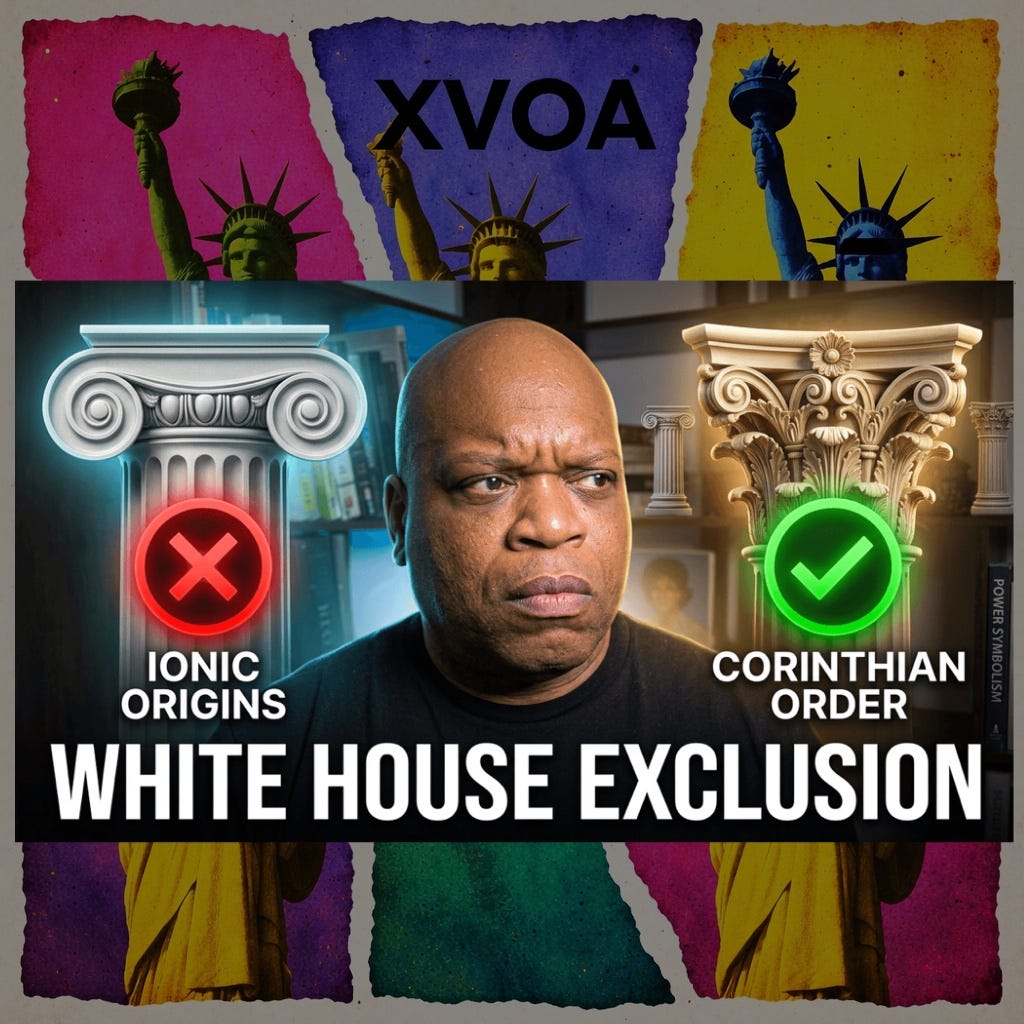
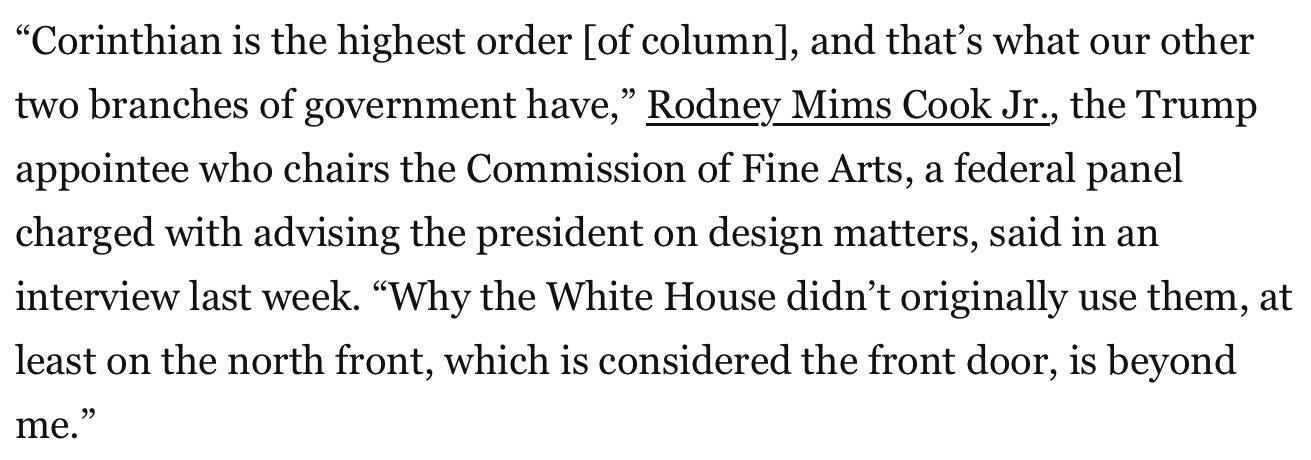
“Why the White House didn’t originally use them… is beyond me,” said Rodney Mims Cook Jr., the Trump-appointed chair of U.S. Commission of Fine Arts, arguing out loud that the “front door” of the executive mansion should trade its Ionic columns for Corinthian ones. Those are the more ornate, “highest order” columns. The expensive-looking kind. The kind that says you do not belong here unless you were invited. [1]
And I felt embarrassed. Not because I was wrong, but because I cared.
I am grown. I have watched people lose jobs, rights, safety, even life. And here I was, mad about columns.
What began to emerge, once I sat with it, was the larger insult. Republicans hate the Founding Fathers. They love the costume of the Founders, the marble, the grandeur, the branding of old America. But the actual men, shaped by Enlightenment reason, liberty of conscience, and suspicion of concentrated power, would have been too “woke” for this party which is trying to make of the People’s House a billionaire drive by motel.
Then that phrase “is beyond me” kept echoing. Not because it was about architecture. Because it sounded like a whole governing posture. A shrug toward inheritance. A shrug toward symbols. A shrug toward the idea that this place is supposed to belong to people who are not rich, not white, not straight, not safely gendered, not politically compliant.
Maybe I’m overreacting to a column. That is the hesitation that kept me honest.
But the deeper I went, the more the columns stopped being columns.
They became a confession.
Look here’s the plain English version: the current Republican brand sells itself as the party of the Founders and “classical liberal” freedom while using federal power to enforce culture, elevate religion as national identity, restrict democratic participation, and preserve a political economy that tilts upward. The fight over the White House looking “more luxurious” is not separate from the fight over who counts as a real American. It is one continuous project, told in marble, law, and bureaucracy. [1][7]
What gets missed is that the Founders were not incidental to classical liberalism. They were its principal American translators, carrying Enlightenment ideas about natural rights, consent, limits on state power, and liberty of conscience into the Declaration and the Constitution. Britannica’s own overview of the Founding Fathers says the Revolutionary generation was responsible for the “liberal ideas celebrated in the Declaration of Independence” and the republican system defined in the Constitution. [15][10]
TLDR
A Trump-appointed arts commission chair floated replacing the White House’s Ionic column capitals with Corinthian ones, arguing Corinthian is the “highest order,” even as the White House said there are no current plans to change the exterior. The suggestion landed inside a broader Trump-era remaking of the White House grounds and its symbolism. [1]
Federal planning review for the East Wing modernization and ballroom project is moving through National Capital Planning Commission, which heard public testimony March 5 and is set to take action April 2. The design fight is not just aesthetic; it is procedural and political. [2][1]
Data shows Christian nationalism is not a fringe accent inside today’s Republican coalition: PRRI finds a majority of Republicans fall into Christian nationalism “Adherents” or “Sympathizers,” and higher levels of Christian nationalism correlate with authoritarian attitudes and some support for political violence. [7]
In the last week, Trump pressured Republicans to pass the SAVE America Act as a strategy for midterm victory, and Reuters reports he wants to add anti-trans provisions to it. AP reporting highlights that the proof-of-citizenship requirements could burden and disenfranchise eligible voters, with particular risks for married women, rural voters, and people of color. [3][4]
The GOP’s claim to “freedom” keeps leaning toward freedom-from-accountability for wealth: the 2017 Trump tax law’s benefits skewed heavily to the top and widened racial after-tax income disparities, undermining the everyday-material liberty classical liberals once claimed to care about. [9]
Restack it and share it.
Send it to one friend who still thinks this is “just aesthetics.”
If you value this work, support it here:
One-time support:
What is happening and why it is trending now
On the surface, the story looks like D.C. insider décor talk.
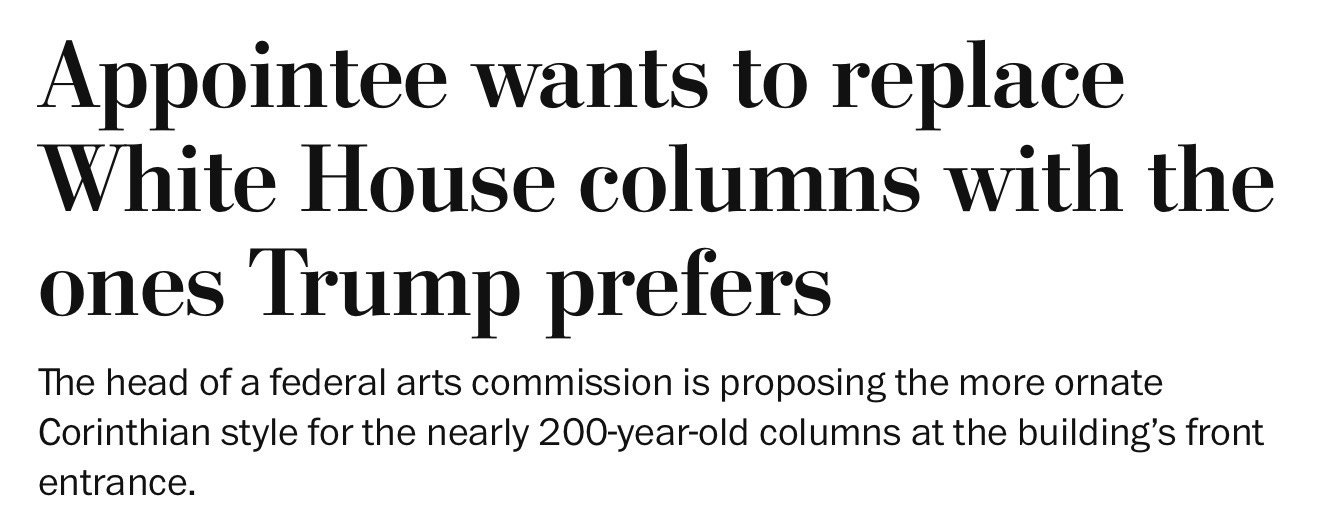
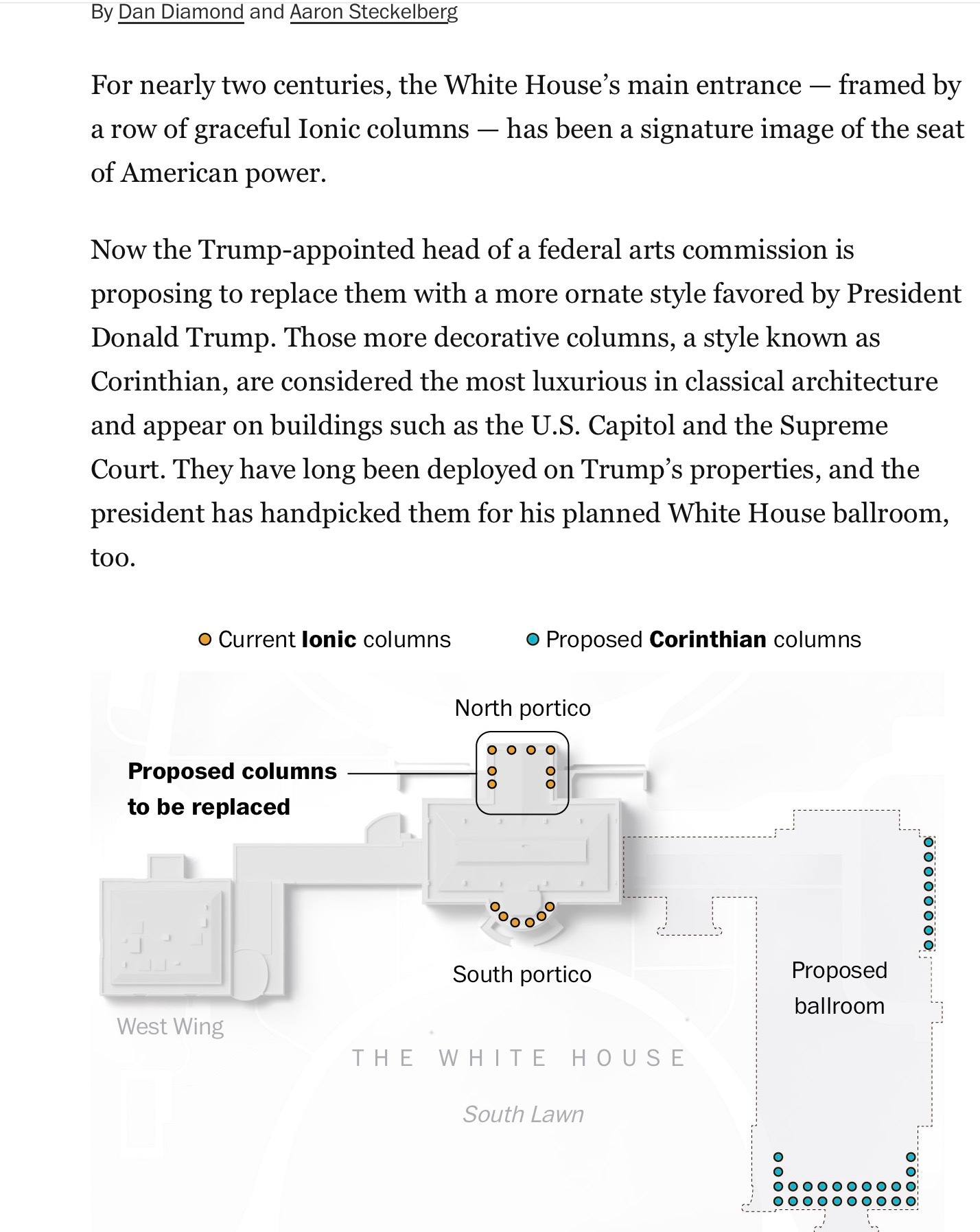
The headline version is simple: a Trump ally wants to “upgrade” the White House entrance by swapping Ionic columns for Corinthian columns, at least by replacing the column capitals. The White House says there are no plans to do that. [1]
But that is the kind of denial that still leaves a smell in the room.
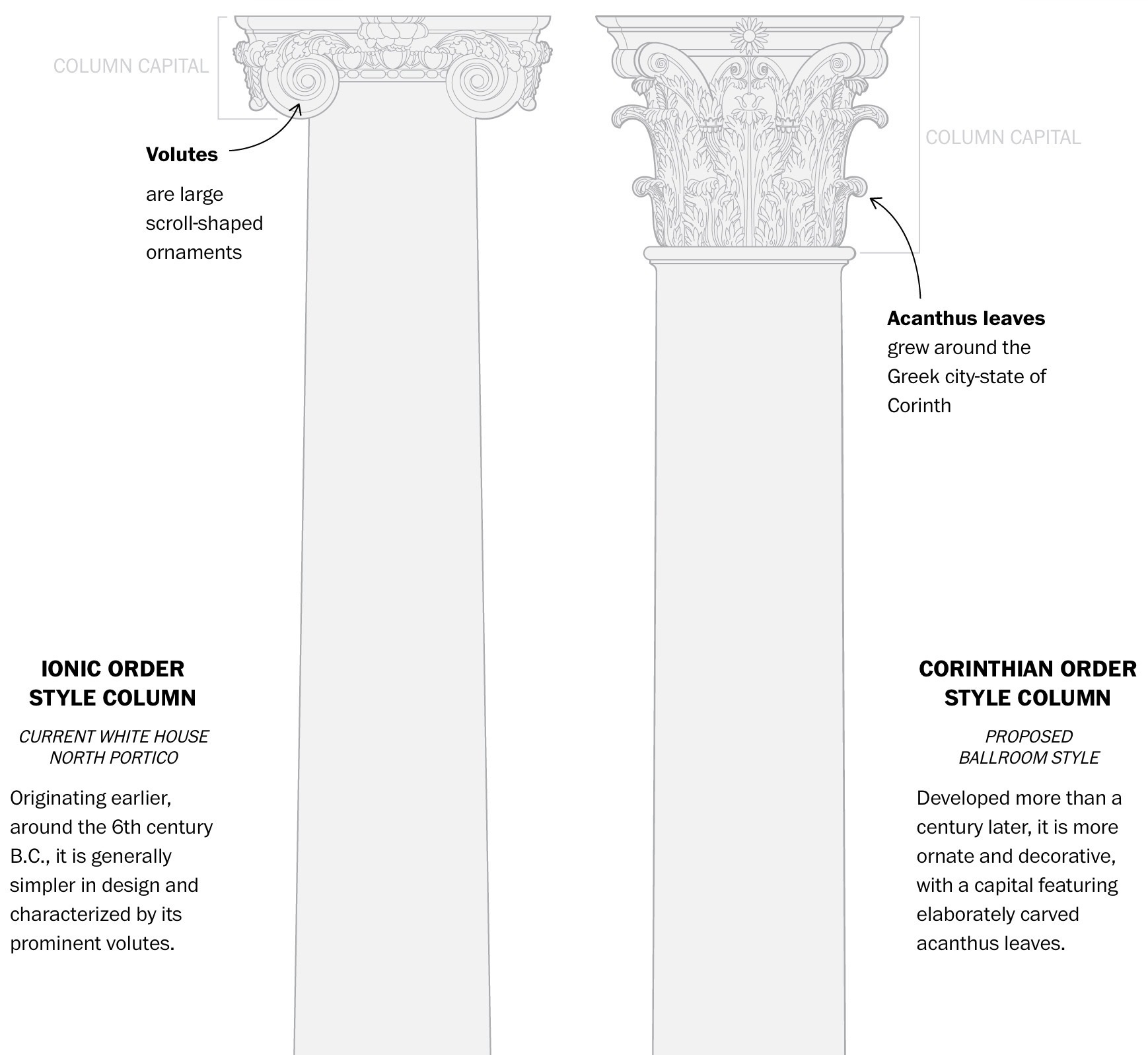
Because Donald Trump has a documented preference for Corinthian columns in his own properties and in new government construction, and the reporting frames Cook’s suggestion as part of a common dynamic in Trump’s Washington: deputies anticipate what he likes and try to implement it, often treating norms as optional. [1]
Meanwhile, the broader White House campus reshaping is not hypothetical. The East Wing ballroom project has already moved through public process steps and is headed toward a decision point, with NCPC describing its March meeting, testimony, and an April 2 action date. [2]
And then came the second beat of the last ten days, the beat that makes this much bigger than architecture.
Trump has been publicly pushing for the SAVE America Act, framing it as a way to “guarantee” midterm victory and threatening to freeze other legislation until it passes. Reuters also reports he wants the bill revised to include bans targeting trans people. [3]
The theme is not subtle anymore.
A government that wants to look more like a temple is also moving to decide who is allowed to walk into the temple.
The receipts and the Founders they cherry-pick
If the current Republican brand is a stage play, “the Founding Fathers” are the props.
They say “Founders” the way certain folks say “the Bible,” meaning: I’m not here to argue, I’m here to end the argument.
But the Founders were not a single man, not a single mood, and not an after-school special about virtue. They were a bundle of contradictions, including slavery, settler violence, and the protection of property. That complexity matters because it means we cannot lie about them in either direction. [14]
Still, one thing needs to be said much more directly than people usually say it. Classical liberalism was not some later garnish sprinkled on the founding after the fact. It was the philosophical heart of the founding project. Natural rights. Consent of the governed. Suspicion of arbitrary power. Separation of powers. Religious liberty. Rule of law. Those are not modern liberal talking points retrofitted onto old parchment. They are central to the founding vocabulary itself. [10][15]
That is why the present Republican habit of invoking “the Founders” while attacking pluralism is so intellectually dishonest. The same generation it romanticizes also built a constitutional order meant to restrain concentrated power and protect conscience from coercion. For all their failures, they were arguing inside an Enlightenment framework that assumed reason, not raw authority, had to do the public work.
Still, there are a few things the record is brutally clear on. And those are the things today’s Christian nationalist project has to twist, ignore, or spiritually launder.
Start with religion
James Madison, in his Memorial and Remonstrance, warned that a bill to fund “Teachers of the Christian Religion” would be a “dangerous abuse of power,” and he rooted religious duty in “reason and conviction, not… force or violence.” He also warned that rulers who overleap the barrier defending people’s rights “are Tyrants,” and he insisted “prudence” requires taking alarm at “the first experiment on our liberties.” [12]
That is not “wokeness.” That is an early American blueprint for resisting religious establishment and creeping authoritarianism.
Thomas Jefferson, in his famous letter to the Danbury Baptists, laid down the core liberal premise in plain language: religion lies between a person and their God, government’s legislative powers reach “actions only, and not opinions,” and the First Amendment builds “a wall of separation between Church and State.” [13]
And then there is the Treaty of Tripoli
That document includes a statement so blunt it continues to ignite arguments centuries later: “the government of the United States of America is not in any sense founded on the Christian Religion.” [11]
That sentence is not a meme. It is a primary document.
And to understand why that sentence existed at all, you have to understand the religious and philosophical climate many of these men came out of. Britannica’s survey of the subject says Deism and religious rationalism influenced many educated founders, and even concludes that “Deism influenced a majority of the Founders.” It describes the movement as standing for “rational inquiry,” skepticism toward dogma and mystery, religious toleration, freedom of the press, and separation of church and state. [16]
Deism, in the simplest terms, was belief in God grounded in reason rather than revelation or church authority. Britannica’s summary calls it belief in God “based on reason rather than revelation or the teaching of any specific religion,” and notes that by the late eighteenth century it had become the dominant religious attitude among Europe’s educated classes and was accepted by many upper-class Americans, including the first three U.S. presidents. [17]
That does not mean every Founder was a neat little textbook deist. It means many of the leading minds of the era were shaped by rational religion, heterodoxy, and Enlightenment habits of inquiry that sit uneasily, to put it mildly, beside modern Christian nationalism. Jefferson is the clearest case. Monticello’s own summary says he rejected Christ’s divinity, biblical miracles, and original sin, once declared “I am of a sect by myself,” and cut the miracles and resurrection out of the Gospels to preserve what he called the moral core. [13]
These were not anti-intellectual sectarian men trying to turn the republic into a church service. They were closer to Enlightenment polymaths. Franklin alone makes the point as printer, publisher, author, inventor, scientist, and diplomat. [18] Call them Renaissance men if you want. More precisely, they were educated men of the Enlightenment, and that matters because the present right keeps claiming ancestors whose actual habits of mind were more rationalist, more experimental, and more suspicious of religious domination than the myth allows.
Now, watch the modern contrast
In January 2026, the White House issued a proclamation for Religious Freedom Day that frames the administration’s project as “bringing faith back to the public square,” describing a “renewal of faith” in schools and government, the establishment of a White House Faith Office and Religious Liberty Commission, and the creation of a “Task Force to Eradicate Anti-Christian Bias.” [6]
Read that again slowly.
The Founding-era logic in Madison and Jefferson is that the state must not use religion as an engine of policy because coercion corrupts both faith and freedom. [12][13]
The modern proclamation logic is that the state is actively tasked with restoring faith centrally, institutionally, and publicly, with bureaucracy designed to identify “anti-Christian bias” across agencies. [6]
That is not a minor difference. That is the difference between a pluralist republic and a national religious project with a federal footprint.
Now layer in “anti-woke” governance
In January 2025, the White House issued an executive order directing agencies to coordinate the termination of DEI and DEIA mandates, offices, grants, and positions, including a sixty-day timeline to “terminate” offices and list employees and programs, while framing DEI as “illegal and immoral discrimination.” [8]
This is where the rhetoric gets slick.
Because if you say “classical liberalism,” a lot of listeners hear “leave me alone.”
But what we are watching is selective non-interference.
The state is aggressive and interventionist when the target is “woke” institutions, multicultural narratives, LGBTQ recognition, and public sector diversity infrastructure. [8]
The state becomes morally allergic to intervention when the intervention would mean redistributing power downward or restraining concentrated private wealth upward. [9][10]
That is not classical liberalism. That is two-tier liberty.
The machine under the story
Let’s name the machine plainly.
The machine is not “conservatism.”
The machine is a coalition project that uses three interlocking moves:
First move: aesthetic legitimacy
You build (or remodel) the seat of executive power as a monument, not a home. You make it grander, more formal, more imperial, and you wrap that in “tradition.” [1]
In the Washington Post reporting, architecture experts note that Ionic columns carry connotations of “dignity, grace,” and even a kind of “intimacy,” while Corinthian columns communicate “formality and monumentality.” [1]
So this is not a neutral design swap. It is a shift in the emotional message of the building.
In Jungian terms, it is the persona of state power getting re-costumed. The mask changes, and the wearer hopes you will forget what the mask is meant to cover.
Second move: religious-national identity as social glue
PRRI’s data shows Christian nationalism is associated with authoritarian tendencies, and that Christian nationalism Adherents and Sympathizers are more likely than others to endorse statements that rationalize political violence. [7]
PRRI also reports Christian nationalism support links with “Great Replacement Theory” beliefs and support for extreme immigration measures, including deportations without due process. [7]
This is why “bringing faith back” is never only about faith. It is about boundary-making. Who is “us” and who is “trouble.”
Third move: democracy narrowed, economics tilted
Reuters reports Trump pushed the SAVE America Act as a strategy to “guarantee” midterm victory and said he would refuse to sign new bills until it passes, while also urging that it be revised to include anti-trans provisions. [3]
AP reporting explains the documentary proof-of-citizenship mandate is likely to have the widest consequences, because noncitizens are already barred from voting in federal elections, and the new requirement would force eligible citizens to produce specific documents, with special burdens for people whose documentation does not neatly match their current legal identity. [4]
The Bipartisan Policy Center, a source that does not belong to anyone’s outrage machine, agrees that citizenship-only voting is already the law and that instances of noncitizen voting are rare. It also warns the SAVE America Act’s approach puts the burden on voters and can create barriers and unintended consequences, especially in an election year. [5]
Now add the wealth layer.
The Center on Budget and Policy Priorities, summarizing estimates from the Tax Policy Center, reports the 2017 Trump tax law boosted after-tax income for the top 1 percent far more than for the bottom 60 percent, with average tax cuts that dwarf what most households see, and it also notes the law widened racial disparities in after-tax income. [9]
Here is the psychological skeleton key: if you cannot offer broad-based material security, you can offer cultural certainty.
If you cannot offer ordinary people economic dignity, you can offer them moral superiority.
If you cannot justify extreme inequality, you can blame “woke” teachers, librarians, trans kids, immigrants, and “the media.”
And to make the story feel holy, you build the cathedral.
What most people miss about classical liberalism
Classical liberalism is not a magic spell you say to avoid moral responsibility.
It is a tradition with real commitments: liberty, toleration, rule of law, and suspicion of arbitrary power. It also has a deep concern with justification: if the state restricts liberty, it must explain why. [10]
That is exactly why the Founders matter here. They were not just owners of powdered wigs and quotable parchment. They were the principal American carriers of this liberal inheritance, even when their conduct betrayed it. The hypocrisy was real. The philosophy was also real. [15][10]
The Stanford Encyclopedia of Philosophy’s entry on liberalism highlights that classical liberalism is strongly tied to the protection of liberty and private property, but it also stresses that the broader classical liberal tradition historically concerned itself with bettering the lot of the working class, women, Black people, immigrants, and more. The aim was to make the poor richer, not simply to preserve the rich. [10]
That matters because modern American “anti-woke” politics often sells a caricature: “liberty” equals no public obligation.
But classical liberalism, in its better form, is anti-arbitrary power wherever it sits. State power, church power, mob power, and oligarch power.
Now look at the current pattern.
When the federal government uses centralized power to eliminate DEI infrastructure and track programs by name for termination, that is not minimal state. That is an activist state. [8]
When the executive branch frames itself as “bringing faith back” with new offices, commissions, and task forces to root out “anti-Christian bias,” that is not a neutral pluralist state. That is a state leaning into religious-national identity. [6]
When voting law becomes a president’s midterm strategy and is bundled with anti-trans additions, that is not liberty as equal citizenship. That is power using the ballot as a gate. [3]
And when the economic record shows tax policy skewing upward and widening racial disparities, the “freedom” being defended starts to look like freedom for wealth to keep winning. [9]
In other words, the current Republican project does not reject big government. It rejects big government that protects the wrong people.
It wants a government strong enough to police culture, identity, and history, but timid around concentrated private wealth.
That is not classical liberalism. That is selective liberalism. Luxury liberty.
Liberty for billionaires, discipline for everybody else.
Who gets paid, who gets hurt, who gets erased
This is where the shiny columns stop being a metaphor and become a policy story.
Let’s talk about the human geography of these moves.
If you are Black, brown, or an immigrant community member in America, Christian nationalism is not abstract ideology. It often arrives as suspicion, policing, and the assumption that your presence is a threat to “real” America. PRRI documents that Christian nationalism adherents are much more likely to endorse Great Replacement ideas and harsh deportation measures. [7]
If you are trans, you are no longer a person in a political argument. You are treated as a clause.
Reuters reports Trump wanted the SAVE America Act revised to add bans on trans women in sports and trans-related surgeries for minors, effectively using voting law leverage to intensify gender policing. [3]
If you are a voter whose documents do not line up cleanly, the SAVE America Act can turn citizenship into paperwork theater.
AP details how the bill’s citizenship proof requirements can be costly and difficult, particularly for those without passports and for those who need extra documentation to match name changes, and warns of disproportionate impacts on people of color, rural residents, and married women. [4]
And the point is not only disenfranchisement.
The point is humiliation.
It is the quiet training of the citizen to beg.
Now add the class axis.
If tax policy is structured so the top captures the largest gains while ordinary people carry the “trade-offs,” the soul of the republic hollows out and gets replaced by spectacle. [9]
A nation that cannot offer equal citizenship materially will try to offer it symbolically.
That is why the White House campus becomes a stage.
That is why the “People’s House” starts to feel like somebody’s brand.
And here is the part that older readers, especially the ones disenchanted with mainstream media, should not miss.
This is not just a left-right argument.
It is a question of whether you still want a republic that treats the citizen as a moral equal, or whether you are willing to be managed as a subject.
Because Corinthian columns are not the most dangerous “highest order” being proposed.
The more dangerous “highest order” is a hierarchy of personhood.
First Experiment On Liberty
I keep returning to Madison’s line about taking alarm at “the first experiment on our liberties.” [12]
That line is older than most of our political categories. Older than “woke.” Older than “DEI.” Older than “culture war.”
It is a psychological warning about how people get trained to accept what they would once have resisted.
First, as a joke.
Then, as a trend.
Then, as “just how things are now.”
If you are waiting for the moment when the authoritarian move announces itself with a drumline, you are going to miss it.
It walks in wearing marble.
It walks in wearing church language.
It walks in wearing a promise that someone else is the problem.
And it walks in wearing the confidence of a man who says “is beyond me” when he is really saying, “I do not have to explain myself to you.” [1]
Here is the sight line I cannot shake and its that a White House that looks more like a palace, a ballot that feels more like a checkpoint, and a public square where “faith” is coded language for whose voice counts. [1][3]
I say this with humility because the Founders were not saints. They were compromised men who built a nation while betraying their own stated ideals, and Black people have lived inside that betrayal since the beginning. [14]
But the fact that the Founders were hypocrites does not mean the liberal principles they articulated were meaningless.
It means the country has always been in a moral fight to make those principles real.
If I could put the people running this project under a bright light and ask the cleanest questions possible, it would sound something like this:
If you claim the Founders, why do you keep building policies that require coercion, exclusion, and paperwork gatekeeping to maintain power? [12][3]
If you claim liberty, why does it keep arriving as punishment for the vulnerable and protection for the wealthy? [9][8]
A Thought Experiment
And I keep running one thought experiment. Abraham Lincoln could have had a civilized, scorching argument with Founders who still spoke the language of natural rights even while betraying it. He could have pressed Adams, cornered Jefferson, and exposed the abyss between principle and plantation because there was still an argument to be had inside the framework of Enlightenment liberty. What I am less sure about is whether he could have had the same kind of argument with people who try to dress slavery up as a social benefit, or who erase its history altogether. There is a difference between hypocrisy and bad faith. Lincoln knew how to fight hypocrisy. A republic cannot survive bad faith.
And here is the question for the rest of us, the ones who still have to live in this house even when the décor changes.
What would it look like to love the Founders as an obligation instead of as a costume?
Because if we keep treating “the Founding Fathers” like a marketing aesthetic, we are going to wake up one day in a country that looks classical, sounds religious, and feels like a lock.
That is the part I cannot shake. That one man saying it was “beyond me” that the White House was not dressed up in more Corinthian grandeur. I keep ending in the same place: that impulse is not really about columns. It is about remaking the People’s House into something closer to Corintiangton, a republic recostumed as a palace, a founding memory turned into brand management, a public inheritance made to look like private taste.
And the people most at risk will keep being the same people.
Black. Brown. Trans. Poor. Unprotected.
The human move is not a hashtag. It is this: pick one right that is being quietly narrowed and defend it out loud, locally, and consistently.
Start with voting access. Start with school truth. Start with your neighbor’s right to exist without being legislated into silence.
Because once the People’s House becomes Corintiangton, the columns will be the least important thing that changed.
That is not “woke.”
That is a free people refusing to let the People’s House become a palace.
Keep This Work Alive
If this work helped you see what the big outlets keep blurring, restack it and share it.
Send it to one person still sitting on the fence, still consuming independent work like it will somehow survive on applause alone.
The existential stakes are simple: we have already watched much of the free press get consolidated, softened, captured, or stripped for parts. What is left will not be saved by vibes. It will be saved by readers who decide this work is worth paying for.
I work for you full time. Because of you, I can do this. If you read this operation regularly and have not subscribed, this is the moment to stop treating independent media like a public utility that runs on faith. Support it here:
If a full subscription is not your move yet, help keep the lights on with a one-time contribution here:
Sources
Trump ally wants to give White House’s entrance a makeover - The must-use reporting hook: Cook’s Corinthian proposal, the “is beyond me” quote, and expert warnings about symbolism and preservation.
NCPC Will Take Action on the East Wing Modernization Project at Its April 2, 2026 Meeting - Primary government record of the review process, public testimony window, and the upcoming action date.
Trump presses Republicans for voting restrictions ahead of midterm elections - Reuters reporting on Trump framing voting restrictions as a midterm strategy and seeking anti-trans additions.
Documents required by GOP’s voting bill can be difficult and costly to get - AP’s detailed reporting on documentation burdens and likely disparate impacts on eligible voters.
Five Things to Know About the SAVE America Act - A “complicating” bipartisan analysis: acknowledges integrity goals while documenting rarity of noncitizen voting and warning about barriers.
Religious Freedom Day, 2026 - Primary White House proclamation showing the administration’s explicit “faith back to the public square” framing and related institutional steps.
Mapping Christian Nationalism Across the 50 States: Insights from PRRI’s 2025 American Values Atlas - The key empirical source on Christian nationalism’s scale within the GOP and its links to authoritarian attitudes and extreme policy views.
Ending Radical And Wasteful Government DEI Programs And Preferencing - Primary executive order documenting the federal anti-DEI approach and its aggressive implementation posture.
The 2017 Trump Tax Law Was Skewed to the Rich, Expensive, and Failed to Deliver on Its Promises - Distributional evidence grounding the “freedom for billionaires” critique, including racial disparity impacts.
Liberalism (Stanford Encyclopedia of Philosophy) - Scholarly framing for classical liberalism and its core commitments, including nuance about the tradition’s broader social concerns.
Treaty of Peace and Friendship, Signed at Tripoli (Article 11) - Founding-era primary source stating the U.S. government is “not in any sense founded on the Christian Religion.”
James Madison, Memorial and Remonstrance against Religious Assessments (1785) - Founding-era primary source arguing against state support of Christianity and warning early against encroachments on liberty.
Thomas Jefferson to Danbury Baptist Association (1802) - Founding-era primary statement of church-state separation and limits of legislative power over belief.
John Adams to George Churchman and Jacob Lindley (1801) - Founding-era primary letter revealing moral conflict, gradualism, and the limits of Founders-as-myth, useful for honest complexity.
Founding Fathers - Britannica overview stating that the Revolutionary generation advanced the liberal ideas celebrated in the Declaration and the republican form of government in the Constitution.
The Founding Fathers, Deism, and Christianity - Useful overview of how Deism and religious rationalism shaped many educated founders and supported toleration, inquiry, and separation of church and state.
Deism summary - Concise definition of Deism as belief in God grounded in reason rather than revelation, with relevance to the intellectual climate of the founding era.
Benjamin Franklin - A clean reference for Franklin as printer, inventor, scientist, and diplomat, supporting the claim that key founders were Enlightenment polymaths rather than narrow sectarians.
Thank you for this. At 91, couldn’t stop reading. “Enlightenment” means too little to too many. Having lived in France, walked the ramparts of Langres in homage to Diderot, been to Monticello, and being involved in WWII and politics from 1956, I was thrilled at your “columns” approach. Again, thank you.
Sorry I can’t afford a subscription. Writer of GOTV postcards, the cost of stamps in the uncertainty of the moment leaves me with only small contributions to the candidates who have no middle class left to support them and a hope to be able to afford decent food.
Our White House, meaning The People’s White House, looks beautiful with its perfectly suited Ionic columns. Corinthian columns would look out of place, but the point is that it is not his property to change. It was perfectly beautiful before severe alterations, destruction, and more changes took place since he moved in. It is the job of Congress or a particular committee to protect our White House, and they need to act promptly and firmly. If he wants Corinthian columns, they can go on some property he owns, not on what our country owns.
This temporary home, permanently belonging to us, the people of the United States, is only a temporary residence, which we allow a current president to live in, only during the Constitutionally defined term. The historic committee, by whatever proper name it has, must insist that no vhdnges be made by a president such as he is trying to do. His idea is to go what he wants, no matter what. A renter taking such liberty would and should be evicted, it seems.