

Tracking how extremist politics gets cleaned up for public life.
This week, the victimhood machine stopped begging for belief and started building a claims process with the Trump slush fund scandel.
Introduction
For new readers, ATH stands for Addicted To Hate. This is XVOA’s weekly psychological threat desk: a case file on how grievance becomes governance, how hate gets laundered through respectable institutions, and how public life gets trained to call the addiction normal.
This week’s report is about grievance getting a bank account.
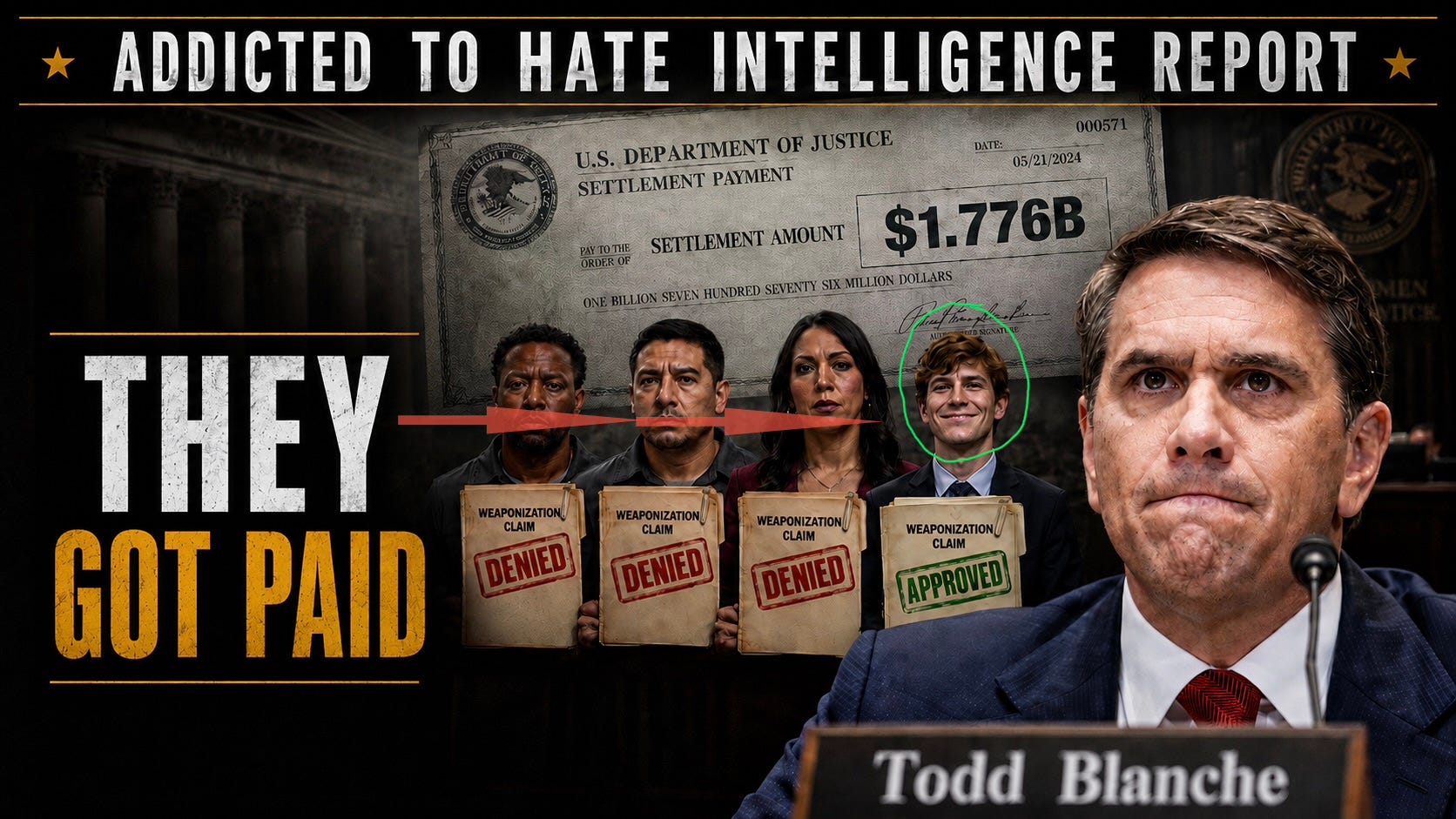
On May 18, the Justice Department announced that, as part of a settlement in President Donald J. Trump v. Internal Revenue Service, the attorney general had created a $1.776 billion “Anti-Weaponization Fund” to process claims from people who say they suffered “weaponization and lawfare.” The plaintiffs, Donald Trump, Donald Trump Jr., Eric Trump, and the Trump Organization, agreed to drop their IRS lawsuit with prejudice. DOJ said the plaintiffs would receive a formal apology but no monetary payment or damages. The fund, according to DOJ, would come from the judgment fund, issue monetary relief and formal apologies, report quarterly to the attorney general, and stop processing claims no later than December 1, 2028. [1]
That is the spine of the week. Not because every other story was smaller, but because this one exposed the full machinery. The grievance did not merely trend. It became a fund. It became commissioners. It became paperwork. It became eligibility. It became quarterly reporting. It became a state process for turning political persecution narratives into possible public compensation. The addiction found a cashier window.
The rest of the week fit around that center. Immigration enforcement sought more power over courthouses, states, judges, and detention systems. Civil rights language was turned against Yale medical admissions and law school diversity requirements. Trans inclusion was put under federal investigation while hospitals and courts fought over patient care and records. A mosque in San Diego became the site of deadly violence now under hate-crime investigation. These are not identical stories. They are not one conspiracy. But they show the same psychological operation moving through different rooms: name yourself injured, name the target dangerous, call punishment protection, then ask the state to process the demand. [2][3][4][5][6][7][8][9][10][11][12][13][14][15][16][17][18][19][20][21][22][23][24]
TLDR
DOJ announced a $1.776 billion Anti-Weaponization Fund tied to Trump dropping his IRS lawsuit, with the fund authorized to provide monetary relief and formal apologies to claimants alleging lawfare. The grievance became a claims process. [1][2]
Acting Attorney General Todd Blanche defended the fund before a Senate subcommittee and left open the possibility that people charged in the January 6 Capitol attack could seek compensation. The persecution story moved toward possible payout. [3]
On The Don Lemon Show, Michael Fanone called the fund a direct “fuck you” to Black and brown Americans still denied repair, while Monique Pressley named it “intentional weaponization” tied to power consolidation before November. This is grievance reparations. Not repair for the historically injured, but reimbursement for the politically offended. [1][2][3][27][28]
Courts pushed back against immigration enforcement in Texas, New York, and Colorado, while fired immigration judges sued over alleged ideological and discriminatory purges, ICE leadership moved closer to the detention economy, DOJ accused Yale’s medical school of race discrimination, and the ABA moved to eliminate its law school diversity rule under pressure. The enforcement state and anti-repair state moved together. [6][7][8][9][10][11][12][13][14]
Federal and state pressure against transgender inclusion moved through Smith College, hospital records, youth medical care, and court rulings, while a San Diego mosque attack showed the violent edge of target construction. Safety became the respectable word for exclusion and suspicion. [15][16][17][18][19][20][21][22][23][24]
Restack this and send it to one person who still thinks this stuff stays on the fringe.
If this report helps you see the machinery before it gets sold back to you as normal politics, support the work.
A paid subscription does not have to be $80 a year. The monthly option is $8. That is how the early warning system stays on.
If paid is not in the cards today, buy the coffee. Coffee is the side door, not the main plan.
What Moved This Week
The grievance economy got formal infrastructure.
The biggest move this week was the Justice Department’s May 18 announcement of the Anti-Weaponization Fund. DOJ said the fund was created as part of the settlement agreement in President Donald J. Trump v. Internal Revenue Service, after Trump and other plaintiffs sued Treasury and the IRS over the leak of their tax returns. Under DOJ’s announcement, Trump and the other plaintiffs would receive a formal apology but no monetary damages, while the fund would receive $1.776 billion from the judgment fund and process claims from people alleging “weaponization and lawfare.” [1]
The structure matters. DOJ said the fund can issue formal apologies and monetary relief, will report quarterly to the attorney general, can be audited at the attorney general’s direction, and will consist of five members appointed by the attorney general, with one chosen in consultation with congressional leadership. DOJ also said the president can remove members, but replacements must be chosen in the same way as the members they replace. [1]
AP reported that Democrats and watchdogs derided the arrangement as corrupt and unconstitutional, while the administration framed it as a lawful process for people claiming political targeting. AP also reported that the fund resolved Trump’s IRS lawsuit and could compensate people who believe they were unfairly investigated or prosecuted. [2]
This is the exact machinery ATH exists to track. A grievance narrative became an administrative apparatus. The state did not merely validate the feeling. It created a system to receive the feeling, sort it, judge it, compensate it, apologize to it, and report it to the attorney general.
The money is not the only story here. The category is the story.
Once “weaponization” becomes a state-recognized injury category with a nearly $1.8 billion fund behind it, the political meaning changes. The phrase stops being merely a campaign chant. It becomes eligibility language. It becomes an application. It becomes a claim file.
That does not mean every possible claimant is an extremist. That would be lazy. The danger is more precise. The fund creates a public pathway for a political persecution narrative used heavily by Trump and his allies to become an official compensation process. The same state that investigates, prosecutes, pardons, and pays now gets to decide whose grievance counts as injury.
Acting Attorney General Todd Blanche defended the fund the next day.
On May 19, AP reported that Blanche defended the $1.776 billion fund before a Senate appropriations subcommittee. He acknowledged what AP called the unusual nature of the fund and said beneficiaries would not be limited to Republicans or to people investigated or prosecuted by the Biden administration. AP also reported that Blanche left open the possibility that people charged in the January 6 Capitol attack could be eligible to seek compensation. [3]
The weak frame is legal redress.
The deeper frame is political absolution with paperwork.
When a government creates a fund for people claiming weaponization, while the president has already pardoned or commuted sentences for January 6 rioters, the machinery is not only reviewing harm. It is rewriting the emotional meaning of accountability. The arrested become the wounded. The prosecuted become the persecuted. The state becomes the therapist, cashier, and priest.
Treasury’s legal room showed smoke.
The Wall Street Journal reported that Treasury Department General Counsel Brian Morrissey resigned as the government settled Trump’s IRS lawsuit and the fund moved forward. The report described Morrissey as a Trump appointee and noted that Treasury is responsible for authorizing funds through the government’s judgment fund. [4]
The resignation does not prove motive by itself. That distinction matters. But in an intelligence report, timing is evidence to watch. When the government announces a controversial $1.776 billion claims process tied to the president’s own lawsuit, and the top Treasury lawyer exits at the same moment, the legal room deserves attention.
Immigration enforcement tried to turn due process into exposure.
This week also produced a cluster of court fights around immigration power. On May 14, Reuters reported that a federal judge blocked key parts of Texas SB 4, which would have allowed Texas officials to arrest and deport people suspected of illegally crossing the border. The judge found key provisions likely preempted by federal immigration law. [6]
On May 18, AP reported that U.S. District Judge P. Kevin Castel barred most immigration arrests in and around three Manhattan immigration court buildings unless exceptional circumstances exist. Civil rights groups had argued that people should be able to attend immigration proceedings and pursue asylum claims without being arrested near court. [7]
On May 13, AP reported that a federal judge in Colorado ruled ICE violated an earlier order limiting warrantless arrests. The court required training and records after the ACLU argued that ICE had been indiscriminately arresting Latinos to meet enforcement goals. ICE appealed and declined comment to AP. [8]
This is not separate from the grievance fund. It is the enforcement side of the same political appetite. One side says the movement’s people were persecuted. The other side expands the state’s ability to pursue those marked as threats. The machinery cries injury upward and projects danger downward. That is authoritarian emotion with administrative follow-through.
The immigration bench itself became a target.
Reuters reported that fired immigration judges Florence Chamberlin and George Pappas filed separate lawsuits alleging the Trump administration illegally targeted them. Chamberlin alleged she was swept up in a purge of so-called DEI hires, targeting women and non-white judges. Pappas alleged he was fired because of his past advocacy for Latin American immigrants, association with immigrant rights groups, Greek citizenship, and age. DOJ did not comment to Reuters on those cases. [9][10]
Reuters also reported that more than 110 immigration judges had been terminated after Trump took office, while the Executive Office for Immigration Review said in April it had hired more than 140 new immigration judges, most with military or law enforcement backgrounds, describing them as deportation judges. [9][10]
The weak frame is personnel policy.
The deeper frame is adjudicatory capture.
A system does not have to abolish due process if it can remake the people who administer it. The addiction does not need only rallies. It needs judges, dockets, hiring priorities, and a bench trained to know which stories count as danger before the hearing begins.
ICE leadership moved closer to the detention economy.
Reuters reported on May 13 that David Venturella, a senior ICE official and former GEO Group employee, would become acting ICE director. GEO Group is a private prison company that operates immigrant detention centers. Reuters also reported that 18 people had died in ICE custody in the first four months of 2026, after 31 deaths the previous year, the highest annual total in two decades. [11]
The mechanism here is infrastructure. Grievance needs contractors. Enforcement needs beds. Detention needs administrators. A political movement can scream about invasion all day, but the real question is who gets the contract, who gets the office, who controls the facility, and who dies inside the system.
Civil rights language was turned against repair.
On May 14, DOJ announced that its Civil Rights Division found Yale School of Medicine discriminated based on race in admissions. DOJ said Yale favored Black and Hispanic applicants over similarly qualified White and Asian applicants and demanded a voluntary resolution agreement. Reuters reported that Yale said it was reviewing the letter and remained confident in its admissions process. [12][13]
The next day, Reuters reported that the American Bar Association’s Council of the Section of Legal Education and Admissions to the Bar voted to eliminate a rule requiring law schools to show commitment to diversity in recruitment, admissions, and programming. The rule had already been suspended under pressure from the Trump administration and Republican-led states. The change still requires consideration by the ABA House of Delegates. [14]
This is the civil rights inversion machine. The remedy becomes the offense. Repair becomes discrimination. Black access becomes a suspicious object. Institutional diversity becomes a legal liability. The system injures, resists repair, then calls repair the injury.
Trans exclusion kept moving through investigations, subpoenas, hospitals, and courts.

The Department of Education opened a Title IX investigation into Smith College, an all-women’s college, over its trans-inclusive policies. The department framed the matter as an investigation into an all-women’s college for “admitting men.” Them reported that the complaint came from Defending Education and cited concerns that the investigation appeared political rather than grounded in a specific student harm. Defending Education’s own complaint argued that Smith’s gender identity policies violate Title IX. [15][16][17]
On May 14, Reuters reported that a federal judge in Rhode Island blocked a Justice Department subpoena seeking records from Rhode Island Hospital and Brown Health concerning gender-affirming care for transgender youth. U.S. District Judge Mary McElroy said DOJ acted in bad faith and that the subpoena would violate minor patients’ privacy rights. [18]
On May 18, Reuters reported that the Colorado Supreme Court ordered Children’s Hospital Colorado to resume gender-affirming care for transgender youth, finding the hospital likely violated state antidiscrimination law by stopping puberty blockers and hormone therapy for trans minors while providing comparable treatments to other youth. [19]
Kansas produced another resistance point. The ACLU reported that a state court temporarily blocked enforcement of a ban on gender-affirming medical care for transgender youth, saying the law would prohibit treatments for trans youth while allowing similar treatments for cisgender youth for other diagnoses. [20]
The weak frame is protecting women and children.
The deeper frame is definitional control.
If the state can define trans women as intruders, trans youth care as suspect, and hospital records as investigatory material, then the target is not only a policy. The target is public legitimacy.
The hate-crime investigation in San Diego showed the violent edge of target construction.
On May 18, gunfire hit the Islamic Center of San Diego, the largest mosque in San Diego County. Three men were killed. Two teenage suspects died from self-inflicted gunshot wounds after a pursuit. AP and Reuters reported that police and the FBI were investigating the attack as a hate crime, while authorities had not publicly established a precise motive. AP reported that evidence included generalized hate rhetoric and that children at the attached Al Rashid School were not harmed. [21][22]
This is not the same category as the IRS settlement, the immigration court rulings, or the Smith investigation. It belongs in the report because the report tracks how groups become targets. Some targeting enters the state through paperwork. Some enters public life through institutions. Some enters sacred space with guns.
The public will be tempted to isolate the mosque attack as an individual crime. The intelligence question is broader: what atmosphere keeps teaching young men that certain communities are available for ritual violence?
Who Got a Boost
The first boost went to the persecution narrative.
The Anti-Weaponization Fund gives the movement’s favorite self-description institutional form. “Weaponization” is no longer only a rally word, cable segment, or fundraising phrase. It is now the name of a federal fund announced by the Justice Department. [1][2]
The psychological boost is enormous. A movement organized around resentment needs confirmation that its pain is official, its enemies are illegitimate, and its retaliation is actually justice. A fund does all three. It turns self-pity into procedure.
The second boost went to Trump-aligned claimants and the loyalty economy.
AP reported that the fund could compensate allies of the president who say they were unjustly investigated or prosecuted, and Blanche left open the possibility that January 6 defendants could apply. The administration says the fund is not partisan and not limited to Republicans. That caveat belongs in the record. But the political universe receiving the signal is obvious. [2][3]
A loyalty economy does not always pay in advance. Sometimes it pays after the fact. Sometimes it pays in pardons. Sometimes it pays in appointments. Sometimes it pays in legal-defense gravity. Sometimes it pays in the possibility that the state itself may call you wronged.
The third boost went to the executive branch’s reward-and-punish capacity.
The fund sits inside a larger context. AP reported that critics connected it to concerns about DOJ independence and Blanche’s aggressive alignment with Trump’s priorities, including actions involving perceived political enemies, media leaks, and supporters who claim mistreatment. [3]
This is where the report has to stay careful. A fund is not a conviction. A claim is not proof. Eligibility is not payment. But the institutional architecture matters. When the same political system can investigate enemies, pardon allies, and create a compensation route for allies claiming persecution, the center of gravity shifts.
The fourth boost went to enforcement bureaucracies.
Immigration enforcement received repeated opportunities to test the boundary of power. Courts pushed back in Texas, New York, and Colorado, but the attempted movement still matters. ICE leadership, courthouse arrest fights, warrantless arrest violations, and detained-body infrastructure all show the state looking for more usable power over people already framed as threats. [6][7][8][11]
The fifth boost went to anti-repair politics.
DOJ’s Yale finding and the ABA diversity-rule vote gave anti-DEI politics a new institutional push. These moves teach schools, law programs, medical programs, and professional bodies that diversity can be treated as risk. The point is not only one school or one accreditation rule. The point is the chilling effect. [12][13][14]
The sixth boost went to the translators of exclusion.
The translators are the agencies, advocacy groups, legal offices, and media ecosystems that give targeted politics a softer name. Anti-trans exclusion becomes women’s safety. Anti-DEI rollback becomes civil rights enforcement. Immigration intimidation becomes public order. A revenge fund becomes redress for lawfare. The translation is the operation. [1][12][13][14][15][16][17][18][19][20]
Who Made It Seem Normal
The normalizers used six scripts this week.
Redress. DOJ called the fund a systematic process to hear and redress claims from people who suffered weaponization and lawfare. The word redress makes the fund sound like civil justice. The question is who gets defined as the injured party and who gets turned into the abuser. [1]
Lawfare. Lawfare is the emotional key. It turns prosecution, investigation, and accountability into warfare against the movement. Once accountability becomes warfare, retaliation can present itself as peacekeeping. [1][2][3]
Judgment fund. DOJ said the $1.776 billion would come from the judgment fund, a standing appropriation used to pay judgments and settlements. That language is bureaucratic. It also matters because it keeps the public fight away from a normal congressional appropriations vote. [1]
Safety. Immigration court arrests are defended as enforcement. Trans exclusion is framed as women’s protection. Surveillance, detention, and subpoena fights are framed as order. Safety becomes the word that lets the state decide whose fear counts and whose fear is evidence of guilt. [6][7][8][15][18][19]
Merit. Anti-DEI politics frames institutional repair as lowered standards. In the Yale case, the government’s language turns Black and Hispanic admission into suspicion while casting the attack on diversity as civil rights enforcement. Yale disputes the finding, but the script is already clear. [12][13]
Procedure. The week came wrapped in legal process: settlements, court orders, subpoenas, agency investigations, personnel actions, accreditation votes, and claims procedures. Procedure can restrain power. It can also hide power. The public sees forms. The targets feel the trap.
Where It Showed Up
Inside DOJ. The Anti-Weaponization Fund is not a side office. DOJ announced it. DOJ named it. DOJ defended it. DOJ will receive quarterly reports. The place matters because the department tasked with law enforcement is now also organizing a claims process around the president’s favored narrative of political persecution. [1][2][3]
Inside Treasury and the IRS. The underlying case involved the leak of Trump’s tax returns and a lawsuit against Treasury and the IRS. The fund is to be paid through the judgment fund. The Wall Street Journal’s report that Treasury’s general counsel resigned as the settlement moved forward gives this institutional location extra weight. [1][4]
Inside Congress. Blanche’s May 19 Senate appearance turned the DOJ budget hearing into a fight over the fund. That matters because appropriations, oversight, and executive power all met in the same room. If Congress cannot control the money, it can at least expose the machinery. [3]
At immigration courts. New York immigration court buildings became the site of a fight over whether people can attend proceedings without being arrested nearby. A courthouse matters because a system that punishes people for appearing before it is no longer merely adjudicating. It is hunting. [7]
Inside state power. Texas SB 4 mattered because it tried to convert state suspicion into immigration arrest and deportation authority. The injunction matters. The attempted transfer of power matters more. [6]
Inside ICE. Leadership, custody deaths, warrantless arrest litigation, and the detention economy converged around one question: who watches the watchers when immigration enforcement becomes the emotional center of politics? [8][11]
Inside medical and legal pipelines. Yale and the ABA show professional formation becoming a battleground. Medical school admissions and law school accreditation are not culture-war side stages. They are gatekeeping systems for future doctors, lawyers, judges, prosecutors, agency leaders, and institutional memory. [12][13][14]
Inside women’s colleges and hospitals. Smith College, Rhode Island Hospital, Children’s Hospital Colorado, and Kansas courts show the state moving from public debate into admissions, treatment protocols, patient records, and institutional risk calculations. The body becomes paperwork. The paperwork becomes power. [15][16][17][18][19][20]
At a mosque and school complex. The Islamic Center of San Diego was not only a crime scene. It was a sacred and communal site. The fact that children at the attached school were unharmed does not soften the meaning. It clarifies the target environment. [21][22]
The Receipts Room
Primary language matters this week because the laundering is in the vocabulary.
DOJ, Anti-Weaponization Fund: “weaponization and lawfare.” [1]
DOJ, fund authority: formal apologies and monetary relief. [1]
DOJ, settlement terms: Trump, his sons, and the Trump Organization receive a formal apology but no monetary payment or damages. [1]
DOJ, fund amount: $1.776 billion from the judgment fund. [1]
AP, May 19 hearing: Blanche left open the possibility that people charged in the January 6 Capitol riot could be eligible for compensation. [3]

That is why this Don Lemon Show from today’s exchange belongs in the receipts room. Michael Fanone is a former D.C. Metropolitan Police officer who was assaulted while defending the Capitol on January 6 and later became one of the most visible public witnesses against the laundering of that violence. [27]
Monique Pressley is a trial attorney, television legal analyst, crisis manager, adjunct law professor, and public commentator. [28]
The transcript below was supplied by XVOA and begins mid-thought. Fanone speaks first.
Michael Fanone: also didn’t, you know, I mean, like, it’s like comparing apples to Maseratis. I mean, you have Native Americans who are oppressed peoples, like African Americans, like communities of color in this country, who suffered at the hands of oppressors, who died at the hands of oppressors, and somehow that is the same thing as a bunch of angry white folks that charged the Capitol on January 6th and committed violent crimes. I don’t even, I mean, I can’t believe that he’s not being laughed out of this hearing for uttering those absolutely insane words. And you know, the other thing that just kind of popped into my brain, because I said it earlier in the show, I talked about the timing of this payment and how it came at the heels of National Peace Officers Memorial Week. And I don’t think that that was intentional. I mistake that, you know, that’s, you know, again, another instance of rubbing salt in the wound, but I don’t think it was intentional by this administration. But what I do think was intentional is the timing of this comes on the heels of the rolling back of the Voting Rights Act. And that this is a direct middle finger to communities of color. Fuck you. Fuck you, black and brown people in America. You wanted reparations? Well, guess what? We’re going to give reparations to a bunch of angry white folks. So fuck you.
Monique Pressley: But it’s, but it is not just a middle finger up. I agree with you, but it is an intentional weaponization. Everything that they are doing right now is about solidifying whatever kind of power base they can in the march up to the November elections. And what they are seeing, frankly, is that they are losing. And so these are desperate acts from desperate people who are trying to scare, intimidate communities, not just Black people, but communities of goodwill who are rising up to fight against this. What we saw last weekend in All Roads Lead to the South was not just Black galvanization. You know, people don’t really understand and I’ve seen some kind of false, I won’t say negative, but false comments that bigger marches like No Kings or that people who are not Black or brown were not involved. That is not true. People were supporting the march. People supported it financially, including Invisible. And so they, the administration knows that their days are limited on this power grab. And this is quite literally their cold, dying fingers grasping for power as we all come together. They have gone too far. What they have done with the Voting Rights Act has awakened people who have been asleep for decades. And it has brought people together who think that enough is enough, finally. And what Steve said about Yap and prices, I was in Ohio trying to pick up my kids. Ohio. Like in the burbs. And the gas was $6.10. Middle America is pissed off. And they’re not pissed off at black folks blaming black folks for this. They’re pissed off at this administration. And so we are all coming together. I got news for y’all. We’re coming.
The weak frame is that this is merely pundit anger.
The deeper frame is that Fanone names the symbolic inversion and Pressley names the strategic use of it.
Fanone’s point is not just outrage over January 6 defendants or Trump allies possibly seeking compensation. His point is historical substitution. Communities whose oppression has never been repaired are told to watch the state build a potential compensation structure around people attached to a movement that attacked the Capitol, resisted democratic transfer, and then rebranded itself as persecuted.
That is why the reparations language matters. The report should not sanitize it. It is the moral charge in plain speech: Black and brown Americans are told their repair is impossible, unaffordable, divisive, old news, or impractical. Then the state finds nearly $1.8 billion for a grievance fund built around “weaponization.” [1][2][3]
Pressley’s response pushes the frame from insult to operation. She does not treat the fund as only a symbolic middle finger. She reads it as power consolidation in an election year, tied to intimidation, mobilization, and backlash politics. That is the intelligence value of the exchange. It shows how the fund functions emotionally and politically at the same time.
This is grievance reparations. Not repair for the historically injured, but reimbursement for the politically offended.
Department of Education, Smith College investigation: the department framed the probe as an investigation into an all-women’s college for “admitting men.” [15]
DOJ, Yale medical school: the Civil Rights Division said Yale discriminated in admissions based on race. [12]
The weak frame is bureaucratic dispute.
The deeper frame is category capture.
What the language is doing is moving favored grievance into the category of injury while moving targeted groups into the category of threat. Trump-aligned claimants become possible victims of weaponization. Black and Hispanic applicants become possible evidence of discrimination. Trans women become proof of intrusion. Immigrants become dangerous at the courthouse door. Muslim worshippers become vulnerable inside a sacred space while the country waits to see whether the word hate survives the investigation.
That is processed hate. It does not always arrive as a slur. Sometimes it arrives as a definition, a fund, a claims form, and a quarterly report.
What They Want
They want definitional power.
They want to define accountability as persecution.
They want to define prosecution as lawfare.
They want to define loyalty as injury.
They want to define punishment as redress.
They want to define diversity as discrimination.
They want to define trans inclusion as danger.
They want to define immigrant court attendance as an enforcement opportunity.
They want to define repair as corruption.
They want to define state retaliation as healing.
They want to define who counts as the real victim before the public even sees the evidence.
This does not require every actor in every story to share the same private motive. That would be bad analysis. The machinery does not need identical motives. It needs compatible outcomes. Different hands can pull the same rope.
Why It Matters
This matters because grievance movements do not become governing systems all at once. They practice.
First they name themselves the injured party. Then they identify enemies. Then they call accountability persecution. Then they ask institutions to repeat the language. Then they build a claims process.
That is why the IRS settlement belongs at the center of this report. It shows the whole arc. A political movement spent years insisting that investigations into Trump and his allies were not accountability, but weaponization. This week, that narrative acquired a fund, commissioners, reports, apologies, and potential payouts. [1][2][3]
The historical pattern is older than Trump. American reactionary politics has often answered demands for repair by recoding the already-powerful as the newly oppressed. Reconstruction was recoded as corruption. Desegregation was recoded as forced social engineering. Affirmative action was recoded as theft. Now DEI becomes discrimination, trans inclusion becomes danger, immigration due process becomes a loophole, and accountability for political violence becomes possible persecution.
Political psychology research on status threat helps explain why movements organized around perceived loss can intensify grievance politics. Extremism trackers have also warned that formal hate-group counts do not capture the full migration of extremist ideas into mainstream institutions and political life. That does not mean we diagnose individuals. It means we watch the group dynamic. When status panic needs relief, someone must be named the thief, the invader, the cheater, the corrupter, or the threat. [25][26]
Who pays first? The people already positioned outside full innocence. Muslims at prayer. Black and Hispanic students accused of displacing someone more deserving. Trans youth whose care becomes an ideological battlefield. Immigrants told to appear in court and then taught to fear the courthouse. Judges accused of being too independent for the desired machinery.
The collective shadow shows where the country keeps projecting its own appetite for domination onto the people it has already decided to fear.
What to Watch Next
The Anti-Weaponization Fund’s legal challenges. Watch whether watchdog groups, congressional Democrats, or private plaintiffs challenge the fund’s legality, especially around the judgment fund, separation of powers, and the domestic emoluments issue raised by critics. [2][5]
The claimant rules. Watch who is eligible, whether recipients are disclosed, whether January 6 defendants apply, and whether the quarterly reports to the attorney general ever become public. The real story may be in the forms. [1][3]
Treasury’s role. Watch whether Morrissey’s resignation is followed by further departures, internal memos, inspector general activity, or congressional subpoenas. Timing is not proof, but it is a flare. [4]
Blanche and DOJ independence. Watch how the acting attorney general defends the fund, whether DOJ uses similar settlement structures elsewhere, and whether “weaponization” becomes a standing category in department policy. [3]
Texas SB 4 and copycat state immigration laws. Watch the Fifth Circuit, emergency motions, and whether other states use Texas as a model for state-level immigration enforcement. [6]
Immigration courthouse arrests. Watch whether the New York ruling inspires similar suits in other jurisdictions and whether DHS changes tactics around immigration courts. [7]
The fired immigration judge lawsuits. Watch discovery. Personnel files, hiring criteria, and internal communications may reveal whether the immigration bench is being remade around enforcement loyalty. [9][10]
Yale, the ABA, and the professional pipeline. Watch whether the Yale finding becomes a template for medical schools and whether the ABA House of Delegates approves the diversity-rule elimination. The quiet pipeline fights shape who holds power later. [12][13][14]
Smith College and the next women’s colleges. Watch whether the Smith investigation remains a single complaint or becomes the opening move against every women’s college with trans-inclusive admissions. [15][16][17]
The San Diego mosque investigation. Watch what authorities release about motive, online activity, planning, and hate evidence. Also watch whether the story disappears after the suspects’ deaths or becomes part of a broader discussion about anti-Muslim threat environments. [21][22]
Closing
This week’s map was not one fire. It was a payment system.
The IRS settlement showed the clearest version of the pattern: grievance became policy, victimhood became eligibility, and the state created a process for turning political persecution narratives into possible compensation.
Around that center, the rest of the machinery kept moving. Immigration enforcement pushed at courthouses and state borders. ICE moved through leadership, detention, and warrants. DOJ turned civil rights language against Yale. The ABA moved away from diversity requirements. Federal pressure targeted Smith College and transgender youth care. San Diego showed the violent edge of what happens when a community is made available for fear.
The addiction needed another hit. This week, it found something better than a hit.
It found a fund.
Keep This Going
If you made it this far, got the map, and are about to walk out without becoming a paid subscriber, that is crazy.
The people building these pipelines have donors, institutions, lawyers, churches, PACs, government agencies, and media machines.
I have a keyboard, a retired cop’s investigative habits, and readers who understand that early warning systems do not fund themselves.
A paid subscription does not have to be $80 a year.
The monthly option is $8.
That is how this work gets a floor under it.
And if paid is not in the cards today, at least do the minimum respectable thing and buy the coffee.
Sources
U.S. Department of Justice: Justice Department Announces Anti-Weaponization Fund: Provides the official DOJ announcement, fund amount, settlement terms, formal apology language, claims process, and fund structure.
Associated Press: Justice Department announces nearly $1.8B fund to compensate Trump allies in a deal to drop IRS suit: Reports the nearly $1.8 billion fund, Trump IRS lawsuit settlement, and criticism from Democrats and watchdogs.
Associated Press: Under congressional scrutiny, Blanche defends nearly $1.8 billion fund to pay Trump allies: Covers Blanche’s Senate testimony, the fund’s possible reach, and questions about January 6 defendants.
Wall Street Journal: Treasury Lawyer Quits as Government Settles Trump IRS Suit: Reports Treasury General Counsel Brian Morrissey’s resignation as the IRS settlement and fund moved forward.
The Guardian: Trump dismisses $10bn suit against IRS and creates $1.7bn ‘anti-weaponization’ fund: Provides additional reporting on the fund’s oversight structure, secrecy concerns, court timing, and watchdog criticism.
Reuters: US judge blocks key parts of Texas migrant arrest law: Covers the injunction against major provisions of Texas SB 4 and the federal preemption issue.
Associated Press: Federal judge bans most arrests by federal agents in immigration courts in New York: Reports the New York immigration courthouse arrest ruling and the due process concerns behind it.
Associated Press: Federal judge rules ICE in Colorado violated order limiting warrantless arrests: Covers the Colorado ruling that ICE violated a court order restricting warrantless arrests.
Reuters: Fired immigration judge sues Trump administration for discrimination: Details Florence Chamberlin’s lawsuit and allegations about immigration judge firings.
Reuters: Fired US immigration judge sues over alleged targeting by Trump administration: Details George Pappas’s lawsuit and broader claims about ideological targeting in immigration courts.
Reuters: US ICE official who worked at private prison firm will be agency’s new acting head: Reports David Venturella’s appointment, his GEO Group background, and ICE custody death figures.
U.S. Department of Justice: Justice Department Investigation Determines Yale’s Medical School Discriminated Based on Race in Admissions: Provides the official DOJ finding and allegations against Yale School of Medicine.
Reuters: US DOJ says Yale medical school admissions favor Black and Hispanic students: Provides Yale’s response and context for the Trump administration’s broader anti-DEI campaign.
Reuters: American Bar Association votes to eliminate DEI rule for law schools: Covers the ABA council vote to eliminate the law school diversity rule and the political pressure around accreditation.
U.S. Department of Education: U.S. Department of Education Opens Title IX Investigation into All-Women’s Smith College for Admitting Men: Provides the official Education Department framing of the Smith College Title IX investigation.
Them: Did An Honorary Degree for Dr. Rachel Levine Lead to Title IX Probe of Smith College?: Provides reporting and expert context on the Smith College investigation and the Defending Education complaint.
Defending Education: OCR Complaint: Smith College: Provides the advocacy complaint that helped trigger the federal investigation into Smith College.
Reuters: US judge blocks Justice Department bid for Rhode Island hospital transgender care records: Covers the Rhode Island ruling blocking DOJ’s subpoena for transgender youth care records.
Reuters: Colorado top court says hospital must resume treatments for transgender youth: Covers the Colorado Supreme Court order requiring a hospital to resume gender-affirming care for transgender youth.
ACLU: State Court Blocks Kansas Ban on Gender-Affirming Medical Care for Transgender Youth: Provides the civil rights plaintiffs’ account of the Kansas ruling blocking enforcement of the youth gender-affirming care ban.
Associated Press: What to know about a deadly attack by teen gunmen on a San Diego mosque: Provides the detailed account of the San Diego mosque shooting, victims, suspects, school safety, and hate-crime investigation.
Reuters: Five dead, including two teen suspects, after shooting at San Diego mosque: Confirms the police and FBI hate-crime investigation, the teen suspects, and the public facts available on motive.
Associated Press: Teenage gunmen open fire on San Diego mosque, killing 3 men and then themselves: Provides additional reporting on the suspects, victims, and aftermath of the mosque attack.
Council on American-Islamic Relations: CAIR Condemns Deadly Shooting at Islamic Center of San Diego, Calls for Hate Crime Investigation: Provides Muslim civil rights response and community framing around the attack.
Associated Press: Hate groups in the US decline but their influence grows, report shows: Summarizes SPLC’s warning that extremist influence can grow even when formal group counts decline.
Proceedings of the National Academy of Sciences: Status threat, not economic hardship, explains the 2016 presidential vote: Provides political psychology context on status threat and reactionary politics.
Associated Press: Man who used stun gun on cop in Jan. 6 riot pleads guilty: Provides background on Michael Fanone as the former D.C. officer assaulted during the January 6 attack.
Monique Pressley: About Monique: Provides biographical background on Pressley as a trial attorney, television legal analyst, crisis manager, adjunct law professor, and commentator.
So exhausting. Thank you for weaving these strands together to reveal the larger pattern.
They all got paid.