

I’ll own this up front: I’ve been a Don Lemon fan since his CNN years - not because he’s flawless, but because he kept showing up in the blast radius, saying the part out loud that polite people whisper.
If you’re not steeped in cable-news lore: Don Lemon is a longtime American broadcast journalist who spent 17 years at CNN, became one of the network’s most recognizable anchors, and then exited abruptly in April 2023 (Lemon said he was terminated; CNN said they were parting ways). After that, he pivoted into independent media with The Don Lemon Show (podcast + YouTube). He also attempted to launch the show through an exclusive partnership on X (formerly Twitter), but the deal was canceled after he interviewed Elon Musk; Lemon later sued over the canceled partnership, according to Reuters. (Sources 13–19)
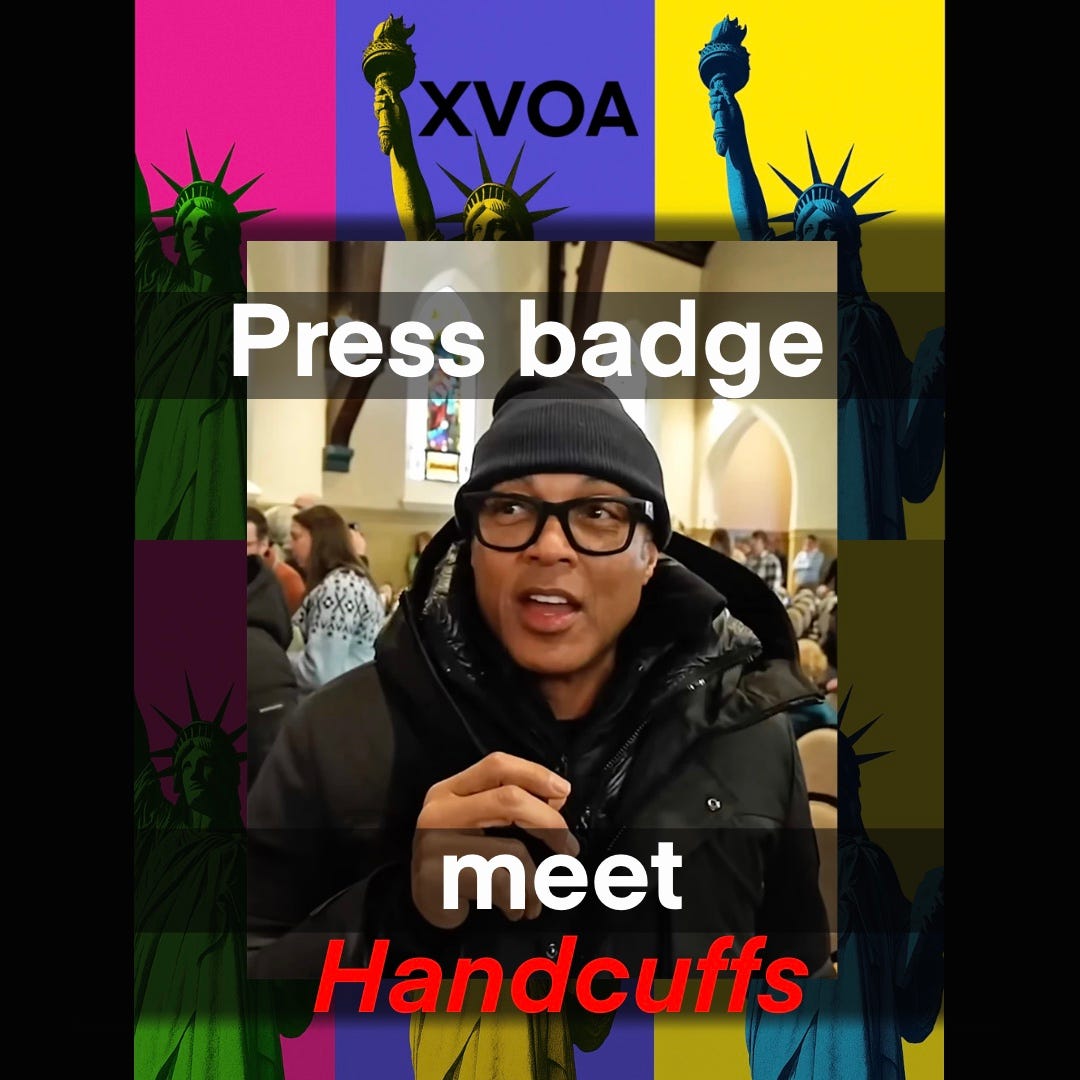
Today, on MLK day of all days, the Trump DOJ publicly signaled it was looking at Don Lemon through the lens of the Enforcement Act of 1871 (often nicknamed the “KKK Act”), alongside the FACE Act, after Lemon livestreamed a disruptive anti-ICE protest inside a Minneapolis church. DOJ Civil Rights leadership framed the issue as this: journalism is not a magic cloak if the reporter is helping to obstruct, conspire, or intimidate. Lemon’s counter-frame was just as blunt: he documented what happened; he didn’t plan it; the First Amendment protects the act of newsgathering. (Sources 1, 4, 7)
TLDR
What it is: Not a filed case yet - a public warning with criminal-ish language, which is often the point: the chill lands before the charges do. (Sources 1, 4, 7)
What DOJ floated: The 1871 Enforcement Act (“KKK Act”) plus the FACE Act, triggered by Lemon livestreaming a disruptive protest inside a Minneapolis church. (Sources 1, 4, 7)
What Lemon says it was: Journalism. Presence ≠ planning. Camera ≠ conspiracy. That’s his entire defense in one breath. (Sources 1, 4)
Conservative creator frame: “Sacred space was violated” → “make arrests” → “Lemon wasn’t documenting, he was embedded.” The moral outrage fuels the legal appetite. (Sources 2, 3, 6)
Liberal creator frame: “They’re redefining reporting as activism” → “then prosecuting the new label.” The KKK Act language becomes symbolic intimidation, not neutral law enforcement. (Sources 5, 6)
Mainstream frame: Procedural + legal threshold: what would have to be proven for speech to become obstruction or conspiracy; what’s allegation vs. what’s on video. (Sources 1, 4, 6)
Foreign frame: Explainer + spectacle: who Lemon is, what the 1871 act is, and why it’s such an American contradiction to see it invoked here. (Sources 9–11)
Next: the anatomy of how each ecosystem turns Lemon into a symbol, and how that symbolic fight can quietly rewrite what counts as “journalism” when the state wants obedience.
Oh and I almost forgot.
If this matters to you, do not just sit with it. Restack, restack, restack. Share it in the places where your people actually read, including group chats, Facebook, and anywhere the algorithm still respects a human recommendation.
Now keep reading, because the rest of this essay is about how the story gets weaponized.
Don Lemon’s Show
Lemon didn’t respond like a man backing away from a storm. He responded like a journalist who recognizes a familiar move: take reporting, rename it “activism,” and then prosecute the rename. In the episode of The Don Lemon Show built around this controversy, he put the accusation on the table before it could metastasize. He told the audience, repeatedly, that he wasn’t protesting. He was reporting, and that showing up with a camera is not the same thing as organizing what the camera sees. (See video.)
With comedian D.L. Hughley in the conversation and Minnesota Attorney General Keith Ellison later joining, Lemon sharpened the argument into something larger than his own legal exposure. He framed the DOJ posture as a moral inversion, a rhetorical “perversion” of civil-rights history, especially jarring on MLK Day: a law associated with stopping terror gets invoked to threaten a journalist documenting public dissent. (See video.)
Then the conversation widened into the kind of American double-standard people feel in their bones. Lemon and Hughley invoked the long, ugly record of Black churches being bombed, burned, and attacked, and contrasted that history with how quickly some voices found reverence when the disrupted church service could be used as a weapon against anti-ICE protest and against Lemon. The point wasn’t to excuse disruption. The point was to expose selective sanctity: who gets protection, who gets lectures, and who gets federal threats. (See video.)
Hughley pushed the hypocrisy harder by pointing out that the same political forces performing outrage over “sacred space” have also advocated expanded enforcement power into “sensitive places,” including churches, when it suits immigration policy and policing. Reverence becomes a costume you put on to justify punishment, then fold back into your pocket when the target changes. (See video.)
Ellison’s contribution was less cultural and more legal, and that’s what gave the exchange weight. He said the DOJ theory was a stretch because it tries to do something subtle first: it tries to make the law fit the headline, instead of making the facts fit the law. (See video.)
On the FACE Act, Ellison’s point was simple. That statute is usually discussed in the context of reproductive health clinics, but it also covers places of religious worship. It is aimed at force, threats of force, or physical obstruction that intentionally interferes with people getting in or worshipping. Ellison’s emphasis was that this law is about coercion and blockage, not about a camera showing up after the fact. If you did not threaten people, physically block entrances, or coordinate the disruption, the FACE Act is a hard fit. (See video.)
On the “KKK Act,” Ellison pulled the listener back to the origin story. The Enforcement Act of 1871 was born out of Reconstruction, when organized violence and coordinated intimidation were used to strip people, especially Black citizens, of basic constitutional rights. In his telling, the heart of that tradition is conspiracy to deprive rights, often under color of law, and often through intimidation that functions like terror. That is why he called the idea of using it against a journalist a category mistake. You do not turn documentation into deprivation just by disliking the documentation. (See video.)
Lemon kept returning to the hinge that makes Ellison’s warning feel bigger than one show: if you can reclassify a reporter as an “activist” because he filmed an event, you can make almost any inconvenient journalism sound like a prosecutable conspiracy. (See video.)
That’s the key to Lemon’s self-defense. It’s not “I’m sorry.” It’s “you’re trying to change the category of what happened.” (See video.)
Conservative Content Creators’ Reactions
Tone and Framing: Conservative commentators and outlets largely applauded or justified the DOJ’s hard line, casting the church protest as a lawless attack on faith and treating Lemon as a participant rather than a journalist. The tone was indignant and triumphant - emphasizing law-and-order, religious sanctity, and alleged liberal hypocrisy. Many pointed out that the same statutes had been used under Biden’s DOJ against right-wing activists, arguing it was only fair or overdue to apply them to leftist protesters(3)(3). The protest was often described in charged terms - e.g. an “anti-ICE invasion” of a church(3) - and Lemon depicted as instigating or “embedded” with the agitators, not an innocent observer(2)(2).
Key Points of Emphasis: Conservative voices stressed that houses of worship are off-limits for protests and celebrated the DOJ for enforcing that principle. They highlighted Dhillon’s assertion that the First Amendment doesn’t protect “pseudo-journalism” used as a cover to disrupt a prayer service(1). Many agreed with her framing of Lemon as potentially part of a “criminal conspiracy” rather than a reporter(2)(2). There was also emphasis on the Ku Klux Klan Act’s original intent to protect civil rights - ironically repurposed here to protect Christian worshippers - and on the hefty penalties (decade+ prison terms) such charges could carry(2).
Recurring Rhetoric and Influential Voices: A common refrain was that “desecration of Christian worship has no place in America.” Right-wing pundit Benny Johnson, for example, blasted the protest as “sickening” and cheered federal action: “This desecration of Christian worship… [is] protected by law. MAKE THE ARRESTS, DOJ! Lock up the church-storming agitators. Protect houses of worship!”(6)(6). Many conservatives on X (Twitter) echoed this “lock them up” sentiment. Trump allies in government also piled on - White House press secretary Karoline Leavitt called the incident “despicable” and declared “President Trump will not tolerate the intimidation and harassment of Christians in their sacred places of worship”(7)(7). Attorney General Pam Bondi similarly warned that “attacks against law enforcement and the intimidation of Christians” would meet the “full force of federal law”(7). Notably, some conservative content crossed into explicitly vitriolic territory: Rapper Nicki Minaj (who has increasingly aligned with MAGA rhetoric) went on an all-caps tirade against Lemon - “DON ‘C--- SUCKIN’ LEMON IS DISGUSTING. … I WANT THAT THUG IN JAIL!!!!! … LOCK HIM UP!!!!!”(12). Her post, laced with a homophobic slur, went viral in right-wing circles, exemplifying the vengeful, celebratory tone of some reactions. (Lemon, for his part, brushed off Minaj’s rant by saying she didn’t understand journalism and calling her a “Pick Me doll”(12).)
In sum, conservative creators framed Lemon as a culprit, not a victim, focusing on the illegality and “shamefulness” of the protest itself. They applauded the DOJ for invoking powerful laws (the FACE Act and KKK Act) to punish those involved, often explicitly urging Lemon’s prosecution. Themes of law, order, and religious freedom trumped any concern for press freedom in this narrative. Some also pointed out that Biden’s DOJ had used these laws against conservative protesters (e.g. at abortion clinics), implying that Lemon and left-wing activists should now face the same consequences(3)(3). The overarching rhetoric painted Lemon as a partisan actor who “got what was coming” for allegedly stoking chaos in a church.
Liberal Content Creators’ Reactions
Tone and Framing: Liberal and progressive commentators reacted with alarm and outrage, portraying the DOJ’s threats as an assault on press freedom and an example of authoritarian overreach by the Trump administration. The tone was often incredulous and outraged. Many highlighted the blatant irony of using the Ku Klux Klan Act - a law designed to protect Black Americans from white supremacist terror - against Don Lemon, a Black journalistcovering a protest(5)(5). MSNBC host Mehdi Hasan captured the shock, posting that it was “HOLY SHIT” alarming to see a DOJ official invoke the KKK Act to publicly threaten a reporter, essentially “letting that sink in” that a 19th-century civil rights statute was being flipped to potentially criminalize newsgathering(22).
Key Points of Emphasis: Liberal voices focused on First Amendment implications, political retaliation, and the distraction from the underlying issue (the ICE shooting). The Daily Beast dubbed Dhillon a “Trump DOJ goon”hyping a “bonkers” probe(5), and noted that “MAGA has decided Don Lemon… is no longer a journalist—but a criminal suspect.” The site reported how Lemon’s on-the-ground reporting was being “framed by Trump’s Justice Department lackeys as a potential federal crime”, with “threats of jail time” and an escalating investigation(5)(5). This framing stressed that the Trump DOJ was targeting a reporter for doing his job, casting doubt on the legitimacy of the investigation. Commentators pointed out that Lemon was not the only journalist present but was being singled out, suggesting a politically motivated effort to make an example of a high-profile media figure(1).
Many on the left highlighted that Lemon flatly denied organizing the protest and insisted he was just documenting events(5). His defenders accepted his explanation that he “had no affiliation with [the protesters]” and that he was “chronicling… an act of journalism” protected by the First Amendment(5). Thus, they saw the DOJ’s stance as criminalizing newsgathering. The historical irony of using the KKK Act was heavily noted - a civil rights law now wielded by a Trump official (Harmeet Dhillon) to potentially punish a Black reporter covering racial justice protests was viewed as perverse. Some suggested it exemplified how the Trump-era DOJ was twisting laws meant to stop racist violence into tools against anti-racist protest and the press.
Recurring Rhetoric and Major Voices: Liberal commentary often described the DOJ’s reaction as authoritarian, anti-press, and a dangerous precedent. The phrase “what free speech?” circulated, implying that the First Amendment was being trampled(5). Progressive pundits drew parallels to tactics used by autocrats to intimidate journalists. For instance, journalist Aaron Rupar highlighted Dhillon’s extreme analogy - likening Lemon to a podcaster “embedded” with bank robbers - to illustrate the DOJ’s view that filming a protest could be treated like abetting a crime(7). Others pointed out that Lemon’s footage actually showed him saying on camera he was “not part of the group” of protesters, underscoring that the evidence of him conspiring was thin(3).
Another theme was that this uproar served to distract from ICE’s actions. Lemon himself, in a statement widely shared by left-leaning outlets, noted the “manufactured outrage” against him and argued that all this energy “would be far better used investigating the tragic death of Renee Nicole Good - the very issue that brought people into the streets in the first place”, reaffirming “I stand by my reporting.”(1). This sentiment - that the real scandal was the ICE killing and crackdown, not a disruptive protest - was echoed in liberal discourse. Activists like Nekima Levy Armstrong (who led Lemon to the church) publicly dismissed the DOJ investigation as “a sham and a distraction from the actions of federal agents” in Minneapolis(6)(6).
Liberal content creators also seized on the culture-war theatrics of the right’s response. The Daily Beast, for example, called out Nicki Minaj’s MAGA-aligned outburst, noting she “joined the pile-on” by “blasting Lemon” with a homophobic slur and calls to jail him(5). This was held up as evidence of how far-right culture warriors were vilifying a journalist in over-the-top ways. Overall, the left’s reaction framed the incident as an egregious attack on a free press and protest rights, with a heavy dose of sarcasm and alarm about the authoritarian tendencies of the Trump DOJ. They emphasized press freedom, the misuse of a civil-rights law, and the racial/political dynamics at play, often accusing the right of caring more about a disrupted church service than about a woman of color shot by ICE.
Mainstream U.S. Media Outlets’ Reactions
Tone and Framing: Mainstream news outlets (major networks, wire services, general-interest publications) approached the story with a more measured, factual tone, while noting the extraordinary nature of the legal threat. Coverage generally summarized the events - the Minneapolis protest, Lemon’s video, Dhillon’s warnings - and provided context on the laws involved and the political climate. Many mainstream reports highlighted that the Enforcement Act of 1871 (Ku Klux Klan Act) is a rare and powerful statute, explaining its Reconstruction-era origin and purpose to protect rights against conspiracies(1). There was an implicit “this is highly unusual” subtext in explaining a 150-year-old law being dusted off for this situation.
Outlets like People, Newsweek, and the AP focused on the facts: who said what, what the laws entail, and what both sides claim. For instance, People Magazine (though better known for entertainment, it ran a detailed news piece) noted that Dhillon threatened Lemon with legal action under both the FACE Act and **“the Ku Klux Klan Act, also known as the Enforcement Act of 1871, which makes it a crime to deny any person’s constitutional rights”*(1)(1). Such coverage gave historical background - e.g. explaining that the KKK Act was passed after the Civil War to stop Klan violence and even allowed suspension of habeas corpus in its day(1) - signaling the weight of invoking it now. Mainstream reports also underscored that no charges had been filed yet, emphasizing the “potential” nature of the prosecution and that an investigation was underway(9).
Key Points of Emphasis: A strong focus was on the press freedom vs. rule-of-law debate. Mainstream outlets often presented Lemon’s side by quoting his responses and other journalists. For example, Fox News (in a straight-news article on its site) noted Lemon’s stance that he was simply “chronicling protests” and that when the church disruption happened, “we did an act of journalism…that’s it. It’s called journalism. First Amendment, all that stuff.”(4). Fox’s piece also highlighted Lemon’s challenge to officials: “Why don’t you talk to the actual person whose idea it was… before you start blaming me?”(4). This reflects that mainstream coverage gave space to Lemon’s own explanation that he neither instigated nor coordinated the protest, but followed the activists as any reporter would.
Mainstream media additionally sought comment from multiple angles. Many included the church’s reaction and local perspectives: e.g., noting that the lead pastor, Jonathan Parnell, told Lemon on camera that the protest was “unacceptable” and “shameful to interrupt” a worship service(3)(6). They also reported the protestors’ rationale - that the pastor (David Easterwood) doubled as an ICE official and thus was seen as “a wolf in sheep’s clothing” by activists outraged at ICE’s lethal actions(7). By including these details, mainstream outlets framed the event in context: a clash between immigration enforcement and community anger, which then morphed into a national free-speech controversy.
Notably, mainstream US coverage did flag the press freedom implications without the partisan edge. ABC, NBC, and others reported Dhillon’s quotes but also raised the question of Lemon’s journalistic protections, often with input from legal experts. For example, one report described Dhillon’s analogy of an embedded journalist as if covering a bank heist, but then countered that courts would ultimately decide “whether conduct crosses from speech into obstruction”(9)(9) - indicating that Lemon’s liability was far from clear cut. The unprecedented nature of potentially charging a journalist under these statutes was a point of journalistic scrutiny.
Patterns and Notable Coverage: Mainstream outlets remained careful in tone - using words like “allegedly” and “reportedly”, and clarifying what was confirmed versus accusation. They also tied this incident to the broader news in Minnesota, such as the federal Operation “Metro Surge” and the protests after Renee Good’s death(7)(7). For example, Newsweek’s piece “MAGA Fury As Anti-ICE Protest Targets Church” set the scene that Minnesota had seen “widespread backlash” to aggressive ICE raids and multiple shootings by ICE agents, with the church protest being just the “latest in a string” of demonstrations(6)(6). By doing so, mainstream coverage often implicitly questioned whether the federal response (FBI teams, talk of KKK Act charges, even Trump floating the Insurrection Act in Minnesota) was proportional or politically charged.
Mainstream media did not shy from the political dimension either: Forbes reported that Donald Trump himself amplified calls for Lemon’s imprisonment on social media(5), and Newsweek detailed how “MAGA supporters” were excoriating the protesters online and on air(6)(6). But these reports tended to attribute such rhetoric to those who said it, rather than endorsing them. They also noted pushback to the DOJ: for instance, Newsweek quoted activist Levy Armstrong’s impassioned response challenging those “more concerned” about a church disruption than “the atrocities…in our community” to “check their hearts”(6). This balanced approach showed the two competing narratives (MAGA outrage vs. racial justice outrage) without adopting either.
Overall, mainstream U.S. outlets struck a factual, contextual tone: highlighting the legal novelty of the KKK Act being invoked, the free press concerns, and the political backdrop (Trump-era immigration crackdowns and protests). They generally did not use inflammatory language themselves, instead quoting strong words from either side. The key themes were legal precedent (is this an appropriate use of an old civil-rights law?), press freedom (was Lemon just doing his job?), and public safety vs. protest rights (were the feds protecting worship or punishing dissent?). By providing history and both perspectives, mainstream coverage allowed readers to see that this was not a simple law-and-order story but a complex clash of rights and narratives.
Foreign Media Outlets’ Reactions
Tone and Framing: Outside the U.S., media coverage tended to take an explanatory and sometimes sensationalapproach, aiming to inform readers unfamiliar with the players or laws. Many foreign outlets introduced “Who is Don Lemon?” and “What is the Ku Klux Klan Act?” explainers to set the stage(9)(9). The tone ranged from neutral analysis in serious publications to eye-catching headlines in tabloids. Broadly, foreign media presented the incident as a curious example of America’s internal conflicts - mixing freedom of press, religion, and race in a politically charged situation.
Key Points of Emphasis: Explainers were common. For instance, India’s Economic Times ran a piece breaking down the history and purpose of the KKK Act (Enforcement Act of 1871), noting it was signed by President U.S. Grant to combat Klan violence that prevented Black Americans from exercising civil rights(9). It clearly stated “the law made it a federal crime to conspire to deny constitutional rights” and gave the president broad powers to enforce it(9). This context was then linked to Don Lemon’s case, explaining that “claims surfaced that federal authorities may review civil rights laws” after the church protest, raising questions about “how old federal laws apply today”(9). Such coverage underscored the legal/constitutional questions raised by the incident in an informative way.
Foreign outlets also highlighted the elements of controversy that made the story global news - namely the involvement of a well-known U.S. TV personality and the evocative mention of the Ku Klux Klan in a modern context. Many headlines encapsulated the drama. For example, the Times of India blared “Don Lemon to face charges any moment for role in covering protest that stormed Minnesota church”(10). This headline (somewhat sensational in its immediacy) was followed by a summary that Dhillon “announced… Lemon may face charges any moment” after he “joined a group of anti-ICE agitators”, with the piece reiterating Dhillon’s hints about KKK Act charges and her “on notice” warning(10)(10). While the body did clarify Lemon’s denial of prior knowledge and his claim of just documenting the protest(10), the framing leaned toward the idea that Lemon was in serious legal peril. This suggests some foreign reports took U.S. officials’ statements at face value and played up the possibility of Lemon’s arrest, perhaps not fully conveying that no charges had actually been filed (as of that time)(9).
On the other hand, foreign coverage also noted Lemon’s perspective and the press freedom angle. The Economic Times, after explaining the incident, explicitly noted “no charges have been filed” and that “Legal experts say social media claims are not official action”, reminding readers that the case was under review and Lemon hadn’t been formally accused in court(9). This measured clarification helped counter the exaggerated narrative of imminent arrest. The Hindustan Times and BBC/UK media (where covered) similarly tended to present it as a developing story - highlighting that a U.S. journalist was “facing serious allegations” under an old law and describing the back-and-forth (including the wild card of Nicki Minaj’s involvement) as news. For example, a Hindustan Times blurb noted “Nicki Minaj blasts Don Lemon over Minnesota church protest; uses homophobic slur”, indicating foreign entertainment news picked up the social media furor aspect as well(11).
Patterns and Unique Angles: A pattern in foreign media was to underscore the historical and civil-liberties aspect. In countries where freedom of press is a keen interest, this story was seen through that prism. Some outlets implicitly questioned the U.S. commitment to press freedoms under Trump. Others simply marveled at the spectacle: a high-profile Black journalist potentially charged under a law named after the KKK. Australian and British outlets carried syndicated reports with titles like “DOJ to charge Don Lemon under the ‘KKK Act’ for inciting church raid”, which immediately signals the unusual nature of the charges (these pieces mostly summarized U.S. conservative media reports, sometimes uncritically). The UK’s Telegraph reportedly wrote that protesters “could face investigation under a 1871 law designed to protect African Americans from the Ku Klux Klan”, pointing out the origin of the statute(21). This shows foreign journalists making sure their audience understands why the KKK Act is significant - it conjures America’s racial history - and thus why its use here is newsworthy.
Foreign coverage also tended to be personality-focused given Don Lemon’s global name recognition from CNN. Many recapped Lemon’s recent career (his firing from CNN in 2023, now operating as an independent journalist)(7), to explain why his clash with the DOJ was notable. Some even touched on Lemon’s public spats - e.g. AllHipHop highlighted Lemon’s response to Nicki Minaj, including a sharp comment where he reportedly said Minaj isn’t even African-American (Minaj is Trinidadian) amid their exchange(11). These human-interest tidbits indicate the story permeated beyond hard news into pop culture internationally.
In summary, foreign outlets provided a mix of straight-news context and sensational highlights. They often stressed the legal gravity and historical context (ensuring readers abroad grasped what the Klan Act is and why a journalist might be charged under it)(9)(9). At the same time, they did not shy from the dramatic elements that made the story viral - a prominent journalist, a Trump-era crackdown, a law with “KKK” in its name, and even a celebrity feud. The framing was generally that this situation raises eyebrows about U.S. governance and rights: as one Indian outlet put it, the debate touches on “legal, political, and constitutional questions” about the limits of protest and journalism(9). Some foreign commentators implicitly cast the incident as part of the polarized climate in America, where even churches and journalists become battlegrounds between “MAGA” forces and social justice activists.
Comparing the Coverage and Key Themes
Framing Differences: Each group filtered the event through its own lens. Conservative creators framed it as a story of lawlessness punished: a mob violated sacred space, and a biased reporter abetted them, so the DOJ rightly cracked down using any available law. The focus was on the protest’s illegitimacy (violating worship, “terrorizing” Christians) and on vindicating the idea that “journalist or not, no one is above the law.” Liberal voices, in stark contrast, framed it as a story of authoritarian overreach: an overzealous DOJ using an archaic law to intimidate a reporter and suppress protest. Their focus was on press freedom, the chilling precedent, and the notion that this was “manufactured MAGA outrage” to distract from state violence(1). Mainstream media tried to frame it as a complex news event with legal and ethical dimensions, often titling it around the clash (e.g. “DOJ civil rights chief blasts Don Lemon…”) and explaining both the DOJ’s argument (protecting worshippers’ rights) and Lemon’s defense (doing journalism). Foreign media framed it as a noteworthy American controversy, frequently highlighting the KKK Act angle or Lemon’s celebrity status to hook readers, then delving into background. They treated it as both a civics lesson (explaining U.S. laws/history) and a dramatic saga (government vs. journalist, with political undercurrents).
Tone: The tone on the right was outraged but also celebratory at times - condemning Lemon and the protesters as criminal agitators, and cheering the prospect of punishment. Words like “shameful,” “unacceptable,” “unspeakable evil” (the latter from some religious leaders (4)) peppered their commentary. The tone on the left was outraged in a very different way - alarmed, caustically critical of the DOJ (“goon,” “lackeys,” “MAGA mouthpiece” were used for officials(5)(5)), and defensive of Lemon. There was an undercurrent of fear for press freedom, evidenced by the incredulity that a journalist could face prison for livestreaming (“Let that sink in,” as Mehdi Hasan exclaimed(22)). Mainstream tone remained largely objective and serious, highlighting the gravity without hyperbole. For example, they quoted Dhillon calling the incident a “heinous act” and Lemon calling the framing “notable”, but the reports themselves did not take a side on those characterizations(5)(1). Foreign tone ranged from straightforward (in newswires and quality dailies) to a bit sensational (in tabloids or social-media-style summaries). However, even the sensational foreign pieces used a matter-of-fact style when explaining context; the sensationalism was mainly in headlines and ledes aiming to grab attention (e.g. “face charges any moment”(10)).
Points of Emphasis: Clear patterns emerged in what each group emphasized:
Legal Precedent: Conservative outlets emphasized that no one had complained when Biden’s DOJ used these laws, implicitly arguing Lemon has no right to complain now(3)(3). Liberal outlets emphasized that these laws were being misused - a civil rights law twisted against a civil rights advocate/journalist. Mainstream sources explained the laws in depth, ensuring readers understood what the KKK Act and FACE Act entail(1)(4), often noting how rarely they’ve been applied in such contexts. Foreign outlets, too, led with explaining the KKK Act’s origins, driving home the historical irony or gravity.
Freedom of the Press vs. Rule of Law: This was arguably the crux. Liberal commentary leaned heavily on freedom of the press - Lemon “committing journalism” cannot justly be criminalized(5)(5). Conservatives largely ignored Lemon’s First Amendment argument, or derided it (Dhillon scoffed that journalism is “not a shield” for law-breaking(2), a line echoed in right-wing discussions). They reframed it as rule of law and equal application: if protestors broke the law (and if Lemon aided them), press credentials shouldn’t save him(2)(2). Mainstream mediaposed this as an open question - noting Dhillon’s claim that journalism isn’t immunity(4), but also noting that Lemon insists he was within First Amendment rights(4). Some mainstream reports invoked expert opinions on whether filming a protest could truly be prosecuted, thereby highlighting the unresolved legal debate.
Political Implications and Bias: Conservatives framed the incident as proof that left-wing activists and media think they can act with impunity - and praised the Trump DOJ for restoring balance. They often implied Lemon got special treatment from liberal media that was now being rectified by the law. Liberals, inversely, saw it as proof of Trump administration’s authoritarian streak, potentially criminalizing dissent and retaliating against a journalist known for criticizing Trump. They noted that Lemon had long been a Trump foil, which made this feel like a vendetta (though mainstream outlets did not openly speculate on that, many readers would know Lemon’s history with Trump). The racial dynamics were subtly present too: Lemon being a Black gay man arguably made Nicki Minaj’s slur and the use of the KKK Act extra charged. Liberal commentators hinted at the irony and racial overtones, whereas conservative ones did not dwell on race except to note (in Dhillon’s words) that this was about protecting Christian worshippers, who in this case happened to be white conservatives under “attack.”Foreign media, when mentioning race, usually did so in explaining the KKK Act’s original intent (protecting Black citizens(7)) and letting the reader infer the contrast.
Notable Viral Moments: Each sphere had its viral highlights. On the right, Harmeet Dhillon’s fiery posts on X - especially her “You are on notice!” warning to Lemon - went viral and were widely shared(1). Clips of her interviews (on Newsmax and Benny Johnson’s podcast) circulated, with many on the right cheering as she vowed to “put people away for a long, long time”(2). Benny Johnson’s own tweet announcing the KKK Act angle (with a video of Dhillon) garnered significant attention in MAGA circles(2). Another viral point was the church protest footage itself, which Lemon had streamed - conservatives replayed snippets to accuse him of complicity (though notably, Lemon’s stream even had him stating he was just filming(3), a nuance often lost in the outrage). Nicki Minaj’s profane post, as mentioned, also went viral and was signal-boosted by right-wing commentators delighted to see a celebrity echo their “lock him up” sentiment(1).
On the left, a major viral element was the sheer disbelief encapsulated in tweets by journalists and commentators. Mehdi Hasan’s tweet highlighting the KKK Act invocation spread widely, as did posts by figures like Dan Rather (who reportedly warned “the use of such a law against a journalist is profoundly dangerous”) and others in media watchdog groups (Committee to Protect Journalists, etc., issued statements of concern, according to some reports). Aaron Rupar’s sharing of Dhillon’s quotes and the protest video with his own critical commentary also gained traction among those following press freedom issues(7). Additionally, Don Lemon’s personal responses - his Instagram/TikTok video clarifying his role, and his statement to Fox News Digital calling the framing “telling”(1) - were picked up by mainstream and left-leaning audiences, effectively becoming part of the story. His quote about receiving “violent threats…along with homophobic and racist slurs” from MAGA supporters, which he said were “amplified by parts of the right-wing press,”was widely reported(1), turning a mirror back on the right’s behavior.
Internationally, the story itself went viral because of its unusual keywords (Ku Klux Klan Act + Don Lemon). It trended in news sections of various countries. The involvement of a pop culture figure (Minaj) further pushed it into entertainment news abroad, making it a crossover topic.
Misreporting or Exaggeration: Amid the social media frenzy, there was some misinformation/misattribution that required correction. One aspect was overstatement of Lemon’s involvement: some conservative pundits claimed or implied Lemon “instigated” the protest outright(1), which Lemon and other journalists on scene refuted. Mainstream fact-focused outlets noted Lemon “wasn’t the only reporter there” and that he clearly said he didn’t organize it(1). Another point was the certainty of charges: headlines like the Times of India’s “to face charges any moment”(10)gave an impression Lemon’s indictment was imminent or already decided. In reality, Dhillon had hinted at possible charges but also said the DOJ was still “getting our ducks in a row” and gathering facts(3). No charges were filed in the immediate aftermath(9). Outlets such as the Economic Times explicitly clarified that “social media claims are not official action” and “the matter remains under review with no confirmed charges”(9). This was important to temper exaggerations.
There was also a degree of sensational rumor that needed debunking - for instance, a narrative that Lemon “kissed the protest organizer on the cheek on livestream” circulated (even TMZ mentioned this detail, suggesting it might be used to show a “closer connection”(8)(8)). This factoid, while true in the video context, was potentially misleading without context (it could have been a cordial greeting or farewell). It exemplified how some media (TMZ, etc.) homed in on provocative visuals to speculate on Lemon’s “sympathy” with protesters, feeding the conservative narrative.
Overall, while the core facts were not in serious dispute (Lemon did film a protest in a church; DOJ officials did threaten possible charges), the interpretation and emphasis diverged wildly, and a reader’s understanding could differ drastically depending on which “side’s” coverage they read. The incident became a Rorschach test in the press vs. power debate: conservatives saw anarchy being quelled, liberals saw press freedom under attack, mainstream saw a contentious legal test unfolding, and foreign observers saw a bit of all of the above, framed through the lens of America’s ever-polarized society.
Support indie media
I work on this day and night for YOU. Not as a hobby. Not as content. This is my full time job. If this reporting has helped you feel less gaslit, less alone, or just more oriented in the chaos, this is your moment to put your money where your mouth is. Become a paid subscriber here:
Do not support me if you are fine with billionaires owning the gateway of truth in the mainstream press. Do not support me if you are fine with a GoFundMe for the ICE agent identified as having fatally shot Renee Nicole Good pulling in hundreds of thousands, and with billionaires publicly boosting that fund while the rest of us are told to hush and be polite. (23)(24)(25)
In Jungian terms, this is the shadow of moral outsourcing. We perform outrage, then delegate our agency to institutions we claim not to trust. Supporting independent work is a small act of integration. It is the moment your values stop being a vibe and become a behavior.
If you cannot subscribe, restack and share. If you can, subscribe and keep this work alive.
Sources:
People - “Don Lemon Responds After Being Put ‘on Notice’ By Trump DOJ Following Minneapolis Church Protest” (Meredith Kile, Jan. 19, 2026). https://people.com/don-lemon-responds-after-being-put-on-notice-by-trump-doj-11888323
The Daily Wire - “Don Lemon Could Face ‘Criminal Conspiracy’ Charges Over Involvement In Minnesota Church Protest” (Leif Le Mahieu, Jan. 19, 2026). https://www.dailywire.com/news/don-lemon-could-face-criminal-conspiracy-charges-over-involvement-in-minnesota-church-protest
Breitbart - “DOJ Investigates Potential Violations of FACE Act, KKK Act After Don Lemon’s Anti-ICE Invasion of Minnesota Church” (Katherine Hamilton, Jan. 19, 2026). https://www.breitbart.com/politics/2026/01/19/doj-investigates-violations-of-face-act-kkk-act-after-don-lemons-anti-ice-invasion-of-minnesota-church/
Fox News Digital - “Don Lemon responds to Trump DOJ’s threat, stands by coverage of anti-ICE protest at Minnesota church” (Brian Flood, Jan. 19, 2026). https://www.foxnews.com/media/don-lemon-responds-trump-dojs-threat-stands-coverage-anti-ice-protest-minnesota-church
The Daily Beast - “Trump DOJ Goon Hypes Up Bonkers Don Lemon Probe” (Tamilore Oshikanlu, Jan. 19, 2026). https://www.thedailybeast.com/trump-doj-goon-hypes-up-bonkers-don-lemon-probe/
Newsweek - “MAGA Fury As Anti-ICE Protest Targets Church” (Aliss Higham, Jan. 19, 2026). https://www.newsweek.com/maga-fury-anti-ice-protest-targets-church-minnesota-11380728
NOTUS - “Top DOJ Official: Don Lemon ‘On Notice’ After Filming Minnesota Church Protest” (Amelia Benavides-Colón, Jan. 19, 2026). https://www.notus.org/media/top-doj-official-harmeet-dhillon-don-lemon-minnesota-church-protest
TMZ - “DOJ Eyes Charges in Minnesota Anti-ICE Church Protest With Don Lemon” (TMZ Staff, Jan. 19, 2026). https://www.tmz.com/2026/01/19/doj-don-lemon-possible-charges-ice-protest/
The Economic Times - “Who is Don Lemon and what is Ku Klux Klan Act? DOJ warning explained…” (Jan. 20, 2026). https://m.economictimes.com/news/international/us/who-is-don-lemon-and-what-is-ku-klux-klan-act-doj-warning-explained-heres-what-happened-lemons-response-civil-rights-laws-protest-inside-a-church-in-minnesota-anti-ice-demonstration-enforcement-act-of-1871/articleshow/126718569.cms
The Times of India - “Don Lemon to face charges any moment for role in covering protest that stormed Minnesota church” (TOI World Desk, Jan. 20, 2026). https://timesofindia.indiatimes.com/world/us/don-lemon-to-face-charges-any-moment-for-role-in-covering-protest-that-stormed-minnesota-church/articleshow/126717193.cms
Hindustan Times - “What is the Ku Klux Klan Act? DOJ levels serious allegations against Don Lemon after Minneapolis church incident” (Vaishnavi Vaidyanathan, Jan. 20, 2026). https://www.hindustantimes.com/world-news/us-news/what-is-the-ku-klux-klan-act-doj-levels-serious-allegations-against-don-lemon-after-minneapolis-church-incident-101768849666916-amp.html
People - “Don Lemon Responds to Nicki Minaj After She Called Him a Homophobic Slur Over ICE Protest Coverage” (Jeff Nelson, Jan. 19, 2026). https://people.com/don-lemon-speaks-out-after-nicki-minaj-calls-him-homophobic-slur-over-ice-coverage-11888185
CBS News - “Don Lemon says he was fired by CNN” (Apr. 24, 2023). https://www.cbsnews.com/news/don-lemon-fired-cnn/
PBS NewsHour - “CNN parts ways with longtime host Don Lemon” (Apr. 24, 2023). https://www.pbs.org/newshour/nation/cnn-parts-aways-with-longtime-host-don-lemon
Apple Podcasts - The Don Lemon Show.
YouTube - The Don Lemon Show channel. https://www.youtube.com/@TheDonLemonShow
The Guardian - coverage of Musk canceling Lemon’s X show (Mar. 13, 2024). https://www.theguardian.com/technology/2024/mar/13/elon-musk-cancel-don-lemon-interview
Axios - coverage of Musk canceling Lemon’s X show (Mar. 13, 2024). https://www.axios.com/2024/03/13/elon-must-don-lemon-x-show-canceled
Reuters - coverage of Lemon’s lawsuit over canceled X partnership (Sept. 24, 2024). https://www.reuters.com/legal/elon-musk-x-seek-dismissal-don-lemons-lawsuit-over-canceled-partnership-2024-09-24/
YouTube - The Don Lemon Show: “HOT TAKES! - Don Talks ICE, Protests, & Renee Good with Minnesota Attorney General Keith Ellison” (Jan. 2026).
The Telegraph - “Anti-ICE protesters storm church during service” (Jan. 19, 2026). https://www.telegraph.co.uk/us/news/2026/01/19/anti-ice-protesters-church-service/
Mehdi Hasan (X) - “HOLY SHIT: DOJ official Harmeet Dhillon is now invoking the ‘Ku Klux Klan Act’ while publicly warning Don Lemon. Let that sink in.” (Jan. 19, 2026).


WIRED - “GoFundMe Ignores Own Rules by Hosting a Legal-Defense Fund for the ICE Agent Who Killed Renee Good” (Dell Cameron, Jan. 2026). https://www.wired.com/story/gofundme-ice-jonathan-ross-renee-good-fundraiser/
Newsweek - “Renee Good Death: GoFundMe for ICE Agent Jonathan Ross Hits New Milestone” (Jan. 2026). https://www.newsweek.com/renee-good-death-gofundme-ice-agent-jonathan-ross-milestone-11350900
Fox Business - “Bill Ackman defends donation to ICE officer who shot Minnesota woman: ‘Presumed innocent until proven guilty’” (Rachel Wolf, Jan. 14, 2026). https://www.foxbusiness.com/politics/bill-ackman-defends-donation-ice-officer-who-shot-minnesota-woman-presumed-innocent-until-proven-guilty
I think religious houses of worship should lose their status as tax exempt because the amount of politics in those places is outrageous. A big chunk of trump’s 36% got radicalized by their pastors in evangelical churches.
Nevertheless, Lemon was signaled out so brazenly by the govt. The racism is disgusting. It’s another case similar to Renee Nicole Good, where bondi, noem etc want to tell us what we saw.
Lemon was acting as a journalist, well within his bonds. We’ve watched the incident, don’t tell us what we saw.
As far as the threat to Greenland, you have to remember that the threat is from a guy whose nickname is “TACO”!
The only thing to realize is that TACO is deteriorating mentally at an alarming pace since he has been stonewalled by Europe on this effort.
He, the person whose niece said that this was stupid even for him, is the man who has the nuclear codes.
He could reduce Greenland to a mere spot and raise the ocean level with nuclear waste!
It’s time for cooler heads in the Oval Office!