

Ok let me just state this plain. I spent night after night after night trying to craft this intro. Then I realized how much I am handicapping my own efforts, and how much I’m quietly taxing the goodwill of the people who’ve invested in me through this work. I need to be saving my best for this novel, and not burning it all up on one essay like it’s a bonfire I can stand next to for warmth.
Because when I look at current events unfolding on the national stage, and then I look back at the Civil War and what came after it in Reconstruction, it feels odd how, in my mind, they almost blend into one major event. Like the same storm system circling back over the same house, just wearing a different name tag.
Author Room
If you’re just landing here, an Author Room post is me letting you into the workshop. It’s where I take a live theme from the news, trace its roots back into history, and then show you pages from the novel while it’s still being built.
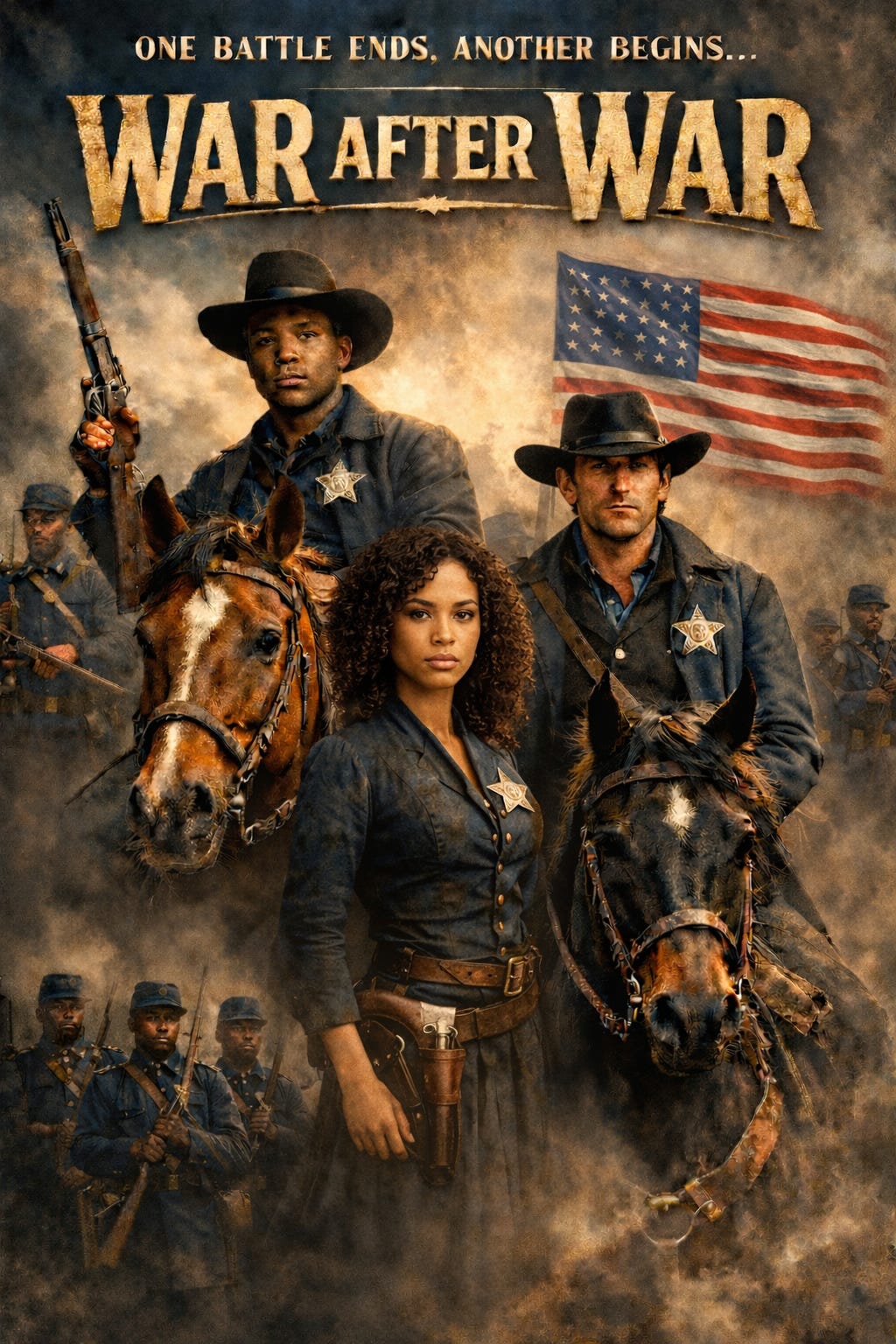
War After War is my Reconstruction-era novel about what happens when a country loses the plot and tries to write a new one while the ink is still wet. It follows Lieutenant Logan Dixon, a Union officer with a complicated past, and Alexander, a Black man who grew up with Dixon on the same plantation and remains his lifelong friend, as freedom arrives loud, uneven, and dangerous and as the two of them, alongside Venus, a former slave who grew up on the same plantation, end up teaming together during Reconstruction to fight guerrilla warfare against militias trying to drag the old world back into place.
Andrew Johnson’s Blueprint
And this is exactly why I do these Author Room posts. I’ll be in the weeds building War After War, then something in the news hits like a tuning fork and suddenly the past starts ringing in the present. That happened to me this week when fellow Substacker Shari Dunn dug up a quote from President Johnson that fit so perfectly into the mess of a puzzle we’re trying to make sense out of with the war on DEI.
Hold up. You think I’m talking about President Lyndon Johnson? No. I’m talking about the drunk one. I’m talking about Andrew Johnson.
The one who was the polar opposite of President Lincoln’s more progressive stance on civil rights. The one who ascended unexpectedly into the seat of power after a Confederate sympathizer assassinated Lincoln. And once he got there, Johnson used that power to resist Reconstruction efforts, especially when it came to bringing the full benefits of citizenship to newly freed African Americans. Instead, he treated Reconstruction like it was less about building a new democracy and more about reconstructing the bruised ego of a Southern white populace that felt humiliated by Sherman’s scorched earth strategy.
Here is the quote directly from Shari Dunn’s post Nike. The EEOC. And A Reconstruction-Era Legal War :
The first clear articulation of what we now call “reverse discrimination” came from President Andrew Johnson, in his veto of the Civil Rights Act of 1866—one of the very Reconstruction-era laws now being repurposed to attack modern inclusion efforts. Johnson vetoed the Act just two years after emancipation, at a moment when formerly enslaved Black people had no land, no money, no political power, and no material security. And yet he argued that extending basic civil rights to them was unfair to white Americans. He warned that the Act would establish, “for the security of the colored race, safeguards which go infinitely beyond that of any that the general government has ever provided for the white race,” and that it would operate “in favor of the colored and against the white race.”
And that’s the part that keeps snagging in my throat. Not just because it’s cynical, but because it’s familiar. Two years after emancipation, with Black folks broke, landless, and exposed, Andrew Johnson could still look up and claim white people were the ones being wronged, that basic protections for the formerly enslaved were “in favor of the colored and against the white race.” That’s the early blueprint for what we now call “reverse discrimination,” and it rides the same old engine: humiliation dressed up as fairness. And in real life, humiliation doesn’t heal anything. It just looks around for a target it can safely punish.
The Ground Shift
It’s tempting to get lulled into the big battlefield scenes and the equally huge egos of the participating generals when researching the Civil War. It’s tempting to make the story all cannons and speeches and maps.
But then you start to notice the widow whose sons were sent away to fight under the Stars and Bars for a cause they weren’t even invested in. They didn’t own any slaves. They were just drafted into a pride project. You start to notice the newly freed people who were suddenly thrust into a world they had no muscle memory for. No land. No protection. No stable rules. Just a new kind of exposure.
The more I dug into the passages, the more I saw a people caught in what I can only call The Long Kiss Goodbye. That moment when history changes the locks while you’re still inside the house. And by the time you realize the ground shifted, it’s already too late to walk back to the world you thought you were living in.
Mourning Disguised as Rage
The Long Kiss Goodbye is what happens when a whole country is forced to grieve in public, but nobody’s allowed to call it grief. A huge swath of the populace are mourning the loss of everything they grew up with, and might not have even agreed with, but it held the familiar world together. Not because it was perfect. Because it was legible.
It’s the slow-motion breakup with the old order, and when I say “it held the world together,” this is what I mean: NATO as the backdrop hum of safety, NAFTA as the promise that “global” wouldn’t mean “gone,” unions as the last everyday lever a working person could pull, the New Deal and the Great Society as proof the government could still do big things for regular folks, political correctness as that awkward social glue that kept the peace in mixed company, mainstream media as the referee you could hate but still recognize as the referee.
And that’s just the grown-up stuff.

And then the cultural anchors vanish too, the stuff you didn’t realize was holding your nervous system together until it was gone. Like, can you believe MTV is basically gone. Not “stopped playing music” gone, we been knew that. I mean shut down, nada, stopped broadcasting. Dayum.
So when people act irrational, when they lash out, when they start treating politics like payback instead of policy, I don’t just see “opinions.” I see mourning disguised as rage. I see a goodbye kiss that lasted too long, long enough for somebody to mistake it for love, long enough for somebody else to pull away and swear they were never touched in the first place.
Charleston After Liberation
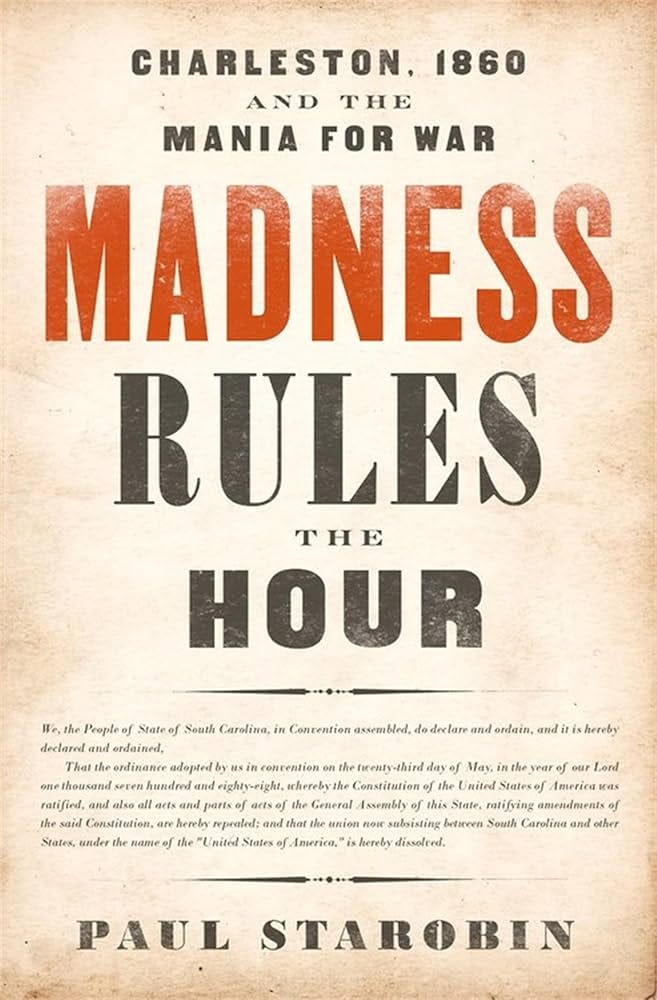
Paul Starobin, in Madness Rules the Hour: Charleston, 1860 and the Mania for War, drops you into a newly liberated Charleston where the symbolism hits before the policy does. The first federal soldier to enter the defeated city was a Black U.S. Army man, riding a mule up Meeting Street with a “Liberty” banner, and Union forces included U.S. Colored Troops, with “Remember Denmark Vesey of Charleston” as a rallying cry. Charleston’s formerly enslaved people, now free beyond the lash, weren’t quiet about it. “I’se waited for you, and prayed for you… and you done come at last,” an elderly Black woman told federal soldiers. In that aftermath, planters evacuate on Confederate orders, then come back and start over in whatever shelter they can find; one of them, John Townsend, swears loyalty to the Constitution and the Union, not as some moral epiphany, but as survival choreography. New power was in town with new oath on your tongue, means you got to keep it moving. (Starobin, pp. 217–219.)
Milledgeville and Sherman’s March to the Sea
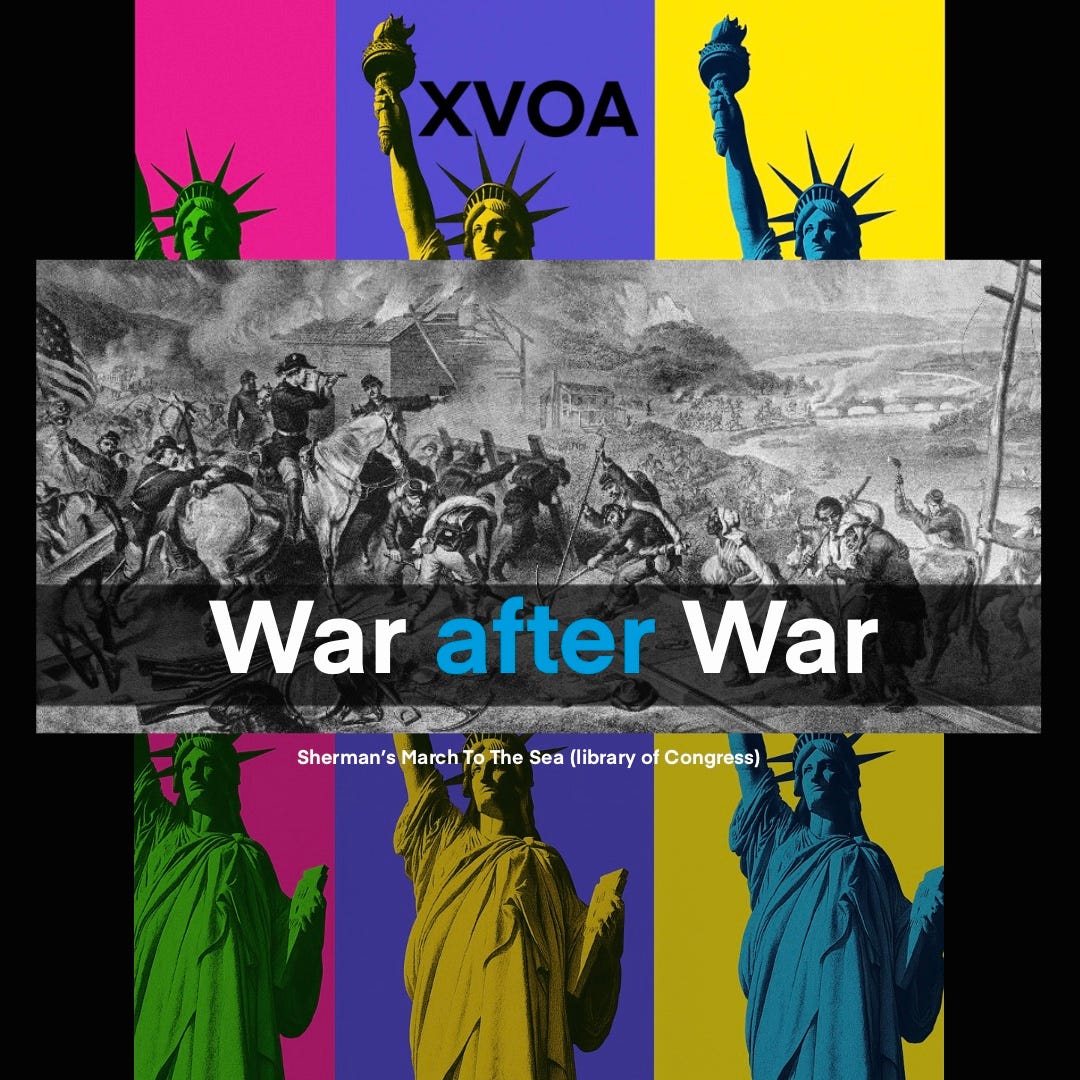
Milledgeville wasn’t some random detour, it was one of Sherman’s loudest stops during the formal military campaign known as “Sherman’s March to the Sea.” His strategy wasn’t just to win battles, but to break the Confederacy’s ability to keep fighting by cutting its nerves: rail lines, telegraph, supply depots, and the confidence that government still meant protection, all while the army lived off the land and kept moving. So when the columns rolled into Georgia’s capital, the statehouse wasn’t just a building, it was a symbol, and symbols were the point.
And I need to be crystal clear about this before you read the excerpt: Lieutenant Dixon is my fictional instrument, but what you’re about to see in that statehouse is not “creative license.” The takeover, the mock legislature, the public humiliation, the pillaging of the library, the scattering of the treasury, the whole thing turning into a drunken stage show, is a documented event that transpired. It just doesn’t sit comfortably inside the Lost Cause bedtime story, so it gets treated like an embarrassing photo nobody wants on the mantle. That’s why this excerpt matters to my concept of The Long Kiss Goodbye: it shows the old world being dismantled in real time, not politely, not gradually, but like a stage set kicked over while the audience is still seated.
Excerpt from War After War
Here’s the excerpt from my novel War After War, when Lieutenant Dixon, Logan Dixon, a Union officer trying to keep his moral footing while the world slides under him, is present as Milledgeville is being taken, and the statehouse becomes a stage.
Wait a minute, almost forgot to ask you to share this and restack.
And if you want to support this work with an Author Room subscription, here’s what you’re actually getting: excerpts directly from War After War as it’s being built, in real time. You’ll be the first to get copies of the finished book, and the first 20 Author’s Room subscribers will have their names printed on a dedicated thank-you page inside it. Most importantly, your subscription sends an undeniable signal to agents and publishers that this work is already finding its readers, already building demand, already moving in the world before anybody in a Manhattan office decides it’s “worth taking a meeting.”
Milledgeville, Georgia — November 23, 1864
The town announced itself first by sound. The clatter of wagon rims over river stones, the thin squeal of axles, the brittle snip of telegraph wire somewhere up the road. “Cut ‘em clean,” a cavalryman had said at dawn, and the wire’s last note still rang in Logan Dixon’s skull like an insect the army would not hear again. Mud kept its own music: a sucking, patient appetite at every hoof-lift; boot soles peeled free with wet kisses and slapped down again.
They passed families in flight. A woman with sleeves rolled up to the elbow drove a mule, her boy beside her hoarding a cradle in his lap. Behind them a cart stacked with bedframes, a washboard, a cedar chest; a man ran alongside with a Bible wrapped in oilcloth, as if the book might drown. Another wagon piled high with barrels of syrup rocked like a ship; a girl steadied them with bare hands. “They’re headed for the asylum,” Sergeant Mills said, pointing with his chin. “Folk say they shoved state papers and books up there in the night.” Private Harlan whistled through his teeth. “Four wagons of books to cure the crazy. Georgia got her treatments backwards.”
Cavalry recon had come in the evening before, lighting brushfires with their cigars, slicing wires, poking at redoubts that turned out to be empty. “Mayor already surrendered, asked for protection,” Ames reported, trotting up. “He’s got a family, sir.” Logan nodded. On the ridge they saw the imprint of three abandoned rebel works, lines of raw earth half-melted by rain; the bayonets that should have bristled there were only broom handles, forgotten when everyone ran. “Cadets guarded the place late summer,” another man offered that they were boys from the Georgia Military Institute, “drilled on the square like bantam roosters. Governor Brown even scraped up a prison militia out of the penitentiary, pardons for a musket.” Harlan spat. “Reckon the killers took the deal, and the honest men stayed in their cells.”
By late morning the road widened into Greene Street, and the army began to dress ranks out of habit, straight lines restoring themselves from march-ragged files. A regimental band struck “Yankee Doodle,” then tried “The Battle Hymn of the Republic,” knuckles purple where the cold bit through gloves, drumsticks tapping measured comfort against the winter air. Harlan sniffed. “Hear that? Sounds like we’re a parade and not the tail of a storm.” A pair of companies peeled off toward the capitol square, and from the column’s shoulder Logan saw two men clamber to the dome and lash a U.S. flag to the staff. The stripes flung themselves horizontal in a sudden breath of wind, and a ragged cheer answered from below. “There it is,” Mills said. “The Union Stars and Stripes are back on top.”
Then came the freed people, pouring from lanes and alleys as if the earth itself had given them up. Some were barefoot, others in rags still marked with plantation dye.