


Fundraiser Update
Another $60 came in since the last update, bringing the reader-supported total to $480 toward the immediate $1,200 goal.
That leaves $720 to close the gap.
A fair question is why there is another fundraiser only about 30 days after the last one that helped stabilize the platform.
The answer is that the previous push stopped an immediate crisis. It kept the lights on, covered core operating costs, and bought enough breathing room to keep publishing without interruption. It stabilized the platform. It did not fully fund the next stage of building it.
This goal is different. It is about moving from emergency survival to sustainable operation. The work has continued to grow, the reporting demands have increased, and the gap between what XVOA is trying to do and the resources available to do it remains very real.
XVOA is being built in public without a newsroom budget, foundation cushion, donor-class patron, or institutional safety net. Every piece like this takes time: reading the hit pieces, checking the sources, tracking the money, listening to the broadcasts, cutting through the panic, and turning the machinery into something readers can actually use.
When the desk is funded, I can keep doing that work with speed and depth. When it is running on fumes, the work gets slower, thinner, and more vulnerable to the exact exhaustion the machine depends on.
That is how independent work gets killed. Usually, nobody has to censor it. They just make it unsustainable. They flood the zone, drain the clock, starve the desk, and count on the people doing the work to burn out quietly.
I am trying to keep that from happening here.
This is the build-or-break period for XVOA: either this becomes a durable Black-led intelligence desk with the tools, time, and stability to keep reading American power from the underside of history, or it stays trapped in survival mode while billion-dollar propaganda systems keep moving without resistance.
The people flooding Senate races with money are not waiting. The people laundering smear campaigns through respectable language are not waiting. The people turning cruelty into policy are not waiting.
So I am asking directly.
Paid subscriptions are the main way to keep this desk alive.
Keep XVOA going:
If a subscription is out of reach today, a one-time contribution still helps close the gap.
Buy Me a Coffee:
XVOA TL;DR: Bullies Always Want the Fight on Their Terms
This is how bullies work: they choose the frame, shove you into defending yourself against the wrong accusation, then punish you for responding inside the trap.
The trap around Graham Platner is making progressives argue over whether women’s concerns matter. They do. That still does not explain why the right survives conduct that would end almost any progressive candidate.
The real issue is the double standard. Conservatives get flawed vessels, redemption arcs, donor protection, and media normalization. Progressives get contamination, purity trials, and career-ending suspicion.
Platner does not need to be a saint for this machinery to be obvious. The question is why moral seriousness arrives with this much force when the target is a left candidate threatening protected power.
Take the women seriously. Take the reporting seriously. Take the disputed facts seriously. Then take the power structure seriously.
The Basic Facts
Before we get to the machinery, here is what the New York Times story actually reported.
Graham Platner is the Democratic candidate for U.S. Senate in Maine, running in a race widely viewed as central to control of the Senate. His likely Republican opponent is Senator Susan Collins. Platner is a combat veteran who has spoken publicly about PTSD, depression, heavy drinking, and the damage he says followed him home from military service.
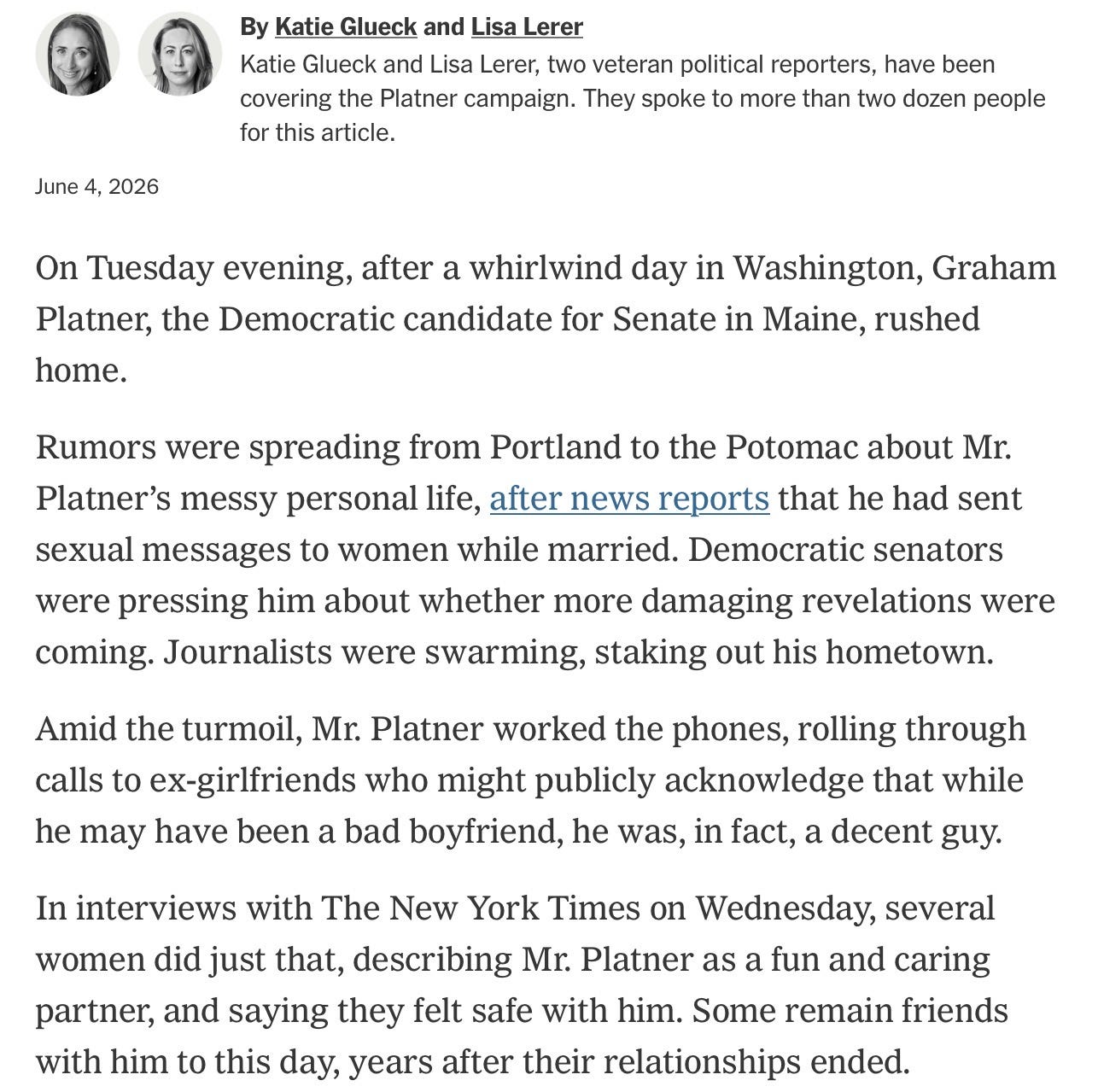
On June 4, 2026, the New York Times published a story by Katie Glueck and Lisa Lerer titled “Several Women Who Dated Graham Platner Recall ‘Unsettling’ Behavior.” The article was based on interviews with more than two dozen people, including six women who had been romantically involved with Platner.
Three women gave critical accounts.
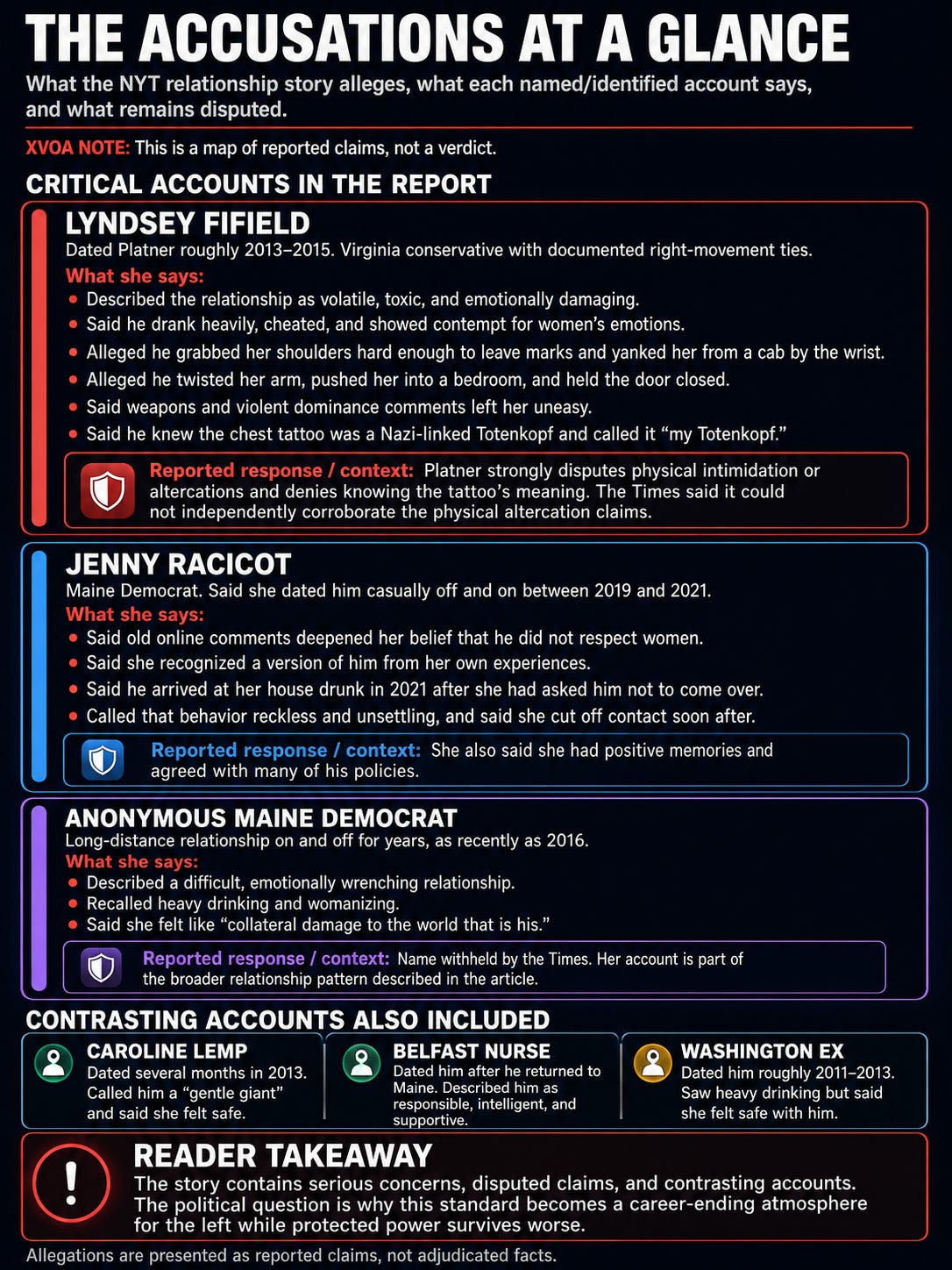
Lyndsey Fifield, who dated Platner roughly from 2013 to 2015 in Washington, described the relationship as volatile, toxic, and emotionally damaging. She said he drank heavily, cheated, demeaned women, made violent comments, and physically intimidated her. She alleged that he grabbed her shoulders hard enough to leave marks, yanked her from a cab by the wrist, and during one argument twisted her arm, pushed her into a bedroom, and held the door closed. She also said Platner knew his chest tattoo was a Nazi-linked Totenkopf and called it “my Totenkopf.”
Platner strongly disputes claims of physical intimidation or altercations. His campaign also denies that he knew the tattoo’s Nazi association. The Times said it could not independently corroborate Fifield’s account of the physical altercations.
Jenny Racicot, a Maine Democrat who said she dated Platner casually off and on between 2019 and 2021, said old online comments about women made her recognize a version of him she had experienced personally. She said he did not respect women. She also said that in 2021 he arrived at her house drunk after she had asked him not to come over, behavior she described as reckless and unsettling. She said she cut off contact soon after.
A third woman, a Maine Democrat whose name the Times withheld, said she had a long-distance relationship with Platner on and off for years, as recently as 2016. She described the relationship as emotionally wrenching and said she felt like “collateral damage to the world that is his.”
The Times also included contrasting accounts. Three other women who dated Platner described him more positively. Caroline Lemp, who dated him in 2013, called him a “gentle giant.” A nurse from Belfast, Maine, who dated him after he returned home, described him as responsible, intelligent, and supportive. Another woman who dated him in Washington said she saw heavy drinking but felt safe with him.
The article also appeared after earlier reporting that Platner, who married Amy Gertner in 2023, had exchanged sexual messages with other women as recently as the previous year. Platner acknowledged that he and his wife went through something hard “because of me,” while his wife publicly defended their marriage.
That is the record readers need before the argument begins.
Listen, I felt the trap almost immediately while reading the New York Times article on Graham Platner. Before I even finished it, I could feel the assignment being placed in my lap: defend the man or abandon him. Argue with the women or surrender to the hit. Start cross-examining their memories, their discomfort, their descriptions of a man they found volatile, selfish, reckless, frightening, cruel, or emotionally destructive. Begin searching for the paragraph that makes somebody less credible.[1]
That is exactly where the machine wants progressives. It wants us dragged into the ugliest possible argument, debating whether women’s concerns matter as though that is the real question. It wants us weighing one ex-girlfriend against another, looking for political affiliations, hunting for contradictions, and saying the kinds of things every political machine wants a progressive man to say when the accused man happens to be useful to his side.
Women are allowed to describe what unsettled them. They are allowed to remember a relationship as damaging. They are allowed to say a man’s behavior left them shaken, wary, exhausted, or wounded. They are allowed to see old online comments and recognize a version of someone they experienced in private. A serious politics has room for that without turning women into campaign props or treating pain as opposition research.
The part we are being trained to miss is the selective machinery around it. The issue is the standard.
Progressives are judged by one standard. Conservatives are judged by another. Left candidates are treated as contaminable. Right-wing candidates are treated as inevitable. One side gets processed through shame, disgust, and moral panic. The other side gets managed, normalized, excused, redeemed, or priced into the cost of doing business.
That is the story.
The Times piece gathered the wreckage of a man’s life, arranged it under the language of concern, and invited readers to experience contamination.[1] Some women described Platner as charming, caring, and safe. Other women described him as toxic, demeaning, reckless, and disturbing. The harshest account came from a woman with documented conservative movement ties.[1][2][5]] Platner denies the most serious claims.[2] The Times itself acknowledged that it could not independently corroborate some of the physical allegations.[1]
That complexity matters because serious readers can hold more than one truth at once. The women’s concerns deserve to be taken seriously. Platner’s denials deserve to be reported accurately.[2] The public deserves to know when pain becomes politically useful to people who had no interest in protecting women until the target threatened their power.
That last sentence is where the machinery lives.
If the concern is women’s safety, apply the standard everywhere. Apply it to the party of Donald Trump. Apply it to the men protected by conservative media, corporate donors, megachurches, think tanks, and the endless mercy machine reserved for powerful men on the right. Apply it to the men who vote against women’s autonomy, mock survivors, defend predators, and still receive institutional shelter.
Standards for everybody. Consequences for everybody. Moral seriousness for everybody.
That is the clean demand. American politics keeps dodging it because asymmetric enforcement is easier to sell than actual accountability. One side gets scandal as a career-ending event. The other gets scandal as branding, proof of dominance, proof that the “system” is afraid of him, proof that the faithful must rally harder.
Graham Platner is useful as a test case because he sits at the intersection of several American anxieties. He is a combat veteran. He has spoken openly about PTSD, drinking, depression, regret, and a past he says no longer represents who he is.[2] He is running as a left-populist against Susan Collins in a Senate race that could help decide control of the chamber.[3] He talks about oligarchy, war, money, health care, and Israel with a bluntness most Democrats are trained to avoid.
That makes him dangerous.
Dangerous candidates rarely get beaten through policy debate alone. They get turned into a feeling. A smell. A warning. A file. A whisper. A question polite people ask with lowered voices: Is there more? Can he survive this? Is he too damaged? Can we really risk him?
Notice how fast the discussion moves away from Maine voters, Senate power, health care, war, money, and Collins. Suddenly the race becomes a referendum on whether one wounded, complicated, ugly, contradictory man can be made narratively unusable before voters decide for themselves.
That is how contamination politics works. It needs enough smoke, enough discomfort, enough liberal panic, and enough progressive shame. It needs people who oppose the right to begin doing the right’s work for them under the banner of standards the right has never lived by.
This is where Kyle Kulinski’s ( from Krystal Kyle & Friends) anger connects with something real. For readers who do not spend their days inside political media, Kulinski is not a household name. He is a progressive political commentator, founder of Secular Talk, and one of the larger independent voices in the online left ecosystem.[6] Over the past decade he has built an audience by criticizing corporate media narratives, challenging Democratic Party leadership from the left, and defending populist candidates he believes are being marginalized by establishment institutions.
He matters here because he was one of the most prominent commentators to react to the New York Times story, arguing that the piece functioned not merely as reporting but as an attempt to politically neutralize a candidate who had become a threat in a high-stakes Senate race.[6]
Whether one agrees with Kulinski or not, his reaction helps explain why this article exists. His criticism highlighted a broader concern circulating among many progressive observers: that stories built around terms like “unsettling behavior” can operate in a gray zone between legitimate reporting, character assessment, social signaling, and political damage.[1][6] The phrase is doing enormous work because it lives between allegation and atmosphere. It invites readers to form a judgment about a candidate’s fitness without necessarily requiring every element of that judgment to rest on the same evidentiary foundation.
That gray zone is where campaigns die. A direct accusation has to survive scrutiny. A charge of criminal conduct has to meet a threshold. But “unsettling” is psychological. It travels through the nervous system. It invites readers to feel danger without forcing every claim to carry the same evidentiary weight.
This is the politics of the shadow. A candidate’s shadow gets exposed, then inflated until it becomes the whole person. His wounds become his identity. His worst moments become his essence. His past becomes a cage. His contradictions become proof that the movement around him is morally fraudulent.
Progressives are especially vulnerable to this because we actually care about harm. We care about misogyny. We care about abuse. We care about power in private life. We care about the ways men use charm, politics, intellect, trauma, and woundedness as cover for selfishness or domination. That care is a moral strength, and it is also a point of entry.
The machine knows how to use our conscience against us.
It knows how to bait us into proving we are good people by destroying our own candidates faster than the right destroys its monsters. It knows how to turn ethical seriousness into unilateral disarmament. It knows how to make us perform purity while the other side performs power.
The answer is a politics with spine and memory. Examine the claims. Hear the women. Report the denials. Name what is corroborated, what is disputed, and what remains unclear. Then ask why this system becomes so exquisitely sensitive when the target is a left candidate in a winnable Senate race.[1][2][3]
Why does the national press suddenly discover moral consequence here? Why does the language of women’s safety become urgent in this specific context, while the right keeps building a political movement around cruelty, domination, sexual humiliation, forced birth, and contempt for anyone outside its hierarchy? Why are progressives expected to carry every ethical burden alone?
That is the wholesale double standard.
The right gets candidates. The left gets case studies. The right gets strategy. The left gets therapy. The right gets “flawed vessels.” The left gets contamination. The right gets endless redemption arcs. The left gets one mistake, one allegation, one ugly screenshot, one ex, one tattoo, one phrase, one bad decade, one moral panic away from being declared unfit for public life.
The trap works because there may be real harm inside the story. That is why the response has to be precise.
A movement that asks women to swallow their pain for the greater good is already spiritually diseased. Any politics worth defending must have room for women to speak plainly about men who harmed, frightened, used, degraded, or exhausted them. A movement that cannot recognize weaponization is also doomed, because power loves a progressive who can only feel guilt.
Power loves a left that can be thrown into internal crisis by a story the right would metabolize before breakfast. Power loves a movement that thinks having standards means handing the enemy a veto over every imperfect messenger.
Maine voters deserve facts. They deserve the full record. They deserve to know what Platner did, what he denies, what is corroborated, what remains contested, and what kind of man he claims to have become.[1][2] They also deserve to know who benefits from turning this race into a character-assassination ritual.
Because this Senate race is not taking place in a vacuum. Susan Collins is vulnerable. Platner has led her in recent polling.[3] Outside money is already flooding the race.[4] Republican-aligned spending has dwarfed Democratic-aligned spending.[4] The Senate is on the line. War policy is on the line. Health care is on the line. The question of whether insurgent left politics can survive outside the safe theater of speeches and podcasts is on the line.
So yes, the Times story matters.[1] So does the machine around it. So does the timing. So does the money. So does the appetite of liberal media and Democratic insiders for disciplining candidates who threaten the donor class, the war consensus, and the bipartisan machinery of American empire.
They do not have to prove Platner is uniquely evil. They only have to make him feel unsafe to support. They only have to make progressive voters feel dirty for asking about proportionality. They only have to make the left spend the next week arguing about whether it hates women instead of asking why the right gets to run monsters through the front door while every progressive candidate gets strip-searched at the gate.
That is the destruction machine.
It arrives wearing institutional concern. It arrives with “many people familiar with the matter.” It arrives through the prestige press. It arrives as a moral test designed so the left fails either way. If we defend Platner too clumsily, they call us hypocrites. If we abandon him too quickly, they learn the button still works.
The answer is discipline. Take the women seriously. Take the reporting seriously. Take the disputed facts seriously. Then take the power structure seriously.
Because the country has never lacked standards. It has lacked equal enforcement.
And that is the real scandal hiding inside this one.
Keep XVOA Alive
If this piece helped clarify the machinery behind the headlines, please consider supporting the work. As noted in the fundraiser update above, XVOA is currently at $480 of the immediate $1,200 goal, with $720 still needed to close the gap and move this project from survival mode toward something sustainable.
XVOA is a Black-led intelligence desk explaining American power from the underside of history. This is the work: tracking the machinery, naming the double standards, and refusing to let power hide behind respectable language.
Paid subscriptions are the main ask.
Upgrade to paid:
If a subscription is out of reach today, a one-time contribution helps keep the desk alive while it is being built.
Buy Me Coffee:
Help This Travel
Like this if the frame is useful.
Comment with where you see the double standard most clearly.
Restack this if you are tired of watching bullies set the rules, break the rules, and then accuse everyone else of lacking standards.
Send this to one person who keeps watching the left and the right get judged like they live in two different countries.
Don’t Do It.
Sources
Sources
[1] Katie Glueck and Lisa Lerer, “Several Women Who Dated Graham Platner Recall ‘Unsettling’ Behavior,” The New York Times, June 4, 2026.
[2] David Smith, “Maine Senate candidate Graham Platner rejects new allegations of abusive behavior,” The Guardian, June 4, 2026.
[3] Randy Billings, “Susan Collins trails Graham Platner by 9 points in Maine Senate race, new poll finds,” Portland Press Herald, May 27, 2026.
[4] Rachel Ohm, “Graham Platner is outraising — and outspending — Susan Collins in Maine’s U.S. Senate race,” Portland Press Herald, May 29, 2026.
[5] Independent Women, “Lyndsey Fifield,” profile page.
[6] Kyle Kulinski / Secular Talk, “NEW MAGA PLATNER SMEAR FALLS APART INSTANTLY!!! Trump CRASHES OUT As Congress REBUKES Iran War!!,” YouTube, June 4, 2026. Transcript reviewed from uploaded file.
Graham Platner is one of millions of human casualties of war.
My own father went ashore at Omaha Beach on D-Day, he came home an alcoholic prone to violence and then disappeared. Many of my friends were forever changed by the Vietnam War, both physically and emotionally. Now several are dying from their exposures and injuries.
More recently, the Gulf wars have taken their toll on service members like Platner who deployed on his first of 3 tours in Iraq when he was 19.
Then later a 4th tour in Afghanistan.
Nineteen years old, with a brain still maturing, his sense of self still forming, thrust into war as an infantrymen and gunner. He was just a boy.
So yes, he came home with PTSD, a drinking problem and emotional wreckage.
My heart goes out to the women who bore the brunt of that wreckage. My heart also goes out to Platner who now carries the shame and guilt of his behavior along with the physical, moral and emotional injuries that come with combat.
When America asks their sons and daughters to fight wars for us, we owe them compassion and care and acknowledgment that they are carrying our collective sins for us all. They are carrying our wounds in their bodies and minds.
Platner is struggling to heal and find a new way to be of service to his country. The truth of his injury is painful and ugly, but, it shouldn’t disqualify him.
What matters now is can he do the job? I think he can and believe we owe him the opportunity.
Do we all remember Al Franken? That was yet another pearl clutching by Democrats - one of my senators (?) was first up to want him to resign - Gillibrand. Over a JOKE! Years earlier. Franken was a really good effective DEMOCRATIC Senator! Well, got rid of him. Easy peasy.
I'm not making light of these accusations - but sure is convenient at this time.
Now if there really is all this "concern" and I'm sure there will be - media wise etc - now is the time to look into say Paxton? Gomez? or maybe even tdump! LONG LONG list! (what aboutism!)
The thing is, these accusations - whether true or not - put him and his campaign on the defensive
and take the spotlight off the policies he has been talking about - cant imagine what this is doing to his family right now - with frankly, media vultures all over it.