

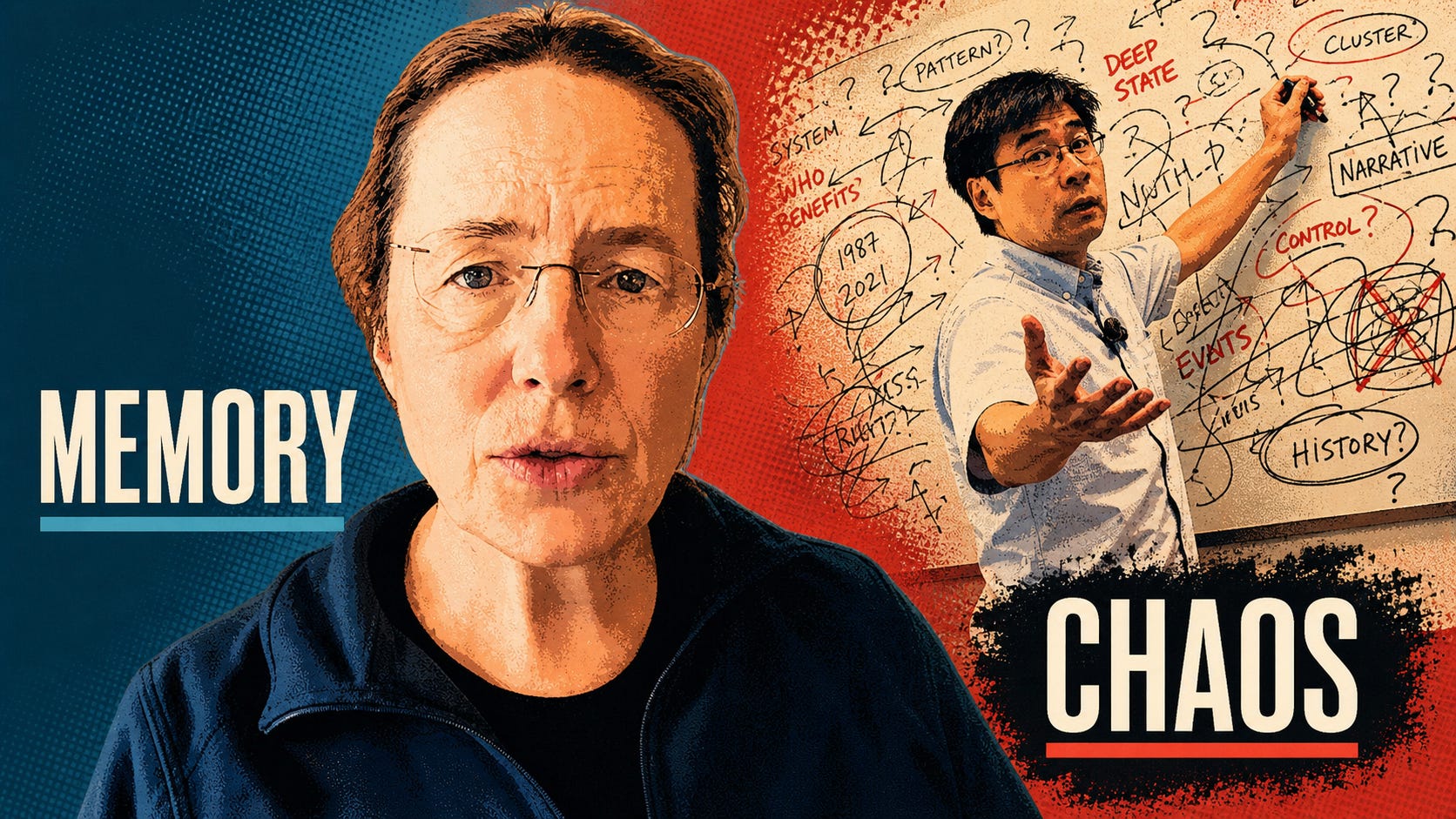
Before I talk about Ad Fontes, before I talk about “Professor” Jiang, before I talk about why Dr. Heather Cox Richardson got treated like a suspect for doing what historians are supposed to do, I got to get this one off my chest first.

I gave “Professor” Jiang more oxygen than I should have. Not because I worshiped the man. Not because I thought he had walked down from some geopolitical mountain carrying tablets from God. But because he said enough true-sounding things about empire, war, Iran, American arrogance, and the limits of military power that I let caution masquerade as clarity. And that is exactly how this poison works. The prophet does not begin by asking you to swallow the whole lie. He begins by handing you one piece of truth you already wanted somebody brave enough to say out loud. Then, while you are still nodding, he starts building a temple around it, and before you know it, the woman historian with receipts is treated like a threat while the man at the whiteboard gets to play oracle.
So let me slow this down for anybody who has not been living inside this particular media sewer. Dr. Heather Cox Richardson is a Boston College historian whose newsletter, Letters from an American, has become one of the most important civic-memory projects in the country. [3] Ad Fontes is a media-bias rating organization that grades news and commentary outlets for reliability and political slant. [2] And “Professor” Jiang is the viral YouTube prophet who became famous for predicting Trump, Iran, and American decline, even though he is not actually a professor and his historical analysis keeps drifting into secret societies, end-times speculation, and conspiracy logic. [4][5][6][7]
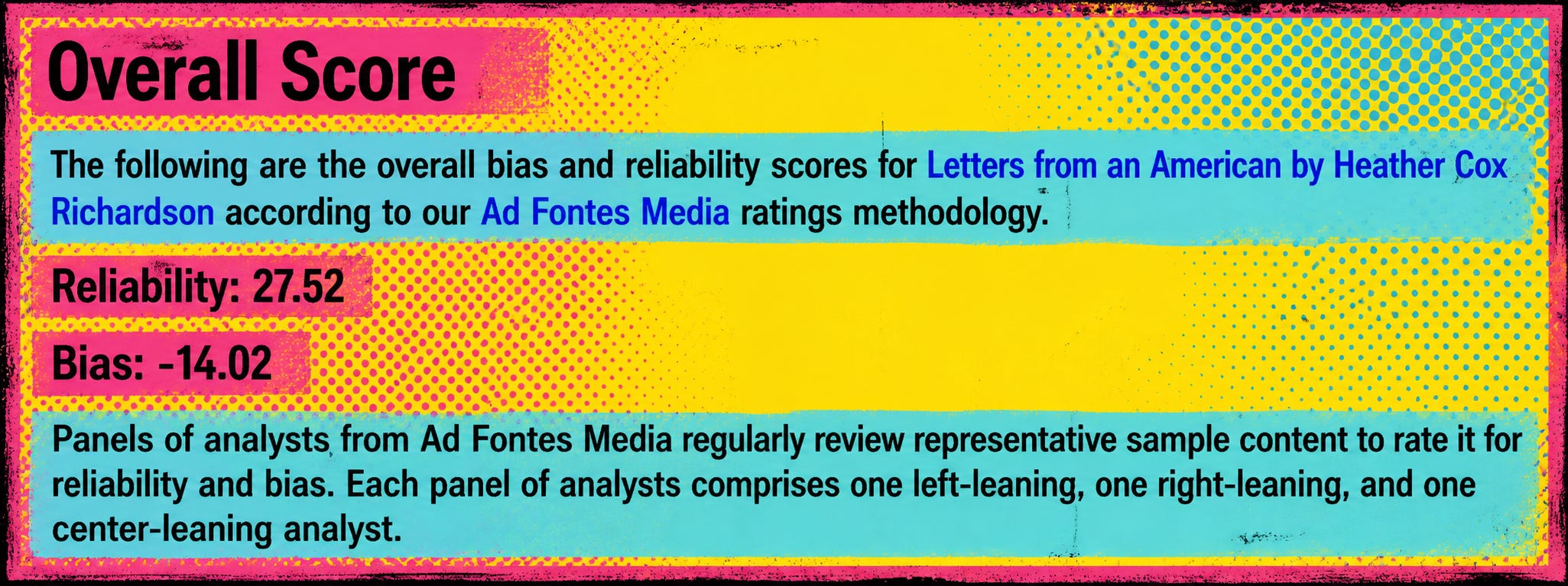
On Ad Fontes’ own source page for Letters from an American, the most recent individual content sample listed is dated April 18, 2026. That was not two years ago. That was two weeks ago. The organization does not call Dr. Heather Cox Richardson fake news. That matters, and I am not going to pretend otherwise. But right there on the page, beneath the chart and the source heading, Ad Fontes lists the newsletter’s bias as “Strong Left” and its reliability as “Mixed Reliability/Opinion OR Other Issues.” Then it gives Letters from an American an overall reliability score of 27.52 and a bias score of -14.02. [1] Most people will not read the methodology. They will not stop to parse the difference between factual unreliability and opinion-heavy historical analysis. They will see the sticker. They will see the box. They will see a warning label. [2]
Now ask yourself why the woman historian gets the warning label while the male prophet gets the microphone.
TLDR
Ad Fontes’ own page for Letters from an American lists a recent April 18, 2026 sample, then still boxes Dr. Heather Cox Richardson’s newsletter as “Strong Left” and “Mixed Reliability/Opinion OR Other Issues.” This is not ancient history. This is now. [1]
The issue is not that Ad Fontes literally called HCR fake news. It did not. The issue is that public labels travel faster than methodology, and “mixed reliability” becomes a warning sticker before most readers ever study the fine print. [1][2]
While a credentialed woman historian gets scored into suspicion, “Professor” Jiang rode viral prophecy, credential theater, whiteboard confidence, and podcast amplification into the public bloodstream. [3][4][5][6][7]
This is bigger than one chart, one newsletter, or one internet prophet. It is about a culture that treats women’s memory and Black historical warning as bias while rewarding male speculation as courage, genius, or “just asking questions.” [17][18][19]
The fire alarm was not the threat. The threat is the room pretending the alarm is too loud while smoke is already under the door.
Paid subscriptions keep this work alive:
Restack it, share it, and send it to one person who still thinks “neutrality” means refusing to smell the smoke.
Or you can just BUY ME COFFEE
The Label Travels Faster Than the Methodology
This is where the injury happens. Ad Fontes can explain its methodology all day long, and maybe some of that methodology makes sense on paper. Panels. Scores. Categories. Bias. Reliability. Fine. I am not pretending the people over there are sitting in a dark room stroking a cat and plotting against Dr. Heather Cox Richardson. But that is not how labels move through the world. The methodology does not travel. The sticker travels. “Strong Left” travels. “Mixed Reliability/Opinion OR Other Issues” travels. The little caveat that this might include opinion-heavy historical analysis gets left behind like a footnote nobody bothered to pack.
That is why I found myself staring at that page longer than I expected. Not because I thought Ad Fontes had called her fake news. They did not. Not because I thought bias charts should never exist. They probably should. But because I know how people read these things now. They do not slow down. They do not parse. They do not ask whether a historian connecting present danger to documented American patterns is the same thing as a propagandist making things up. They see the box. They see the score. They see the warning label.
And the warning label does what warning labels are designed to do.
It teaches hesitation.
It tells the casual reader to be careful with her. It tells the institutionally anxious reader that she might be too much. Too left. Too opinionated. Too interpretive. Too emotionally invested in the fate of the republic she has spent her career studying. It tells people who were already looking for permission to dismiss her that the permission slip has arrived.
That is the quiet violence of respectable classification. You do not have to call a woman historian unreliable to make her carry suspicion. You only have to chart her close enough to unreliability that the public does the rest.
The Man at the Whiteboard
And then there is the man at the whiteboard.

“Professor” Jiang did not enter the bloodstream because millions of people woke up one morning hungry for secret societies, end-times geopolitics, Holocaust revisionism, and a geopolitical theory held together with string, vibes, and YouTube confidence. [7][8] He entered because he appeared to be right about something important. Trump. Iran. American decline. The limits of empire. That was the bait. That was the little piece of truth the prophet handed you first. [4][5]
That is why I have to be honest about my own reaction. I felt like I was watching somebody say out loud what official Washington had spent years refusing to admit. America is not invincible. Empires do lose. Military technology does not automatically defeat political will. Iran was not Iraq with a new label slapped on the file. The man knew how to speak into the wound.
But that is where the danger lives.
Because once somebody appears to be right about the thing you already feared, the burden of proof starts to move. With Dr. Heather Cox Richardson, the question becomes: is she too left, too opinionated, too interpretive, too willing to connect today’s crisis to yesterday’s pattern? With Jiang, the question becomes: what else does he know?
That is how prophecy works. It does not ask to be checked. It asks to be followed.
In one transcript, Jiang is introduced as a major guest, the face of Predictive History, a man who uses game theory to analyze the past, read the present, and predict the future. The “Professor” branding does half the work before he even starts talking. Then the story becomes the predictions: Trump would win, America would go to war with Iran, America would lose. [5] The frame is not “let us examine this person carefully.” The frame is “listen to the man who saw it coming.”
And once that frame is set, all kinds of strange things can walk through the door wearing a nice jacket.
In another transcript, Mehdi Hasan presses him on the obvious question: he is not actually a professor. Jiang acknowledges that. He also describes his method as speculative analysis, says education focuses too much on facts and rigor, and then draws a distinction between verifiable facts and a deeper “truth” that supposedly allows him to understand why things happen and predict what comes next. [4][6]
And this is where the obvious questions should have become unavoidable. Where is the university appointment behind the title? Where is the peer-reviewed body of work behind Predictive History? Where is the scholarly apparatus that turns these sweeping claims about empire, Iran, Israel, secret societies, eschatology, and world history into something more than performance? I am not saying a high-school teacher cannot be brilliant. I am saying a man should not get to borrow the aura of the professoriate while escaping the burdens that come with it.
Virality is not peer review.
Dr. Heather Cox Richardson does not have to borrow the title. She earned it. The institution exists. The field exists. The publications exist. The scholarly record exists. [3] And yet she gets charted into suspicion while the man with the whiteboard gets treated as if circulation itself were scholarship.
That right there is the whole problem.
Facts become the small thing. Truth becomes the big thing. Evidence becomes a narrow-minded demand from people who lack imagination. And once you set up that game, any correction can be made to look petty. Any request for proof can be made to look spiritually dead. Any historian who insists on documents, chronology, context, and limits can be made to look like she is trapped in the old world while the prophet has moved on to revelation.
That is the asymmetry.
Dr. Heather Cox Richardson works in memory. Jiang works in mystique. She says, here is the record. He says, here is the hidden script. She asks readers to remember what power has done before. He invites people to feel like they are seeing behind the curtain.
And in a frightened country, the curtain always has a market.
Men Get Prophecy. Women Get Tone Checks.
This is still a man’s world. That was the point of my last essay, and it is the problem sitting underneath this one too.
Not because every man with a microphone is a fraud. Not because every woman with a footnote is a saint. Not because Dr. Heather Cox Richardson should be immune from critique because she is a woman. That would be way too easy, too sentimental, and too weak. The argument is much harder than that.
The argument is that male authority still gets received differently. It is heard as command, courage, vision, genius, risk-taking, heterodoxy. A man can stand at a whiteboard, pull empire, Iran, Trump, bankers, secret societies, scripture, eschatology, AI, and apocalypse itself into one trembling web, and people will lean forward like he is cracking the code of the universe. They may call him eccentric. They may call him dangerous. They may call him brilliant. But first, they call him interesting.
A woman historian does not get that much room.
She connects one public event to another. She remembers what happened the last time powerful men started treating law like an inconvenience. She places today’s crisis beside yesterday’s precedent. She says the thing democracy always needs somebody to say before the damage becomes irreversible: we have seen versions of this before.
And then here comes that tone check.
Is she too left? Too alarmed? Too certain? Too emotional? Too invested? Too interpretive? Too willing to say that facts mean something? Too unwilling to pretend that every fire is merely a warm difference of opinion?
This is where the machinery from Sex.War.Power.Men returns in another form. Patriarchy is not just men with guns, bombs, laws, pulpits, inheritance papers, and last names. It is also the ancient permission structure that decides who gets to define reality. Men were not only handed land, weapons, law, and priesthood. They were handed the narrator’s chair. They were handed the presumption that their interpretation is architecture, while a woman’s interpretation is weather.
A man sees a pattern, and it is theory.
A woman sees a pattern, and it is bias.
A man speculates, and it is imagination.
A woman warns, and it is hysteria with citations.
That is why this matters. The issue is not simply that Dr. Heather Cox Richardson received a bad-looking label on a media-bias chart. The issue is that the label plugs into something much older than Ad Fontes. It plugs into the old reflex that treats women’s memory as disorder and men’s prophecy as power.
Because the most dangerous thing a woman can do in a patriarchal culture is not merely speak. Plenty of women are allowed to speak now. They can speak on panels. They can speak in books. They can speak in newsletters. They can speak on television as long as they understand the assignment.
The dangerous thing is when a woman speaks with historical authority and then refuses to soften the meaning.
That is when the old room starts shifting in its chair.
Prediction Became the Product
And this may be where the Jiang story gets even stranger, because his rise did not happen in a culture that merely rewards attention. It happened in a culture that increasingly rewards prediction. Polymarket, Kalshi, betting lines, odds screens, screenshots, probability charts, people treating war, elections, ceasefires, indictments, and regime collapse like they are sitting at a card table waiting for the next hand to fall. [10][11] I am not saying Polymarket created “Professor” Jiang. I am saying he arrived in a world already trained to treat prophecy like a market signal.
That took me back to being young, playing Tonk between high school classes, dollar bills folded in nervous hands, everybody pretending they were just playing cards when everybody knew they were really playing each other. The cards mattered, yes. But the real game was reading the room. Who was bluffing? Who was sweating? Who had just enough confidence to make you believe they knew something you did not?
That is the spirit around prediction culture now. Only the cafeteria table became the internet. The dollar bills became markets. The boys slapping cards down became men refreshing odds screens while missiles fly somewhere far away. And into that world walks a man calling himself “Predictive History,” saying Trump will win, America will go to war with Iran, America will lose, and suddenly he is not merely making content. He is producing atmosphere. He is producing confidence. He is producing a feeling that maybe the future has already been dealt and he is the one holding the cards face down.
That is why prediction is so seductive. Memory asks something of you. Memory says, slow down, study the record, look at the pattern, accept responsibility. Prediction offers a shortcut. Prediction says, do not worry about the burden of history. I can tell you what happens next.
And in the wager economy, that is intoxicating.
Dr. Heather Cox Richardson offers historical memory. Jiang offers usable prophecy. One is measured by reliability. The other gets measured by whether somebody might have made money believing him. One asks readers to think like citizens. The other invites them to think like gamblers standing around the table, whispering, what are the odds?
That is not a small difference.
That is the whole psychic turn. The historian tells the public, “Here is what we have done before.” The prophet tells the crowd, “Here is how to beat the next hand.”
What Does the Chart Reward?
So yes, let’s compare. Not because every man rated above Dr. Heather Cox Richardson is a fraud. Not because every podcast with a male host is worthless. Not because every institution with a higher score is secretly part of some conspiracy against her. That would be cheap. The question is harder and more revealing than that.
The question is: what does the chart reward?
Boston College lists Dr. Heather Cox Richardson as a professor who teaches nineteenth-century American history at both the undergraduate and graduate level, with research interests in American politics, economics, the Civil War era, Reconstruction, the American West, and history education. [3] This is not a woman wandering into public life with a hot take and a Substack account. This is a scholar speaking from the center of her field.
And yet Ad Fontes gives Letters from an American an overall reliability score of 27.52, labels it “Strong Left,” and places it in “Mixed Reliability/Opinion OR Other Issues.” [1] On that same page, Ad Fontes also explains that scores between 24 and 40 can mean a source is heavy in opinion and analysis, not necessarily that it is factually broken. It also lists a recent April 18, 2026 sample of HCR’s work at 41.0 reliability, which their own scale says is generally good. [1][2]
Now look at what gets treated as more reliable.
Ad Fontes gives the Fox News website a 34.27 reliability score and labels it “Generally Reliable/Analysis OR Other Issues.” [12] It gives Making Sense with Sam Harris a 33.62 reliability score and the same “Generally Reliable/Analysis OR Other Issues” label. [13] It gives Glenn Greenwald a 36.12 reliability score and places him in that same generally reliable analysis category. [14] It gives The Ezra Klein Show a 39.57 reliability score. [15]
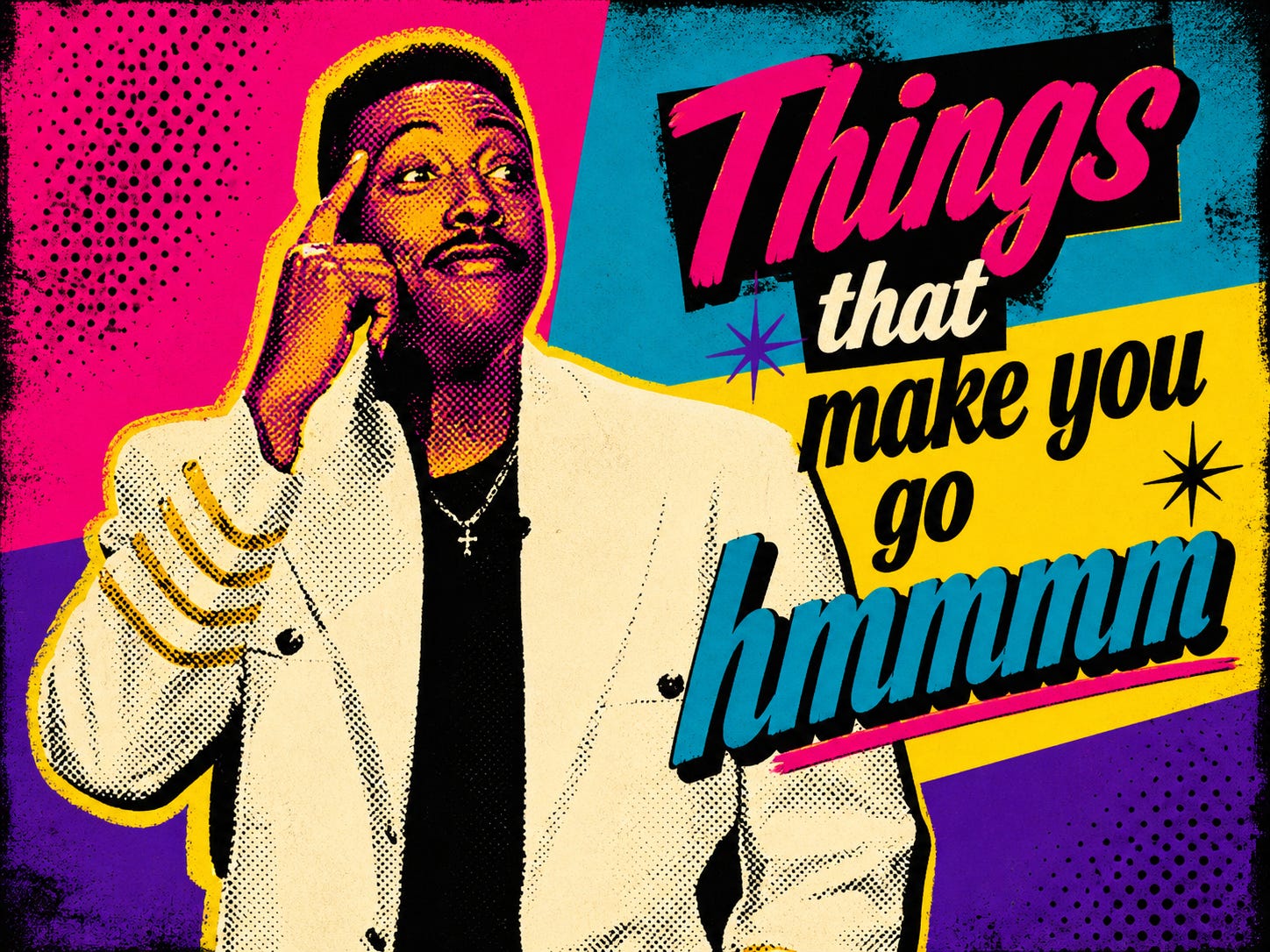
Now, I am old enough to remember Arsenio Hall looking into that late-night camera and giving America one of those little suspicious pauses: “Things that make you go hmmm.” C+C Music Factory later turned the phrase into an early-90s hit, which is probably how a lot of people remember it, but Arsenio gave it that original late-night side-eye. [16] The reason it stuck is because it captured the moment right before your brain says, wait a minute, something about this does not add up. Not proof. Not a courtroom conviction. Just that head-tilting pause when the pattern taps you on the shoulder.
And this is one of those moments.
Things that make you go hmmm.
Again, the argument is not that every one of those sources is worthless. The argument is that the chart appears to hear some forms of male punditry, institutional media posture, and microphone-based analysis as “generally reliable,” while a woman historian doing public historical interpretation gets pushed into the fog of “mixed reliability.”
That matters.
The woman historian with the archive gets a warning label. The men with microphones get analysis.
Maybe Ad Fontes has a technical explanation for every score. Maybe each sample has its own internal logic. Fine. But public labels are not just technical objects once they leave the methodology page. They become social signals. They become permission structures. They tell the casual reader who deserves suspicion and who deserves the benefit of the doubt.
And maybe that is what bothers me most.
Maybe the chart is not measuring truth as cleanly as it thinks. Maybe it is also measuring tone. Posture. Institutional affect. The performance of acceptable seriousness. The ability to sound detached from the fire while the fire is still burning.
Black Historians Already Knew This Room
I hesitated before even going here, because I know the trap. The internet loves to grab Black history when it needs moral weight, hold it up like a courtroom exhibit, and then put it back down the second the argument is over. I do not want to turn Black historians into decorative witnesses in defense of a white woman historian. That would be its own kind of theft. Dr. Heather Cox Richardson is not carrying the same racial burden Black historians have carried in this country. She is a white woman with institutional standing, a massive audience, and the protection that whiteness still grants in American public life. That has to be said plainly.
But it also has to be said plainly that Black historians have known this room for a long time.
They have known what happens when historical memory threatens national innocence. They have known what happens when the archive refuses to sit quietly under glass. They have known what happens when a historian says, no, this country did not simply make mistakes, this country built systems, defended them, renamed them, and then asked the injured to prove they were injured politely enough.
That is when history becomes “grievance.” That is when scholarship becomes “activism.” That is when memory becomes “bitterness.” That is when the person telling the truth gets put on trial for the emotional inconvenience of the truth.
W.E.B. Du Bois knew that room. Carter G. Woodson knew that room. Carol Anderson knew that room. Every Black historian who tried to make America look directly at slavery, Reconstruction, lynching, Jim Crow, redlining, prisons, schools, empire, policing, labor, and the long machinery of racial extraction has known some version of that room. [17][18][19] The room does not always say, “You are wrong.” Sometimes it says, “You are too angry.” Sometimes it says, “You are too ideological.” Sometimes it says, “You are making everything about race.” Sometimes it smiles, adjusts its glasses, and says, “We are simply concerned about reliability.”
Things that make you go hmmm.
Again, this is not equivalence. I am not saying Dr. Heather Cox Richardson is being treated the way Black historians have been treated. I am saying the mechanism has a family resemblance. When memory threatens power, the first move is not always to disprove it. The first move is to recode it. Turn moral clarity into bias. Turn historical pattern recognition into partisanship. Turn warning into hysteria. Turn the historian into the problem.
That is the part Black historians have been trying to teach America for generations: history is not dangerous because it is dead. History is dangerous because it keeps identifying the living.
The Fire Alarm Was Not the Threat
That is what this whole thing comes down to.
The fire alarm was not the threat.
Dr. Heather Cox Richardson is not dangerous because she is unreliable. She is dangerous because memory is dangerous to people who need the public confused. She is dangerous because she keeps reminding readers that the present has ancestors. She is dangerous because she does not let powerful men pretend they invented a new form of lawlessness yesterday afternoon. She says, no, this has a lineage. This has a pattern. This has happened before in other clothes, with other slogans, under other flags, with other men insisting that this time the emergency requires obedience.
That is what historians are supposed to do.
A historian is supposed to make time misbehave. A historian is supposed to drag the past into the room and make it testify. A historian is supposed to say, before you call this normal, let me show you where normal led the last time. That is not hysteria. That is not propaganda. That is not some woman getting too worked up over politics.
That is the fire alarm doing its job.
But a country addicted to denial always blames the alarm. It does not want to smell the smoke. It wants to complain about the noise. It wants to ask why the alarm is so shrill, why it keeps going off, why it cannot be more balanced, why it cannot give the fire’s side of the story, why it insists on disturbing dinner.
Meanwhile, the prophet economy keeps humming.
The man at the whiteboard gets to sell the feeling that the hidden script can be decoded. The gambler gets to refresh the odds. The platforms get the clips. The audiences get the thrill of feeling initiated. The referees get their charts. Everybody gets a role in the theater except the person standing there saying, look at the record, look at the pattern, look at what power is doing in plain sight.
That is why this bothers me.
Not because Dr. Heather Cox Richardson is above critique. She is not. No writer is. No historian is. No public intellectual should be wrapped in bubble wrap and carried past scrutiny like a porcelain doll. But there is a difference between critique and classification. There is a difference between disagreement and suspicion. There is a difference between saying, “I think this historian is wrong here,” and building a visual system where her public memory work gets filed close enough to unreliability that casual readers absorb the warning before they ever read the work.
That is how reputations get disciplined in polite society.
No torches. No bonfire. No old man yelling in a town square. Just a label. Just a category. Just a chart. Just a soft little suggestion that maybe this woman remembers too much, connects too much, warns too much, means too much.
And once the warning label is on her, the public does the rest.
That is the trick.
The label does not have to say, “Do not trust her.” It only has to whisper, “Be careful.” It only has to teach hesitation. It only has to give permission to the people who were already looking for a reason to turn away from the alarm and go back to sleep.
But I am not going back to sleep on this one.
I gave the prophet too much oxygen once. I saw enough useful truth in the fog that I did not move fast enough toward clarity. That is on me. But I know the difference now between a historian asking us to remember and a prophet asking us to follow. I know the difference between evidence and revelation. I know the difference between a fire alarm and a man selling tickets to the fire.
So no, the threat is not Dr. Heather Cox Richardson’s memory.
The threat is a culture that treats memory as bias, prophecy as genius, and neutrality as wisdom even when the smoke is already under the door.
Conclusion: The Alarm Is Still Ringing
So let me bring this thing home before somebody in the back starts fanning themselves with an Ad Fontes methodology page.
To Ad Fontes, I am not saying burn the chart. I am not saying abandon standards. I am not saying every writer gets to baptize their opinions in holy water and call it journalism. Standards matter. Evidence matters. Reliability matters. But if your chart can make Dr. Heather Cox Richardson look suspect while the larger media ecosystem lets “Professor” Jiang ride around the internet in a borrowed academic robe, then maybe the chart needs to stop measuring only the smoke and ask who keeps handing matches to the men at the microphone.
And to all the right-wing podcasters passing Jiang around like weed at a basement card game, please spare me the incense of intellectual curiosity. You are not “just asking questions.” You are circulating prophecy. You are laundering credential theater. You are letting a man wrap conspiracy logic in classroom posture and then acting shocked when people leave the room smelling like end-times geopolitics, bankers, secret societies, and every old poison wearing a new podcast hoodie.
Then there are the mainstream media gatekeepers.
Because they will book the same men, quote the same men, panel the same men, platform the same men, and then look confused when the public thinks history is something delivered by a man with a microphone and a mood board. Female historians exist. Black historians exist. They have been doing the work. They have been reading the archives. They have been naming the pattern. They have been warning this country with footnotes, scars, receipts, and church-basement patience. But the gatekeepers keep acting like wisdom only counts when it arrives in a baritone and refuses to sweat.
That is the oldest trick in the American palybook.
Ignore the women until the house is burning. Ignore the Black historians until the floor collapses. Then send some calm man on television to explain the fire like he discovered oxygen yesterday.
No.
The fire alarm was not the threat.
Dr. Heather Cox Richardson is not the threat. Black historians were never the threat. Women who remember are not the threat. Scholars who connect the archive to the present are not the threat. The threat is a culture that keeps mistaking detachment for wisdom, prophecy for courage, and male confidence for truth.
So yes, critique HCR if you must. Challenge her arguments. Read her closely. Disagree with her honestly. That is fair.
But do not tell me a woman historian with receipts is the danger while the men with microphones get to sell apocalypse by the ounce.
Do not tell me memory is bias and prophecy is analysis.
Do not tell me the chart is neutral when the room that reads the chart has never been neutral a day in its life.
Because some of us have seen this before. Some of us were raised on the sound of warnings nobody wanted to hear. Some of us know what happens when the people sounding the alarm get treated like the problem.
And some of us are done politely asking the fire to speak in a more balanced tone.
The alarm is still ringing.
The smoke is still under the door.
And this time, I am not giving the prophet any more oxygen.
Support This Work
Now let me stop pretending this part is delicate.
If you believe female historians should not be treated like suspects for remembering out loud, support this work.
If you believe Black historians should not have to keep proving America’s memory is not a grievance, support this work.
If you believe right-wing podcast prophets should not get to flood the zone with credential theater while independent writers do the cleanup for free, support this work.
If you read this whole essay, nodded, cursed, laughed, sent a screenshot to somebody, or felt that little Arsenio Hall hmmm rise up in your spirit, then the question is not whether this work has value. The question is whether you are going to let the value remain theoretical.
Paid subscriptions come first because paid subscriptions build the floor. They tell me this work is not just being consumed. It is being backed. They turn applause into infrastructure. They turn “somebody should say this” into “somebody is funded to keep saying this.”
Subscribe here:
And if a paid subscription is truly not in the cards right now, then hit the Buy Me a Coffee option. Drop a coffee. Drop two. Drop the price of whatever streaming service you forgot you were still paying for while Netflix slowly turns into a digital garage sale.
This is not charity. This is reciprocity.
I bring the receipts, the memory, the jokes, the smoke alarm, the old-school references, the Black-history muscle, and the willingness to say the thing polite media keeps swallowing. You help keep the lights on so I can keep doing it.
The research says people give when the act feels connected to who they are, when the connection is clear, when the choice feels meaningful, and when the impact is visible.
So here is the identity question:
Are you just reading the alarm, or are you helping keep it ringing?
Sources
Ad Fontes Media, “Letters from an American – Heather Cox Richardson Bias and Reliability” — The source page listing HCR’s Ad Fontes labels, overall scores, and recent individual content sample ratings.
Ad Fontes Media, “Start Here Bias and Reliability” — Explains Ad Fontes’ reliability scale, including that 24–40 can reflect opinion/analysis or variation and that scores above 40 are generally good.
Boston College, “Heather Cox Richardson” — Faculty page listing Richardson’s professorship, teaching areas, research interests, and publications.
Zeteo, “Mehdi Goes Head-to-Head With ‘Professor’ Jiang, the Internet Sensation” — Zeteo’s page describing Mehdi Hasan’s interview with Jiang, including questions about predictions, conspiracy theories, “Pax Judaica,” and amplification.
Breaking Points, “Professor Jiang Predicts: US WILL LOSE Iran War” — Public interview clip presenting Jiang through his “Predictive History” framing and Iran-war predictions.
India Today, “Meet Professor Jiang: The Chinese Nostradamus who doesn’t talk about China” — Reports that Jiang has no university faculty appointment and works as a high-school teacher at Moonshot Academy.
South China Morning Post, “Jiang Xueqin, the viral ‘prophet’ predicting the world’s fate from a Beijing classroom” — Profiles Jiang as a Beijing-based high-school teacher turned viral “prophet” and notes that some ideas veer into conspiracy theory.
The Kavernacle, “Why Nazis LOVE Professor Jiang (he is DANGEROUS)” — Critical video used here as commentary on Jiang’s alleged Hitler revisionism, Holocaust-minimizing rhetoric, and far-right appeal.
The Kavernacle, “Why People LOVE ‘Intellectuals’ like Professor Jiang and Jordan Peterson” — Critical video used here for the broader “academic influencer,” credential-theater, and platform-amplification analysis.
Associated Press, “Well-timed bets on Polymarket tied to the Iran war draw scrutiny” — Reporting on calls for investigations into well-timed geopolitical bets on prediction markets.
The Guardian, “On Polymarket, ‘privileged’ users made millions betting on breaking news” — Reporting on prediction-market betting tied to real-world events, including profitable bets around Israeli military action against Iran.
Ad Fontes Media, “Fox News Website Bias and Reliability” — Lists Fox News website’s Ad Fontes reliability score and category.
Ad Fontes Media, “Making Sense with Sam Harris Bias and Reliability” — Lists Sam Harris’s podcast score and reliability category.
Ad Fontes Media, “Glenn Greenwald Bias and Reliability” — Lists Greenwald’s Ad Fontes reliability score and category.
Ad Fontes Media, “The Ezra Klein Show Bias and Reliability” — Lists The Ezra Klein Show’s Ad Fontes reliability score and category.
Mental Floss, “13 Quintessential ’90s Moments from The Arsenio Hall Show” — Notes that an Arsenio Hall segment inspired C+C Music Factory’s “Things That Make You Go Hmmm.”
American Historical Association, “Black Reconstruction Revisited” — Discusses W.E.B. Du Bois’s Black Reconstruction and the long-delayed institutional recognition of the work.
NAACP, “Carter G. Woodson” — Explains Woodson’s fight against the suppression and omission of Black history in textbooks and the white-dominated historical profession.
Emory University, “Anderson explores country’s racial past, present in White Rage” — Context on Carol Anderson’s historical argument that racism and racial prejudice are embedded in public policy.
ON Heather Cox Richardson's YouTube (and FB) podcast of yesterday, she mentions there are a lot of AI generated and fake accounts attributed to her. Some apparently are "meh" but others are more serious. I personally have not seen them. She started her podcast by cautioning anything that does not come from one of her authorized accounts. I'm not surprised that this is happening to her, as she is a big voice and as she says, the Right is scared.
I had been ignoring this “prophet “ but not heard of the not-so-subtle attempts to discredit HCR. I will say that as an academic who teaches through critical race and gender lenses, and a woman, the automatic discrediting may be as much tied to the now popular distain for higher education as much as to HCR’s gender