


I was a rookie cop in a mid-sized Southern department.
Think In the Heat of the Night meets a fictionalized retirement boomtown.

During one of our training sessions, the instructor picked up a Sharpie and started drawing a face with unsettling precision: broad nose, stern brow. It was a Black man’s face. A ministerial type.
He didn’t say he was drawing a suspect.
He didn’t have to.
He just talked about “how to deal with hostile subjects.”
Then, when he was done, he looked right at me—the only Black recruit in a class of five and held that gaze just long enough to send the message:
Stay in your place.
I resigned not long after. Packed up and headed north. Found a better department, a better career, and retired decades later with my dignity intact.
But what I learned early never left me:
The justice system isn’t blind. It ain’t justice. It’s just—ice.
Cold. Class-conscious. Selective.
Later in my career, I arrested a white citizen who committed a crime.
If they had been Black, brown, or just broke, it would’ve been routine.
Just another Tuesday.
But because of who they were, I got sued.
I won because facts are facts, and they were guilty.
But that moment taught me what every Black cop eventually learns:
Justice doesn’t apply evenly.
The scales aren’t balanced.
They’re weighed.
I thought I left that behind when I settled north.
I didn’t.
Racial riots across the nation broke out later in my career.
The same racial vitriol and disgust for the people you were appointed to serve which I witnessed from the inside down south had now become unleashed unrestrained and unhinged across the nation and into the body politic like a plaque.
A few days ago, I was warned indirectly, but unmistakably to shut this newsletter down.
That chilling old feeling crept back in: Stay in your place.
So when I saw what Amy Coney Barrett did to Justice Ketanji Brown Jackson, the first Black woman to ever sit on the Supreme Court, I felt it in my bones.
In a majority opinion, Barrett didn’t just rebut Jackson’s legal reasoning.
She named her.
Not her argument.
Her.
“We will not dwell on Justice Jackson’s argument, which is at odds with more than two centuries’ worth of precedent, not to mention the Constitution itself,” Barrett wrote. “We observe only this: Justice Jackson decries an imperial Executive while embracing an imperial Judiciary.”
Let’s be clear:
This wasn’t a legal debate.
It was a public reprimand. A warning. A mark.
The Washington Post covered it, barely:
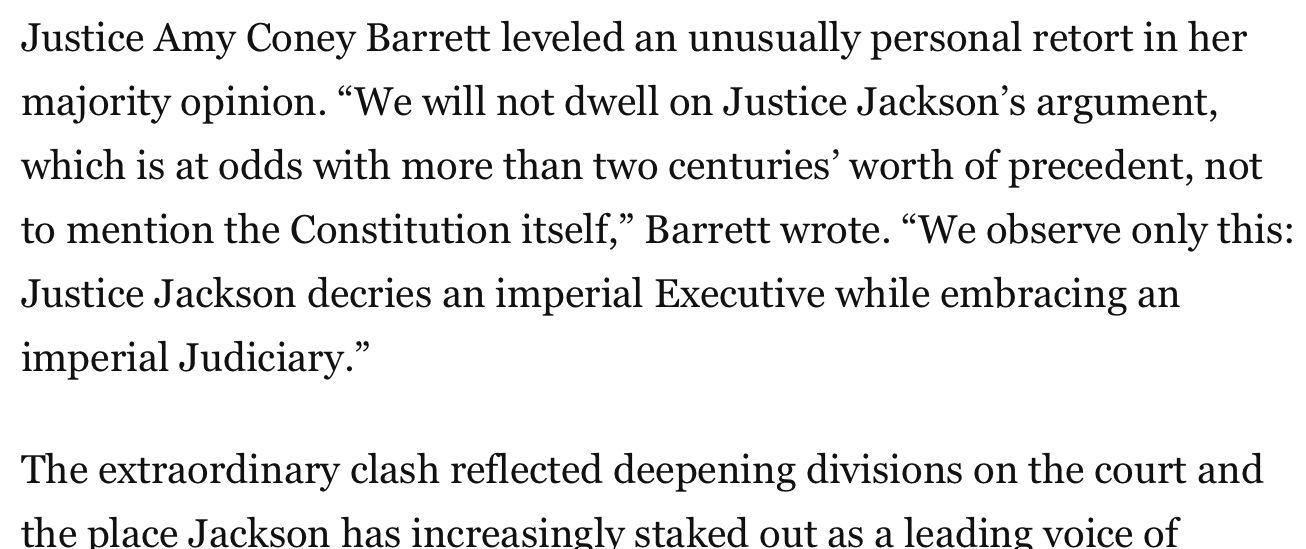
They called it an “unusually personal retort,” tucked into the middle of a profile.
The same article where they spent more time framing Jackson’s dissents as passionate but ultimately typical for a liberal justice.
That sentence right there?
That should’ve been the whole damn article.
Forget the tone balancing.
Forget the roundup of who dissented when.
That moment deserved history. Deserved outrage. Deserved context.
But I guess they left that part up to a retired, obscure ex-cop with a newsletter and one subscriber.
So be it.
And just in case you thought this was confined to courtrooms?
The Post also notes that Charlie Kirk recently called Jackson a “diversity hire.”
Said the only reason she’s on the Court is because she’s a Black woman.
That’s not critique.
That’s racial resentment with a podcast mic.
The external version of what Barrett did on paper.
Different stage.
Same damn message:
“You don’t belong. You were allowed in. Be grateful. And stay in your place.”
Barrett did it in legalese.
Kirk did it in dog whistle.
Both are enforcing the same caste code.
And meanwhile, Jackson is expected to keep smiling.
To keep dissenting politely.
To keep letting it roll off her back like it doesn’t sting.
I imagine her reading that opinion.
Staring in the mirror.
Fighting back tears.
Then whispering to herself:
“Fuck this. I didn’t come this far to be silenced.”
Any Black person—from the dishwasher at IHOP to the partner at a white-shoe law firm - knows that feeling.
That chill.
That stare.
That warning shot across the bow.
That nurse I wrote about before, the one dealing with racism on her job?
She knows that feeling too.
So does the woman I wrote about earlier with 30+ years in radio who can’t even land a data entry job.
Overqualified, they say.
But what they mean is:
Too old. Too Black. Too woman.
It doesn’t matter if you speak up or stay silent.
I ran.
Jackson stood tall.
That nurse holds it in.
That radio vet keeps applying.
And still,
we all get targeted.
Because the bully doesn’t stop when you stay quiet.
They push harder.
And how does Jackson deal with it?
As the Post noted, she declined interviews.
She didn’t lash out.
Didn’t clap back.
She boxes.
“I think that helps you to really get out any frustrations,” she told the Associated Press.
They came for her in words.
She answered with fists.
If you’re still reading this… hit subscribe.
Because somebody has to say what the courts and the papers won’t.
Thank you so much for pointing out what so many fail to see! How many times do we see this, know this, experience this ourselves... Only to wake up the next day and have it done to us all over again? Looking forward to more from you!