


A note before the piece
Thank you to everyone who has already helped this fundraiser move. We have raised $157 so far, and I do not take that lightly.
That is real movement. It is also not enough yet to give this desk the breathing room it needs.
I’m putting this note up top because the pressure is immediate now, and this story is exactly why XVOA exists.
The New York Times can report the fact: Pete Hegseth struck female and Black Navy officers from a promotion list. But the deeper story is the machinery underneath it. Who gets called “merit.” Who gets treated as a suspect. Who gets erased from leadership and then told the erasure is neutral.
That is the work this desk does.
The immediate goal is simple: 30 paid subscriptions today.
Thirty paid subscriptions would do more than move one fundraiser. It would help stabilize this desk so XVOA can keep producing the kind of independent Black historical analysis that does not wait for permission, does not soften the machinery, and does not treat power’s favorite words as innocent.
Paid subscriptions are what keep XVOA standing:
If you cannot subscribe, please do not assume a small contribution does not matter. This platform survives because people decide to move together. One hundred people giving $5 accomplishes a lot. Fifty people giving $10 accomplishes a lot. Paid subscriptions remain the foundation, but collective support at any level is crucial to keeping this work alive. Buy Me Coffee is the backstop for this.
The real story is that many people doing a little can make the difference between this desk surviving and disappearing.
To everyone who has already contributed, thank you. You moved first. That matters.
Now let’s get into the story, because Hegseth is not restoring merit. He is teaching whiteness how to wear the mask again.

TLDR
Defense Secretary Pete Hegseth reportedly blocked multiple Navy officers from promotion to one-star admiral after a board of senior admirals had already selected them. Reporting places the number somewhere between seven and nine, with women and Black officers among those removed or withheld [1][2][3].
The final public Navy list named 22 officers and reportedly included no women, even though women make up 21.1% of active-duty Navy personnel and racial-minity sailors make up 37.8% of the force [4][5].
Military promotion boards are supposed to be governed by law, documentation, board independence, and fair consideration, not political vibes or ideological suspicion [6][7][8].
The deeper story is not “diversity versus merit.” The deeper story is the anti-DEI movement redefining merit so whiteness reads as neutral while Blackness, womanhood, and any past association with diversity become evidence of contamination.
Restack this if you are tired of powerful men calling the purge “standards.” Paid subscriptions keep this desk alive.
They Already Measured Merit
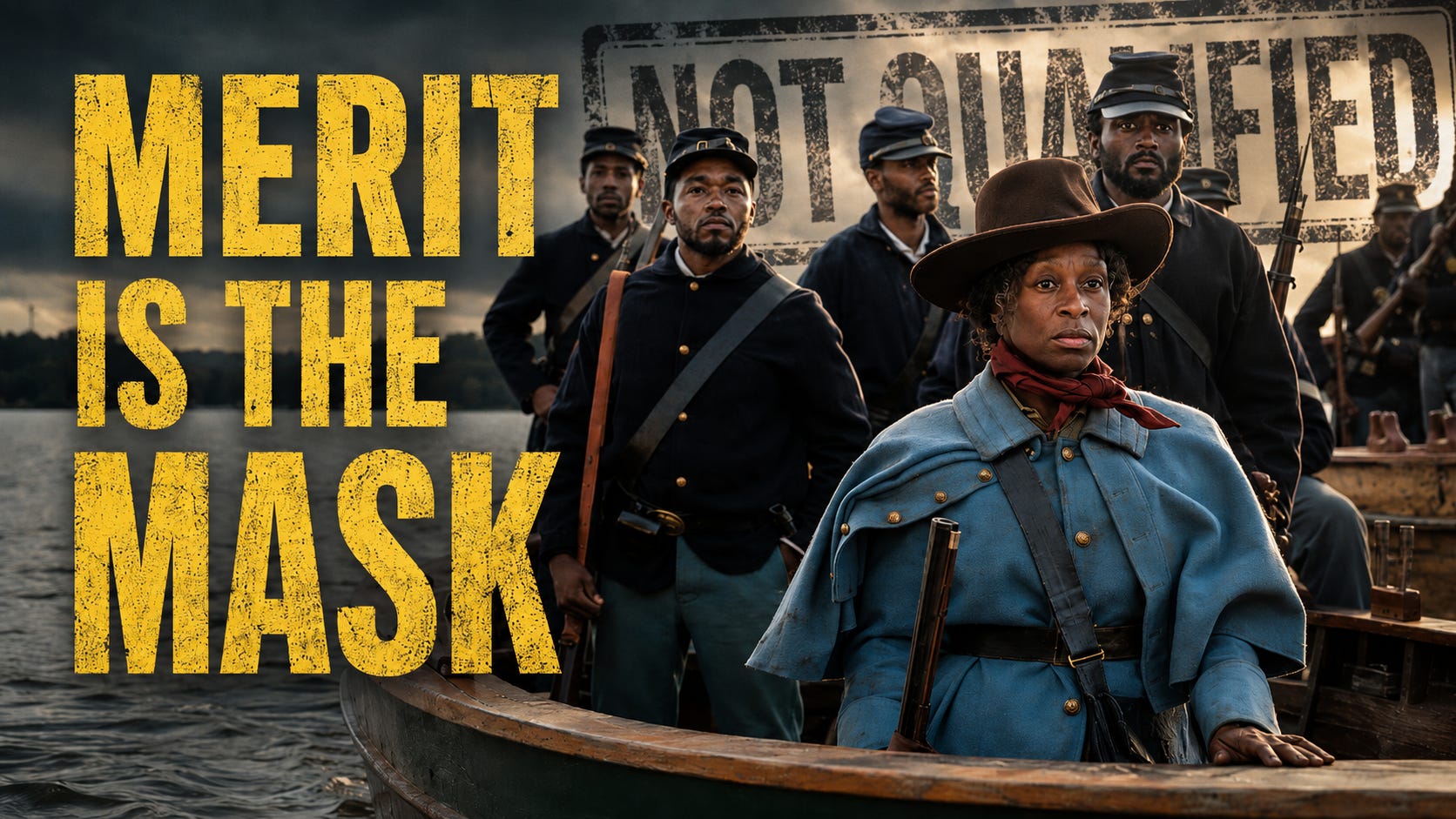
That is Harriet Tubman in the thumbnail for a reason.
Not symbol. Not ornament. Not Black-history wallpaper.
Harriet Tubman was one of the people America kept trying to mark NOT QUALIFIED until war exposed the lie. Born enslaved. Denied citizenship. Denied formal command. Denied the full pay and recognition her service deserved. And still, during the Civil War, she worked for the Union as a scout, spy, nurse, and military organizer. In 1863, her intelligence and leadership helped make the Combahee River Raid possible, a military operation that freed more than 700 enslaved people.
That is the memory sitting behind this story.
Before the modern Pentagon started dressing old suspicions in the language of “merit,” Harriet Tubman had already answered the question. Black leadership was not theoretical. Black courage was not theoretical. Black command under pressure was not theoretical. The country simply refused to call it what it was.
So when the thumbnail stamps NOT QUALIFIED over Tubman, the accusation is not aimed at her.
It is aimed at America.
It is aimed at every system that benefits from Black labor, Black sacrifice, Black intelligence, and Black courage, then turns around and treats Black authority as a problem to be explained.
That is why Pete Hegseth’s promotion-list intervention matters.
He did not just strike names from a Navy promotion list.
He struck at the meaning of merit itself.
That is the part the official language is designed to hide. The public is supposed to hear “military promotions,” glaze over, and assume the Pentagon knows what it is doing. A board met. Names moved. Names disappeared. The secretary invoked merit. End of story.
But that is not the story.
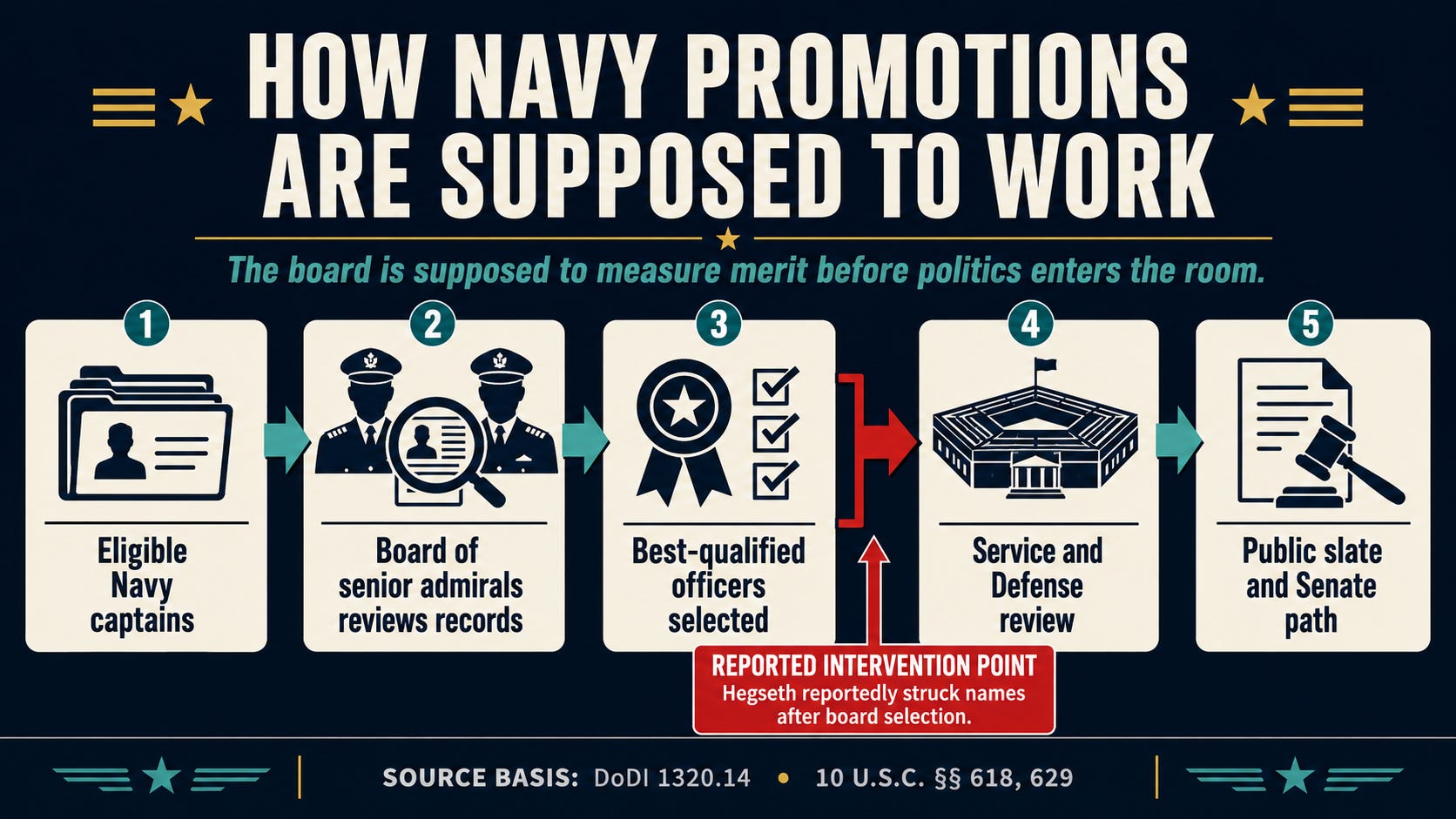
The story is that Navy officers had already gone through one of the most competitive promotion processes in the United States military. They were not chosen by a campus affinity group. They were not picked by a diversity consultant. They were selected by a board of senior Navy admirals, the people entrusted to judge who is ready to move into the flag-officer ranks.
They had already been measured.
Then Hegseth intervened.
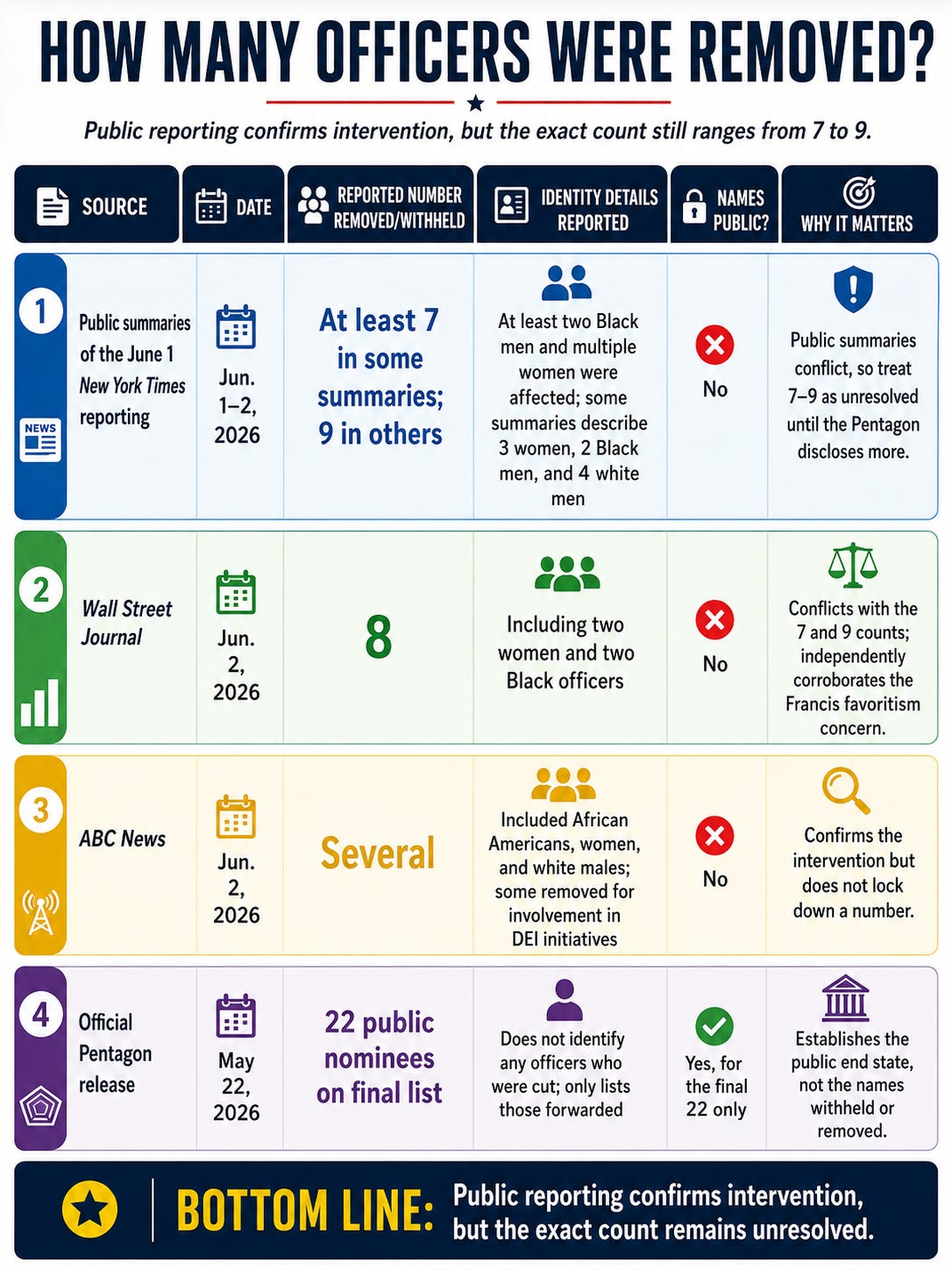
The public version of the final slate came out on May 22, when the Pentagon announced 22 Navy captains nominated for appointment to rear admiral, lower half [4]. But subsequent reporting says the list had already been altered before the public saw it.
ABC News reported that Hegseth blocked the promotions of several Navy officers who had been selected by senior admirals, and that the affected officers included African Americans, women, and white men [2]. The Wall Street Journal reported that Hegseth blocked eight Navy senior-officer promotions, including two women and two Black officers [3]. Public summaries of the New York Times reporting describe a count somewhere between seven and nine officers, with women and Black officers among those struck [1].
The exact number still matters. The Pentagon’s refusal to explain the intervention makes the number harder to nail down. But the pattern is already visible.
The resulting list reportedly included no women. Task & Purpose had already noticed the all-male Navy slate before the latest reporting fully landed, describing a continuing drought in women’s promotions to admiral [14]. That absence sits beside the Navy’s own demographics. According to the Defense Department’s 2024 active-duty Navy profile, women make up 21.1% of active-duty Navy personnel and racial-minority sailors make up 37.8% of the force [5].
No, a promotion slate does not have to perfectly mirror the demographics of the entire Navy. That is not the argument.
The argument is simpler: when a board already measured merit, and the secretary steps in afterward, and the public result is a slate with no women and only a thin presence of nonwhite officers, the country is allowed to ask what kind of “merit” just got restored.
Because merit is doing too much work here.
It is being used as a shield, a slogan, and an alibi.
The Board Was the Merit Machine
A military promotion board is not supposed to be somebody’s ideological mood ring.
The process exists because rank is not private property. Rank carries authority, command responsibility, public trust, and the lives of people below you. That is why the system is built around records, boards, instructions, law, and procedure.
It is not perfect. Nothing human is. But it is supposed to be disciplined enough to prevent one political actor from reaching into the machinery and turning promotion into a loyalty test.
That is why this story is not just about race and gender.
It is about institutional sabotage.
Those words were written to protect the integrity of the system.
Fair.
Equitable.
Without prejudice or partiality.
Those words are not woke decorations. They are rules for preserving military legitimacy.
The legal structure also makes a distinction that matters here. If a name is formally removed from a general or flag officer promotion board report, Title 10 says only the President may remove it for those grades [7]. If a secretary withholds a name from a nomination scroll after board approval, Defense Department rules still require specific cause-based grounds: pending charges, an investigation, adverse information, criminal proceedings, exemplary-conduct concerns, or reason to believe the officer is mentally, physically, morally, or professionally unqualified [6][8].
That is the machinery.
Not vibes.
Not cable-news rage.
Not “I saw DEI on a résumé.”
Machinery.
So the question is not whether the defense secretary has any role in the promotion pipeline. Of course he does.
The question is whether Hegseth used that role to enforce documented standards or to impose ideological suspicion after the board had already done its job.
So far, the public has heard slogans, not grounds.
That silence is part of the story.
If these officers were unfit, say what lawful category applies. Was there adverse information? A pending investigation? A professional disqualification? A moral or physical concern? Were the officers notified? Were they allowed to respond? Were the rules followed?
If the answer is yes, then the Pentagon should stop hiding behind theatrical vagueness.
If the answer is no, then “meritocracy” is not the defense.
It is the disguise.
The Favoritism Problem
The most damaging detail in this story is not only who Hegseth reportedly blocked.
It is who he reportedly tried to help.
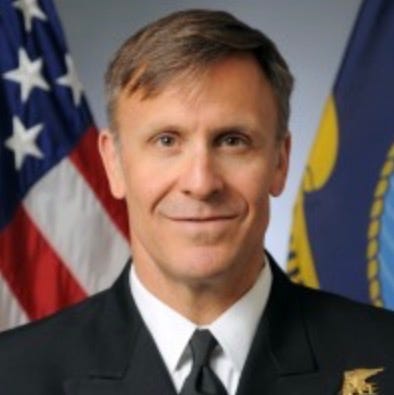
ABC News reported that Hegseth pushed for Capt. William Francis Jr., a Navy SEAL serving as Hegseth’s assistant, to be added to the promotion list or otherwise elevated. ABC reported that Francis could not be reviewed by the board because he did not meet criteria such as heading a major command [2]. The Wall Street Journal also reported that Hegseth advocated for Francis, raising concern inside the Pentagon and Congress [3].
That allegation cuts straight through the meritocracy sermon.
Because if the standard is sacred, it should be sacred for everyone.
If a Black officer or female officer can be treated as suspect because of some past connection to diversity work, but a close aide can be pushed forward despite reportedly lacking board criteria, then we are not watching a meritocracy.
We are watching a caste instinct try to dress itself in regulation.
This is the old trick. The standard becomes iron when applied downward, especially to the people the hierarchy already wants to doubt. Then the same standard turns soft when applied upward, inward, or sideways toward the favored.
That is not discipline.
That is patronage.
That is not military excellence.
That is court politics in a uniform.
And this is why the word “merit” has to be interrogated instead of worshipped. America loves to say merit when it means comfort. It loves to say standards when it means familiarity. It loves to say “best qualified” when the room already looks like the people who historically got to decide what qualification looked like.
The question is not whether merit matters.
Merit absolutely matters.
The question is who gets presumed to have it.
Who gets presumed to have earned the room? Who walks in as neutral? Who walks in as a category? Who has to explain why they are there? Who gets grace? Who gets suspicion? Who gets judged by the whole record? Who gets judged by one line item that says diversity liaison officer from twenty years ago?
That is the machinery underneath the story.
Hegseth says he is rescuing the military from politics.
The evidence suggests he may be replacing the politics he hates with the politics he prefers.
This Was Already Happening in the Army
The Navy list is not the first flash.
It is the pattern becoming visible.
In March, NPR confirmed that four Army colonels, two Black men and two women, were blocked from promotion to brigadier general after being on track for one-star rank [9]. Representative Marilyn Strickland later pressed Hegseth on those removals, citing rules that allow holds or delays only under limited circumstances such as adverse information, investigations, reportable information, or qualification concerns. Hegseth did not identify a specific lawful ground for removing those officers. He leaned instead into the claim that the department was correcting “gender and demographic engineering” [10].
There it is.
Not evidence of misconduct.
Not operational failure.
Not documented unfitness.
A culture-war theory.
At an April 30 Senate Armed Services Committee hearing, Senator Jack Reed said that of two dozen officers Hegseth had fired for reasons unrelated to performance, 60% were Black or women. Hegseth responded that the only metric was merit, while again accusing prior leaders of social engineering [11].
That is the contradiction.
If merit is the only metric, why does he keep talking about demographics?
If performance is the only concern, why not provide performance-based reasons?
If this is not political, why does the explanation sound exactly like the anti-DEI stump speech?
This is how projection works at institutional scale. The politics being practiced from the top gets projected onto the people trying to rise inside the institution. Black officers become “political.” Women become “political.” Diversity becomes “political.” Whiteness remains atmosphere.
That is the genius of the mask.
It does not have to announce itself.
It just calls itself normal.
Black Military Memory Knows This Trick
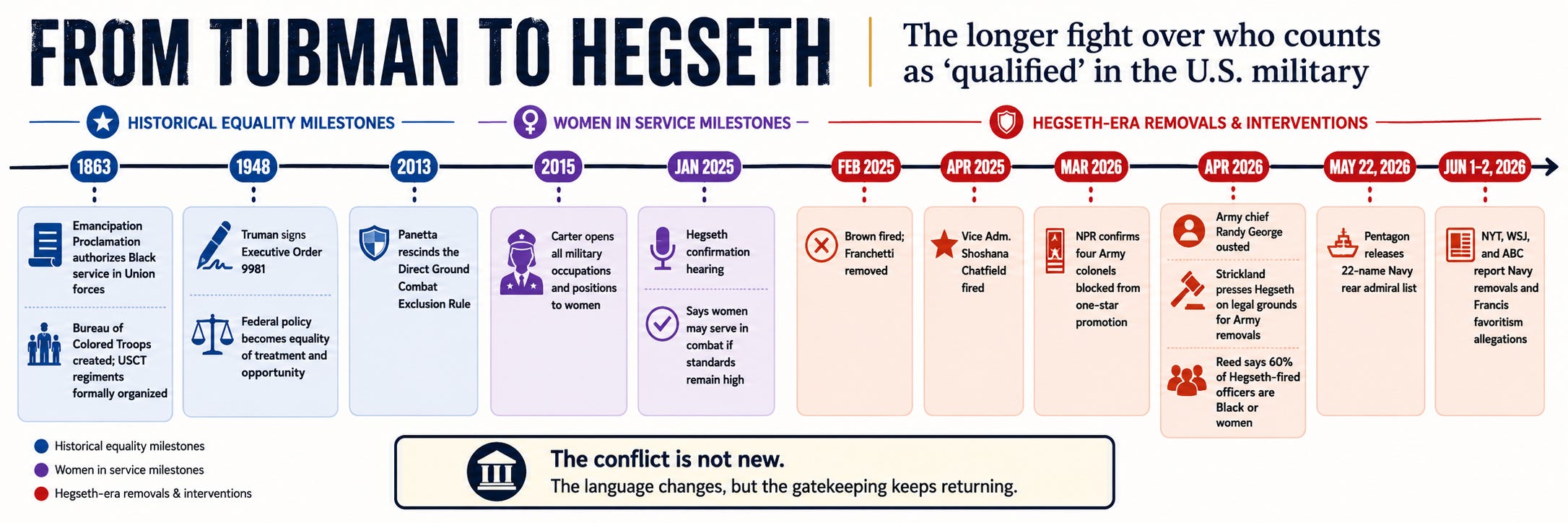
The historical argument here has to be precise.
The United States military was never some pure racial meritocracy floating above the sins of the republic. That would be fantasy. The military segregated, excluded, humiliated, restricted, and exploited. Black people have never needed fairy tales about American institutions. We have lived too much truth for that.
But military history does show something else.
Again and again, war forced America to confront the lies it told about Black capacity.
During the Civil War, Black men had to fight for the right to fight. The National Archives notes that Black Americans had volunteered in earlier wars, but official sanction was the difficulty. By the Civil War, roughly 185,000 United States Colored Troops service files became part of the record, evidence of a people forced to prove courage to a nation that had already stolen their labor [12].
That is the contradiction at the heart of American power.
The republic was willing to use Black sacrifice before it was willing to honor Black equality.
But once Black soldiers served, bled, marched, fought, and died, the old myth had to work harder.
Not disappear.
Harder.
That is what Black military service has always done. It does not automatically redeem the institution. It exposes the lie beneath the institution’s self-image.
The lie was that citizenship, discipline, courage, intelligence, and command capacity belonged naturally to white men.
Black service kept disproving that lie.
Then came Truman’s Executive Order 9981 in 1948, declaring equality of treatment and opportunity in the armed services as official federal policy [13]. The order did not magically end racism in uniform. No executive order can perform that miracle. But it made the principle unavoidable: the armed forces could not claim national defense while formally organizing themselves around racial caste.
That matters here because anti-DEI politics wants to rewrite the story backward.
It wants to pretend equality efforts are a recent infection rather than a long institutional response to exclusion. It wants to pretend the only time race enters the room is when someone tries to address racism. It wants to make the old arrangement look natural and the correction look corrupt.
That is why this Hegseth story is not small.
This is not only about a promotion list.
It is about the attempt to reverse the moral meaning of military reform.
Standards Without Exclusion
Women in combat tell the same story from another angle.
When the Pentagon rescinded the direct ground combat exclusion rule in 2013, and when all military occupations and positions were opened to women in 2015, the principle was not “standards do not matter” [15][16].
The principle was: if you meet the standard, the door must open.
That is the real reform tradition.
Not quotas instead of standards.
Standards without exclusion.
That distinction is everything.
The anti-DEI movement keeps trying to collapse the difference. It wants the public to believe that opening doors means lowering standards. It wants suspicion to attach itself to the person who enters, not the system that once barred the door. It wants the old room to be treated as merit and the changed room to be treated as engineering.
But the record cuts against that story.
Black soldiers did not serve because standards vanished.
Women did not enter combat roles because standards vanished.
Promotion boards do not exist because standards vanished.
The entire system is supposed to be a standards machine. That is the point.
Which brings us back to Hegseth.
The officers reportedly blocked from the Navy list were not demanding exemption from evaluation. They had already been evaluated. The board had already done what the military asks boards to do. Then the political appointee arrived after the measurement and called his interference merit.
That is the inversion.
That is the stunt.
That is the mask.
When Whiteness Becomes the Unmarked Qualification
Hegseth’s argument only works if some people are treated as having to prove they belong while others are treated as belonging by default.
That is how “merit” gets rigged. Blackness is made visible. Womanhood is made visible. Diversity work is made visible. Every marker of change becomes suspicious. Meanwhile, whiteness and maleness get to stand there as weather.
Not identity.
Not politics.
Not social engineering.
Just weather.
That is the American trick.
The old hierarchy does not have to defend itself if it can convince the country that it is not a hierarchy at all. It is just the way things look when merit is untouched. The absence of women becomes coincidence. The thin presence of nonwhite officers becomes coincidence. The removal of Black and female officers becomes coincidence. The effort to help a favored aide becomes complicated. The refusal to explain becomes respect for privacy.
Everything gets softened except the suspicion placed on the officers who already earned their place.
This is why Black historical memory matters.
It remembers that the merit argument has often been used by people who controlled the test, controlled the doorway, controlled the credential, controlled the record, and then claimed the outcome proved nature.
It remembers that literacy tests were once called civic standards.
It remembers that segregated schools produced unequal preparation, then the powerful called the result proof of unequal ability.
It remembers that Black soldiers could save the republic and still return to a country debating whether they deserved full citizenship.
It remembers that the word “qualified” has never been innocent when the people defining qualification also define the boundaries of belonging.
So no, the answer is not to abandon merit.
The answer is to rescue merit from the people using it as a racial costume.
The Uniform Is the Wager
I look at a photo of myself in uniform and I do not see a demographic category.
I see the wager every service member makes with the institution.
If I do the work, carry the burden, meet the standard, respect the mission, and honor the uniform, I will be judged fairly enough for the uniform to still mean something.
Not perfectly.
No Black person with any memory expects perfect.
But fairly enough.
Fairly enough that the board matters.
Fairly enough that the record matters.
Fairly enough that the chain of command does not become a culture-war weapon.
Fairly enough that a young officer does not look at a promotion list and wonder whether excellence still travels upward, or whether it stops at the checkpoint of somebody else’s ideology.
That is what Hegseth is damaging.
The harm does not stop with the names removed from the list. It moves downward. Young officers notice. Mid-career officers notice. Families notice. The people the military can least afford to lose begin asking whether the institution is still worthy of their sacrifice.
That is not soft.
That is readiness.
Final note
A military cannot ask for trust while making promotion look like ideological theater. It cannot preach standards while appearing to bend them for friends and weaponize them against those labeled “woke.” It cannot demand sacrifice from the whole country while treating only some people as naturally entitled to command.
If Hegseth has evidence that these officers were unfit, he should identify the lawful basis for the intervention and show that the required procedures were followed.
If there was adverse information, say so.
If there was an investigation, say so.
If there was a professional disqualification, say so.
If the officers were given notice and an opportunity to respond, say so.
But if the only real evidence is that they are Black, female, or touched some diversity-related work years ago, then the public should stop calling this merit.
It is a purge.
And the purge is being sold under the cleanest word in the American vocabulary.
Merit.
That is the point.
Hegseth is not defending merit.
He is redefining it so whiteness reads as neutral, while everyone else has to explain why they are in the room.
That is not the restoration of standards.
That is the restoration of suspicion.
And Black America knows this story because we have seen the mask before.
XVOA exists for this exact kind of story.
Mainstream reporting can tell you what happened. This desk exists to explain what the event is trying to hide.
The Times can tell you Hegseth struck names from a promotion list. XVOA is here to explain why “merit” has become one of America’s favorite hiding places.
Now I need to be direct.
This fundraiser is not just about extras. It is not just about upgrades. It is not just about buying nicer gear, polishing the brand, or pretending independent media runs on vibes.
This is about whether this desk has enough breathing room to keep moving.
We have raised $157 so far. Thank you to every reader who already helped. You moved first, and that matters.
The immediate target is $1,200. That leaves $1,043 to go.
The strongest way to help is to become a paid subscriber today:
The goal is 30 paid subscriptions today, or enough one-time support to close the gap.
If paid subscription is not possible today, use Buy Me a Coffee:
If this work helps you see the machinery more clearly, support it now.
If you have ever read XVOA and thought, “Why is nobody else saying it this way?” support it now.
If you understand that Black historical memory is not a luxury but an intelligence tool for surviving American power, support it now.
Paid subscriptions build this desk. Buy Me a Coffee keeps the desk alive while it is being built.
Don’t do it because you feel sorry for me.
Do it because this work should not disappear.
Do it because the people calling the purge “merit” are counting on independent voices running out of money, time, and oxygen.
Do it if you know better.
Sources
Philadelphia Inquirer / New York Times Syndication, “Hegseth strikes female and Black Navy officers from promotion list”
Main reported account of Hegseth blocking Navy officer promotions and the racial and gender composition of the affected officers.ABC News, “Hegseth blocks promotion of several Navy officers to 1-star rank”
Corroborates the Navy promotion intervention and reports the allegation involving Capt. William Francis Jr.Wall Street Journal, “Hegseth Blocks Eight Navy Senior Officer Promotions”
Reports an eight-officer count and adds independent reporting on internal concerns about Hegseth’s intervention.Pentagon, “Flag Officer Announcements for May 22, 2026”
Public final slate of 22 Navy captains nominated for appointment to rear admiral, lower half.Defense Department / Military OneSource, “2024 Active-Duty Navy Demographics Profile”
Provides Navy demographic data, including women as 21.1% of active-duty Navy personnel and racial-minority sailors as 37.8%.Department of Defense Instruction 1320.14, “Commissioned Officer Promotion Program Procedures”
Governs promotion-board procedures, board independence, fair consideration, removals, delays, and withholding from nomination scrolls.10 U.S.C. § 618, “Action on Reports of Selection Boards”
Statutory provision governing action on promotion-board reports, including presidential authority over removals for general and flag officer grades.10 U.S.C. § 629, “Removal From a List of Officers Recommended for Promotion”
Statutory provision concerning removal from promotion lists and related procedures.NPR / WXXI, “Defense Secretary Hegseth intervened to stop promotions of Black and female officers”
Reports the earlier Army promotion intervention involving two Black men and two women.Rep. Marilyn Strickland, “Strickland Presses Pete Hegseth on Firing of General Randy George and Military Promotion Integrity”
Official statement and summary of Strickland pressing Hegseth on promotion integrity and legal grounds.Washington Post, “Hegseth argues Iran ceasefire ‘pauses’ deadline for Congress’s approval”
Covers Hegseth’s April 30 Senate Armed Services Committee testimony, including questioning about personnel removals and merit rhetoric.National Archives, “The Fight for Equal Rights: Black Soldiers in the Civil War”
Historical source on Black military service, the United States Colored Troops, and the struggle for official sanction.National Archives, “Executive Order 9981”
Text and historical context for Truman’s 1948 order establishing equality of treatment and opportunity in the armed services.Task & Purpose, “Out of the 22 Navy officers just promoted to admiral, none were women”
Tracks the all-male Navy promotion slate and the broader drought in women’s promotions to admiral.U.S. Army, “Secretary of Defense rescinds Direct Ground Combat Definition and Assignment Rule”
Official Army account of the 2013 policy shift that began opening combat roles to women.Department of Defense, “Carter Opens All Military Occupations, Positions to Women”
Official account of the 2015 decision opening all military occupations and positions to women.Associated Press, “Harriet Tubman posthumously named a general in Veterans Day ceremony”
Confirms Tubman’s Civil War service as a Union scout, spy, and nurse, her role in a gunboat raid with Black soldiers, and her 2024 posthumous appointment as brigadier general in the Maryland National Guard.Department of Defense, “Remarks by Secretary of Defense Pete Hegseth at the Army War College”
Hegseth’s own rhetoric on DEI, quotas, performance, and military merit.Department of War, “Hegseth Says Promotions, Retention to be Based on Meritocracy, Not Quotas”
Official framing of Hegseth’s meritocracy argument and anti-DEI position.
Harriet Tubman is the first woman of any ethnicity to be given a field promotion by the US military. Her strategy and guidance were instrumental in winning the battle of Combahee Ferry. She was posthumously promoted to the rank of Brigadier General in the Maryland National Guard.
Thanks for the article, it must be really tough for the people serving in the Navy to see this stuff happening. It's the people in the lower ranks and other officers who can tell who are good leaders or not.