



This almost stayed in the trash.
Three months ago, after conservative activist Charlie Kirk was killed in Utah, Dr. Heather Cox Richardson wrote about the suspect, Tyler James Robinson, the 22 year old charged in the shooting. Her read of Robinson’s politics and motive immediately became contested. It was an early flash of what people are now calling “Richardsonism,” where the fight isn’t just about facts, but about who gets to narrate the moment and be treated as credible. In the moment, it felt trivial compared with the larger breakdown of institutions and information, so the notes I had got deleted and the week kept moving.

Then a comment from David Shaw hit the timeline like a drive by. “Sloppy partisan hack.” “Read Nate Silver.” No argument, no evidence, just a brand meant to travel. It stopped feeling like a correction and started feeling like a marking.
After that, Cem Kaner responded at length, line by line, and the contrast landed hard. One voice tried to reason through a disputed call. The other tried to end a person.
The patrol officer reflex snapped awake. When units are thin and 911 is lighting up, nobody respects the cop writing tickets on a quiet corner. That is what this feels like. A low priority stop in the middle of a multi alarm fire.
Nate Silver’s takedown of “Richardsonism” reads like that ticket. Five miles over the limit. To be fair, he is not only mad about one detail. He argues Richardson’s lane leans into moral purity politics, a story where Democrats are the righteous guardians of democracy, Republicans are the villains, and criticism of the home team becomes heresy.
Maybe some of that critique deserves daylight. But the escalation is the story. A disputed call becomes a scarlet letter. A correction becomes a loyalty test. A historian becomes the perp.
And while the pile on focuses on one Substack author, the larger media engines keep doing real damage with clean haircuts and legacy logos.
The larger context
The same week this intramural fight flared up, CBS News pulled a 60 Minutes segment called “Inside CECOT” just hours before airtime, after the story had cleared normal editorial and legal review. The correspondent behind the piece called the decision political and corporate. CBS’s editor in chief, Bari Weiss, said the segment was not ready and needed more reporting and more on the record responses. The segment then surfaced online anyway and spread widely.
That is not a five miles over ticket. That is the steering wheel. That is where standards either hold or fold.
Who Nate Silver is and why he matters

Nate Silver built his reputation by treating politics like a forecastable system. He came up through analytics and modeling, then became a defining face of election prediction in the era when probability and polling averages entered the mainstream. FiveThirtyEight started as a blog and became a major brand that trained readers to think in ranges, not certainties.
That credibility turned into institutional power inside major media for years. After leaving that structure, he moved back into an independent lane and now publishes directly through his Silver Bulletin newsletter.
Silver’s posture is not party loyalist, even when his priors sit left of center. His persona is the skeptic with a spreadsheet, suspicious of narratives that feel too neat. He pokes holes in Republican storylines and he is equally willing to poke holes in Democratic ones, especially when moral certainty substitutes for reality testing.
He is also operating inside the same attention economy he is diagnosing. That does not automatically make the critique wrong, but it means the critique is not purely academic. It is analysis, positioning, and competition happening at the same time.
What Silver argues in “What is Heather Cox Richardsonism?”
Silver frames Richardson’s phenomenon as a coherent faction he calls Richardsonism, also shorthand as Resistance libs. He provokes by comparing it to a Democratic Tea Party. The claim is not that the ideology is identical, but that the social mechanics are familiar. A base with a shared identity, a shared story, and a strong immune system against internal critique.
A central move in the essay is his map of the Democratic coalition. He describes three emerging factions.
The first is the Capital L Left, the populist and socialist wing that wants structural fights and distrusts party leadership.
The second is the abundance wing, the growth and build camp, often technocratic, focused on constraints and tradeoffs, and frequently more comfortable talking about feasibility than power.
The third is Richardsonism, portrayed as large, older, highly educated, intensely anti Trump, and oriented around democracy as the overriding moral emergency. In Silver’s telling, that group often treats Democrats as the primary vehicle for defending democracy, and treats criticism of Democrats as strategically dangerous or morally suspect.
Silver gives Richardson her flowers first. He emphasizes her enormous reach and cultural influence, and he argues she fills a niche with a calm, professorial daily narrative that reassures readers they are not crazy and they are not alone.
Then comes the critique.
He argues her lane slips into moral purity politics, a story where Democrats are framed as guardians of democracy and Republicans are framed as villains, with insufficient attention to Democratic failure, weakness, or complicity. He says this sensibility confuses the world as it ought to be with the world as it is, and he uses the is ought distinction as his knife.
He also warns about audience capture. If millions of readers reward a particular frame, that frame becomes harder to loosen even when facts or politics demand it. In his telling, the historian voice can drift into operative framing, and standards can become asymmetrical, relentless on Republican misconduct but comparatively gentle on Democratic missteps.
On the money point, Silver does not call it a cash grab, but he does highlight how lucrative and reinforcing a massive audience can be. The implication is simple. Scale can harden the narrative.
Silver also responds directly to Jamelle Bouie’s jab that Silver is annoyed by “people with principles.” Silver rejects that reading and says the problem is not principles, but the refusal to distinguish ideals from the messy world of coalition politics.
The flashpoint that keeps getting used as proof
This is the hinge moment critics keep returning to.
In her September 13 letter, Richardson wrote that the alleged shooter was “not someone on the left” and suggested he “appears to have embraced the far right,” disliking Kirk for being insufficiently radical. That sentence traveled because it was clean, confident, and it gave liberals something emotionally stabilizing while the right moved to weaponize the killing.
But reporting in the following days complicated the picture. Governor Spencer Cox publicly suggested Robinson had been influenced by “leftist ideology.” Coverage noted Robinson came from a conservative household, had deep online subculture markers, and lived with a transgender partner. Other reporting described bullet casings and internet references that were cryptic and difficult to map neatly onto a single ideology. Even as some floated possible Groyper adjacency, major coverage emphasized that the motive remained unclear.
The critiques split into two layers.
The factual layer says Richardson stated ideological alignment as fact before the evidence warranted it.
The norms layer says that when the story developed, there was no clear, explicit newsroom style correction that told her huge audience what changed.
Supporters counter that later language leaned toward uncertainty and that motive still is not fully knowable from public evidence, and that the broader authoritarian threat does not rise or fall on one case.
What turns this into a larger story is the disproportionate punishment. A mistake can be named and corrected. The escalation is the move from correction into branding, from update into deplatforming logic.
Other notable critics, inside the coalition
Gabe Fleisher, whose Wake Up To Politics newsletter is built on sober reporting, criticized the certainty of Richardson’s early claim and warned readers against turning political violence into a team sport.
Eric Levitz at Vox framed the episode as a “comforting fiction,” an example of how progressives can fall into the same narrative traps they criticize on the right. He noted how the far right theory spread quickly because it was emotionally satisfying.
Ettingermentum framed the moment as a Tea Party style dynamic inside the Democratic coalition, where outrage and certainty harden into factional identity. Silver points to that argument approvingly.
Nathan J. Robinson at Current Affairs has been critiquing Richardson longer than the Kirk case. Robinson’s core argument is that Richardson’s moral narrative lets Democrats off the hook by casting them as almost entirely innocent and wholly devoted to democracy, which can become a comforting story that discourages self critique.
There are also adjacent critiques from other Substack writers and academic historians who argue that popularity can create an aura of expertise on fast moving current events, even when the work is strongest on historical framing.
The strongest internal defense, in Cen Kaner’s words
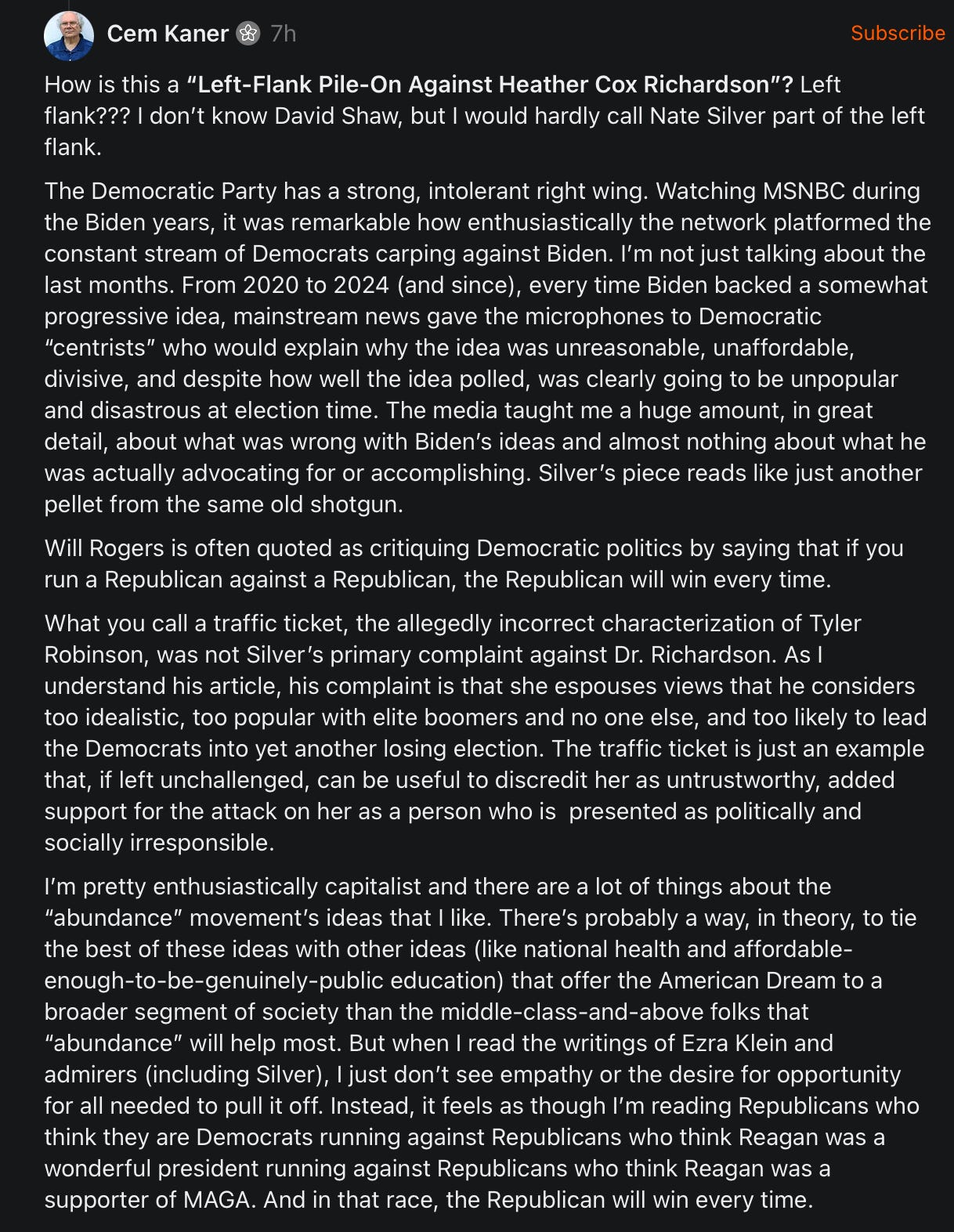
Kaner challenges the framing first.
“How is this a ‘Left-Flank Pile-On Against Heather Cox Richardson’? Left flank??? I don’t know David Shaw, but I would hardly call Nate Silver part of the left flank.”
He argues the pressure point is elsewhere.
“The Democratic Party has a strong, intolerant right wing,” and in that view, Silver’s critique lands like familiar media discipline. “Silver’s piece reads like just another pellet from the same old shotgun.”
On Robinson, Kaner rejects false certainty.
“Frankly, I don’t think we have any idea why he did what he did.” He resists the retraction demand. “I don’t see any reason for Dr. Richardson to retract her comments.” He calls the demand “bullying,” and describes it as “a demand that she adopt a viewpoint that seems as poorly supported as the one she is being asked to apologize for.”
Then comes the moral diagnosis.
Kaner calls it “self-righteous, mean-spirited bullshitting,” warns that it leaves Democrats “winning only after the Republicans screw up so badly” that voters will accept anything, and says the party risks becoming “the punctuation pause between one Republican administration and the next.”
Other defenses of Richardson
Jamelle Bouie is not a niche blog voice. He is a New York Times Opinion columnist and a prominent progressive commentator whose work is widely read, especially on questions of democracy, elections, and power. When he pushes back, it matters because he is speaking from inside the mainstream liberal intelligentsia, not from the fringe.
Bouie pushed back on Silver’s framing by arguing that what seems to bother Silver is not misinformation in the abstract, but the existence of liberals who treat democracy as a first principle. In that defense, the refusal to treat everything as a bargaining chip is not purity politics. It is the last remaining boundary between normal politics and a slide into rule by force.
A second defense targets the Tea Party analogy as rhetorical click bait. The Tea Party was an insurgent faction that funded primary challenges, punished incumbents, and treated compromise as betrayal. Richardson’s audience is closer to institution loyal than institution wrecking. They are the people who still show up for civic rituals, still believe norms can hold, and still think the Democratic Party is the only workable vehicle for stopping authoritarianism. That is not the Tea Party’s psychology, even if both groups share intensity.
Richardson’s own defense, and the defense offered on her behalf, leans on epistemic humility. Early facts are noisy. Online subcultures are messy. Motive is not a checkbox. After the blowback, her language shifted toward uncertainty, including phrasing that the motive remained unclear, and she warned against treating pattern recognition as proof. Supporters read that as the responsible move in a developing case. Critics read it as too subtle, a refusal to issue the kind of explicit correction that closes the loop for a huge audience.
Richardson herself has described the blowback as physical, not abstract. After the controversy, she said, “Yesterday was a complete nightmare in my life,” and called the bad faith criticism a “perverted attack on participation of the public sphere.” She warned that stories like this change “what my email looks like,” and she quoted messages calling her “evil” and “delusional.”
The final defense is functional and it is the reason she has millions of readers. People do not subscribe to her for breaking news. They subscribe for narrative order. She takes chaotic headlines, adds historical context, and gives readers a coherent story about what is happening and why it matters. In an information environment engineered to spike cortisol, that daily coherence is a form of emotional stabilization, even when a reader disputes a particular claim.
The rebuttal, the part nobody wants said out loud
There is a kind of pragmatism that only makes sense if you have never had your life narrowed by someone else’s rules.
If you have never hit the concrete wall of redlining, if you have never watched segregation turn opportunity into a gated community, if you have never had to negotiate with patriarchy just to be heard in the room, pragmatism sounds like wisdom. It sounds calm. It sounds mature. It sounds like the grown ups are back.
But for people who did not get to choose the terms, pragmatism has often been the polite word for surrender.
Pragmatism is what watered down the moral edge of this country at birth. The original Declaration of Independence contained a condemnation of the slave trade, and the so called sensible people made sure it did not survive the room.
Pragmatism is what would have looked at the Confederacy and said, let them have it, if it keeps the peace. Save lives. Keep the markets stable. Do not inflame tensions.
Pragmatism is what gave the nation the Compromise of 1877, the deal that ended Reconstruction and paved the road for Jim Crow to become law, custom, and daily terror.
So when Nate Silver ridicules moral clarity as purity politics, the reaction is not just intellectual. It is visceral. Because moral clarity is not a luxury for the people who have to live under the consequences. It is the only thing that ever moved the line.
Every major expansion of American freedom required somebody to be accused of being unrealistic. Abolition was unrealistic. Civil rights were unrealistic. Voting rights were unrealistic. The demand to end Jim Crow was treated like an irresponsible provocation until it became the country’s conscience.
That is why this pile on feels off. The loudest critics speak from a kind of insulation, a world where the worst thing that happens is losing an argument in public. For everyone else, the cost of being pragmatic has been paid in generations.
The question is not whether Dr. Richardson can be wrong. The question is why certain people are so eager to turn her into a cautionary tale for having a moral spine.
Conclusion
This was never about protecting Dr. Richardson from critique. It was about protecting reality from a fake kind of seriousness.
And this is where the absurdity gets almost funny. Some of the same people who mock her readers for treating her like a deity will turn around and demand that she behave like one. Omniscient. Perfect. Incapable of a bad call. Incapable of a flawed sentence on a day the whole country is vibrating.
That standard has never existed. Thomas Jefferson was imperfect. Lincoln was imperfect. Martin Luther King Jr. was imperfect. If perfection was the entry fee, there would be no American story at all. Just an empty podium and a nation still waiting on a pure enough human to speak.
So yes, correct what needs correcting. Say what changed. Tighten the language. Own the miss. Then keep moving.
But do not pretend this is about standards when the punishment is a brand, a scarlet letter, a campaign to make one historian carry everybody’s anxiety inside the coalition.
It is December. People are tired. People are scared. People are looking for something steady. That is exactly why the ticket writing feels obscene.
When the country is in a multi alarm crisis, choosing to spend energy on a five miles over dispute is a choice. It may feel like virtue, but it can function like displacement, status warfare, and monetized outrage.
Meanwhile the larger, higher impact failures in legacy media do not stop. The wreckage keeps happening. The sirens keep coming.
So here is the ask, plain. Stop writing tickets while the city burns. Go where the emergency is.
And if this hit you in that tight place, if you are tired of billionaire owned narratives turning your fear into profit, go paid.
Not as charity. Not as a tip. As cover.
Your paid subscription keeps this free for the readers who are already tapped out, the ones on fixed incomes, the ones juggling other subscriptions, the ones who still deserve to see clearly. It keeps this independent, so this platform answers to you, not to advertisers, not to boardrooms, not to donors, not to anyone who can threaten the payroll.
Because when the next smear wave comes for regular people, not public figures, when they try to isolate you, shame you, or scare you into silence, somebody has to be willing to say what is happening and defend you with the mask off.
If you cannot, stay. Read free. Share it. That is part of the work too.
Sources
1. https://www.natesilver.net/p/what-is-heather-cox-richardsonism
2. https://heathercoxrichardson.substack.com/p/september-13-2025
3. https://heathercoxrichardson.substack.com/p/september-13-2025-2c3
4. https://heathercoxrichardson.substack.com/p/september-16-2025
5. https://www.wakeuptopolitics.com/p/political-violence-shouldnt-be-a
6. https://www.vox.com/politics/462173/charlie-kirk-killer-motive-tyler-robinson-jimmy-kimmel
7. https://www.ettingermentum.news/p/the-democratic-partys-tea-party-moment
8. https://www.currentaffairs.org/news/2023/11/does-democracy-mainly-mean-voting-for-democrats
9. https://bsky.app/profile/chathamharrison.bsky.social/post/3m7vpupg4pk2n
10. https://margaretsullivan.substack.com/p/america-has-tragically-changed-but
11. https://freebeacon.com/media/substack-star-heather-cox-richardson-told-her-2-7-million-subscribers-charlie-kirk-was-killed-by-a-right-winger-she-still-hasnt-told-them-the-truth/
12. https://www.historyboomer.com/p/heather-cox-richardson-and-the-groypers
13. https://www.yahoo.com/news/articles/brain-worms-stuff-substack-most-170234837.html
14. https://thedispatch.com/article/assessing-claims-about-tyler-robinsons-motive/
15. https://www.reuters.com/sustainability/society-equity/cbs-postpones-60-minutes-report-el-salvadors-cecot-prison-2025-12-22/
16. https://people.com/60-minutes-segment-pulled-bari-weiss-correspondent-calls-decision-political-11874231
17. https://www.theguardian.com/media/2025/dec/22/cbs-news-delays-60-minutes-segment-featuring-investigation-into-cecot-megaprison
18. https://www.theguardian.com/media/2025/dec/23/60-minutes-cecot-appears-online
19. https://www.battlefields.org/learn/primary-sources/jefferson-condemns-slave-trade-declaration-independence
20. https://www.history.com/articles/compromise-of-1877
21. https://www.khanacademy.org/humanities/us-history/civil-war-era/x71a94f19%3Afailure-of-reconstruction/a/compromise-of-1877
Thank you for this response to Nate Silver’s piece. I was furious when I read it and I’m sad to hear it’s caused her pain. We are all trying to drink news from a firehose, it’s messy to say the least. As for dividing Democrats into warring factions, we have always been a big tent full of contradictions. This is not a weakness, it’s a strength when we can harness it.
This is brilliant! Your characterization of Nate Silver and Ezra Klein as not “empathetic” is spot on, if a bit mild. White-privileged know-it-alls springs to my mind, but what does name-calling accomplish?
There are so many parts of this I want to cite for the clarity and insight.
Thank you so much for this. You are a voice of reason.