


Welcome to the Spin Spectrum. This series is a simple tool for people who want the news without being quietly steered by it. Each time, I take one headline and line up how different outlets cover the same event from left, center, right, domestic, and foreign so you can see what gets emphasized, what gets softened, and what gets left out.
What makes the Spin Spectrum different is restraint. I’m not here to “win” the story, punish villains, or crown heroes. Even when a headline hits a nerve, I deliberately hold back my own hot takes and moral outrage not because I don’t have them, but because outrage can become a fog machine that hides the real shape of things. The goal is to let the facts breathe, then let the patterns in coverage show themselves.
I’ve tried to emphasize brevity in this run in response to those who can only absorb so much info in one stetting. I get it. Don’t hesitate to voice approval or otherwise in the comments.
What Happened
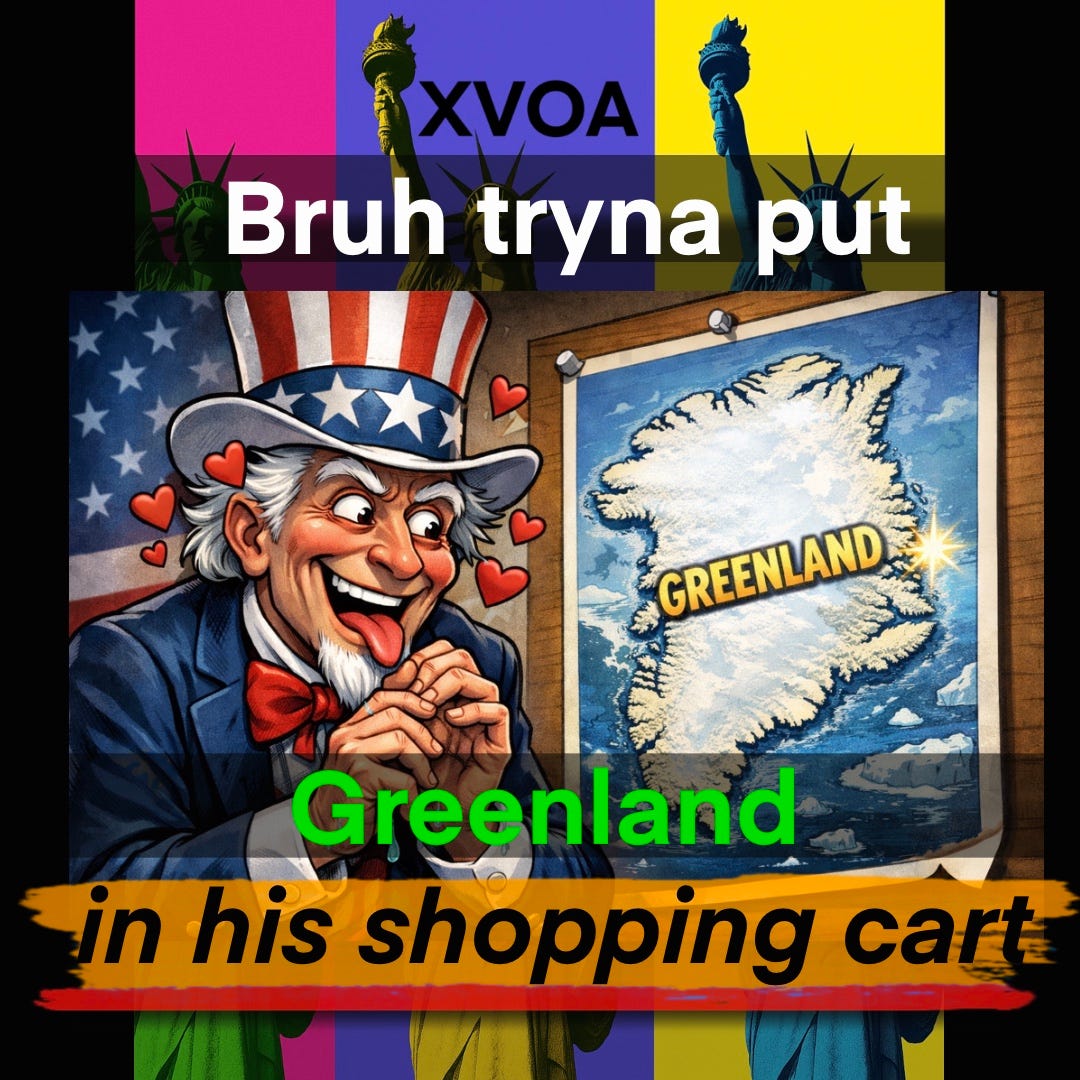
On Saturday, January 17, 2026, President Donald Trump said the U.S. will place new import taxes (tariffs) on goods from eight European countries unless the U.S. is allowed to make a deal to buy Greenland. [3][5]
Those countries include Denmark, Norway, Sweden, France, Germany, the Netherlands, Finland, and the United Kingdom. Trump said the tariffs would start at 10% in early February and could rise to 25% on June 1 if no deal happens. [1][3][5]
European leaders condemned the move and warned it could harm U.S.–Europe relations. European Union officials also prepared an emergency meeting in Brussels to discuss how to respond, including possible retaliation. [1][3][13]
How Liberal Media Covered It
The Guardian treated Trump’s tariff threat as a form of pressure on close allies, using language that paints it as coercion and a danger to alliances. It focused on the idea that Greenland is “not for sale,” and it framed the tariff threat as a serious break from normal diplomacy between friends. [9]
The Daily Beast leaned hard into tone and personality. Its headline and labels (“petty,” “unhinged,” “tariff tyrant”) turn the story into a warning about Trump’s style of leadership. It highlighted that the announcement was made in a short social media post, and it underlined the drama and shock value more than the paperwork side of trade policy. [11]
Salon went even further into motive and meaning. It presented the Greenland push as about ego, legacy, and humiliation, and it used emotional details (like Greenland’s foreign minister becoming tearful in an interview) to show the human cost of pressure tactics. [12]
What these left-leaning outlets emphasized
• Trump’s character and motives (impulse, ego, dominance). [11][12]
• Alliance damage: the idea that this breaks trust with NATO partners. [9][12]
• Human emotion: protesters, fear, embarrassment, tears. [11][12]
What they downplayed or omitted
• The “inside baseball” of trade law (exact legal tools, how tariffs are implemented country-by-country, and what the EU can do step-by-step). That detail shows up more in wire services than in opinion-heavy coverage. [5][11][12]
In plain English, these outlets are mostly saying…
“This is bullying, it’s risky, and it could blow up long-term alliances—just to satisfy Trump’s obsession with owning Greenland.” [9][11][12]
Quick pause. If you’ve been looking for a place where the facts get room to breathe and where sources get compared without turning everything into a morality play then this is it. The internet pays the loudest voices. It rarely pays the clearest ones.
If Spin Spectrum helps you think instead of just react, consider becoming a paid subscriber. Not because outrage is “bad” (it has its uses and I’ve done my share), but because a timeline powered by rage needs a counterweight using a steady, sober comparison that doesn’t flinch and doesn’t spin.
Support the work that keeps your mind free.
How Centrist / Mainstream Media Covered It
Reuters and The Associated Press (AP) stuck close to the basics: what Trump threatened, who is affected, how Europe replied, and what happens next. They leaned on official quotes like “dangerous downward spiral,” and they described the diplomatic process (statements, meetings, working groups, and what each government said). [1][3][5]
They also gave readers the key “process” questions:
• How can the U.S. target individual EU countries when the EU is a single trade bloc? [5]
• What legal authority would the White House use to impose these tariffs? [5]
• What tools does Europe have to respond, and how quickly can it use them? [1][2]
Axios did mainstream reporting, but with a punchier “why it matters” style. It emphasized Europe’s growing talk of a trade “bazooka”—the EU’s anti-coercion instrument—and it framed the moment as a stress test of the post–World War II alliance system. [6]
The Financial Times highlighted the U.S. argument for the policy by focusing on comments from Treasury Secretary Scott Bessent, who said Europe is too weak to guarantee Greenland’s security. That style fits the FT’s habit of centering high-level officials and economic power politics. [7]
What mainstream coverage emphasized
• Clear timeline, key quotes, and next steps (meetings, statements, votes). [1][3][5]
• The retaliation threat as a concrete risk: Europe discussing about €93 billion (about $108 billion) worth of counter-tariffs and possible limits on U.S. companies in Europe. [2]
• The EU’s “never used” anti-coercion tool as a serious escalation option. [1][6]
Tone compared to liberal outlets
• Less emotional language.
• More “here’s what each side says,” plus the practical question: “What can they actually do?” [1][5]
What a typical centrist reader would take away
“Trump made a major tariff threat tied to Greenland, Europe is coordinating a response, and there is a real risk of a trade fight that could spill into NATO politics.” [1][2][5]
How Conservative Media Covered It
Fox News featured the allied pushback (“dangerous downward spiral”) but also gave space to the U.S. national security framing and the strategic importance of Greenland. It leaned into NATO, Russia/China competition, and security themes. [10]
The Washington Examiner kept a sharper political edge than Reuters or AP. It stressed that the EU called an emergency meeting and highlighted warnings from European leaders. It also repeated the idea that Greenland is tied to U.S. defense needs, including talk about Trump’s “Golden Dome” missile defense concept. [13]
The Daily Caller framed the European response as heavy on words and light on action, spotlighting how few troops some countries reportedly sent. That angle nudges readers to see Europe as posturing—and to see Trump as applying pressure from a position of strength. [14]
The Spectator (a right-leaning UK magazine) treated the tariffs as part of a bigger struggle about power, technology, and global order. It connected the Greenland dispute to missile defense, satellites, and leverage over Europe’s broader policies. [15]
How this differs from liberal and centrist framing
• Liberal outlets tend to spotlight bullying and moral danger. [9][11][12]
• Mainstream outlets spotlight process and consequences. [1][5]
• Right-leaning outlets more often spotlight power and security (and sometimes Europe’s weakness or hypocrisy). [10][14][15]
Domestic vs Foreign Coverage
Domestic outlets (U.S.-based)
U.S. outlets spent more time on:
• Trump’s political style and how he announced it (social media, “shock” tactics). [11][12]
• Whether the move is smart for U.S. interests: will it raise prices, damage alliances, or box the U.S. into a corner? [5][6]
• The internal U.S. story: lawmakers reacting, legal authority questions, and whether “checks and balances” will limit what happens next. [5][6]
In the U.S., even when the story is about Europe meeting, the coverage often swings back to: “What does this mean for America?”
Foreign / international outlets (outside the U.S.)
Foreign outlets focused more on:
• Sovereignty: Greenland and Denmark deciding Greenland’s future. [1][9]
• Europe’s response options, including retaliation and big EU tools. [1][2][8]
• Alliance survival: whether this breaks the post-war bargain that the U.S. and Europe act like partners, not rivals. [6][9]
Tone difference
• Foreign coverage often sounds more alarmed about the alliance cracking. [1][6][9]
• Domestic coverage is more likely to treat it as another big Trump move and ask whether it will work. [5][11][14]
One simple reason for the difference
Countries usually cover threats more intensely when they feel targeted. Europe is the one facing the tariffs, so European-focused outlets are more likely to talk about retaliation and “red lines.” The U.S. press, by contrast, often treats it as part of the ongoing U.S. political story. [1][2][5]
Big Picture: What This Tells Us About Media Bias
If someone followed only liberal media, they would likely see this as a clear story of bullying: a powerful country using money pressure to grab territory and humiliate allies. They’d expect major long-term damage to U.S. credibility and NATO unity. [9][11][12]
If someone followed only conservative media, they would more likely see it as hard bargaining in a dangerous world: the Arctic matters, Russia and China matter, and Europe has leaned on U.S. protection for a long time. They may also see Europe as overreacting or performing for the cameras. [10][14][15]
Centrist outlets often land in the middle: this is escalating fast, and both sides are making moves that can trigger retaliation. They focus on the practical question: “What is the next step, and what can each side legally do?” [1][2][5]
A psychologist’s note (in plain language): when politics gets heated, people often do projection—they accuse the other side of doing exactly what they fear their own side might do. Projection just means “I’m putting my worries onto you.” That’s why headlines can feel like moral judgment even when they’re describing the same event.
How to triangulate the truth (simple tips)
1. Start with one wire story (Reuters or AP) to lock down the basic facts and timeline. [1][5]
2. Then read one left source and one right source to see what each side thinks is the “real” story. [9][10]
3. Track the numbers and the next actions (like €93 billion in retaliation talk, or use of the EU anti-coercion tool). Those are harder to spin than feelings. [2][6][8]Listen, if you actually made it to the end, you just did something rare online which is that you stayed with the facts long enough for the pattern to show itself.
Spin Spectrum is my attempt to build a small, level-headed room inside that noise where we can compare coverage without being recruited into somebody’s emotional army.
If this helped you see clearer, consider becoming a paid subscriber.
You’re not just supporting me. You’re funding a style of reading that the algorithm will never reward, but democracy can’t live without.
Sources:
Reuters (Jan 3):
https://www.reuters.com/world/americas/trump-says-us-has-captured-venezuela-president-maduro-2026-01-03/
Reuters (Jan 3, broader write-up):
https://www.reuters.com/world/americas/loud-noises-heard-venezuela-capital-southern-area-without-electricity-2026-01-03/
Reuters (Jan 4, interim govt):
https://www.reuters.com/world/us/venezuelas-maduro-custody-trump-says-us-will-run-country-2026-01-04/
Reuters (world reactions):
https://www.reuters.com/world/americas/world-reacts-us-strikes-venezuela-2026-01-03/
The Guardian (Jan 3):
https://www.theguardian.com/world/2026/jan/03/explosions-reported-venezuela-caracas
The Guardian (Jan 3, “run Venezuela”):
https://www.theguardian.com/us-news/2026/jan/03/trump-venezuela-oil-industry
The Guardian (Jan 4, Congress/war powers angle):
https://www.theguardian.com/us-news/2026/jan/04/trump-congress-venezuela-attack
The Guardian (Jan 4 live blog):
https://www.theguardian.com/world/live/2026/jan/04/nicolas-maduro-jailed-us-attack-venezuela-donald-trump-reaction-latest-news-updates-live
Fox News (Delta Force explainer):
https://www.foxnews.com/world/what-is-delta-force-what-do-they-do-inside-elite-us-army-unit-captured-maduro
Fox News (military timeline story):
https://www.foxnews.com/us/us-military-details-timeline-operation-capture-maduro-revealing-more-than-150-aircraft-involved
Al Jazeera (how it unfolded):
https://www.aljazeera.com/news/2026/1/4/how-the-us-attack-on-venezuela-abduction-of-maduro-unfolded
Al Jazeera (Jan 3 live blog):
https://www.aljazeera.com/news/liveblog/2026/1/3/live-loud-noises-heard-in-venezuelas-capital-amid-us-tensions
PBS NewsHour (Jan 3):
https://www.pbs.org/newshour/world/us-strikes-venezuela-and-says-its-leader-maduro-has-been-captured-and-flown-out-of-the-country
PBS NewsHour (how the capture happened):
https://www.pbs.org/newshour/world/how-u-s-forces-captured-venezuelan-leader-nicolas-maduro-in-caracas
AP (live updates / “Latest”):
https://apnews.com/article/d337c7b96fc4a0b47eba6b33adc515e6
DW (Congress authorization angle):
https://amp.dw.com/en/venezuela-operation-not-authorized-by-us-congress/video-75382652
ABC News (live updates):
https://abcnews.go.com/International/live-updates/venezuela-live-updates-trump-give-details-after-us/?id=127792811
PolitiFact (fact-check):
https://www.politifact.com/article/2026/jan/03/trump-maduro-venezuela-capture-attack-oil/
MS NOW / MSNBC (war powers piece):
https://www.ms.now/news/venezuela-strikes-legal-justification-trump
And however many ways I look at this it’s still wrong to threaten a hostile takeover of Greenland whether by military force or economic coercion.
It not only violates Greenland’s sovereignty, it upends NATO, giving Putin what he has tried and failed to achieve by force.
Thank you for your reporting; I especially appreciate the links to your sources.
Discussing Greenland, as important as it is, as a discrete issue risks missing the bigger picture here: taken together with threats against Mexico, Canada, Iran, the actions against Venezuela, and the assertions of intention to control the "western hemisphere", it's apparent that American imperialism is being revived. He even has a name for it: the Don-roe Doctrine. I can't think of any time in our past when we've gone galumphing around other countries getting our sticky fingers in resources that do not belong to us, that it has gone well for us.
So yes, absolutely we need to consider Greenland as its own issue, but we also need the broader context.
It also surprises me that he apparently is happy to narrow America's influence from the world to a hemisphere.