

Voting Rights Watch Weekly | June 17, 2026
A weekly XVOA audit of ballots, maps, rolls, courts, and the quiet machinery of Black political power.
This week, the machinery moved through maps, voter files, court calendars, and the old American habit of calling Black political power a technical problem.
The official language was careful. Race-neutral redistricting. List maintenance. Election integrity. Voter confidence. Administrative reform. But the audit question remains the same: who gets counted, who gets challenged, and who gets erased before Election Day ever arrives?
This was not one door slamming shut. It was a set of locks clicking into place.
TLDR
Georgia opened a special redistricting session after Louisiana v. Callais, with lawmakers preparing to redraw congressional and state legislative lines that could diminish Black and nonwhite voting power while proposed maps remained out of public view as the session began [1][2][3].
In Tennessee, the NAACP, Tennessee NAACP, Lawyers’ Committee, LDF, and impacted voters moved for a preliminary injunction against a new congressional map they allege dismantles the state’s only majority-Black district and fractures Black voting power in Memphis and Shelby County [4][5].
Michigan’s Senate passed a state Voting Rights Act package designed to rebuild state-level protections against voting discrimination, vote dilution, intimidation, and access barriers after federal protections were weakened [6][7].
North Carolina advanced HB 958, a sweeping election bill that would bar state and county election-board members from publicly encouraging voter turnout while adding new challenge, cure, and administration provisions [8][9].
The federal voter-roll and enforcement machine kept expanding through DOJ demands for sensitive statewide voter data, an OLC memo authorizing voter-list sharing with DHS, litigation over late voter purges, an expedited mail-voting appeal, ICE access to local voter files, and FBI searches of an Ohio voter-registration group [10][11][12][13][14][15][16].
Restack And Support
Restack this. Send it to someone who still thinks voting rights only get stolen on Election Day.
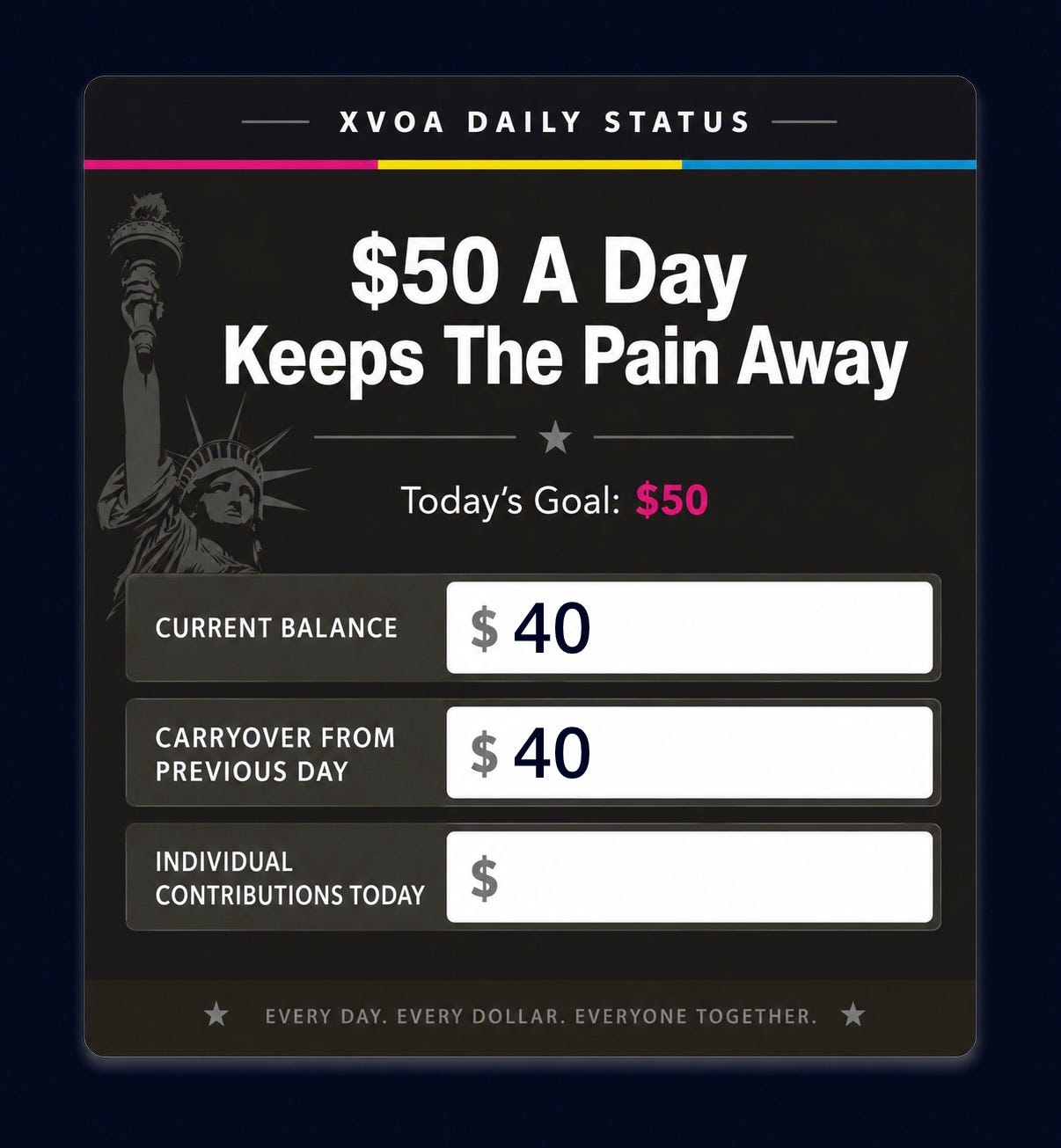
This work is sustained by a daily commitment to raise $50 a day for the next 365 days in support of the reporting, research, sourcing, and analysis behind these audits. There is already $40 carried over from yesterday, which means today’s gap is only $10.
If this report gave you value, help close that gap and keep the desk moving. Paid subscriptions are the primary way to keep XVOA standing:
And for readers who want to contribute without committing to a subscription, Buy Me a Coffee is the one-time backstop that helps keep the reporting desk running:
The Five Moves That Matter
1. Georgia opened the post-Callais statehouse laboratory.
What happened: Georgia lawmakers convened a special session called by Gov. Brian Kemp in response to the Supreme Court’s Louisiana v. Callais ruling. AP reported that proposed maps had not been unveiled as the session began, even though lawmakers were expected to address congressional and state legislative districts [1]. The ACLU of Georgia said the special session is limited by the governor’s proclamation and includes redrawing congressional and legislative boundaries for 2028, plus action on Georgia’s QR-code ballot deadline [2].
The machinery: This is not routine map maintenance. Georgia may become the first state to apply Callais to its state legislature, not only to congressional districts [1]. That matters because Black political power does not live only in Congress. It lives in statehouse districts, county delegations, school-board pressure, utility regulation, criminal law, health budgets, and every local system state legislators control.
Black voter harm audit: AP reported that Georgia’s U.S. House delegation currently includes five districts where the electorate is majority or plurality nonwhite, and all five elected Black Democrats in 2024 [1]. Common Cause Georgia says its priorities for the session include transparency, protection of Black voting power, and protection of districts already won in court [3]. The harm is not hypothetical. The target zone is where Black and nonwhite voters have built real electoral power.
What mainstream coverage missed: The euphemism is “race-neutral.” The mechanism is power removal. When a state says race must disappear from the map, the audit question is whether the state is removing racial discrimination from law or removing Black voters from effective representation.
What happens next: Watch when maps appear, how much time the public gets to analyze them, whether the state legislative lines receive the same scrutiny as congressional lines, and whether Georgia extends the QR-code deadline to avoid election-administration chaos [1][2][3].
Sources: AP documents the special session and the potential impact on Black and nonwhite voting power [1]. ACLU of Georgia explains the special-session scope and QR-code deadline [2]. Common Cause Georgia documents the session agenda and Black voting-power concerns [3].
2. Tennessee’s Memphis map fight put Black vote dilution back in the courtroom.
What happened: The NAACP, NAACP Tennessee State Conference, impacted voters, Lawyers’ Committee, and LDF filed a motion for a preliminary injunction against Tennessee’s new congressional map [4]. The plaintiffs allege the map dismantles Tennessee’s only majority-Black congressional district and unlawfully dilutes Black voting power [4].
The machinery: This is cracking in plain English. A Black political community is split across multiple districts so its voters remain present but lose the ability to elect their preferred candidate. The ACLU’s earlier lawsuit says the map divides Black voters in Memphis and Shelby County across three majority-white districts stretching hundreds of miles into central Tennessee [5].
Black voter harm audit: This is direct Black voter harm as alleged in the litigation. The plaintiffs argue the map fractures Memphis and Shelby County’s Black civic power, weakens Black voters’ ability to elect candidates of choice, and should be blocked before 2026 elections proceed under the new lines [4][5].
What mainstream coverage missed: This is not only “redistricting.” It is the map doing what old suppression laws used to do more openly. The ballot remains. The district gets cut apart.
What happens next: The court must decide whether to halt the map before the election calendar makes the injury permanent for 2026. The deadline pressure is the point. Once ballots are cast under a challenged map, the damage cannot simply be unwound afterward [4].
Sources: NAACP documents the preliminary-injunction motion and the allegation that the map dismantles Tennessee’s only majority-Black district [4]. ACLU documents the underlying Memphis and Shelby County vote-dilution claims [5].
3. Michigan moved to build a state shield where the federal shield has been cut down.
What happened: The Michigan Senate passed Senate Bills 961 through 964 to establish the Michigan Voting Rights Act [7]. LDF describes the package as a major step toward state-level protections against discrimination in elections [6].
The machinery: State VRAs are becoming the defensive architecture of the post-Shelby, post-Brnovich, post-Callais era. If federal law is narrowed, states can either use that opening to restrict power or build new protections inside state law.
Black voter harm audit: Michigan is not a harm story in the same sense as Georgia or Tennessee. It is a repair story. LDF explicitly frames the bill against what it describes as the greatest assault on voting rights facing Black voters since Jim Crow-era state-enforced racial discrimination [6]. The Michigan Senate Democrats’ release says the legislation now moves to the House for further consideration [7].
What mainstream coverage missed: Voting-rights coverage often treats the field as only defensive. Michigan matters because it shows a state trying to write enforceable protection into the machinery itself: discrimination claims, access rights, intimidation protection, and local representation safeguards.
What happens next: The Michigan House becomes the next gate. If the package passes, Michigan could become an important state-level model for protecting voters where federal remedies have been weakened [6][7].
Sources: LDF documents the voting-discrimination framework and federal-rights context [6]. Michigan Senate Democrats document Senate passage, bill numbers, sponsors, and next movement to the House [7].
4. North Carolina tried to make turnout encouragement look suspicious.
What happened: North Carolina Republicans advanced HB 958 through the House Elections Committee. Democracy Docket reports the proposal would bar state election officials from publicly encouraging people to vote as part of a broader election overhaul [8]. The bill text itself bars state and county election-board members from making written or oral statements intended for public distribution that encourage or promote voter turnout in any election [9].
The machinery: This is the gagging of civic infrastructure. The state does not merely decide how ballots are counted. It decides whether election officials can publicly say voting is worth doing.
Black voter harm audit: The bill does not name Black voters as its target. The burden is procedural and cumulative. Voters with less time, less bureaucratic margin, less transportation, less legal knowledge, and less access to trusted election information are the voters most exposed when official outreach is chilled. In North Carolina, that burden does not fall on a blank civic map.
What mainstream coverage missed: “Neutrality” is the mask. Encouraging turnout is not the same thing as endorsing a candidate. A state that treats voter participation itself as suspicious is not protecting elections from bias. It is protecting low participation from challenge.
What happens next: The bill remains under consideration. If it passes the legislature, Democracy Docket reports that Gov. Josh Stein is expected to veto it [8].
Sources: Democracy Docket reports the bill’s committee movement and turnout-promotion restriction [8]. The official HB 958 text documents the ban language and related ballot-cure, provisional-ballot, and administration provisions [9].
5. The voter-roll state is becoming a federal database project.
What happened: Brennan Center reports that the Justice Department has demanded election-related records from nearly every state and Washington, DC, including statewide voter lists, ballots from prior elections, and access to voting equipment, and has sued 30 states and DC for not complying [10]. A DOJ Office of Legal Counsel memo says the Civil Rights Division has authority to seek statewide voter lists and share them with DHS as part of identifying ineligible voters [11]. Democracy Docket reports DOJ is also attacking the NVRA’s 90-day quiet period, the rule that limits systematic voter removals close to elections [12].
The machinery: The roll is no longer just a state file. It is being pulled into a federal eligibility, immigration, enforcement, and litigation architecture. The database becomes the battlefield.
Black voter harm audit: The stated target is ineligible voting. But database errors do not strike evenly. Voters with name changes, unstable housing, old documents, limited transportation, limited English access, criminal-legal contact, or less time to chase paperwork carry more risk when the state decides belonging must be constantly proven. That risk is not exclusively Black, but Black working-class voters sit inside the danger zone of every bureaucratic burden America has historically weaponized.
What mainstream coverage missed: “List maintenance” can be legitimate. But mass data demands, DHS sharing, late purge theories, and local voter-file access are not ordinary list maintenance. They are a shift in who controls the voter file and what suspicion gets attached to it.
What happens next: The D.C. Circuit expedited an appeal over Trump’s mail-voting executive order, with opening briefs due June 17, responses due June 29, and replies due July 6 [13]. Watch DOJ’s voter-data suits, the NVRA quiet-period litigation, ICE requests to local election offices, and fallout from the FBI search of the Ohio Organizing Collaborative [10][11][12][13][14][15][16].
Sources: Brennan Center tracks the DOJ voter-data demands [10]. DOJ’s OLC memo states the department’s authority theory [11]. Democracy Docket reports the quiet-period challenge and mail-voting appeal schedule [12][13]. Axios reports ICE access to local voter files [14]. AP and The Guardian report the Ohio voter-registration group search and intimidation concerns [15][16].
The Black Voter Harm Audit
The week’s clearest direct harm is in the maps.
Georgia is the statehouse laboratory. Tennessee is the Memphis fracture. In both places, Black political power is not an abstraction. It is a district, a coalition, a turnout network, a church van, an organizer’s contact list, a school-board pressure campaign, a neighborhood that knows where its people live and how they vote [1][3][4][5].
The week’s indirect harm is in procedure. North Carolina’s HB 958 does not need to say “Black voters” to create danger. A turnout gag aimed at election officials, combined with challenge provisions and bureaucratic curing rules, shifts burden onto voters who already have the least margin to absorb paperwork, delay, and confusion [8][9].
The week’s database harm is national. DOJ demands for sensitive voter data, the OLC theory allowing voter-list sharing with DHS, the attack on the NVRA quiet period, and ICE access to local voter files all point in the same direction: the voter roll is being converted from an access list into a suspicion file [10][11][12][14].
The week’s civic-infrastructure harm is Cleveland. Federal agents searched the Ohio Organizing Collaborative, a group AP says supports voter registration and describes its work around criminal justice reform, racial justice, and voting rights [15]. The Guardian reports that Prentiss Haney, a board member, described the action as an attack on Black and working-class voter turnout [16]. The audit does not need to declare the investigation baseless. It does need to name the chilling effect. When the state raids the voter-registration ecosystem, the message travels farther than the warrant.
The wound was renamed procedure. The map was called compliance. The purge was called maintenance. The file request was called integrity. The trick was to make Black political power look like an administrative problem.
The Local Trapdoor
Shasta County, California: the county charter as ballot-access weapon.
Where: Shasta County, California.
What changed: Shasta County voters approved Measure B, a local charter measure that would require single-day in-person voting, restrict absentee voting, require photo ID, require hand counting, and sharply limit mail voting [17]. California Attorney General Rob Bonta and Secretary of State Shirley Weber sued to strike down the measure, saying it illegally overhauls the county election system and conflicts with state election-law protections [18].
Why it matters: This is how the trapdoor opens locally. A county can become a testing ground for rules that would be politically or legally harder to impose statewide.
Black voter harm audit: Shasta is not a Black-majority county story. The direct burden is broader: elders, disabled voters, rural voters, caregivers, shift workers, and voters without flexible transportation lose access first. The Black voter significance is national. Ballot-access experiments built in one county can become templates elsewhere.
Coverage gap: National voting-rights coverage often waits for Congress or the Supreme Court. Shasta shows the local boardroom version of suppression logic: make voting harder, then call the obstacle confidence.
Webb County, Texas, and Forsyth County, North Carolina: local voter files entered the immigration-enforcement lane.
Where: Webb County, Texas, and Forsyth County, North Carolina.
What changed: Axios reported that Homeland Security Investigations, part of ICE, requested specific local voter files and obtained them in Webb County and Forsyth County [14].
Why it matters: This is a local voter-file story, not just an immigration story. The county election office becomes an access point for federal enforcement.
Black voter harm audit: The stated subject is alleged noncitizen voting, not Black voters specifically. But the machinery can still endanger Black voters, Latino voters, naturalized citizens, voters with name mismatches, and low-margin voters when the state treats registration as suspicion.
Coverage gap: The quiet transfer of voter-file information can matter as much as a public law. The public sees “election integrity.” The machine sees address, date of birth, voting history, driver’s license data, and a reason to knock.
Cleveland, Ohio: voter-registration work became a federal search site.
Where: Cleveland, Ohio.
What changed: AP reported that FBI agents searched the office of the Ohio Organizing Collaborative, seized documents and computer files, and visited homes of people associated with the group [15].
Why it matters: A raid does not need to produce charges to chill civic work. Organizers pause. Volunteers hesitate. Donors wonder. Communities get the message.
Black voter harm audit: The Guardian reports that a board member described the raid as an attack on Black and working-class voter turnout [16]. That claim should be treated as an allegation and a warning, not as a court finding. The warning is still serious because the target was civic infrastructure.
Coverage gap: This was not merely a law-enforcement item. It was federal power entering the voter-registration ecosystem before the midterms.
The Map Room
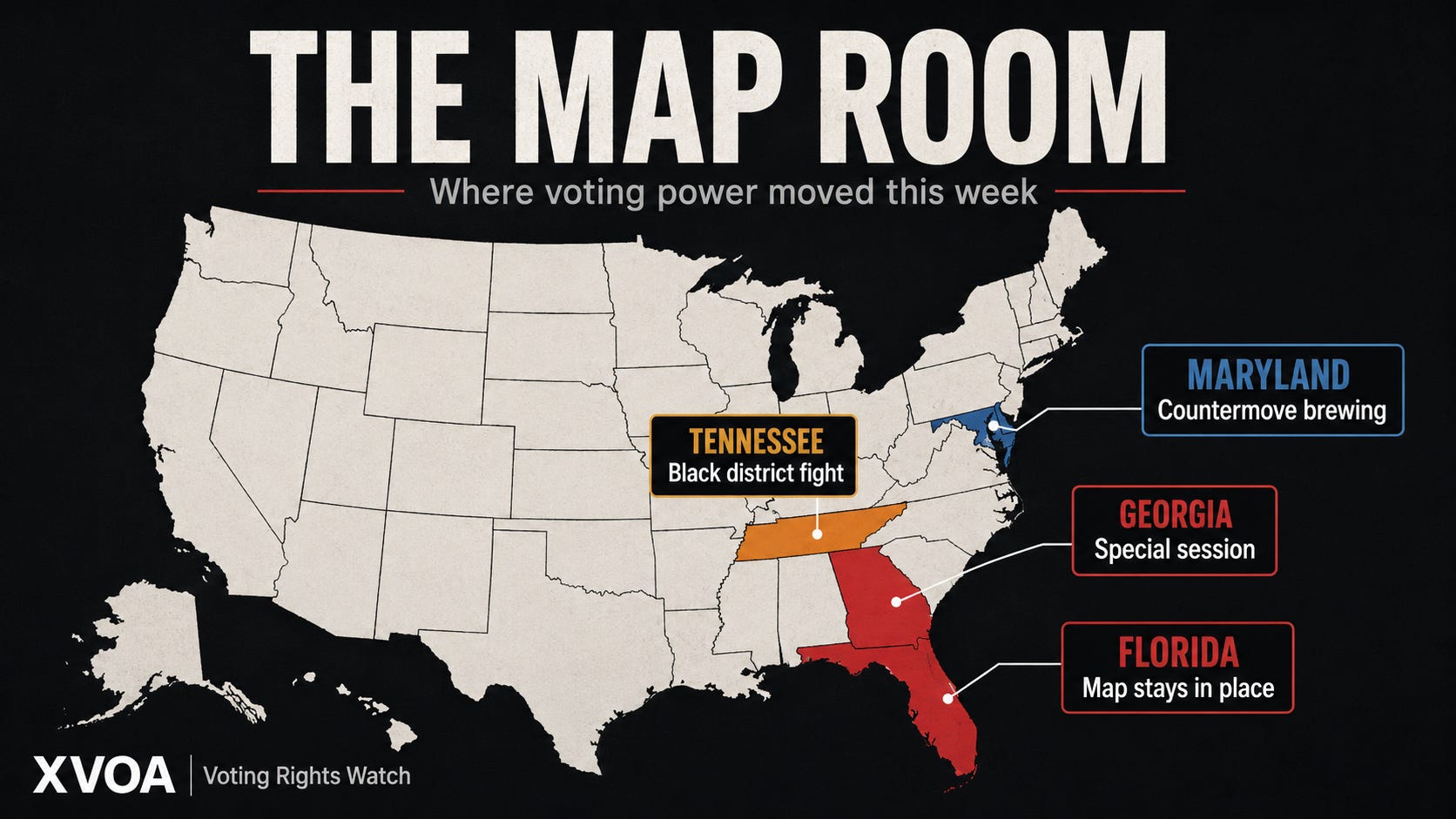
Georgia and Tennessee are the map room’s center of gravity.
Georgia’s session shows how Callais can cascade beyond Congress into state legislative maps [1]. Tennessee shows the same machinery at street level in Memphis and Shelby County: Black voters allegedly cracked across three majority-white districts after the state eliminated its only majority-Black congressional district [4][5].
Florida adds the calendar lesson. Reuters reported that the Florida Supreme Court declined to block a new Republican congressional map before the midterms, ruling it lacked jurisdiction while the case remains pending in a lower appeals court [19]. The immediate effect is that the challenged map is likely to remain in place for the fall elections [19]. That is how map power works. A line does not need final moral vindication if it survives long enough to govern the election.
Maryland is the counter-map story. Democracy Docket reports that Maryland’s top Democrats are preparing a possible special session after the June 23 primary to place a redistricting amendment before voters, with a July 31 deadline to put the measure on the November ballot [20]. This is not a Black voter harm story in the same way Tennessee is. It is evidence that the map war has become national, reactive, and increasingly untethered from the old once-a-decade norm.
Plain English: packing wastes power by crowding a community into too few districts. Cracking weakens power by splitting a community across too many districts. Vote dilution is the result. The people are still there. The map makes their power harder to see.
The Roll Call
The roll call begins with the file.
Brennan Center reports that DOJ has demanded statewide voter registration lists and other election-related records from nearly every state and Washington, DC, and has sued 30 states and DC for refusing to provide certain data [10]. DOJ’s OLC memo says the Civil Rights Division may seek statewide voter lists and share them with DHS to identify people it says are ineligible to vote [11]. Democracy Docket reports that DOJ is also taking aim at the NVRA’s 90-day quiet period, which limits systematic voter removals close to federal elections [12].
Legitimate list maintenance exists. States can update records when voters move, die, or become ineligible. But the danger line appears when list maintenance becomes mass suspicion, when purge timing creeps toward Election Day, when sensitive data is pulled into federal systems, and when voters have too little time to fix mistakes before the ballot closes.
The harm question is not whether rolls should be accurate. The harm question is who has to prove belonging over and over again. Who gets caught by database mismatch? Who has the birth certificate, the transportation, the flexible job, the legal confidence, and the bureaucratic stamina to survive the error?
That is where “maintenance” becomes machinery.
The Ballot Access Desk
Ballot access this week moved through three channels: mail voting, cure rules, and official silence.
The D.C. Circuit expedited the appeal over Trump’s mail-voting executive order, which Democracy Docket says directs DHS to help create lists of verified citizens and directs USPS to restrict mail and absentee ballot delivery based on state-submitted lists [13]. The expedited schedule does not block the order, but it shows the court understands the election calendar is already moving [13].
Shasta County’s Measure B is the local version of the same access fight. It would limit voting to a single in-person Election Day with narrow exceptions, restrict mail voting, require photo ID, and mandate hand counting [17][18]. This is how voting becomes theoretically available and practically harder.
North Carolina’s HB 958 contains some cure provisions, including notice and cure opportunities for missing signatures on provisional ballots and certain absentee deficiencies [9]. But the same bill also contains the turnout-promotion gag for state and county election-board members [9]. That is the contradiction: help voters cure some defects after the fact, while chilling public encouragement before they vote.
The voters most affected are the ones with the least room for state games: elders, disabled voters, working people, caregivers, rural voters, students, formerly incarcerated voters, voters with unstable housing, and Black voters who already know the system has never treated their participation as innocent.
Closing Note
The bridge does not get pulled up all at once. Sometimes it is dismantled by court posture, board agenda, map line, database field, proof document, silence order, and county charter.
Voting power is not only stolen at the ballot box. It is stolen before the voter ever gets there.
Support XVOA
This desk is operating on a daily discipline: $50 a day to keep the reporting, research, sourcing, and analysis moving.
Today, $40 is already carried over from yesterday, which means the gap is just $10.
Paid subscriptions are the primary way to keep XVOA standing:
And for readers who cannot commit to a subscription but still want to help close the daily gap, Buy Me a Coffee is the one-time backstop that helps keep the desk running:
The work is not just reading headlines. It is tracing the machinery before the damage gets renamed procedure.
It overwhelms my mind to read all this. I suppose that is how it feels out on the street - overwhelmed.
I truly do not know how Black people maintain. Maybe it's that they know the racists want to start a war and won't give them the satisfaction. The whole thing is pathetic. The lines are being drawn. Let's hope they don't get away with their shit.