

Voting Rights Watch Weekly | May 22, 2026
A weekly XVOA audit of ballots, maps, rolls, courts, and the quiet machinery of Black political power.
Before XVOA, I spent twenty years writing police reports. That job teaches you something ugly about power. Power does not always kick in the door. Sometimes it hides in paperwork. Sometimes it hides in a deadline. Sometimes it hides in the sentence that says, “procedure was followed.”
That is why Voting Rights Watch Weekly exists.
Because they do not have to steal your vote on Election Day if they already moved your power before you got there.
This is not a generic voting-rights roundup. This is XVOA’s weekly democracy audit of the quiet rooms where political power gets moved while everybody else is watching the speech, the scandal, the trial, or the circus.
We are watching the maps. The voter rolls. The court orders. The county board meetings. The mail rules. The school board lines. The local notices most people never see until the bridge is already gone.
The question is simple: who gets counted, who gets challenged, and who gets erased?
The injury gets treated like normal politics. The repair gets treated like the crime.
This week, the machinery moved through South Carolina’s map room, Tennessee’s Memphis split, federal voter-roll demands, Wisconsin ballot handling, and a Black civil response that moved from Montgomery to Jackson to college sports.
The ballot was never the whole battlefield. This week, the fight moved before the ballot, into the machinery that decides how much power the ballot has left.
TLDR
South Carolina’s House passed a new congressional map targeting Jim Clyburn’s district, while the bill would delay U.S. House primaries and discard some already-cast congressional absentee and overseas ballots [2][3].
Tennessee’s map fight hit the ground when Rep. Steve Cohen said he would not seek reelection after Republicans split Shelby County, including Memphis, into three Republican-leaning districts [5].
Federal judges in Maine and Wisconsin dismissed Justice Department lawsuits seeking detailed voter data, part of a larger DOJ campaign for sensitive voter-roll information [6][7].
A Dane County judge ordered Madison to count 23 absentee ballots that voters had submitted on time but that were delayed by clerk delivery error [9].
Black civic power answered back through rallies in Alabama and Mississippi, a Black clergy registration push, and the NAACP’s “Out of Bounds” campaign aimed at public universities in states accused of weakening Black voting power [13][14][15][18].
Restack this. Send it to someone who still thinks voting rights only get stolen on Election Day. If you can support the work,
If a subscription is not possible today, coffee is the backstop:
The Five Moves That Matter
1. South Carolina moved to put Jim Clyburn’s district on the chopping block.

What happened: On May 20, 2026, South Carolina’s Republican-controlled House approved a new congressional map aimed at longtime Democratic U.S. Rep. Jim Clyburn. Reuters reported that the map still needed Senate approval, and that the bill would move the state’s U.S. House primaries from June 9 to August 18 [2]. AP reported that the proposal would remove U.S. House races from the June primary calendar, require a special congressional primary later in the summer, and toss some absentee and overseas military ballots already cast for Congress [3].
The machinery: This is not only a map. It is a calendar weapon. Change the lines, delay the primary, reopen candidate filing, and make local election officials clean up the chaos.
Black voter harm audit: Clyburn has represented the 6th District since 1993. The Guardian reported that the district includes the Gullah Geechee coastal homeland, two HBCUs, Black Belt farmland, and some of the poorest communities in the state [4]. Reuters reported that Democratic lawmakers called the map an effort to deny Black voters political power, while Republicans denied race was the motive and argued the map reflected conservative voting strength [2].
What mainstream coverage missed: The polite headline is “redistricting.” The wound is a state taking its only Democratic-held congressional seat, rooted in Black political history, and treating it like an inconvenience to be erased.
What happens next: The bill goes to the South Carolina Senate. If it passes, the state’s congressional primary calendar changes, local election offices absorb the disruption, and lawsuits are likely [2][3].
Sources: Reuters, AP, and The Guardian documented the South Carolina map, the primary delay, Clyburn’s district, and the Black voter-power stakes [2][3][4].
2. Tennessee showed what a split Black district looks like in real life.

What happened: Rep. Steve Cohen said on May 15 that he would not seek reelection after Tennessee Republicans redrew his Memphis-based district. Reuters reported that Cohen represented a majority-Black district in Memphis, but the new map split Shelby County into three Republican-leaning districts [5].
The machinery: This is cracking. A politically concentrated community is split across several districts so its power cannot land in one place. The voter still has a ballot. The community loses the district.
Black voter harm audit: The harm is direct. Memphis is one of the strongest Black political centers in Tennessee. When Shelby County is broken into three Republican-leaning districts, Black voters do not merely lose a representative. They lose the structure that allowed their votes to gather force [5].
What mainstream coverage missed: This is not only the end of one congressman’s career. Cohen’s exit is the human receipt for the map. The map did not just move lines. It changed who could realistically run, who could win, and whose community could speak with force in Congress.
What happens next: Tennessee’s new lines remain under challenge in state and federal litigation. State Court Report noted that plaintiffs in NAACP v. Tennessee argue lawmakers lacked authority to change the law banning mid-decade redistricting during the special session that produced the map [16].
Sources: Reuters reported Cohen’s decision and the Shelby County split. State Court Report documented the Tennessee litigation after Callais [5][16].
3. DOJ’s voter-roll dragnet took two more court losses.
What happened: Federal judges in Maine and Wisconsin dismissed Justice Department lawsuits seeking detailed voter registration information. AP reported that the DOJ has sued at least 30 states and Washington, D.C. for detailed voter data, including dates of birth, addresses, driver’s license numbers, and partial Social Security numbers [6].
The machinery: This is voter-roll centralization. States run elections. DOJ is trying to force states to turn over detailed voter files, then use federal power to inspect who belongs on those rolls [6][7].
Black voter harm audit: This does not name Black voters in the demand. That does not make it harmless. Black working-class voters, Black immigrant communities, elders, students, people who move often, and voters with record mismatches are more likely to be hurt when a database error becomes a voting problem. A purge does not have to announce itself as racial to have racial results.
What mainstream coverage missed: “List maintenance” sounds clean. The real question is who gets made to prove belonging, who has the documents, who has the time, and who can survive being flagged by a government system.
What happens next: The Wisconsin and Maine dismissals join other federal court defeats for DOJ, but the State Democracy Research Initiative tracker shows the broader campaign for sensitive voter data is still active [6][7].
Sources: AP reported the Maine and Wisconsin dismissals. The State Democracy Research Initiative tracker documents DOJ’s broader voter-data push [6][7].
4. Wisconsin showed how a ballot can be nearly erased by an office mistake.
What happened: A Dane County judge ordered Madison to count 23 absentee ballots that voters had submitted before the deadline but that were delivered late to polling places because of a clerk-office delay. WPR reported that the Wisconsin Elections Commission had previously voted 5-1 not to count the ballots [9].
The machinery: This is the ballot-access desk at its most basic. The voter did the thing right. The office failed. Then the system debated whether the voter should pay for the government’s mistake.
Black voter harm audit: The reporting does not show specific Black voter harm in Madison. But the mechanism matters everywhere. When the rule is “your ballot dies because an office mishandled it,” the voters with the least time, money, legal help, transportation, and institutional trust are the ones least able to fight back.
What mainstream coverage missed: Twenty-three ballots may sound small. But rights are often tested in small numbers first. If a ballot can be discarded through no fault of the voter, the principle is already bleeding.
What happens next: The Wisconsin absentee-ballot fight sits inside a larger national fight over mail ballots, cure rules, notice, and whether clerical error becomes voter punishment [8][9].
Sources: WPR reported the Dane County order and the 23 ballots. The Brennan Center’s May roundup tracked broader national fights over mail ballots, voter ID, proof of citizenship, and federal voter data [8][9].
5. Black civic power moved from protest to pressure.
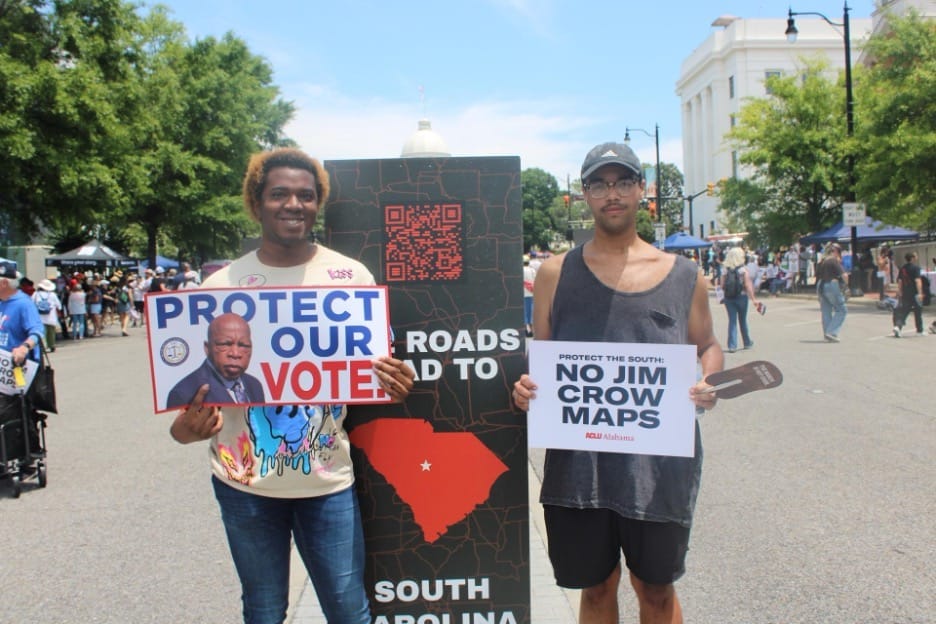
What happened: Thousands rallied in Montgomery, Alabama, on May 16 for the All Roads Lead to the South rally after Callais [13]. Thousands more gathered in Jackson, Mississippi, on May 20 for voting rights, on ground tied directly to Mississippi’s long history of Black disenfranchisement [14]. The NAACP and Congressional Black Caucus also launched the “Out of Bounds” campaign, calling on Black athletes and supporters to withhold athletic and financial support from public universities in states accused of weakening Black voting representation [15].
The machinery: This is counter-machinery. Courts and legislatures moved power through maps. Black civic institutions answered through churches, rallies, athletes, alumni, and money.
Black voter harm audit: The response itself tells you the harm is not symbolic. If public universities profit from Black athletes while state governments weaken Black political power, then the field, the campus, and the ballot are part of the same ecosystem [15].
What mainstream coverage missed: This is not just protest culture. It is a pressure map. Black communities are asking which institutions benefit from Black bodies, Black talent, Black culture, and Black money while staying quiet about Black political erasure.
What happens next: The NAACP campaign names Alabama, Florida, Georgia, Louisiana, Mississippi, Texas, and South Carolina. The Congressional Black Caucus also connected the issue to federal college-sports legislation, giving the campaign a policy lever beyond moral appeal [15].
Sources: The Guardian reported the Alabama and Mississippi rallies. AP reported the NAACP and CBC boycott campaign. National Catholic Reporter documented Black clergy organizing and voter-registration strategies after Callais [13][14][15][18].
The Black Voter Harm Audit
This week, Black voting power was directly targeted through maps in South Carolina and Tennessee [2][5]. South Carolina’s map aims at Clyburn’s district, which carries Black political memory, HBCU geography, Gullah Geechee history, and the state’s only Democratic-held congressional seat [2][4]. Tennessee’s map split Shelby County and made the Memphis district politically unrecognizable [5].
Black voting power was indirectly threatened through voter-roll demands and ballot-handling rules [6][8][9]. These systems sound neutral because they do not say “Black voters” out loud. But they create risks through paperwork, data matching, ID demands, mail delays, provisional ballots, and limited time to fix mistakes.
Black power was also being tested through institutional silence. The NAACP’s “Out of Bounds” campaign is built around a simple charge: state universities cannot profit from Black athletes while their states weaken Black voters [15]. That is not a side issue. It is an XVOA issue. Who benefits? Who pays? Who gets erased while somebody else cashes the check?
The clearest historical echo came from Mississippi. The Guardian reported that the Jackson rally moved through ground tied to the 1890 Mississippi Plan, the system white leaders used to disenfranchise Black voters after Reconstruction [14]. That is not decoration. That is memory doing its job.
The Local Trapdoor
South Carolina: congressional chaos becomes local election chaos.
Where: South Carolina.
What changed: The House-backed map would pull U.S. House races out of the June primary and move them to a later special primary. AP reported that some absentee and overseas military votes already cast for Congress would be tossed out if the plan becomes law [3].
Why it matters: This is a state map fight landing in local election offices. Ballots, candidate filings, voter education, poll planning, election costs, and voter trust all get dragged behind the map line.
Black voter harm audit: The Black harm is both district-based and administrative. The target is Black political influence in Clyburn’s district, but the damage also spreads to voters who already acted under the old calendar [2][3][4].
Coverage gap: National coverage can make this sound like one more partisan fight. The local story is that voters and election workers are being forced to live inside a rushed power grab.
Texas: city councils and school boards are part of the danger zone.
Where: Farmers Branch, Carrollton-Farmers Branch ISD, Keller ISD, Tarrant County, and other local Texas bodies.
What changed: Votebeat reported that Callais could affect local governments across Texas, where Section 2 helped Black and Latino voters gain representation in city councils and school boards [10].
Why it matters: Local democracy is where roads, schools, policing, zoning, and budgets live. A school-board map can hide as much power as a congressional map.
Black voter harm audit: Votebeat reported that Section 2 changes across Texas local bodies helped Black and Latino voters gain representation. After Callais, local officials have more room to defend systems that dilute minority votes, especially by claiming partisan or nonracial motives [10].
Coverage gap: The cameras go to Congress. The trapdoor is the school board.
Wisconsin: Madison’s 23 ballots show how procedure can erase voters.
Where: Madison and Dane County, Wisconsin.
What changed: A judge ordered 23 absentee ballots counted after voters submitted them on time and clerk-office delivery delays created the problem [9].
Why it matters: This is the difference between voter responsibility and government responsibility. If the voter did the right thing, the government should not turn its own failure into disenfranchisement.
Black voter harm audit: No specific Black voter harm was reported in the Madison case. The broader danger is procedural: when ballot cure rules, clerk discretion, or delivery mistakes decide whose vote counts, marginalized voters usually have less margin to fight the system.
Coverage gap: Small ballot disputes are often treated like local noise. They are how the legal meaning of a vote gets built.
The Map Room
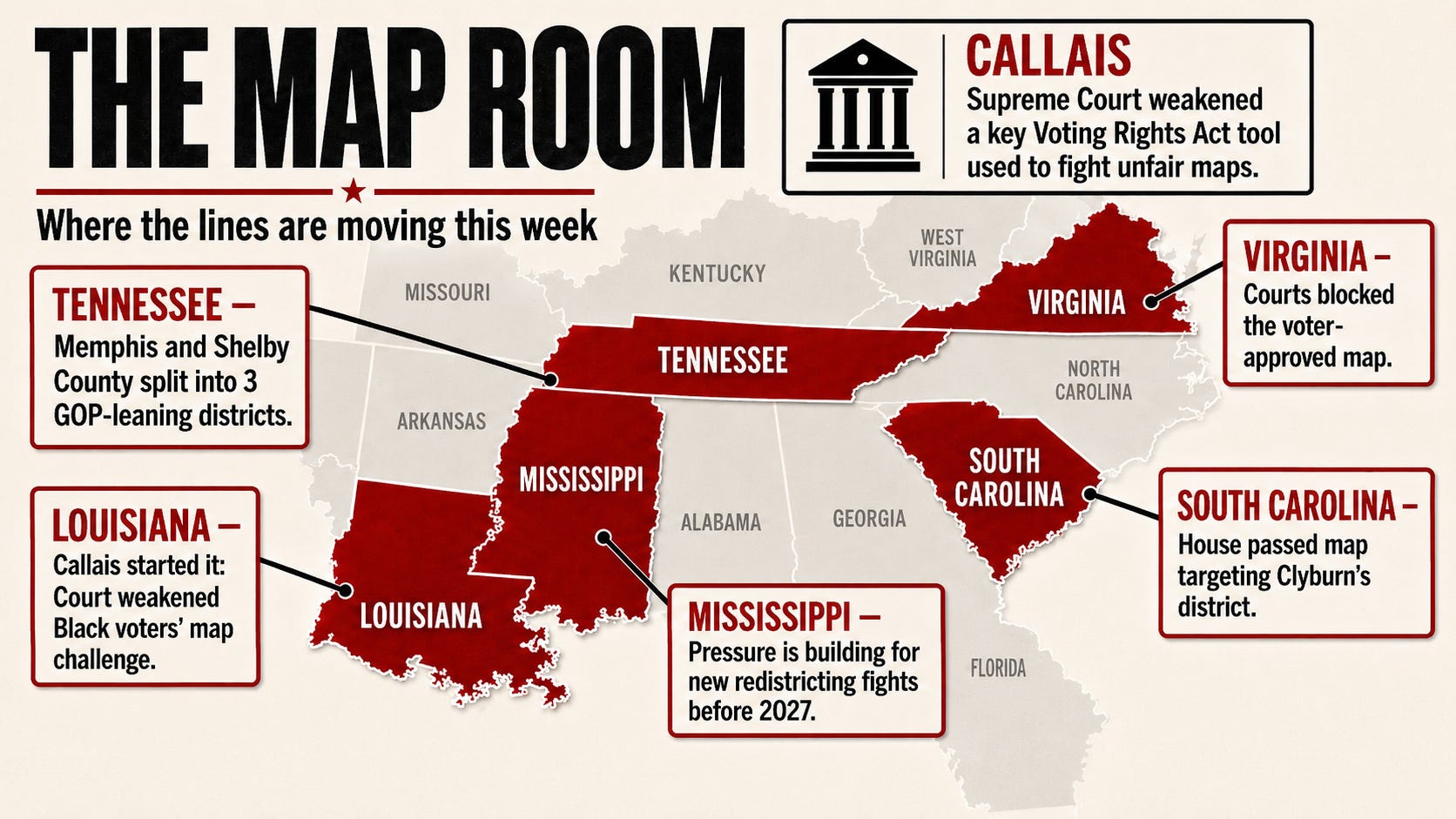
The map room is now operating under Callais. The Supreme Court weakened Section 2 protection for voters of color, and states heard the message [1]. State Court Report described the aftermath as a growing wave of litigation in state courts, especially as federal voting-rights claims become harder to win [16].
South Carolina is the week’s loudest map fight. The House passed a plan targeting Clyburn’s district, and the plan would move congressional primaries to August if it becomes law [2][3]. The Guardian’s reporting adds the missing historical geography: the district includes Black Belt farmland, the Gullah Geechee homeland, HBCUs, and poor rural communities that have long been part of South Carolina’s Black political base [4].
Tennessee is the week’s cleanest example of cracking. Shelby County, including Memphis, was split into three Republican-leaning districts, and Cohen’s exit showed how quickly a map can change the field [5].
Virginia remains the process warning. The U.S. Supreme Court refused to revive the voter-approved map, leaving in place the Virginia Supreme Court decision that blocked it [11]. News From The States reported that several Democratic candidates who launched campaigns in districts that would have existed under the proposed map ended their bids after the ruling [12]. That is how a court ruling moves into campaign reality.
Mississippi is the memory warning. The state did not finish a new map this week, but the pressure is live. Mississippi has the highest percentage of Black residents of any state, no Black statewide elected officials, and one Black member of Congress, whose seat Republicans have discussed targeting after Callais [14].
The Roll Call
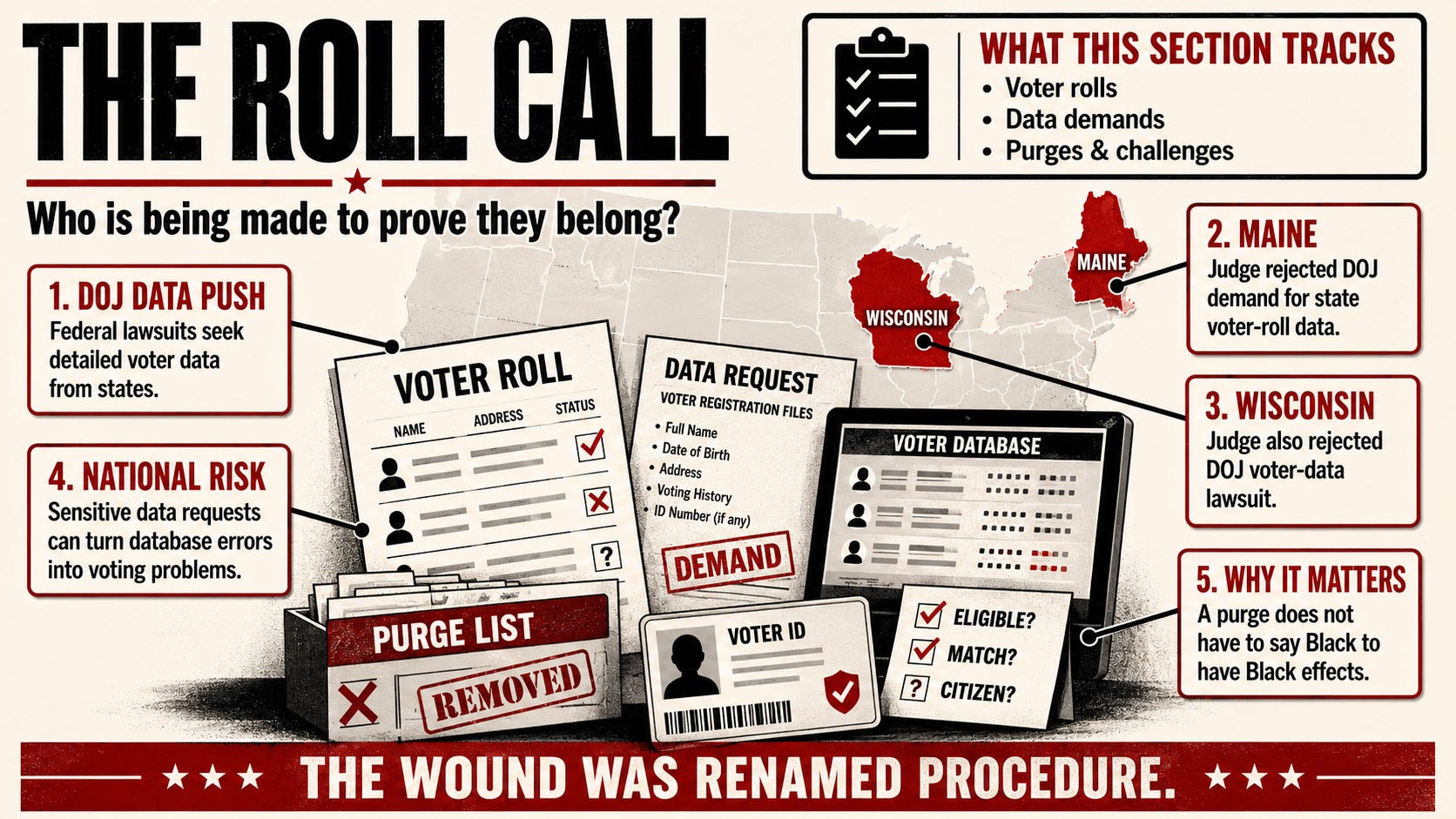
The voter-roll fight is no longer theoretical. DOJ’s lawsuits in Maine and Wisconsin were dismissed, but AP reports the department has sued at least 30 states and Washington, D.C. for detailed voter data [6]. The State Democracy Research Initiative tracker says DOJ has demanded complete voter-registration lists, including highly sensitive data such as birthdates, partial Social Security numbers, and driver’s license numbers [7].
The Brennan Center’s May roundup shows the broader climate. Between January 1 and May 1, at least nine states enacted 12 restrictive voting laws, and lawmakers in at least 41 states considered at least 302 restrictive voting bills [8]. The roundup also flagged proof-of-citizenship rules, narrower voter ID rules, voter challenges, and federal voter-roll pressure as major 2026 risks [8].
The core question is not whether voter rolls should be accurate. They should be. The core question is whether “accuracy” becomes the mask for mass challenge systems, citizenship fishing expeditions, and database traps.
Who is being made to prove they belong?
That is the roll-call question.
The Ballot Access Desk
Wisconsin gave the cleanest ballot-access lesson of the week. Madison voters submitted 23 absentee ballots on time. The office delayed delivery. Then the state commission said the ballots should not count. A judge reversed that and ordered the ballots counted [9].
That is the wound in plain English. The voter did not fail the system. The system almost failed the voter.
The Brennan Center also warned that several states are narrowing acceptable ID, adding proof-of-citizenship requirements, or expanding voter challenges. Those changes can hit hardest when voters lack transportation, updated documents, flexible work hours, legal help, or time to fix a problem [8].
The South Carolina map bill also belongs in the Ballot Access Desk because it would discard some already-cast congressional absentee and overseas military ballots if the new primary structure becomes law [3]. That is not just a map issue. That is the state saying a ballot cast under yesterday’s rules may not survive tomorrow’s power move.
The Week Ahead
South Carolina Senate: The House-passed map still needs Senate approval. If enacted, it would delay U.S. House primaries from June 9 to August 18 [2][3].
May 26: South Carolina early primary voting was scheduled to begin under the existing calendar, which shows how close the redistricting push is to actual voting [3].
Alabama: AP reported that Alabama plans to void results in four U.S. House districts and hold special primaries on August 11 under different boundaries [3].
Tennessee: Litigation over the Memphis-splitting map continues, including challenges to whether lawmakers had authority to change the redistricting rules during the special session [16].
DOJ voter data: Maine and Wisconsin are new losses for DOJ, but the broader voter-roll litigation campaign remains active [6][7].
Mississippi: Voting-rights groups are using the Jackson rally and NAACP organizing to keep pressure on state officials as redistricting remains possible before 2027 [14][19].
State legislatures: The Brennan Center’s May roundup shows restrictive and expansive voting-law fights are still moving through the 2026 cycle [8].
Closing Note
The bridge does not get pulled up all at once. Sometimes it is taken apart by a court opinion, a House map, a voter-roll demand, a clerk error, a primary delay, and a polite sentence about procedure.
This week’s pattern is simple. Black political power is being treated as a map problem, a voter-roll problem, a mail-ballot problem, and a public-university problem.
But Black civic power is answering in the old language and the new one. Church. Court. Street. Campus. Stadium. Lawsuit. Ballot.
Voting power is not only stolen at the ballot box. It is stolen before the voter ever gets there.
Support XVOA
If this desk matters, support it with a paid subscription. The work is not just reading headlines. It is tracing the machinery before the damage gets renamed procedure. Paid subscriptions help keep Voting Rights Watch Weekly going.
If a subscription is not possible today, coffee is the backstop: Buy Me a Coffee.
Sources
NAACP Legal Defense Fund, Louisiana v. Callais - Explains the Supreme Court’s Callais ruling and its impact on Section 2 of the Voting Rights Act and Black political representation.
Reuters, South Carolina lawmakers advance U.S. House map targeting powerful Democrat Clyburn - Reports the South Carolina House map, the proposed August 18 primary date, and lawmakers’ arguments over Black political power.
Associated Press, South Carolina House backs congressional map favoring GOP but bill faces a more skeptical Senate - Details the South Carolina House vote, primary delay, discarded absentee ballots, and related Southern redistricting moves.
The Guardian, ‘Jim Crow 2.0’: Republicans move to oust James Clyburn, South Carolina’s only Black Democratic congressman - Provides historical and geographic context for Clyburn’s district, including Black Belt, Gullah Geechee, and HBCU stakes.
Reuters, Democratic U.S. Representative Cohen won’t seek reelection in redrawn Tennessee district - Reports Cohen’s retirement decision after Tennessee split Shelby County and weakened the Memphis-based majority-Black district.
Associated Press, Judges in Maine and Wisconsin reject DOJ efforts to obtain voter rolls - Reports federal court dismissals of DOJ lawsuits seeking detailed voter data from Maine and Wisconsin.
State Democracy Research Initiative, Tracker: DOJ Lawsuits Seeking States’ Sensitive Voter Data - Tracks DOJ lawsuits and requests for sensitive state voter-registration data.
Brennan Center for Justice, State Voting Laws Roundup: May 2026 - Summarizes 2026 restrictive and expansive voting laws, voter ID changes, proof-of-citizenship rules, voter challenges, and federal voter-roll pressure.
Wisconsin Public Radio, 23 Madison absentee ballots must be counted after all, judge rules - Reports the Dane County order requiring Madison to count 23 absentee ballots delayed by clerk-office error.
Votebeat, The Supreme Court’s voting rights decision could reshape local government across Texas - Explains how Callais could affect city council, county, and school board representation in Texas.
Reuters, U.S. Supreme Court rebuffs Virginia Democrats in bid for new voting map - Reports the Supreme Court’s refusal to revive Virginia’s voter-approved congressional map.
News From The States, U.S. Supreme Court decision ends Virginia’s redistricting fight, reshapes 2026 races - Details how the Virginia ruling reshaped 2026 campaigns.
The Guardian, ‘They may draw racist maps, but we are the South’: thousands rally in Alabama for Black voting rights - Reports the Montgomery voting-rights rally and Black civic response after Callais.
The Guardian, ‘We will not go back to Jim Crow’: thousands rally in Mississippi for voting rights - Reports the Jackson voting-rights rally, Mississippi’s Black political stakes, and the historical connection to the 1890 Mississippi Plan.
Associated Press, NAACP urges Black athletes to boycott college sports in the South - Reports the NAACP and Congressional Black Caucus “Out of Bounds” campaign and its connection to Black voting representation.
State Court Report, Redistricting Litigation Heats Up - Tracks post-Callais litigation in state courts, including Tennessee and Louisiana.
National Conference of State Legislatures, Changing the Maps: Tracking Mid-Decade Redistricting - Provides a national tracker of mid-decade redistricting developments.
National Catholic Reporter, Black clergy strategize, preach and urge election turnout after Voting Rights Act gutting- Reports Black clergy organizing, church-based voter registration hubs, and Souls to the Polls plans after Callais.
NAACP, Mississippi Fights Back Rally - Documents the May 20 Mississippi rally and NAACP framing around Black political power after Callais.
Campaign Legal Center, Redistricting 101 and the Fight for Fair Representation After Callais - Provides a plain-language explainer on redistricting, Callais, and fair representation after the Supreme Court ruling.
If a subscription is too much right now I get it. Just buy me coffee:
Here we are: Jim Crow 2.0. I’ll give Republicans this much — they did their homework. They built a narrative machine designed to destroy trust in professionals, scientists, institutions, and anyone once considered a credible authority. At the same time, they keep the public chasing a revolving cast of boogeymen to distract from the real issues.
Who’s next in the blame game while the actual problems keep getting worse?
What worries me most is that Democrats don’t seem prepared to meet this moment. No clear message. No real urgency. No strong new leadership emerging. And that leaves people asking: where exactly are we supposed to turn?
I don’t have much faith the Democrats can turn this ship around in its current form. At the very least, they should be relentlessly connecting the dots between the Trump administration, corruption, and the economy — because economic pain is where everyday Americans actually feel the consequences.
I keep hoping this chaos is the beginning of the end for the old political order. Maybe what comes next is a new generation of leadership — even within the same two-party system — but with new blood, real courage, and people willing to actually clean out the proverbial swamp instead of campaigning on it every four years.