

I saw a 1972 Corvette convertible drive by. I saw me. I saw us. Sophisticated and refined on the outside. Still easy on the eyes even in its old age. On the inside, it’s a whole different story. A carburetor sitting on top of a pushrod V8. Take the small-block version and that engine family goes back to the 1955 Chevy. A ten-year-old could understand it.[1]
I’m driving the equivalent of that Corvette, and I’m chasing after the editor who greenlit this shit.
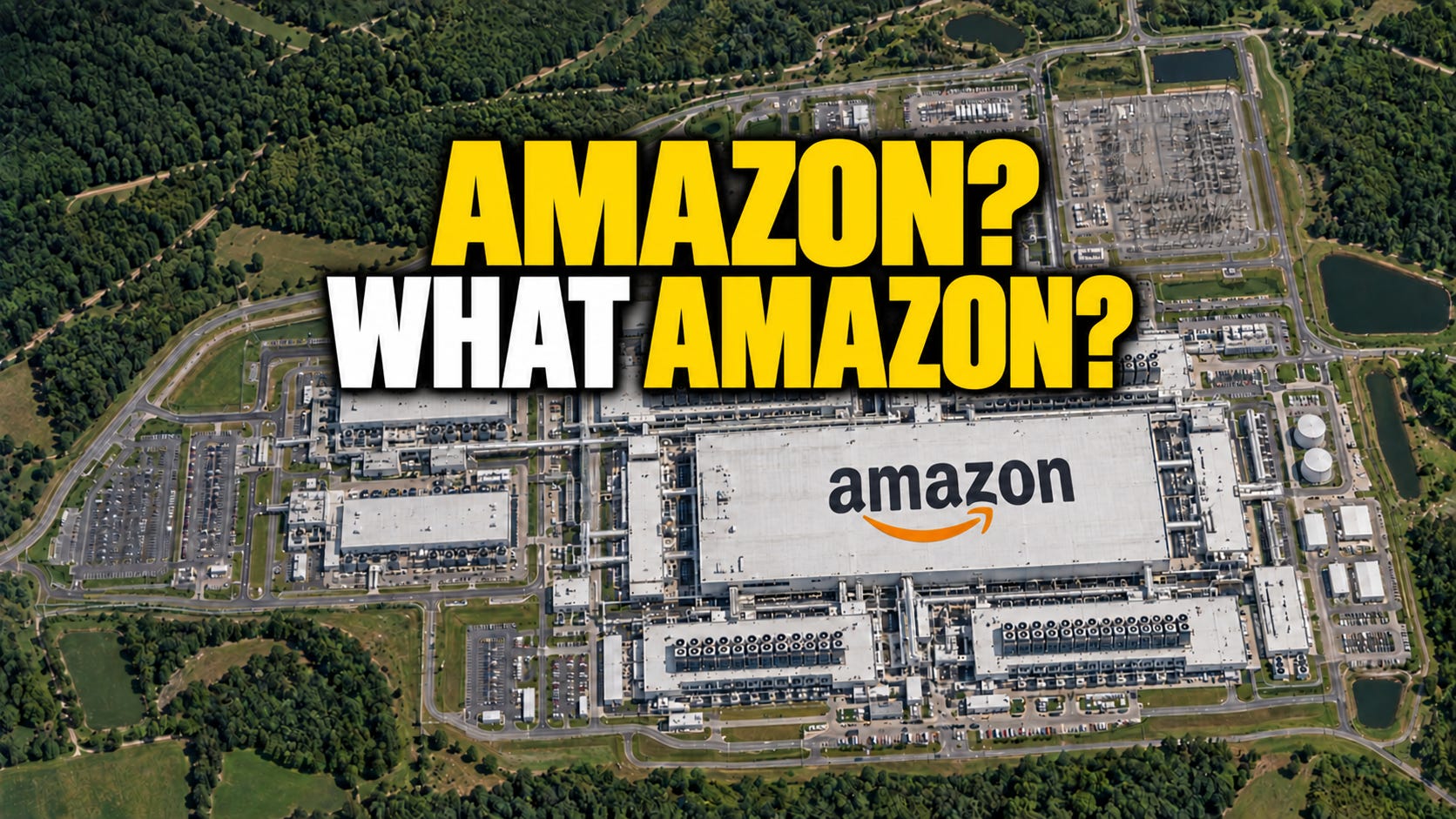
The Washington Post reports on data centers reshaping the landscape. Musk gets named. Meta gets named. Amazon gets no mention in the narrative.[2] Meanwhile, the man who owns the newspaper, Jeff Bezos, is Amazon’s founder and executive chair. Amazon has a whole data-center business.[3][4] You would think that might deserve a sentence.
Just one simple disclosure would have held off my wrath. Now I’m obliged to pull off the gloves and come at you directly, WashPost.
No video to edit. No transcript to adapt for readers who aren’t here for the flash and splash of video. No chasing this thing through a never-ending house of mirrors of timelines, pics and talking heads. We can do this right here.
Oh, you think I’m coming after you, Kevin Schaul? Relax, bruh. I’m picturing you back on Slack, still smiling at your chief editor while you restrain what you really want to say to him. Go ahead. Keep smiling. I’m gone do it for you, Kevin.
TLDR
The Post’s written narrative names Musk and Meta without naming Amazon or disclosing Bezos’s ownership. That leaves readers to supply a rather relevant connection themselves.[2][3]
Amazon announced another $15 billion in Indiana data centers, following an earlier $11 billion commitment. We are discussing a company with $26 billion in announced commitments in one state.[4]
The Post has disclosed Bezos’s ownership before. The sentence is available. Apparently, somebody needs help finding it.[5]
Restack this so the disclosure gets a little more circulation than the omission.
Such powerful satellite imagery
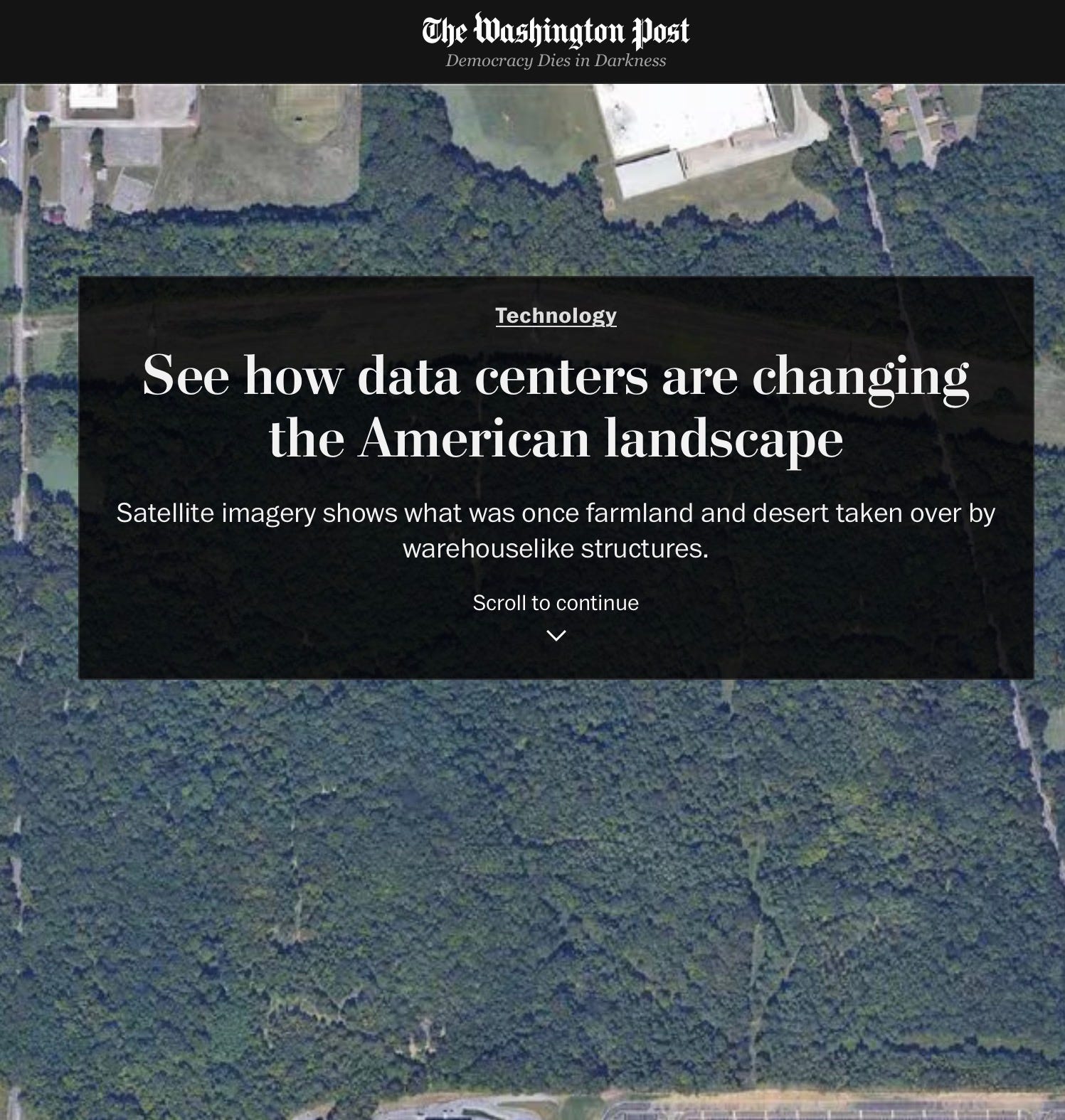
The piece opens with an appropriately enormous claim: “America’s landscape is undergoing one of the largest transformations in decades.”[2] We get satellite imagery. We get scale. We get the chance to watch the ground change beneath all that talk about the cloud.
There is useful reporting here. People deserve to see the physical footprint of infrastructure usually advertised through words like intelligence and innovation. The dirt has to go somewhere. So does the equipment.
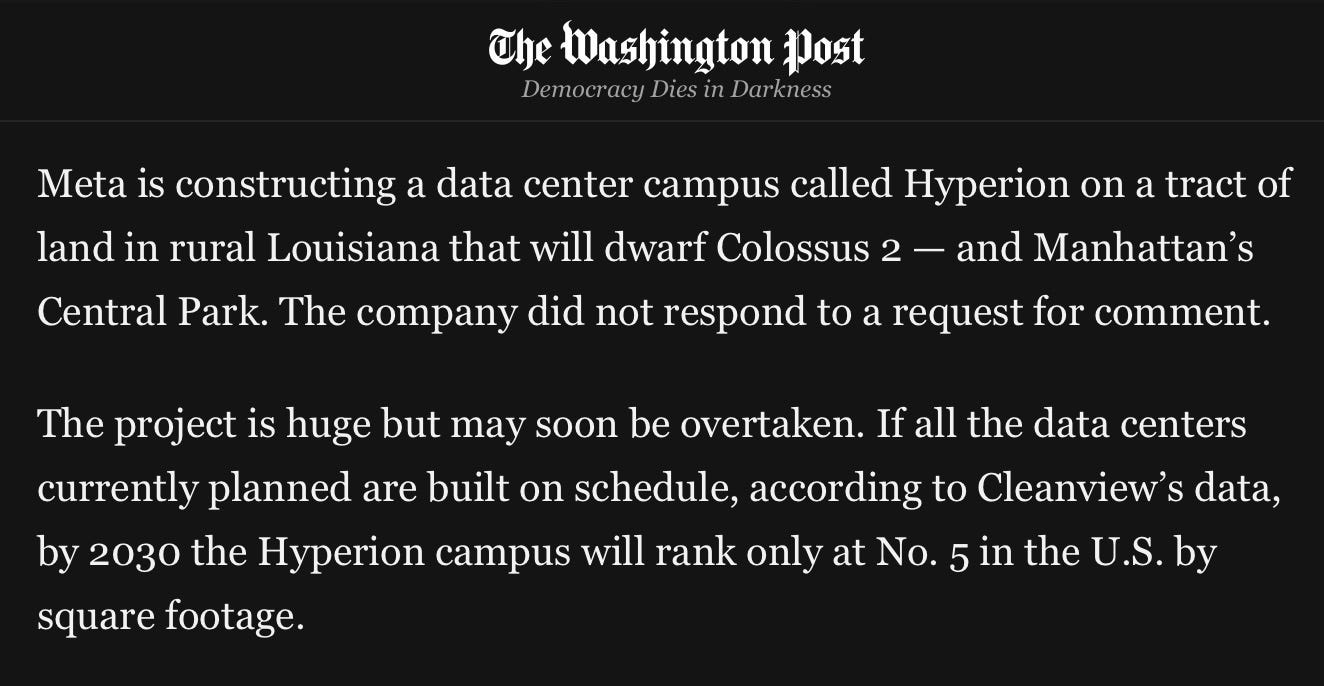
Then comes this: “Meta is constructing a data center campus called Hyperion on a tract of land in rural Louisiana that will dwarf Colossus 2 — and Manhattan’s Central Park.” Immediately afterward: “The company did not respond to a request for comment.”[2]
Beautiful. A named company. A named project. A memorable comparison. An opportunity to answer. The machinery of journalism appears to be running.
And then we arrive at Amazon, by which I mean we don’t.
Somewhere in the editorial process, this needed the church mother pause. Glasses lowered. Silence long enough for everybody to reconsider what they just said. “Now, you know better.”
Allow me to introduce you to Amazon
C’mon man.
Amazon. The company with a cloud business called Amazon Web Services. AWS. Those three letters should not require an archaeological expedition at the newspaper owned by Amazon’s founder.[3][4]
For a little perspective, Amazon announced an additional $15 billion for data-center campuses in northern Indiana. That followed an earlier $11 billion commitment in the same state.[4] These are announced investments, so let’s keep the accounting straight. They also give us twenty-six billion reasons to consider whether Amazon belongs in this conversation.
Perhaps the editor thought Amazon was a small local operation. A fellow named Jeff selling used paperbacks out of a garage, hoping this internet thing catches on.
I’m being precise about what’s missing: Amazon isn’t named in this written piece. I’m not claiming to have identified the operator of every building in every satellite image. A building’s possible appearance somewhere in the imagery would still leave the reader without the ownership disclosure.
A story cannot name every company. Fine. But when your owner founded and chairs a major company in the industry you’re covering, you owe readers a disclosure.
This is what makes the omission feel like such a gross fucking troll. The paper is inviting us to inspect everybody else’s landscape while stepping around its own backyard.
Eight words. Was that so damn hard?
April 13, 2026. Same newspaper:
“Amazon founder Jeff Bezos owns The Washington Post.”[5]
Eight words. I went ahead and counted them because apparently we’re dealing with a production challenge that requires outside assistance.
What happened? Did the parentheses go down? Was there a ticket? Is somebody in IT explaining that the disclosure module won’t be available until Thursday?
The paper has already demonstrated the ability to tell readers this. The sentence exists. It has survived contact with a publishing system. We can retire the possibility that ownership disclosure requires a technology humanity has yet to invent.
And the standard is modest. Put the relationship where the reader can see it, at the moment the relationship matters. Let us decide what weight to give it.
Readers shouldn’t have to maintain a billionaire family tree beside the morning coffee. You know who signs the checks. We deserve the relevant information without having to crawl underneath the masthead with a flashlight.
You could have handled this in eight words. Now we’re out here counting them like somebody shorted the collection plate.
What next, an investigation into billionaire newspaper owners?
This would make a helluva follow-up.
A major American newspaper examines whether a billionaire’s ownership affects what the public gets to read. There could be charts. Perhaps an interactive graphic showing how close the publisher’s office is to the place where everyone insists editorial independence lives.
Sources should be easy to locate.
In February 2025, Bezos directed the Post’s opinion section to support “personal liberties and free markets,” saying “viewpoints opposing those pillars will be left to be published by others.”[6]
That instruction concerned the opinion section. It doesn’t establish what happened with Schaul’s news article. It does make a reader’s question about ownership a fairly reasonable one.
The owner publicly gave an editorial direction. We are allowed to remember it when assessing the institution. Memory remains available to people without a newsroom login.
WashPost, Musk gets named. Meta gets named. Amazon gets the witness protection program. Stop the cap. Put the fucking disclosure in the story.
So yes, WashPost, commission the billionaire-owner story. Name names. Explain the arrangements. Quote the owner’s instructions. Ask who benefits when readers have to discover relevant relationships on their own.
You’ve already got a promising local source.
We can still read the machinery
The insult here is the assumption built into the finished product which is that readers can be trusted to appreciate an elaborate visual presentation while supplying the inconvenient context themselves.
We notice who gets a name. We notice who gets a request for comment. We notice when a newspaper’s own relationship to the subject somehow fails to make the trip into the copy.
C’mon. You brought satellites to a story and left us to find the man who owns the paper.
That Corvette is still in my head. Beautiful bodywork. Decades of polish. Lift the hood and the machinery remains understandable.
The public can read the machinery, too. We can recognize a relevant financial relationship. We can ask why it wasn’t disclosed. And we can expect an answer from the editor who approved the piece.
Kevin, keep smiling if you need to.
I’m already under the hood.
About that darkness
Democracy dies in darkness, WashPost? Then quit making the public hunt for the light switch.[2]
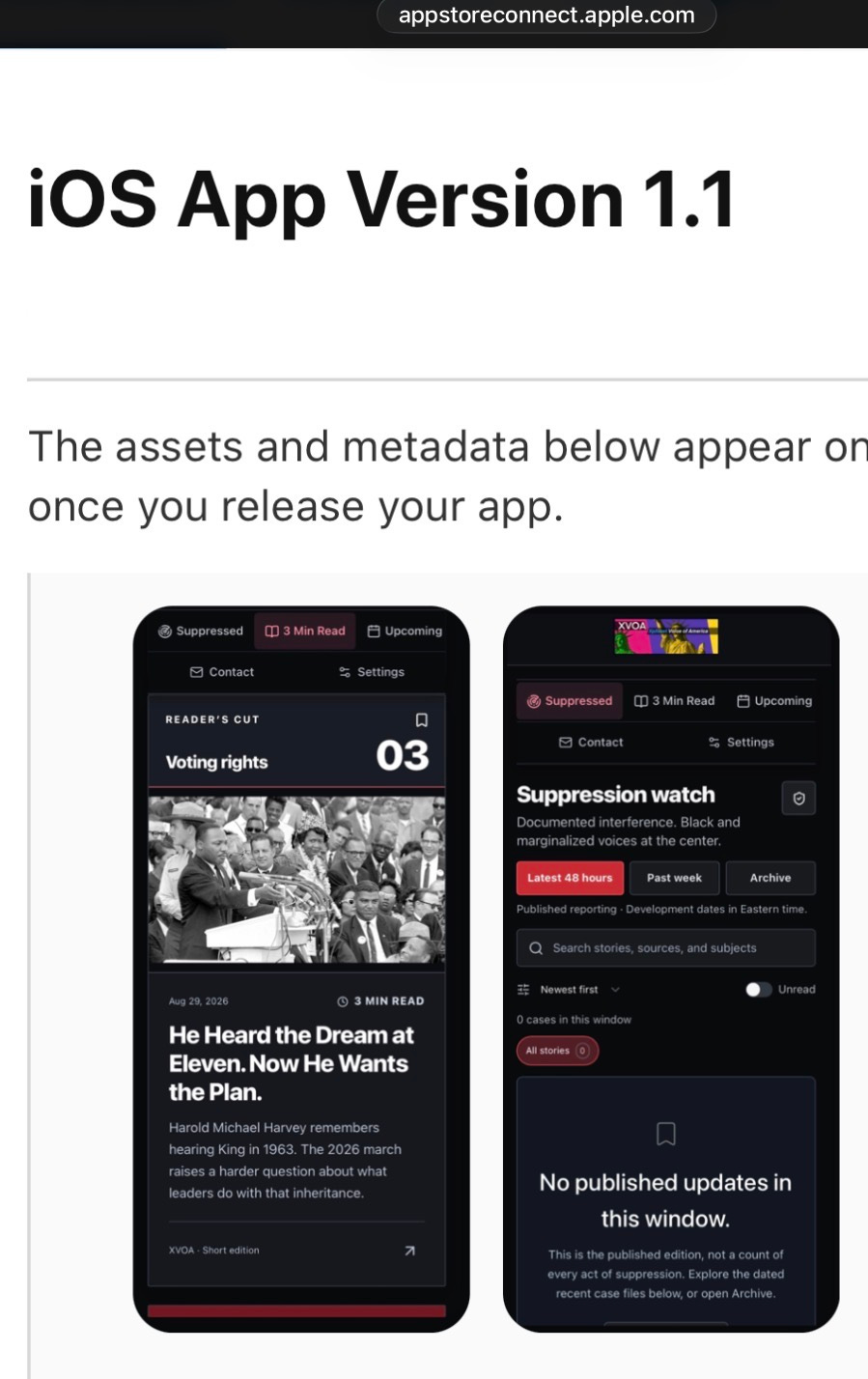
SUPPRESSED NEWS. That’s why I built the XVOA app. A dedicated feed, exclusive to the app, for stories people in power have tried to bury. You get the reporting and the sources to examine the evidence yourself.
Reader support is helping build a weapon against darkness you can carry in your pocket. The app is in beta, with three-minute reads, alerts, and another route for XVOA to reach you if Substack becomes unavailable.
Become a paid XVOA subscriber to help finance the reporting and the app.
For one-time support, there’s Buy Me a Coffee.
P.S. Already a paid subscriber and want to help beta test? Reply in the comments with BETA, and I’ll send the invitation details.