


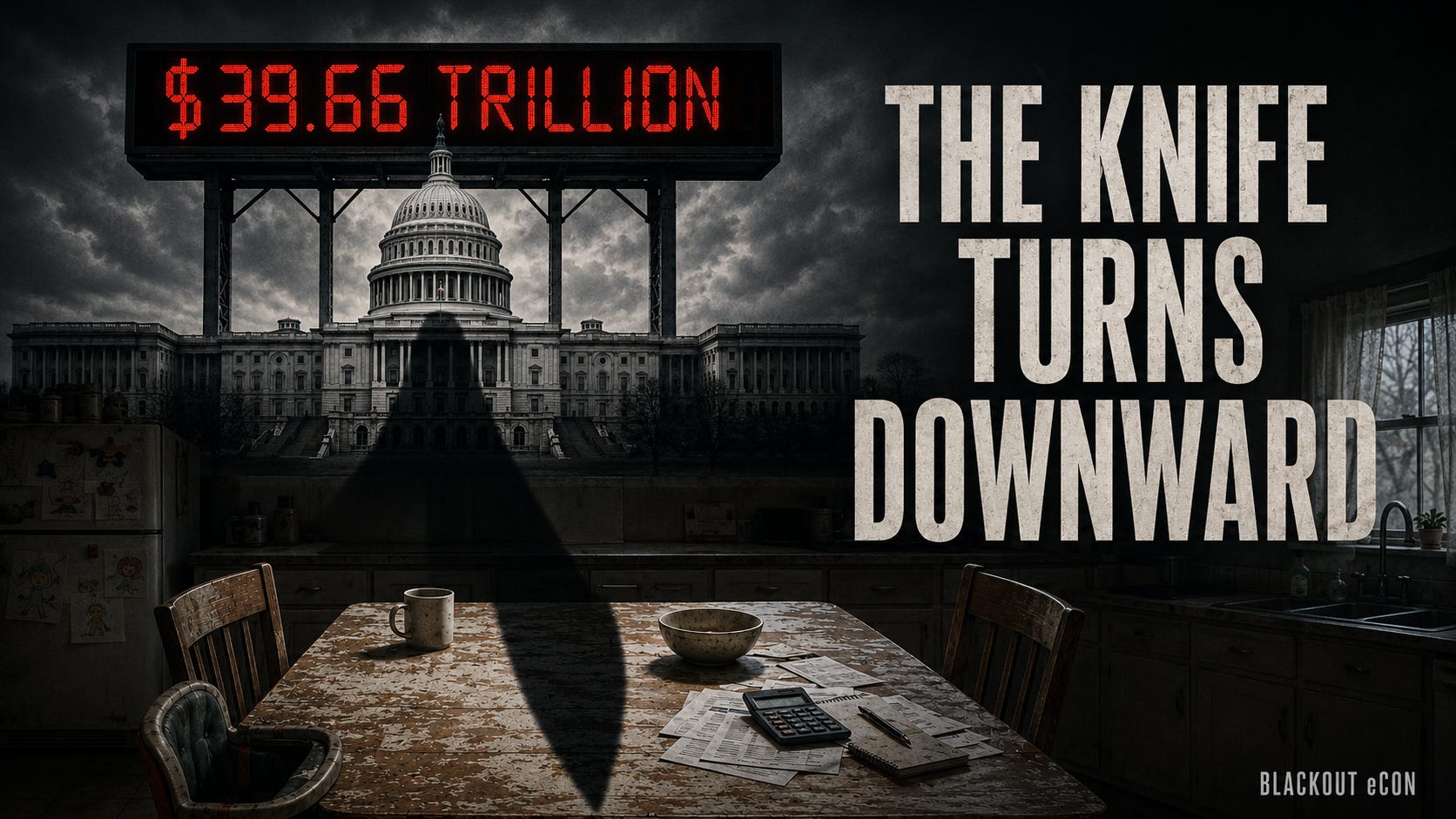
BLACKOUT eCON | PAID REPORT | JULY 22, 2026
I was twelve years old when the national debt got inside my head.
Debt at twelve might mean somebody owes your mother five dollars, or you borrowed lunch money and now the whole afternoon feels morally complicated. I mean the debt. The national debt. That running American number that would appear on television or in newspapers during the Reagan years, all those commas marching across the screen as if the country had discovered a new kind of mathematics.
Two trillion dollars, more or less. The exact fiscal year-end number in 1986 was $2.13 trillion, but what did “trillion” mean to a child? Million already sounded impossible. Billion sounded like outer space. Trillion sounded like adults had made up another word because the old words could no longer hold what they were doing. [2]
I would stare at that number and start asking questions nobody around me seemed especially troubled by. Would we pay it off? Was there a plan? Was some president going to stand at a podium one day and announce that America had finally mailed the last check? Or would it keep going up forever? Could it keep going up forever? What happened if it reached ten trillion? A hundred trillion? Did somebody come collect? Did the lights go out? Did the country belong to whoever held the paper?
I was twelve. I assumed the adults knew where this ended.
Memory is slippery here. I can still see glowing numbers, but that may be television, a newspaper illustration and later images of the famous Times Square debt clock all collapsed into one room in my head. What I know is that the number was already a character in American political life, and I was already trying to imagine meeting it in the future.
Well ladies and gentlemen. Here we are.
Forty years later, the gross federal debt is $39.66 trillion. The twelve-year-old kid in me wants to say, So nobody stopped it? Nobody found the plan? We just kept adding commas? The adult in me finally understands that I was asking the wrong question. [1]
The important question was never simply whether America would repay the debt.
The important question was: Who was Washington willing to borrow for, and who would Washington make pay when that borrowing became expensive?
Washington kept spending beyond its revenue, year after year, through changing administrations and changing priorities. Those annual deficits accumulated into the debt on the counter. [3]
Now the 30-year Treasury yield is 5.15 percent, and fiscal 2025 net-interest outlays exceeded national-defense outlays by $53.7 billion. [4][9]
That is when Washington reaches for the word that makes political choices sound like weather.
Sacrifice.
The boy staring at the counter finally has his answer. The counter kept climbing. The powerful kept setting the priorities. When the bill became more expensive, the knife turned downward.
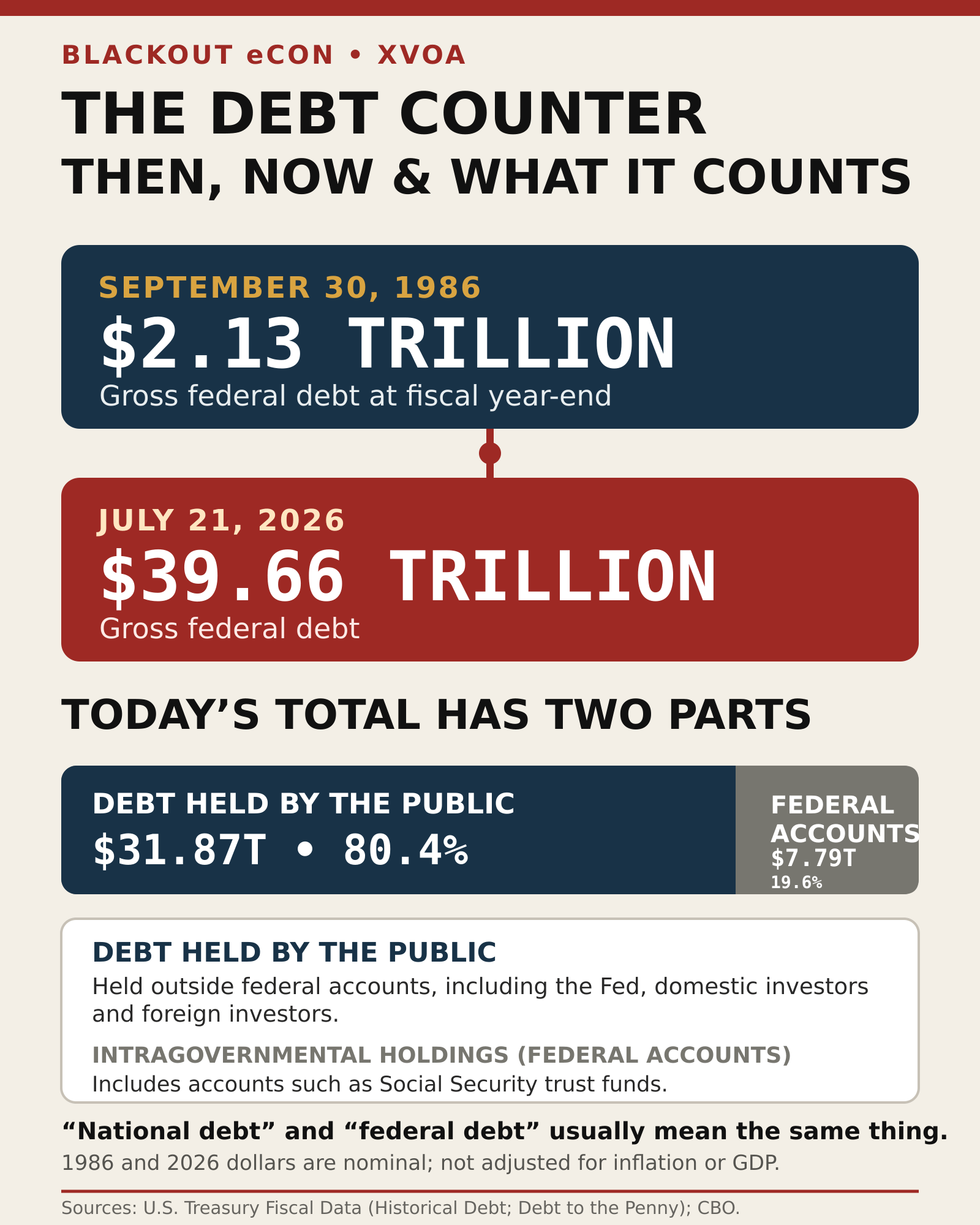
This report starts with the debt counter, but it is not a panic story about a magic number or a prediction that 2007 is about to happen again. Buyers have not abandoned Treasury debt. America has not received a $39.66 trillion invoice due tomorrow morning. [1][3][7]
The danger is slower, more ordinary and more political.
New federal borrowing remains expensive. As securities mature, some are being refinanced at rates higher than those they replace. That pushes interest costs higher over time. Then the people who protected the borrowing choices announce that there is no room left for care, housing, public employment, education or household security. [3][4][8]
This Blackout eCon audit follows the wider high-rate environment from a 5.15 percent long-bond signal through federal and local budgets, mortgage costs, public workplaces and Black households with less wealth available to absorb another emergency.
