


My earliest memory of Saturday Night Live goes back to when I was about five years old, sitting there watching Chevy Chase fall down all over the stage like a grown man had declared war on his own balance. I did not know anything about satire. I did not know anything about media criticism. I just knew something in me lit up watching an adult make public foolishness look like a form of truth-telling.
That memory came back to me the other night.
Colin Jost came out on Saturday Night Live this weekend dressed as Pete Hegseth, standing behind a podium, brushing off the Iran conflict with a line that should not have made more sense than a week of official language, but did: “This isn’t a war, it’s a situationship.” [1]
And just like that, I was back in that old feeling. Watching somebody fall down in public. Only this time the public screwup was not physical. It was political. It was military. It was the United States government eating carpet in front of the whole world while much of the press still searched for a more tasteful verb.
That is the whole problem in one punchline.
A lot of Americans, especially younger ones, no longer expect mainstream media to tell the truth straight when power is involved. They expect stagecraft. They expect throat-clearing. They expect the anchor face, the serious music, the polished lower-third, the careful verbs, the verbal bubble wrap. They expect a story to be handled, not told.
So they went looking somewhere else.
Not because comedians are more factual by nature. Not because jokes are inherently nobler than reporting. But because comedy, at least the good kind, admits that it is performing. And once mainstream news started performing neutrality so hard that it could barely sound human, a lot of people decided the lie told on purpose felt truer than the lie told in a necktie.
TLDR
A fake Pentagon-style press conference on Saturday Night Live managed to say the quiet part out loud faster than a week of sober, respectable coverage: “This isn’t a war, it’s a situationship.” That joke landed because it translated euphemism into emotional truth. [1]
This did not come out of nowhere. Young Americans have been using comedy as a political decoder for decades, from S.N.L. to The Daily Show to The Colbert Report. [7][8][9]
Meanwhile, trust in mainstream media has eroded, especially among younger adults, while podcasts, social video, and influencers have taken a larger share of the public’s news diet. [2][3][4][5][6][12]
The upside is that satire can wake people up. The downside is that it can train people to trust charisma over institutions, which is how a truth tool can slowly become just another stage. [10][11]
If this is helping you name what has happened to the news, restack it and pass it to one person who still thinks this shift was accidental.
If you want to help me keep doing this kind of work, go paid at
And if you are not looking for another subscription but still want to put something on the engine, hit the coffee jar and keep this newsroom breathing a little longer.
Picasso saw this coming before cable did
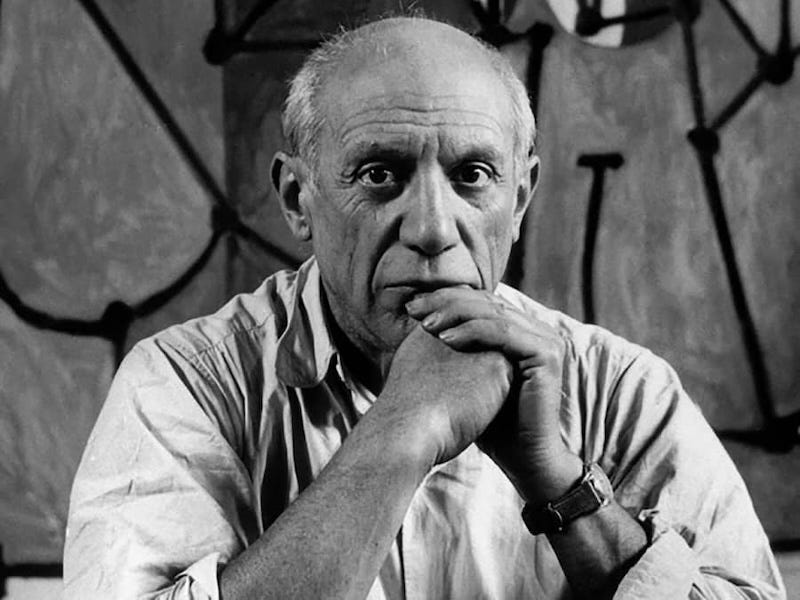
Picasso is supposed to have said, “Art is a lie that makes us realize truth.” [10]
That line matters here because satire works by exaggerating the mask until the mask becomes visible. It does not pretend to be raw reality. It bends reality so you can finally see the shape of the thing standing in front of you. That is what the Hegseth sketch did. The official language around war is always trying to deodorize the body. It wants you to hear “operation,” “response,” “kinetic action,” “de-escalation.” The joke translates all that into plain English: this is violence without accountability, commitment without honesty, branding without adulthood. [1]
That is why the joke hit.
It did what too much mainstream coverage now refuses to do. It named the feeling in the room.
And once you understand that, the larger arc comes into focus. Americans did not suddenly become unserious. They became suspicious. They started sensing that the people paid to tell them what was happening were often more committed to ritual than revelation.
Young people did not abandon the news. The news abandoned them first.
That part matters.
The lazy version of this story says young people got distracted, got ironic, got lazy, got poisoned by the internet, and wandered away from the anchor desk because they wanted entertainment. That is the boomer bedtime story. It lets institutions off the hook.
The harder truth is that the handoff began a long time ago. Back in 2004, Pew was already finding that one in five young people regularly got campaign news from late-night comedy programs, including Saturday Night Live and The Daily Show. [7] That is not a cute side note. That is an early warning light on the dashboard.
Then came the Stewart-Colbert era, which formalized something huge. The Daily Show and later The Colbert Reportbecame places where the audience could watch politics, media, and power get decoded in real time. Pew’s 2008 analysis of The Daily Show made the paradox plain: Jon Stewart insisted he was not doing journalism, and strictly speaking he was right. The show was selective, stylized, and openly satirical. [8] But that was also why it felt more honest to a lot of viewers. It was not pretending to float above the fray like some priest of objectivity descending from a cloud of pure reason. It was saying, plainly, these people are acting. Watch them act.


By 2010, Pew was showing that the audience for The Daily Show and The Colbert Report skewed younger, more liberal, and more skeptical of the mainstream press. [8] By 2014, Pew was reporting that some Americans, especially younger men, did not just watch The Colbert Report for laughs. They trusted it as a source of political news. [9]
That is the handoff right there.
Not from truth to comedy. From one kind of performance to another.
The network desk still wanted to act like naming a lie too directly was somehow rude, partisan, or unprofessional. Comedy, meanwhile, had no such manners. And once a generation got used to hearing politics translated through wit, timing, ridicule, and emotional clarity, it became very hard to go back to the sterile language of the respectable press.


Then the joke left television and put on headphones
This is where the story gets darker.
Because the comedy-to-news pipeline did not stop with late-night TV. It migrated. First into prestige satire. Then into podcasts. Then into streamers. Then into news influencers. Then into that weird algorithmic swamp where a guy in a hoodie, a mic, and a ring light can become a larger part of the public’s civic education than a newsroom that used to have foreign bureaus.
Again, there are receipts.
Gallup reported in 2025 that trust in mass media had fallen to 28 percent, a record low. [2] Pew’s 2025 work showed that adults ages 18 to 29 were about as likely to trust information from social media as they were to trust information from national news organizations. [3] Pew’s 2026 analysis found a sharp difference in the way younger and older Americans encounter news: younger adults tend to come across it passively, while older Americans are more likely to go looking for it on purpose. [4]
That one matters more than it sounds like it does.
Because if news becomes something you “happen to come across,” then the platform matters as much as the reporting. The setting matters. The vibe matters. The voice matters. The host matters. The format matters. In other words, performance matters.
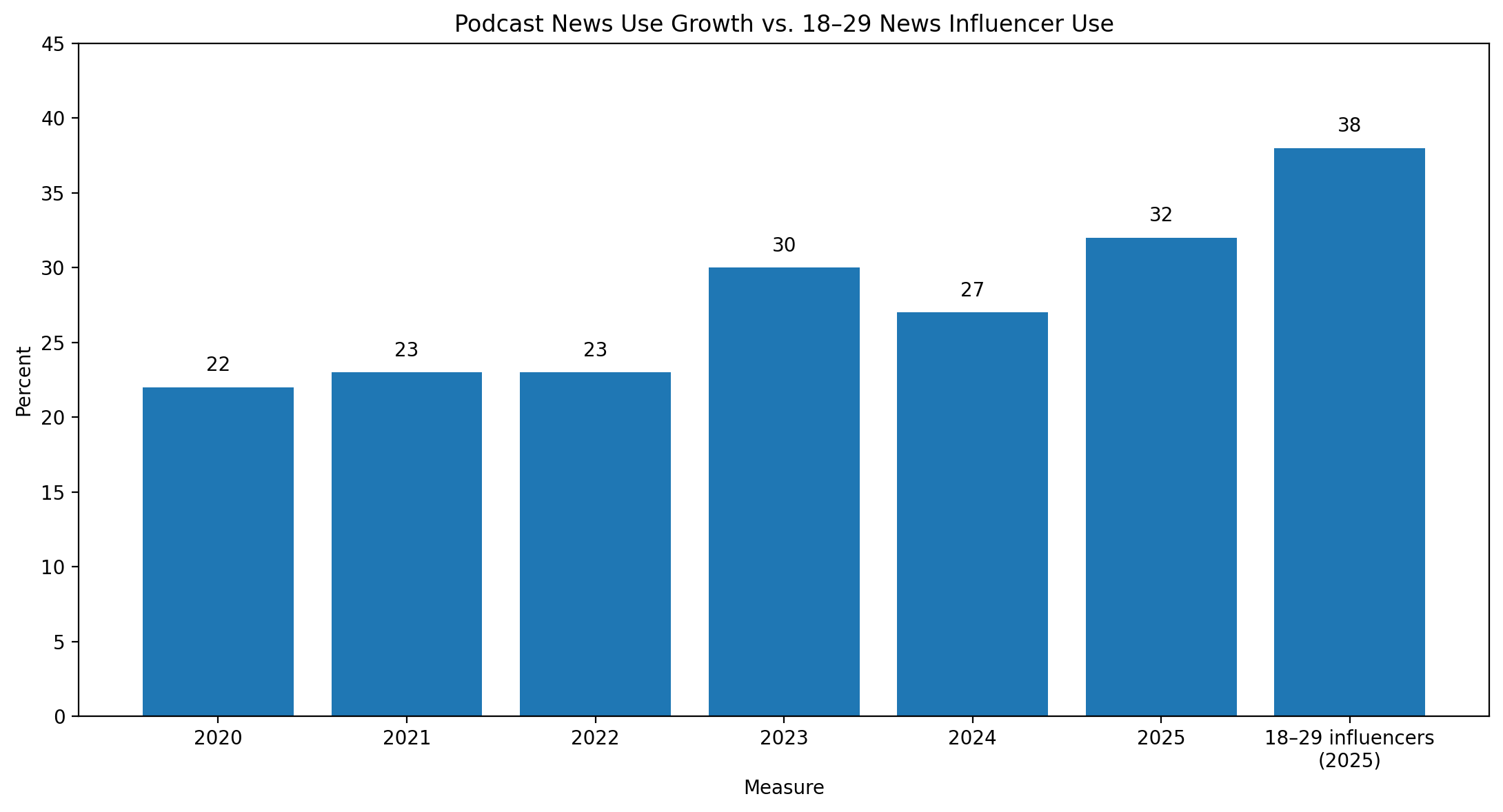
Pew also found that about a third of U.S. adults now get news from podcasts at least sometimes, and younger adults do so at higher rates. [5] Another Pew fact sheet found that 21 percent of U.S. adults regularly get news from news influencers on social media, including 38 percent of adults ages 18 to 29. [6] Reuters reported that in the week after the January 2025 inauguration, more Americans said they got news from social and video platforms than from television or news sites for the first time, and more than half of people under 35 were relying on those platforms as their main source of news. [12]
That right there is a psychological shift.
The news is no longer merely something delivered by an institution. It is increasingly embodied by a person.
And once news gets embodied by a person, that person’s charisma starts carrying evidentiary weight it does not deserve.

The real villain here is not comedy
The villain is cowardice.
Or, if you want the academic version, defensive objectivity.
Gaye Tuchman called objectivity a “strategic ritual,” a professional shield that protects journalists from backlash. [11] Jay Rosen later took a flamethrower to the same problem with his critique of the “view from nowhere,” that familiar pose where news organizations try to sound authoritative by pretending they themselves have no angle, no location, no stake, no blood pressure, no pulse. [11]
And maybe that sounded noble once. Maybe. But over time it curdled into something weaker.
When one side is lying, and the other side is describing the lie as a “controversial claim,” the audience notices. When one side is escalating a war, and the other side is still playing grammar games over what to call it, the audience notices. When newsrooms begin to fear clarity because clarity might look like bias to bad-faith actors, the audience notices that too.
That is how cowardice works in modern media. Not usually through outright fabrication. Through euphemism. Through flattening. Through tone-policing reality. Through treating moral clarity like a breach of decorum.
Satire rose in that vacuum because satire was willing to say, in effect, everybody hush for a second, this is insane.
It did not replace journalism because it was more rigorous. It became culturally necessary because journalism stopped sounding alive in the presence of power.
But let’s not get high off our own punchlines
There is a price to all this.
Satire can wake people up. It can make the violation legible. It can get politically inattentive people to pay attention. [8] It can say in one line what a cautious article takes twelve paragraphs to tiptoe around. It can give exhausted people a way back into public life when standard coverage feels like a legal deposition read by a sleeping robot.
But satire can also breed a corrosive kind of superiority. A permanent smirk. A habit of seeing through everything and believing in nothing. Research on The Daily Show years ago already pointed to the risk that satirical political content could increase cynicism, including cynicism toward the news media itself. [8]
That is the catch.
Skepticism can protect you. Cynicism can hollow you out.
And once a culture learns to sort truth through performance, once it gets used to trusting timing, confidence, style, cadence, humor, and vibe, it also becomes vulnerable to performers who have no real loyalty to truth at all. That is how the corrective can become the disease. That is how the translator can become the new priest. That is how a generation fleeing one stage winds up living inside another one.
So yes, comedy helped expose the lie.
But it also trained the public to trust whoever could make the best show out of telling it.
That is not a small side effect. That is the bill.
The clown should never have had to do this job
The point of this essay is not to sneer at young people for leaving the anchor desk. The anchor desk gave them reasons.
The point is also not to romanticize comedians as the last honest men and women in America. Lord knows that road leads straight into a merch table and a supplement code.
The point is simpler, and uglier.
When the news turned coward, comedians stepped into the hole. Then podcasters stepped into it. Then streamers. Then influencers. Then every charismatic loudmouth with a camera and a brand deal.
Some of them clarified reality. Some of them exploited the opening. Most did a little of both.
That is why the Hegseth “situationship” joke matters. Not because it was funny, though it was. Not because it was edgy, though it was that too. It matters because it captured a century of drift in a single line. A fake briefing suddenly felt more emotionally honest than the real thing.
And once a nation starts relying on jokes to translate its wars, its scandals, its propaganda, and its official fictions into plain speech, that nation has a media problem much bigger than comedy.
It has a truth problem.
The joke, in other words, did not just make people laugh. It made people feel less crazy. And that sent me right back to that five-year-old kid watching Chevy Chase throw himself across a stage, laughing before he had words for why public foolishness felt weirdly honest. Back then it was a grown man falling down for a laugh. Now it is a government doing it in real time while much of the press still stands there pretending not to see the carpet burns.
That is dangerous for a crumbling media order. Once the audience realizes the clown is naming reality more plainly than the man in the suit, the suit has a problem.
That does not mean comedians should be our new priesthood. God help us. We have already seen what happens when a microphone, a little swagger, and a loyal crowd start passing for evidence. But it does mean this: if the official press keeps sanding the sharp edges off power, the public will keep outsourcing moral clarity to whoever is willing to say the impolite thing out loud.
That is how you wind up in a country where a fake press conference feels more honest than a real one. That is how you wind up relying on punchlines to translate war, propaganda, corruption, and decline into plain English. That is how you wind up staring at the screen, laughing first, then wincing, because the joke was not really a joke at all. It was a field report wearing clown shoes.
I began with a five-year-old boy laughing at Chevy Chase throwing his body at the floor. I end as a grown man watching the country lose its footing under hotter lights, while the people paid to describe the fall keep powdering the bruise and calling it balance.
So here is the part where I do what every self-respecting independent journalist eventually has gotta do. I pass the hat after telling you the whole damn building is on fire.
If this piece gave you language for something you have been feeling in your gut for years, restack it. Send it to the person still pretending the collapse of trust in the media just happened because kids got distracted by shiny objects and memes. No. The audience did not just wander off. They were trained to leave.
And if you want more work like this, go paid at
Not as charity. Not as a digital tip jar for my ego. As a practical investment in a newsroom stubborn enough to keep calling a public screwup a public screwup even when powerful people insist it is choreography.
And if paid ain’t your lane, I get it, buy me a coffee.
Consider it a small patriotic act. The republic may or may not survive, but at least I can stay caffeinated long enough to document the weird little costume changes that pass for public life in the meantime.
Sources
TV Insider — “‘SNL’ Cold Open Lambasts Donald Trump & Pete Hegseth” — Recap of the March 7, 2026 cold open and the “situationship” line.
Gallup — “Trust in Media at New Low of 28% in U.S.” — 2025 trust data, including the record low and generational divides.
Pew Research Center — “Young Adults and the Future of News” — Trust patterns among younger adults, including the narrowing gap between trust in social media and national news.
Pew Research Center — “The Age Divide in How Americans Think About News” — Differences between passive and active news habits across age groups.
Pew Research Center — “Podcasts and News Fact Sheet” — Growth of podcast-based news consumption.
Pew Research Center — “News Influencers Fact Sheet” — Data on how many Americans, especially young adults, regularly get news from influencers.
Pew Research Center — “The Late-Night Shows” — Early evidence that young people were already using comedy programs as campaign information sources.
Pew Research Center — “Journalism, Satire or Just Laughs? ‘The Daily Show with Jon Stewart’ Examined” — Analysis of The Daily Show as satire, media criticism, and quasi-news.
Pew Research Center — “For Some, the Satiric ‘Colbert Report’ Is a Trusted Source of Political News” — Evidence that political satire was functioning as a trusted news source for some audiences.
Quote Investigator — “Art Is a Lie That Makes Us Realize Truth” — Background on the Picasso quote and its attribution history.
PressThink — “The View from Nowhere: Questions and Answers” — Jay Rosen’s critique of ritualized neutrality in journalism.
Reuters — “U.S. News Consumers Are Turning to Podcaster Joe Rogan Away from Traditional Sources” — Reuters reporting on the platform shift toward social video, podcasts, and personality-driven news ecosystems.
I am pretty sure that you and most of your followers are too young to remember the Smother Brothers TV show, but I do! It was great...lots of political satire and anti Vietnam stuff. That was in the era of multi-performer shows that are no longer affordable. CBS wanted it toned down, which was absurd; it was dead on target, and the Smother Brothers refused to capitulate. Nor did Joan Baez, the folk singer, when she was a guest on the show and paid tribute to her brother who was in jail for not allowing himself to be drafted into a war started on a false pretense -- that the Viet Cong posed an imminent threat to America (sound familiar?) and that if they succeeded communism would rapidly spread across the globe -- it was called the domino effect and was absolute nonsense. But the show, best satire of its time on American TV, was cancelled. As a Canadian I thought the Vietnam war was absurd even if the trigger, the Gulf of Tonkin incident were actual, which it was not.
Fast forward a couple of decades and I was on one of my many visits to Washington D.C. and I visited the Vietnam Memorial wall, or whatever it's called...a vast stretch of polished black stone with the names of all the fallen (that means killed) American service people etched into it, none of whom needed to die in the defense of America.
And that only told a fraction of what happened, with no people in the actual country invaded mentioned, and I won't get into the animals, wild and domestic, killed off, but be sure that they suffered too, a massive volume of living destroyed, taken from those who, like you and me, wanted to live, to experience the act of living.
Which is my way of saying that the Smother Brothers were right, and represented what I see as good in your country....a freedom claimed, that of free speech, but not allowed.
In my youth -- I think I remember woolly mammoths -- I toyed with being a political cartoonist, but my passion for painting birds -- a niche if ever there was one -- prevailed. But I do think that when they are at their best, political cartoonists do as those SNL comedians do, and bring a level of truth to the table to far more people than can the most erudite thought piece by this or that professor of whatever, although both are absolutely essential. Of course they, too, risk being fired, and often have to pass their ideas pass establishment-indoctrinated editors genetically fearful of the truth. Doonesbury was incredible, but very few comic strips dare to due what Gary Trudeau did, or can do much more than touch upon the edges of what we really have to know or understand.
But here is a question. Do the Trumps, Vances, Hegseths, Millers, Bondis and their repulsive ilk ever SEE any of that? Are they not aware of the level not just of satire, but ridicule, leveled against them by increasing numbers of both your countrymen, and us foreigners?
i've given up on Trump ever responding to logic or compassion....he is truly and absurdly nuts. But what of the others? Are they caught up in some sort of inescapable Faustian deal whereby the benefits outweigh the darkly hideous corner of history they are doomed to occupy? How can they not know.
I cannot, at this moment, think of a more dangerous human on the planet than Donald Trump; not one. Runners up, for sure, but none more threatening to life and to the generation now young, and those to come.
Wow you called this shit out. Great piece X.