


XVOA Report | June 17, 2026 | 10-minute read
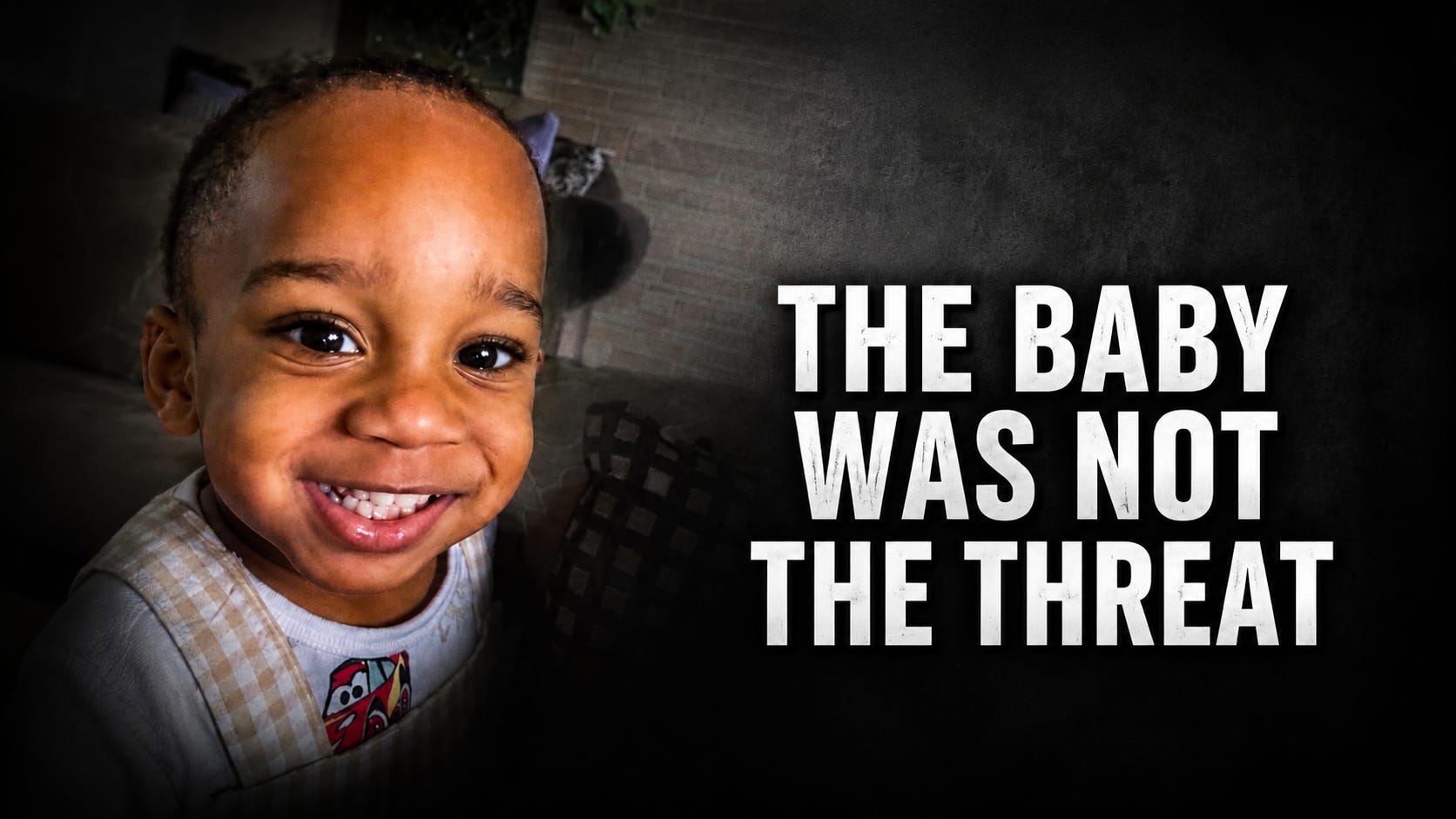
A 1-year-old child is dead after police responded to a reported shoplifting call at a Walmart in Senatobia, Mississippi. That sentence should stop the country before the usual ritual begins.
Before the slogans. Before the defense lawyers. Before the local officials ask the public to be patient. Before anonymous police sympathizers start dragging the mother, the driver, the family, the neighborhood, the protesters, and everybody except the bullet.
TLDR
A 1-year-old child, Kohen Wiley, is dead after police responded to a reported shoplifting call at a Walmart in Senatobia, Mississippi. AP reports that police say the vehicle drove toward officers and nearly struck one before an officer fired at it. [1]
The public record is still incomplete. The family disputes key parts of the story, wants body-camera and Walmart surveillance footage released, and the officer who fired has reportedly been placed on administrative leave. [2] [3] [4]
As a retired police officer, my first question is procedural: what were the charges? Mississippi law treats first and second shoplifting convictions for merchandise valued at $1,000 or less as misdemeanors, with felony treatment depending on value and prior convictions. [5]
Shooting at a moving vehicle is not a minor tactical choice. DOJ policy limits vehicle gunfire to deadly-force circumstances where no objectively reasonable alternative appears to exist, including moving out of the vehicle’s path. [6]
This is not a case-closed report. It is a question report. A child is dead, and the official story raises questions that should not be difficult to answer.
You’re Missing Out On Free Access
Restack this. Send it to someone who still thinks police shootings begin at the trigger instead of in the decisions that made the trigger available.
You are reading XVOA from the outside right now. Step inside the desk.
Subscribe for free and get what non-subscribed readers do not get: notifications for Public Blackout Briefs, I Hate The News, essays, Notes, access to visual graphs and charts, sources with links, and selected dispatches from the XVOA desk.
A drive-by reader has to find the work.
A free subscriber gets called back when the desk moves.
A reported shoplifting call became a Walmart parking lot shooting. AP reports that Kohen Wiley was in a vehicle with his mother and her friend after they exited the store. The Mississippi Bureau of Investigation says officers tried to stop the vehicle, the driver drove toward officers and almost hit one, and an officer fired at the vehicle. The vehicle then left the scene and arrived at a hospital, where Kohen was pronounced dead. Kohen’s mother was physically unharmed and her friend was seriously injured. [1]
The Mississippi Free Press reports that officers from the Senatobia Police Department and Tate County Sheriff’s Department were involved, that the shooting happened while Kohen was inside a silver sedan in the Walmart parking lot, and that family members have denied that any shoplifting took place. The report also notes that the Department of Public Safety statement appears to acknowledge officers saw the child before the vehicle encounter. [2]
The Guardian reports that the officer was placed on administrative leave, that protests followed, and that Kohen’s family is demanding body-camera footage and Walmart surveillance video. [3] WMC reports that state investigators are reviewing body-camera footage, dash-camera footage, Walmart surveillance, and witness statements. [4]
The Unrest Was Part of the Story
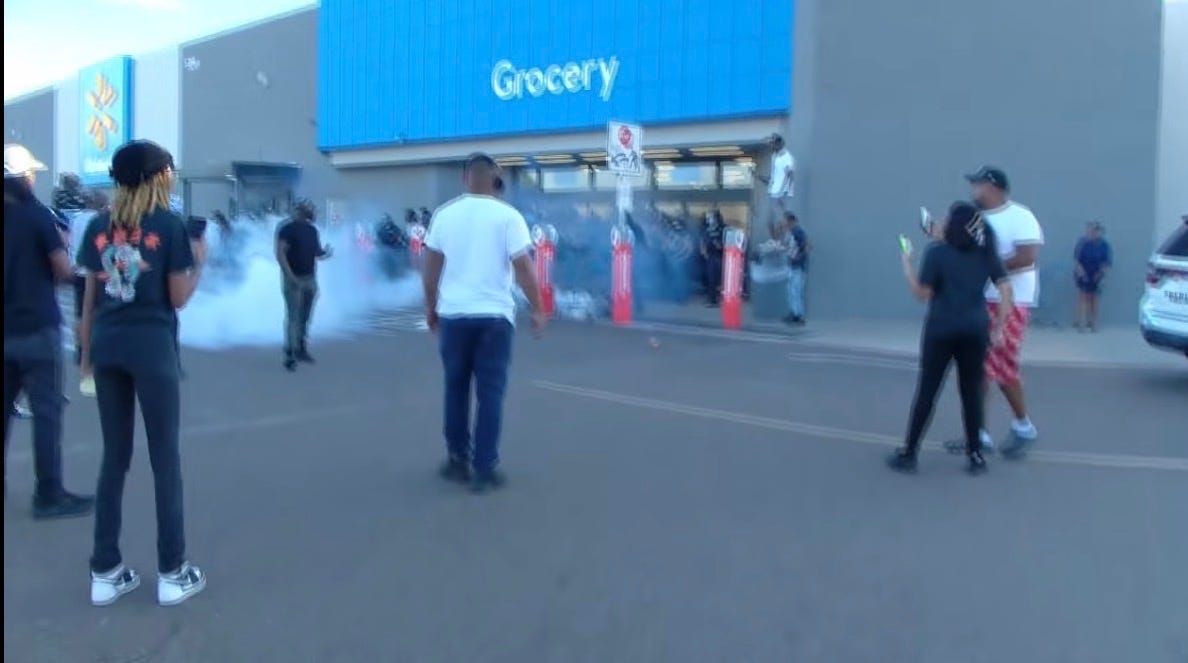
The public response is not a side note either. The Guardian reported that demonstrations erupted in Senatobia after Kohen Wiley was killed, including protests outside city hall and outside the Walmart where the shooting began. As tensions escalated, law enforcement officers wearing gas masks formed a line in front of the Walmart and deployed a chemical irritant, colloquially referred to as tear gas, toward demonstrators, forcing people at the scene to disperse. [3]
That belongs in this report because it shows the second act of state power. First, the public is asked to accept that a reported shoplifting call somehow became gunfire into a vehicle with a baby inside. Then, when the community gathers to demand answers, the state meets public grief with gas masks and chemical force.
That right there is the machinery revealing itself.
The question is not only why a 1-year-old child is dead after a Walmart call. The question is also why the public’s demand for answers had to be managed like a threat.
I do not have all the answers. That is exactly the problem. A baby is dead, and the public is being asked to stand inside one of the oldest rooms in American policing: the car moved toward the officer.
I Worked These Calls
I am a retired police officer. That does not make me infallible. It does not make me the investigator. It does not give me the right to declare every unknown fact from a distance.
But it does give me a professional memory.
I worked calls like this. Retail theft. Possible shoplifting. People leaving the store. Store security upset. A manager wanting prosecution. A suspect already gone or getting into a car. Somebody pointing into the parking lot and saying, “There they go.”
And never, ever, ever did it occur to me that a reported misdemeanor theft should become a chase after people got into a vehicle.
I am getting the tag number. I am getting the description. I am getting the Walmart video. I am identifying the registered owner. I am writing the report. Then I am going home.
That is not softness. That is not laziness. That is police work. The job is not to win every encounter. The job is to protect life. The job is to know when the safest thing an officer can do is let a car leave, document the evidence, and let the system that claims to love law use paperwork instead of gunfire.
The First Supervisor Question
If I had given chase anyway, the first question from my supervisor would not have been, “Did you catch them?”
It would have been: what are the charges?
That question matters because police power is supposed to be proportional. The public danger must match the public necessity.
What were the charges? Was anyone charged before gunfire entered that car? Was the alleged theft confirmed before the shooting? What was the dollar value of whatever Walmart said had been taken? Was this still a shoplifting call when the officer fired? What did the officer know in that exact moment?
Under Mississippi law, shoplifting is not automatically a felony. The statute treats first and second convictions for merchandise valued at $1,000 or less as misdemeanors, while felony exposure can depend on value, prior convictions, and other statutory factors. [5]
That does not settle the whole case. It sharpens the question. If the public story began as a low-level retail allegation, then the burden of explanation belongs to the state. The state must explain why a call that should have been preserved through video, tags, statements, and follow-up became a deadly-force event in a parking lot with a child in the car.
The Moving Vehicle Trap
There is a dangerous geometry in policing: officer, car, windshield, gunfire, official fear, community disbelief.
Once an officer is in front of a vehicle, the car can become the stated deadly threat. Once the car becomes the threat, the officer’s fear becomes the center of the story. Once the officer’s fear becomes the center of the story, everyone else gets pushed to the edges.
The child. The passenger. The bystander. The mother trying to communicate that there was a baby in the car, if that is what happened. The family asking why police were firing in a Walmart parking lot over an allegation that had not yet been tested in court.
That is why the tactical question matters. Did the vehicle create the deadly-force problem, or did police tactics help create it?
Was the officer trapped? Could the officer move? Was the car boxed in? Was there an attempt to physically stop a moving vehicle over a property allegation? How many rounds were fired? From what direction? Into which part of the car? What did officers know about the baby before the weapon was fired?
Those questions are not anti-police. Those questions are supervision. Those questions are training. Those questions are the difference between public safety and domination dressed up in a uniform.
The Department of Justice policy is not Mississippi law for every local officer, but it is a useful national reference point because it states the danger plainly: deadly force may not be used solely to prevent the escape of a fleeing suspect, firearms may not be discharged solely to disable moving vehicles, and shooting at a moving vehicle is restricted to deadly-force circumstances where no objectively reasonable alternative appears to exist, including moving out of the vehicle’s path. [6]
That phrase matters: moving out of the path. Every moving-car shooting asks the same haunted question. Was the officer in danger because the suspect weaponized the vehicle, or was the officer in danger because the police response created a position where the vehicle became the justification for the gun?
I Have Heard This Sentence Before
I was in the police academy in St. Petersburg, Florida, in 1996 when TyRon Lewis was killed. That was not a history lesson to me. That was atmosphere. That was the city. That was the academy. That was the sound of a place absorbing the meaning of a police shooting and discovering that the official explanation did not quiet the wound.
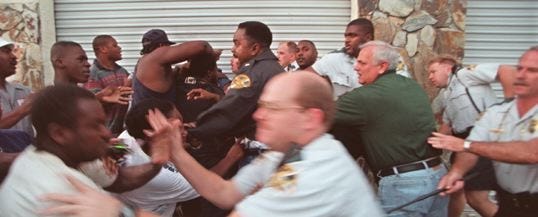
TyRon Lewis was 18 years old. FOX 13 reported on the 25th anniversary that he was an unarmed Black teen stopped by police in 1996, shot and killed by a white officer, and that the death pushed St. Petersburg to the verge of chaos, with unrest returning after the shooting was ruled justified and the officers were cleared. [9]
An archived Philadelphia Inquirer report from the time described the police account as Officer Jim Knight firing after the car lurched forward and appeared to try to run him over. It also reported witness accounts saying Knight was standing with his hands on the hood when the car inched forward, and one witness said the car was not even going 2 miles per hour. That same report described fires, injuries, riot gear, and more than 350 state and local officers responding as the neighborhood erupted. [10]
I am not saying the TyRon Lewis case and the Kohen Wiley case are identical. They are not. Different states. Different facts. Different years. Different agencies. Different victims. Different investigations.
I am saying the sentence is familiar.
The car moved. The officer feared for his life. The shooting was justified. The public should wait. The community should calm down. The family should trust the process.
I have heard that sentence before. I have lived near what that sentence can do to a city. And that is why I cannot hear it now, after a 1-year-old has been shot in Mississippi, and pretend it answers more than it asks.
The Law Does Not Worship Panic
The law gives officers room to make fast decisions. Anyone who has worn the badge knows that. Anyone who pretends policing happens in a quiet classroom is lying.
But the law does not worship panic.
In Graham v. Connor, the Supreme Court said excessive-force claims are judged under the Fourth Amendment’s “objective reasonableness” standard. That means the analysis turns on the facts and circumstances, not just the officer’s inner emotional state. [8]
In Tennessee v. Garner, the Court held that deadly force cannot be used against an apparently unarmed, nondangerous fleeing suspect unless it is necessary to prevent escape and the officer has probable cause to believe the suspect poses a significant threat of death or serious physical injury to the officer or others. [7]
Those cases will not answer every question in Mississippi. But they make one thing plain: “I was afraid” is not the end of the inquiry. The inquiry must include the severity of the alleged offense, the immediacy of the threat, the alternatives available, the officer’s position, the presence of innocent people, the decision to shoot into a vehicle, and the fact that a child was inside.
The Questions That Should Not Be Hard
This is the part where people often demand certainty before they allow grief. They say wait for all the facts.
Fine. Then give us the facts.
Release the body-camera footage. Release the dash-camera footage. Release the Walmart surveillance footage. Release the dispatch audio. Release the original call notes. Release the officer’s position. Release the department’s policy on shooting at moving vehicles. Release the pursuit policy. Release the use-of-force policy.
Release whether any supervisor was present or notified. Release whether officers knew Kohen Wiley was in the car before the shot. Release whether the alleged stolen property was recovered, what it was, and its value. Release whether anyone had been charged with anything before the officer fired. Release how many rounds were fired, from which officer, from what location, and into which part of the car.
The Guardian reports that the Mississippi Bureau of Investigation said no officers suffered serious injuries. [3] WMC reports that investigators are reviewing body and dash camera video along with Walmart surveillance. [4]
Good. Then the public should see enough to understand why a baby is dead and not because curiosity is entertainment. Because secrecy is how institutions train communities to swallow contradictions.
Property Was Recoverable. Kohen Was Not.
Here is the moral ratio in all this.
The alleged property was recoverable. The report was writable. The tag was obtainable. The video was reviewable. The suspect was identifiable. The case was survivable. Kohen had one life.
That is what makes this so unbearable. The state did not run out of options. It ran into escalation. And escalation is not just a moment. It is a habit. It is a culture. It is a reflex. It is what happens when noncompliance gets treated as a threat, when flight gets treated as war, when property gets protected with more urgency than a child’s body.
That is the XVOA charge. Not that every fact is known. Not that every legal conclusion is already settled. But that the machinery is asking us to accept a dead baby as the price of a parking lot decision.
I cannot accept that without questions.
The Report I Would Have Written
I know the report I would have written.
Reported shoplifting. Suspects left in vehicle. Tag obtained. Store video requested. Witness statements taken. Follow-up pending.
That is how this should have ended. Boring. Procedural. Unviral.
No national outrage. No grieving grandfather. No family demanding footage. No protests. No officer on administrative leave. No Walmart parking lot turned into another American sentence about fear.
Just a report.
That is why this hurts so much. The ordinary ending was still available. Paperwork was still available. Identification was still available. Time was still available. The courts were still available. A baby’s life was still available.
And then the gun entered the story.
Closing Note
I do not know every fact in Senatobia. I do not know what every camera will show. But I know enough about police work to know what the questions are. I know enough about misdemeanor theft calls to know what the ordinary ending looks like. I know enough about moving-car shootings to know that “the vehicle drove toward the officer” is not an explanation. It is the beginning of an investigation.
And I know enough about American power to know that Black grief is always asked to wait politely while institutions get their damn language together.
No.
A 1-year-old child is dead. The baby was not the threat. The paperwork was still available. The state has questions to answer.
You’re Missing Out
You made it to the end, so you already know what kind of desk this is.
Subscribe free and get what non-subscribed readers do not get: notifications for Public Blackout Briefs, I Hate The News, essays, Notes, access to visual graphs and charts, sources with links, and selected dispatches from the XVOA desk.
A drive-by reader has to hope the algorithm brings them back.
A free subscriber gets called back when the desk moves.
If you cannot subscribe today, restack the report. Send it to one person who needs to understand why “the car moved” is not enough when a baby is dead.
Sources

1.
Thank you.
I would just note not just Black people are grieving this child, and the failure of the system and the people who created and protect and defend it instead of human beings.
Dental appointment coming up, so this from memory. We had a case a few years back where the police fired at a bad guy as he drove away. A bullet struck and killed a child that the cops did not know was in the car. Two days ago, on a bridge in Toronto I've often walked, driven, rode over and walked under, at about 1:30 a.m., a car rammed a cop up against concrete, injuring him (he'll be okay) and then drove off amid gunfire. The driver stopped, fled, and was caught, and found to be injured by -- something...bullet, shrapnel, something else. He was 12 years old!
I haven't seen today's news but last I heard he had come through surgery and would be charged with, among many things, attempted murder.
In both these cases, especially the last one as it is fresh in my mind, we read that, put simply, thou shall not shoot at a fleeing vehicle unless there is an immediate threat to someone's life, even though thy be a cop.
As always when a police gun is fired in public (I can think of an exception I once witnessed...but that's a whole different story) we await the results of an investigation.
About a week or so ago, in remote northern Ontario, an Ontario Provincial Police officer was struck and killed by a vehicle,, (allegedly) on purpose, driver charged with murder.
And then ere that registered, a special force officer of, I think, the Toronto Police, on a dark-of-early morning high risk raid of an apartment had a single shot fired at him., and was killed.
Had I a gun and had someone rammed me up against concrete, and tried to kill me, I think, gentle though I may be, I'd have emptied the magazine in the direction of his fleeing car provided it was not fleeing toward a crowd, but I'm not a trained cop.
So the rules for police up here are don't shoot. at a fleeing car, and under no conditions is shoplifting grounds for lethal force, full stop, period. But then look at those murders of the ICE protestors...they must be prosecuted. if your country is ever to be regarded one where there is rule of law.
We are a deadly species...always with a reason to kill...but almost never one that is morally justified any which way, IMHO.