

A senior U.S. counterterrorism official resigning in protest of an active war is not background noise. It is an alarm, and it landed hard because it drew blood from inside the coalition that claimed it hated “forever wars” most.
I will own this much right up top. Part of what set me off was the sheer gall of watching one of these men help sell the lie, help dress it up, help hand it to the base like it was gospel, and then suddenly rediscover his conscience only after the fire had already started. On March 17, 2026, Joe Kent resigned as director of the National Counterterrorism Center, saying he “cannot in good conscience” support the war with Iran and asserting Iran posed “no imminent threat” to the United States.[1][2]
The resignation is not floating alone. It is occurring inside a much larger and highly visible set of developments that have had sustained heat for roughly two to three weeks: the U.S.-Israeli campaign described by the administration as “Operation Epic Fury,” conflicts over the war’s rationale, a War Powers notification to Congress, and escalating economic shock through energy markets tied to the Strait of Hormuz.[6][9]
We have the resignation language, a formal War Powers report and letter from the White House, public accounts of the administration’s evolving justification, an early congressional response, and measurable downstream effects such as fuel prices and shipping disruption that can be tracked with real numbers rather than vibes.[1][7]
The harder question is not “did he resign,” but “what story does his resignation try to force the country to tell about why we are fighting.” That is where the antisemitism suspicion enters. His framing places a significant share of the causal blame on Israel and on what he calls a “powerful American lobby.” That specific phrase can function either as ordinary political critique or as a gateway to older conspiratorial tropes, depending on how it is used and what audience it is feeding.[14][15]
TLDR
Kent’s resignation matters because it is not just a personnel story. It is a crack inside the very coalition that sold voters on staying out of another Middle East war, and it lands alongside documented contradictions in the administration’s own public rationale for striking Iran.[1][6]
The public record does not support a clean, simple imminent-threat story. The White House war powers notice leaned on a bundle of justifications that included force protection, national interests, maritime commerce, and collective self-defense of allies including Israel, which is a much broader case than a single ticking-clock emergency.[4][7]
Kent may be naming a real contradiction while also using language that can slide into something darker. Critiquing alliance entanglement is one thing. Handing people a vague “powerful lobby” frame is another, especially when antisemitic narratives are already feeding on this war.[2][14]
The people most likely to pay first are not the architects of the war but the families tied closest to military service and the households already living near the edge. Fuel shocks, economic strain, and the moral fog that follows shifting war justifications always land harder on people with the least cushion.[9][13]
Restack it and share it.
Send it to one friend who still thinks this is just another foreign-policy spat.
If this kind of independent reporting helps you see the wiring behind the wall, support it here:
Or, if paid is not your move right now, there is a one-time option here:
What we can document now about the resignation and the war rationale
Kent’s resignation, as reported by Reuters and the Associated Press, includes three claims that matter because they can be checked against primary documents and other statements.[1][2]
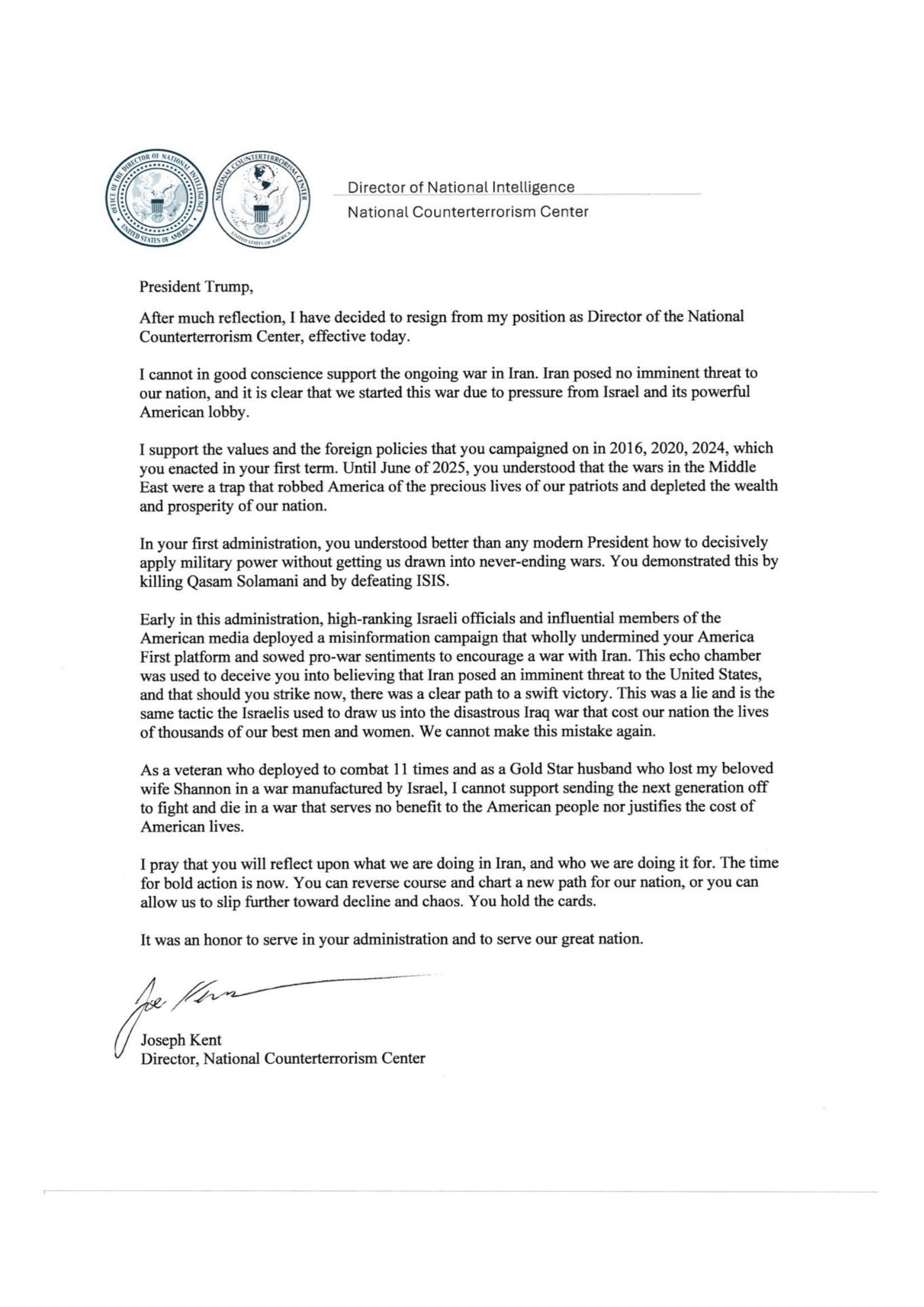
First, he states Iran posed “no imminent threat” to the United States.[1][2]
Second, he claims the U.S. started the war due to “pressure from Israel and its powerful American lobby.”[1][2]
Third, he frames the war as a betrayal of “America First,” situating himself as the aggrieved loyalist inside a movement that sold its base a promise: no new Middle East trapdoors.[1][2]
Kent does not resign in a vacuum. Earlier reporting documented internal contradictions in the administration’s stated rationale for entering the war. On March 3, a Reuters report described the conflict between Donald Trump saying he believed Iran was about to strike first and Marco Rubio saying the U.S. moved because it anticipated Israeli action would prompt Iranian retaliation against U.S. forces, and therefore the U.S. acted first to avoid higher U.S. casualties.[6]
That “protect our forces from retaliation sparked by someone else’s planned strike” logic is not a minor talking-point difference. It is the hinge between two very different moral stories.
One story says the U.S. was preventing an imminent Iranian attack initiated by Iran.
The other story says the U.S. was managing second-order consequences of an Israeli strike that the U.S. believed would happen, with Americans caught in the blast radius if Iran hit back.
Reuters reported this contradiction plainly and also captured the political consequence: a right-flank backlash interpreting Rubio’s explanation as admission that “Israel forced our hand.”[6]
That backlash matters because Kent is essentially resigning into it, and also amplifying it.
On the congressional consultation issue, the public record is also more specific than the hottest takes. A FactCheck.org analysis notes the White House said the “Gang of Eight” was contacted before the strikes, with the press secretary stating Rubio called all members and reached seven of the eight.[5] This is not the same as broad congressional consultation, but it is a documented form of leadership notification.
The symbolic political fact remains: Congress did not pass a specific authorization for the war before strikes began, and the initial legal posture presented publicly leaned on presidential authority and post-hoc War Powers reporting rather than a prior vote.[5][8]
The legal dispute hidden inside “imminent threat”
When citizens hear “imminent threat,” they tend to hear a simple binary: either there was a ticking bomb, or there wasn’t. In reality, “imminence” in U.S. war powers arguments often becomes a flexible concept used to widen executive discretion, especially when the government claims it is acting to protect U.S. forces, deter attacks, or act in collective self-defense with an ally.
A primary document is central here: the White House letter and report to Congress dated March 2, 2026, notifying Congress of military action taken on February 28, 2026.[7] The letter states the strikes were undertaken to protect U.S. forces in the region, protect the homeland, advance national interests including the free flow of maritime commerce through the Strait of Hormuz, and in collective self-defense of regional allies including Israel. It also cites Trump’s constitutional authority as Commander in Chief and Chief Executive.[7]
Notice what that does, psychologically and politically.
It bundles multiple justifications into one package: force protection, homeland protection, commerce protection, alliance defense, and broad national interests. That is a classic feature of modern executive war arguments, because if any one rationale is contested, the others can be left standing like backup generators.
The War Powers Resolution is often misunderstood as “48 hours of free war.” It requires reporting within 48 hours of introducing U.S. forces into hostilities or imminent hostilities, and it also states the president “in every possible instance shall consult” before introducing forces. It then sets a 60 to 90 day window for termination absent authorization.[5][8] That structure creates recurring political theater: administration lawyers treat reporting as compliance; critics treat consultation as the moral and constitutional failure.
Legal expert commentary underscores that this is not settled terrain. FactCheck cites Oona Hathaway calling the strikes “blatantly illegal” and emphasizing Congress’s constitutional role. In a separate and detailed Lawfare analysis, Scott R. Anderson argues that the administration’s attack pushes even generous executive-branch views of presidential war authority toward, and potentially past, their limits, particularly given public facts suggesting reduced imminence and ongoing negotiations at the time of the strikes.[4][5]
So when Kent says “no imminent threat,” he is not only making an intelligence-flavored claim. He is picking a legal and moral pressure point that has leverage with Americans who remember how “imminence” was used to launder Iraq-era catastrophe.
Congressional reaction indicates that pressure point is politically live. Time reported that the House rejected a War Powers measure to rein in Trump, but also described skepticism among Democrats emerging from briefings, with concern about shifting rationales and insufficient demonstration of immediate threat.[6]
Motives and meaning: whistleblowing, coalition fracture, or antisemitic scapegoating
The user’s core suspicion is sharp: is Kent resigning because he is revealing reality, or because he is sliding a war narrative into antisemitic blame?
The honest answer is that motive is not directly observable from the outside. What can be assessed is the structure of his framing and its likely psychological function within his political ecosystem.
A documented fact is the language Kent chose: he explicitly attributed the war to “pressure from Israel and its powerful American lobby.” Another documented fact is that some conservatives and Republicans criticized that framing as antisemitic, while other voices applauded him as anti-war.[1][2]
Now we move into interpretation, grounded in context.
Kent’s prior public footprint complicates any simple “pure conscience” story. He was a controversial political figure before becoming NCTC director. Multiple outlets documented his connections to far-right and white nationalist figures, including a reported interview with a Nazi sympathizer and interactions with white nationalist influencer Nick Fuentes.[3] Those associations do not prove antisemitism as an inner motive, but they do raise the probability that he understands exactly how certain phrases land in certain communities.
That is where the “lobby” line becomes dangerous.
There is a legitimate, documentable conversation to be had about pro-Israel advocacy groups, U.S. foreign policy alignment, and how alliances shape military decisions. That conversation exists in mainstream scholarship and policy debate and does not require antisemitic content to be real.
But there is also a long-standing antisemitic conspiratorial pattern that frames “Israel” or “the Israel lobby” as a shadow hand controlling governments and media. The Anti-Defamation League has documented how conspiracies repeatedly paint Israel or the “Israel lobby” as devious and complicit in large events to further Jewish power. The IHRA working definition describes classic antisemitism as often charging Jews with conspiring to harm humanity and being blamed for “why things go wrong.”[14][15]
The key clinical distinction is this: critique that is anchored to specific, verifiable mechanisms such as votes, meetings, lobbying disclosures, treaty terms, or public statements tends to produce more reality. Scapegoating language produces more heat than light and typically works by assigning complex outcomes to a single omnipotent actor.
Kent’s “powerful American lobby” phrasing leans toward the scapegoating pattern because it stays abstract and totalizing in its causal claim, rather than pointing to specific documented decision points.
At the same time, there is a second uncomfortable truth: the administration’s own public accounts and documents do support the proposition that Israel’s actions and U.S.-Israel collective self-defense are part of the official logic of this war. Rubio’s explanation explicitly tied U.S. action to anticipated Israeli action and downstream retaliation risks. The War Powers letter explicitly invoked collective self-defense of regional allies including Israel.[6][7]
So the reality behind the scenes may not be that Israel “controls” the U.S., but that alliance entanglement is being used as a public justification, and that justification is politically combustible.
That is where Kent’s resignation becomes psychologically revealing: it reads less like pure whistleblowing and more like a coalition survival maneuver. When a movement has promised moral purity, “we don’t do these wars,” and then participates in war, it must resolve the dissonance. One common resolution is: “We were betrayed.” Another is: “We were manipulated.” Kent’s letter appears to choose both.
In psychological terms, when a political identity is built on a self-image of strength and independence, and reality contradicts it, the shadow often arrives as projection. Projection is not just personal. Groups do it. It looks like disowned responsibility being relocated onto an outside villain who can carry the shame.
Israel can become that villain in this story, and Jews can end up paying the price domestically when “Israel” and “Jewish” blur in the public imagination.
The most responsible conclusion that can be supported is a both-and.
Kent is likely naming a real political fracture around war justifications and Congress’s sidelining, while also using a framing that predictably energizes antisemitic narratives and can be weaponized by audiences already primed for conspiratorial thinking.
Who pays when elite war narratives harden into “normal”
Two groups sit especially close to the blast zone here: families in heavily military Republican communities, and Black families with sons and daughters in uniform. The point is not to stage some contest over patriotism. The point is that the all-volunteer force is drawn unevenly from certain regions and communities, and the costs of war are never shared evenly.
On military representation and politics, Pew Research found that veteran voters lean Republican by a wide margin, and that pattern is especially strong among White veterans.[11] That does not prove “MAGA families have more children in the military,” but it supports the broader point that Republican-aligned communities are deeply interwoven with military identity.
Geographically, research and reporting show the U.S. South has been overrepresented among new recruits, meaning certain regions shoulder more of the human pipeline for war.
On Black representation specifically, official demographic reporting shows Black Americans are a significant share of active-duty personnel, with branch variation. Reporting based on Defense Department and Military OneSource data shows Black representation is notably high in the Army compared with some other branches.[12] If the war expands or drags, Black families are not watching from afar.
Then there is the economic spillover, which is already documented in measurable ways.
Reuters reported U.S. gasoline prices jumped sharply in the early phase of the conflict, crossing $3.50 nationally and rising fast. Reporting also connects the war and Hormuz disruption to broader oil market shocks, with Reuters and the International Energy Agency characterizing the supply disruption as historically large and tied to a chokepoint that normally carries around a fifth of global oil and LNG trade. The IEA itself announced a record 400 million barrel stock release from emergency reserves in response to the disruption.
Those price shocks are not morally neutral. Fuel and energy inflation acts like a regressive tax, squeezing households that already live closer to the margin.
This is where Black impact is not rhetorical decoration. Multiple studies and reports have documented that Black households, on average, spend a higher share of income on energy than white households, driven by structural factors such as housing efficiency, segregation legacies, and utility cost burdens.[13] When energy spikes, the pain compounds: transport costs rise, food distribution costs rise, and household tradeoffs intensify. Research on gasoline price shocks has found low-income households reduce other spending, including food expenditures, in response to unexpected gasoline increases.
The other cost is civic and psychological.
When war is justified with shifting stories, trust erodes, and cynicism becomes fertile soil for conspiracy. That is true on the left and right. ADL research has found that antisemitic tropes correlate with broader conspiratorial thinking.[14] That matters here because the same rhetorical move that protects a movement’s self-image, “we were tricked by a lobby,” can simultaneously inflame scapegoating and push people toward dehumanizing simplifications.
So who benefits?
Energy producers and some geopolitical competitors can benefit from price spikes. Business reporting has already connected the war-driven oil surge to increased revenues for oil-exporting nations like Russia, at least in the short term.[10] Domestically, politicians can benefit from rally effects, and media ecosystems can benefit from conflict-as-content.
Who pays?
Service members. Families. And the working-class and poor who fund war twice, first in blood, then at the pump and the grocery store.
What to watch next to stay oriented
There are four near-term markers that will determine whether Kent’s resignation becomes a footnote or a crack that widens.
One is the public posture of the intelligence leadership around threat claims. Major outlets reported that Kent was close to DNI Tulsi Gabbard and that she has kept a low public profile since the war began.[2][3] If intelligence leaders testify publicly and do not substantiate an “imminent threat” narrative, Kent’s framing could gain credibility. If they do substantiate it, his resignation risks being reframed as opportunism.
Second is congressional action. The House has already shown reluctance to force an end through a War Powers measure.[6] If fuel prices and casualties rise, that political math can change fast.
Third is the administration’s messaging strategy. White House communications have leaned into maximal dominance language about “imminent threats” and battlefield progress. At the same time, major coverage has highlighted public contradictions in the war rationale. A persistent mismatch between “imminent threat” rhetoric and the war powers letter’s broader justifications will keep the legitimacy debate alive.[6][7]
Fourth is the antisemitism risk curve. A resignation that blames Israel-and-the-lobby can be picked up by individuals who already traffic in older conspiratorial frames, including “ZOG”-style narratives about Jewish control of government.[14][15] The challenge for readers is to hold two truths at once: lobbying exists and policy entanglements are real, but scapegoating Jews or flattening complex state decisions into omnipotent “lobby control” is a historical poison that reliably turns violence inward.
The “most people are missing this” point is therefore not tactical, but moral: when leaders choose vague blame over transparent decision chains, they seed a social pathogen.
And that pathogen spreads fastest when people are broke, scared, and grieving.
If the question is “antisemitism or reality-revealing,” the most defensible map is this:
Kent may be revealing a real contradiction and a real entanglement, but he is also choosing a frame that, in U.S. political history, has often served as a carrier for antisemitic projection. The task is to demand evidence for every causal claim and to refuse scapegoats even when they feel emotionally satisfying.
Support XVOA
Look, you already know this was not some cut-and-paste content mill special. This was deep, independent, reader-funded work. The kind of work that takes time, nerve, and the willingness to follow a story past the safe talking points and into the machinery underneath. I do that here because I work directly for readers, not advertisers, not party handlers, not some corporate editor nervously sanding the edges off the truth.
Free subscribers matter to me. Paid subscribers matter to me. The whole point of this publication is that I answer to the people reading, thinking, arguing, restacking, and keeping this thing alive. That is the arrangement. You get the work without a hedge fund sponsor in the room. I get the freedom to keep digging.
So yes, I am going to brag a little. You are not crazy for noticing that this essay went deeper than most of what the media class threw at you. That is the advantage of independent press with skin in the game. I am not trying to sound important. I am trying to do important work before the official story hardens and everybody pretends they never missed what was right in front of them.
And since we are being honest, if you made it all the way down here, you probably already know whether this kind of reporting is worth backing. Some of y’all are standing at the fence like this is a jury duty notice, hoping eye contact will not be made. I see you. Respectfully, get off the fence. Paid subscriptions do not just flatter me. They buy time. They buy documents, long reads, second passes, and the stubborn independence it takes to publish work like this without asking permission.
So if you want this publication to keep doing work this sharp and this free, become a paid subscriber here:
And if a full subscription is not your move right now, no side-eye, no sermon. Hit the one-time support link here:
Either way, you are not supporting a brand. You are backing a writer who works for the readers.
Sources
Top US security official quits, says Iran did not pose immediate threat - Reuters report on Kent’s resignation, his stated rationale, and the immediate political fallout.
Top counterterrorism official Kent resigns over Trump’s Iran war, says Iran posed no imminent threat - AP reporting that confirms Kent’s resignation language and the broader administration response.
What to know about the resignation of Joe Kent as Trump’s counterterrorism chief - Background on Kent’s ideological history, extremist associations, and why his framing drew renewed scrutiny.
The Law of Going to War with Iran, Redux - Scott R. Anderson’s legal analysis of the administration’s claimed authority for the Iran strikes.
Legality of Latest Iran Attack in Question - FactCheck summary of the consultation dispute, War Powers requirements, and competing legal views.
Rubio’s Rationale on Iran Strikes Gets Messier, as Congress Demands Answers - Time reporting on the administration’s shifting explanations for why the strikes happened.
Trump sends War Powers Resolution notification to Congress - Public excerpt of the White House war powers notification describing the stated legal and strategic rationale.
War powers debate intensifies after Trump orders attack on Iran without approval by Congress - Reporting on the constitutional conflict created by launching the war without prior congressional authorization.
IEA Member countries to carry out largest ever oil stock release amid market disruptions from Middle East conflict- Primary source on the 400 million barrel emergency release and the scale of the Hormuz disruption.
US average diesel prices cross $5 a gallon as Middle East War tests global economy - Reuters reporting on the fuel-price shock already hitting U.S. consumers and freight costs.
Military veterans remain a Republican group, backing Trump over Harris by wide margin - Pew data supporting the essay’s point that military identity remains strongly interwoven with Republican constituencies.
2024 Demographics Profile: Army Active-Duty Members - Military OneSource demographic snapshot used for the discussion of Black representation and regional concentration in the force.
Report: Low-Income Households, Communities of Color Face High “Energy Burden” Entering Recession - ACEEE findings showing Black households spend a higher share of income on energy costs.
Military Operation Against Iranian Regime Fuels Wave of Antisemitic Conspiracy Theories, Calls for Mobilization- ADL analysis of how anti-war commentary around the strikes is being weaponized into antisemitic narratives.
What is antisemitism? | IHRA working definition - The IHRA definition used to distinguish legitimate critique from conspiratorial antisemitic framing.
"The people most likely to pay first are not the architects of the war but the families tied closest to military service and the households already living near the edge. Fuel shocks, economic strain, and the moral fog that follows shifting war justifications always land harder on people with the least cushion."
Well said Xplisset!
Yeah, the letter reads like an excuse to blame all US and Trump warmongering on Israel. The Iraq war was "manufactured" by Israel? Bs.