

Don’t do as I do. It’s dangerous. It’s three in the morning, and while you sleep and let your body and mind rest, I’m traveling downward into the caverns of the underworld we neglect and suppress.
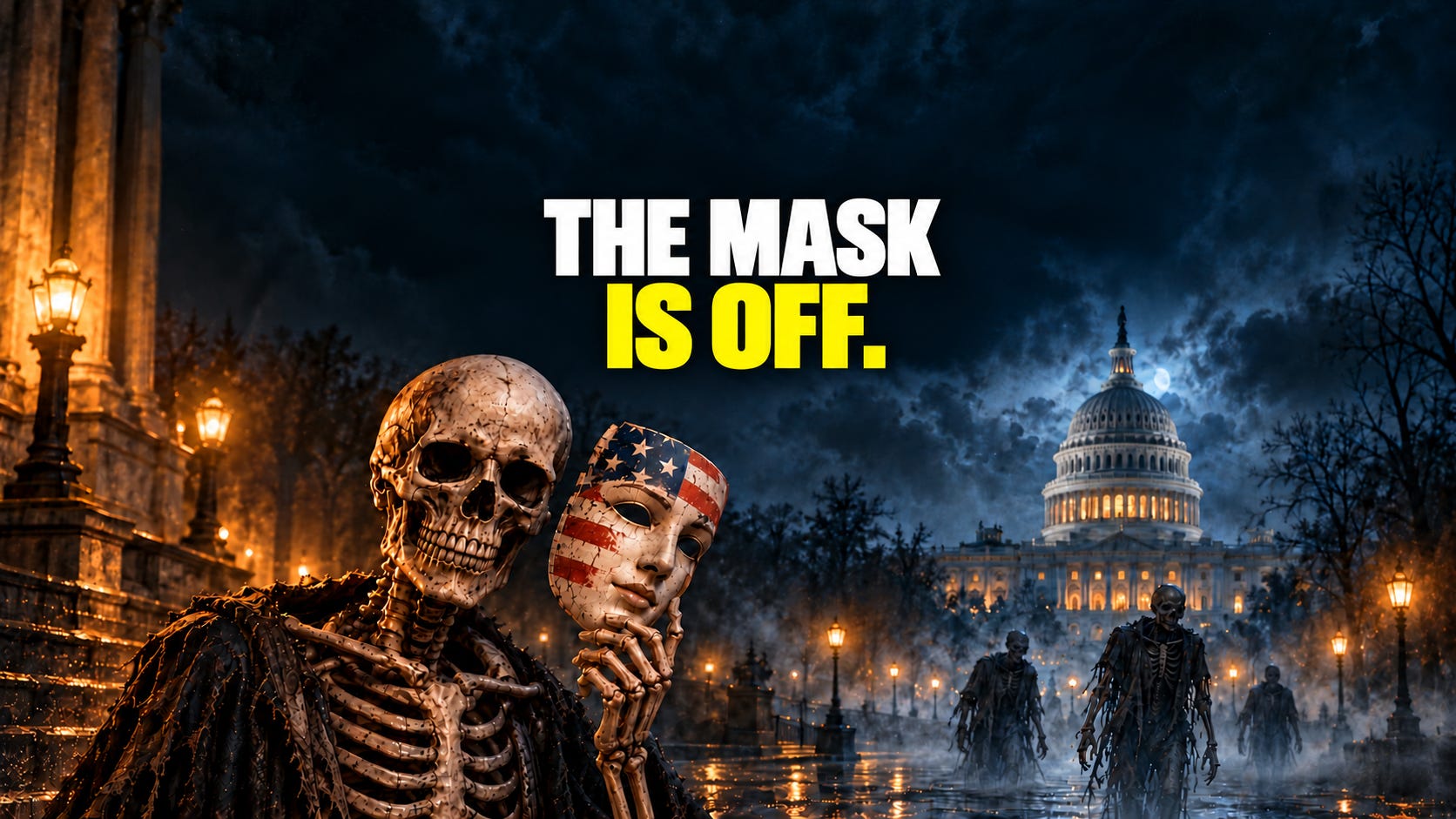
The mask is off. I’m naked now. I see someone at war with himself. Don’t act like you don’t know what I’m talking about. It’s called being human.
I’m at war with my own fascination and reverence for the Founding Fathers, with men like Thomas Jefferson whose words I admire and whose writings placed people like me beneath him. [1] (monticello.org) I’m at war with my own patriarchal tendencies.
We can get very good at hiding our own contradictions from ourselves, or explaining them away when we do notice. [2] (pmc.ncbi.nlm.nih.gov) My job as a writer, and as a novelist in particular, is to look under the hood of the psyche and expose the machinery in such a delicate way that it doesn’t scare you away. It’s not the mask that terrifies us. It’s what’s behind the mask.
Btw. Please restack this and help spread this message if you like what you’ve read.
I know, I know. I said I would try and write shorter posts. I’ll get back to that. But I wanted to write this one out fully, and I didn’t want to edit out my thoughts. It’s a 12-minute read. If you don’t have that, I’ll sum it up for you:
TLDR
I’m at war with my own contradictions. Reverence for the Founding Fathers, excusing my own patriarchal tendencies. My country is at war with itself, too.
Listening to the blues, I hear betrayal. The music of living with broken promises of equality. [15] [16] [18]
The Department of Justice backed away from proposed police oversight agreements and faces accusations of obstructing Epstein investigations. Whose rights are worth protecting and whose suffering can powerful people ignore? [11] [12] [22]
Patriotism doesn’t excuse an attack on the republic. Nor should war be a spectator sport. Remembering the Union dead and those who fought fascism, can we not extend our humanity to the children killed in Iran? [13] [14] [26] [28]
If you vote Democrat, remember, you’re not voting for them or their consultant class. We vote for the ghosts of enslaved women, freedpeople, the war dead, and the living who are still owed justice. Take them with you to the polls.
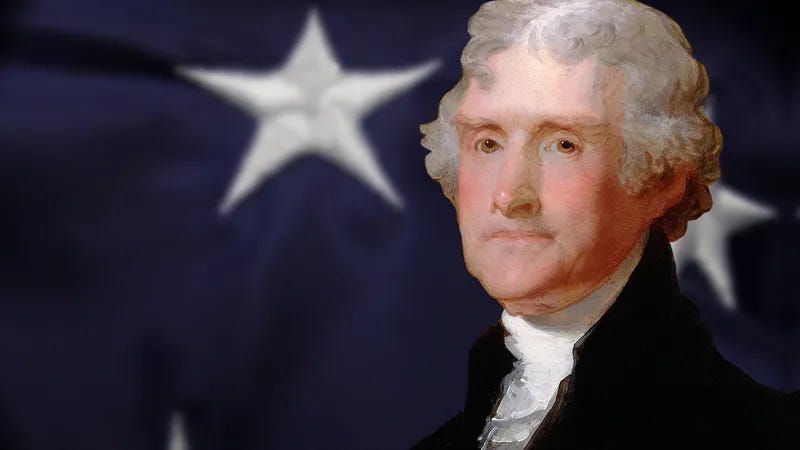
Jefferson penned “all men are created equal” in the Declaration of Independence. [3] [4] (archives.gov, archives.gov) Later, Jefferson penned Notes on the State of Virginia, which included theories about the inferiority of Black people. [1] (monticello.org) According to their son Madison, Sally Hemings returned to slavery at Monticello from France when she was sixteen, pregnant by Thomas Jefferson. While rumors swirled earlier, the allegations became a public political scandal in 1802. [5] (monticello.org)
We must call everyone to account and follow the evidence wherever it leads, even if the accused is powerful or loved.
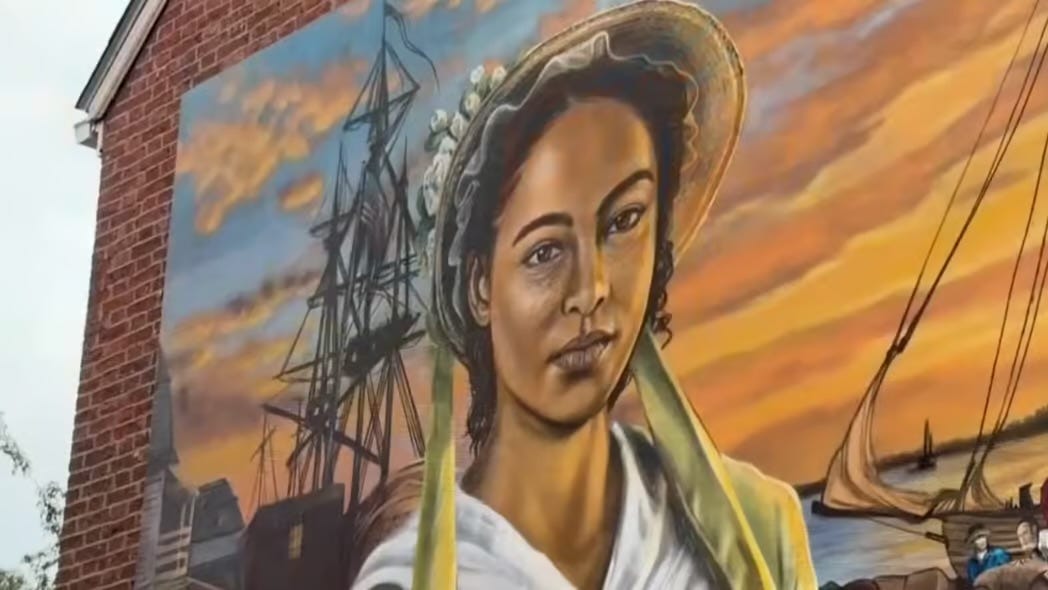
Washington sent agents after Ona Judge when she fled slavery, all the way to New Hampshire. They never recaptured her. [6] (mountvernon.org)
Symbols within dreams and stories that become myth can be complicated, full of war within that we’re not yet ready to make sense of, much less talk about openly. But it’s the fight for equality, and who that equality includes, that I keep coming back to.
Abraham Lincoln opposed slavery while declaring his support for giving white people the superior position. [7] (archive.oah.org) He promoted Black colonization abroad, including in Central America. [8] (presidency.ucsb.edu) By his last public speech, he was advocating voting rights for Black Union soldiers and those he called “very intelligent.” He had moved toward equality. There were still conditions attached. [9] (nps.gov)
I wonder how much of that war they felt, and how much they had learned to explain away. I have to ask myself the same thing.
Some mornings we get a glimpse of ourselves with the mask off and see the war within. The doubts creep in for a split second before we wash away our sins of omission and get on with the day. Halloween is here, three days before the November 3 election. [10] (fec.gov) The skeletons have come out of the closet, and we cannot hide them anymore. America is at war with itself.
Today the ghosts walk among us as we go through the ritual of symbolic disguise.
Enslaved Black women and girls whose bodies were violated, and whose children became somebody else’s property, walk among us as we allow the Justice Department to retreat from protecting their descendants while it stands accused of shielding sexual abusers. [5] [11] [12] (monticello.org, justice.gov, democrats-judiciary.house.gov)
The Union soldiers who fought to preserve this republic walk among us as we reward those who attacked it on January 6. [13] (justice.gov)
The dead soldiers who fought Nazi Germany, let’s call it what it is, the pinnacle of white supremacy, walk among us as we cozy up to its fascist descendants at home and overseas. [14] (encyclopedia.ushmm.org)
And here I am, three in the morning, contemplating my own contradictions.
All with a soundtrack provided courtesy of a people who believed in the literal interpretation of Thomas Jefferson’s “all men are created equal.” For about 140 years, the blues and the music that grew from it have helped them reconcile those lofty ideals with our lived experience. [15] (loc.gov)
The children of emancipation
The feeling of betrayal at America’s failure to put “all men are created equal” into practice carries a particular weight in the African American experience. Reconciliation, in other words, does not ask you to be a civil-rights activist. It does not ask you to forgive. It does ask you to make room for all of it, the anger and desire, but also pleasure, and to refuse to cede the principle just because Jefferson couldn’t live up to it.
Music might provide a place to hold what can’t be reconciled, to make room for all of it. For the limits of freedom in America and the persistence of desire anyway, for anger and for pleasure too. For all the ways people found freedom despite everything – in work and play, in sex, in music, in community, in rest, in movement from one place to another, in family and in friendship, in humor and in prayer.
Angela Davis, writing about the blues, talks about the ways that sex and mobility were freed up by emancipation even as economic and political freedom remained limited. [16] (everand.com) In that context, songs about wanting somebody, losing somebody, leaving town, making it to the other side have heft, have weight. The blues was emerging as a distinct form and tradition by the 1890s, during the adulthood of the generation emancipated as children. [15] (loc.gov) Isuspect that the slew of public education initiatives that led to the first public schools in this nation played some role in passing on the newfound Reconstruction ideals of equality to black children only to have those ideals shattered as they came of age in the Jim Crow South. The music they would later create were not just about love or money or work. And people could recognize themselves in each other’s songs. There was a life behind the singing, and there were lives out there, listening.
Slavery ended. Black men could vote and ran for and won political office. Black communities pooled money to pay for and support schools sometimes sending their children, sometimes going themselves, including intergenerational classrooms with grandparents and grandchildren learning together. [17] [18] (home.nps.gov, loc.gov) All of that was real. Belonging wasn’t just an abstraction: there were jobs and politics you could try to get included in, and schools your children could go to. And then Reconstruction ended, white rule was restored, and those gains came under sustained attack. [18] What did it mean to be the child of emancipation, to come of age during this restoration of white rule? What might it have meant to learn to read the Declaration, then be told, effectively, that you shouldn’t expect too much? I suspect some of what we hear in the blues comes from that encounter. You can believe the words and still know exactly what kind of man wrote them. That is part of the war I’m talking about.
Who gets protected
Even Virginia’s separate Declaration of Rights, written by George Mason in 1776, needed extra words to allay white people’s fears about what the idea of universal freedom would mean for slavery: “when they enter into a state of society,” the delegates added, a qualification understood to exclude enslaved people. [19] (colonialwilliamsburg.org) In 1662, Virginia passed a law determining the enslaved/free status of children based on that of their mothers, meaning that an enslaved woman could give birth to her enslaver’s child, that child his property. [20] (encyclopediavirginia.org) These are some of the ways white people figured out how to keep both their principles and their property, and left the work of living with the contradiction to the people they owned.
When I’m writing about white men I can’t help but think about women, especially about whose story gets interrupted, in whose favor history bends, whose suffering gets weighed more heavily. And I can’t help but think, What am I overlooking because I admire this person, find his accomplishments impressive, want to champion his work? How does my admiration make me complicit? Because this is my question as much as it’s anyone else’s.
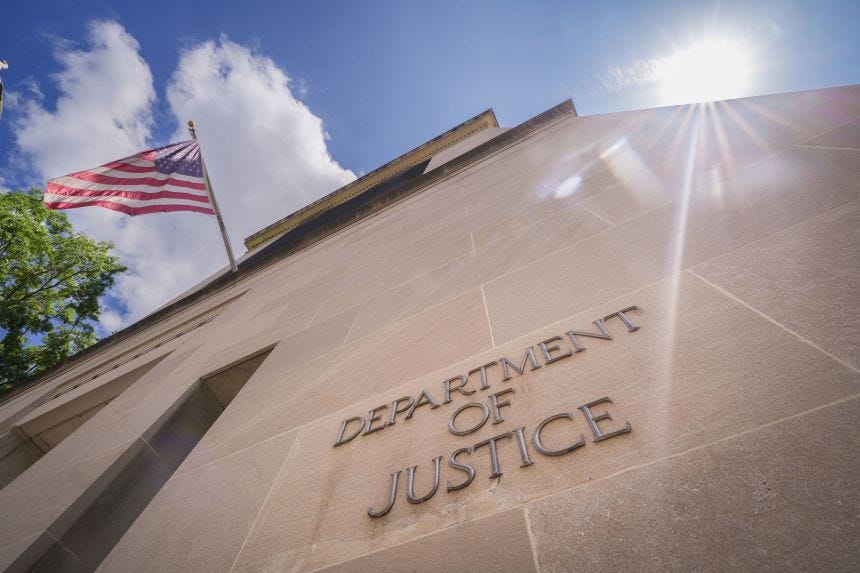
When the Justice Department was established in 1870, one of its first jobs was to defend the rights of freedpeople, sending lawyers to prosecute members of the Ku Klux Klan for their attempts to undermine Black Americans’ political participation and exercise of their other new rights through violence and threats. [21] (justice.gov) Its actions say something important about its inactions.
In May 2025, the DOJ announced it would seek to dismiss its police misconduct lawsuits in Louisville, Kentucky, and Minneapolis, Minnesota, abandon the proposed consent decrees, close the underlying investigations, and rescind its findings of constitutional violations. The department said the proposed consent decrees imposed too great a burden on the departments, were overly intrusive, and weren’t sufficiently supported by evidence. [11] (justice.gov)
These are decisions with profound consequences, for the men and women who work in law enforcement and for the people they serve. Who deserves protection here, and from whom?
On August 5, the state of New Mexico filed suit against the DOJ for its failure to turn over unredacted Epstein investigative files, saying its obstruction has hampered New Mexico’s ability to carry out its own investigation into alleged crimes at Epstein’s Zorro Ranch. [22] On October 22, Jamie Raskin said the DOJ is hampering state and foreign government investigations into potential Epstein crimes and co-conspirators. [12] (nmdoj.gov, democrats-judiciary.house.gov)
When children are abused, does your concern change depending on which adults’ reputations might be tarnished by the investigation?
What the dead are owed
On January 20, 2025, Trump commuted the sentences of fourteen specifically named January 6 defendants and pardoned all others convicted of offenses covered by his proclamation. He further directed the attorney general to seek dismissal of pending indictments for the covered conduct. [23] (whitehouse.gov)
America’s dead belong to us, but what do we owe them? What did they give their lives to protect? And what has that cost us?
How can I square pardoning those responsible for trying to prevent the peaceful transition of power with Trump’s claim that he loves the country? Unless you believe democracy and free elections are nothing more than games, rigged or otherwise, you have to accept that sometimes you lose. Losing is part of living in a country in which other people’s votes matter as much as yours. When your own continued leadership matters more, you see your country as your possession, entitled to be defended at all costs, even from its own citizens. And all the lip service in the world to patriotism won’t paper over that.
Black men marched into Nazi Germany as members of a still-segregated US military. Some of them helped liberate concentration camps. [14] They fought, and helped to win, a war to destroy a genocidal, white supremacist regime while enduring white supremacy at home. (encyclopedia.ushmm.org)
In February 2025, after bemoaning the firewall erected by mainstream German political parties, JD Vance met with Alice Weidel, the leader of the Alternative for Germany (AfD) party. [24] AfD member Björn Höcke was convicted in May 2024 of knowingly using a Nazi slogan. [25] (apnews.com, apnews.com)
What did those who died fighting fascism give their lives to protect, and what has that cost us? Can we venerate their sacrifice while whitewashing the ideology that necessitated their sacrifice?
The war on the screen
In March, the White House posted videos of the strikes on Iran spliced with movie and video game footage, one including the word “wasted” superimposed over an explosion, another concluding with the declaration of “flawless victory” from Mortal Kombat. [26] Someone thought it would be more entertaining to turn real-life war footage into a video game, where violence against others is empowering fun rather than the ugly business it actually is, and where the clip ends before you have to reckon with what happens next. (abcnews.com)
And while some of us fantasize about dropping bombs on countries we barely know anything about, according to the Associated Press, American officials have encouraged allies in the region to prepare for possible additional American strikes on Iran after our November 3 election, although Trump himself has not yet made a final decision on new strikes, according to the diplomats AP spoke with. [27] (apnews.com)
In a March 5 statement, UNICEF cited reports of children killed in Iran, including girls whose school in Minab was struck while classes were in session. [28] (unicef.org)
What did those children ever owe this war?
And to those of you whose jingoistic fantasies of leveling cities leave you with a hard on and ready for action: How the hell is it that you’re so quick to defend child rapists here at home? If you’re going to turn on your war-hungry side, at least be consistent. We must call everyone to account and follow the evidence wherever it leads, even if the accused is powerful or loved. No child deserves to be raped, full stop, and that truth should matter to you even if learning who did it might reflect badly on someone you think of highly.
I started by acknowledging my own hypocrisies, since pointing out contradictions in others can all too easily be used as a fig leaf for dodging self-examination, letting me sleep easy at night with someone else’s sins weighing down my conscience instead of my own. I’m aware of the ways I can be patriarchal, and I’m working to be less so, starting with recognizing that I don’t get to grant absolution from rape for men whose accomplishments I admire. My opinions about them should have no bearing whatsoever on what they should or should not be held accountable for.
I also revere many of the founding ideals of this country, even as I’m disappointed in us for so routinely falling short of them. I’m trying to figure out how to hold both truths at once: that we routinely fail to live up to our ideals, and that those ideals are still worth striving for. The blues to include the whole of black music has helped with this. So has recognizing that by excusing us for falling short of our ideals time after time after time, we become complicit in that failure.
That’s why those children’s deaths made me angry. They should trouble me. And if “all men are created equal” means anything to me, it can’t stop at the borders of countries I understand, or the boundaries of nations I imagine as allies instead of enemies. Those children don’t stop mattering just because my clip ends.
Halloween will be over by Tuesday. The costumes will be put away, and we will still have to decide who gets power over other people.
This election is not about electing Democrats and their consultant class who are beholden to special interests that do not represent the majority of the American people. Nor is this about pretending to forget what problems exist after the election. We will hold all elected officials accountable for their failures after November 4.
Our vote is for Sally Hemings and all of the women who were enslaved and considered property of the men who claimed liberty as their own. [5] [20]
Our vote is for Ona Judge, who escaped, and those who did not make it. [6]
Our vote is for those who built schools for freedpeople to learn in and for the children who learned to read in those schools. [17] [18]
Our vote is for those Union dead who will never know what became of the Union they fought to save.
Our vote is for those who died fighting Nazi Germany and for Black men who fought to defeat a racist ideology in the segregated military. [14]
Our vote is for all of those children killed in Iran whose lives meant more than some person’s thrill of seeing a building explode. [28]
Our vote is for those who survived and are still seeking justice, those children who still have a chance at growing up, those trying to create a life in a nation that continually postpones its promises to them.
Take these ghosts with you into the voting booth. The living deserve better than excuses.
Take all these ghosts with you into that voting booth Tuesday. The living deserve better than excuses.
I’m still not sure what that asks of me. I know writing is part of it.
I know encouragement helps. I wish I’d had some when I was younger. I have a couple of old essays that I got A’s on that I sometimes go back and look at when I need reminding that I can do this. I don’t remember a teacher ever encouraging me to keep writing.
Readers’ encouragement in particular has helped me continue with these essays. I don’t know how long I would’ve kept writing them without it.
The restacks have helped these essays get to people who otherwise would’ve never seen them. I can’t let that go unnoticed.
I’ve got plenty more I want to write. So if you aren’t already subscribed, please become a FREE XVOA subscriber. It’s free. It tells Substack you want to read my essays.
I’d like to see you around for the next one.
Become a FREE XVOA subscriber.
Sources
Monticello. Thomas Jefferson’s Attitudes Toward Slavery.
Cancino-Montecinos, Sebastian, Fredrik Björklund, and Torun Lindholm. A General Model of Dissonance Reduction: Unifying Past Accounts via an Emotion Regulation Perspective. Frontiers in Psychology 11 (2020): 540081.
National Archives. Declaration of Independence: A Transcription.
National Archives. The Declaration of Independence: How Did it Happen?.
Monticello. The Life of Sally Hemings.
George Washington’s Mount Vernon. Ona Judge.
Lincoln, Abraham. Fourth Debate with Stephen A. Douglas at Charleston, Illinois. September 18, 1858. Organization of American Historians.
Lincoln, Abraham. Address on Colonization to a Deputation of Colored Men. August 14, 1862. The American Presidency Project.
National Park Service. Lincoln on Slavery.
Federal Election Commission. Election and voting information.
U.S. Department of Justice. The U.S. Department of Justice’s Civil Rights Division Dismisses Biden-Era Police Investigations and Proposed Police Consent Decrees in Louisville and Minneapolis. May 21, 2025.
U.S. House Judiciary Committee Democrats. Ranking Member Raskin Demands Answers on DOJ’s Obstruction of State and Foreign Investigations Into Epstein’s Co-Conspirators. October 22, 2026.
U.S. Department of Justice, Office of the Pardon Attorney. President Trump’s Proclamation Granting Pardons and Commutations of Sentences for Certain Offenses Relating to the Events at or Near the United States Capitol on January 6, 2021. Updated May 21, 2025.
U.S. Holocaust Memorial Museum. African Americans in Nazi Germany.
Library of Congress. Blues.
Davis, Angela Y. Blues Legacies and Black Feminism: Gertrude “Ma” Rainey, Bessie Smith, and Billie Holiday. Book excerpt, chapter “I Used to Be Your Sweet Mama.”
National Park Service. Reconstruction Era African American Schools in the South.
Library of Congress. Reconstruction and Its Aftermath.
Colonial Williamsburg. The Virginia Declaration of Rights. January 2, 2026.
Virginia General Assembly. “Negro womens children to serve according to the condition of the mother” (1662). Transcription published by Encyclopedia Virginia.
U.S. Department of Justice. Attorney General Merrick B. Garland Delivers Remarks at the Justice Department’s Celebration of the 60th Anniversary of the Civil Rights Act of 1964. July 9, 2024.
New Mexico Department of Justice. New Mexico Sues DOJ For Blocking Access to Unredacted Epstein Investigative Files in Zorro Ranch Criminal Probe. August 5, 2026.
The White House. Granting Pardons and Commutation of Sentences for Certain Offenses Relating to the Events at or Near the United States Capitol on January 6, 2021. January 20, 2025.
Associated Press. US Vice President JD Vance meets German far-right leader as he criticizes “firewalls” in Europe. February 14, 2025.
Associated Press. German court fines prominent far-right politician for knowingly using a Nazi slogan in a speech. May 14, 2024.
Stoddart, Michelle. White House posts so-called “hype” videos combining real Iran war footage alongside movie, video game clips. ABC News, March 6, 2026.
Madhani, Aamer, and Samy Magdy. US warns allies to prepare for possible Iran strikes, retaliation after elections, AP sources say. Associated Press, October 28, 2026.
UNICEF. The brutality of war measured in children’s lives as hostilities escalate in Iran. March 5, 2026.
Blistering sir! And all too true. America has lifted up her skirts. We can clearly see her distressed, stained underwear!
Beautifully written. That all PEOPLE are created equal is still worth fighting for. I have felt for a long time that part of the human tragedy is our seemingly innate need to see or create the "other". I think one of the biggest differences between the blues and the reds is that blues understand the existence of the instinctual other, but fight against it, both in themselves (our skeletons) and in our society. Thank you for this wonderful analysis of our countries history of "otherness"