

TLDR
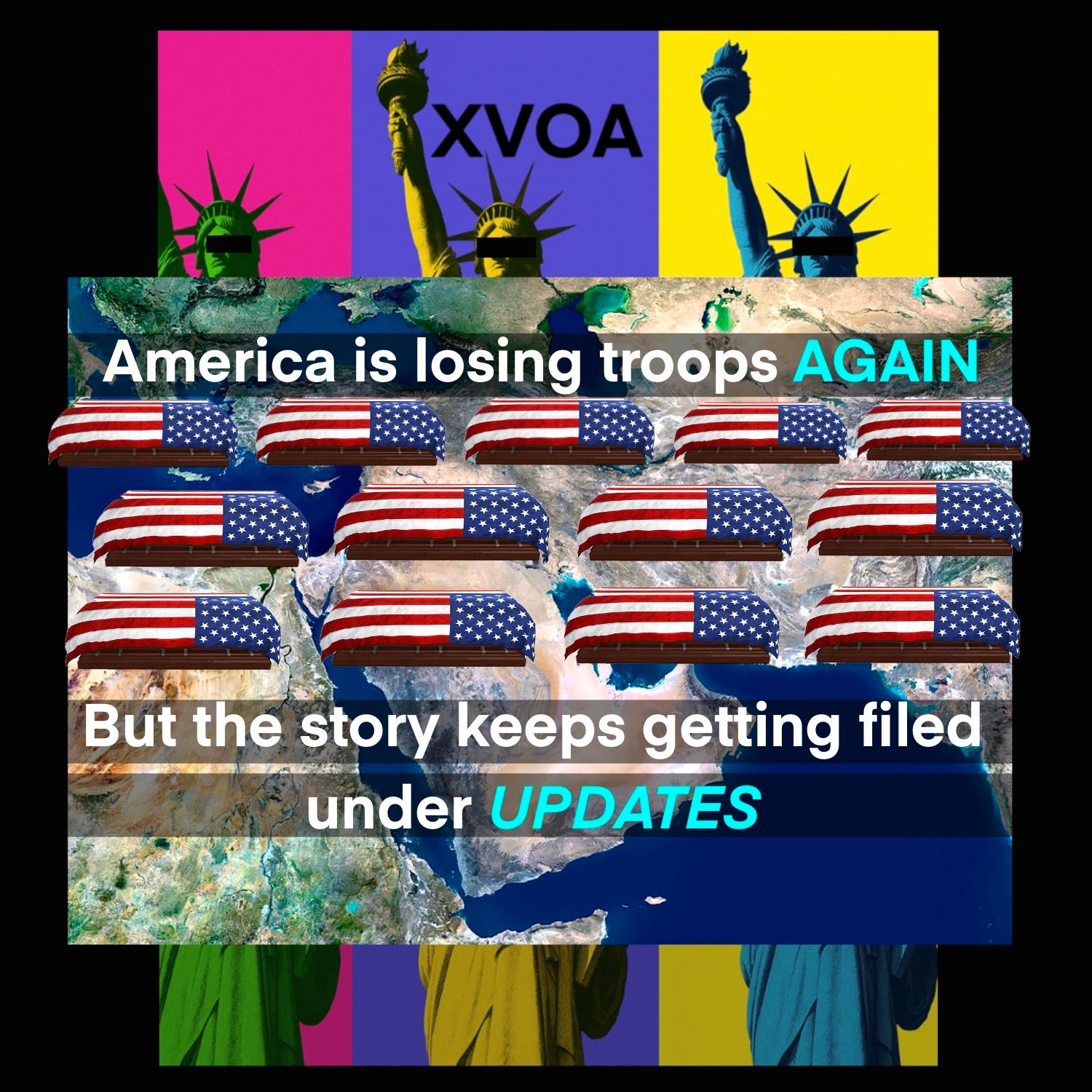
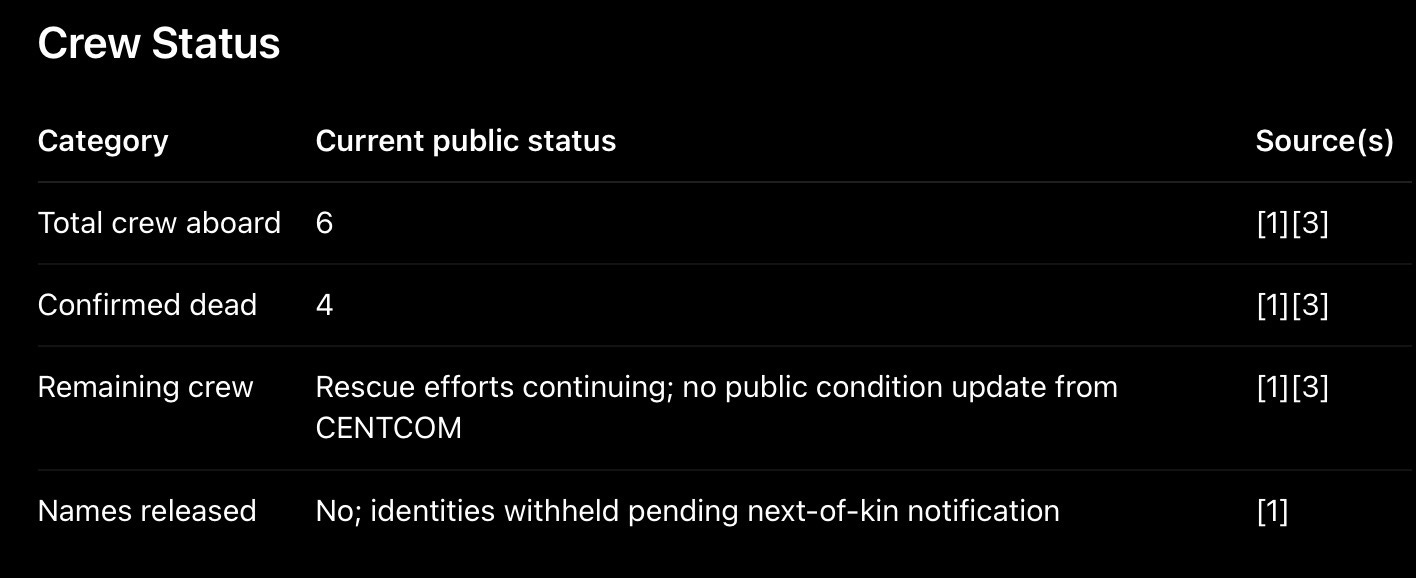
CENTCOM says the KC-135 went down in western Iraq at approximately 2 p.m. ET on March 12. Four of the six crew members have now been confirmed dead, and rescue efforts continue for the remaining two. CENTCOM says the crash was not caused by hostile fire or friendly fire. [1][2][3]
The crash involved a second aircraft that landed safely. Multiple outlets, citing U.S. officials, reported that the other aircraft was also a KC-135, but CENTCOM has not publicly identified the second aircraft by type in its own statements. [2][4][5][6]
This is at least the fourth publicly acknowledged U.S. aircraft loss since Operation Epic Fury began. Stars and Stripes later put the total U.S. dead in the operation at 11, including this tanker crew, while some earlier outlet tallies were still working from lower numbers before Friday’s confirmations. [8][9][12]
The evidence this morning does not support a strong claim that the crash was ignored. Major outlets mostly gave it standalone treatment. The more precise point is that the deaths were rapidly absorbed into the grammar of rolling war coverage, logistics language, and update culture. [5][6][7][8][9][13]
Restack it and share it. Send it to one person who still thinks war only counts as war when the dead dominate the front page.
If you want more reporting like this, become a paid subscriber:
If a full subscription is not your move right now, you can support this work here:
What Happened
Update 1045am ET: The U.S. military now says all six crew members are dead after the KC-135 refueling aircraft crash in western Iraq. Reuters reported the full fatality confirmation Friday, while AP reported earlier that Central Command said the aircraft loss was not due to hostile fire or friendly fire. Strip away the euphemisms and this is what escalation looks like: another U.S. military death story folded into a war already driving price shocks, civilian casualties, and widening regional instability.
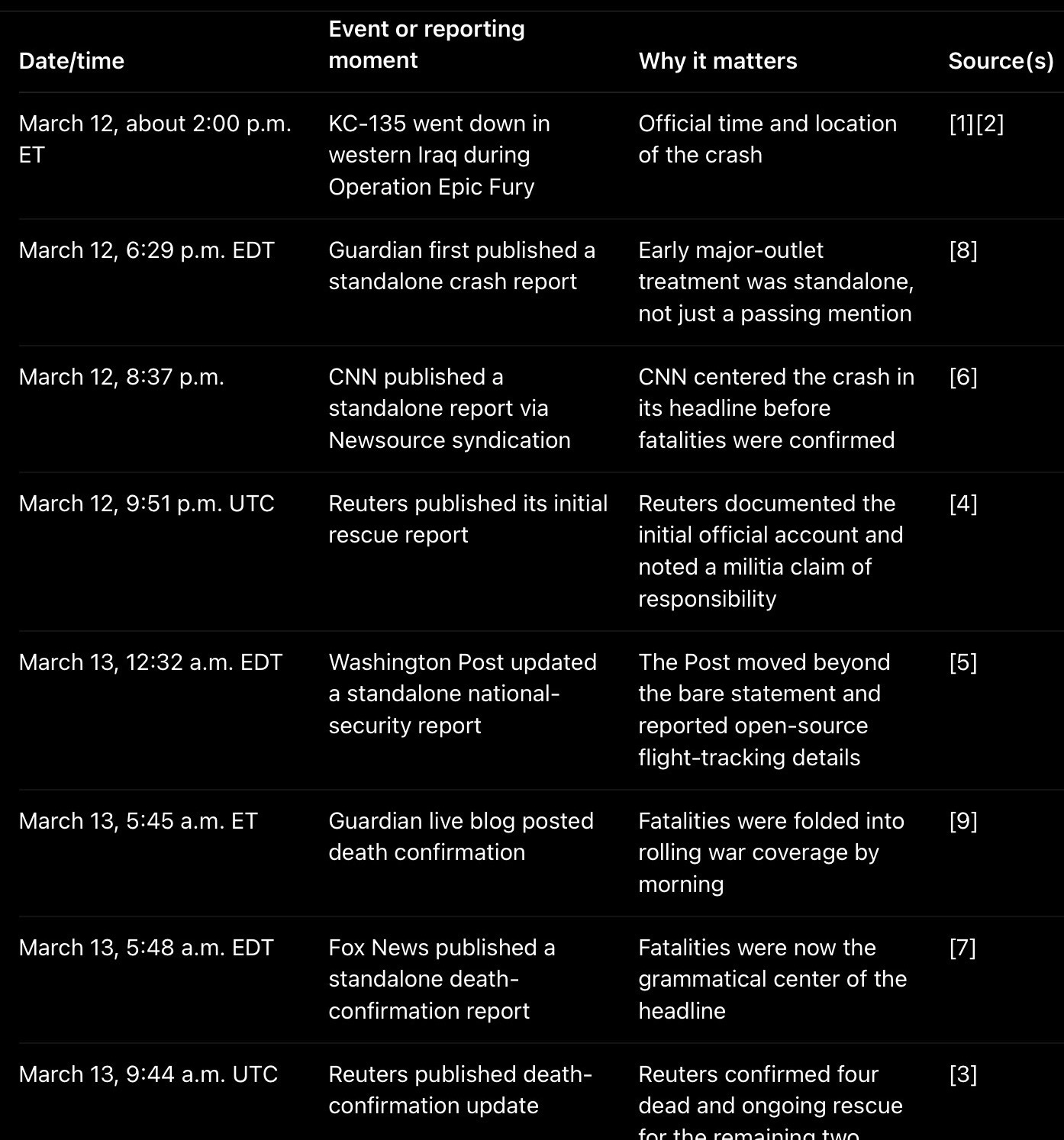
At about 2 p.m. ET on Thursday, March 12, a U.S. KC-135 refueling aircraft went down in western Iraq during Operation Epic Fury. On Friday morning, U.S. Central Command said four of the six crew members had been confirmed dead, rescue efforts were still underway for the remaining two, and the loss was not caused by hostile fire or friendly fire. The crash is already being counted as the fourth publicly acknowledged U.S. aircraft loss since the war with Iran began on February 28. The immediate facts are grim enough. The deeper question is what it means when repeated American aircraft losses and service-member deaths begin to read like normal campaign maintenance instead of a political alarm. [1][2][3][12]
Why This Matters
A tanker is not background equipment. The Air Force’s own fact sheet says the KC-135’s primary function is aerial refueling and airlift. Its crew normally includes a pilot, co-pilot, and boom operator, with some missions requiring a navigator. In plain English, this aircraft is one of the machines that keeps the air war in the air. When one goes down in what the military itself describes as friendly airspace, that is not just a sidebar. It is a stress signal about tempo, complexity, and system strain, even before investigators assign a cause. [10][11]
As a veteran who spent four years in the Army, including time in South Korea and Walter Reed, I know how fast the language can flatten a military death into a procedural update. A tanker goes down. Rescue efforts continue. Families are being notified. Then the public scroll moves on. But a refueler is not a spreadsheet entry. It is a flying hinge in a larger war machine, and six people were inside it.
The stronger evidence this morning is not that the crash vanished. It is that the crash was immediately processed through a familiar wartime filter: first the systems language, then the casualty update, then the broader campaign rolls forward. That is how normalization works. Not by silence alone, but by repetition, pacing, and the steady shrinking of shock. [5][6][7][8][9]
What We Know This Morning
CENTCOM’s public timeline is clear on the essentials. The command said the incident happened in friendly airspace during Operation Epic Fury, involved two aircraft, and left one aircraft down in western Iraq while the other landed safely. In its Friday update, CENTCOM said four of the six crew members had been confirmed dead and that rescue efforts were continuing. It also repeated that the aircraft was not lost to hostile fire or friendly fire. [1][2]
Reuters’ Friday update added one important point: the remaining two crew members had not been publicly accounted for beyond the statement that rescue efforts were ongoing. Reuters’ earlier reporting, along with AP, CNN, and The Washington Post, said U.S. officials described the second aircraft as another KC-135, but that detail still has not appeared in the formal CENTCOM releases. [3][4][5][6]
The crash is also not an isolated wartime aviation event. The Guardian, CNN, AP, and Stars and Stripes each treated it as the fourth publicly acknowledged U.S. aircraft loss since the start of the Iran war on February 28. Stars and Stripes later reported that, including this tanker crew, 11 U.S. service members have now been killed in Operation Epic Fury. [6][8][9][12]
Timeline of Events and Reporting
What the Coverage Did
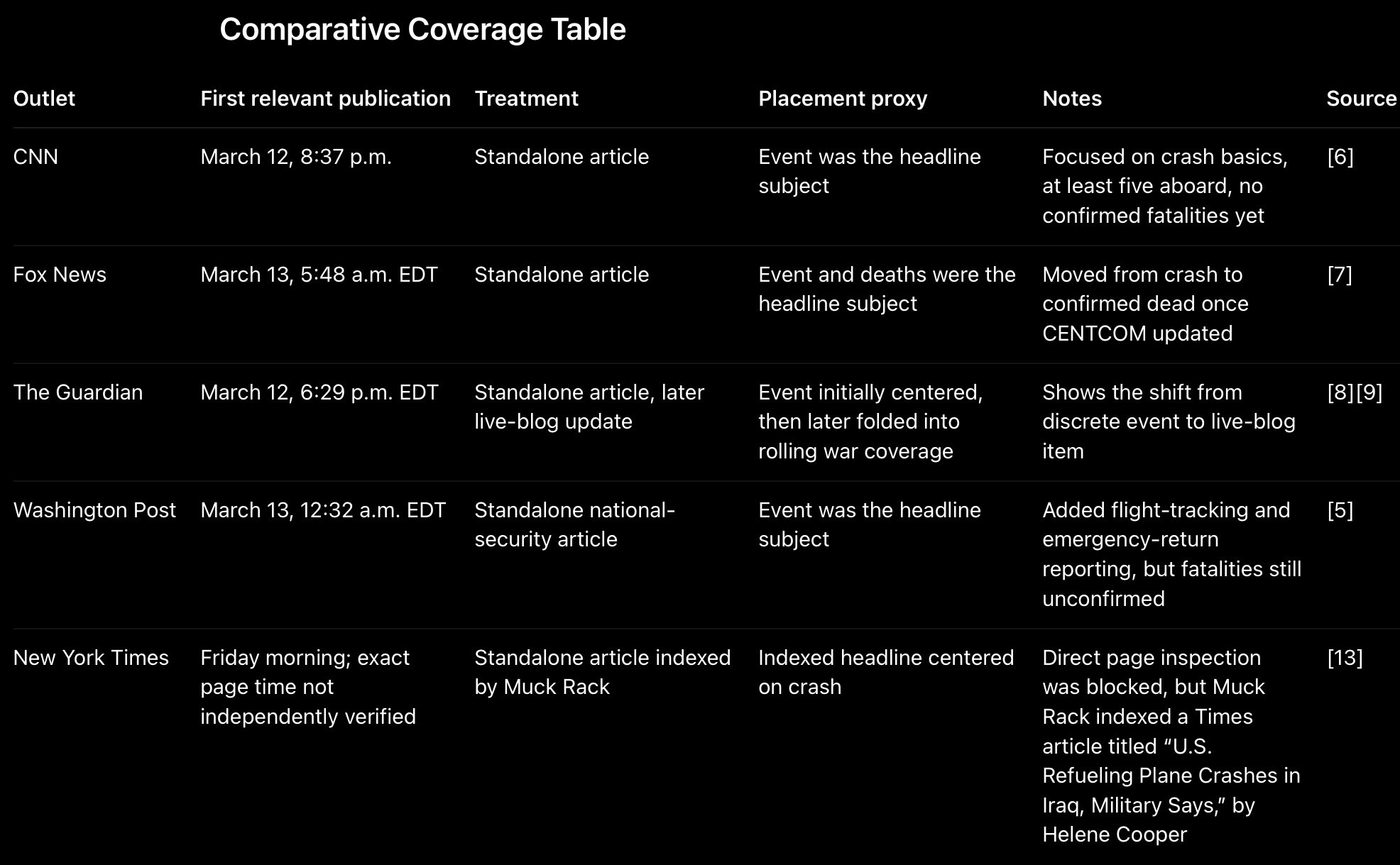
The evidence available by 7:30 a.m. ET points to a more nuanced conclusion than “the media ignored it.” CNN, The Washington Post, Fox News, The Guardian, and an indexed New York Times item all treated the crash as a discrete story at some point, usually with the crash itself as the grammatical subject of the headline. That matters, because it means the strongest available criticism is not non-coverage. [5][6][7][8][13]
But treatment did shift. CNN and The Washington Post published standalone reports while the crew status was still uncertain. Fox’s later standalone report moved the deaths to the top once they were confirmed. The Guardian did both things: it first ran a standalone article, then by Friday morning placed the death confirmation inside a live blog dominated by the wider Iran war. That is not the same as burying the story. It is a form of absorption. [5][6][7][8][9]
The real pattern is compression. A crash that killed four Americans was reported, yes. But it was also quickly translated into the larger operating language of a widening war: sortie support, rescue efforts, rolling strikes, oil shock, Tehran explosions, shipping lanes, retaliation. Once that happens, service-member deaths start sharing oxygen with everything else the campaign machinery produces. [4][8][9]
Comparative Coverage Table
What Remains Unanswered
The central unanswered question is the cause. CENTCOM says the crash was not caused by hostile fire or friendly fire, but that still leaves a wide field of possibilities, including mechanical failure, contact between aircraft, or some other noncombat mishap. The Post reported open-source flight-tracking data showing a tanker returned to Ben Gurion after declaring an emergency and said a photo circulated online appeared to show damage to its vertical stabilizer, though the paper said it could not independently verify that image. [1][5]
There is also an information-war layer already forming around the crash. Reuters reported that the Islamic Resistance in Iraq, an umbrella group of Iran-backed armed factions, claimed responsibility for downing the aircraft. That claim directly conflicts with CENTCOM’s official account and, as of publication, has not been substantiated by the U.S. military’s public statements. [2][4]
Finally, the public casualty picture is still catching up in real time. Stars and Stripes said 11 U.S. service members have now been killed in Operation Epic Fury including this crew, while the Guardian’s earlier standalone report was still citing a lower pre-confirmation total. That kind of lag is common in breaking war coverage. It is also exactly how the public loses a clean sense of scale. [8][12]
Crew Status
Why Placement Matters
When a tanker goes down in friendly airspace, the story is not only about one aircraft. It is about the health of the campaign system behind it. The KC-135 is the refueling backbone that extends range and endurance for other aircraft. If that system starts producing repeated losses, then the public deserves more than a rolling sequence of “incident,” “ongoing,” and “under investigation.” [10][11]
That is why placement matters even when outlets technically cover the event. A death-confirmation line inside a war live blog does something psychologically different from a story that forces readers to stop and ask what four aircraft losses in roughly two weeks says about the campaign itself. The first format updates the war. The second format interrogates it. [8][9][12]
Historical or Structural Warning
The KC-135 is old. The Air Force says the last KC-135 was delivered in 1965, though the fleet has undergone life-cycle upgrades meant to improve reliability. The official museum description of the aircraft also underscores how delicate the mission is: the boom operator physically guides the nozzle into the receiving aircraft, and the operation requires precise and steady flying by both aircraft. None of that proves age or mission complexity caused this crash. It does, however, establish the structural backdrop: this war is being flown through a high-risk refueling architecture built on old airframes and exacting procedures. [10][11]
That does not excuse overreach or speculation. It does mean the public should resist the temptation to hear “not hostile fire” and translate it into “nothing deeper to ask here.” [1][10][11]
The Real Question
So is this the new normal? Not in the shallow sense that “war is dangerous.” Everybody knows that already. The harder version is this: are Americans being trained, in real time, to accept expanding war, repeated aircraft losses, drifting casualty counts, and incomplete explanations as ordinary background conditions of foreign policy? [3][8][12]
Because that is what the pattern looks like from here. Four confirmed dead. Two still being searched for. A second aircraft safely down but surrounded by unanswered questions. A militia claim colliding with an official denial. Major outlets covering the story, but quickly moving it into the larger weather system of the war. That is not a media blackout. It is something arguably more dangerous: normalization with receipts. [1][4][5][8][9]
If a country can watch a refueling aircraft fall out of the sky over “friendly airspace,” lose four service members, and fold the whole thing into the morning’s operational churn, then the question is no longer whether this war is escalating. The question is whether the public’s threshold for what counts as escalation has already been reset. [1][2][12]
Before This Becomes Normal
If you do not want this kind of story reduced to a systems update, help me keep dragging it back into human language. Help me keep asking what the pace of this war is doing to the people inside the aircraft, not just the officials briefing the press after the fact.
Become a paid subscriber if you want this newsroom digging after the headlines move on:
If a one-time contribution is more your speed, you can support the work here too:
Sources
U.S. Central Command, “Four Confirmed Deceased in Loss of U.S. KC-135 Over Iraq” - official confirmation of four deaths, approximate crash time, and continuing rescue efforts.
U.S. Central Command, “Loss of U.S. KC-135 Over Iraq” - initial official statement confirming two aircraft were involved, one landed safely, and the event occurred in friendly airspace during Operation Epic Fury.
Reuters, “Four US service members killed in plane crash over Iraq” - confirms four of six crew dead and that rescue efforts continued for the remaining two.
Reuters, “US carrying out rescue effort after military aircraft crash in Iraq” - early account of the crash, including the militia claim of responsibility and the official statement that the loss was not due to hostile or friendly fire.
The Washington Post, “U.S. Air Force refueler crashes in Iraq while supporting Iran war” - standalone national-security report with flight-tracking details and the unverified image of damage to the surviving aircraft.
CNN via KVIA, “US Air Force refueling plane crashes over Iraq, at least five crew on board” - syndicated CNN report showing early standalone treatment and publication timing.
Fox News, “4 US service members killed in refueling aircraft crash in Iraq” - standalone death-confirmation report with 5:48 a.m. EDT publication time.
The Guardian, “Rescue effort under way as US military refuelling plane crashes in Iraq” - early standalone report showing how the crash was framed before fatalities were confirmed.
The Guardian live blog, “Four crew members confirmed dead in US plane crash in Iraq” - morning live-blog update showing how the death confirmation was folded into rolling war coverage.
U.S. Air Force fact sheet, “KC-135 Stratotanker” - official aircraft background on mission, crew composition, inventory, and delivery history.
National Museum of the U.S. Air Force, “Boeing KC-135R Stratotanker” - official explanation of the boom-refueling process and the precision required from both aircraft.
Stars and Stripes, “Four confirmed dead in KC-135 crash, CENTCOM says” - military-focused reporting on the fourth aircraft loss and the current 11-dead tally for Operation Epic Fury.
Muck Rack index for The New York Times, “U.S. Refueling Plane Crashes in Iraq, Military Says” - independent index showing a standalone Times item by Helene Cooper, used here only to assess treatment because direct Times access was blocked.
Our minds control our bodies and our minds tell us that once our bodies go, so too do our minds.
So why do we men still wage wars?
We know they defy reason. We know they solve nothing. We known they kill more innocents than combatants. We know they only destroy.
Are we literally insane?
Seemingly specious questions but they must be asked or they will never be answered.
We men, some of us, are destroying lives which can never be regained and flattening irreplaceable structures that will never be replaced
Deadly and deformed egotistical pursuits that must end before one among us takes it upon himself (and it will be a man) to push the final button
Thanks MAGA America. This is all on you!