


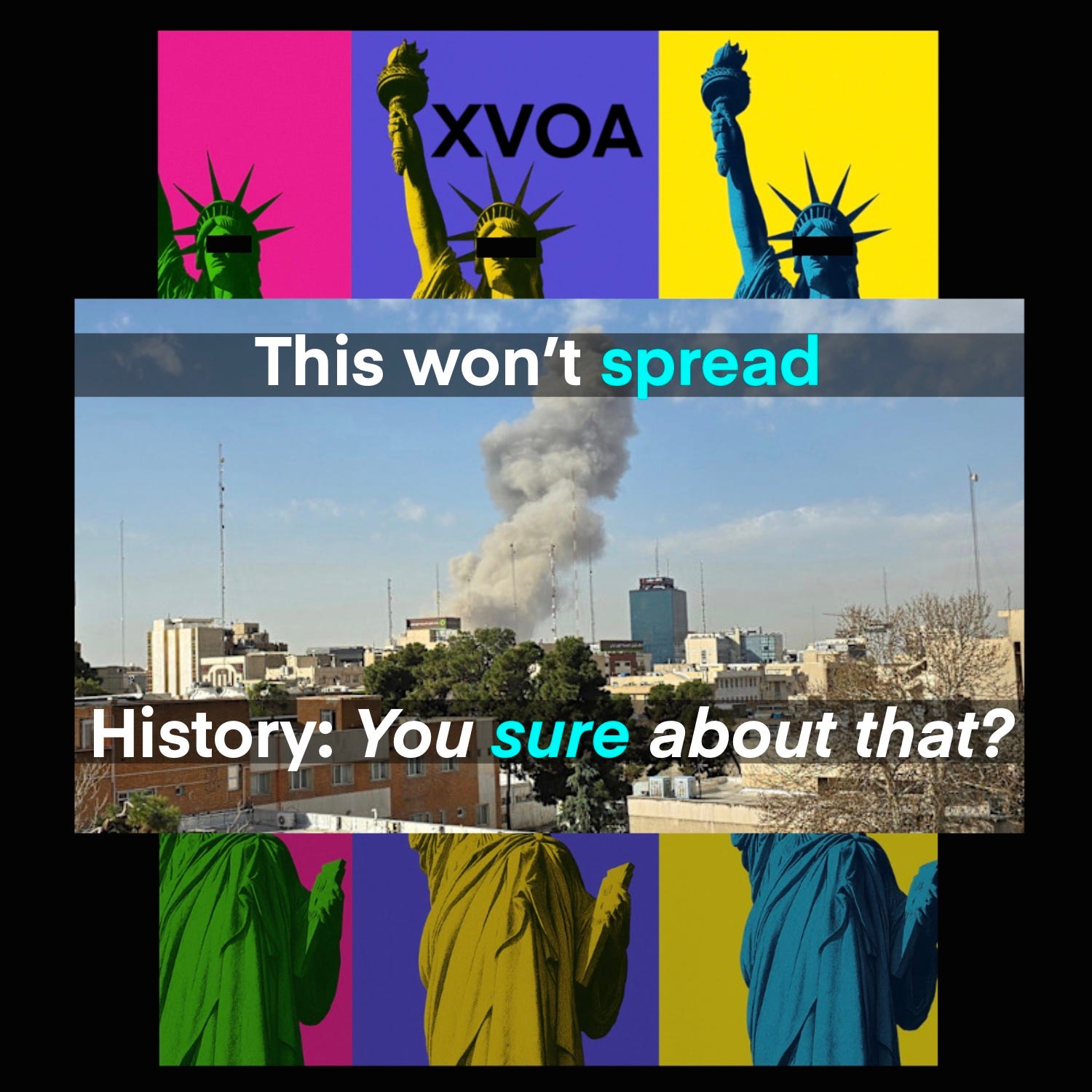
Early Saturday, Feb. 28, 2026, the United States and Israel launched strikes on Iran, a major escalation that could expand quickly if Iran retaliates against Israel, U.S. forces in the region, or both. [2] I wasn’t surprised when I saw the alert—after days of military buildup and worsening military brinkmanship, this was the direction things were leaning but I did feel some kind of way at how quickly it moved from threat to action. [3][4] According to the Associated Press, explosions were reported in and around Tehran, and Iran launched missiles toward Israel soon after the strikes began. [2]
This story is moving in real time. But one thing is already clear: the U.S. is not describing this as a limited action. [1]
What happened
Israel says it carried out a “preemptive” attack. [2] Early reporting says the U.S. joined the operation. [2] The AP described strikes hitting multiple sites and said one of the early attacks was near the area of Iran’s Supreme Leader’s offices. [2] The AP also reported that Iran responded with missile launches toward Israel, setting off warnings and emergency measures. [2]
In other words, this is not only a question of what was hit in Iran. It is a question of what comes next, and how fast the cycle of strike and counterstrike spins. [2]
What President Trump said within the last hour
President Donald Trump posted a video statement on Truth Social saying the United States had begun “major combat operations” in Iran. [1] Reuters reported that he framed the mission as defending Americans by eliminating what he called “imminent threats” from Iran, and that he warned there may be U.S. casualties. [1]
Trump also described the target set in unusually broad terms. Reuters reported that he said the strikes were aimed at destroying Iranian missiles and “annihilating” Iran’s navy. [1] That is not the language of a one-night raid. It signals sustained pressure across multiple parts of Iran’s military power. [1]
Then Trump moved from military aims to political aims. Full-text versions of his statement published by multiple outlets include an ultimatum to Iran’s security forces to lay down their weapons, paired with a promise of immunity, and an appeal to the Iranian public to “take over your government” after the bombing ends. [8][9]
If you were waiting for a clear sign that this is drifting toward regime-change logic, that is the sign. [8][9]
Why this is different from a “strike” headline
In public, officials often sell an attack as precise and limited. In reality, wars widen because of retaliation and momentum.
The first problem is retaliation. Once Iran is hit, Iran’s leaders have to decide how to respond in a way that looks strong at home and credible abroad. [2] Iran’s options are not limited to one lane. It can hit Israel with missiles and drones. [2] It can target U.S. forces and bases in the region. [2] It can push conflict sideways through allied militias. It can also create maritime risk that shakes global markets. [7]
The second problem is the map. The Strait of Hormuz is not a theory. It is a narrow, real-world corridor that carries a huge amount of global energy shipping. CENTCOM warned in a January 2026 statement that the Strait is an essential trade corridor and noted that roughly 100 merchant vessels transit the strait on a given day. [7] That is why even the fear of disruption can move prices.
The third problem is mission creep. Trump’s own framing widens the mission. [1][8][9] Once you make it about missiles, ships, and “imminent threats,” you create a logic where the next step always feels justified. [1] After missile sites come command sites. After command sites come internal security nodes. Then the question becomes whether a regime can still govern.
The buildup did not start today
This escalation has been building. In late February, reporting described one of the largest U.S. force postures in the Middle East in decades. [3] An AP report published by Military Times said the U.S. had assembled a major concentration of warships and aircraft, including two aircraft carrier strike groups and large numbers of supporting aircraft. [3]
Separate Reuters reporting described a sharp rise in support aircraft at Prince Sultan Air Base in Saudi Arabia, based on satellite images. Reuters reported that the number of aircraft visible at the base rose sharply during a four-day window, including refueling tankers and airborne early warning aircraft. [4]
That context matters because it suggests planning and preparation for sustained operations, not a single moment. [3][4]
The nuclear backdrop is not going away
This war is happening in the shadow of a nuclear verification crisis.
On Feb. 27, Reuters reported on a confidential International Atomic Energy Agency (IAEA) report calling inspections “indispensable and urgent,” and pointing to concerns about uranium enriched up to 60% stored in an underground tunnel complex at Isfahan. [5] The IAEA issue here is not only enrichment levels. It is uncertainty. When inspectors cannot verify what exists and where it is, decision-makers fill the gap with worst-case assumptions. [5]
The Associated Press reported around the same time that the IAEA said it could not verify whether Iran has suspended enrichment or determine the size and location of Iran’s enriched uranium stockpile due to restricted access. [6]
When verification breaks down, diplomacy gets narrower and military logic gets louder. [5][6]
What Iran is likely to do next
Iran’s response will shape everything. The AP reported Iran launched missiles toward Israel soon after the strikes. [2] If Iran expands that response, there are a few likely directions.
One direction is direct attacks on Israel that continue for days, not hours. [2] Another is attacks on U.S. bases or personnel in the region, which would sharply raise the risk of a wider U.S. campaign. [2] Another is maritime pressure that raises the risk level in the Gulf and rattles global markets. [7]
Iran can also combine these options. That is part of what makes this moment dangerous.
What to watch in the next 24 to 72 hours
The first sign is whether Iran targets U.S. forces directly. If that happens, Washington’s political pressure to expand targets and duration will rise fast. [2]
The second sign is whether U.S. and Israeli officials confirm follow-on waves. Trump’s phrase “major combat operations” is a signal that more strikes are expected. [1]
The third sign is whether any serious incident occurs near major shipping routes. Even without a formal closure, a single high-profile maritime event can trigger a global price spike. [7]
The fourth sign is whether governments widen evacuations, close airspace, or pull diplomats. These are practical signals that officials expect escalation.
The fifth sign is rhetoric. When leaders start speaking in terms of surrender, immunity, and “take over your government,” they are no longer describing a limited mission. [8][9]
What this means for Americans at home
Foreign wars come home quickly.
Prices can move fast, especially if shipping risk rises. [7] Cyber retaliation is also a common feature of state conflict, and it can show up as disruptions, attacks, or “gray-zone” chaos that is hard to pin on one actor in the moment. And politically, war creates emergency weather. It can be used to demand unity, rush decisions, and frame critics as disloyal.
Bottom line
Tonight’s most important question is not whether the strikes happened. They did. [2]
The question is what kind of war the U.S. just entered. Trump’s own words, and the full-text versions of his statement, point toward a campaign with broad military targets and explicit political messaging aimed inside Iran. [1][8][9]
If Iran retaliates hard, and if the U.S. answers by expanding objectives, this can become a wider regional war with no clean off-ramp. [2][1]
If you want more reporting like this, please consider becoming a paid subscriber. It helps fund the time it takes to pull documents, track updates as they drop, and keep writing fast without waiting on permission from a corporate newsroom. Paid support also helps me keep key posts open for readers who can’t swing a subscription but still need to know what’s being done in their name.
Sources
Reuters (Feb. 28, 2026): Trump says U.S. began “major combat operations” in Iran — Summary of Trump’s video statement, targets described, and warning about possible U.S. casualties.
AP (Feb. 28, 2026): U.S. and Israel launch strikes on Iran as Iran retaliates — Breaking coverage of strikes in Iran, impacts in Tehran, and early Iranian missile response.
Military Times / AP (Feb. 26, 2026): U.S. assembles largest force posture in decades in the Middle East — Reporting on U.S. warship and aircraft buildup and what it suggests about readiness.
Reuters (Feb. 27, 2026): Satellite images show more aircraft at Saudi airbase used by U.S. forces — Satellite-based reporting on support aircraft buildup at Prince Sultan Air Base.
Reuters (Feb. 27, 2026): IAEA report says Iran stored highly enriched uranium at Isfahan tunnel complex — Summary of confidential IAEA reporting and verification concerns.
AP (Feb. 27, 2026): IAEA says it cannot verify enrichment pause or stockpile location — Reporting on inspection limits and the loss of monitoring continuity.
CENTCOM (Jan. 30, 2026): Statement urging safe conduct during IRGC naval exercise in the Strait of Hormuz — Official U.S. statement describing Hormuz as an essential trade corridor.
Times of Malta (Feb. 28, 2026): “Read his statement in full” — Full-text publication of Trump’s remarks, including surrender and regime-change language.
The National (Feb. 28, 2026): Full text of Trump declaring war on Iran — Full-text publication of Trump’s remarks as posted on Truth Social.
Thank you for this very clear report on a subject that's so emotional for so many. This is one of many reasons why I went paid, and why I came to your Substack first when I got up (too early) this a.m.
EPSTEIN EPSTEIN EPSTEIN EPSTEIN EPSTEIN EPSTEIN EPSTEIN EPSTEIN EPSTEIN EPSTEIN EPSTEIN EPSTEIN EPSTEIN EPSTEIN EPSTEIN EPSTEIN