



My eyes were sandy, my fingertips felt like chalk, and my thumb kept drifting toward the Netflix app like it had a mind of its own. It was Friday night. You’re tired. I’m tired. The country is tired. Most of us just want to clock out of doomscrolling and pretend, for a few hours, that the next bill is not already waiting in the mailbox.
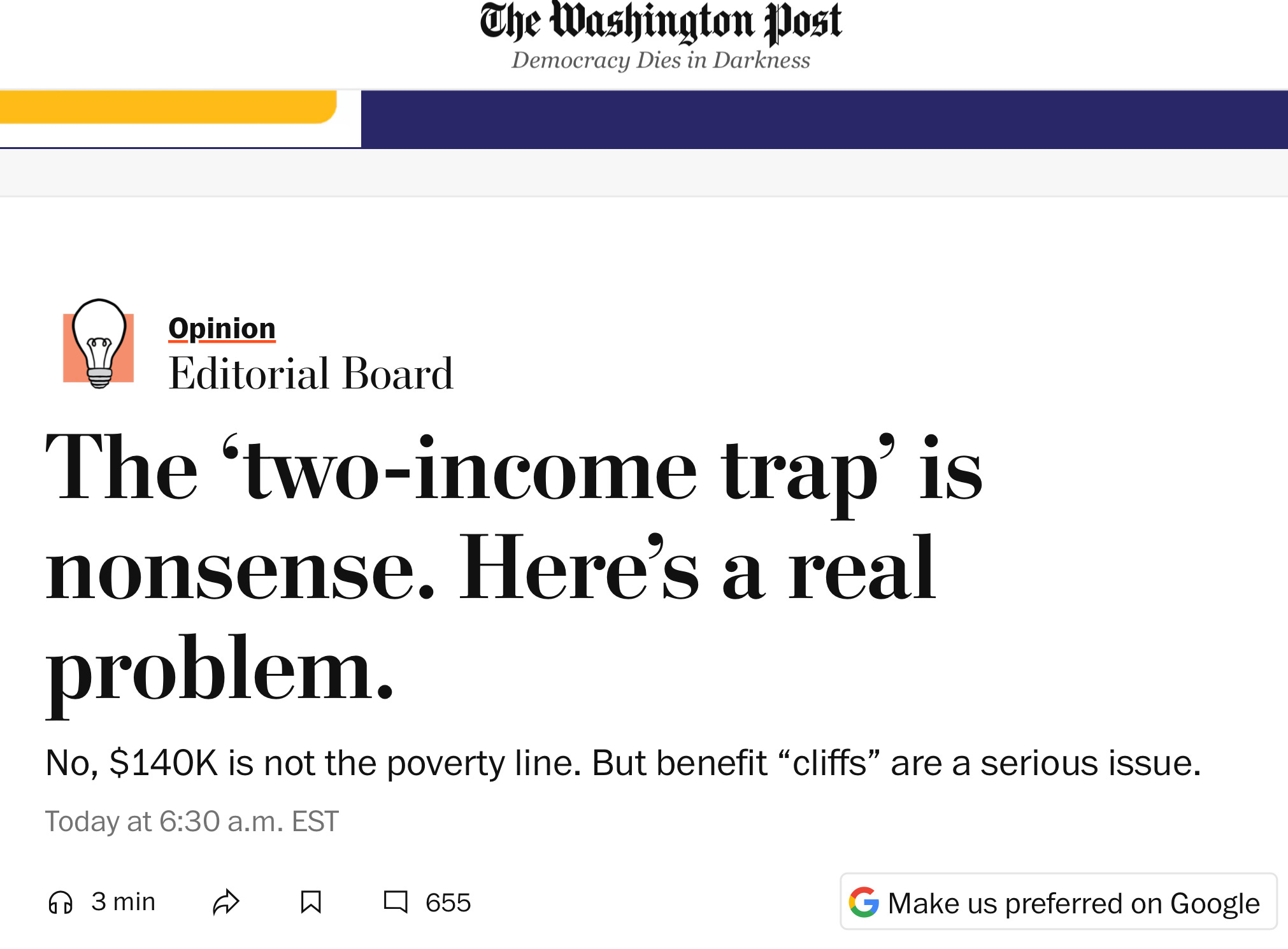
That is exactly when I stumbled across a tiny opinion piece from the Washington Post, Jeff Bezos’s newspaper. A short, timid little column, published late in the week, taking aim at a Substack writer named Michael W. Green. Not a billionaire. Not a senator. A guy with a spreadsheet, a brain, and a paid post called “My Life Is a Lie: How a Broken Benchmark Quietly Broke America.” by Michael W. Green
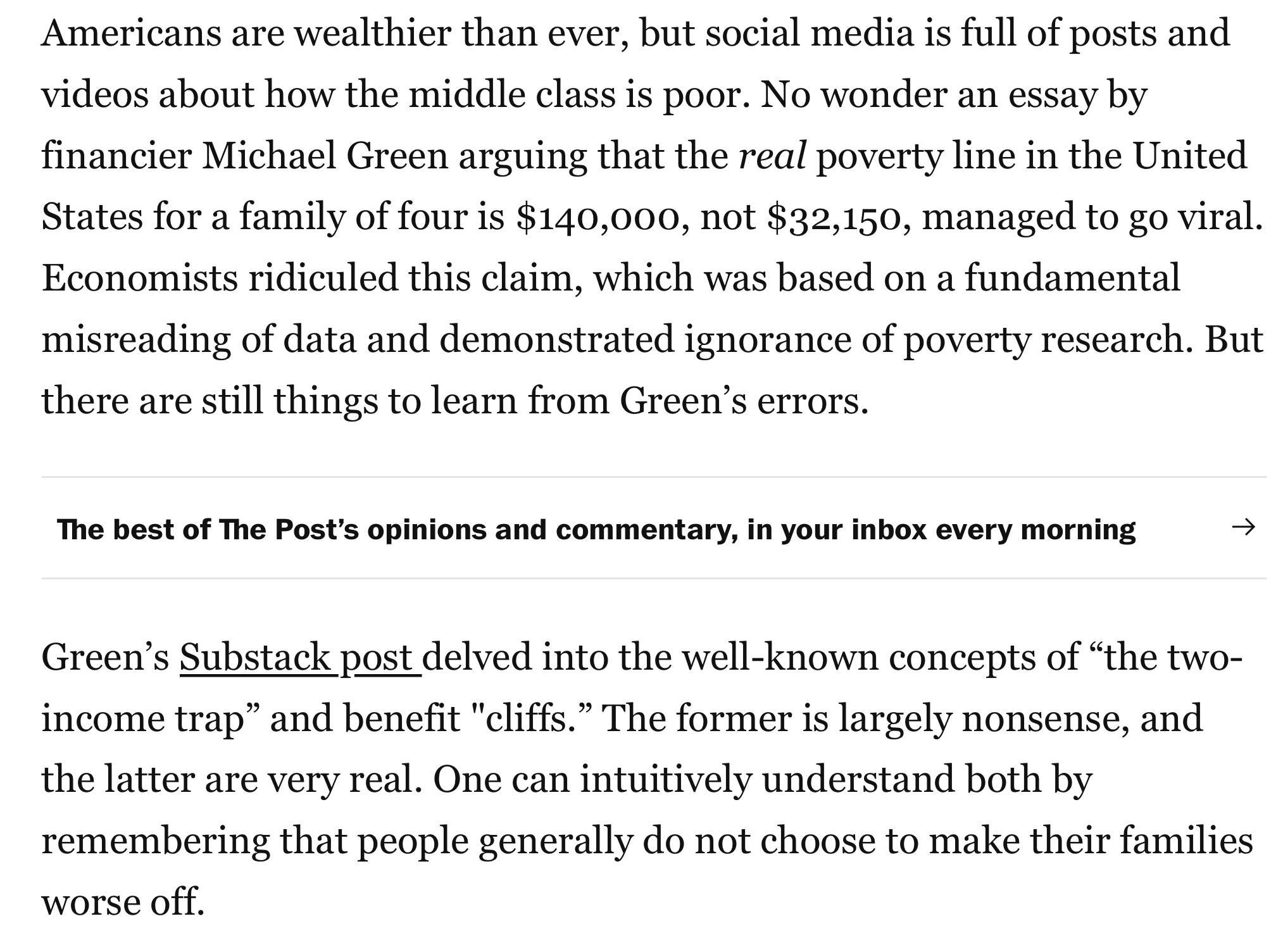
If you missed Green’s piece, here’s the one-sentence version: he went back to the original 1960s poverty formula, applied the same logic to today’s actual cost of participation (housing, childcare, healthcare, transportation), and came away with a blunt conclusion. For a family of four, the real “too little to function” line is not thirty-one thousand dollars. It is somewhere around one hundred forty thousand. In his words, most of the “middle class” is actually the working poor, stuck in a “Valley of Death” where every raise strips away benefits faster than wages rise.
The Post’s response, which I’ll call the “two-income trap is overblown” piece, does not really engage that math. Instead, it uses Green as a cautionary tale about “flashy commentary” that misreads data, pats itself on the back for knowing poverty research, and reassures readers that the real problem is limited to “poor, working families,” not the broad middle he is talking about. In other words: relax, the benchmarks are fine, and if you feel like you are drowning at seventy, eighty, or ninety grand, that is a vibes issue, not a numbers issue.
So let me be very clear about the sides here. Michael Green is the one sitting at his laptop, doing the ugly arithmetic of what it actually costs to keep a roof over kids’ heads and stay out of collections. Bezos’s paper is the one publishing a skinny Friday column that swats at him instead of admitting the possibility that their beloved poverty line is a museum piece that no longer describes American life.
And that Friday timing is not an accident. If the Washington Post truly believed this was a solid takedown, they would not bury it at the very moment when the people Green is writing about are wiping down restaurant tables, driving Uber, or trying to forget the week ever happened. They tossed out a quick rebuttal on the least-read day of the news cycle, just enough to say to donors and dinner-party friends, “See, we handled that,” without really inviting the middle-class families in the blast radius to read it, argue with it, or see themselves in it.
Before we even touch the Washington Post, let’s ground ourselves in what Michael W. Green actually said because his argument isn’t vibes, it’s math.
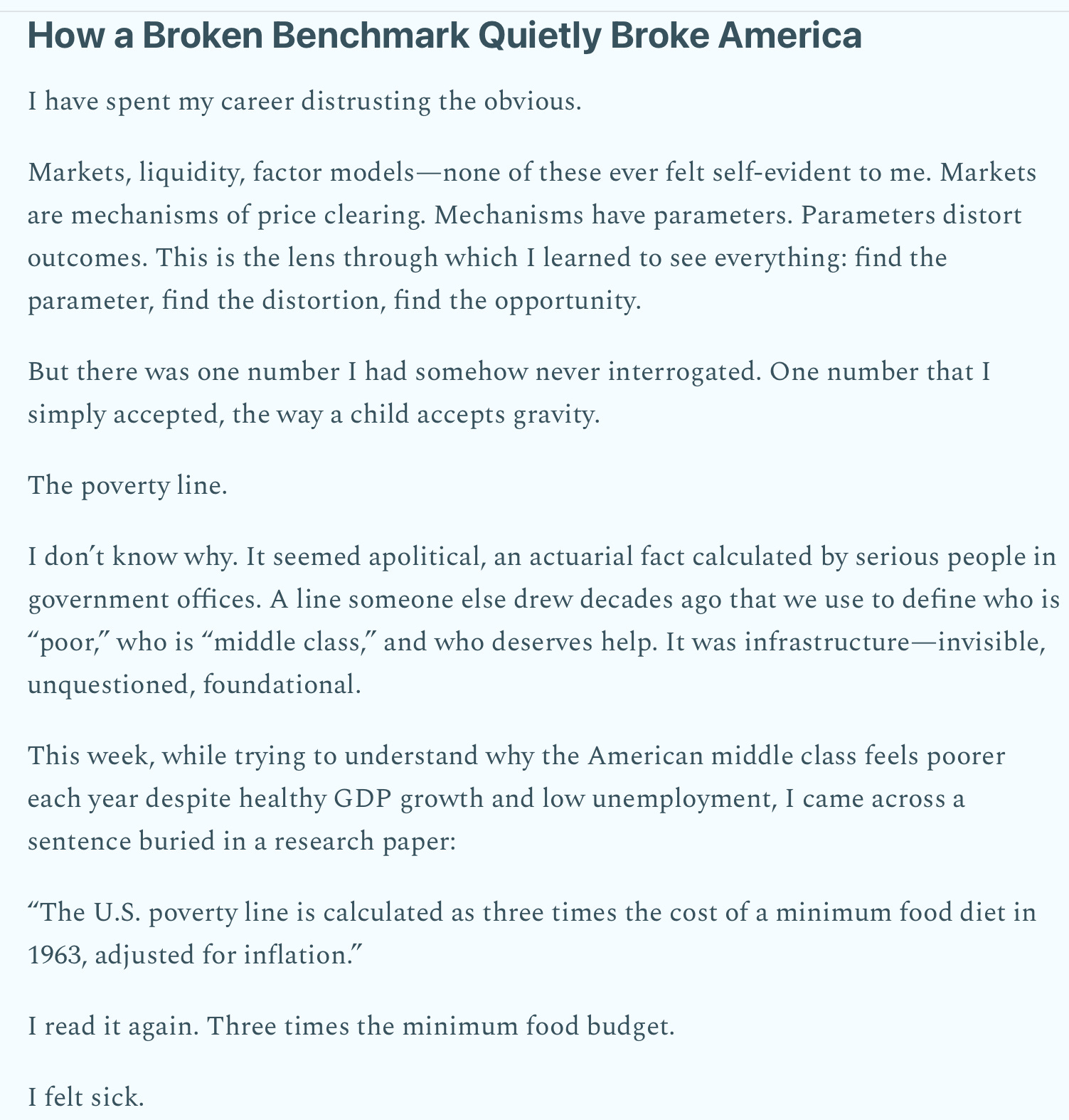
First, he goes back to the original poverty formula created in the early 1960s: take the cost of a bare-bones food budget and multiply it by three. That worked back then because food made up a third of a family’s expenses.
Today, food is 5 to 7 percent. Housing, healthcare, childcare, and transportation now eat the whole pie. Update the food-share ratio using Orshansky’s own logic and the multiplier isn’t three—it’s sixteen.
Second, plug in today’s real “participation costs”—the cost of doing the basics required to function in modern America:
• childcare that costs more than in-state tuition,
• housing where $2,700 rent gets you nothing but keys,
• healthcare where a family premium is a mortgage payment,
• transportation because most of the jobs are now geographically inaccessible without a car.
Add it up, and the true “can this family survive without falling apart?” number for a household of four lands somewhere around $136,000 to $150,000.
Third, he shows why families climbing from $40k to $100k often feel poorer with each raise: every new dollar triggers the loss of Medicaid, childcare help, food assistance, and housing support. His name for it—the Valley of Death—isn’t dramatic. It’s descriptive. Middle-class families aren’t overspending; they’re getting hit with benefit cliffs that erase mobility.
Fourth, he points to the lockdowns as the accidental proof: when the “cost of participation” temporarily vanished—no commute, no childcare, no work expenses—the median family suddenly looked flush. The problem was never laziness. It was structure.
That’s the argument. Straightforward. Documented. Rooted in basic arithmetic and the lived experience of tens of millions of families who feel “middle class” on paper and bankrupt in practice.
Now here’s what the Washington Post, Bezos’s newspaper, chose to do with that argument.
They did not engage the $140,000 threshold.
They did not engage the participation-cost model.
They did not engage the Valley of Death.
They did not engage the lockdown arbitrage.
Instead, in their Friday hit piece titled “The Two-Income Trap Isn’t Really a Trap,” they reduced Green’s entire argument to a caricature: a guy who thinks “working more literally makes you poorer” and then gently explained that “people aren’t that dumb.”
That’s not a rebuttal. That’s condescension dressed as analysis.
Green wasn’t calling anyone dumb.
He was saying the system’s math is dumb.
And the Post answered with a pat on the head and a chart from 1967.
That’s the gap. That’s the tension. And that’s exactly why this fight matters.
How Bezos’s Paper Tries to Make You Feel Crazy
Here’s how the Washington Post tries to talk you out of believing your own bank account.
Move #1: Turn a structural argument into a vibes problem.
Instead of grappling with Green’s $140,000 “too little to function” line, the Post reframes the whole thing as a question of “how people feel about the economy.” If you’re stressed at $80,000 or $100,000, well, that’s unfortunate, but the data says you’re fine. Translation: your anxiety is irrational; the rulers on our spreadsheet are real. Green’s whole point is that the rulers are broken. They never answer that.
Move #2: Pretend Green said “hard work makes you poorer,” then swat that straw man.
The Post acts like Green is arguing that taking a promotion is always a bad idea because “people aren’t that dumb” and can see when it pencils out. But Green’s charts show something more subtle and more damning: there’s a long stretch of income where raises do make you functionally poorer once you lose benefits and pay full freight for childcare and healthcare. He’s not insulting workers’ intelligence. He’s indicting a system where rational choices still leave you drowning.
Move #3: Shrink the trap down to “the poor,” erase the middle.
Bezos’s paper concedes there are “benefit cliffs” for low-income families, then gently insists the middle class is doing okay. That’s the sleight of hand. Green’s entire argument is that the so-called middle class is the working poor now—that the Valley of Death runs right through the $50k–$150k band economists love to color in blue. By confining the problem to “the poor,” the Post lets its core subscriber class off the hook from seeing themselves as trapped too.
Move #4: Hide behind old charts and old language.
The hit piece leans on official poverty stats and mobility charts that assume the 1960s food-times-three poverty line still tells the truth about 2025. Green shows, line by line, that food tracked CPI while everything else to include housing, healthcare, childcare, connectivity went rogue. The Post holds up the old ruler and says, “See? Poverty is down.” Green holds up the receipt from daycare and rent and says, “No, starvation is down. Ruin is up.”
Put all that together, and the emotional message of the Post’s column is simple: if you are exhausted, one bill away from disaster, and somehow still “not poor” on paper, that’s on you. The model is fine. Your fear is a data error. That is why I keep saying, when they came for Michael Green, they came for us. Because what they are really defending is not truth; it is a story where our suffering is a rounding error.
Now picture one of those same opinion hands a few days from now at a Georgetown Christmas party, name tag crooked, jacket off, eggnog poured a little too strong. He has spent the week telling readers that the middle class is fine, that the trap is “mostly for the poor,” that people “aren’t that dumb.” But after his third drink, he is not talking like a chart. He is talking like a man who knows exactly how tight his own mortgage feels, exactly how much his kid’s tuition bill is, exactly how close his own life is to the edge Green described.
He laughs too loud and tells a colleague he is just trying to hang on long enough to get that last tuition check to Harvard paid before he gets the hell out of this game. It don’t hurt now…until it does. He leans in, voice low, breath warm with cinnamon, and lets the sentence slip that never makes it into print: “I didn’t work my way up to this level to be a hit man for some goddamn billionaire.” It don’t hurt now…until it does. For a moment you can see it land on his own face, the way it lands on yours when the card gets declined or the rent jumps overnight. It don’t hurt now…until it does. He knows the rulers are broken, he knows the Friday hit was thin, he knows that every time he tells you the system is working, he is really telling himself a bedtime story. It don’t hurt now…until it does.
Remember this line, because we are coming back to it. “I didn’t work my way up to this level to be a hit man for some goddamn billionaire.” If you felt something in your chest when you read it, you already understand the quiet rebellion this moment is asking of us.
First, let me talk to you directly, Washington Post editorial board. The fact that your “rebuttal” to Michael Green could fit in a matchbox tells me everything I need to know. When the house is on fire and you send out a paragraph and a half, that is not confidence. That is a twitch. That is a tell. Thin copy betrays a thick lie, and both you and I know exactly which side of that line this little Friday item sits on.
I know it’s bullshit and you know it’s bullshit. You know the rulers are broken. You know the old poverty line is a museum artifact. You know that telling people making eighty or ninety thousand a year they are “fine” while they drown in childcare and deductibles is a form of spiritual malpractice dressed up as data. You are not ignorant. You are busy.
And since I am almost certainly on your radar now, let me make one simple request. When it is my turn to stand in the line of your next hit piece, at least have the decency to swing in daylight. Don’t give me a half-hearted, three-graf drive-by quietly slid out on a Friday when you hope no one is sober enough to read it. If you are going to come for a broke Substack writer with a keyboard and a conscience, then come like you mean it.
Because here’s the thing, y’all: I am not writing this just to clap at the Washington Post for sport. I am writing it because every time a billionaire’s paper steamrolls a Karen Attiah, or pretends Dr. Heather Cox Richardson doesn’t exist, or swats at Michael Green instead of wrestling with his math, they are really trying to shut you up. When they tell you the “two-income trap” is overblown, they are telling the single mom in my comments to swallow her rage. When they bury a rebuttal on a Friday, they are counting on you to be too tired to notice.
If you want somebody who will drag this stuff into the light, name names, and stand shoulder to shoulder with the Substackers and readers who don’t have a platform big enough to fight back, that is what I am trying to build here. My goal is simple: to become your voice that walks into these propaganda rooms, points at the broken rulers, and refuses to let them call it rain while we are standing here soaked. A paid subscription is what makes that possible, because it buys me the hours to read, to dig, to write, and to take these swings full time instead of on stolen sleep. If you are able, and only if you are able, you can join the folks already backing this work here:
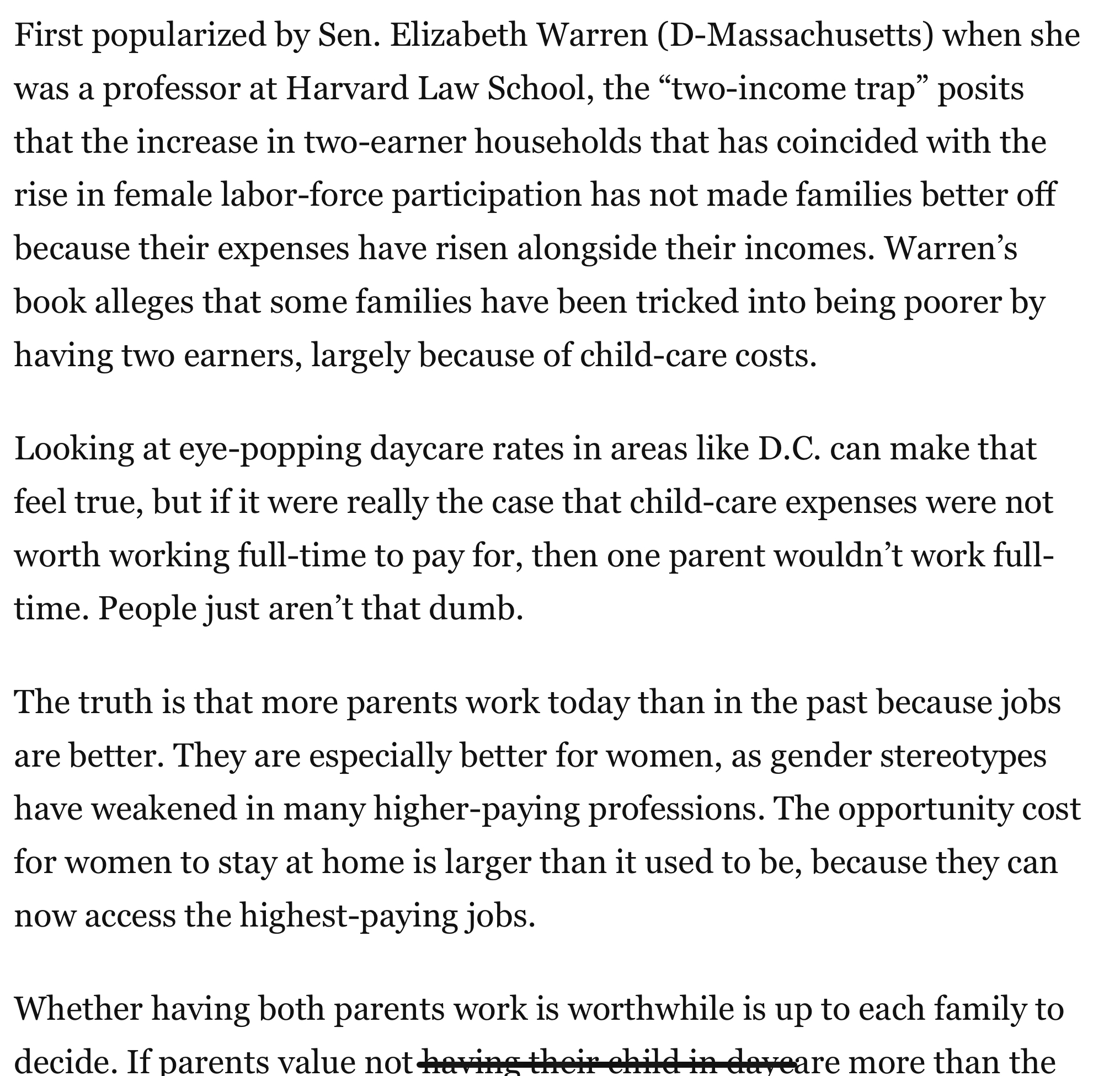
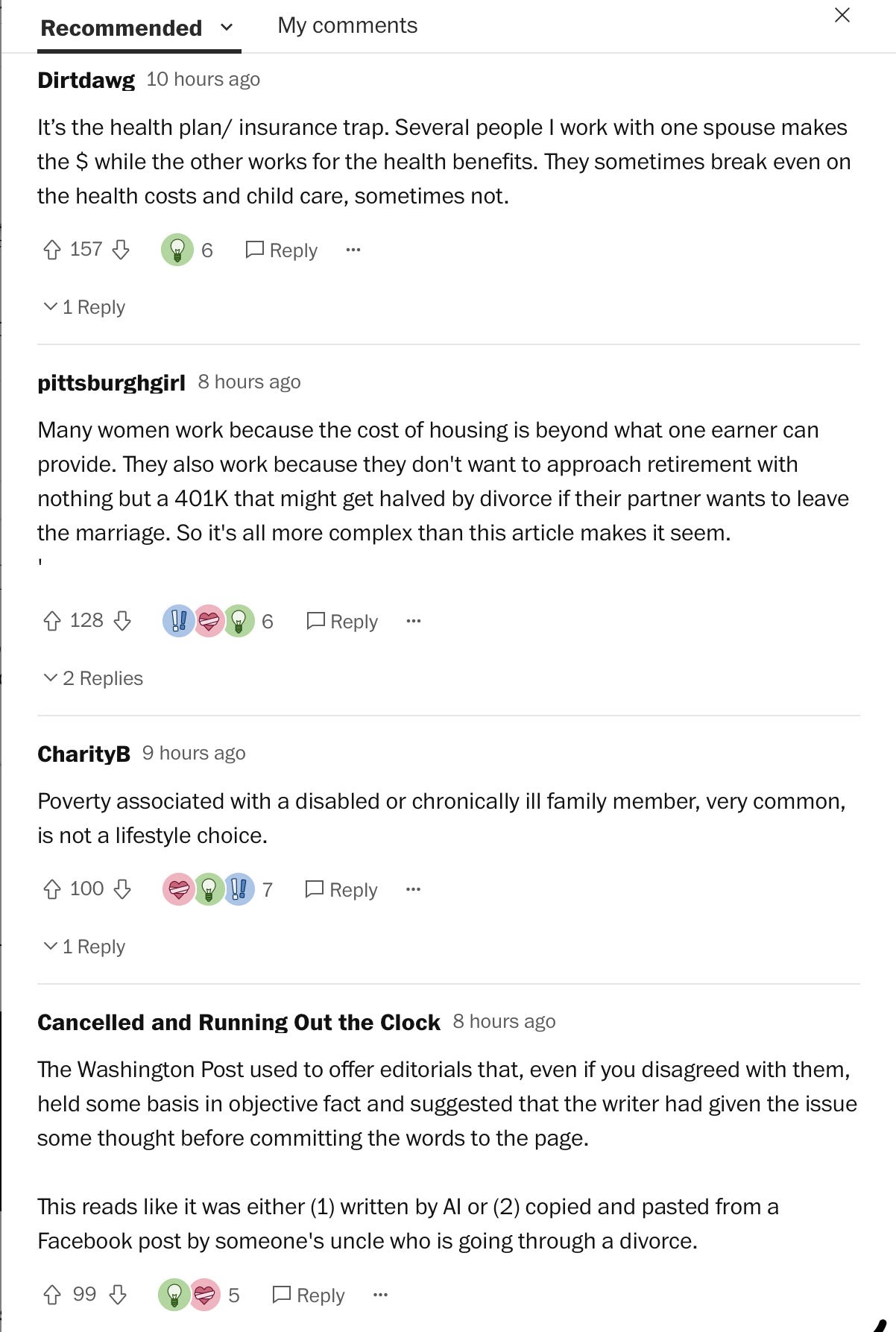
From WaPo's editorial: "Truth is that more parents work today than in the past because jobs are better. Especially for women, as gender stereotypes have weakened..."
Both of these statements are debatable. I bet this wasn't written by a woman.
Well done once again, Mr. Plisset! I especially like your calling out the WaPo unsigned editorials.