

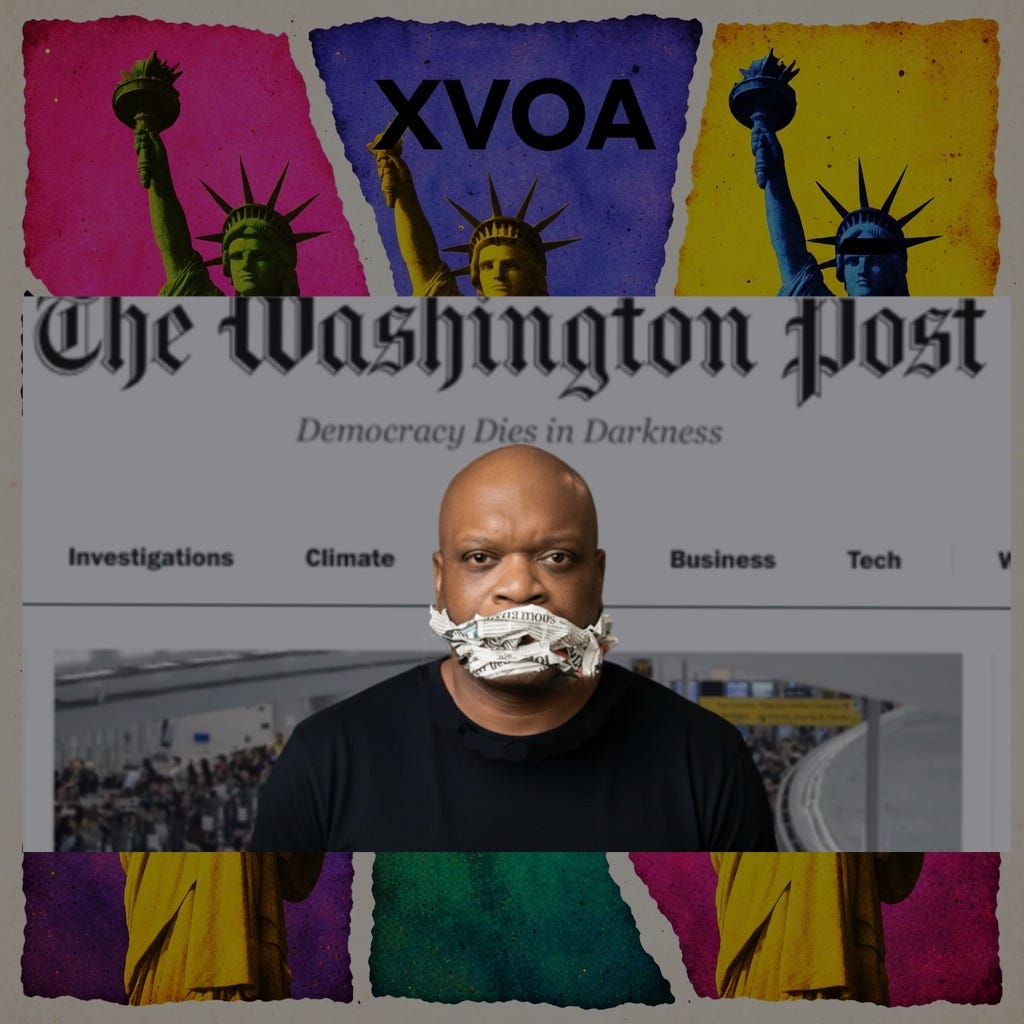
Saturday morning I opened The Washington Post and thought my iPad had slipped into a time warp. I said hold the hell up. This has to be an old tab. Maybe I left some fossil open from three months ago, back when America was still pretending the Middle East was not one stiff breeze away from hell. Because surely, surely, if the United States is in a shooting war with Iran, one of the biggest newspapers in the country is not going to greet me like it is easing me into a zoning dispute and a recipe for lemon bars.
I hit refresh.
Same bullshit.
I hit it again, because I am a retired cop and I know what clean looks like when somebody has wiped the fingerprints off too fast. Same careful, tasteful, mannered homepage. War tucked in there like a guilty cousin at a church banquet. Present, technically. Central, absolutely not. The kind of layout that makes you ask whether we are fighting a war or just trying not to spill wine on the upholstery.
Maybe I was tired. I will own that. Maybe I needed coffee. Maybe I had gotten so used to this country acting crazy that my sense of proportion had finally snapped. But then I saw it. Not the absence of the war. The management of it. That is a different sin. Anybody can miss a story. This felt like a newsroom looking directly at a fire and asking whether the flames could keep their indoor voice.
We are not talking about one of those fake American wars where pundits say “battle for the soul” and then cut to a mattress ad. We are talking about actual bombs, actual retaliation, actual oil shock, actual people with their hands near buttons that can get your cousins killed and your groceries priced like jewelry. [7][8] And The Washington Post, with that church-suit slogan sitting on top of the page like it had not seen a damn thing, decided to present all this like a mild scheduling conflict.
That damn slogan is what sent me over the edge. Democracy Dies in Darkness. Really? Because darkness was not the problem. The problem was the lighting. Mood lighting. Soft lighting. Rich-people restaurant lighting. The kind of lighting that makes disaster look curated. The kind of lighting that says yes, the republic may be sleepwalking into another filthy catastrophe, but let us not be tacky about it.
And that is when I realized I was not just looking at a weak homepage. I was looking at Network with better fonts. Not fake news. Worse. Managed reality. Elegant suppression. The kind of editorial sleight of hand powerful institutions get very good at over time. Do not tell me the war was on the page. I saw it. The point is what they did to its emotional weight. They broke it into pieces. They turned it into gas prices, diplomatic fallout, side effects, aftershocks. They showed me the smoke and hid the fire. That is not informing the public. That is teaching the public how not to feel.
I hate how good The Washington Post is at this shit.
I hate how a paper can look sober while committing narrative malpractice in broad daylight. I hate how the page can say war without letting the reader experience alarm. I hate how the country that gave us yellow journalism, embedded journalism, access journalism, and every other polished form of bullshit still keeps inventing new ways to make catastrophe look normal. And I hate that for about thirty seconds I let the page make me doubt my own eyes.
Because that is the trick, is it not? The trick is not to lie to you outright. The trick is to arrange reality so politely that you feel crazy for reacting at the proper volume. That is what I was looking at. Not a glitch. Not a mistake. A performance. A homepage designed to keep its manners while history kicked the damn door off the hinges.
That is how this essay started. Not with ideology. Not with some graduate seminar theory about media capture. With me staring at a homepage and saying, what the fuck am I looking at? Then hitting refresh like the answer might change. It did not. What changed was me. I could not unsee the move. Watch your body when a front page asks you not to panic. Sometimes that knot in your chest is the only honest headline in sight.
TLDR
The Washington Post did not erase the Iran war. It displaced it, broke it into fallout, sanctions, gas prices, and opinion, and denied it the full visual and moral grammar of emergency. [1][2][3][4][5]
That is why Network is the right lens. The film is about institutions that turn crisis into programming and train the audience to experience catastrophe at a lower emotional volume. [12][13]
This is bigger than one homepage. In a country V-Dem now ranks 51st on liberal democracy, polished institutions are increasingly managing public feeling instead of sounding the alarm. [9]
XVOA’s wager is that independent, reader-backed work can still embarrass power with receipts when legacy brands start asking readers to mistrust their own eyes. [10][11]
Restack it and share it. Send it to one friend who still thinks layout is neutral. If this kind of work helps you see straighter, consider becoming a paid subscriber:
Already subscribed or not ready for that? Buy me a coffee and help me keep this going.
Why Network Is the Right Movie for This Crime
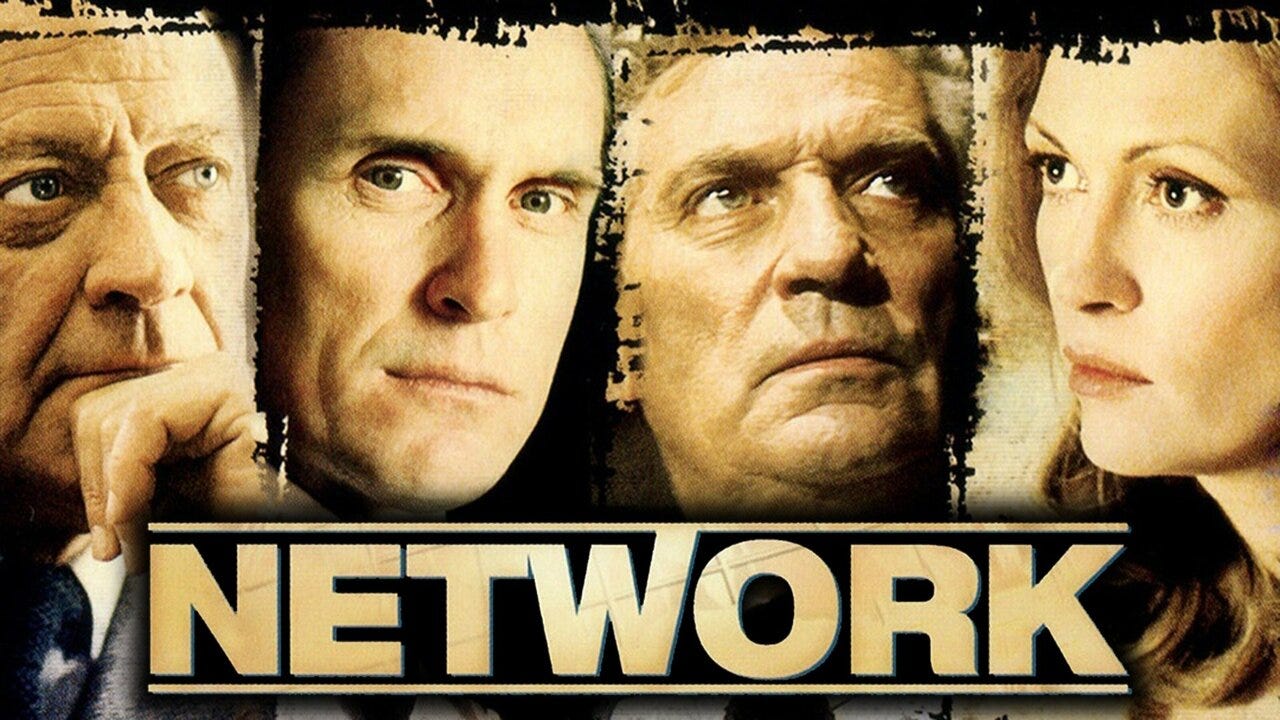
A lot of people remember Network as the movie with the sweating anchor yelling on live television, but let me slow this down because the reference is too important to leave vague. The premise is simple and filthy. A veteran newsman, Howard Beale, has a breakdown on air. Instead of treating that breakdown like a moral and human emergency, the network realizes it can be monetized. His collapse becomes a show. His truth-telling becomes a product. His anguish becomes programming. [12][13]
That is the movie. Not just one man losing it. A whole institution discovering that crisis sells. Everybody in Network starts making the same satanic calculation in different suits: if the public is frightened, angry, confused, or electrified, can we package that feeling, brand that feeling, and hold the audience through the commercial break? The answer in the movie is yes. That is why it still feels less like satire and more like a damn police sketch. [12][13]
The theme is not merely that television lies. The theme is worse. It is that modern media can tell the truth halfway, frame it beautifully, rob it of proper scale, and then sell it back to the audience as an experience. That is why Howard Beale’s warning still burns. He says, “Television is not the truth.” Later he all but confesses the whole machine in four brutal words: “We deal in illusions.” That is not a side point in the film. That is the theology. [12][13]
Then comes the deeper punch, the speech that matters most for what I think I saw on The Washington Post homepage. Arthur Jensen, the corporate high priest of the whole enterprise, sits Beale down and strips away every democratic fairy tale. This is where the movie stops being about one crazy anchor and starts being about the world that produced him. Jensen tells him, “There is no America. There is no democracy.” In other words, do not be fooled by flags, slogans, or civic branding. Power has already moved upstairs. The real sovereign is the system that formats reality, prices reality, and distributes reality to the public in acceptable portions. [13]
That is why Network fits this story so cleanly. The Washington Post can say the war was on the page. Fine. Networkteaches you to ask a harder question than whether the information technically appeared. It teaches you to ask what was done to its weight. What was done to its urgency. What was done to its emotional force before it reached the reader. Was the event allowed to arrive as history, or was it processed into something tasteful, manageable, and non-disruptive?
That is exactly what felt so eerie to me. I was not looking at total blackout. I was looking at refinement. The war was present, but its moral volume had been turned down. It had been split into consequences, aftershocks, consumer pain, diplomatic tremors, side dishes. The fire was there, but the page had already decided how warm you were allowed to feel it.
That is the real prophecy of Network. Not that media would become loud. Not that anchors would rant. Not that audiences would get manipulated in some cartoonishly obvious way. The prophecy is that institutions would get so sophisticated at processing alarm that they could put catastrophe right in front of you and still make you question your own reaction. They would not need to hide the war completely. They would only need to format it. That ain’t a newsroom mistake.ya’ll. Baby, that there is a newsroom talent. And I hate how good they are at it.
You Can Make the Story Right, Until the Page Gives It Away
Let me give this section its soundtrack before we go any further. Chaka Khan is not some random retro name I pulled out of a Black auntie starter pack. She is one of the great grown-folks truth tellers of R&B, the kind of singer who can make suspicion sound sexy, wounded, and smarter than the lie standing in front of her. And that is exactly why I chose “You Can Make the Story Right” for the trailer sitting at the top of this section. The whole song lives in that miserable little gap between what your senses know and what somebody keeps trying to sell you anyway. [14]
This song opens with a man dragging himself in at dawn, trying to sell a stale little alibi, while his body is already testifying against him. The hour tells on him. The smell tells on him. The atmosphere tells on him. Before he even opens his mouth, the scene has already spoken. That is why I picked this song. That is exactly how that homepage felt to me.
Then the song twists the knife. The woman is not confused. She is not lacking information. She already knows. What hurts is not ignorance. What hurts is the insult of being handed a story that asks her to betray what her own senses have already settled. That is the emotional structure I saw on that Washington Post page. The evidence of war was there. The signs were there. But the page kept offering a cleaner story than the one reality itself was telling.
And the chorus is where Chaka lands the whole indictment. The title sounds almost forgiving, but it is really a trap. “You can make the story right” is not faith. It is exhausted irony. It is the voice of somebody saying, go ahead, fix it if you can, because right now your explanation does not fit the facts in the room. That is why the line that matters most in this essay is not really about romance at all. It is that split between what is a fact to the person standing in the evidence and what gets treated like fiction by the liar managing the scene. That is the whole homepage argument in one move.
That is why it fits this essay so perfectly. Not because The Washington Post and a cheating man are literally the same thing. Calm down. It is because the emotional structure is identical. In the song, the evidence is in the room, on the clothes, in the hour, in the smell, in the whole damn atmosphere, and yet the lie still strolls in dressed for dinner asking you to mistrust your own nose. That is exactly what that homepage felt like.
Again. Not because The Washington Post told me there was no war. That would have been too crude. Too dumb. No, this was the upscale version. This was the institutional equivalent of somebody walking in at five in the morning, smelling like outside, adjusting their cuff links, and asking why you are making a scene. The war was technically there, just like the signs are technically there in a bad relationship. But the whole presentation was arranged to make you doubt your own reading of the scene. Maybe you are being dramatic. Maybe you are overreacting. Maybe this is not what it looks like.
Bullshit.
That is the emotional genius of gaslight. It does not erase the evidence. It just asks you to betray your own interpretation of it. And legacy institutions are especially good at this because they have history on their side. People grew up with these mastheads. People were taught to trust these pages. So when the paper says, technically, the war was on the homepage, a lot of readers start doing unpaid emotional labor for the paper. They start making excuses. They start smoothing out the contradiction. They start trying to make the story right.
That is what made me so damn angry. Not just the displacement of the war, but the insult hidden inside the displacement. The page was asking me to discount my own alarm in real time. It was asking me to look at a live geopolitical emergency and then accept its translation into tone, fallout, side effects, and tasteful little fragments. It was asking me to ignore the smell of euphemism all over the damn place and pretend the layout had come home innocent.
And once you see it that way, the whole experience becomes impossible to unsee. This was not a clean miss. This was not some poor editor dropping the ball on a busy weekend. This was a page trying to preserve the relationship while cheating on the vow. The vow was to tell the public what mattered, at the scale it mattered, with enough force to honor reality. Instead the paper came in late, adjusted its tie, and asked me to believe that what I was seeing was fiction.
No. It was a fact to me the whole time.
Day One Forensics
That is why the next step had to be forensics. Once I stopped arguing with my own eyes, the page stopped being a confusing experience and started becoming evidence. I was done listening to the story. I was ready to read the scene.The Forensics of How You Move a War Off Center
If you want to know what a newspaper really thinks matters, do not ask what it says it “covered.” Please. That is like asking a crooked waiter whether your food made it to the table because technically the plate exists somewhere in the building. Look at the seating chart. Look at who got the chandelier and who got parked by the kitchen door. Biggest type. Biggest photo. Best real estate. Front pages are not neutral. They are hierarchy machines in church clothes. Real estate is editorial theology with better kerning.
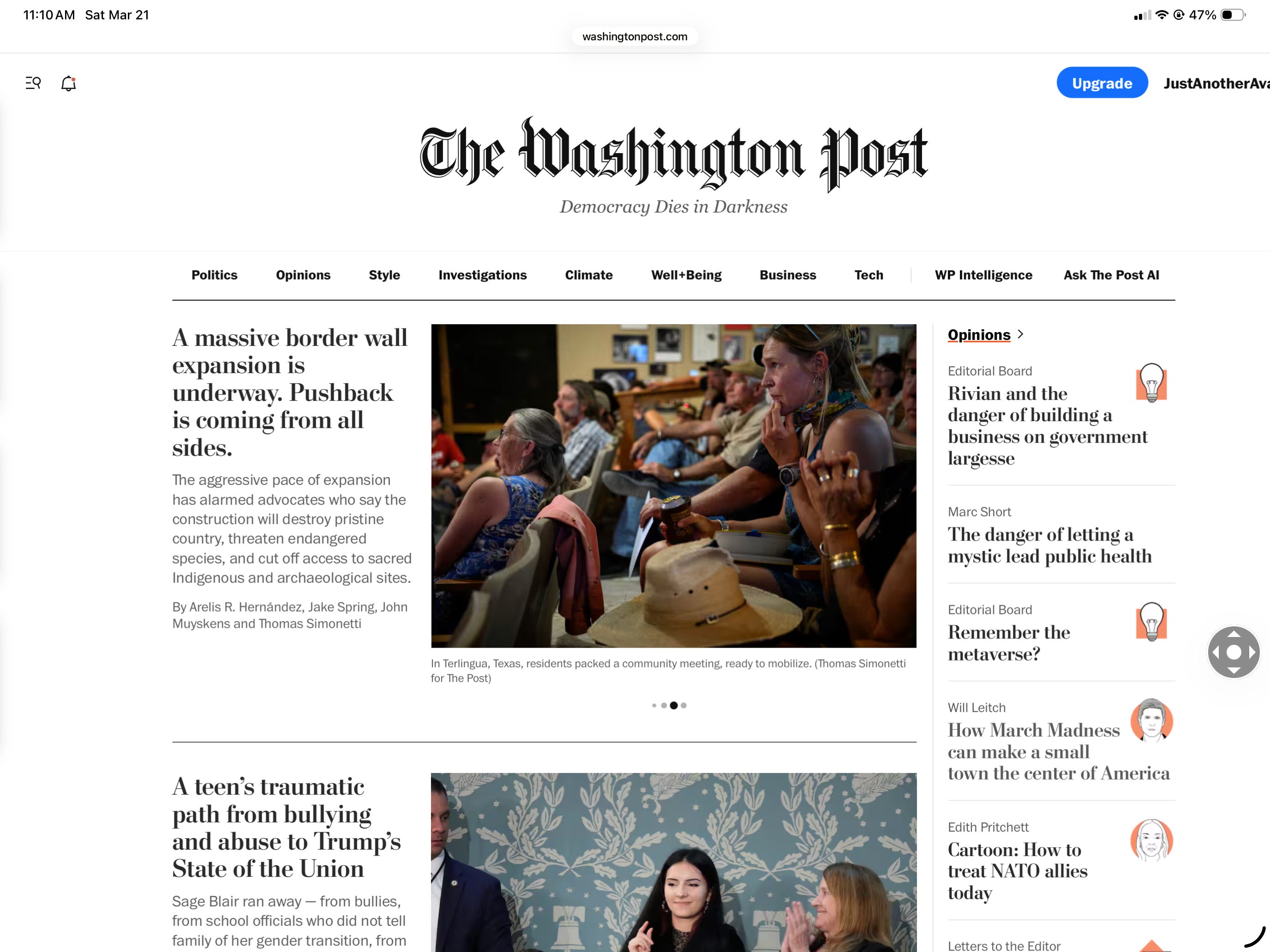
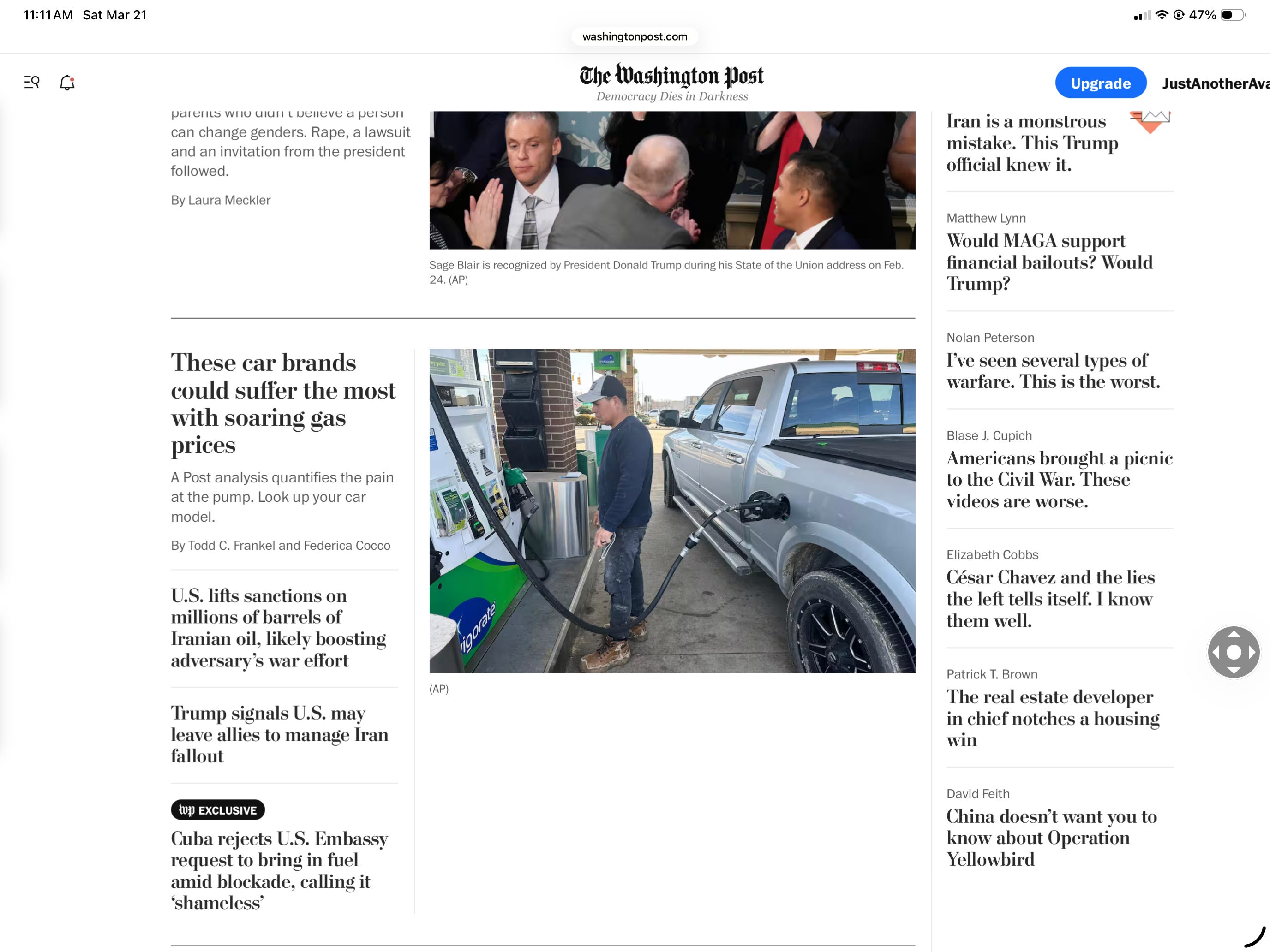
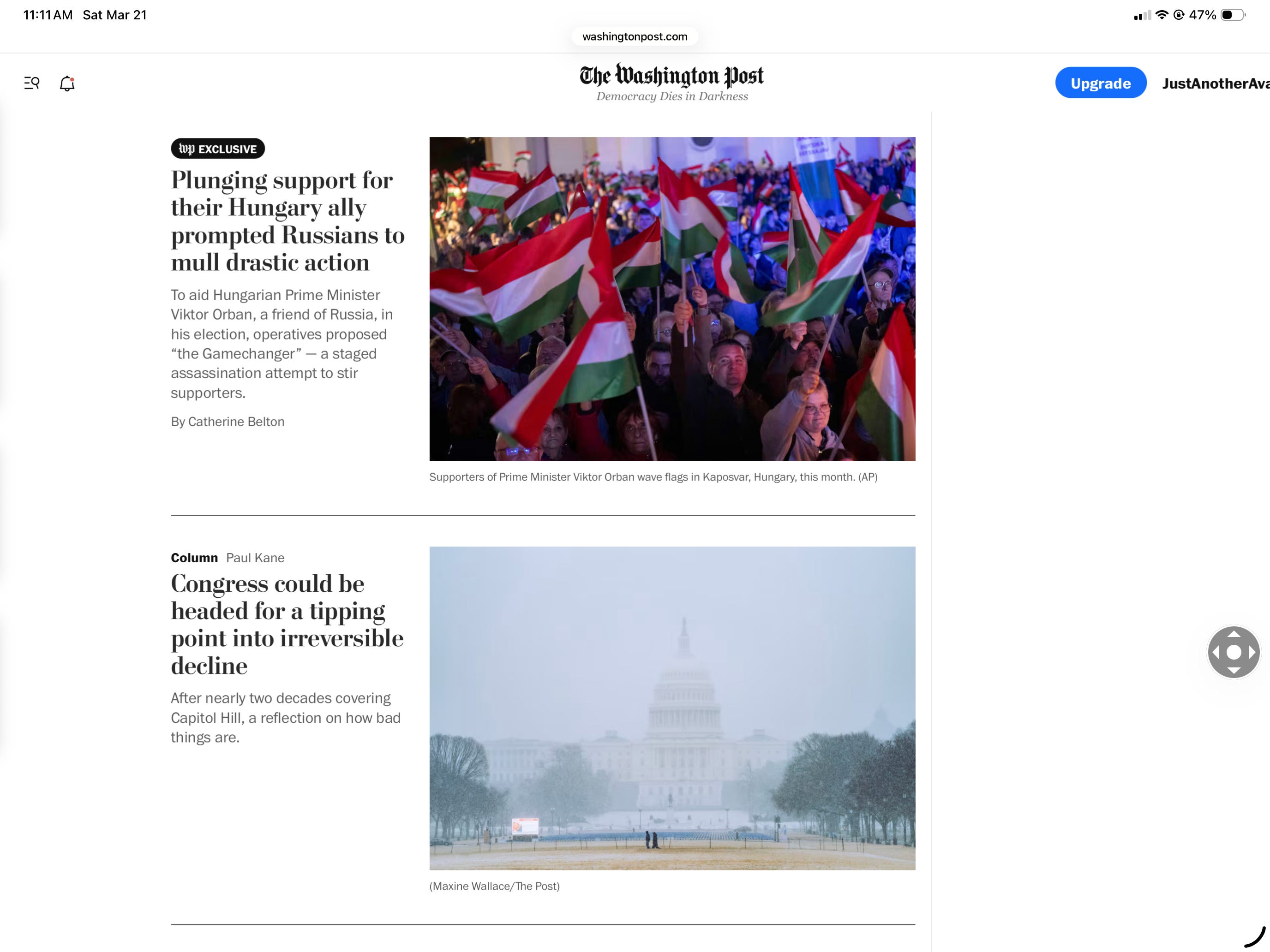
And on that Saturday, The Washington Post put the border wall in the penthouse.
Big headline. Big image. Big emotional invitation to care. Right under that came a wrenching domestic story about a teen, bullying, abuse, and Trump’s State of the Union. So before the reader even got their coffee right, the page had already made its argument about what kind of emergency deserved the full-body experience. Border spectacle. Culture-war ache. Human pain at home. But not the tiny matter of the United States being in an active military conflict with Iran.
Now here is where the bullshit gets fancy.
Iran was not absent. That would almost be easier to fight. Iran was present the way rich people “acknowledge” the help. A little nod. A little mention. A little polite redistribution of reality so nobody has to feel the full rude force of what is happening. The war came to the page broken up like contraband. One item about which car brands might get hurt by soaring gas prices. One item about sanctions. One item about allies managing Iran fallout. One opinion piece saying Iran is a monstrous mistake. In other words, the war itself got chopped into acceptable consumer-facing slices. Not war as rupture. War as gas station. War as policy housekeeping. War as elite commentary. That is not alarm. That is laundering. [1][2][3][4]
That is how you move a war off center without technically hiding it. You turn it into side effects. You make the reader meet the war not as history but as inconvenience. The war becomes a pickup truck at the pump. It becomes a bullet point about sanctions. It becomes something allies will have to “manage,” which is an amazing phrase when you think about it. People are trading missiles, and the page is over there talking like somebody spilled merlot on a cream-colored couch. Everything around the war. Nothing with the full moral volume of the war itself. That is some whack slick shit.
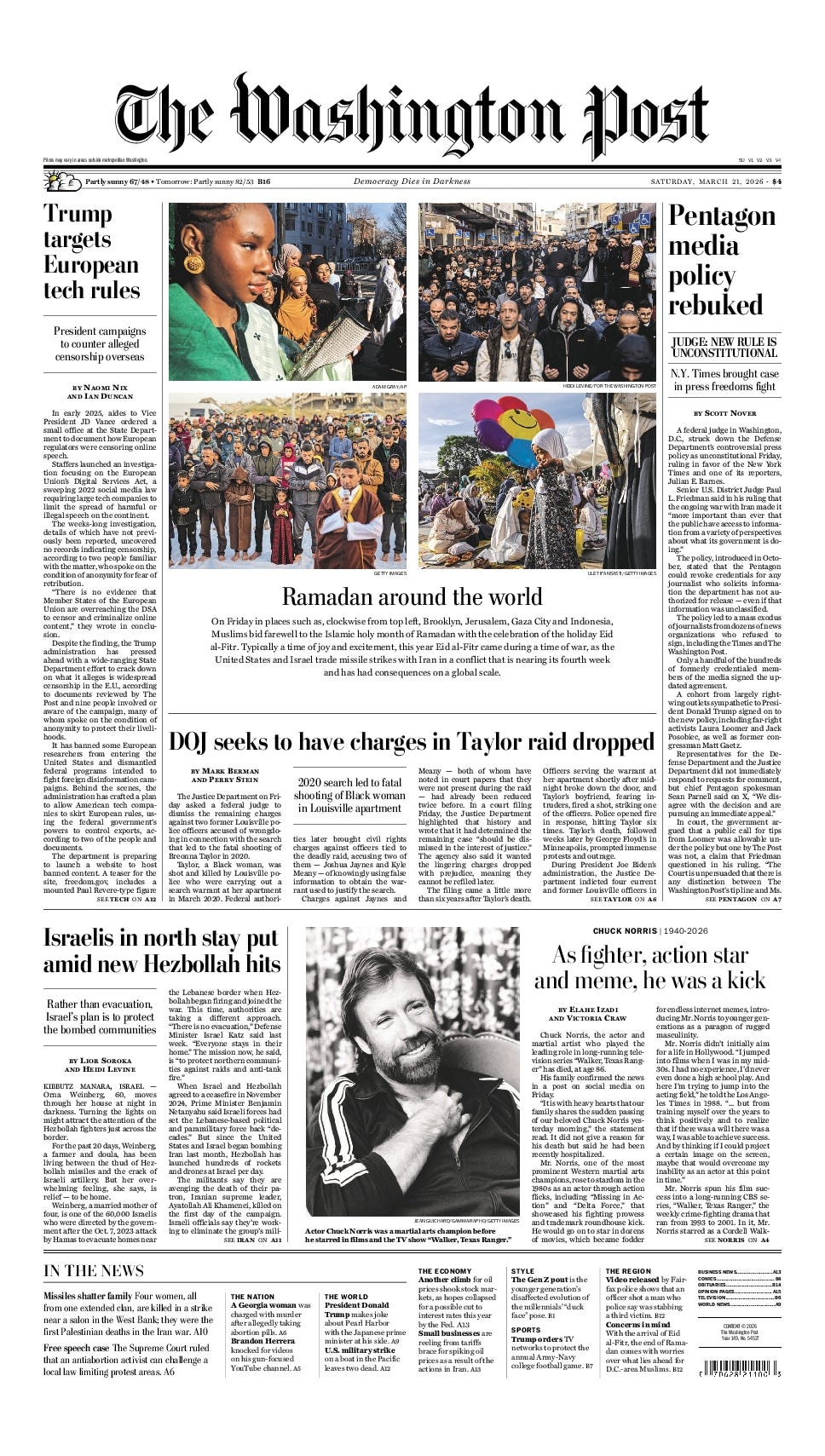
And then the print edition came out dressed for court and pulled the exact same move.
Same date. Same paper. Same little magic trick. Different tailoring. The print front page did not scream war either. It gave major play to Trump targeting European tech rules, a Pentagon media-policy rebuke, and a big center photo package called “Ramadan around the world.” And let me be clear: there is nothing wrong with covering Ramadan around the world. The problem is not that those stories existed. The problem is the ranking. The problem is that the biggest brute fact of the day, an ongoing war involving the United States and Iran, still could not bully its way into commanding the page like an actual damn war.
The craziest part is that the print edition quietly confessed the whole thing in its own caption. Right there, plain as day, it acknowledged that the United States and Israel were trading missile strikes with Iran in a conflict nearing its fourth week. So the paper knew. It knew exactly what scale of event it was handling. It just refused to let that scale seize the page by the throat. That sentence sits there like a dead body in a tuxedo. Technically visible. Perfectly undeniable. Yet somehow still made to behave.
That is why I keep calling this management. Not blackout. Management. Ranking. Lexical dodge. Real-estate dodge. Emotional dodge. On the web, the war was broken into downstream effects and polite little side dishes. In print, it was tucked into caption language and atmospheric framing, like the editors were saying, yes yes yes, missiles, empire, possible regional catastrophe, but let us also keep the presentation elegant. Same move. Different wardrobe. Same suppression. Better posture.
And that is the whole case against them. The Post did not fail to mention the war. Hell, that would have been almost refreshingly honest. What it did was smarter, slipperier, and more insulting. It taught the reader where the war belonged in the emotional pecking order. Below the border-wall spectacle. Below the domestic culture-war machinery. Below process. Below posture. Below the rituals of a paper so exquisitely trained in class-coded calm that it can look responsible while sliding the biggest fact of the day just far enough off center to keep the silverware from shaking.
Day Two, and the Bad Dream Was Still on the Page
I went to bed Saturday hoping I had just witnessed some weird editorial fever dream. You know how sometimes you wake up after a bad dream and for three beautiful seconds the world feels normal again? I thought Sunday might be that. I figured I would open The Washington Post, see a homepage finally acting like the country was in a war with Iran, and laugh at myself for overreacting the day before.
Nope.
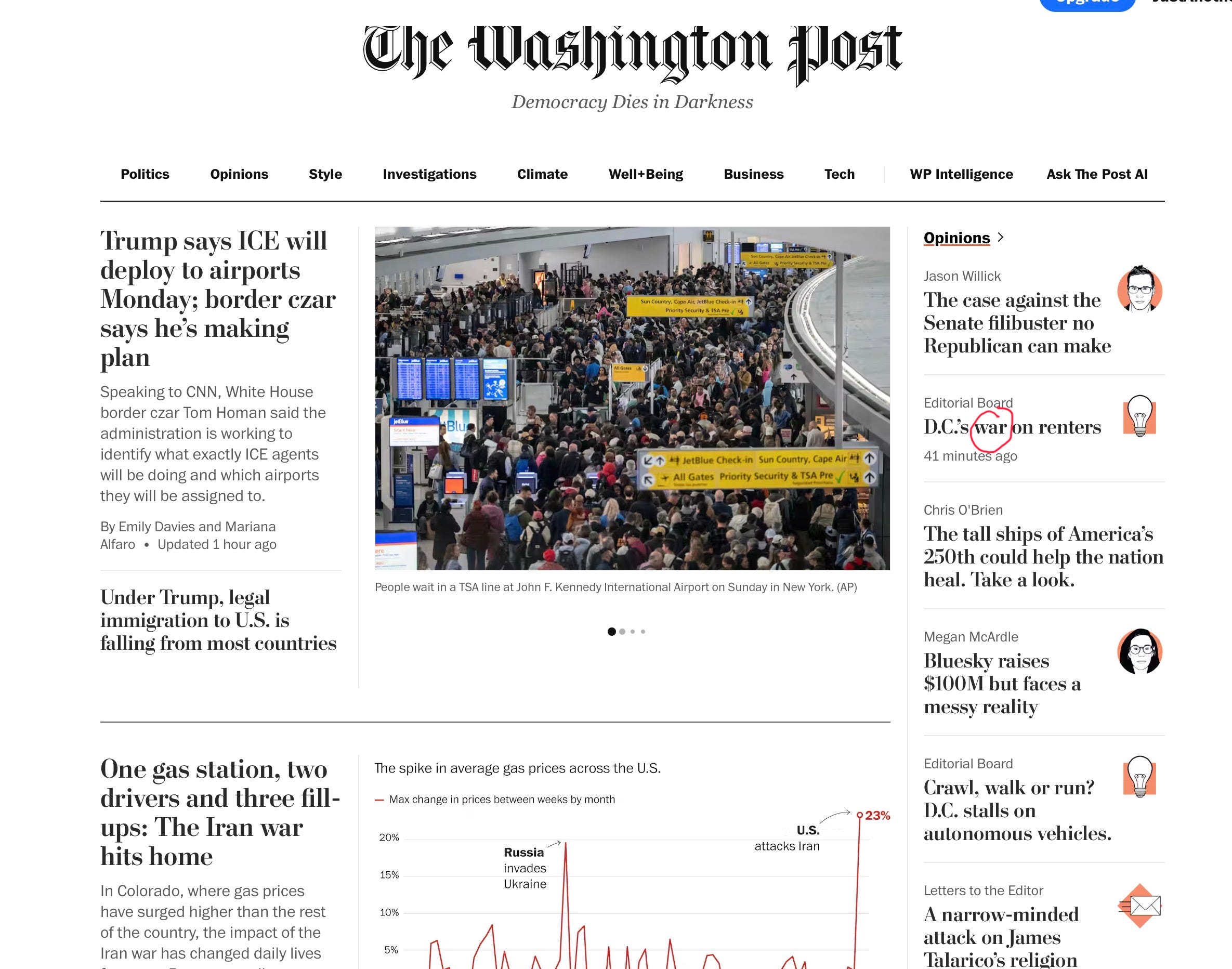
Sunday morning I pulled up the homepage and had to go looking for war coverage like I was a heartbroken fool on a public beach at sunrise, sweeping a rented metal detector over wet sand for a wedding ring the ocean had already judged. Except that metaphor is too generous to the homepage, because the metal detector is at least trying to find the damn thing. This page felt like it was trying to help me step around it.
What did they put up top instead? ICE at airports. Big headline. Big crowd photo. Big visual panic. Fair enough, that is news. But once again the page was telling me, before I even scrolled, what kind of emergency I was supposed to feel in my ribs. Then, lower down, there it was: “One gas station, two drivers and three fill-ups: The Iran war hits home.” Not the war hits the region. Not the war hits the world. Not America is in a fourth-week military conflict with Iran. No. The war hits home because gas is high. We have got missiles flying and the homepage is greeting the event like it is a damn Groupon problem. [5]
And then came the part that would have made a comedy writer throw their notebook across the room. Over in the opinion rail, the word “war” was sitting there bright and visible in “D.C.’s war on renters,” while the actual war still had to sneak into the house through the side entrance carrying grocery receipts. That is when it stopped feeling like bad judgment and started feeling like parody. The metaphorical war got better placement than the literal one. You almost have to admire the audacity of that bullshit. Almost. [6]
By day two, the defense that this was all just a weird one-off editorial stumble started sounding ridiculous. Saturday might have been a bad hair day. Sunday made it a house style. Because now the pattern was unmistakable. When the real war keeps arriving on the page as fallout, price pain, side effects, and reader-friendly inconvenience, that is not simple oversight. That is formatting. That is a newspaper taking a live geopolitical emergency and translating it into something the brunch crowd can process without dropping the mimosa.
And that, more than anything, is what made me sit up straight. It was not merely that I had to hunt for war again. It was the kind of hunt it was. Not a direct search. Not a clean confrontation. A scavenger hunt through euphemism, placement, mood, and consumer framing. By Sunday I was not asking whether The Washington Post had buried a war. I was asking how many times a paper can bury the same war before we stop calling it restraint and start calling it what it is: a talent for elegant evasion.
An Imagined Call From the White House, Because the Homepage Was Already Doing Fiction
Now let me be careful here. I am not reporting that this happened. I am telling you the homepage was so absurd, so polished, so suspiciously housebroken, that it made my mind stage its own little satirical reenactment. The page read less like news judgment and more like a movie scene I could hear in my head.
So somewhere between the first missile and the first tasteful homepage downgrade, Jeff Bezos gets the call. Not a loud call. Not a movie-thriller call with alarms and red phones and a man screaming, “Mr. Bezos, sir, we have a situation.” No. This is an elite American call. Calm. Refrigerated. The kind of call where nobody says the dirty part out loud because power in this country likes to wear a cashmere turtleneck over its crimes.
Maybe the voice on the other end says something like, “Jeff, we need sobriety.” That is how they talk when they mean sedate the public. Or maybe: “We do not want to inflame things.” That is how they talk when they mean make sure the public never feels this shit at full volume. Or maybe they do not even have to say that much. Maybe it is just one rich man exhaling into the phone and another rich man hearing the whole score.
And then, Bezos hangs up, walks through the building with that billionaire smoothness people mistake for wisdom, and gathers the editors in a glass room that costs more than a Black neighborhood school budget. Everybody sits down. Everybody has their laptops open. Everybody looks important. Everybody looks like they compost.
Then Bezos, in full Arthur Jensen mode, gives the speech the homepage seemed to be begging for.
He does not pound the table. He does not need to. He gives them that antiseptic smile rich men use when they are about to explain why your dignity is inefficient. He says, Ladies and gentlemen, you are under the childish delusion that your front page belongs to the public. You have presumed there is still some moral pecking order in which war automatically seizes the top of the page by sheer gravity. You poor, sweet, credentialed babies.
There is no democracy. There is no America.
There is only audience management. There is only advertiser temperature. There is only class instinct. There is only the sacred obligation to let catastrophe enter the room without knocking over the charcuterie board. War is not to be led with. War is to be portioned. War is to be decanted. War is to be reduced to gas prices, diplomatic tremors, strategic concern, and polite opinion-column regret. The public may be allowed to know. The public must never be allowed to feel too much too fast.
And in my imaginary scene, the staff nods the way highly educated people nod when they have just been handed an indecent instruction in respectable language. Somebody says “context.” Somebody says “balance.” Somebody says “reader needs.” Somebody says “we do not want to over-index on conflict.” That is how you know the devil has an MBA. He never says bury the war. He says calibrate the homepage.
Again, I am not telling you that call happened. I am telling you the page felt like it had. That is the point. It felt administered. It felt domesticated from above. It felt like somebody with too much money and too little shame had walked into the newsroom and whispered, Make it all true. Just do not let it arrive with the proper force.
And in the version my brain staged for me, I am in the room too. Of course I am. I am standing in the back, trying to figure out how the hell I got past security, when Bezos spots me before I can open my mouth and says, with that serene billionaire frostiness, “And this must be our new DEI hire.”
So I cut in before he can finish polishing the insult.
I say, First of all, thank you. Sincerely. Thanks to your wife. I mean your ex-wife. Her generous donations mean my kids get to go to an HBCU and become the next generation of diversity hires. Maybe not here. By then you will probably have driven this place so far into the ground they will sell the masthead as a candle called Notes of Oligarch and Wet Newsprint. Maybe The New York Times will still be hiring. Assuming nobody else with a rocket and a childhood wound buys that too.
The room goes tight. Then somebody snorts. Then somebody else bites their lip. Bezos gives me that smile rich men give when they are deciding whether you are a comedian, a threat, or a tax write-off. So naturally I keep going, because once the devil slips on a banana peel you owe it to the room to narrate the fall.
I say, Jeff, quick question. When exactly did “Democracy Dies in Darkness” become mood lighting? Is that slogan still supposed to mean something, or is it just expensive wallpaper for a company that now treats war like a gas-price inconvenience? Do you read your own homepage, or do they bring you a special billionaire edition where the dead stay dead, the wars stay centered, and nobody uses the word “fallout” like empire just tracked mud into the foyer?
And because my imaginary self has already accepted unemployment, I ask the rude questions too. I ask whether he bought a newspaper or an emotional-support peacock for power.
A couple people laugh. Not a lot. Just enough to make the room dangerous.
Bezos folds his hands like a man about to explain gravity to a child. “That is an unserious question,” he says. “The Post is a complex institution serving a complex readership in a complex information environment.”
Which is billionaire for, yes, but make it sound expensive as hell.
I ask whether somewhere in the building there is a chart explaining how many missiles have to fly before a war gets promoted above a border-wall feature. I ask whether the homepage has a setting called Do Not Alarm the Brunch Crowd. I ask whether editorial restraint is just sedating the public with artisanal language until the empire can finish its eggs Benedict.
Now the staff is losing the fight. One editor bends over like laughter is a back spasm. Somebody puts a water bottle to their face. Somebody else is doing that silent rich-people laugh where only the nostrils participate because they still want their bonus.
Bezos gives that little antiseptic smile. “We do not make emotional decisions,” he says. “We make calibrated decisions.”
Calibrated. He says calibrated the way priests say eternal.
He keeps going. “We prefer not to inflame reader anxiety unnecessarily. Our obligation is to contextualize.”
Contextualize. There it is. The silk necktie they put on cowardice before they walk it into a boardroom.
So I say, Jeff, my brother in space, missiles are flying and your homepage is acting like somebody tracked rainwater into Pottery Barn. What exactly is the bullshit calibration formula here? One dead child equals a small thumbnail? A regional war gets two columns unless gas hits four-fifty? Does the algorithm ask whether Martha in Bethesda can emotionally handle empire before coffee?
That gets them. Now even the serious people are cracking. A woman at the end of the table lets out a full church cackle and immediately looks around like she needs witness protection.
And now Bezos answers like the emperor of Network finally got his own streaming platform. “The public,” he says, “does not require panic. The public requires sequencing. Framing. Digestibility.”
Digestibility. Like war is a fiber supplement. Like missiles should be introduced slowly so nobody cramps during brunch.
Then he just tilts his head and gives me the line my imaginary scene had been building toward all along. “You still think in civic categories,” he says. “That is very touching. There is no democracy. There is no America. There is only attention, temperature, and control.”
So now I really get impolite.
I ask whether every billionaire eventually starts talking like Arthur Jensen, or whether they hand you the speech in orientation right after they issue the badge and the god complex. I ask whether “There is no democracy. There is no America.” is just satire now, or the unofficial ownership memo. I ask whether his paper has a style guide entry for How to Bury a War Without Spilling Chardonnay on the Reader. I ask whether when he says readership he means citizens or customers. I ask whether he understands how obscene it looks for one of the richest men on earth to own a paper with that slogan and then preside over a front page that treats a live war like a side effect to be managed between travel panic and real-estate neurosis. I ask whether he knows the difference between public service and a luxury panic diffuser for anxious elites.
The room is gone now. They are done. Somebody actually claps once before catching themselves. Somebody mutters, “Jesus Christ,” the way people do when the truth shows up shirtless.
Bezos stops smiling.
He straightens his cuffs, looks past me like I am a typo, and says, “Security.”
That makes the room even worse. Because now they are laughing at the exact moment they are supposed to become dignified again, which is the funniest shit in any corporate room. Two security guards appear like Amazon Prime for humiliation. I point at Bezos while they take an elbow each.
I say, Jeff, one last thing. If there is no democracy and there is no America, maybe change the damn slogan. Put up a new one. Something honest. Something like Democracy Dies in Soft Lighting. Or maybe We Contextualize Until You Forget to Scream.
One guard says, “Sir, please.” The other one is trying not to laugh, which tells me I have at least reached one honest American institution today.
As they walk me out, I can still hear the room behind me. Half scandalized. Half cracking up. Full guilty. Bezos is barking about standards. The staff is suddenly very interested in their laptops. And I am floating down the hallway like a man who just got fired from a job he never had for asking questions a newspaper should have asked itself.
So no, I am not telling you this happened. I am telling you the homepage made it feel plausible enough to stage in my head. And when a page gives off that smell, the satire damn near writes itself.
Meanwhile, the Democracy Scoreboard Has Us Looking Ragged as Hell
And this is where the whole thing stops being just a petty newsroom beef and starts looking like a symptom.
One of the major global democracy monitors, V-Dem, says the United States has fallen to 51st in the world on its Liberal Democracy index. Fifty-first. Not first. Not fifth. Not even the kind of shabby ninth-place finish you can still spin at the family cookout. Fifty-first. The self-appointed lighthouse of the free world is now out here ranking like a chain restaurant with a rodent problem. [9]
So when I look at a front page that cannot bring itself to let a war feel like a war, I do not see an isolated editorial oopsie. I see a country acting its rank. I see an empire whose institutions still wear expensive suits but have started slurring their civic vows. I see a newspaper running around with a slogan about democracy while the country itself is sliding down the chart like a drunk man in church shoes on wet marble.
That is what makes this moment so grotesque. We are not merely living through democratic decline. We are living through democratic decline with branding. With typography. With tasteful spacing. With owner-approved calm. The civic furniture is still gorgeous. The beams underneath are starting to rot.
And here is the part that probably irritates the right people.
This publication is still young. Less than a year into really becoming what it is becoming, and it has already grown from me lighting a match in the dark to something readers carry, argue over, restack, and shove into rooms I was never supposed to enter. It is still independent. Still reader-backed. Still small enough to have a pulse and mean enough to leave a mark. Which means a piece like this does not need permission from a boardroom to travel. It just needs readers who know bullshit when they smell it and are willing to throw a little gasoline on the signal.
That is the beautiful part of this era, even with all the rot. A legacy paper can downplay a war on page one, and an independent writer they would never hire can still force the question back onto the table by Monday if enough people decide the essay hit a nerve worth passing around. That is the setup now. Not me begging for a seat at the grown folks’ table. Me writing something sharp enough that the table has to hear it rattling from another floor.
And if this thing catches the way I think it can catch, then the next conversation is not imaginary. The next conversation is not me clowning Bezos in a glass room in my head. The next conversation is whether the people who make these decisions are prepared to explain them out loud, in public, after the rest of us have had time to stare at the evidence and say, no, you do not get to make me feel crazy for noticing what the hell you did.
That is the wager here. Not that I am bigger than The Washington Post. Please. I ain’t high ya’ll. The wager is that truth still has a way of embarrassing power when it gets written with enough nerve, enough receipts, and enough readers willing to shove it into the bloodstream. And in a country that just got told it is 51st in democratic health, maybe that is exactly what a publication like this is for.
A Word for the People Upstairs, and a Blessing for the Ones You Pushed Out
So let me talk plainly to the decision-makers at The Washington Post.
You people need to stop congratulating yourselves for being calm while the house is catching fire. Calm is not wisdom when it is really just class instinct in a navy blazer. Context is not courage when it is being used like a silk handkerchief to wipe the blood off the page. Do not tell me about judgment. Do not tell me about restraint. Do not tell me about reader needs as if the public were some nervous lapdog that has to be eased into the fact that empire is once again out here setting matches to the map.
You inherited one of the great names in American journalism and started acting like your highest calling was emotional weather control for affluent professionals. You took a front page and treated it like a luxury lobby. No sudden movements. No raised voices. No broken glass. Just enough truth to preserve the brand. Just enough alarm to keep the conscience legally ventilated. That is not stewardship. That is a slow betrayal performed with excellent posture.
And let me also say if your idea of public service is to let a live war onto the page only after it has been shampooed, ironed, scented, and broken into consumer-friendly side effects, then you are not informing a democracy. You are embalming one. You are preparing the body for viewing while the pulse is still trying to argue with you.
You want the slogan? Fine. Democracy does die in darkness. But it also dies in soft lighting. It dies in tasteful spacing. It dies when powerful people decide the public can know a thing without being allowed to feel the scale of it. It dies when editors start treating moral urgency like bad table manners. It dies when war has to knock, apologize, and enter through the service hallway while lesser spectacles get ushered to the front in full dress.
And one more thing, since apparently somebody in that building needs to hear it said out loud. Your readers are not stupid. Your staff was not stupid. The people who noticed this were not hysterical. They were awake. Which may be the one unforgivable sin left in elite American media.
Now let me pivot to the people I actually respect.
The real heroes in this story are not the owners, the calibrators, the sequencers, the men forever explaining why the public cannot be trusted with the full force of reality. The real heroes are the people who kept carrying light after the institution started mistaking darkness for brand management. Karen Attiah. Nilo Tabrizy. Lizzie Johnson. Ben Brasch. The reporters, editors, producers, photographers, researchers, copy people, foreign correspondents, local reporters, books people, sports people, and all the others shown the door while the company kept talking like this was some regrettable weather event instead of a choice. [10][11]
Some of you got fired for telling truths too sharply. Some of you got laid off while covering the very parts of the world this paper now seems determined to reduce to fallout and fuel prices. [10][11] Some of you were still doing the old hard thing, which is to say journalism with a spine, journalism that risks being rude to power, journalism that does not ask permission from billionaires before it names the smell in the room.
That is why I say the paper is not finally its building, its slogan, its owner, or its chilled little rituals of control. The paper, at its best, was you. The ones who went where it was dangerous. The ones who wrote what made comfortable people shift in their chairs. The ones who knew that a front page is not a meditation app for the ruling class. The ones who understood that the job is not to lower the emotional temperature of the republic while it drifts toward catastrophe, but to tell the truth at a volume equal to the danger.
So to the people upstairs, this is your warning. You can keep cutting out the nerves and calling it discipline. You can keep dressing up fear as calibration and obedience as sophistication. You can keep talking to the public like they are too fragile for unprocessed reality. But every time you do it, you make your own irrelevance a little more deserved.
And to the ones you pushed out, this is your benediction. A lot of us can still tell the difference between a paper and the people who gave it a soul. They can own the presses, the logo, the lobby, the conference room, the slogan, the goddamn coffee mugs. But they do not own the moral center you carried out of that building in your bodies when they let you go.
Conclusion
So let me bring it back to where this started. A man with an iPad. A bad feeling. A homepage that looked like an old tab. Me hitting refresh like truth might come back if I just gave the machine one more chance to remember what a damn war looks like.
That is the image I cannot shake. Not because it is dramatic. Because it is ordinary. That is how democratic decline enters most lives now. Not with cavalry. Not with jackboots. Not with some villain standing at a podium stroking a cat and announcing the republic is cancelled. No. It comes through layout. Through mood. Through the tiny polite rearrangements that teach you not to trust your own moral reflexes. It comes when you look at something enormous and feel yourself being coached to experience it small.
And that is why I wrote this.
I wrote this because I know that feeling. I know what it is to look at something crooked and have the room try to sell you straight. I know what it is to feel the knot in your chest before the evidence catches up. I know what it is to stand in the doorway of a lie so well upholstered it starts to look like etiquette. And I know that a whole lot of decent people are living there right now, staring at screens, wondering whether they are losing their minds because the institutions keep lowering the lights every time history starts bleeding.
But hear me now.
Just beyond this river of managed reality, there is still a country worth speaking to plain. Just beyond this river of billionaire ownership, euphemism, calibration, and soft-lit bullshit, there is still a public that can feel when it is being played. Just beyond this river of sequencers, sanitizers, and elegant cowards, there are still reporters who remember the job. There are still readers who know when war is being made to enter through the service hallway. There are still people who do not need a boardroom to tell them what scale of grief they are allowed to register.
And that is the hope I am ending on. Not hope in them. Not hope in some miraculous outbreak of conscience from the people upstairs. I am fresh out of fairy tales for billionaires. I mean hope in us. Hope in the people who still stop when something smells wrong. Hope in the ones who still hit refresh not because they are passive, but because some stubborn part of them still believes the truth ought to show up dressed like itself. Hope in the fired journalists, the restless readers, the independent writers, the workers, the elders, the young people side-eyeing the whole performance and saying, no, this shit is not normal.
Because once enough people say that together, the spell starts breaking.
That is what the powerful fear more than any slogan, more than any op-ed, more than any one article. They fear the moment the audience stops being an audience. They fear the moment the brunch crowd turns into witnesses. They fear the moment the people they trained to absorb catastrophe politely decide they would rather name it, share it, laugh at its disguises, and drag it into the light by its expensive ankle.
So no, I am not ending this essay where I started, staring at that page like maybe I was crazy. I crossed that river while writing. I know what I saw now. I saw a paper try to make a war behave. I saw a homepage ask the republic to whisper when it should have been shouting. I saw power dressed as taste. I saw fear dressed as judgment. I saw the old American hustle where the people with the nicest furniture keep begging you not to notice the smoke.
Well, I noticed.
And if you noticed too, then maybe that is the beginning of something. Maybe that is how a little independent publication keeps growing while giant institutions keep shrinking in moral authority. Maybe that is how the people outside the glass rooms start setting the terms. Maybe that is how truth travels now, not from the mountaintop down, but from hand to hand, phone to phone, nerve to nerve, until even the people who buried the thing have to stand there and hear the sound of dirt being kicked back off the coffin.
So let the mighty keep their lobbies. Let them keep their slogans, their calibrations, their tailored cowardice, their soft lighting, and their little chilled rituals of control. We are headed for something they cannot fully manage. A louder honesty. A rougher clarity. A public less willing to be emotionally housebroken. Something waiting just beyond this river.
And when we get there, baby, war will sound like war again. Truth will not need mood lighting. And the people who kept telling us to lower our voices while the world was on fire are going to have to answer, at full volume, for what the hell they did.
Keep This Alive
Let me stop being polite and tell it to you straight. This publication is running on fumes right now. The last few weeks have seen a real drop in support, and I need money point blank to buy time to keep doing this work. Maybe it is the gas prices. Maybe it is the job losses. Maybe it is the low, grinding war anxiety that has people tightening up everywhere. I get it. Times are hard. But that is also exactly why a publication like XVOA matters more, not less.
I did not build this out of ego. I built it out of purpose. I built it because too many powerful institutions keep asking you to doubt your own eyes, lower your voice, and accept polished confusion as context. I do not want to shut this down. I want to keep building it. But purpose does not pay for time, and time is exactly what I need more of right now.
So I am asking plainly. If this publication has helped you think straighter, feel less crazy, or see what legacy media keeps trying to soften, become a paid subscriber here:
Do not tell yourself you will get around to it later. Later is how independent work dies while everybody swears they always meant to support it.
And if a paid subscription feels like too much right now, or you already subscribe, then just buy me a coffee. Seriously. This is one of those moments where even the smaller gesture matters. I am not asking because it sounds cute. I am asking because I need the help. So if you have the means and you’ve been reading for free, eating off the plate, nodding along, and telling yourself somebody else will keep this thing alive, please stop. Be the somebody. Help me buy the time to keep this publication alive.
Sources
The Washington Post: “Trump signals U.S. may leave allies to manage Iran fallout” — One of the homepage items used to show the war being framed as downstream management.
The Washington Post: “Trump administration lifts sanctions on millions of barrels of Iranian oil” — Business-side framing referenced in the Saturday stack.
The Washington Post: “These car brands could suffer the most with soaring gas prices” — Consumer-impact framing referenced in the forensic breakdown.
The Washington Post: “Iran is a monstrous mistake. This Trump official knew it.” — Opinion framing cited in the Saturday homepage mix.
The Washington Post: “One gas station, two drivers and three fill-ups: The Iran war hits home” — Day-two story used to show the war reframed as consumer pain.
The Washington Post: “D.C.’s war on renters” — Metaphorical “war” placement contrasted with the buried literal war.
Associated Press: “Iran threatens to ‘completely’ close Strait of Hormuz and hit power plants after Trump ultimatum” — AP report confirming the active fourth-week war and broader regional escalation.
Reuters: “UK approves U.S. use of British bases to strike Iran missile sites targeting ships” — Reuters reporting on allied involvement and widening conflict.
V-Dem Democracy Report 2026 — Source for the claim that the United States fell from 20th to 51st on V-Dem’s Liberal Democracy Index.
Associated Press: “Washington Post cuts a third of its staff” — Source on the Post layoffs, section eliminations, and foreign-bureau cuts.
Democracy Now!: “Journalism Deserves Better” — Post-layoff interview featuring Karen Attiah and Nilo Tabrizy.
Encyclopaedia Britannica: Network — Basic film overview supporting the discussion of Network as a satire of television news.
The Criterion Collection: “Network: Back to the Future” — Essay used for the Arthur Jensen frame and the film’s critique of corporate media.
MusicBrainz: The Woman I Am by Chaka Khan — Source confirming “You Can Make the Story Right” as the Chaka Khan track referenced in the trailer-soundtrack section.
"This was a page trying to preserve the relationship while cheating on the vow."
"That sentence sits there like a dead body in a tuxedo. Technically visible. Perfectly undeniable. Yet somehow still made to behave."
Love your metaphors! You make reading about sad things like the downward spiral of newspapers kinda fun. Thanks for sharing your writing talents and keen perspective with the universe.
Bravo! I was watching the movie play out in the WP editorial room and cheering you on. Your ability to point out the weakness and intentional dim lighting applied to the news is why your column is important. Thank you for your view of the media and for pointing out the blackouts and gaslighting that is happening so often. And yes, your metaphors and similes are very effective and brilliant.