



I already had 55 in mind
One night when I was a teenager, I lined up next to an ’86 Mustang GT in my dad’s ’68 Camaro. It was dark, the light was red, and I’d already decided how much of a fool I was willing to be. Fifty-five miles an hour. When the light turned green I hit it, and at 55 I broke it off. If you’re wondering which car was faster, hell, so was I. I just didn’t want to know bad enough to keep my foot down in my dad’s car.
The way I see it, Jensen Huang floored it and took it to 120 in a 50. On Thursday morning, amid reports of his extramarital affairs, Nvidia announced that its co-founder had resigned as CEO. By the closing bell, another $182 billion had come off the value of Nvidia’s shares. That brought the loss from Friday, November 6, through Thursday, November 12, to $493 billion in market value. [1][2]
Aight now let’s suppose you’re trying to borrow some money to build a data center. You then plan to fill it to the brim with Nvidia chips, and part of what makes your banker very comfortable is that Nvidia has helped provide the financing for some of the very companies buying those same chips. Now with Huang gone, your now somewhat uncomfortable banker would like to know whether the next CEO is willing to put up money for a deal like yours. [3] You came in to talk about a building. How the hell did another man’s love life wind up in your loan meeting?
I know, I know. Subscription fatigue is real. Honestly asking for subscriptions isn’t my strong suit, aight?
But if I don’t stick up for my own stuff, who the hell is gonna?
If I don’t promote this publications 3-sec-check competitive advantage where I bet you’re gonna click those little three dots in the top right corner and see nuthin but green 100% human, who the hell else is? Try me baby.
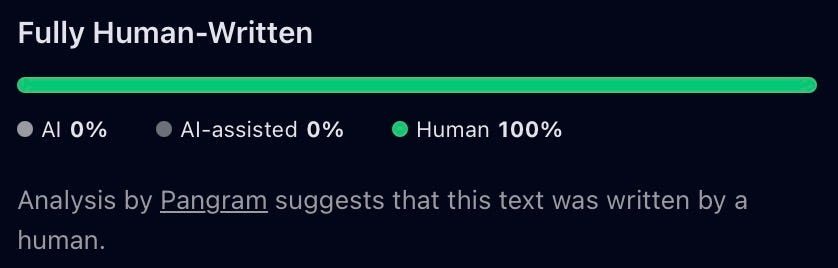
I’m not about to sit twiddling my thumbs hoping some Substack Digest editor decides to feature my writing alongside a bunch of cookie-cutter, pretty faced Substackers who would never in a million years write the word “ain’t” in one of their essays.
Nah.
So if you are lovin’ these deep dives and fully 100% human written articles on subjects the mainstream press will sometimes never cover, then consider subscribing to my free newsletter. It’s one less way the MSM can manipulate you. And hey, one less time you’ll have to read some Substack Digest featuring Karen’s lackluster, forgettable essay.
Ok, is my jealousy coming out just a lil bit?
I digress.
If for whatever reason you’re not down to subscribe…
RESTACK this biatch and keep reading.
Bye.
Y’all took a picture too?

One of the pictures turned up on LinkedIn. It shows Jensen and Alice Huang sitting next to each other at a trade show party in Taipei in 2024. I suppose that is where you’d post a picture with a customer. Alice was an executive at Megaspeed, a Singapore company that bought Nvidia chips. [4] In a letter this week, Senators Elizabeth Warren and Chris Coons put Megaspeed’s tab at more than $4.8 billion since June 2024. [5]
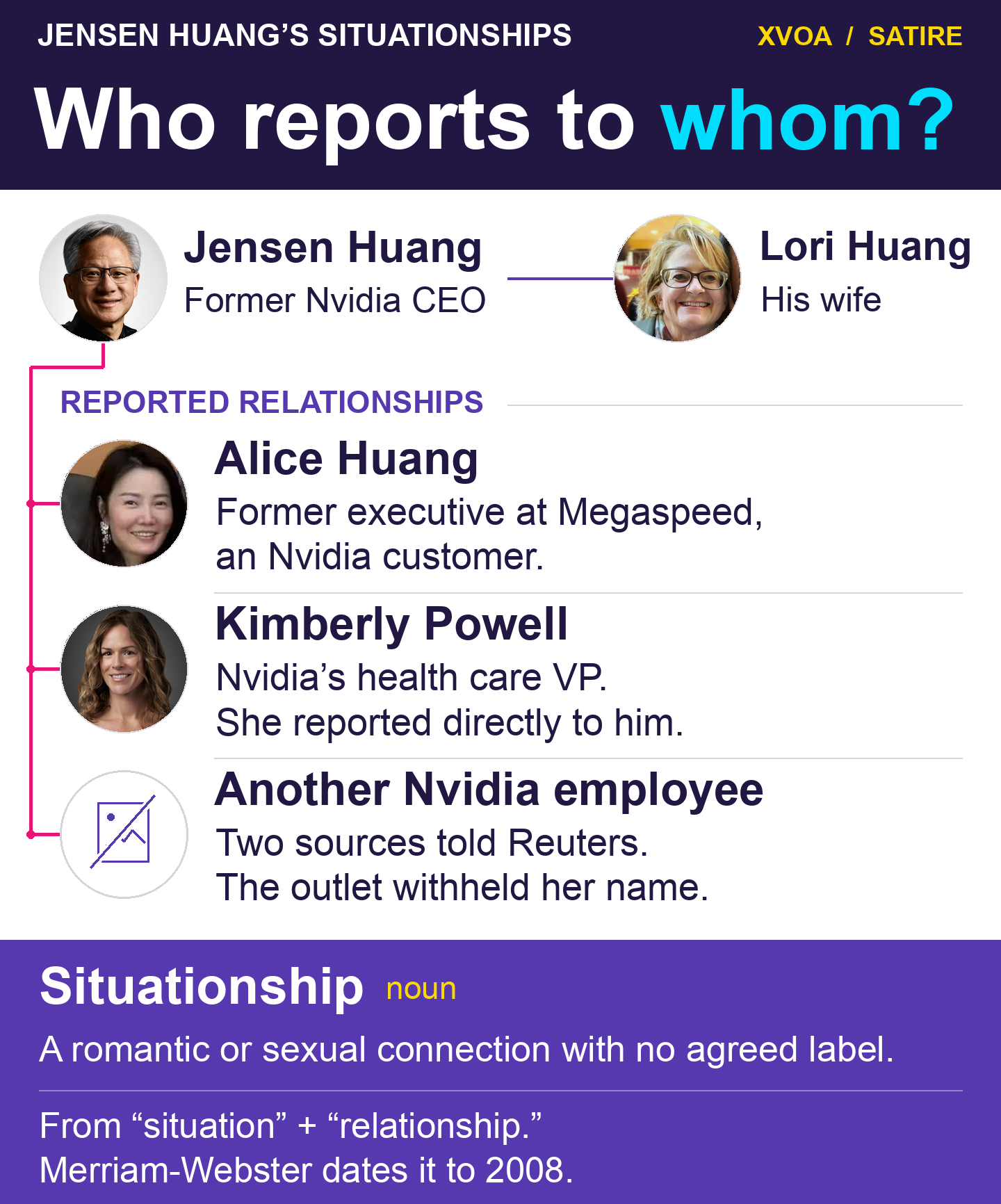
On Sunday, Jensen told his employees he’d been unfaithful to his wife. He didn’t name anybody. On Wednesday, citing five people who’d worked at Nvidia, The New York Times reported that he’d had a relationship with Kimberly Powell. She ran Nvidia’s health care business and reported directly to him. When the paper called Jensen about Powell, he said, “I don’t think you should be talking to me directly,” and hung up. [6] The next day Reuters cited two people who said he’d also been involved with another Nvidia employee. Reuters didn’t name her. [7]
Say you work for Powell and somebody else gets the promotion you thought you’d earned. You’ve listened to what she’s had to say. Hey, maybe she’s got a point, but you’d still like her boss to take a second look. I can see myself sitting there with Jensen Huang’s name in the To line, trying to decide how badly I want that second opinion.
The bet that made him rich

I might’ve voted to kill CUDA. Nvidia had a perfectly good business selling graphics chips to gamers. Jensen Huang wanted a scientist to be able to use one of those chips to do a whole lot of math in a hurry. What CUDA did is give programmers a way to do that. It also made the chips more expensive to build, and as Huang told it, the folks buying them saw no reason to pay the difference. [8] In 2012, three researchers in Toronto used a pair of Nvidia graphics cards to teach a computer to recognize what was in a picture. They won that year’s ImageNet competition by a mile. [9] So much for my vote.
It seems as if Huang could easily imagine going broke. At Stanford in 2003, he said he kept warning his employees they were thirty days from going out of business. Then he mentioned the billion dollars Nvidia had in the bank. [10] Years later, Patrick Collison asked whether Nvidia’s board had put pressure on him over CUDA. Huang said he’d start each conversation by telling the directors what he believed. “And they believed it because they saw me deeply believe it.” [8]
In one of five studies on power, Cameron Anderson and Adam Galinsky asked people to write about a time they’d had power over someone or a time someone had held power over them. Then everybody got the same predicament. You go home with somebody you’re attracted to and neither of you has a condom. The people who’d just remembered being in charge saw less danger and said they’d be more willing to go ahead. There was a hint, too, that the ones who wrote more about their responsibilities were more inclined to stop. [11]
If I’m the director who wanted to kill CUDA, I’d like to think I’d still speak up when I heard about Megaspeed. You bet I can also see myself sitting through half that meeting hoping somebody with a better voting record will bring it up first.
Who’s paying for the AI buildout?
What if CoreWeave comes to me to borrow money? I ask for three phone numbers. A supplier’s, an investor’s and a customer’s. They hand me Nvidia’s number three times. I look up CoreWeave’s data centers and, sure enough, there are the servers humming away with Nvidia chips inside. CoreWeave sells time on those computers. Nvidia bought shares, $2 billion worth in January. [12] That accounts for two of the phone calls.
About that third one. In September 2025, Nvidia made a deal with CoreWeave. If CoreWeave gets the machines covered by the deal up and running and can’t rent all the time on them, Nvidia will buy up the slack. CoreWeave put the initial value of the deal at $6.3 billion. It runs through April 2032. [13]
Imagine you’re the landlord in Pike County, Ohio. SB Energy is constructing a data center campus there. An OpenAI affiliate will lease it. Say one of those buildings is ready and the lease kicks in. Then the tenant stops paying rent. You find another tenant or sell the place. If you recover less than the minimum Nvidia guaranteed, Nvidia can owe you the difference. Across those leases the cap is $105 billion. The tenant has agreed to reimburse Nvidia for whatever it pays. [14]
That Ohio promise is part of the $164.5 billion Reuters tallied in Nvidia’s financial commitments. [3] The first of those buildings is looking like it’ll be ready in 2028. The tenant just might pay its rent diligently for twenty years. If it does, Nvidia might never have to pay out on that lease. [14] Either way, landlords love Nvidia.
On Thursday, Nvidia shed $182 billion in market value. That brought the loss since the previous Friday to $493 billion. [1][2] Colette Kress took the wheel as interim chief executive. Harvey Jones, Nvidia’s chairman, said he expected the company to honor its existing commitments to customers. [15]
Lenders love Nvidia. But you’re not CoreWeave. If you were to come in to borrow for your building and then hand me those same three phone numbers, what’s Colette going to tell me after I make that third call?
Who got hurt by Thursday?
That ain’t all ya’ll. There’s Applied Digital which is CoreWeave’s landlord in Ellendale, North Dakota, which also had a rough go of it by Thursday. Back in October 2025, Applied Digital estimated it would collect around $11 billion in rent from CoreWeave over roughly fifteen years at that one site. [16] By Thursday’s close, Applied Digital’s stock was down 5.4% and CoreWeave’s was down 6.9%. [17]
But not everyone had a rough time Thursday. AMD’s stock rose 5.9%, and another Nvidia competitor, Broadcom, gained 5.5%. [18] If I worked for AMD and sold chips, I’d be calling that customer of mine again on Friday, the one who always says he’s happy with Nvidia. Maybe this time he’ll at least let me put in a bid.
Even in China, some of these AI companies are out scrambling to secure computing power like vultures circling in the wild. The U.S. puts restrictions on shipments of Nvidia’s most advanced chips to China, but researchers there can train their models by renting time on machines abroad instead. [19] In January, the House passed a bill that would let the Commerce Department restrict that kind of remote access and as of Thursday, it was still awaiting Senate action. [19][20]
Three people familiar with the situation told Reuters that some AI companies in China worried the Huang drama could give that bill a push. There’s one major cloud provider that was still deciding whether to book time overseas. Others had already reached out to data centers to ask what was available. [19]
Who was in a position to put a foot on the brake?


Elizabeth Warren and Chris Coons had some phone calls they were interested in, too because on November 11 the two senators asked the White House, Commerce and State departments to save the records regarding Nvidia’s chip exports to China. Those two senators wanted a briefing on what the suspected intelligence operation might have put at risk. A few pages into the letter they get pretty specific about what to keep. Any notes or transcripts of calls between Jensen Huang and President Trump, for instance. [5]
Me, I’m still stuck on that picture on LinkedIn. [4] There’s a question on page six of Nvidia’s code of conduct. “Could I defend my action if it became public on social media or came to the attention of respected colleagues?” Flip back to page three and see who signed the letter asking everybody to read the thing. Jensen. [21]
On Sunday, November 8, Nvidia’s directors opened an independent investigation into whether a foreign intelligence service had targeted Huang. They said they had no reason to believe U.S. national security or Nvidia’s secrets had been compromised. They also said they had confidence in Jensen. [22] On Wednesday they accepted his resignation as CEO and from the board. [23]
By Thursday morning the board had “full confidence in Colette and the leadership team.” but then again there was Harvey Jones, the new chairman, telling customers he expected Nvidia to keep its promises to them. Colette Kress, mind you, still had her old job as chief financial officer, too. [15]
Page seven of that same code says if a personal interest could get in the way of a decision you’re making for Nvidia, you take yourself out of it. [21] You best better believe if I had five minutes with those directors, I’d spend them on Megaspeed. Did any of you ever ask to see who signed off on those orders?
Whose car was it, anyway?
I looked up how much of Nvidia actually belonged to Jensen. As of March 23, Nvidia put his stake at 3.58%. Now look at the footnote next to his name. More than half a billion of those shares were in a trust he and his wife Lori ran together. [24]
Then there’s you all out there. You picked the S&P 500 index fund when you signed up for your 401(k) at work. Then you watched last year as Nvidia did more than any other company to pump that index up. You could’ve done pretty well off Jensen without ever knowing the man’s name. [25] By Thursday, Nvidia’s shares were worth $493 billion less than they’d been the Friday before. [1][2] If you still held that fund, some of the shares that took that hit were in there with your retirement money. Anybody ask you what you thought of Megaspeed?
I’ve been giving my teenage self a fair amount of credit here for backing off at 55. Maybe a little too much. Suppose I’d had to go home and explain to my dad that I’d lined his ’68 Camaro up next to an ’86 Mustang GT. I know which part of that story I’d be in a hurry to tell him. Dad, I let off at 55.
Somehow I think he’d still want to know what the hell I was doing racing his car in the first place.
Related Essays:


Sources
MarketWatch, Nov. 12, 2026. Nvidia erases $182 billion in market value over the course of Thursday’s trading
CBS News, Nov. 12, 2026. Nvidia sheds nearly $500 billion in value as Jensen Huang resigns
Ankur Banerjee, Reuters, Nov. 12, 2026. Investors worry the AI trade might lose Nvidia’s largesse after Huang
Wen-Yee Lee, Andrew Silver and Laurie Chen, Reuters, Nov. 10, 2026. Alice Huang, Chinese businesswoman tied to Nvidia CEO, went from finance to chips
Sens. Elizabeth Warren and Chris Coons, Nov. 11, 2026. Letter to the White House, Commerce and State requesting preservation of Nvidia chip-export records
Reuters, Nov. 11, 2026. Nvidia board weighs CEO Huang’s future as leadership crisis deepens
Max A. Cherney, Krystal Hu, Alexandra Alper and Deepa Seetharaman, Reuters, Nov. 12, 2026. Former Nvidia CEO Huang had a relationship with a second employee, sources say
Patrick Collison and Jensen Huang, Stripe Sessions, 2024. A conversation with NVIDIA’s Jensen Huang
Alex Krizhevsky, Ilya Sutskever and Geoffrey E. Hinton, 2012. ImageNet Classification with Deep Convolutional Neural Networks
Jensen Huang, Stanford eCorner, Jan. 29, 2003. Reinvention and Adaptation
Cameron Anderson and Adam D. Galinsky, European Journal of Social Psychology, 2006, Study 4, pp. 523–526. Power, optimism, and risk-taking
CoreWeave, Jan. 26, 2026. NVIDIA and CoreWeave Strengthen Collaboration to Accelerate Buildout of AI Factories
CoreWeave, Sept. 15, 2025. Form 8-K on Nvidia’s agreement to buy unsold computing capacity
Nvidia, Aug. 17, 2026. Form 8-K on the SB Energy lease guarantees in Pike County, Ohio
Nvidia, Nov. 12, 2026. NVIDIA Announces CEO Transition
Applied Digital, Oct. 27, 2025. Ellendale campus announcement and estimated revenue from CoreWeave’s leases
Reuters, Nov. 12, 2026. Equities close lower as Nvidia drop outweighs energy gains
Reuters, Nov. 12, 2026. U.S. market close and gains for AMD and Broadcom
Reuters, Nov. 12, 2026. Chinese AI firms rush to secure Nvidia chip capacity as spy scandal stirs fear of US curbs
U.S. Congress, Jan. 13, 2026. H.R. 2683, Remote Access Security Act, as referred to the Senate
Nvidia, pp. 3, 6–7. Our Code
Nvidia, Nov. 8, 2026. Statement From NVIDIA Board of Directors
Nvidia, filed Nov. 12, 2026. Form 8-K recording the board’s Nov. 11 acceptance of Huang’s resignation
Nvidia, 2026 proxy statement. March 23 ownership table and footnote 1 on Huang’s shares
Associated Press, Nov. 12, 2026. Jensen Huang steps down and Nvidia shares drop
Here's a timeline https://embed.kumu.io/8a567b6e974bf3b932bb726b96a10a7d
and an org chart https://embed.kumu.io/2055da3091b32f2c981ecfcf3a1e62b2
I update these infographics as more details emerge.